In May 2026, the US-Iran nuclear talks entered a critical window. According to multiple media reports, both sides are approaching a preliminary understanding agreement with the nature of a “one-page memorandum,” aiming to end the current conflict and lay the groundwork for subsequent comprehensive nuclear talks. Meanwhile, on Polymarket’s prediction market, contracts tied to a “permanent US-Iran peace agreement” have been unusually active, becoming an important window for observing shifts in geopolitical expectations.

Can a one-page memorandum open the door to peace?
The core text of the current US-Iran talks is a 14-point framework agreement, covering key issues such as a formal ceasefire announcement, the restoration of shipping through the Strait of Hormuz, limits on Iran’s nuclear program, and a gradual easing of US sanctions. According to Axios, the US side is waiting for Iran to provide an official response to the main points of the agreement within 48 hours. US Secretary of State Marco Rubio said the early negotiation phase may focus on a broad principles framework rather than the full text of a final agreement, but both sides need to reach a clear consensus upfront on negotiation topics and the scope of concessions. At the same time, US President Trump has paused the “Project Freedom” action intended to escort strait-bound ships to concentrate on pushing the final agreement talks with Iran, while also stating that the blockade measures would remain “fully effective.” This balancing strategy—releasing goodwill while keeping pressure tools—reflects the US side’s cautious posture in negotiations.
How does the market price different peace-time milestones?
Source: Polymarket
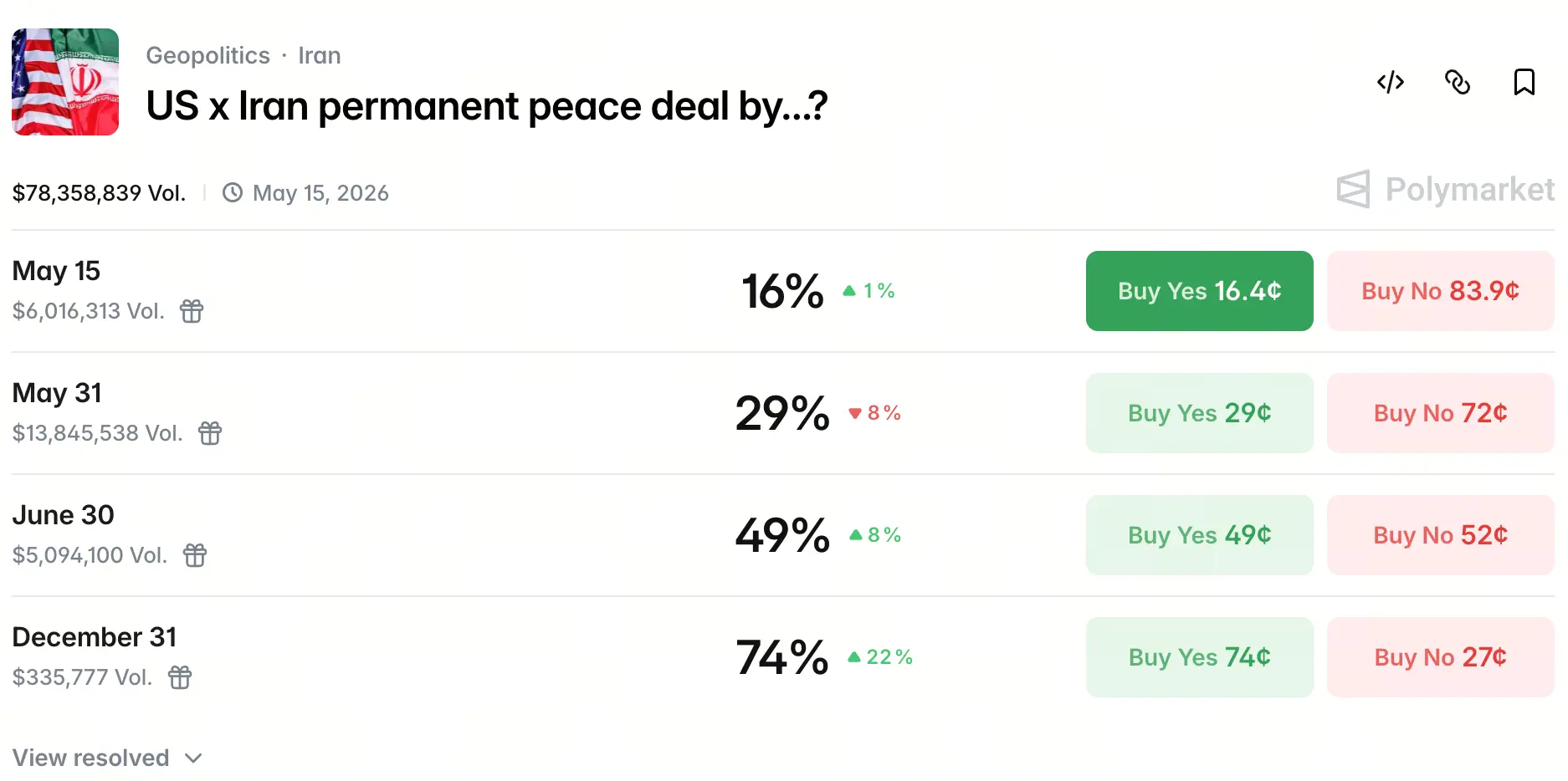
According to data shown on the Gate x Polymarket page, the total trading volume around the topic of a “permanent US-Iran peace agreement” has already exceeded $78 million. The market currently prices the probability of completing the agreement by different time milestones in a differentiated way: 16% before May 15, 29% before May 31, rising to 49% before June 30, and reaching 74% before December 31.
This probability distribution reveals the market’s basic judgment: the likelihood of reaching a comprehensive peace agreement in the short term is relatively low, but as the time window expands, expectations for a diplomatic solution gradually strengthen. Notably, Polymarket’s trading price essentially reflects the aggregated collective belief of market participants about the event outcome, rather than a deterministic forecast of the future. When contract prices fluctuate around $0.50, it usually means there is serious disagreement among market participants about that outcome.
From 6.7% to 10.2%: What recent catalysts drove the move?
Polymarket contract prices are highly sensitive to news events. Based on PolyBeats monitoring data, the probability of “whether the US and Iran will reach a permanent peace agreement before May 15” jumped from 6.7% to 10.2% within five minutes on May 6. The direct cause of this change was that multiple media outlets reported that both sides are nearing a preliminary agreement, and that the end of the core military action of the conflict, “Epic Fury,” had been announced.
This rapid price repricing reflects the core efficiency of prediction markets: once information enters the public domain, the market incorporates it into pricing almost immediately. From a more macro perspective, the prediction market around the US-Iran conflict generated tens of millions of dollars in trading volume over the past two months, and its pricing efficiency has been validated multiple times.
How does the Polymarket Builders ecosystem connect users and prediction markets?
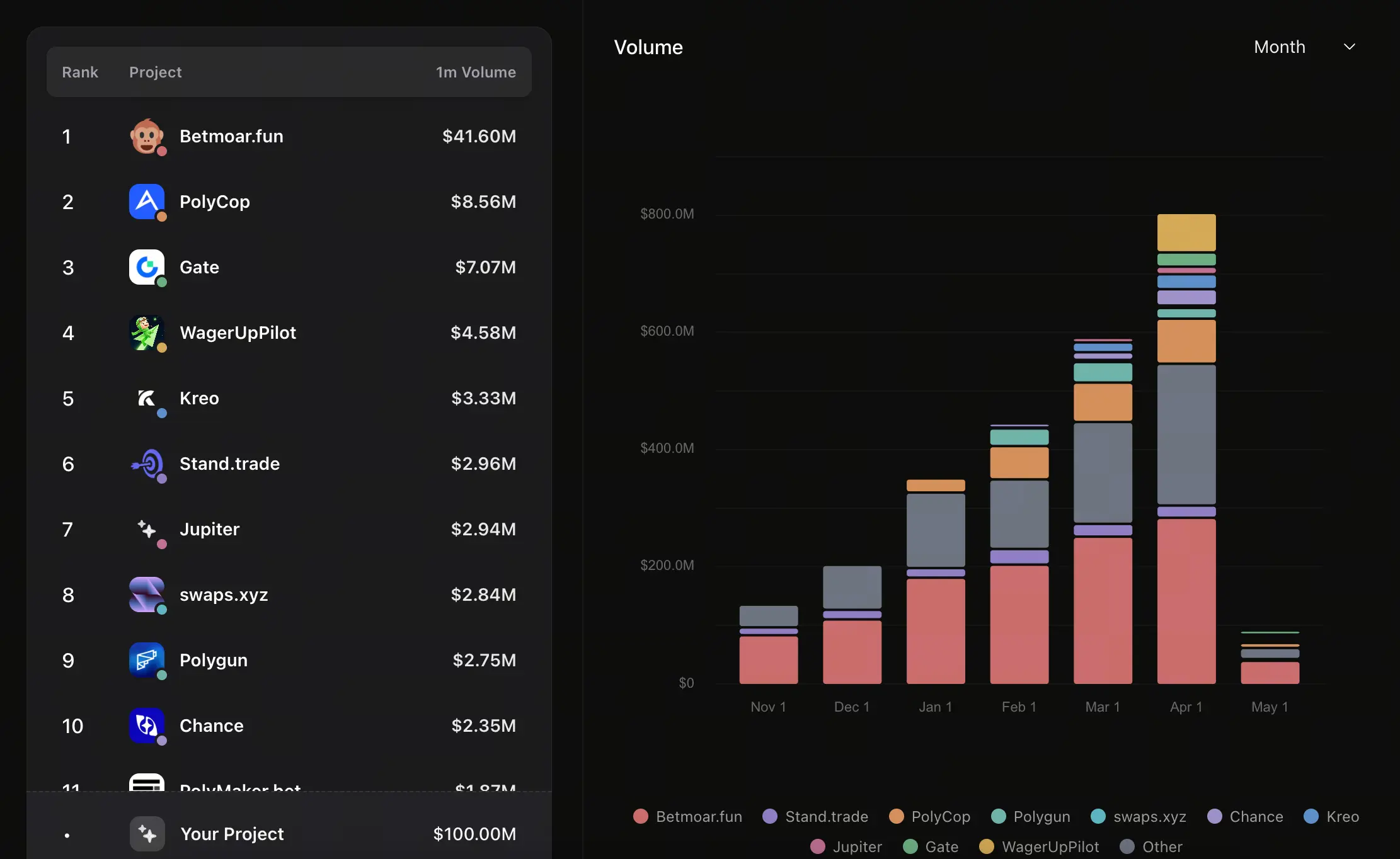
The value of prediction markets is not only in their pricing function, but also in their increasingly rich application ecosystem. The Polymarket Builders Program allows third-party developers to build differentiated front-end applications on top of its infrastructure, including trading terminals, follower apps, and data analytics tools. About 200 developers have already joined the program, with access to up to $2.5 million in funding.
Source: Builders Polymarket
According to the latest data from Builders Polymarket, in the past month, Gate platform users’ total amount participating in Polymarket predictions exceeded $7 million, ranking third among all third-party integrations into Polymarket. This figure not only reflects prediction markets’ appeal to crypto users, but also demonstrates the real-world effect of an open ecosystem in expanding user reach.
How does the Hormuz Strait game affect the pricing of the peace agreement?
Traffic conditions in the Strait of Hormuz are one of the key variables for assessing the trajectory of the US-Iran conflict, and also a core basis for prediction market contract pricing. The Trump administration’s statement pausing “Project Freedom,” as well as discussions between both sides about gradually easing shipping restrictions in the strait, have directly affected the prices of peace agreement contracts. At the same time, Iran’s stance is also continuously changing. Reports say Iran’s negotiation representatives proposed limiting uranium enrichment levels to 3.5%, representing a significant concession compared with its previous position. However, a spokesperson for the Iranian Ministry of Foreign Affairs also said, “At this stage, we do not have nuclear talks,” suggesting that nuclear issues may be deferred to be discussed after the ceasefire and blockade are lifted. This ambiguous pattern of statements is itself an important source of market volatility. In prediction markets, information asymmetry and the diversity of interpretations jointly form the core drivers of trading activity.
What trust and regulatory challenges do prediction markets face?
The rapid growth of prediction markets has also come with a trust crisis. Abnormal betting behavior that appeared before the ceasefire announcement on April 7, 2026 has drawn regulatory attention. According to reports, before Trump publicly announced the ceasefire, accounts had already heavily bought ceasefire contracts at an extremely low price of 2.8 cents; after the ceasefire news was released, the contract price jumped to nearly $1, with profit exceeding $450k per trade. The US Department of State has issued internal instructions to diplomatic personnel worldwide, warning them not to profit on prediction markets using confidential government information, and emphasizing that “misusing non-public information to obtain economic benefits is a serious illegal act.”
These events pose two challenges to the long-term development of prediction markets: first, issues of market integrity may erode users’ trust; second, tighter regulation may limit the compliance space for platform operations. For ordinary users, this means they need to more carefully assess information sources and trading risks when participating in prediction markets.
What can prediction market data tell us?
After integrating information across the above dimensions, Polymarket’s US-Iran peace agreement contracts show a relatively clear pricing logic. The market’s short-term pricing reflects a rational understanding of the core disagreements between both sides—key issues such as nuclear enrichment, sanctions relief, and control of the strait cannot all be resolved within two weeks. The medium-term probability of close to 50% (before June 30) reflects the market’s expectation of a “preliminary agreement,” which is closer to a memorandum of understanding indicating negotiation intent and direction rather than a final peace treaty covering all details. Long-term pricing reaching 74% indicates that the market leans toward believing that a framework agreement will be reached within 2026, as a high-probability event. However, it’s important to note that prediction market prices are not prophecies; they are the outcome of market participants’ game based on their respective information sets and risk preferences. When interpreting these data, it is more prudent to treat them as a “signal of collective beliefs” rather than as “a certain answer about the future.”
Frequently asked questions
Q: What does the “permanent peace agreement” on Polymarket refer to?
The contract’s “permanent peace agreement” is typically defined as a formal bilateral agreement covering key provisions such as the formal end of the conflict, the restoration of shipping through the Strait of Hormuz, controlled Iran’s nuclear program, and a gradual easing of US sanctions. Different time milestones on the market correspond to different expectations for the agreement’s completion phase.
Q: Does the contract price represent real probability?
Contract price is a direct reflection of the market’s supply and demand, representing the collective pricing given by market participants based on currently available information, rather than an objective probability. Polymarket’s pricing efficiency has been validated by multiple events, but the price itself still contains participants’ subjective judgments and risk premiums.
Q: How can ordinary users participate in prediction markets safely?
Before participating, users should fully understand contract rules and settlement conditions, and assess their own ability to bear risk. Prediction markets involve the risk of losing all principal, so it’s recommended that users only invest funds they can afford to lose, and remain critical about information sources. Gate’s integration services allow users to participate in the Polymarket ecosystem through existing account operations.
Q: How is Gate users’ participation on Polymarket reflected?
According to the latest data, in the past month, Gate platform users’ trading volume participating in predictions through the Polymarket Builders ecosystem exceeded $7 million, ranking third among all channels integrating with Polymarket via third parties. This data reflects the activity level and depth of participation by Gate users in cross-border prediction markets.


