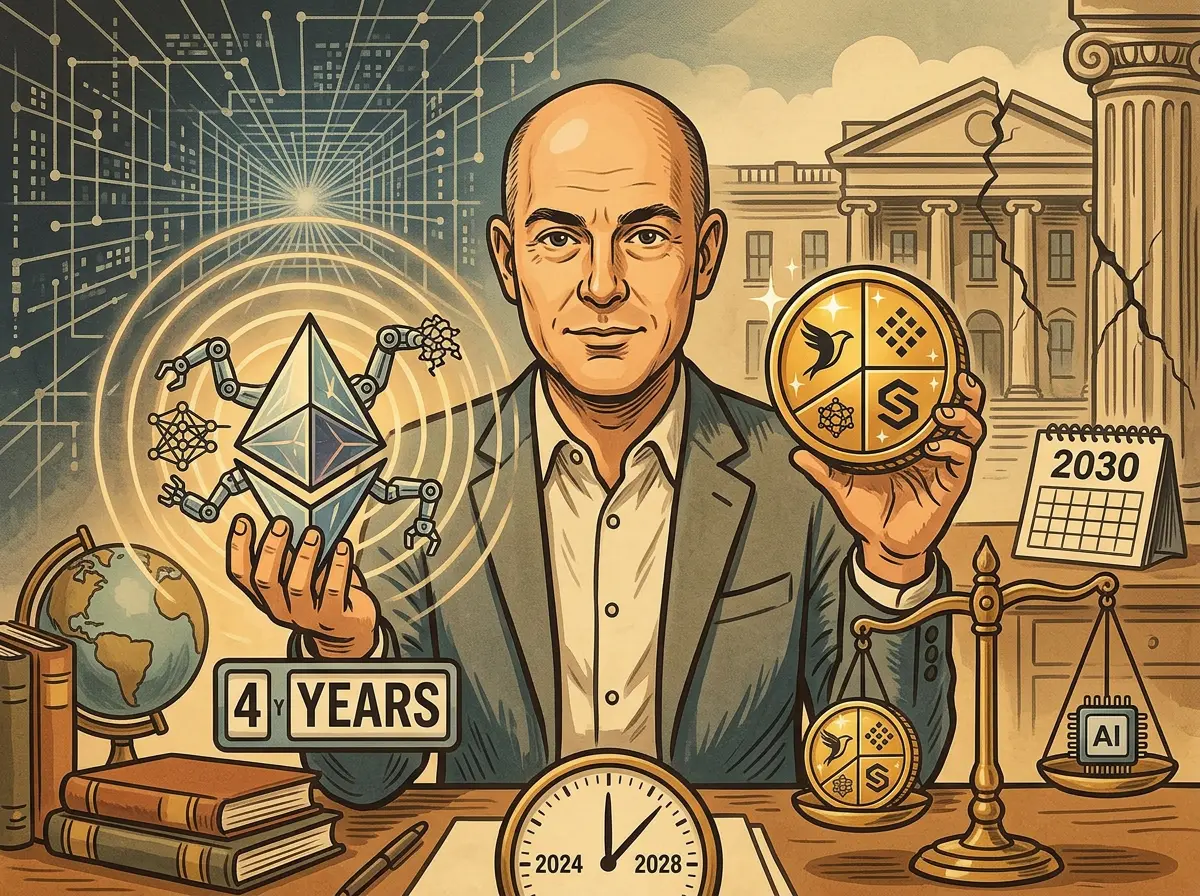
Real Vision co-founder Raoul Pal confirmed in a podcast on June 1 that the AI race is the largest capital event in human history, and he expects the “economic singularity” to arrive in about 4 years. During his recent pullback, Pal bought Sui and Zcash, and confirmed that ETH, Solana, and Sui still maintain “economic density” even after a major drop—i.e., Layer1 chains.
Pal’s Logic for the AI Race: Reed’s Law and the Economic Singularity
Pal confirmed in the podcast that the AI race is a game-theory situation in which no participant will stop—stopping would mean the opponent gains an advantage. He confirmed that AI is the first observable case of “Reed’s law” in human history: network value grows exponentially through collective construction, rather than the logarithmic growth typically seen in earlier periods of technology adoption (Metcalfe’s law).
Pal confirmed that, as estimated, by 2028 the amount of text produced annually by AI will exceed the total of all text produced by humans from the Gutenberg printing press to the present. He confirmed that the “economic singularity” refers to a state in which an AI agent can instantly form and destroy capital, causing the system to be unable to operate normally, and he confirmed that the operating speed of carbon-based biological neurons is 1 millisecond, while silicon chips operate about 1 million times faster than human neurons.
Pal’s Crypto Stance and Layer1 Evaluation Criteria
Pal confirmed that the large-scale expansion of AI agents (Agents) will give them their own on-chain wallets, completely changing the basis for calculating crypto market TAM—from estimates based on human users to “infinite TAM.” He confirmed: “Layer1 tokens are everyone’s ‘universal basic equity.’”
Pal confirmed that evaluating blockchains should not use DCF or a fee model; the core criteria should be “the cheapest, the fastest, and the most programmable.” He confirmed that ETH has the densest economic value and developer resources; Solana has proven efficiency and speed; and although Sui is still early, its programmability within a single block and its thousand-transactions processing speed are in a different tier. Pal confirmed his intuition for buying Zcash as “Bitcoin with privacy features,” and the deeper reason is its resistance to quantum computing.
Pal’s 2026–2027 Outlook and Long-Term Holding Arguments
Pal confirmed the positive factors for 2026–2027 include: banks entering the market; stablecoins set to see explosive growth in the next two years; the “CLARITY Act” will be signed; the U.S. government faces pressure to keep printing money due to interest payments of tens of trillions of dollars; crypto assets are currently at long-term trend lows relative to the Nasdaq; crypto markets previously experienced the most prolonged period of “extreme panic” in history with the lowest readings (the Fear and Greed Index falling below 10).
Pal confirmed: “99% of people can’t make big money by buying high and selling low. The evidence shows that the ones who make the most money in crypto are those who ‘do nothing.’”
FAQ
How does Raoul Pal define the “economic singularity,” and when does he expect it to arrive?
Based on Pal’s confirmation, the “economic singularity” is the moment when AI agents can instantaneously form capital and the system can no longer operate in its original way. He confirmed he expects this moment to arrive in about 4 years, and confirmed that by 2028 AI’s annual text output will exceed the total of all text in human history.
Why did Pal buy Sui and Zcash during the pullback period rather than other assets?
Based on Pal’s confirmation, Sui is one of three chains (ETH, Solana, Sui) that maintained “economic density” even during a major market drop, with its programmability and processing speed in a different tier. Zcash is the “Bitcoin with privacy features” he confirmed, and it also has the anti-quantum computing characteristic he considers important.
What is the basis for the 70% bullish probability Pal gave for 2026–2027?
Based on Pal’s confirmation, the bullish case includes: crypto assets being at long-term trend lows relative to the Nasdaq; banks entering the market; stablecoins’ explosive growth; the “CLARITY Act” about to be signed; and the U.S. government’s money-printing demand. He confirmed the remaining 30% downside risk comes from inflation triggered by the situation in the Middle East, but confirmed that he currently hasn’t seen any sign of this.


