This reversal is not an isolated event. Since the start of 2026, Seagate’s stock has gained a cumulative 159.89%, making it one of the most closely watched targets in the AI infrastructure segment. Against the backdrop of broad pressure on the AI sector and continued uncertainty about the durability of capital expenditure, Seagate sent a clear signal to the market through an above-expectations earnings report and an aggressive 2027 fiscal-year outlook: AI demand for storage is shifting from narrative to real, measurable profitability.
Seagate Q4 earnings: Beating expectations isn’t just about the numbers—it’s validation that AI demand is taking hold
Key financial metrics from Seagate’s 2026 fiscal fourth quarter (ended July 3, 2026):
Q4 revenue reached $3.63 billion, above the market expectation of**$3.49 billion**; adjusted EPS was**$5.71**, exceeding the expected**$5.08**. Revenue in the same period grew48%year over year, and Non-GAAP gross margin rose to52.7%.
Net profit in the fourth fiscal quarter was $1.29B, up more than 164% from $488 million in the prior-year quarter. Operating cash flow was $1.3 billion, and free cash flow was $1.1 billion. For the full fiscal year, Seagate delivered revenue of $12.2 billion, up 34% year over year; adjusted EPS was $15.58, nearly double from $8.10 in the prior fiscal year.
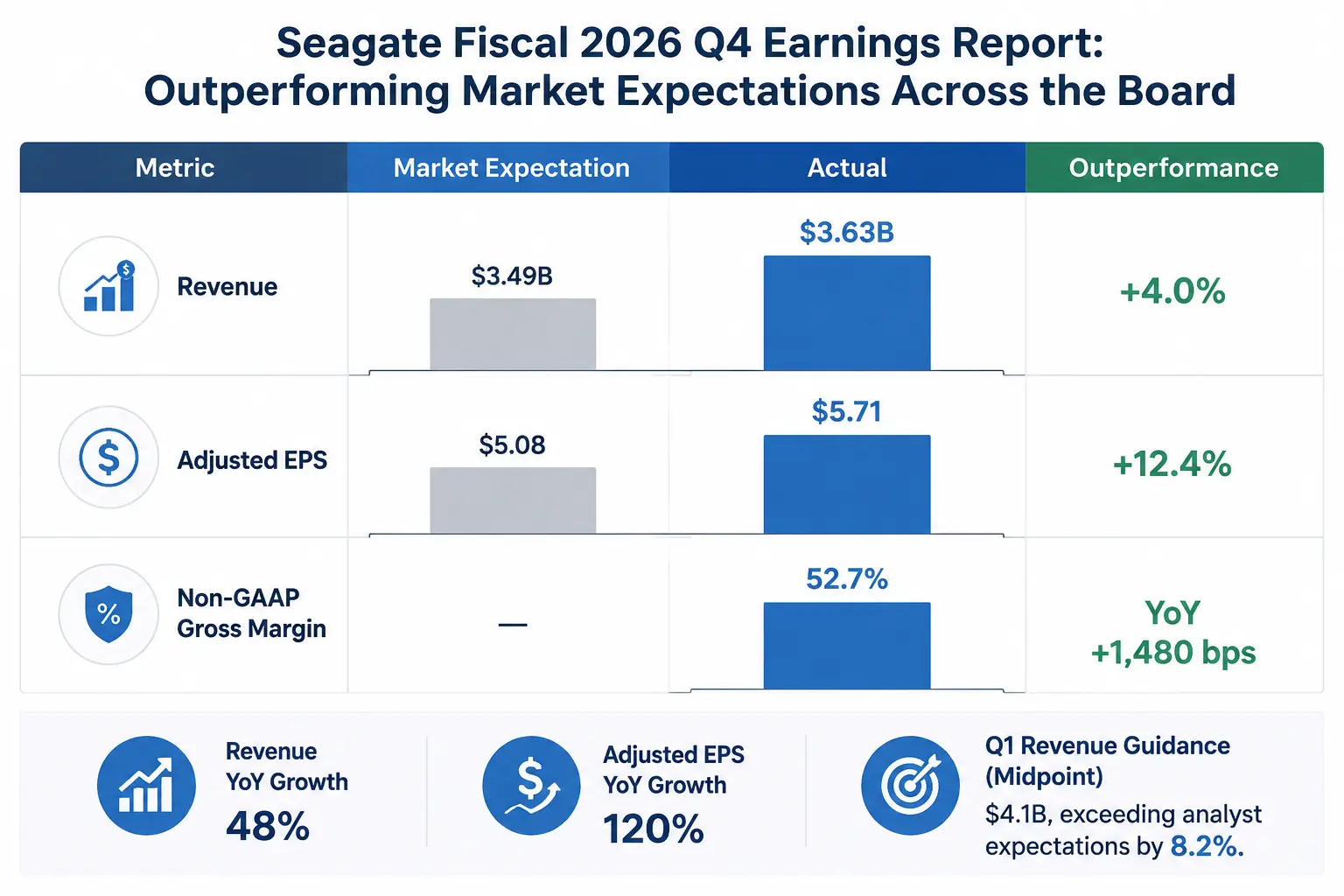
Seagate Q4 earnings—key data at a glance
What the market is focused on is not just the phrase “beating expectations,” but the industrial logic behind these figures. In the earnings report, Seagate Chairman and CEO Dave Mosley said, “Our performance growth was driven by strong demand from cloud computing data centers and strict execution discipline. We expect this momentum to continue into fiscal 2027. As AI accelerates data generation and enhances data value, demand for high-capacity storage has long-term resilience.”
Gross margin jumped from 37.9% in the prior-year quarter to 52.7%, an expansion of 1,480 bps. The significance is that Seagate’s growth is not simply dependent on volume expansion; it reflects a comprehensive shift toward higher-value enterprise products and stronger pricing power. When a hardware company achieves systematic margin expansion during a demand growth cycle, it provides a foundation for the market to reassess its valuation logic.
Three drivers behind Seagate’s 159% year-to-date stock rise
The 159.89% gain since 2026 has made Seagate one of the top performers in the AI infrastructure segment. This rally is not driven by a single factor, but by the combination of three layers of logic.
First: AI data centers bring a structural upgrade in storage demand. In the past two years, market understanding of AI beneficiaries has been highly concentrated on compute-and-memory segments such as GPUs (NVIDIA) and HBM (SK hynix). But the full picture of the AI value chain is far broader than that—AI model training and inference need not only GPUs for computing and HBM for high-speed caching, but also vast storage capacity to hold training data, model parameters, and inference context. As model parameter scales move from the trillion-parameter level to the ten-trillion-parameter level, data storage demand rises exponentially. Seagate management noted on the earnings call that KV cache storage is driven by agentic AI applications generating massive context data, while physical AI will produce large volumes of unstructured video data—both “still in the early stage.” Seagate predicts that by 2031, the total storage data volume for agent-related applications will reach 10 ZB.
Second: Expansion of cloud providers’ capital expenditures directly boosts enterprise HDD demand. In the wave of AI data center buildouts, hyperscalers are the core driver of storage demand. Tech giants such as Microsoft, Meta, and Amazon have continued to ramp up capital expenditures, which directly translate into purchases of high-capacity enterprise HDDs. Seagate’s production capacity has been locked in through long-term supply agreements through 2028, and customer willingness to extend plans into 2029 continues to strengthen. The supply-demand gap is widening—Mosley disclosed on the call that contracts are typically locked for one year, but after yield improvements free up additional capacity, customers are willing to pay prices higher than the contract price, pushing pricing upward in a stepwise fashion quarter by quarter.
Third: Improved profitability drives a systematic reassessment of valuation. For full-year 2026, non-GAAP gross margin rose from 35.8% to 46.1%, reaching 52.7% in the fourth quarter. This margin level sits in a very high range for the hardware manufacturing industry. More importantly, the improvement trend is still accelerating—gross margin guidance for the September quarter is around 57%, operating margin around 50%, and incremental gross margin is expected to be far above 60%. Promotional pricing for early HAMR customers will be fully removed in the September quarter, further lifting the blended average price. When a company’s gross margin rises from the 30% range to the 50% range and continues upward, the market’s expectations for its profitability will inevitably undergo a systematic reassessment.
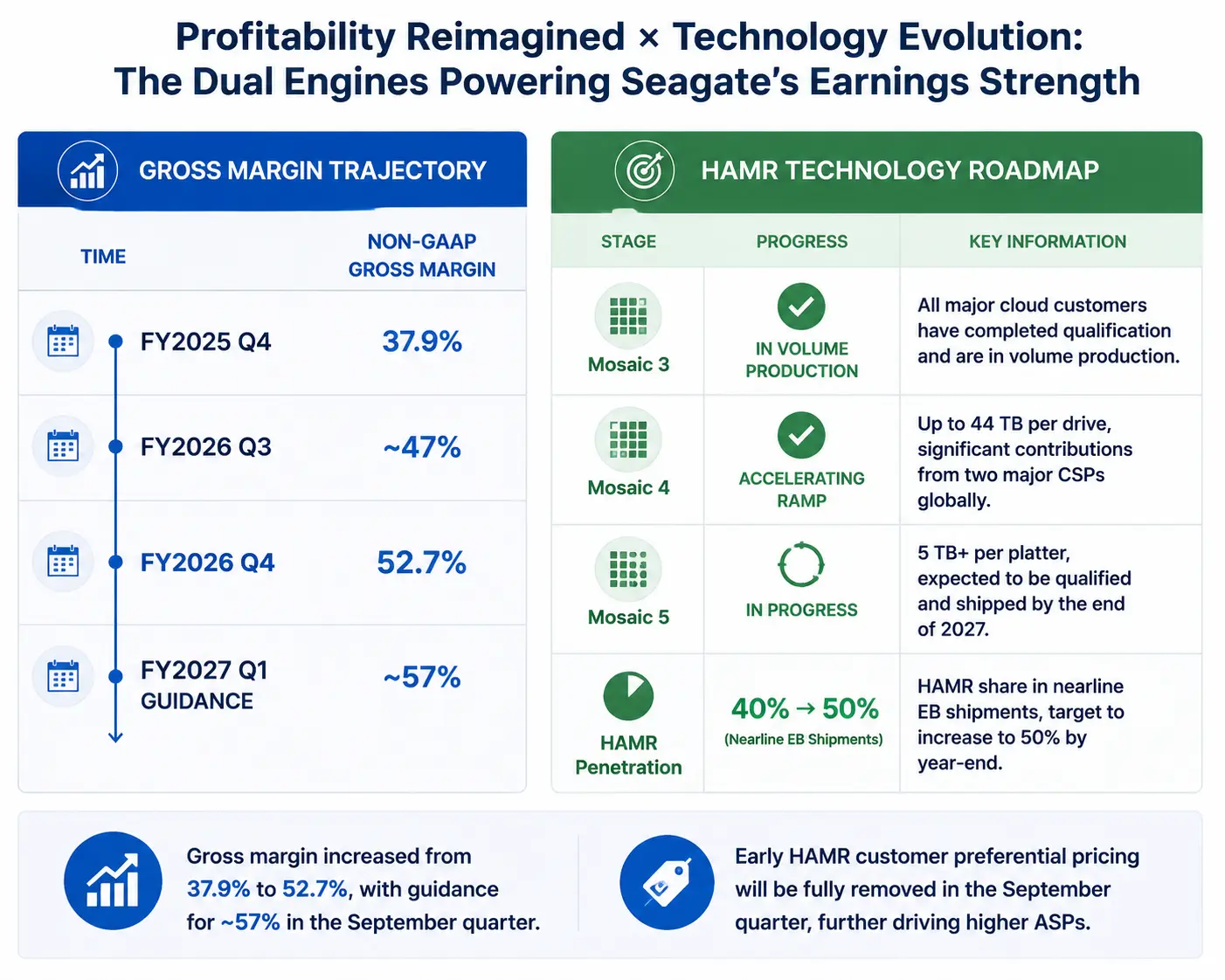
Seagate’s gross margin jump and the HAMR technology roadmap
Why did it fall 8.53% before the earnings release? What is the market worried about?
On Tuesday during regular trading hours, Seagate fell 8.53%. This drop needs to be understood in the context of the broader market.
First, the AI sector was in an overall adjustment cycle. Before the earnings release, core AI names such as NVIDIA, SK hynix, and Micron all saw pullbacks to varying degrees, and the semiconductor index as a whole weakened. Prior to the earnings release, Seagate’s stock had already fallen about 22% from the month’s intraday high. This adjustment was not specific to Seagate; it reflected the market’s cooling on AI trading broadly.
Second, the 159% gain earlier in the year means a large amount of capital had already positioned itself ahead of the AI storage-cycle logic. Ahead of the earnings report, reducing risk exposure and locking in some profits is a common behavior in a high-rally environment.
A deeper concern is the sustainability of AI capital expenditures. Investors are focused on whether AI spending from cloud providers like Microsoft, Meta, and Amazon will ultimately translate into revenue. This concern is especially pronounced in the storage segment—storage has historically seen sharp boom-and-bust cycles, and the market has remained cautious about whether “this time is different.”
Seagate’s earnings call delivered a strong response to these concerns. The CEO clearly committed that fiscal 2027 revenue growth will exceed fiscal 2026, projecting full-year growth of 34%. The CFO further said, “We will deliver quarterly revenue growth and gross margin expansion throughout fiscal 2027.” Near-line HDD capacity is already locked through 2028, and customers have begun planning orders for 2029. In after-hours trading, the stock briefly surged by more than 10%, and the market responded with real money by endorsing Seagate’s backing of durable demand.
Outlook: Upside support and potential risks
Bullish logic
On the supply side, production discipline in the storage industry is strengthening. Unlike past cycles where vendors expanded blindly and led to oversupply, major players today are more restrained in capacity expansion. Morgan Stanley research shows that in 2026, near-line HDD supply will be short of demand by about 300 EB (exabytes), which is equivalent to a gap of 10% to 15%. In 2027 and 2028, the expected gaps are further widening to about 400 EB each.
On the technology side, the HAMR (heat-assisted magnetic recording) technology roadmap is progressing as planned. Mosaic 3 has completed certification with all major cloud customers and entered mass production. Mosaic 4 (up to 44 TB per drive) has accelerated its ramp across the two largest cloud service providers globally and is already making “significant contributions” to financials. Mosaic 5 (5 TB+/disk) is expected to start certification shipments by the end of 2027. In near-line EB shipments, HAMR’s share is already 40%, with a target to reach 50% by year-end. Higher storage density means unit costs continue to fall, providing room for further gross margin expansion.
From a financial perspective, Seagate’s balance sheet continues to improve. Net-debt leverage has declined to 0.4x, and the company will repay $1.2 billion of debt again in the September quarter, while share repurchases are accelerating.
Wall Street consensus ratings for Seagate are “Strong Buy,” with an average target price of about $1,020, implying more than 25% upside versus the pre-earnings closing price. Wedbush raised its target price from $825 to $1,000. Rosenblatt lifted it to $1,300. Mizuho increased it to $1,090.
Risk factors
On the valuation front, the 159% rally year-to-date has already priced in a large amount of bullish expectations. The market expects profit growth to keep delivering consistently; any signal below expectations could trigger sharp pullbacks.
Uncertainty remains around the pace of AI capital expenditures. If major cloud providers cut data center investments due to macro conditions or earnings pressure, storage demand would be directly hit.
Cyclicality inherent to the storage industry cannot be ignored. History repeatedly proves that the cycle of rising demand → capacity expansion → increased supply → price declines keeps occurring in storage. Even though supply discipline is stronger today, high margins themselves will attract capital, and changes in the long-term supply-demand balance still need ongoing observation.
Conclusion
The significance of Seagate’s Q4 earnings goes beyond merely beating expectations on performance. It proves that the investment wave in AI infrastructure is flowing downstream from compute layers such as GPUs and HBM into the storage layer—and that this transmission has already turned into measurable revenue growth and gross margin expansion. A 52.7% gross margin, 34% full-year revenue growth, and capacity locked through 2028—these figures point to a conclusion: AI demand for storage is not a short-lived theme; it is a structural force reshaping the HDD industry’s profitability model. Of course, the 159% year-to-date rally also means the market has already priced in a lot of optimism; the key going forward is whether Seagate can continue to deliver on its growth commitments. At least from this earnings report and the earnings call, management appears quite confident in its outlook.
FAQ
Q1: What are the key above-expectations data points in Seagate’s fiscal 2026 Q4 earnings?
Q4 revenue was $3.63 billion, above the market expectation of $3.49 billion; adjusted EPS was $5.71, above the expected $5.08. Revenue grew 48% year over year, and gross margin rose from 37.9% in the prior-year quarter to 52.7%.
Q2: Why has Seagate’s stock risen about 160% since 2026?
Three drivers: AI data centers bring a structural upgrade in storage demand; increased cloud providers’ capital expenditures directly drive enterprise HDD purchases; and gross margin rising from the 30% range to the 50% range supports a systematic reassessment of valuation.
Q3: What guidance does Seagate provide for fiscal 2027 performance?
The CEO committed that fiscal 2027 revenue growth will exceed fiscal 2026, with full-year growth expected at 34%; the CFO said it will deliver quarterly revenue growth and gross margin expansion throughout fiscal 2027. The midpoint of Q1 revenue guidance is $4.1 billion, well above analysts’ expected $3.78 billion.
Q4: What does HAMR technology mean for Seagate?
HAMR (heat-assisted magnetic recording) is Seagate’s key technology path for increasing storage density. Mosaic 3 is already in mass production, Mosaic 4 (44 TB per drive) is ramping up at the two largest cloud service providers globally, and Mosaic 5 (5 TB+/disk) is expected to have certified shipments by the end of 2027. HAMR’s share in near-line EB shipments is already 40%, with a target to reach 50% by year-end.
Q5: What are Seagate’s main risks?
If AI capital expenditures slow down, it will directly pressure storage demand; inherent cyclicality in the storage industry (capacity expansion → oversupply → price declines); and the 159% rally earlier in the year has already priced in many optimistic expectations, creating significant pressure to deliver results.