On May 20, 2026 (local time), SpaceX officially filed an S-1 registration statement with the U.S. Securities and Exchange Commission, planning to list on Nasdaq under the stock ticker SPCX. Underwriters include Goldman Sachs, Morgan Stanley, Bank of America Securities, Citigroup, and JPMorgan Securities. Although the S-1 filing has not yet disclosed the specific number of shares to be issued or the pricing range, market estimates put SpaceX’s target valuation for this IPO between $1.75 trillion and $2 trillion, with the fundraising amount potentially reaching $75 billion to $80 billion, which would significantly surpass the $29.4 billion IPO financing record set by Saudi Aramco in 2019.
This development is not limited to traditional capital markets. Viewed from the crypto industry perspective, multiple structural clues lie behind SpaceX’s IPO—Starlink’s stablecoin payment practices, the company’s Bitcoin holdings on its balance sheet, and trading activity on crypto platforms during the Pre-IPO stage—together forming an industry topic worth deep dissection.

When will the SpaceX IPO application and market conditions take shape?
The timeline for SpaceX’s listing is full of strategic considerations. In April 2026, the company submitted a confidential S-1 filing to the SEC under the internal codename “Project Apex.” The public offering was released on May 20, with global roadshows expected to begin on June 4. Pricing is expected to be completed on June 11, and the company will be listed on June 12.
Notably, OpenAI released IPO signals at nearly the same time. Two trillion-level tech companies share Goldman Sachs and Morgan Stanley as core underwriters, an arrangement that has no precedent in modern equity capital markets history. Against the backdrop of dual listing expectations, market attention on IPOs in cutting-edge technology sectors is objectively amplified.
Based on data in the S-1 filing, how high a valuation does SpaceX’s financial condition support?
In the prospectus, SpaceX reported that it completed the merger with xAI Holdings Corp. on February 2, 2026. The business is divided into three segments: aerospace, connectivity (Starlink), and artificial intelligence. Financial data shows that in Q1 2026, consolidated revenue was $17.5k, but operating loss was $20k, and net loss was $8B. For full-year 2025, consolidated revenue was $4.69B, with net loss of $1.94B.
The segments are clearly divergent. The connectivity segment (Starlink) is the only profitable engine. In Q1 2026, revenue was $4.28B and operating profit was $18.67B. Meanwhile, the artificial intelligence segment incurred an operating loss of $4.94B in the same period due to massive investment in building AI compute infrastructure. Using the $2 trillion valuation ceiling, the implied price-to-sales ratio is over 100x, far above the average levels of traditional defense, telecommunications, or cloud services companies. The market is effectively pricing in an extremely aggressive long-term growth expectation.
What direct connection does SpaceX have with crypto assets?
SpaceX’s S-1 filing disclosed a detail that has been under long-term scrutiny: as of the time it filed for its IPO, the company held 18,712 Bitcoins, with a cost basis of about $35,000 per coin. This means SpaceX entered the crypto asset market early, and its holdings themselves constitute an important asset on the balance sheet.
Starlink’s business, meanwhile, provides a more direct scenario for real commercial use of crypto assets. According to people familiar with the matter, SpaceX has used stablecoins to process payments for part of its Starlink customers in “long-tail countries”—collecting local currency from markets vulnerable to the financial system, converting it into a dollar-pegged stablecoin, transferring it to the United States, and then exchanging it back into dollars. This mechanism achieves three goals at once: preventing profit erosion from foreign exchange volatility, bypassing the slow settlement processes of traditional wire transfers, and providing a channel for users without bank accounts to hold digital dollars. In addition, Musk has repeatedly said that SpaceX goods will accept DOGE payments and may expand to Starlink monthly subscription fee scenarios.
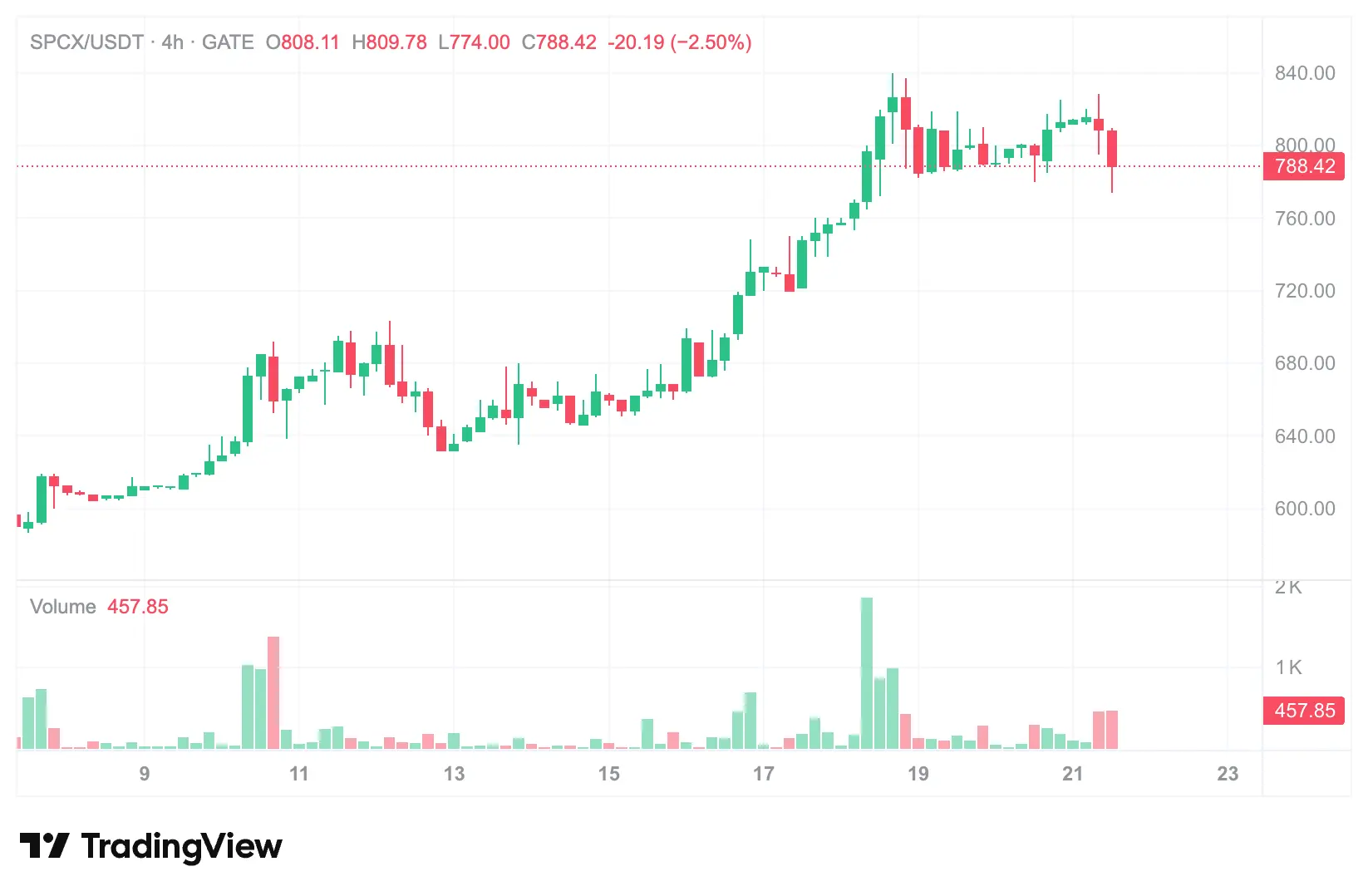
SPCX price chart
In the Pre-IPO stage, SPCX created direct interactions with crypto market investors through its Gate Pre-IPOs product. As of May 21, 2026, SPCX was quoted at 790 USD, up more than 30% from the earlier 590 USD subscription price.
What spillover effects could SpaceX’s listing have on the crypto market’s capital flows?
Based on historical experience, major events in the U.S. tech capital markets often have spillover effects on crypto asset prices. 2025 was viewed within the industry as a “banner year for IPOs” in crypto: stablecoin issuer Circle listed on the NYSE; multiple companies including Bullish and Gemini completed listings; and crypto-related IPOs raised about $14.6 billion. The emergence of this IPO window created a reinforcing positive-feedback relationship with the overall upward trend in crypto market valuations.
If SpaceX completes its listing at a $2 trillion valuation, it would surpass Broadcom, Saudi Aramco, and Tesla to become the seventh-largest company globally by market value. An IPO of this magnitude could affect the crypto market from two directions: first, it could raise institutional investors’ overall risk appetite for “frontier technology assets,” and crypto assets, as high-volatility instruments within that category, may attract incremental capital; second, Starlink and xAI within SpaceX’s business footprint have narrative logic resonance with parts of the crypto industry—such as DePIN (decentralized physical infrastructure networks) and on-chain payments—which could drive capital to reassess the long-term value of those sectors.
What are the key controversies in the market over SpaceX’s valuation?
Even though market sentiment is high, disagreements over valuation are equally significant. Analysts generally believe that SpaceX’s IPO pricing will reflect strong expectations for AI and the space economy, but what follows will be sharp volatility and extremely high execution risk. Specifically, the controversy centers on three layers:
Financial layer: In Q1 2026, the aerospace segment posted a loss of $662 million, and the AI segment lost $3.26B. Relying solely on Starlink profits is far from sufficient to cover massive capital expenditures. In Q1 2026, total capital expenditures reached $1.19B, of which the AI segment alone accounted for $2.47B.
Governance layer: SpaceX uses a dual-class equity structure. Before listing, Musk held 12.3% of Class A shares and 93.6% of Class B shares, with combined voting power totaling 85.1%. This means that after the IPO, the founder would continue to fully control the company’s strategic direction. Such a centralized governance structure reduces institutional investors’ expectations for board-level checks and balances.
Liquidity layer: Because Musk’s stake is extremely high and he has pledged to “sell no shares,” the post-listing tradable float is expected to be only about 5%. If passive index funds quickly absorb it, it could trigger a rare “structural squeeze.”
What trends are emerging in the current IPO window?
SpaceX’s listing is viewed as a key variable that could boost confidence in the IPO market, but IPO windows for crypto companies themselves are shrinking. Entering 2026, the Bitcoin price saw a sharp pullback, and investors’ risk appetite for crypto concept stocks clearly cooled. As the first crypto IPO in 2026, BitGo was priced at $18 in January but later fell to $7. Circle’s share price, which once dipped from its 300 USD peak to below $50. Bullish, once at $118, also fell below $25.
Reflecting preparations, Kraken paused its IPO plans due to “difficult market conditions,” Ledger postponed its U.S. listing, and Consensys pushed its IPO to no earlier than this fall. Whether SpaceX’s listing can activate the IPO window for crypto companies will depend on the market signals delivered by its IPO pricing and subsequent stock performance.
What integration directions might exist between blockchain technology and commercial space?
The blockchain technology market in the global aerospace and aviation sector is showing a growth trend. The space currency and economic markets are expected to reach $3.2 billion by 2029, with a compound annual growth rate of 18.9%. Behind this growth are multiple parallel integration paths.
In the cross-border payments layer, Starlink’s stablecoin practice has already validated the commercial feasibility of blockchain settlement in globalized business scenarios. At the infrastructure level, the logic of satellite internet aligns closely with DePIN—using token incentives to build real-world infrastructure, including network nodes and communication coverage. In the on-chain capital markets layer, SPCX’s trading activity during the Pre-IPOs stage also indicates that capital flow channels between traditional equities and crypto assets are broadening.
Looking further ahead, SpaceX has applied to regulators to deploy as many as 1 million satellites, plans to build “space data centers” in low Earth orbit, and is in discussions with Google about the possibility of sending orbital data center equipment into space. Such distributed compute infrastructure and the underlying needs of blockchain networks have a natural coupling space.
What market expectations does SPCX’s performance in the Pre-IPOs stage reflect?
Through the Gate Pre-IPOs product, investors had the chance to participate early before SpaceX’s official listing. SPCX opened subscription at a 590 USD price and, as of May 21, 2026, its quote reached 790 USD, with a cumulative increase of more than 30%. This price movement reflects a generally positive market outlook toward the overall SpaceX IPO. Especially after the S-1 filing was formally submitted, market sentiment received further confirmation.
The trading mechanism of Pre-IPOs allows investors to establish positions before the underlying asset is publicly listed. Its price is often viewed as a forward indicator of market expectations for IPO pricing. SPCX’s price trend shows that, driven by the disclosure of the S-1 filing and the prospectus, the market has formed preliminary acceptance of the $2 trillion valuation range. The evolution of this indicator will be ultimately tested in SpaceX’s official IPO pricing and subsequent trading.
Frequently Asked Questions (FAQ)
Q: What is SpaceX’s target valuation and fundraising size for its IPO?
Market estimates place SpaceX’s target valuation for this IPO between $1.75 trillion and $2 trillion, with the fundraising size potentially reaching $75 billion to $80 billion, making it the largest IPO in capital markets history.
Q: Can SpaceX’s financial fundamentals support such a high valuation?
From the financial data, full-year 2025 consolidated revenue was $20k, but net loss was $8B. Only Starlink achieved profitability, while both the aerospace and AI segments remained loss-making. With a price-to-sales ratio of over 100x based on a $2 trillion valuation, it means the market pricing already fully includes extremely optimistic expectations for future growth.
Q: What direct links does SpaceX have with the crypto industry?
SpaceX holds 18,712 Bitcoins (cost basis of about $35,000 per coin), Starlink has used stablecoins to process part of its emerging-market customer payments, and the company’s goods have also been announced to accept DOGE payments.
Q: When is SpaceX’s listing expected to be completed?
Based on the disclosed IPO timetable, SpaceX is expected to begin global roadshows on June 4, complete pricing on June 11, and formally list for trading on Nasdaq on June 12 under ticker SPCX.
Q: How has SPCX’s price performed during the Pre-IPOs stage?
SPCX opened subscriptions at a 590 USD subscription price via the Gate Pre-IPOs product. As of May 21, 2026, its quote was 790 USD, up more than 30% from the subscription price.


