On June 12, 2026, Space Exploration Technologies Corp. (SPCX) listed on the Nasdaq at an IPO price of $135, setting a record for the largest IPO financing in history at $86 billion. On its first day of trading, the stock surged 19% to $161, and subsequent trading days quickly pushed it to a historical high of $225.64.
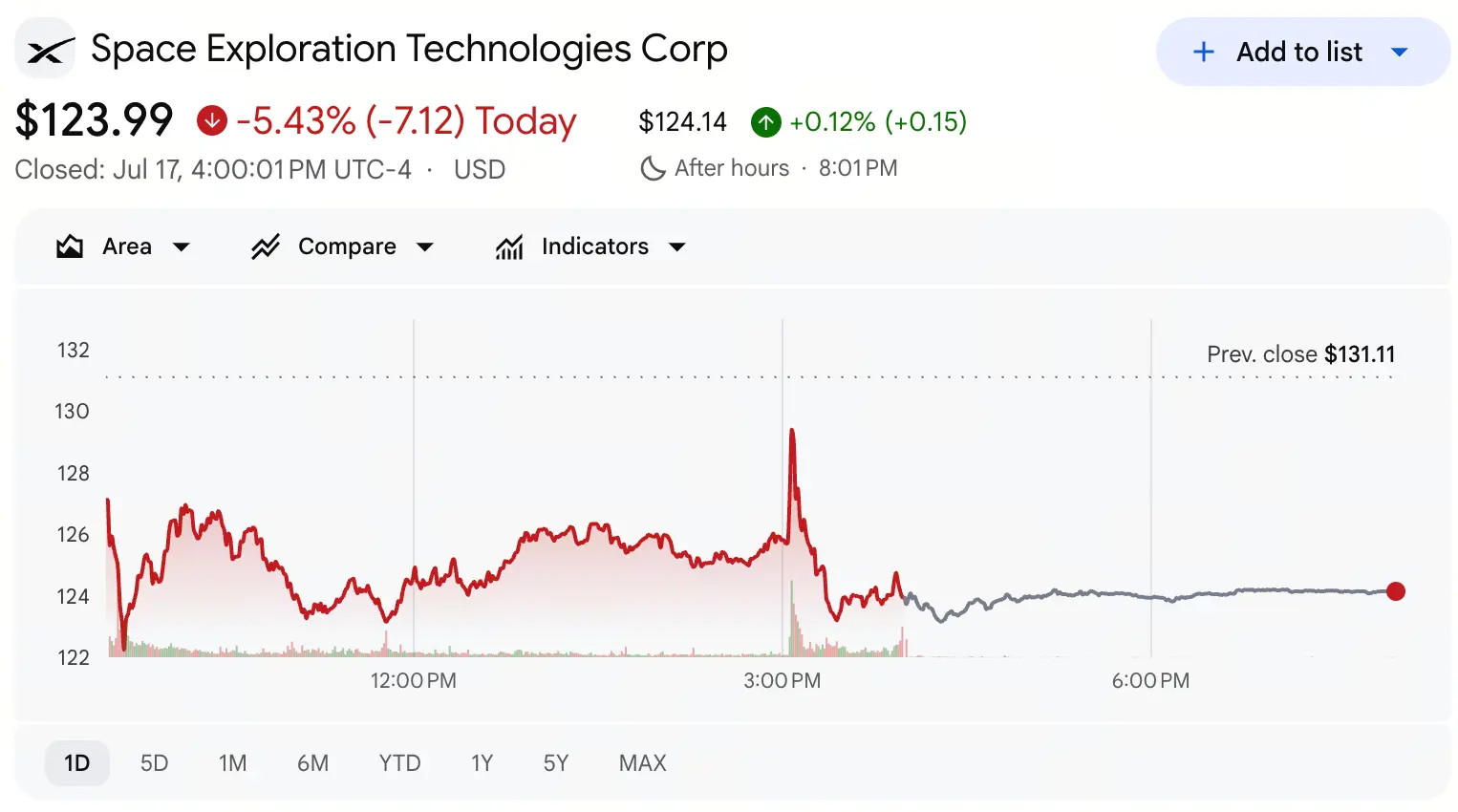
However, as of July 20, 2026, SPCX has already fallen by more than 40% from its IPO peak. On July 17, it closed at $123.99, and during the day it briefly touched $122.12, a 52-week new low. Since the market-cap peak of $2.64 trillion on June 16, the company’s market cap has evaporated by more than one trillion dollars.
Over five weeks, from the much-hyped IPO myth to breaking below the issue price, SPCX’s violent volatility reflects not only valuation reversion at the single-stock level, but also a deeper game in the capital markets surrounding the emerging commercial spaceflight track.
Behind SPCX’s issue-price break: how do multiple pressures resonate together
SPCX’s rapid decline is not caused by a single factor, but by the overlapping resonance of three major negative catalysts:
- First: Starship test flights keep hitting setbacks. On July 16, the 13th Starship test flight that SpaceX had planned to conduct was automatically aborted during the ignition phase because four Raptor engines failed to start. This was originally intended as the company’s first launch mission after listing, carrying the market’s dual expectations for validating the Starship V3 iteration and deploying Starlink V3 satellites. The test-flight failure directly triggered a post-market stock plunge on July 16 and pushed the stock to keep sliding 5.43% the next day.
- Second: the impending flood of restricted-share unlocks. Starting in August, about 1.2 billion shares of SPCX stock will gradually enter circulation, increasing the float by roughly 900% from current levels. They will be released in four tranches from August to October, totaling 44% of the company’s total share capital. Early investors and insiders had extremely low cost bases, so the cash-out pressure after the unlock becomes the biggest supply-side concern for the market. One fund professional said bluntly that even if SpaceX conquers the moon and finds gold, it still wouldn’t have enough money to absorb selloffs of this scale.
- Third: short positions accumulate rapidly. Within three weeks, SPCX short interest jumped from 5%–7% of the float to 29%, with short positions totaling $25 billion and roughly $4 billion in paper profit. This is one of the fastest-accumulating short positions among newly listed stocks in U.S. market history. Economist Peter Schiff said on a social platform that SPCX is already below its IPO price, and that the main lock-up period has not yet expired; by year-end, the float could expand eightfold.
When these three pressures overlap within the same time window, they form a complete narrative chain behind SPCX’s break below the issue price.
Why the valuation framework has fundamental disagreements
The core controversy SPCX faces lies in whether the valuation framework is applicable.
From financial data, SpaceX’s full-year 2025 revenue was $18.7 billion, up 33%, while net losses were $4.9 billion. In Q1 2026, revenue was $4.69 billion, with growth already slowing to 15.4%, yet single-quarter net losses were as high as $4.28 billion. The company’s free cash flow is negative at $9.07 billion. Even if valued by market cap after breaking below the issue price, SPCX’s price-to-sales multiple remains near 100x.
The bullish camp argues that SpaceX’s valuation should not be measured against current earnings, but should be based on its potential market space in three major areas: space transportation, satellite internet, and space computing. RBC Capital expects the total potential market SpaceX can reach to be close to $2 trillion by 2035. Goldman Sachs broke the company into three business segments—space, connectivity, and AI—saying SpaceX’s share in the orbital-quality transportation market is already 80%, and that the per-kilogram launch cost of Falcon 9 is more than 85% lower than the industry average.
The bearish camp emphasizes that SpaceX’s valuation has already discounted growth expectations for the coming years. Even using today’s market cap, the company’s valuation is above that of most traditional earnings-heavy incumbents. A sharp slowdown in Q1 revenue growth combined with continued expansion of losses has led the market to question its commercialization timeline.
The extremity of this valuation divide is reflected in the target-price ranges from Wall Street analysts—spanning from $62 to $310, nearly a fivefold range.
Is the commercial spaceflight sector’s outlook changing
Does SPCX’s break below issue price imply a broad cooling of the commercial spaceflight sector? Judging from macro industry data, the answer is no.
According to data from the CASS Institute (CCID), China’s commercial spaceflight market size in 2025 reached RMB 2.83 trillion, up 21.7%; in 2026, it is expected to further rise to RMB 3.5 trillion. From a global perspective, institutional forecasts estimate that the global space technology market size in 2026 will reach $652.75 billion. Space Capital data shows that investment in the space sector in the first half of 2026 already totaled $31.6 billion, exceeding the full-year level of 2025.
From industry trends, commercial spaceflight is accelerating from the “technology verification” stage into the “systems operations” stage. Directions such as reusable rockets, low-earth-orbit satellite internet, and space computing continue to receive both capital and policy support. In April 2026, the release of the “Commercial Spaceflight Standard System (Version 1.0)” further promoted standardized development in the industry.
SPCX’s break below issue price more reflects the squeezing of an individual valuation bubble rather than a deterioration of the sector’s fundamentals. SpaceX’s absolute leading position in the launch market, validation of Starlink’s business model, and Starship’s long-term technical potential have not changed due to short-term stock price volatility.
How do short-term catalysts and risks clash
In the coming weeks, SPCX faces several key time nodes.
- Restart of the 13th Starship test flight. SpaceX has announced plans to attempt a launch again on July 23. If this test flight succeeds, it will validate the reliability of Starship V3 and deploy Starlink V3 satellites for the first time. For the market, this is an important confidence-repair window.
- Early-August Q2 earnings. This will be SpaceX’s first quarterly earnings report since listing. EPS is expected to be about -$0.16, with revenue around $6.87 billion. The report will be tested by the market for the first time as a public company, making updates to full-year guidance especially crucial.
- The actual impact of restricted-share unlocks. The phased unlocks beginning in August represent the biggest supply-side uncertainty. But unlocks do not equal immediate selling; the real impact depends on the stock price level at that time and early investors’ willingness to reduce holdings.
The logic of both bulls and bears contrasts sharply here: bears bet that unlock-related selling pressure and fundamental uncertainty will continue to weigh on the stock price; bulls argue that the very size of short positions itself creates potential mechanical force for a short squeeze—roughly every $1 of price movement corresponds to about a $200 million change in short position profit and loss. Once a positive catalyst appears, short covering could drive prices upward quickly.
Reconstructing commercial spaceflight investment logic from SPCX volatility
The intense volatility of SPCX over the five weeks since listing provides important lessons for investment logic in the commercial spaceflight sector.
The line between bubble and value is becoming clearer. When IPO enthusiasm pushed the stock above $225, the market’s tolerance for valuation reached a peak. After the break below issue price occurred, investors began to scrutinize commercialization cadence, cash-flow paths, and the profitability timeline more strictly. This shift from “story-driven” to “data-driven” is a necessary stage for the sector to mature.
Technical milestones remain the core pricing anchor. The success or failure of Starship test flights is directly tied to price volatility, showing the market has not yet found a more reliable valuation reference than technology verification. Before large-scale commercialization of reusable rockets and satellite internet, the frequency and quality of technical breakthroughs will continue to dominate market sentiment.
Industry leaders and the sector overall are decoupling. SPCX’s decline has not triggered a systemic collapse across the commercial spaceflight sector. Peers such as AST SpaceMobile and Rocket Lab are still receiving institutional coverage and ratings. This indicates the market is differentiating pricing for different companies’ technology routes, commercialization stages, and valuation levels—rather than simply treating SPCX’s volatility as a sector signal.
Over a longer time horizon, the sector’s transition from “national engineering” to a “complete industrial system” is still accelerating. SPCX’s break below issue price is one of the jolts in this transition process—not a reversal of direction.
FAQ
Q: What is SPCX’s current stock price?
As of July 20, 2026, SPCX is at $123.99, and during the day it briefly touched $122.12, a 52-week new low. Compared with the $225.64 peak after listing, the price has pulled back by more than 40%.
Q: Why did SPCX fall below its issue price?
Main reasons include: the 13th Starship test flight was aborted due to an engine failure, which hit market confidence; starting in August, about 44% of total shares will face restricted-share unlocks; and within three weeks, short interest surged to 29% of the outstanding shares. The combined effect of the three pressures led to sustained weakness in the stock.
Q: Has the outlook for the commercial spaceflight sector been affected?
The industry fundamentals have not changed fundamentally. Global space investment in 2026 is still expected to remain strong, and China’s commercial spaceflight market size is expected to reach RMB 3.5 trillion. SPCX’s volatility reflects mainly the squeezing of an individual stock’s valuation bubble, not a reversal of sector trends.
Q: What key milestones should be watched next for SPCX?
Focus on: the restart of the 13th Starship test flight on July 23; the first Q2 earnings report after SpaceX’s listing in early August; and the real market reaction to the phased unlocks of restricted shares starting in August.
Q: How to trade SPCX and other U.S. stocks on Gate?
Gate has launched real U.S. stock trading services, supporting trading for 10,000+ U.S. stock tickers. Users can participate directly in investing in热门 U.S. stocks like SPCX through the Gate platform.


