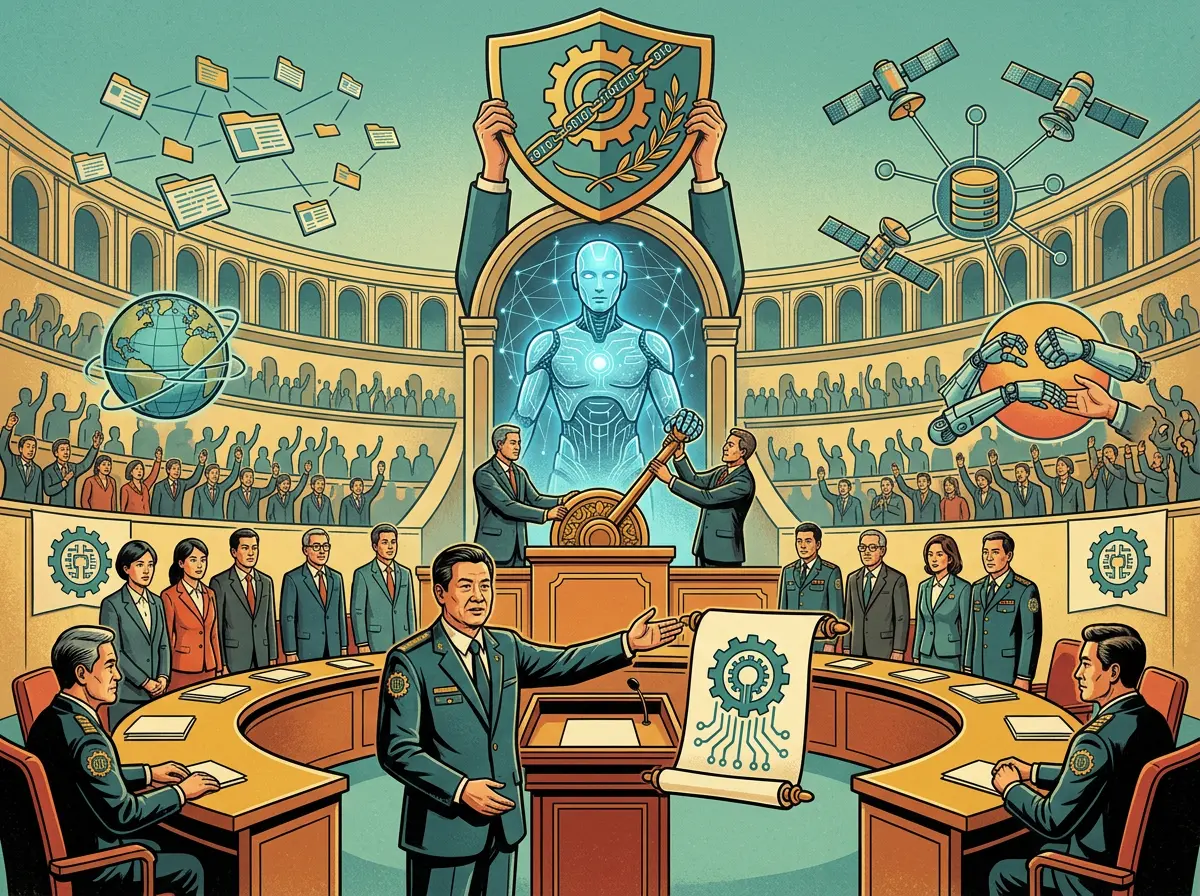
According to CryptoCity on May 22, Taiwan’s Premier Cho Jung-tai announced on Thursday after the Executive Yuan meeting where he heard a report on the “Implementation Plan for the AI Basic Act,” that the Executive Yuan will establish a “Special Committee on the AI Strategy,” with the Premier serving as convener to comprehensively coordinate, promote, and oversee Taiwan’s AI-related affairs.
Taiwan AI Risk Management Timeline: Assessment Deadline in July, Industry Standards to Be Built Before 2028
All Taiwan government agencies must complete risk assessments for the use of public-service AI by July 2026, and within 1 year establish internal control and management regulations. The Ministry of Digital Development is responsible for advancing the “AI Risk Classification Framework,” validating tools, and data governance systems. Executive Yuan spokesperson Li Hui-chih said the AI risk classification framework has been submitted to the Executive Yuan and is expected to complete review soon before being formally announced; the deputy minister of the Ministry of Digital Development, Hou Yi-hsiu, said the related framework has referenced the European Union AI Act’s direction for identifying high-risk AI and international standards.
Under the provisions of the “AI Basic Act,” each competent authority for its respective industries must, by January 2028, establish AI risk management regulations, industry guidelines, and legal/regulatory adjustment measures for the industries under its supervision. Future high-risk AI applications will be required to clearly display warning notices and establish responsibility allocation and remedy and compensation mechanisms. After the “AI Basic Act” takes effect, a 2-year legal/regulatory adjustment period will be launched.
AI Talent Ark Program: Education Guidance and Public Servant AI Competency Standards
The Executive Yuan is also simultaneously promoting the “AI Talent Ark Program.” The three key focuses are: building an AI learning environment, cultivating AI interdisciplinary teaching talent, and strengthening data-driven decision-making capabilities. The Ministry of Education will publish AI usage and learning guidance by July 2026 to establish students’ and teachers’ capabilities for “responsible use of AI.” The National Civil Service Administration and the Ministry of Digital Development are expected to launch the “Guidelines for Recognizing AI Public-Service Talent” in June 2026; AI talent recognition guidelines version 3.0 has added two capability items: “AI governance literacy” and “AI collaboration and development.”
Taiwan’s Special Committee on the AI Strategy: Member Composition and Scope of Functions
Cai Miao-tzu, Director of the National Science and Technology Council (NSTC) Forward-looking and Applied Technology Department, said the members of Taiwan’s Special Committee on the AI Strategy will include representatives from Taiwan’s various ministries and commissions, local government agencies, scholars and experts, civil society organizations, and industry—promoting AI policies and industry development through cross-industry collaboration. Cho Jung-tai also emphasized that while Taiwan promotes AI development, it must simultaneously address issues such as child and youth protection, human rights, and gender impact; the Ministry of Digital Development has completed phase-based impact assessments together with the NSTC, the Ministry of Education, and the Ministry of Health and Welfare, and the related reports have been released to the public.
Common Questions
When will the “AI Basic Act” officially take effect, and how long is the regulatory adjustment period?
Taiwan’s “AI Basic Act” was officially promulgated and took effect on January 14, 2026. This is Taiwan’s first AI basic law. After its implementation, a 2-year regulatory adjustment period will be launched, led by the NSTC to完善 data governance mechanisms and an environment for industry self-discipline.
What are the specific timelines for AI risk management across Taiwan’s government agencies?
All Taiwan government agencies must complete risk assessments for the use of public-service AI by July 2026, and within 1 year establish internal control and management regulations. Each competent authority for its respective industries must establish AI risk management regulations and industry guidelines for the industries under its supervision by January 2028. The AI risk classification framework has been submitted to the Executive Yuan and will be formally announced after review.
What are the main contents and timeline of the “AI Talent Ark Program”?
The program’s three key focuses are building an AI learning environment, cultivating AI interdisciplinary teaching talent, and strengthening data-driven decision-making capabilities. The Ministry of Education will announce AI usage and learning guidance by July 2026; the National Civil Service Administration and the Ministry of Digital Development will release the “Guidelines for Recognizing AI Public-Service Talent” in June 2026, adding indicators for AI governance literacy and AI collaboration and development capabilities.


