The European Parliament voted on July 9 to extend the "chat monitoring" transitional rules, with a result of 314 votes against, 276 votes in favor, and 17 abstentions. The approved transitional rules will last until April 3, 2028, covering platforms such as Instagram, Discord, Snapchat, Skype, Xbox private messages, and Gmail and iCloud email accounts being re-included in the scanning list.
314 votes against exceeds the 276 votes in favor, with a 47-vote margin below the veto threshold allowing the rules to technically pass
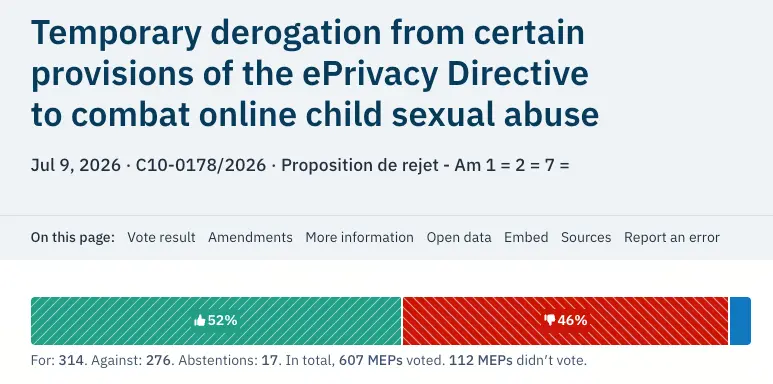 (Source: EU How They Vote platform)
According to reports, the European Parliament’s vote on July 9 resulted in 314 votes against, 276 in favor, and 17 abstentions; under parliamentary rules, rejecting a bill requires an absolute majority of 361 votes. Since the opposition only received 314 votes, 47 votes short of the threshold, the rules passed technically on procedural grounds.
The European People's Party (EPP) used an emergency procedure to bring this matter back to the agenda before the vote, after Chat Control had already been rejected twice by the European Parliament in March this year.
Former European Parliament member and digital rights activist Patrick Breyer stated: "For Chat Control to move forward despite the majority of lawmakers opposing it is a farce and a blow to democracy. The real losers are our children."
Instagram, Discord, Snapchat, Gmail, and others re-included in the scanning list
According to reports, the approved transitional rules include the following US tech services in the "no court order or prior suspicion required" scanning list:
Private messaging services: Instagram, Discord, Snapchat, Skype, Xbox
Email services: Gmail, iCloud
Duration: Until April 3, 2028, or until a permanent regulation agreement is reached
Exceptions: End-to-end encrypted services (such as WhatsApp) receive a symbolic exemption, but this is an acknowledgment of technical reality rather than a policy concession, as service providers cannot scan end-to-end encrypted content.
Communication and email providers within Europe have never been required to implement Chat Control.
EU Commission data: 48% of reports lack criminal relevance; indiscriminate scanning does not increase convictions
According to the EU Commission’s own report, six figures point to the same conclusion—that large-scale scanning does not effectively protect children:
- Since 2022, suspicious abuse reports from the US have decreased by 50%;
- In 2024, large-scale private message scanning accounts for only 36% of all abuse reports, with most clues coming from public posts and cloud storage;
- Germany’s Federal Criminal Police Office (BKA) found that 48% of reports lack criminal relevance;
- In ongoing investigations, 40% of targets are minors themselves;
- About 99% of reports generated by Meta are repetitive hits of known material, offering limited help in stopping ongoing abuse;
- The EU Commission admits there is no evidence that indiscriminate scanning increases convictions or rescues more children.
Chat Control 2.0 negotiations to restart in September, EU Parliament demands targeted warrants for suspects
According to reports, the transitional rules are only extended until 2028, with negotiations on the permanent "CSAM Regulation" (Chat Control 2.0) set to resume in September 2026. The European Parliament’s conditions for negotiations include: warrants must target actual suspects (not universal scanning); the establishment of an EU Child Protection Center responsible for removing known material; and communication software must adopt "Security-by-Design" standards.
Privacy advocate Alexander Hanff stated: "Chat Control was not created to protect children; it’s about big tech companies like Meta and Google wanting access to our data, and states expanding mass surveillance."
Frequently Asked Questions
How did the European Parliament’s vote result allow chat monitoring to pass despite more votes against?
Reports indicate that on July 9, the vote was 314 against, 276 in favor. Although more votes were against, parliamentary rules require an absolute majority of 361 votes to reject a bill. Since the opposition fell short by 47 votes, the rules technically allowed the measures to pass on procedural grounds.
Which platforms and services are included in the chat monitoring scanning list?
Reportedly, the services included are: private messages on Instagram, Discord, Snapchat, Skype, Xbox, and email accounts on Gmail and iCloud. Scanning does not require a court order or prior suspicion. End-to-end encrypted services like WhatsApp receive a symbolic exemption, valid until April 3, 2028.
How does the EU Commission evaluate the effectiveness of indiscriminate scanning?
According to the EU Commission’s own report: 48% of reports lack criminal relevance; 40% of investigations target minors themselves; about 99% of reports from Meta are repetitive hits of known material. The Commission admits there is no evidence that indiscriminate scanning increases convictions or rescues more children.


