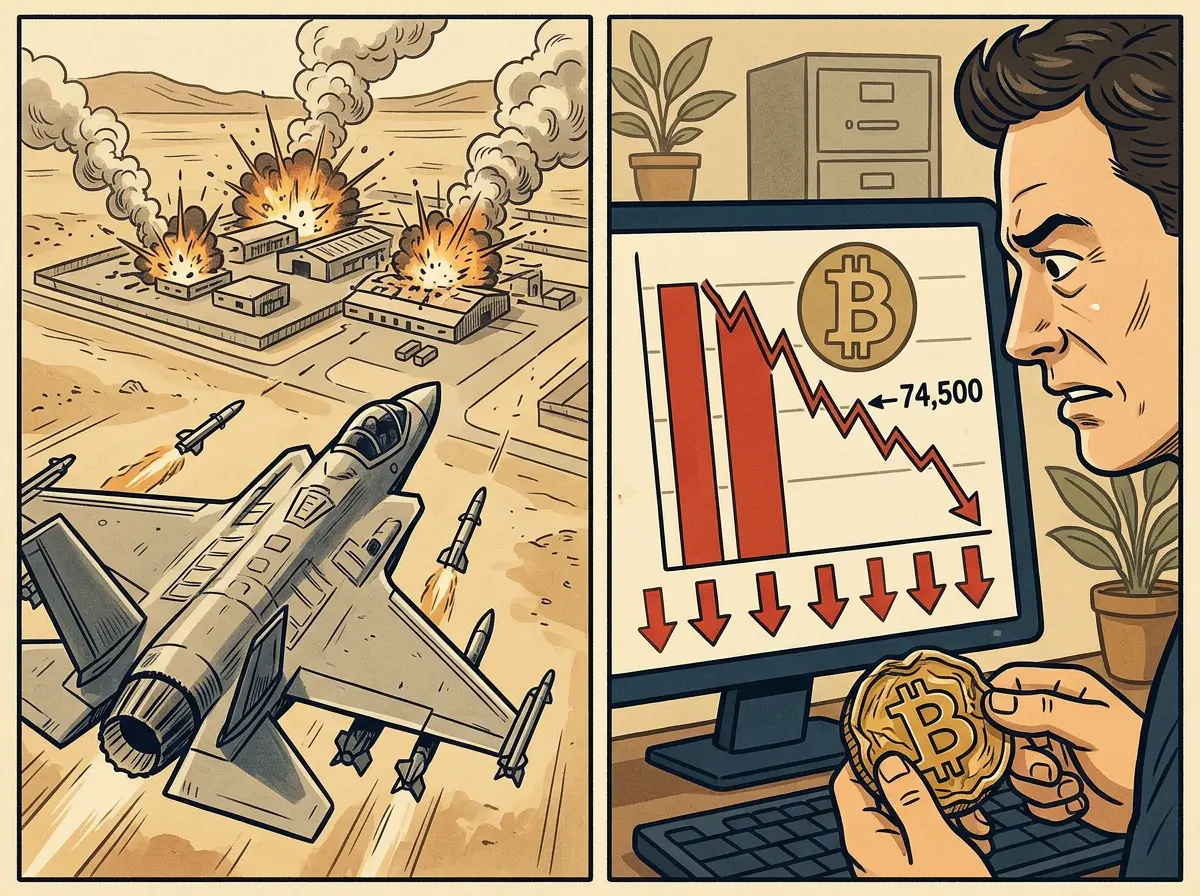
On May 28, Bitcoin fell by about 2.8%, touching a weekly low of $74,530. Reuters reported that a U.S. official, who requested anonymity, said that the U.S. military launched a new round of strikes overnight on Wednesday against an Iranian military base, which the authorities have officially identified as posing a threat to U.S. forces and commercial shipping through the Strait of Hormuz. The U.S. military also intercepted and shot down multiple Iranian drones. In the same period, on-chain data showed that multiple Bitcoin wallets that had been dormant for more than 12 years began moving funds.
U.S. Military Strike Details Against Iran Confirmed by Reuters and Oil Price Market Reaction
Reuters confirmed that this U.S. military strike, which had not been previously disclosed, took place during peace negotiations aimed at ending the three-month conflict between the U.S. and Iran. Since the joint U.S.-Israeli strike on February 28, 2026, the conflict has resulted in thousands of deaths and has significantly pushed up global energy prices. The most recent “defensive” strike by the U.S. occurred on Monday; targets included ships attempting to lay sea mines and missile launch sites. Iran said the action violated the fragile ceasefire between the two sides.
U.S. President Donald Trump publicly dismissed reports from Iranian state media about “Iran and Oman jointly managing Strait of Hormuz shipping” on Wednesday, confirming that the waterway will remain open. Analysts confirmed that around one-fifth of the world’s oil transport needs to pass through the Strait of Hormuz, and any event that affects its passage will have a direct impact on global energy supplies.
Around $74,500 for Bitcoin: On-Chain Data Confirming Dormant Wallets
On-chain data detected by btcparser.com confirmed that an old version P2PKH wallet established on January 4, 2014, transferred 103.96 BTC at block height 951160 on May 26, its first transaction in 12 years. The funds were first moved to another old version P2PKH address, and were then split into two transactions, with at least 53.96 BTC ultimately sent to the Coinbase exchange. On January 4, 2014, the price of Bitcoin was $823; as of May 28, it was about $75,256, corresponding to a realized return on holdings of approximately 9,044%. Blockchair gave the privacy score for that 2014 wallet as 45 points.
In the same week, two other P2PKH wallets established in 2016 and 2017 respectively transferred 21.85 BTC and 24.99 BTC. Blockchair’s privacy scores for both were 55 points, and the on-chain characteristics were closer to wallet consolidation rather than immediate selling. Earlier in this week, five 2014 wallets together moved 964.85 BTC. Bitcoin is currently about 40% below the all-time high of $126,000 reached in October 2025.
Frequently Asked Questions
In what kind of negotiation context did this U.S. military strike take place?
Based on Reuters’ confirmation report, the strike occurred during U.S.-Iran peace negotiations, aimed at ending the conflict that has lasted three months since the joint U.S.-Israeli strike on February 28, 2026. The conflict has resulted in thousands of deaths and has pushed up global energy prices. On the same day, Trump confirmed that the Strait of Hormuz will remain open.
Does the transfer of 53.96 BTC to Coinbase confirm that it was a sell-off?
According to a report by Bitcoin.com News, the transfer of 53.96 BTC to Coinbase makes the related transfer “more likely to be a sale rather than consolidation,” but this is an analytical inference rather than a confirmed realized sale. On-chain data only confirms that these bitcoins reached the Coinbase address; the exchange’s actual disposal method was not separately disclosed by on-chain data.
What confirmed link is there between dormant wallets waking up and Bitcoin’s price drop?
According to Bitcoin.com News, the movement of dormant wallets appeared in sync with Bitcoin’s weekly drop to $74,530. Multiple wallets dormant for 10 to 12 years began moving funds between May 26 and 27, but on-chain data cannot confirm whether the moves were triggered by the price drop, or driven by independent wallet management decisions.


