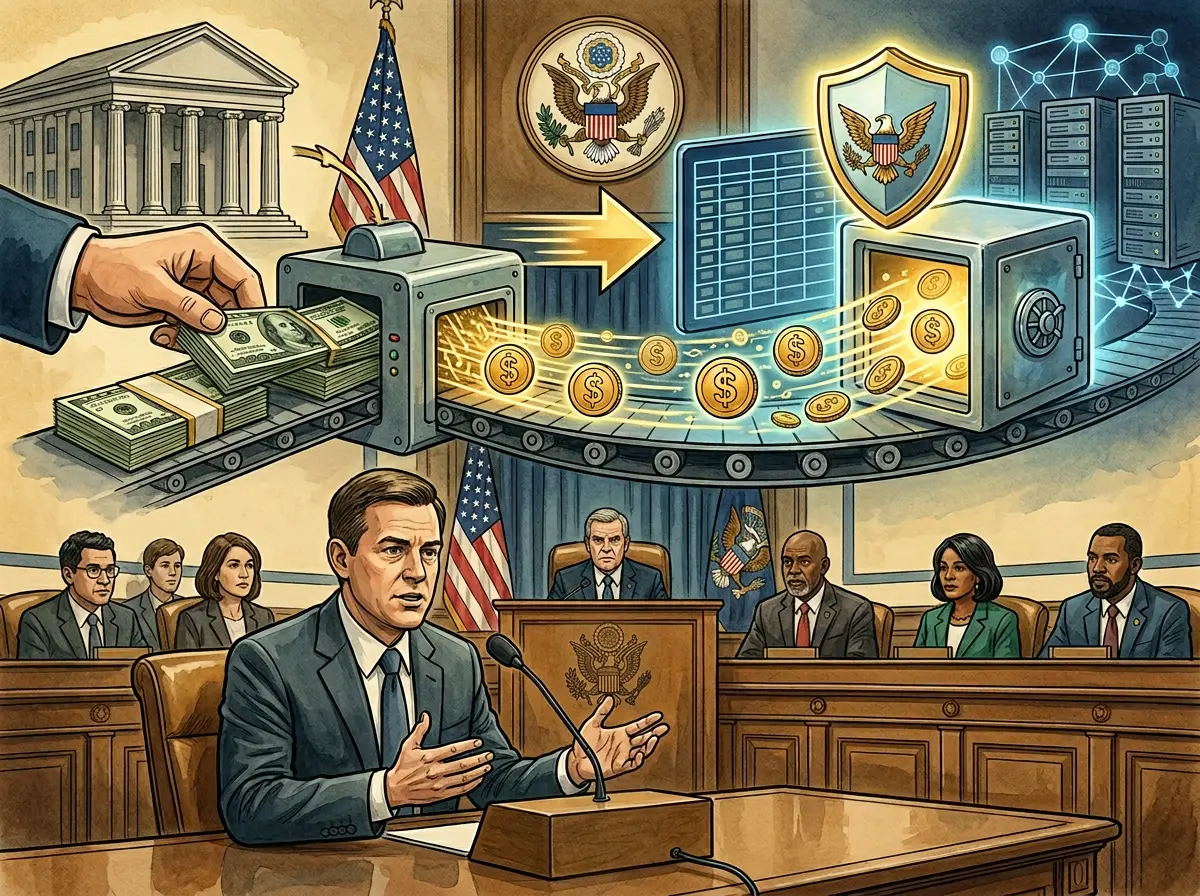
According to CryptoCity on June 11, former senior FDIC (Federal Deposit Insurance Corporation, U.S.) executive Alexandra Steinberg Barrage confirmed at a U.S. House hearing in late May that U.S. banks are rapidly partnering with FinTech companies to expand their布局 for crypto and blockchain services. Tokenized deposits have become a core strategic direction for large banks.
Three Key Crypto Deployment Priorities for Banks Confirmed at the Hearing
At the hearing, Barrage confirmed that the directions currently most emphasized by U.S. banks span three aspects:
Digital asset custody: Banks establish digital-asset custody capabilities through third-party FinTech service providers. Some institutions have already built partnerships with crypto exchanges, enabling customers to buy, sell, and hold cryptocurrencies directly through their bank relationship.
On-chain financial activity: Banks are incorporating crypto services into existing financial product frameworks rather than treating them as standalone, high-risk markets. Barrage confirmed that this model is similar to the Banking-as-a-Service (BaaS) architecture that has gained momentum in recent years.
AI technology integration: Barrage confirmed AI as a top integration priority in the digital transformation of traditional financial institutions, standing alongside crypto and blockchain services.
Definition and Tested Status of Tokenized Deposits
Barrage confirmed the definition of tokenized deposits: converting commercial bank deposits into digital form on the blockchain, so that funds can circulate and settle instantly on-chain while maintaining the bank’s supervisory and regulatory framework. She said tokenized deposits are more likely to be accepted by regulators than crypto financial models that operate outside the banking system.
She said that multiple major financial institutions have begun testing the related technologies, but specific institution names and the progress of technology deployment were not further disclosed by Barrage at the hearing.
Division of Roles Between Banks and FinTech: Cooperation Model Confirmed at the Hearing
Barrage confirmed the current division of responsibilities: FinTech companies handle custody, clearing, compliance, and on-chain technology; banks handle supervision, risk controls, and customer relationship management. Through this division, banks can accelerate the rollout of digital asset services without having to bear excessively high technology and compliance costs themselves.
Stance of Smaller and Medium-Sized Banks: Cautious Attitude Continues
Barrage confirmed that U.S. smaller and medium-sized banks and community banks remain relatively cautious for now. She said that after banking stress events in 2023 and 2024, some smaller financial institutions have become more conservative in their approach to FinTech partnerships, with concerns mainly concentrated on the regulatory and risk-management dimensions. She also confirmed that the number of community banks investing in crypto and FinTech partnerships has clearly declined over the past few years, but she pointed out that small banks with sufficient internal expertise and risk-control frameworks still have the ability to effectively manage such collaborations.
Frequently Asked Questions
How are tokenized deposits different from stablecoins like USDC and USDT?
Tokenized deposits convert commercial bank deposits into an on-chain digital form and still operate within the bank’s regulatory framework. The depositor’s funds remain the bank’s liabilities. USDC and USDT are independent issued stablecoins backed by reserve assets held by the issuers. At the hearing, Barrage confirmed that tokenized deposits have an advantage in regulator acceptance due to maintaining the bank supervision framework.
What is the institutional background of this hearing, and what position does Barrage’s statement represent?
The hearing was hosted by the U.S. House Committee on Subcommittee on Digital Assets, Financial Technology, and Artificial Intelligence. Barrage attended in her personal capacity as a former FDIC senior executive. Her remarks represent her personal views on observations of regulatory trends, not the official position of the FDIC or any regulator.
At what stage are tokenized deposit tests in the U.S. banking industry currently?
At the late-May hearing, Barrage confirmed that multiple large financial institutions are conducting technical tests, but she did not disclose specific institution names or deployment timelines. Her remarks are an observational description, not an official policy announcement or an institutional statement.


