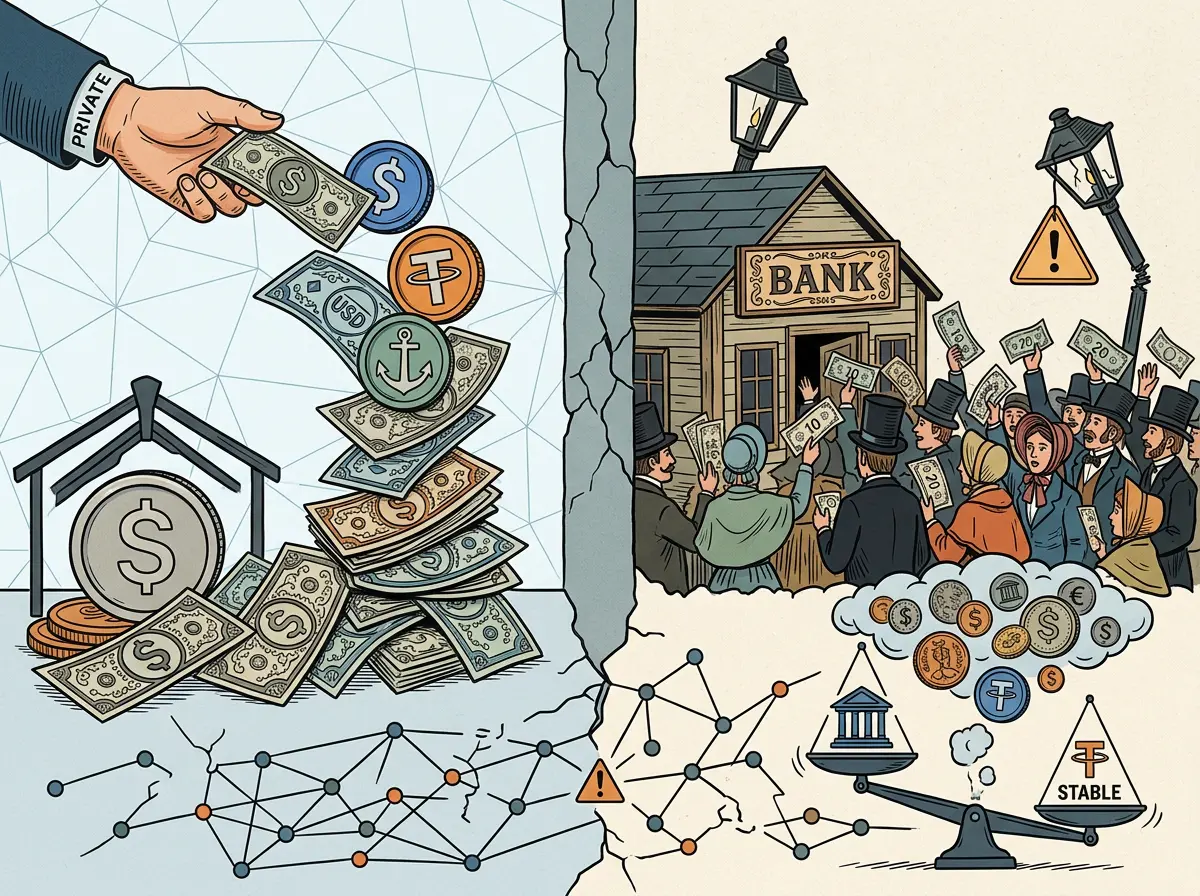
The Wall Street Journal (WSJ) published an analysis on May 26 stating that, although the GENIUS Act has been signed into law and the CLARITY Act is under review in the U.S. Senate, the nature of stablecoins still remains a form of “private money,” which could pose structural risks to the financial system. Chainalysis data shows that stablecoins account for 84% of illicit cryptocurrency activity (mainly involving sanctions evasion and money laundering).
WSJ’s core analysis: stablecoins lack the “single-ness” of the dollar
In the article, WSJ points out that a basic property of money is “single-ness”—no matter when or where, one dollar must equal one dollar. Bank deposits have this single-ness because they can be redeemed through Federal Reserve borrowings; stablecoins, however, operate on their own independent decentralized infrastructure and do not have this attribute. Even though USDT and USDC are pegged to the dollar, their prices may still deviate from $1. WSJ cites BIS Chief Executive Officer Pablo Hernández de Cos as saying: “Stablecoins try to borrow credibility from public money, yet they remain outside the established settlement system.” WSJ believes stablecoins are replaying the path of private money from 19th-century America’s “free banking era” (1837 to 1863), when individual banks could issue their own currency, but the system was fragmented, fraud was common, and the value of different currencies fluctuated against each other.
The scope of the current regulatory framework and confirmation gaps
Federal Reserve Governor Michael Barr previously said that the GENIUS Act has gaps: bank deposits may be uninsured; and stablecoins can receive funds through “repurchase” loans, including foreign capital (which may cover the use case acknowledged by El Salvador for bitcoin). The GENIUS Act does not cover cryptocurrencies operating outside the United States, so Tether’s USDT is therefore not directly within the scope, even though Tether has launched a U.S.-compliant version of USAT. Japan has a carefully designed regulatory framework for crypto, but the market value of yen stablecoins is less than 0.01% of dollar stablecoins (de Cos pointed out).
Data foundation: Chainalysis 84% and research from the Federal Reserve Bank of Kansas City
Chainalysis data shows that stablecoins account for 84% of all illicit cryptocurrency activity, mainly involving sanctions evasion and money laundering; trading cryptocurrencies remains the primary use case for stablecoins. The research conclusion from the Federal Reserve Bank of Kansas City is that the proportion of stablecoins used for payments in the real economy is less than 1%. WSJ notes that the vast majority of stablecoins are pegged to the U.S. dollar and that most are held outside the United States, usually to avoid legal or capital controls.
Frequently asked questions
Has the GENIUS Act resolved the main risks of stablecoins?
The GENIUS Act has been signed into law and requires U.S. stablecoins to be backed by safe, liquid assets (such as Treasury bills and bank deposits). Federal Reserve Governor Michael Barr said the bill has gaps, including the possibility that bank deposits may be uninsured. WSJ says no legislation can fully eliminate the risks inherent to stablecoin design itself.
Is Tether’s USDT regulated by the GENIUS Act?
The GENIUS Act does not cover cryptocurrencies operating outside the United States, and Tether’s USDT is mainly operated outside the United States, so it is not within the bill’s direct scope. Tether has launched a version—USAT—that complies with U.S. regulations, but USDT itself is not regulated by this bill.
What exactly does Chainalysis mean by “stablecoins account for 84% of illicit activity”?
Based on Chainalysis data, stablecoins (rather than other cryptocurrencies) account for 84% of all illicit cryptocurrency activity, mainly involving sanctions evasion and money laundering. This is the statistical data WSJ uses to argue that stablecoins still have limitations in compliant application scenarios; the specific methodology should follow Chainalysis’s original report.


