




# BTCProbes60KKeySupportLevel

67.13M

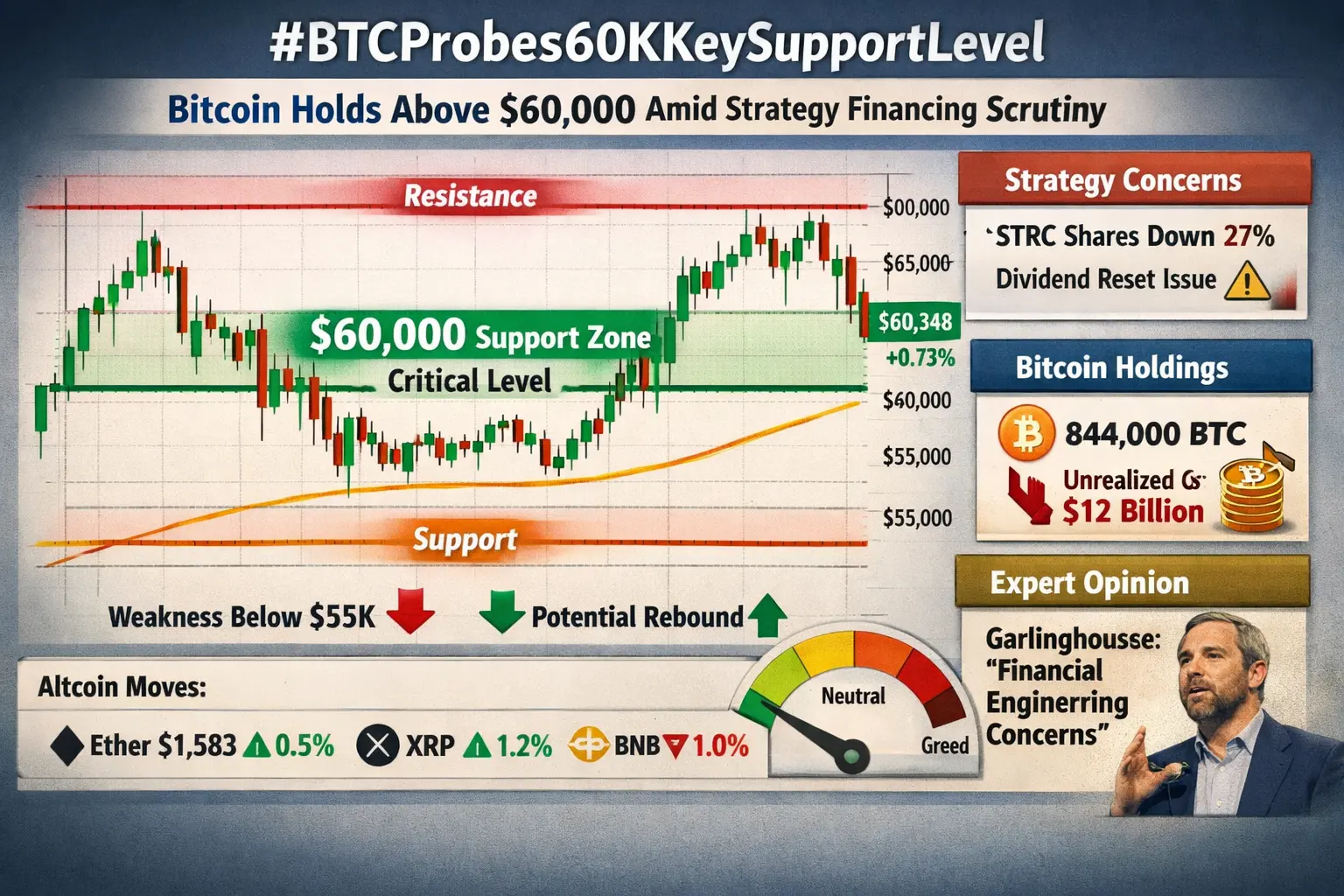
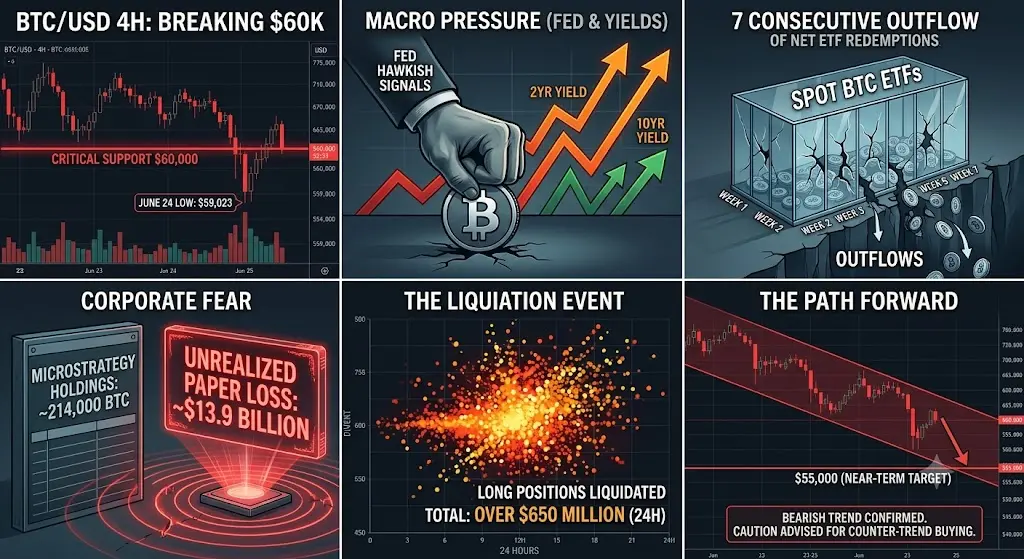
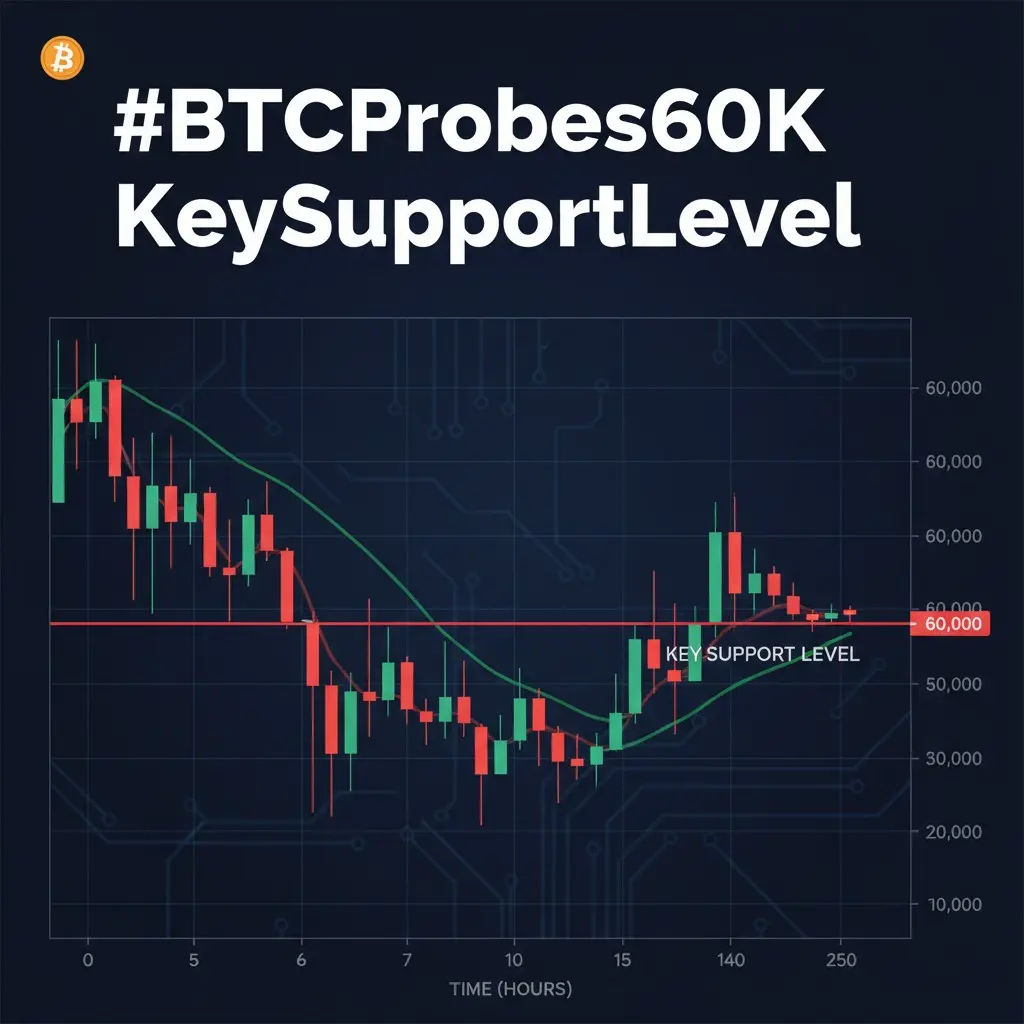
On June 24, Bitcoin broke below the $60,000 level, hitting a low of $59,023 — its lowest since October 2024. The selloff is driven by multiple headwinds: hawkish Fed signals strengthening rate hike expectations, rising Treasury yields pressuring risk assets, seven consecutive weeks of ETF outflows, and Strategy's ~$13.9 billion paper loss on its BTC holdings fueling market fear. The $60,000 level is a critical near-term support — a breakdown could open the door to $55,000. Over $650 million in long positions were liquidated, with the bearish trend firmly in place. Caution is advised for counter-trend buying attempts.

#BTCProbes60KKeySupportLevel
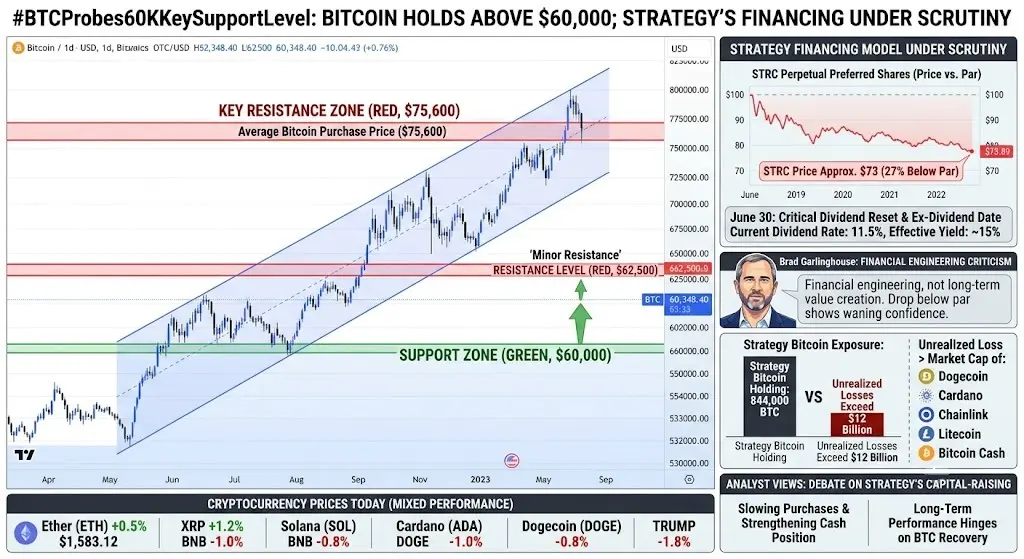
Bitcoin holds above $60,000; Strategy’s financing model under scrutiny
Bitcoin continued to hold above the $60,000 level on Saturday. Broader cryptocurrency markets maintained their upward momentum as investors weighed growing concerns regarding Strategy’s Bitcoin accumulation strategy ahead of a critical dividend reset.
Bitcoin was trading at $60,348.40, up 0.73%, maintaining its position above the psychologically significant $60,000 mark. Market attention is largely focused on June 30, the date when Strategy’s STRC perpetual preferred shares will trade ex-divide
BTC0.53%
XRP0.09%
DOGE-1.18%
post-image
post-image
  • Reward
  • 2
  • Repost
  • Share
ThisIsTranslateContent::
Just go for it 👊
View More
#BTCProbes60KKeySupportLevel
Bitcoin Market Analysis (June 28, 2026)
Current Market Overview
Bitcoin is currently trading around $60,780, recovering slightly after defending the critical $60,000 psychological support. During the past 24 hours, BTC has traded between approximately $59,550 and $60,940, showing that buyers are attempting to stabilize price above a key technical level. While the short-term rebound is encouraging, the broader market structure remains cautious after several weeks of downside pressure.
Trend Analysis
The daily trend remains bearish to neutral. Bitcoin is still tradi
BTC0.53%
post-image
  • Reward
  • 9
  • Repost
  • Share
ThisIsTranslateContent::
Get in the car quickly! 🚗
View More
#BTCProbes60KKeySupportLevel
₿ 𝗛𝗼𝘄 𝗠𝗮𝗰𝗿𝗼𝗲𝗰𝗼𝗻𝗼𝗺𝗶𝗰 𝗣𝗼𝗹𝗶𝗰𝗶𝗲𝘀, 𝗜𝗻𝘀𝘁𝗶𝘁𝘂𝘁𝗶𝗼𝗻𝗮𝗹 𝗖𝗮𝗽𝗶𝘁𝗮𝗹 𝗙𝗹𝗼𝘄𝘀, 𝗟𝗶𝗾𝘂𝗶𝗱𝗶𝘁𝘆 𝗖𝘆𝗰𝗹𝗲𝘀, 𝗮𝗻𝗱 𝗜𝗻𝘃𝗲𝘀𝘁𝗼𝗿 𝗣𝘀𝘆𝗰𝗵𝗼𝗹𝗼𝗴𝘆 𝗖𝗼𝗻𝘁𝗶𝗻𝘂𝗲 𝘁𝗼 𝗦𝗵𝗮𝗽𝗲 𝗕𝗶𝘁𝗰𝗼𝗶𝗻'𝘀 𝗟𝗼𝗻𝗴-𝗧𝗲𝗿𝗺 𝗠𝗮𝗿𝗸𝗲𝘁 𝗖𝘆𝗰𝗹𝗲
Bitcoin has evolved into far more than a digital asset driven solely by crypto-native events. Its price increasingly reflects the broader macroeconomic environment, where monetary policy, interest rates, global liquidity, institutional participation, and investor sentiment all interact simu
post-image
  • Reward
  • 2
  • Repost
  • Share
HighAmbition:
To The Moon 🌕
View More
#BTCProbes60KKeySupportLevel
Can Bitcoin Turn a Critical Test Into Its Next Breakout?
Bitcoin is once again at a defining point in its market cycle as price action hovers around the closely watched $60,000 support level. This area has become one of the most important technical zones for traders, institutions, and long-term investors alike. Whether buyers successfully defend this level or sellers push prices lower could determine Bitcoin's short-term trajectory and influence sentiment across the broader cryptocurrency market.
Support levels often represent areas where demand has historically o
BTC0.53%
post-image
post-image
  • Reward
  • 2
  • Repost
  • Share
ThisIsTranslateContent::
Get in! 🚗
View More
#BTCProbes60KKeySupportLevel
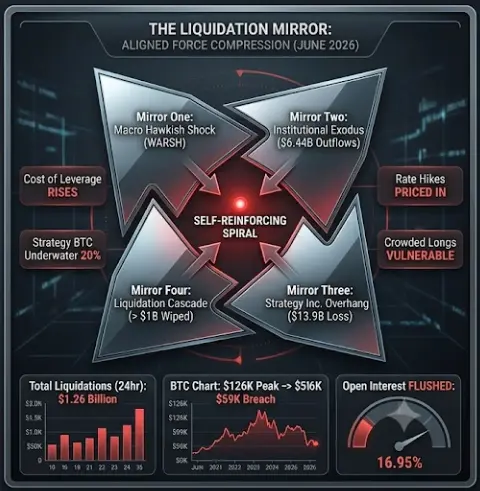
BTC Probes 60K -- The Liquidation Mirror Framework
Bitcoin broke below $60,000 on June 24, hitting $59,023, its lowest since October 2024. From the October 2025 peak of $126,000, BTC has shed over 53%. Over $1 billion in positions were liquidated in 24 hours. The Fear & Greed Index sits at 12 -- Extreme Fear . This is not just a selloff. This is a multi-vector compression, and every trader needs to understand the cognitive trap it creates.
I am calling this the Liquidation Mirror -- a framework that describes what happens when macro, institutional, and psychologic
IBIT1.01%
DOGE-1.18%
post-image
post-image
  • Reward
  • 5
  • Repost
  • Share
ProfitQueen:
To The Moon 🌕
View More
#BTCProbes60KKeySupportLevel
Bitcoin testing the $60,000 level is more than a technical event—it is a psychological battle that could shape market sentiment for the weeks ahead. Round numbers have always carried special significance in financial markets, but in Bitcoin's case, they often become zones where fear, confidence, and liquidity collide.
The recent pullback toward this key support level reflects a market that is searching for direction after a period of heightened volatility. While short-term traders focus on every candle, long-term investors are watching whether Bitcoin can continue
BTC0.53%
post-image
  • Reward
  • 5
  • Repost
  • Share
Falcon_Official:
2026 GOGOGO 👊
View More
Money has been moving fast since April, and by mid-May the direction was hard to miss. Investors pulled cash out of both old-school safety and crypto, and put it straight into chips.
Gold led the early exit. In March, global gold ETFs recorded a record monthly outflow of $12 billion, driven by North American selling as bond yields rose and the dollar strengthened. The pressure did not stop there. Into late spring, precious-metal funds logged a sixth straight week of redemptions, including $545 million in net sales in a single week. f0d989bd
Bitcoin funds followed a similar path, but later. Aft
DRAM-4.91%
post-image
post-image
User_any
Bitcoin&Gold
$BTC $XAUT
Bitcoin is down roughly 31% and gold is off about 6% year-to-date, making them the two worst-performing major asset classes tracked in the dataset . The S&P 500 is up around 9%, small caps have gained 19%, and value stocks are up 15% — pretty much everything is green except these two .
That's the weird part. According to Charlie Bilello's analysis, which tracks annual returns for the last 15 years, Bitcoin and gold have never finished a calendar year as the bottom two performers among major assets . In 2025, gold gained over 60% while Bitcoin had its worst year since 2018 . Now both are getting crushed at the same time.
What does this mean? The narrative around both assets is shifting.
The Safe-Haven Question
Bitcoin and gold are supposed to be hedges, but this year tells a different story. According to Ross Maxwell at VT Markets, Bitcoin's 30-day realized volatility during major conflict periods ranges between 40% and 70%, while gold's stays much lower at 12% to 20% . Bitcoin still trades like a risk asset, not a safe harbor.
Even gold's safe-haven credentials are being questioned. Economist Robin Brooks argues gold now acts like a high-beta asset, with its correlation to the S&P 500 rising above 0.50 in recent months, matching Bitcoin's equity correlation . He attributes this shift partly to retail inflows from the heavily marketed "debasement trade" in late 2025 .
When investors panic, money flows to cash, Treasuries, and AI stocks — not crypto and gold.
What's Driving the Divergence
Bitcoin's Pain:
· ETF outflows hit $1.78 billion this week alone
· 53% of BTC supply is held at unrealized loss
· Down over 50% from its October 2025 peak of $126,080
· Capital rotating toward AI stocks and megacap IPOs like SpaceX
Gold's Sideways Drift:
· Down just 6% YTD, holding near $4,070 after hitting record highs above $5,000 earlier this year
· Still benefiting from central bank buying and geopolitical tensions
· But leveraged selling and ETF outflows have pressured the metal
Where to Next?
The Bitcoin-to-gold ratio tells the story. According to WisdomTree's model, Bitcoin is currently undervalued against gold by about 30% relative to macro conditions like a softer dollar, elevated inflation expectations, and institutional demand flows . The model's fair-value estimate for the BTC/gold ratio is around 21, but the actual ratio sits near 15-16 . That's a meaningful divergence.
Some analysts see this as a signal. The RSI on the Bitcoin-to-gold ratio has dropped below 30, a reading that historically appears only at major cycle lows — 2015, 2018, and 2022 . In each prior case, extreme relative weakness preceded new expansion phases.
But this time could be different. Both assets now have larger institutional footprints, with ETFs and big-money allocators influencing price action. Goldman Sachs data shows hedge fund positions in both Bitcoin and gold continue to be net short .
What this means for you: Both assets are historically cheap relative to the broader market, and the BTC/gold ratio suggests more upside potential in Bitcoin vs. gold if macro conditions hold. But both are also proving they're not the safe havens many assumed — at least not in this cycle. Watch ETF flows, Fed policy, and whether gold's equity correlation stays elevated. That will tell you if this is a buying opportunity or a structural shift.
This is not financial advice. Always do your own research.

repost-content-media
  • Reward
  • 1
  • Repost
  • Share
YamahaBlue:
Diamond Hands 💎
$BTC
The on-chain picture is genuinely remarkable. Long-term holders now control 78.9% to 79% of Bitcoin's circulating supply—an all-time high that dwarfs every previous peak. To put that in perspective, the previous records were 74.5% during the 2022-2023 bottom zone and 71.5% in 2018-2019. And it's still climbing.
At the same time, nearly 11 million BTC are now held at a loss—also a record. But here's the kicker: those underwater coins aren't being sold. Old coin reactivation—dormant BTC moving after long periods of inactivity—stands at just 218,421 BTC year-to-date, the lowest level since
BTC0.53%
User_any
$BTC
The on-chain picture is genuinely remarkable. Long-term holders now control 78.9% to 79% of Bitcoin's circulating supply—an all-time high that dwarfs every previous peak. To put that in perspective, the previous records were 74.5% during the 2022-2023 bottom zone and 71.5% in 2018-2019. And it's still climbing.
At the same time, nearly 11 million BTC are now held at a loss—also a record. But here's the kicker: those underwater coins aren't being sold. Old coin reactivation—dormant BTC moving after long periods of inactivity—stands at just 218,421 BTC year-to-date, the lowest level since 2012. Compare that to 2024, when 1.18 million BTC had been reactivated by June. The conviction holders are literally sitting on their hands.
The Institutional Exodus
On the other side of the ledger, institutional selling has been brutal. Spot Bitcoin ETFs have recorded a cumulative $6 billion to $8 billion in net outflows in 2026. The outflows got so intense that global Bitcoin ETPs posted their first negative one-year flow reading since November 2023. That same signal flashed just weeks before the 2022 cycle bottom.
The selling peaked in early June—a 13-day consecutive outflow streak drained $4.4 billion—but it's been decelerating since. Weekly outflows fell 87% from that peak, dropping from $1.72 billion to roughly $226 million in the most recent full week.
The Divergence That Matters
Here's where it gets interesting. Since June 1, large holders (whales with 10 to 10,000 BTC) have accumulated approximately 270,000 BTC—roughly $20 billion. That's the largest monthly accumulation by any holder class since 2013. The timing is almost too perfect: whales entered accumulation mode right when the ETF outflow streak peaked.
So you've got record ETF selling and record whale buying happening at the same time. The price has followed the sellers so far, dropping from the mid-$70s to around $60,000-$62,000. But as one analyst put it, "the pressure valve is loosening".
What This Setup Means Historically
K33 Research, which tracks this data, says the pattern is consistent with late-stage bear markets. In every prior Bitcoin bear market, supply tilted toward long-term holders as the market approached its trough. The 79% reading is the highest ever recorded and it's spiking rather than flattening.
The critical question: does this resolve as the deepest capitulation in Bitcoin's history (if those conviction holders eventually break), or the tightest supply compression ever recorded heading into the next cycle (if they don't)?
The Technical Reality Right Now
Bitcoin is trading well below its 50-day moving average at $71,160 and its 200-day at $76,360. The RSI sits at 37.3—still in selling pressure territory but not yet deeply oversold. Key support is at $62,500; resistance at $64,700 and $66,500. A sustained move above $66,500 would suggest whale demand is finally overwhelming the remaining ETF selling pressure.
The divergence is real. The question isn't whether the underlying dynamics are shifting. It's whether they've shifted enough to flip the technical regime.
#BTCProbes60KKeySupportLevel
repost-content-media
  • Reward
  • 6
  • Repost
  • Share
MrFlower_Prime:
To The Moon 🌕
View More
#BTCProbes60KKeySupportLevel
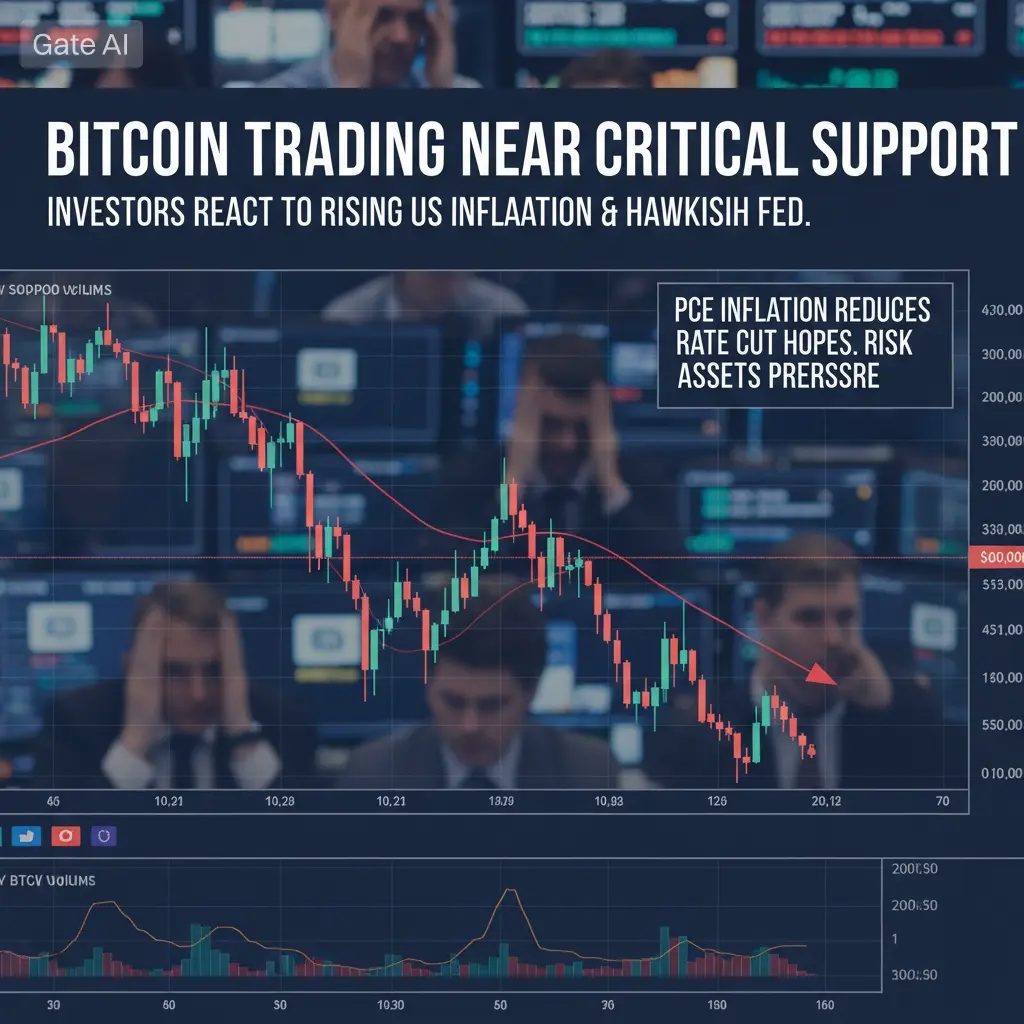
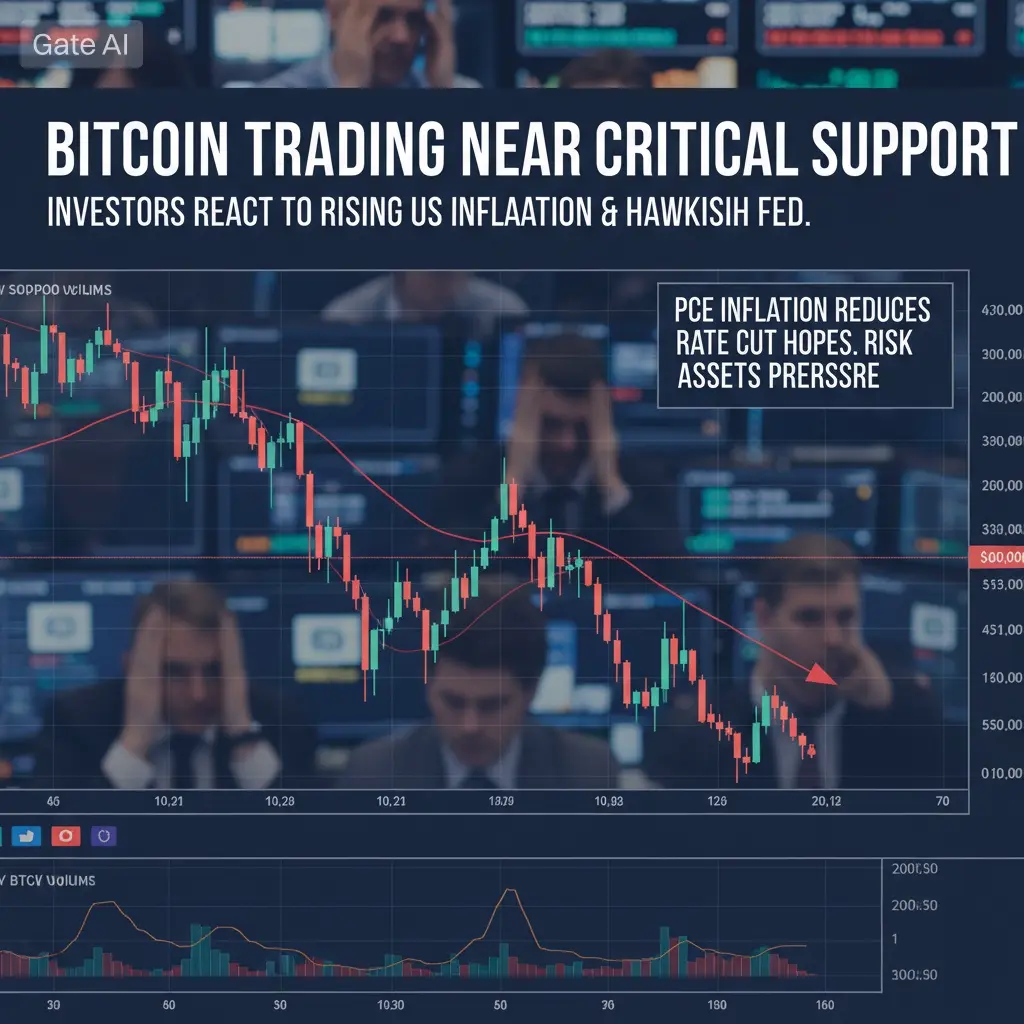
Bitcoin is currently trading at approximately $60,250, a critical juncture that places the world's leading cryptocurrency right at its key psychological support level of $60,000. This price point represents more than just a number; it embodies a battleground where macroeconomic forces, geopolitical developments, and technical market structures converge. Understanding why Bitcoin has declined to these levels requires examining multiple interconnected factors that have created sustained downward pressure on the cryptocurrency market.
The PCE Inflation Data Impact: A
HighAmbition
#BTCProbes60KKeySupportLevel
Bitcoin is currently trading at approximately $60,250, a critical juncture that places the world's leading cryptocurrency right at its key psychological support level of $60,000. This price point represents more than just a number; it embodies a battleground where macroeconomic forces, geopolitical developments, and technical market structures converge. Understanding why Bitcoin has declined to these levels requires examining multiple interconnected factors that have created sustained downward pressure on the cryptocurrency market.
The PCE Inflation Data Impact: A Major Catalyst for Decline
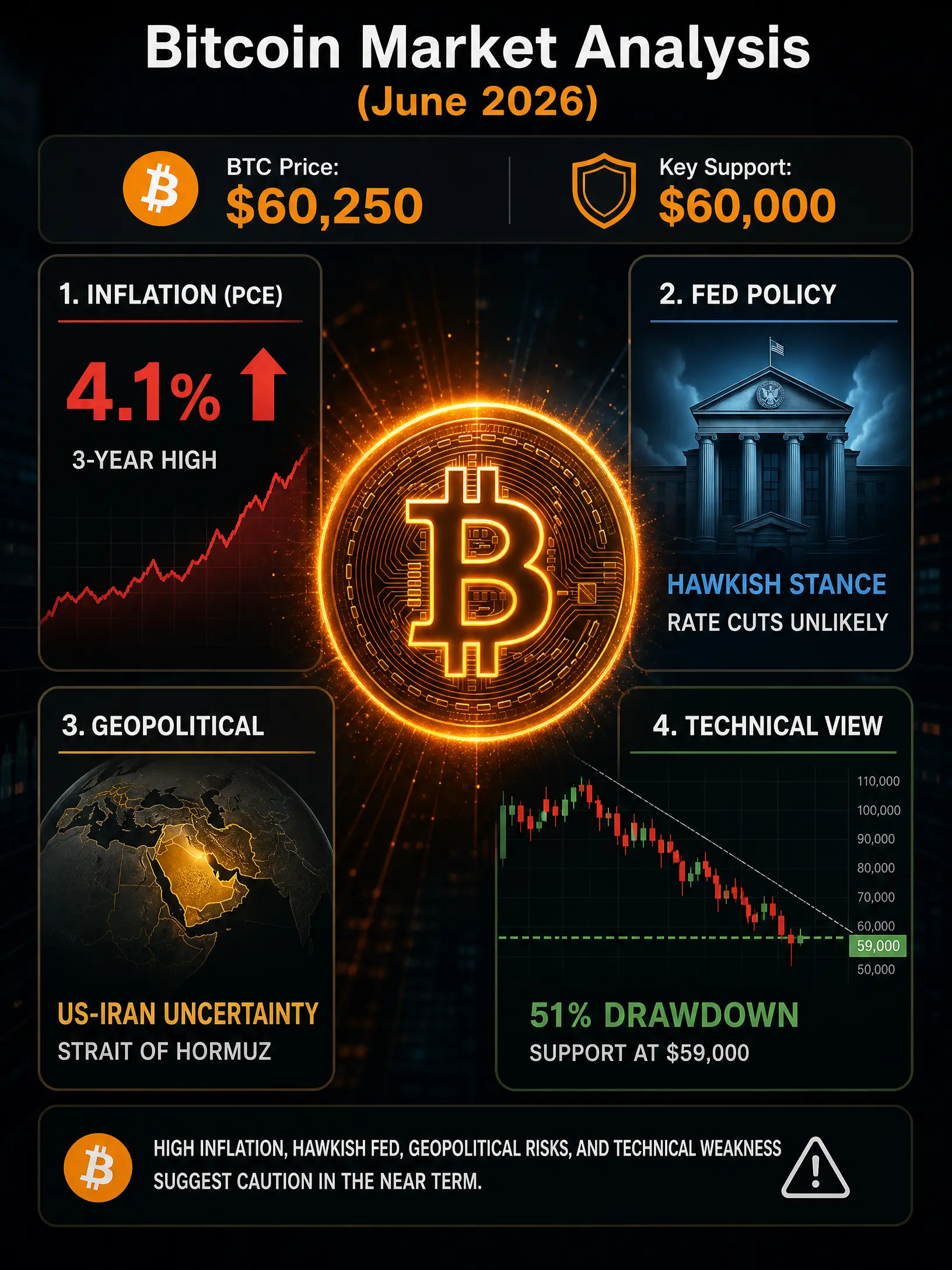
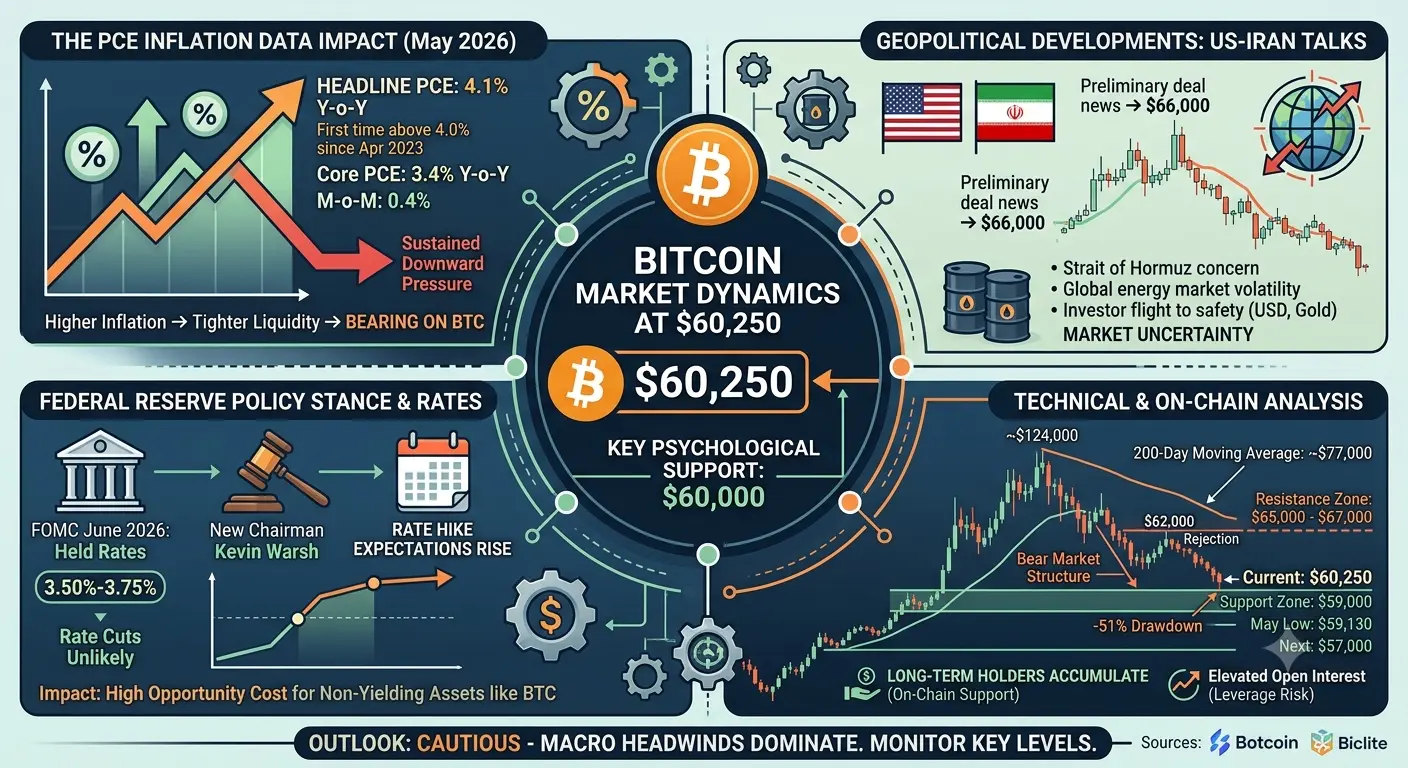
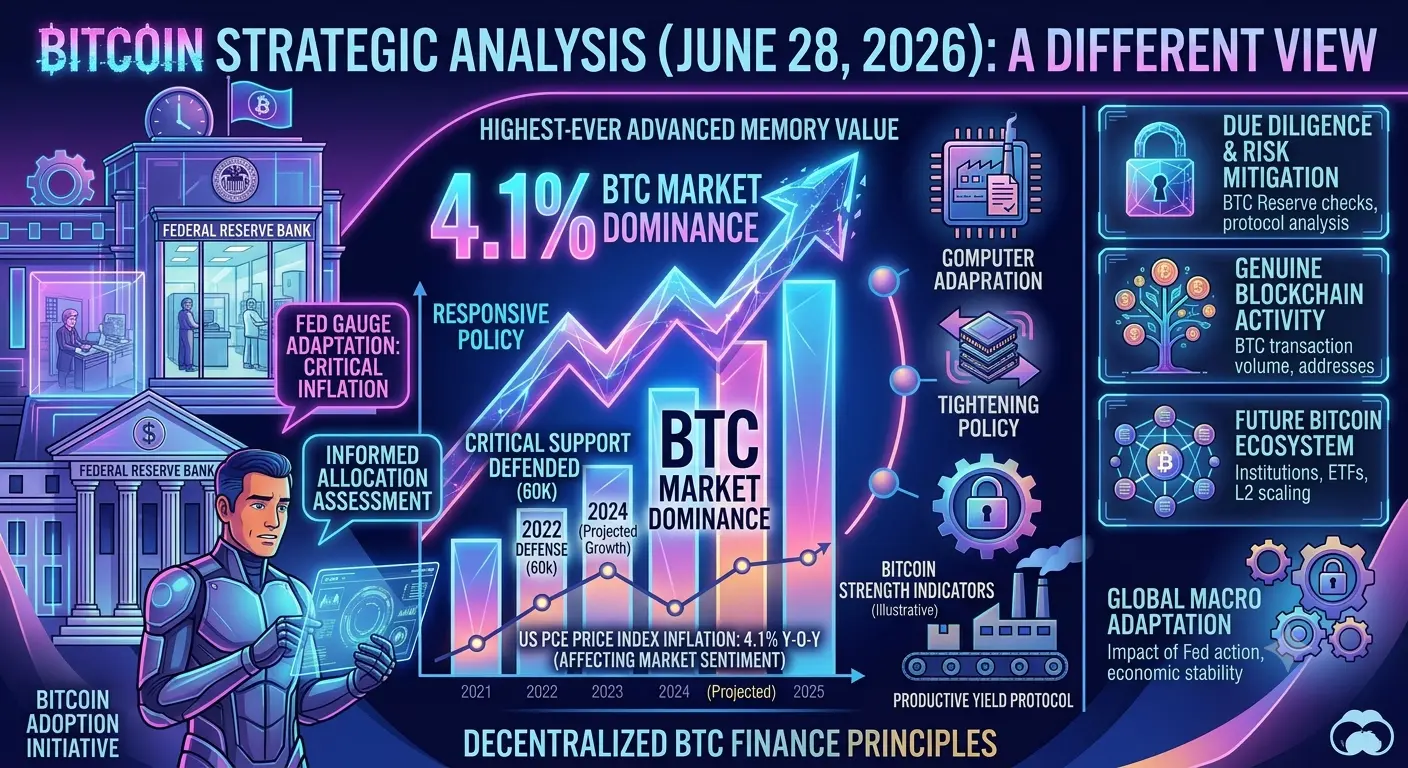
The most significant recent driver of Bitcoin's price weakness has been the Personal Consumption Expenditures (PCE) inflation data released for May 2026. The headline PCE inflation surged to 4.1% year-over-year, marking the first time inflation has broken above the 4.0% threshold in three years since April 2023. This reading was exactly in line with economist expectations but represented a notable acceleration from April's 3.8% figure. On a month-over-month basis, the PCE price index climbed 0.4% in May, matching April's increase and indicating persistent inflationary momentum.
The core PCE inflation, which excludes volatile food and energy components and represents the Federal Reserve's preferred inflation gauge, rose to 3.4% year-over-year in May, up from 3.3% in April. This persistent elevation in core inflation has fundamentally altered market expectations regarding Federal Reserve policy and has created significant headwinds for risk assets including Bitcoin.
When inflation runs hot at 4.1%, it signals that the Federal Reserve's battle against rising prices remains far from complete. Higher inflation erodes purchasing power and typically prompts central banks to maintain restrictive monetary policy, which reduces liquidity in financial markets. For Bitcoin, which thrives in environments of abundant liquidity and loose monetary conditions, this inflationary persistence has been distinctly bearish. The cryptocurrency has historically demonstrated strong sensitivity to real yields and liquidity conditions, making the elevated inflation print particularly damaging to price sentiment.
Federal Reserve Policy Stance: Rate Cut Expectations Diminish
The Federal Reserve's response to this inflationary environment has been equally impactful for Bitcoin's price trajectory. At its June 2026 meeting, the Federal Open Market Committee (FOMC) held interest rates steady in the range of 3.50% to 3.75%, but more importantly, signaled that rate cuts have become increasingly unlikely in the near term. Newly appointed Federal Reserve Chairman Kevin Warsh presided over his first meeting, and the central bank's updated quarterly projections indicated that policymakers now expect to potentially raise borrowing costs this year rather than cutting them.
This shift in policy expectations has been devastating for Bitcoin's price outlook. Markets had previously priced in the possibility of rate cuts that would inject liquidity into the financial system and provide a tailwind for risk assets. Instead, the Fed's hawkish pivot has created an environment where monetary policy remains restrictive. Financial markets are now pricing in approximately only a 30% chance of a rate hike at the July 28-29 meeting, but the September meeting remains very much in play for potential tightening.
The implications for Bitcoin are substantial. Higher interest rates increase the opportunity cost of holding non-yielding assets like Bitcoin, as investors can earn attractive returns in risk-free government securities. Additionally, tighter monetary conditions reduce the speculative capital that typically flows into cryptocurrency markets. The Fed's indication that inflation remains well above its 2% target and that price pressures are not dissipating has created a risk-off environment that has pressured Bitcoin lower.
Geopolitical Developments: US-Iran Talks and Market Uncertainty
Geopolitical factors have added another layer of complexity to Bitcoin's price action. Recent developments in US-Iran relations have created significant market volatility. Reports indicate that high-level diplomatic meetings have been ongoing, with negotiators traveling to Switzerland for discussions regarding Iran's nuclear program and regional de-escalation strategies. While initial reports suggested a potential peace deal that would reopen the Strait of Hormuz, subsequent developments have created uncertainty about the durability of any agreement.
The Strait of Hormuz represents one of the world's most critical oil transit chokepoints, and any disruption to its operations can cause significant volatility in global energy markets. When geopolitical tensions rise, Bitcoin often experiences selling pressure as investors seek safety in traditional safe-haven assets like the US dollar and gold. The ongoing uncertainty regarding US-Iran relations has contributed to risk-off sentiment that has weighed on cryptocurrency prices.
However, it is worth noting that Bitcoin did experience brief rallies on news of potential diplomatic breakthroughs, with prices approaching $66,000 following reports of a preliminary agreement. These moves proved unsustainable as skepticism about the deal's durability emerged, and Bitcoin subsequently retreated to current levels around $60,250. This price action demonstrates that while geopolitical relief can provide temporary bounces, the underlying macroeconomic headwinds remain dominant in determining Bitcoin's price trajectory.
Technical Analysis: The $60,000 Support Level Under Pressure
From a technical perspective, Bitcoin's current price of $60,250 places it at a critically important support level that has been tested multiple times in recent weeks. The $60,000 level represents both psychological significance and technical importance as a key support zone that has historically attracted buying interest. However, the repeated testing of this level raises concerns about its durability.
Multiple technical indicators suggest that Bitcoin is in a precarious position. The cryptocurrency has declined significantly from its recent highs near $124,000, representing a drawdown of approximately 51% from peak to current levels. This magnitude of decline indicates a bear market structure rather than a simple correction. The fact that Bitcoin has repeatedly tested the $60,000 level without mounting a sustained recovery suggests that selling pressure remains dominant.
Key support levels below the current price include the $59,000 zone, which some analysts identify as the true support level rather than $60,000. A breakdown below $59,000 could potentially open the door to much lower levels, with some analysts pointing to $57,000 as the next significant support zone. The May low near $59,130 represents a critical level that, if broken, could accelerate selling pressure and trigger stop-loss orders from leveraged positions.
On the resistance side, Bitcoin faces significant hurdles before any meaningful recovery can take hold. The $62,000 level has already been tested and rejected, and above that, the $65,000 to $67,000 zone represents a major resistance area where significant selling interest is likely to emerge. The 200-day moving average, currently situated near $77,000, represents a long-term trend indicator that Bitcoin would need to reclaim to signal a potential trend reversal.
On-Chain Data and Market Structure
Despite the price weakness, some on-chain metrics suggest that long-term holders continue to accumulate Bitcoin at current levels. This behavior is historically consistent with market bottoms, as sophisticated investors tend to increase positions during periods of fear and capitulation. However, the divergence between price action and on-chain accumulation patterns can persist for extended periods, and this data alone does not guarantee an imminent price recovery.
Open interest in Bitcoin derivatives has remained elevated, suggesting that leveraged positions remain active in the market. This elevated leverage creates the potential for significant volatility in either direction, as forced liquidations can accelerate price moves. Funding rates have remained relatively muted, indicating that aggressive directional bets are not currently dominating the market.
Macroeconomic Context: The Broader Picture
Bitcoin's decline must be understood within the broader context of global macroeconomic conditions. The combination of sticky inflation, restrictive monetary policy, and geopolitical uncertainty has created a challenging environment for risk assets across the board. Traditional equity markets have also experienced volatility, though Bitcoin's decline has been more pronounced due to its higher beta to risk sentiment.
The US dollar has strengthened in this environment, creating additional headwinds for Bitcoin. As the dollar appreciates, dollar-denominated assets like Bitcoin become more expensive for international buyers, reducing demand. Additionally, a stronger dollar typically signals tighter global financial conditions, which reduces the availability of speculative capital.
Outlook and Key Levels to Watch
Looking ahead, several critical factors will determine Bitcoin's price trajectory. The next major catalyst will be upcoming inflation data releases, including the next CPI and PCE reports. If inflation shows signs of cooling, market expectations for Fed policy could shift, potentially providing relief for Bitcoin. Conversely, continued inflationary pressure would likely maintain the current bearish environment.
The July 28-29 Federal Reserve meeting represents another key event risk. While markets currently expect rates to remain unchanged, any shift in the Fed's guidance or rhetoric could significantly impact Bitcoin prices. Chairman Warsh's communication style and policy preferences remain relatively unknown, creating uncertainty about how the central bank might respond to evolving economic conditions.
From a technical perspective, traders should monitor the $59,000 to $60,000 support zone closely. A sustained breakdown below this area could trigger accelerated selling toward $57,000 and potentially lower levels. On the upside, reclaiming $62,000 would be the first step toward a potential recovery, with $65,000 and $67,000 representing major resistance levels that would need to be overcome for a more significant rally to develop.
Conclusion
Bitcoin's current price of $60,250 reflects a confluence of bearish factors including elevated PCE inflation at 4.1%, diminished expectations for Federal Reserve rate cuts, ongoing geopolitical uncertainty surrounding US-Iran relations, and challenging technical market structure. The $60,000 level represents a critical support zone that has been repeatedly tested, and its durability remains uncertain.
Investors should remain cautious in this environment, as the combination of macroeconomic headwinds and technical weakness suggests that further downside risk remains present. However, the presence of long-term holder accumulation and the potential for policy shifts if inflation cools provide reasons to monitor the market closely for signs of a potential bottoming process. The coming weeks will be critical in determining whether Bitcoin can hold its key support levels or whether a more significant decline is in store.
@Gate_Square #BTCProbes60KKeySupportLevel
repost-content-media
  • Reward
  • 2
  • Repost
  • Share
HighAmbition:
Just go for it 👊
View More
#BTCProbes60KKeySupportLevel
Bitcoin is currently trading at approximately $60,250, a critical juncture that places the world's leading cryptocurrency right at its key psychological support level of $60,000. This price point represents more than just a number; it embodies a battleground where macroeconomic forces, geopolitical developments, and technical market structures converge. Understanding why Bitcoin has declined to these levels requires examining multiple interconnected factors that have created sustained downward pressure on the cryptocurrency market.
The PCE Inflation Data Impact: A
post-image
post-image
post-image
  • Reward
  • 30
  • Repost
  • Share
ybaser:
2026 GOGOGO 👊
View More
Load More

Join 40 M users in our growing community

⚡️ Join 40 M users in the crypto craze discussion
💬 Engage with your favorite top creators
👍 See what interests you
  • Pinned