#TradFi交易分享挑战
#FUTU
Futu Holdings Ltd. has become one of the most recognized digital brokerage and fintech platforms in Asia, particularly through its flagship trading platform Moomoo, which continues expanding across international markets including Hong Kong, Singapore, the United States, Australia, Japan, and other fast-growing financial regions. The company operates in the rapidly expanding digital investing industry where retail investors increasingly prefer mobile-first, technology-driven brokerage ecosystems instead of traditional financial institutions.
Unlike conventional brokers that mainly focus on transaction execution, Futu has built a broader ecosystem combining stock trading, options, ETFs, wealth management, market data, community engagement, and financial education into one integrated platform. This has allowed the company to attract younger retail investors who prefer fast, modern, and user-friendly investment infrastructure.
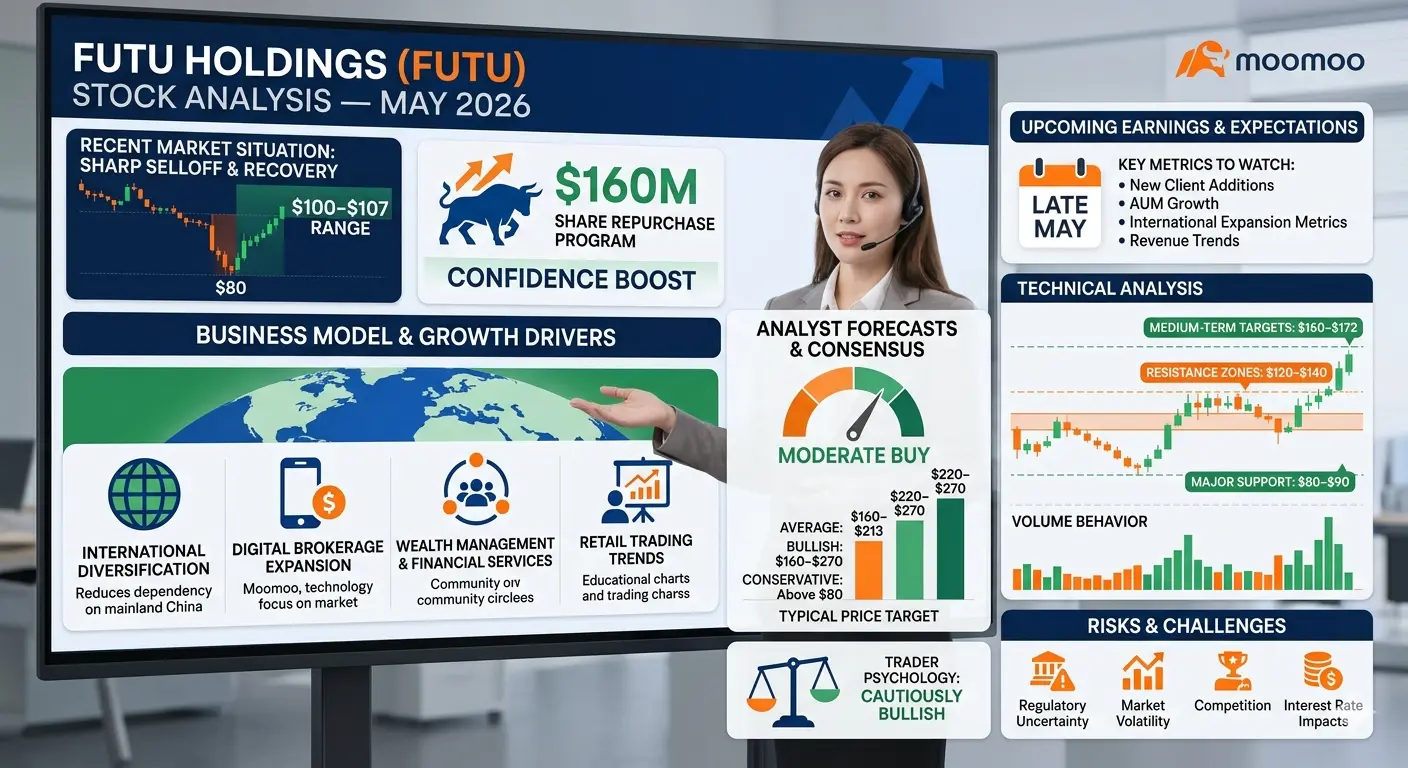
As of late May 2026, FUTU stock is trading around the $100–$107 range, following a dramatic recovery from a sharp selloff that pushed the stock toward approximately $80 lows earlier in the month. The recovery has attracted major market attention because many traders believe the selloff became excessively emotional relative to the company’s underlying international growth trends.
Recent Market Situation — Sharp Selloff and Recovery Phase
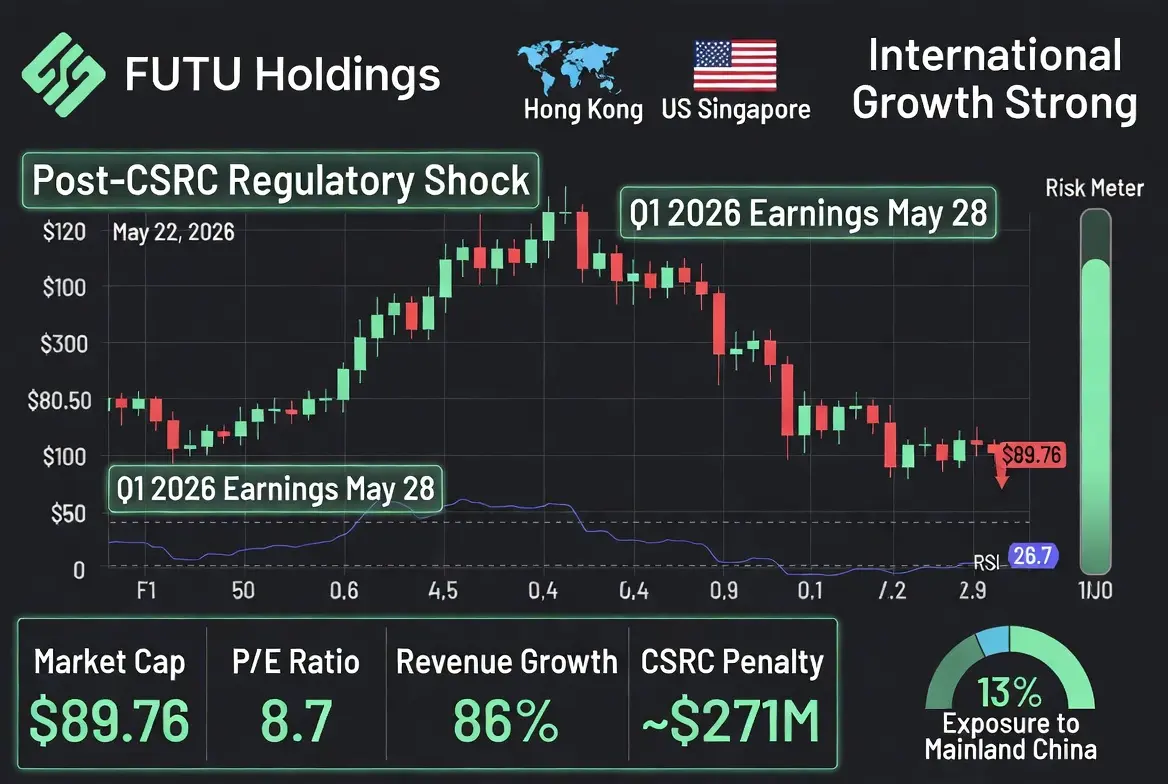
FUTU experienced one of its most volatile periods recently after reports emerged regarding regulatory discussions connected to historical cross-border business activities involving mainland Chinese clients. The market reacted aggressively, triggering a decline exceeding 25–30% within a short period, causing panic selling and large intraday volatility spikes.
The stock temporarily collapsed toward the $80 region, which became a major psychological support zone. However, after the initial panic phase, traders and institutional investors gradually began reassessing the situation more calmly, especially after management emphasized that overseas operations continue functioning normally and that the company has already implemented compliance-focused adjustments.
A major confidence booster came through the announcement of a $160 million share repurchase program, which signaled that management believes the stock had become undervalued following the sharp correction. Buyback announcements often strengthen investor confidence because they show that the company itself sees long-term value at current levels.
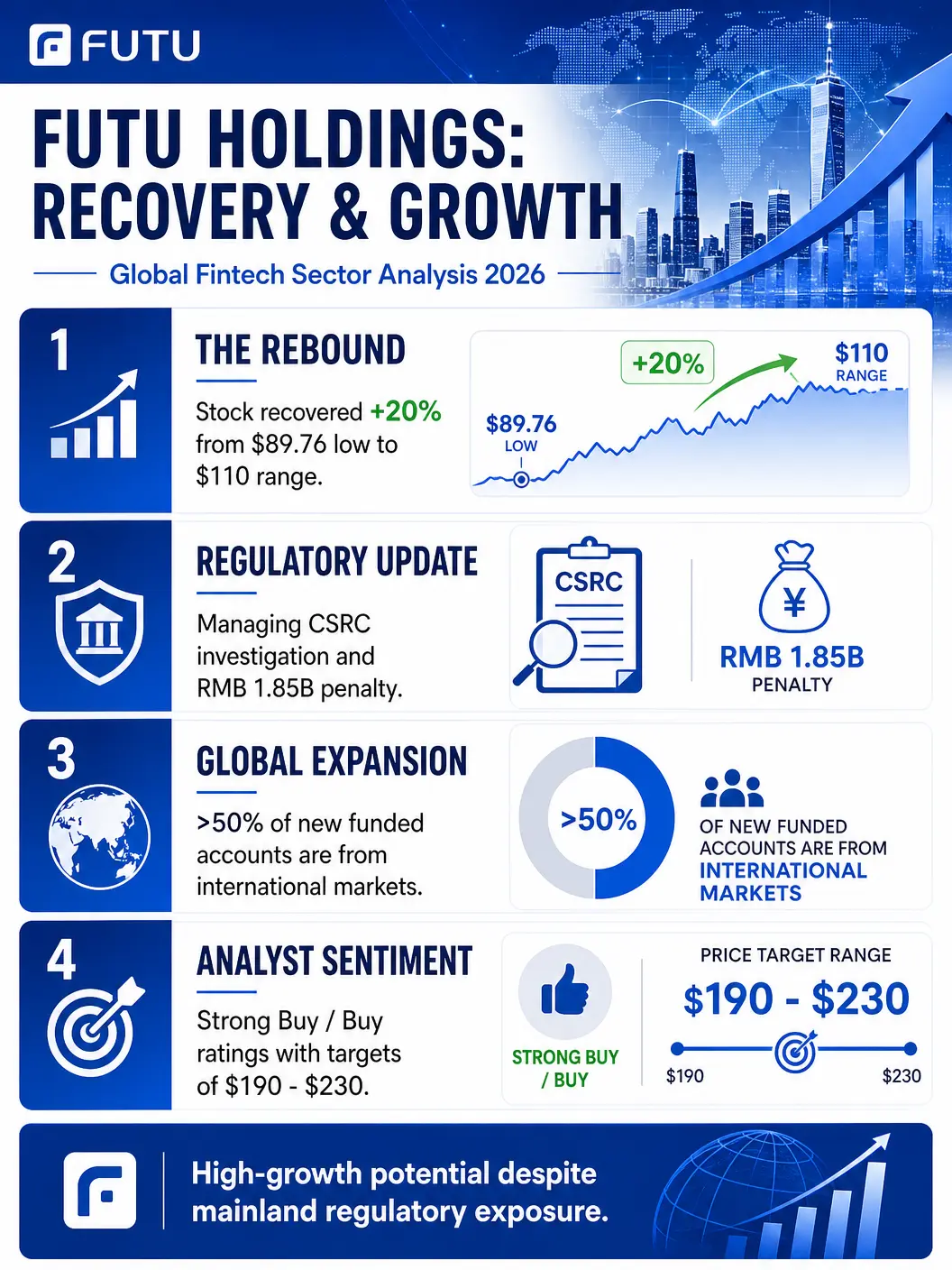
As a result, FUTU rebounded strongly back toward the $100–$107 zone, demonstrating that buyers remain active and that many investors continue viewing the long-term international growth story positively.
Business Model and Growth Drivers
Futu’s long-term growth potential comes from several important areas that continue supporting expansion beyond traditional brokerage operations.
Digital Brokerage Expansion
The company’s core strength remains its advanced digital brokerage ecosystem, particularly through Moomoo, which has gained popularity among retail investors interested in U.S. stocks, Hong Kong equities, ETFs, and options trading. The platform’s strong technology infrastructure and mobile-first experience make it highly competitive against older brokerage models.
International Diversification
One of the most important positive developments for Futu has been the gradual reduction of dependence on mainland China client exposure. International markets are now becoming the primary growth engine, reducing concentration risk and improving long-term operational stability.
Management highlighted that mainland-related exposure now represents a much smaller portion of total funded accounts compared to earlier years. This diversification strategy is considered highly important by investors because it creates stronger resilience against regional market pressures.
Wealth Management and Financial Services
Beyond simple stock trading, Futu continues expanding into:
Wealth management products
Cash management services
Market intelligence tools
Community-based investing features
Financial education ecosystems
These additions increase user engagement while also improving recurring revenue opportunities.
Retail Trading Growth Trends
Global retail trading participation remains structurally stronger than previous decades, especially among younger investors using digital platforms. Market volatility, AI-driven trading interest, and international investing trends continue creating favorable conditions for brokerage platforms like Futu.
Financial Performance and Operational Strength
Historically, Futu has demonstrated strong revenue growth driven by:
Increasing client numbers
Growth in assets under management (AUM)
Higher trading volumes
Margin financing activity
Interest income expansion
The company has consistently shown the ability to scale efficiently because digital brokerage platforms benefit from operational leverage as user activity grows.
Analysts continue focusing heavily on:
Funded account growth
Client retention rates
International expansion metrics
AUM growth trajectory
Revenue diversification outside transaction fees
Upcoming quarterly earnings remain especially important because investors want clarity regarding whether recent volatility affected user activity or growth momentum.
Upcoming Earnings and Market Expectations
One of the most important short-term catalysts for FUTU is the upcoming quarterly earnings release expected around late May 2026. Traders and institutions will closely monitor several critical areas:
New client additions
Assets under management growth
International market expansion
Revenue trends
Trading activity metrics
Management commentary regarding regulatory developments
Strong earnings could reinforce the recovery narrative and potentially trigger another upward momentum phase, while weak numbers could temporarily increase volatility again.
Technical Analysis — Key Price Levels and Structure
From a technical perspective, FUTU currently remains in a high-volatility recovery structure following the sharp selloff earlier in the month.
Major Support Levels
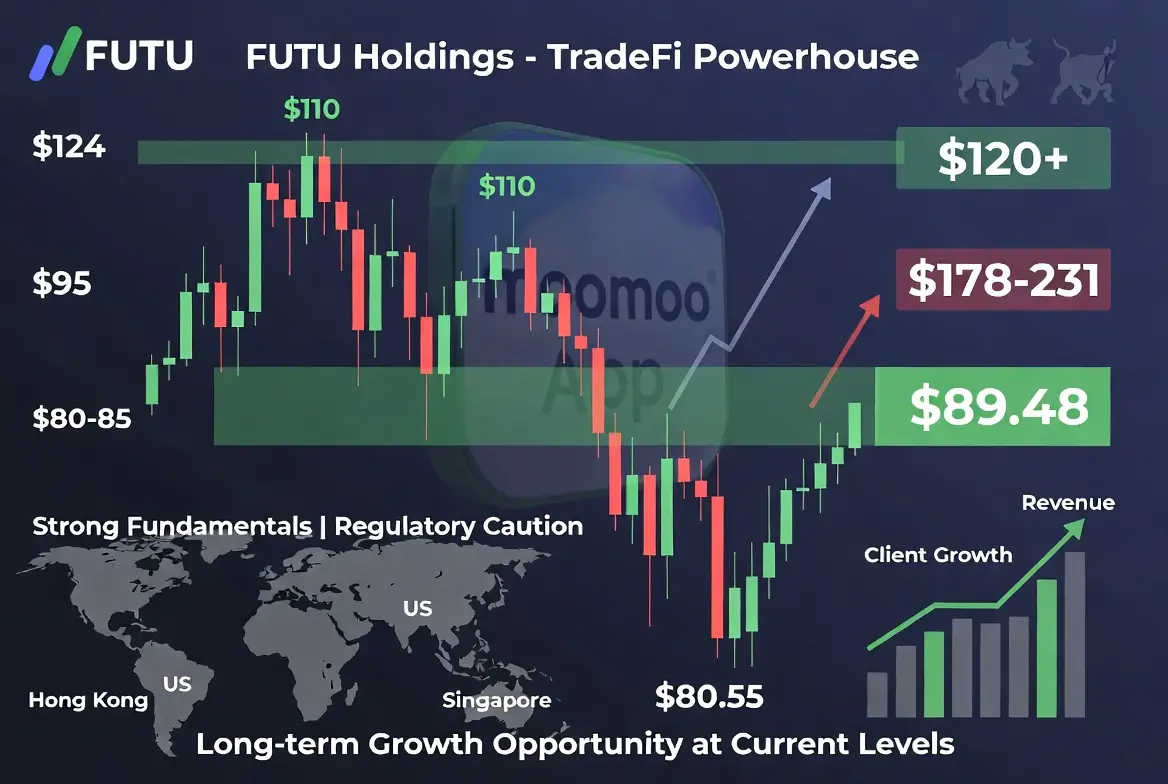
$80–$90 → Major panic low and recovery support
$95–$100 → Intermediate support region
Below $80 → High-risk bearish breakdown zone
Major Resistance Levels
$120–$140 → Short-term breakout zone
$160–$172 → Medium-term analyst target region
$200–$220+ → Aggressive bullish scenario zone
The current recovery structure suggests that the stock is attempting to rebuild bullish momentum after capitulation selling pressure.
Volume behavior also indicates that large institutional and retail participation returned during the rebound phase, which often signals improving confidence after panic-driven declines.
Analyst Forecasts and Price Targets
Wall Street sentiment remains cautiously optimistic despite recent volatility.
Consensus Outlook
Most analysts maintain:
Moderate Buy
Buy
Positive long-term growth outlook
Average Price Targets
Average targets: $160–$213
Bullish projections: $220–$270
Conservative estimates: Lower but still above recent lows
This suggests that many analysts still believe substantial upside potential exists if the company successfully continues international growth while maintaining operational stability.
Market Sentiment and Trader Psychology
Current trader sentiment surrounding FUTU can best be described as cautiously bullish but highly sensitive to news flow.
Bullish Factors
Traders supporting the stock highlight:
Strong technology platform
Global retail investing growth
International diversification success
Attractive valuation after selloff
Share buyback support
Strong historical revenue growth
Cautious Factors
More conservative investors remain focused on:
Ongoing regulatory uncertainty
Sensitivity to market volatility
Dependence on trading activity levels
Competition from other fintech platforms
Despite these concerns, the sharp recovery suggests that many market participants believe the worst of the panic selling phase may already be behind the stock.
Trading Strategies for FUTU
Short-Term Swing Trading Strategy
Because FUTU remains highly volatile, many traders focus on swing trading opportunities between support and resistance zones.
Typical approach:
Buy near support levels around $95–$100
Target rebounds toward $120–$140
Use disciplined stop-loss management below key support
This strategy works best during periods of elevated volume and positive momentum.
Medium-Term Growth Strategy
Investors with a medium-term horizon often focus on:
Earnings growth trends
International expansion metrics
User growth acceleration
Long-term fintech adoption trends
If growth remains strong, the stock could gradually move back toward higher analyst target zones over the next several quarters.
Long-Term Investment Perspective
Long-term investors view Futu as part of the broader digital finance transformation where traditional brokerage services increasingly shift toward mobile-first fintech ecosystems.
Key long-term strengths include:
Scalable digital infrastructure
International growth opportunities
Younger investor demographics
Expanding wealth management services
However, long-term investing still requires patience and acceptance of substantial volatility.
Risks and Key Challenges
Despite strong growth potential, FUTU still faces important risks:
Regulatory uncertainty affecting market sentiment
Competition from global brokerage firms
Slower retail trading activity during weak markets
Interest rate impacts on investor participation
Market sensitivity to China-related headlines
Revenue dependence on trading volume cycles
These risks mean the stock can remain highly volatile even when fundamentals remain relatively strong.
Broader Market Context and Industry Trends
The broader fintech and brokerage industry continues benefiting from:
Increasing retail market participation
Digital-first investing behavior
Cross-border investing interest
AI-enhanced trading tools
Growth of wealth management platforms
As younger investors continue preferring app-based financial ecosystems, companies like Futu may continue benefiting from structural industry trends over the long term.
Conclusion — Final Market Outlook
Futu Holdings Ltd. remains one of the more interesting high-growth fintech and brokerage companies in the Asian market ecosystem, particularly because of its strong technology infrastructure, growing international diversification, and expanding global retail investor presence.
The stock recently experienced extreme volatility after regulatory-related concerns triggered heavy selling pressure, but the strong rebound toward the $100–$107 region suggests that investor confidence is gradually stabilizing again.
Short term, the market will remain focused on earnings results, user growth, and management commentary. Medium term, the company’s ability to continue expanding internationally while maintaining strong client growth could support further upside potential toward analyst target zones.
Long term, Futu’s future depends on whether it can continue transforming into a globally competitive digital financial ecosystem while successfully navigating changing market environments.
Overall, FUTU remains a high-volatility but potentially high-growth fintech stock where disciplined risk management and careful monitoring of market developments remain extremely important for investors and traders alike.@Gate_Square @Gate广场_Official #StockTradingChallengeUpTo17000U #TradeCFDWinGold #DailyPolymarketHotspot
#FUTU
Futu Holdings Ltd. has become one of the most recognized digital brokerage and fintech platforms in Asia, particularly through its flagship trading platform Moomoo, which continues expanding across international markets including Hong Kong, Singapore, the United States, Australia, Japan, and other fast-growing financial regions. The company operates in the rapidly expanding digital investing industry where retail investors increasingly prefer mobile-first, technology-driven brokerage ecosystems instead of traditional financial institutions.
Unlike conventional brokers that mainly focus on transaction execution, Futu has built a broader ecosystem combining stock trading, options, ETFs, wealth management, market data, community engagement, and financial education into one integrated platform. This has allowed the company to attract younger retail investors who prefer fast, modern, and user-friendly investment infrastructure.
As of late May 2026, FUTU stock is trading around the $100–$107 range, following a dramatic recovery from a sharp selloff that pushed the stock toward approximately $80 lows earlier in the month. The recovery has attracted major market attention because many traders believe the selloff became excessively emotional relative to the company’s underlying international growth trends.
Recent Market Situation — Sharp Selloff and Recovery Phase
FUTU experienced one of its most volatile periods recently after reports emerged regarding regulatory discussions connected to historical cross-border business activities involving mainland Chinese clients. The market reacted aggressively, triggering a decline exceeding 25–30% within a short period, causing panic selling and large intraday volatility spikes.
The stock temporarily collapsed toward the $80 region, which became a major psychological support zone. However, after the initial panic phase, traders and institutional investors gradually began reassessing the situation more calmly, especially after management emphasized that overseas operations continue functioning normally and that the company has already implemented compliance-focused adjustments.
A major confidence booster came through the announcement of a $160 million share repurchase program, which signaled that management believes the stock had become undervalued following the sharp correction. Buyback announcements often strengthen investor confidence because they show that the company itself sees long-term value at current levels.
As a result, FUTU rebounded strongly back toward the $100–$107 zone, demonstrating that buyers remain active and that many investors continue viewing the long-term international growth story positively.
Business Model and Growth Drivers
Futu’s long-term growth potential comes from several important areas that continue supporting expansion beyond traditional brokerage operations.
Digital Brokerage Expansion
The company’s core strength remains its advanced digital brokerage ecosystem, particularly through Moomoo, which has gained popularity among retail investors interested in U.S. stocks, Hong Kong equities, ETFs, and options trading. The platform’s strong technology infrastructure and mobile-first experience make it highly competitive against older brokerage models.
International Diversification
One of the most important positive developments for Futu has been the gradual reduction of dependence on mainland China client exposure. International markets are now becoming the primary growth engine, reducing concentration risk and improving long-term operational stability.
Management highlighted that mainland-related exposure now represents a much smaller portion of total funded accounts compared to earlier years. This diversification strategy is considered highly important by investors because it creates stronger resilience against regional market pressures.
Wealth Management and Financial Services
Beyond simple stock trading, Futu continues expanding into:
Wealth management products
Cash management services
Market intelligence tools
Community-based investing features
Financial education ecosystems
These additions increase user engagement while also improving recurring revenue opportunities.
Retail Trading Growth Trends
Global retail trading participation remains structurally stronger than previous decades, especially among younger investors using digital platforms. Market volatility, AI-driven trading interest, and international investing trends continue creating favorable conditions for brokerage platforms like Futu.
Financial Performance and Operational Strength
Historically, Futu has demonstrated strong revenue growth driven by:
Increasing client numbers
Growth in assets under management (AUM)
Higher trading volumes
Margin financing activity
Interest income expansion
The company has consistently shown the ability to scale efficiently because digital brokerage platforms benefit from operational leverage as user activity grows.
Analysts continue focusing heavily on:
Funded account growth
Client retention rates
International expansion metrics
AUM growth trajectory
Revenue diversification outside transaction fees
Upcoming quarterly earnings remain especially important because investors want clarity regarding whether recent volatility affected user activity or growth momentum.
Upcoming Earnings and Market Expectations
One of the most important short-term catalysts for FUTU is the upcoming quarterly earnings release expected around late May 2026. Traders and institutions will closely monitor several critical areas:
New client additions
Assets under management growth
International market expansion
Revenue trends
Trading activity metrics
Management commentary regarding regulatory developments
Strong earnings could reinforce the recovery narrative and potentially trigger another upward momentum phase, while weak numbers could temporarily increase volatility again.
Technical Analysis — Key Price Levels and Structure
From a technical perspective, FUTU currently remains in a high-volatility recovery structure following the sharp selloff earlier in the month.
Major Support Levels
$80–$90 → Major panic low and recovery support
$95–$100 → Intermediate support region
Below $80 → High-risk bearish breakdown zone
Major Resistance Levels
$120–$140 → Short-term breakout zone
$160–$172 → Medium-term analyst target region
$200–$220+ → Aggressive bullish scenario zone
The current recovery structure suggests that the stock is attempting to rebuild bullish momentum after capitulation selling pressure.
Volume behavior also indicates that large institutional and retail participation returned during the rebound phase, which often signals improving confidence after panic-driven declines.
Analyst Forecasts and Price Targets
Wall Street sentiment remains cautiously optimistic despite recent volatility.
Consensus Outlook
Most analysts maintain:
Moderate Buy
Buy
Positive long-term growth outlook
Average Price Targets
Average targets: $160–$213
Bullish projections: $220–$270
Conservative estimates: Lower but still above recent lows
This suggests that many analysts still believe substantial upside potential exists if the company successfully continues international growth while maintaining operational stability.
Market Sentiment and Trader Psychology
Current trader sentiment surrounding FUTU can best be described as cautiously bullish but highly sensitive to news flow.
Bullish Factors
Traders supporting the stock highlight:
Strong technology platform
Global retail investing growth
International diversification success
Attractive valuation after selloff
Share buyback support
Strong historical revenue growth
Cautious Factors
More conservative investors remain focused on:
Ongoing regulatory uncertainty
Sensitivity to market volatility
Dependence on trading activity levels
Competition from other fintech platforms
Despite these concerns, the sharp recovery suggests that many market participants believe the worst of the panic selling phase may already be behind the stock.
Trading Strategies for FUTU
Short-Term Swing Trading Strategy
Because FUTU remains highly volatile, many traders focus on swing trading opportunities between support and resistance zones.
Typical approach:
Buy near support levels around $95–$100
Target rebounds toward $120–$140
Use disciplined stop-loss management below key support
This strategy works best during periods of elevated volume and positive momentum.
Medium-Term Growth Strategy
Investors with a medium-term horizon often focus on:
Earnings growth trends
International expansion metrics
User growth acceleration
Long-term fintech adoption trends
If growth remains strong, the stock could gradually move back toward higher analyst target zones over the next several quarters.
Long-Term Investment Perspective
Long-term investors view Futu as part of the broader digital finance transformation where traditional brokerage services increasingly shift toward mobile-first fintech ecosystems.
Key long-term strengths include:
Scalable digital infrastructure
International growth opportunities
Younger investor demographics
Expanding wealth management services
However, long-term investing still requires patience and acceptance of substantial volatility.
Risks and Key Challenges
Despite strong growth potential, FUTU still faces important risks:
Regulatory uncertainty affecting market sentiment
Competition from global brokerage firms
Slower retail trading activity during weak markets
Interest rate impacts on investor participation
Market sensitivity to China-related headlines
Revenue dependence on trading volume cycles
These risks mean the stock can remain highly volatile even when fundamentals remain relatively strong.
Broader Market Context and Industry Trends
The broader fintech and brokerage industry continues benefiting from:
Increasing retail market participation
Digital-first investing behavior
Cross-border investing interest
AI-enhanced trading tools
Growth of wealth management platforms
As younger investors continue preferring app-based financial ecosystems, companies like Futu may continue benefiting from structural industry trends over the long term.
Conclusion — Final Market Outlook
Futu Holdings Ltd. remains one of the more interesting high-growth fintech and brokerage companies in the Asian market ecosystem, particularly because of its strong technology infrastructure, growing international diversification, and expanding global retail investor presence.
The stock recently experienced extreme volatility after regulatory-related concerns triggered heavy selling pressure, but the strong rebound toward the $100–$107 region suggests that investor confidence is gradually stabilizing again.
Short term, the market will remain focused on earnings results, user growth, and management commentary. Medium term, the company’s ability to continue expanding internationally while maintaining strong client growth could support further upside potential toward analyst target zones.
Long term, Futu’s future depends on whether it can continue transforming into a globally competitive digital financial ecosystem while successfully navigating changing market environments.
Overall, FUTU remains a high-volatility but potentially high-growth fintech stock where disciplined risk management and careful monitoring of market developments remain extremely important for investors and traders alike.@Gate_Square @Gate广场_Official #StockTradingChallengeUpTo17000U #TradeCFDWinGold #DailyPolymarketHotspot