#SummerCreationCamp
#MU,
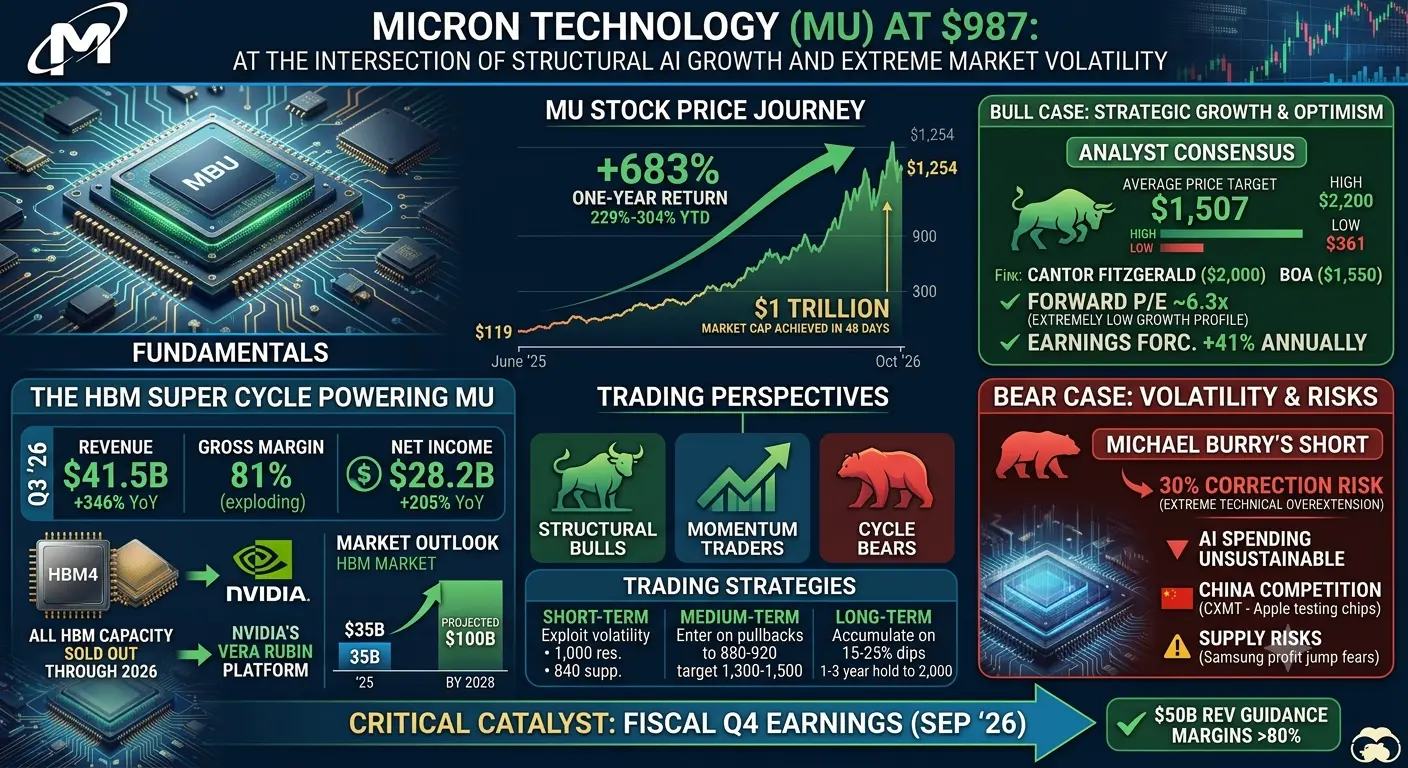
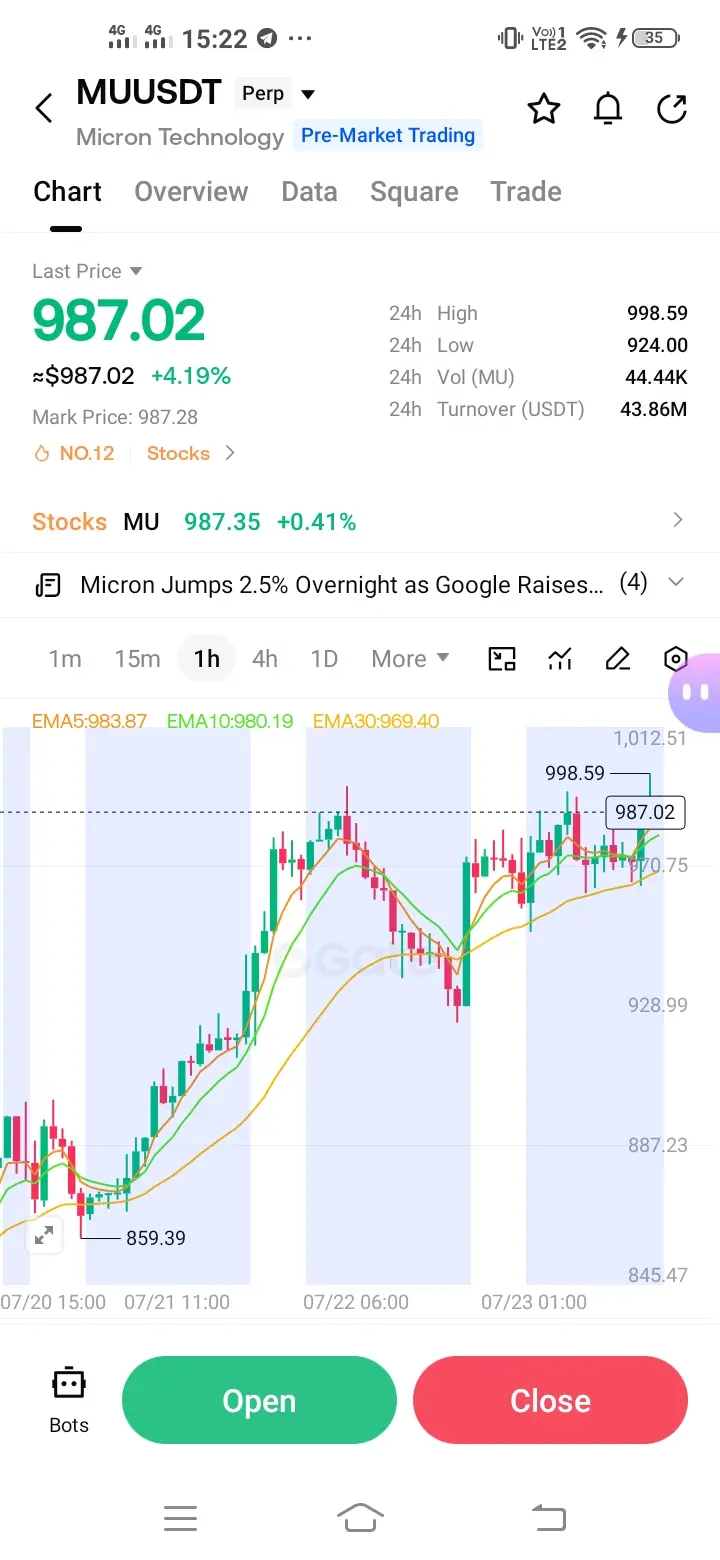
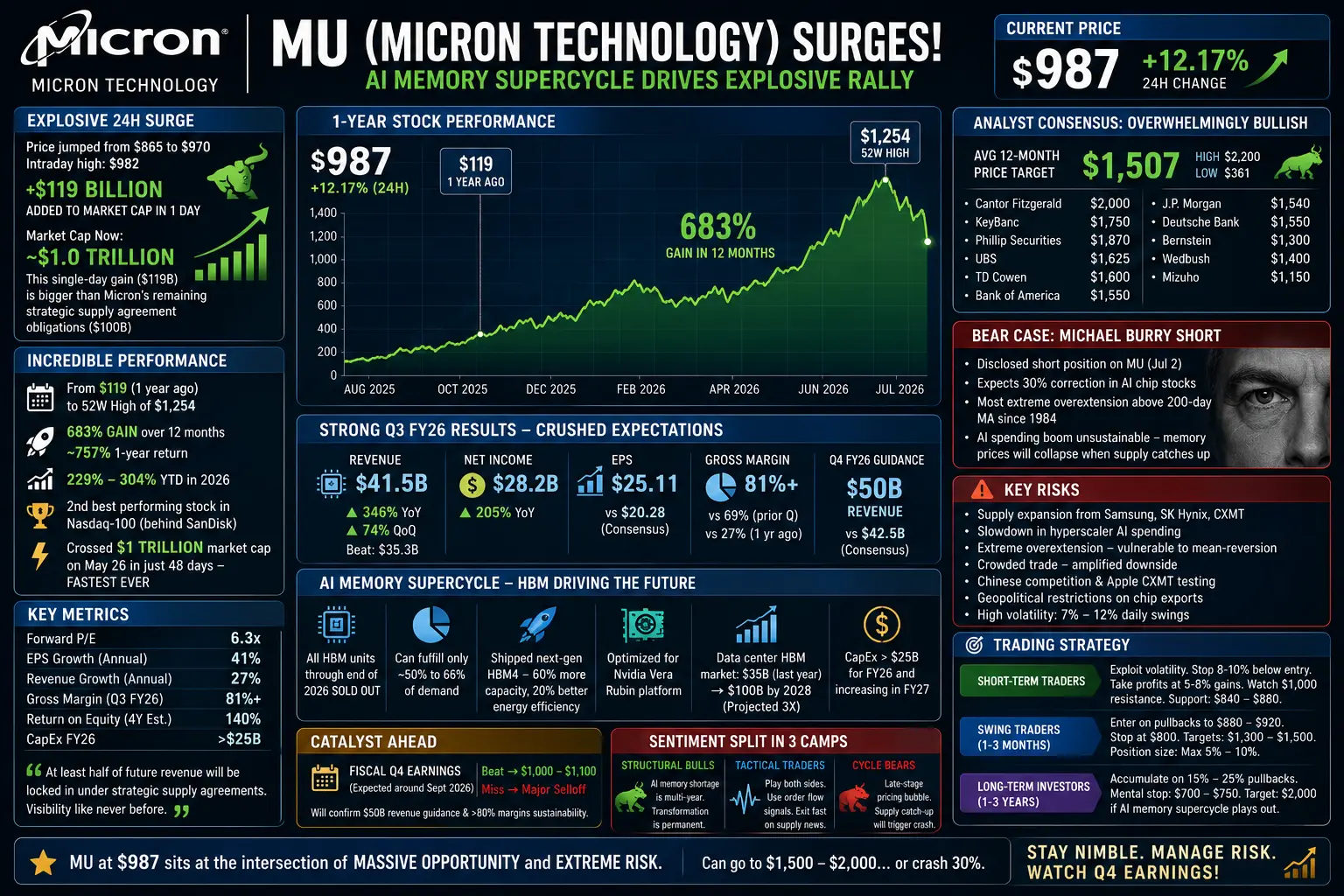
MU (Micron Technology) is currently trading around 987 dollars and the entire semiconductor market is watching this stock very closely because it has produced one of the most explosive rallies in recent history. The stock surged 12.17 percent in the last 24 hours, jumping from 865 to 970, with an intraday high touching 982. That single-day surge added approximately 119 billion dollars to Micron's market cap, which is a figure larger than the company's own remaining strategic supply agreement obligations of 100 billion. The catalyst behind this surge was a Power Inflow signal from institutional order flow analytics that shifted buying pressure aggressively, combined with Bank of America analyst Vivek Arya raising his price target to 1,550 and reiterating a Buy rating, which triggered a broader memory sector rally lifting SanDisk 8 percent and Western Digital 9 percent on the same day.
The year-long trajectory of MU has been historic. From 119 dollars just one year ago, the stock reached a 52-week high of 1,254, representing a 683 percent gain over 12 months and approximately 757 percent one-year return. Year to date in 2026, MU is up 229 to 304 percent, making it the second-best performing stock in the Nasdaq-100 behind only SanDisk. Micron crossed the 1 trillion dollar market cap on May 26 in just 48 days from its previous doubling, the fastest such ascent ever recorded. This transformation from a cyclical memory company trading near 50 dollars in early 2023 to a near-trillion-dollar structural growth powerhouse is unprecedented in semiconductor history.
The fundamental driver behind everything is the AI memory supercycle centered on High Bandwidth Memory or HBM. Micron's fiscal Q3 2026 results crushed all expectations. Revenue hit 41.5 billion dollars, a 346 percent year-over-year increase and 74 percent quarter-over-quarter jump, beating estimates of 35.3 billion. Net income surged 205 percent year-over-year to 28.2 billion. EPS came in at 25.11 versus consensus of 20.28. The most remarkable metric was gross margins exploding above 81 percent, up from 69 percent the prior quarter and just 27 percent one year earlier. This margin expansion is entirely driven by HBM pricing power. Every unit of HBM Micron can produce through the end of 2026 is already sold out, and the company can only fulfill roughly half to two-thirds of customer demand. Q4 guidance was set at 50 billion dollars in revenue, crushing the 42.5 billion consensus. Micron has also begun shipping next-generation HBM4 chips offering 60 percent more capacity and 20 percent better energy efficiency over HBM3E, optimized for Nvidia's Vera Rubin platform. The data center HBM market was 35 billion last year and Micron projects it will triple to 100 billion by 2028. Capital expenditure exceeds 25 billion for fiscal 2026 with further increases planned for 2027. At least half of future revenue will be locked in under strategic supply agreements, giving the memory industry visibility it has never had before.
Analyst consensus is overwhelmingly bullish. Across 42 analysts, the average 12-month price target is approximately 1,507 dollars, with a high of 2,200 and a low of 361. Nearly every major firm maintains Buy ratings. Key targets include Cantor Fitzgerald at 2,000, KeyBanc at 1,750, Phillip Securities at 1,870, UBS at 1,625, TD Cowen at 1,600, Bank of America at 1,550, J.P. Morgan at 1,540, Deutsche Bank at 1,550, Bernstein at 1,300, Wedbush at 1,400, and Mizuho at 1,150. The forward P/E sits at approximately 6.3, which is extraordinarily low for this growth profile. Earnings are forecast to grow 41 percent annually and revenue at nearly 27 percent. Return on equity is projected to hit 140 percent within four years. Motley Fool published a prediction that MU will hit at least 2,000 within one year if forward P/E holds steady and earnings continue accelerating. However, short-term technical models are mixed. The short-term moving average gives Buy signals but the long-term average holds Sell signals due to extreme overextension. Algorithmic forecasts project a potential 62 percent rise over 3 months with 90 percent probability placing the stock between 1,400 and 2,200. The 24/7 Wall St. model is more conservative at 957 dollars implying roughly 2 percent upside and a Hold rating.
The bear case centers on Michael Burry, who disclosed a short position against MU on July 2, adding to shorts on Nvidia, Applied Materials, and the semiconductor ETF. Burry argues AI chip stocks face a 30 percent correction, citing the most extreme technical overextension above the 200-day moving average since 1984. His thesis is that the AI spending boom is unsustainable and memory prices will collapse when supply catches up. His timing was unfortunate as the short was squeezed by the 12 percent surge after Q3 earnings, but his longer-term argument remains that 242 percent year-to-date rallies represent the kind of extreme overextension that historically precedes major corrections. Beyond Burry, there are structural risks. On July 15, MU plunged 8 percent on news that Apple is testing Chinese DRAM maker CXMT chips, signaling intensifying competition. On July 7, Samsung reported a 19x profit jump that paradoxically triggered a 7 percent selloff in memory stocks because investors feared increased supply would pressure pricing. Prediction markets assign 72 percent probability that MU touches 840 in July, indicating expected continued volatility and potential downside even within the bullish trajectory.
Trader sentiment is split into three camps. Structural bulls believe the AI memory shortage is multi-year and Micron's transformation is permanent, pointing to sold-out HBM, 100 billion HBM market projections, strategic supply agreements, and a forward P/E of 6.3. Tactical momentum traders play both sides using order flow signals and exit quickly on supply news, exploiting the 7 to 12 percent daily swings. The cycle bears led by Burry see this as a late-stage pricing bubble that will collapse when supply normalizes, citing historical memory cycle patterns and emerging Chinese competition.
For trading strategy, short-term traders should exploit the volatility with strict discipline. Set stops at 8 to 10 percent below entry, take partial profits at 5 to 8 percent gains, and use institutional order flow signals as entry triggers. The 1,000 level is immediate psychological resistance and a breakout above that with volume could trigger a move toward 1,050 to 1,100. Support sits at approximately 840 to 880 where recent pullbacks found buyers. Medium-term swing traders holding 1 to 3 months should enter on pullbacks to 880 to 920 with stops at 800 and targets at 1,300 to 1,500, but position size should never exceed 5 to 10 percent of portfolio given the 30 percent correction risk. Long-term investors should accumulate on 15 to 25 percent pullbacks from highs, set mental stops at 700 to 750, and plan for 1 to 3 year holds if the structural thesis plays out toward 2,000. The critical catalyst ahead is the fiscal Q4 earnings expected around September 2026, which will confirm whether the 50 billion revenue guidance is achievable and whether margins stay above 80 percent. A beat pushes toward 1,000 to 1,100, a miss triggers a major selloff.
The key risks are competitive supply expansion from Samsung, SK Hynix, and CXMT compressing pricing power, any slowdown in hyperscaler AI spending reducing HBM demand, extreme technical overextension making the stock vulnerable to mean-reversion, the crowded trade amplifying downside on negative catalysts, Burry's short creating narrative risk, geopolitical restrictions on chip exports, and the sheer volatility with 7 to 12 percent daily swings requiring strict risk management. MU at 987 sits at the intersection of a powerful structural growth story and extreme technical overextension. It can go much higher if the AI memory shortage persists toward 1,500 to 2,000, and it can crash 30 percent if supply catches up. Stay nimble, manage risk, and watch the Q4 earnings as the next definitive catalyst.@Gate_Square
#MU,
MU (Micron Technology) is currently trading around 987 dollars and the entire semiconductor market is watching this stock very closely because it has produced one of the most explosive rallies in recent history. The stock surged 12.17 percent in the last 24 hours, jumping from 865 to 970, with an intraday high touching 982. That single-day surge added approximately 119 billion dollars to Micron's market cap, which is a figure larger than the company's own remaining strategic supply agreement obligations of 100 billion. The catalyst behind this surge was a Power Inflow signal from institutional order flow analytics that shifted buying pressure aggressively, combined with Bank of America analyst Vivek Arya raising his price target to 1,550 and reiterating a Buy rating, which triggered a broader memory sector rally lifting SanDisk 8 percent and Western Digital 9 percent on the same day.
The year-long trajectory of MU has been historic. From 119 dollars just one year ago, the stock reached a 52-week high of 1,254, representing a 683 percent gain over 12 months and approximately 757 percent one-year return. Year to date in 2026, MU is up 229 to 304 percent, making it the second-best performing stock in the Nasdaq-100 behind only SanDisk. Micron crossed the 1 trillion dollar market cap on May 26 in just 48 days from its previous doubling, the fastest such ascent ever recorded. This transformation from a cyclical memory company trading near 50 dollars in early 2023 to a near-trillion-dollar structural growth powerhouse is unprecedented in semiconductor history.
The fundamental driver behind everything is the AI memory supercycle centered on High Bandwidth Memory or HBM. Micron's fiscal Q3 2026 results crushed all expectations. Revenue hit 41.5 billion dollars, a 346 percent year-over-year increase and 74 percent quarter-over-quarter jump, beating estimates of 35.3 billion. Net income surged 205 percent year-over-year to 28.2 billion. EPS came in at 25.11 versus consensus of 20.28. The most remarkable metric was gross margins exploding above 81 percent, up from 69 percent the prior quarter and just 27 percent one year earlier. This margin expansion is entirely driven by HBM pricing power. Every unit of HBM Micron can produce through the end of 2026 is already sold out, and the company can only fulfill roughly half to two-thirds of customer demand. Q4 guidance was set at 50 billion dollars in revenue, crushing the 42.5 billion consensus. Micron has also begun shipping next-generation HBM4 chips offering 60 percent more capacity and 20 percent better energy efficiency over HBM3E, optimized for Nvidia's Vera Rubin platform. The data center HBM market was 35 billion last year and Micron projects it will triple to 100 billion by 2028. Capital expenditure exceeds 25 billion for fiscal 2026 with further increases planned for 2027. At least half of future revenue will be locked in under strategic supply agreements, giving the memory industry visibility it has never had before.
Analyst consensus is overwhelmingly bullish. Across 42 analysts, the average 12-month price target is approximately 1,507 dollars, with a high of 2,200 and a low of 361. Nearly every major firm maintains Buy ratings. Key targets include Cantor Fitzgerald at 2,000, KeyBanc at 1,750, Phillip Securities at 1,870, UBS at 1,625, TD Cowen at 1,600, Bank of America at 1,550, J.P. Morgan at 1,540, Deutsche Bank at 1,550, Bernstein at 1,300, Wedbush at 1,400, and Mizuho at 1,150. The forward P/E sits at approximately 6.3, which is extraordinarily low for this growth profile. Earnings are forecast to grow 41 percent annually and revenue at nearly 27 percent. Return on equity is projected to hit 140 percent within four years. Motley Fool published a prediction that MU will hit at least 2,000 within one year if forward P/E holds steady and earnings continue accelerating. However, short-term technical models are mixed. The short-term moving average gives Buy signals but the long-term average holds Sell signals due to extreme overextension. Algorithmic forecasts project a potential 62 percent rise over 3 months with 90 percent probability placing the stock between 1,400 and 2,200. The 24/7 Wall St. model is more conservative at 957 dollars implying roughly 2 percent upside and a Hold rating.
The bear case centers on Michael Burry, who disclosed a short position against MU on July 2, adding to shorts on Nvidia, Applied Materials, and the semiconductor ETF. Burry argues AI chip stocks face a 30 percent correction, citing the most extreme technical overextension above the 200-day moving average since 1984. His thesis is that the AI spending boom is unsustainable and memory prices will collapse when supply catches up. His timing was unfortunate as the short was squeezed by the 12 percent surge after Q3 earnings, but his longer-term argument remains that 242 percent year-to-date rallies represent the kind of extreme overextension that historically precedes major corrections. Beyond Burry, there are structural risks. On July 15, MU plunged 8 percent on news that Apple is testing Chinese DRAM maker CXMT chips, signaling intensifying competition. On July 7, Samsung reported a 19x profit jump that paradoxically triggered a 7 percent selloff in memory stocks because investors feared increased supply would pressure pricing. Prediction markets assign 72 percent probability that MU touches 840 in July, indicating expected continued volatility and potential downside even within the bullish trajectory.
Trader sentiment is split into three camps. Structural bulls believe the AI memory shortage is multi-year and Micron's transformation is permanent, pointing to sold-out HBM, 100 billion HBM market projections, strategic supply agreements, and a forward P/E of 6.3. Tactical momentum traders play both sides using order flow signals and exit quickly on supply news, exploiting the 7 to 12 percent daily swings. The cycle bears led by Burry see this as a late-stage pricing bubble that will collapse when supply normalizes, citing historical memory cycle patterns and emerging Chinese competition.
For trading strategy, short-term traders should exploit the volatility with strict discipline. Set stops at 8 to 10 percent below entry, take partial profits at 5 to 8 percent gains, and use institutional order flow signals as entry triggers. The 1,000 level is immediate psychological resistance and a breakout above that with volume could trigger a move toward 1,050 to 1,100. Support sits at approximately 840 to 880 where recent pullbacks found buyers. Medium-term swing traders holding 1 to 3 months should enter on pullbacks to 880 to 920 with stops at 800 and targets at 1,300 to 1,500, but position size should never exceed 5 to 10 percent of portfolio given the 30 percent correction risk. Long-term investors should accumulate on 15 to 25 percent pullbacks from highs, set mental stops at 700 to 750, and plan for 1 to 3 year holds if the structural thesis plays out toward 2,000. The critical catalyst ahead is the fiscal Q4 earnings expected around September 2026, which will confirm whether the 50 billion revenue guidance is achievable and whether margins stay above 80 percent. A beat pushes toward 1,000 to 1,100, a miss triggers a major selloff.
The key risks are competitive supply expansion from Samsung, SK Hynix, and CXMT compressing pricing power, any slowdown in hyperscaler AI spending reducing HBM demand, extreme technical overextension making the stock vulnerable to mean-reversion, the crowded trade amplifying downside on negative catalysts, Burry's short creating narrative risk, geopolitical restrictions on chip exports, and the sheer volatility with 7 to 12 percent daily swings requiring strict risk management. MU at 987 sits at the intersection of a powerful structural growth story and extreme technical overextension. It can go much higher if the AI memory shortage persists toward 1,500 to 2,000, and it can crash 30 percent if supply catches up. Stay nimble, manage risk, and watch the Q4 earnings as the next definitive catalyst.@Gate_Square