#MetaSellsComputeTriggersChipSlump
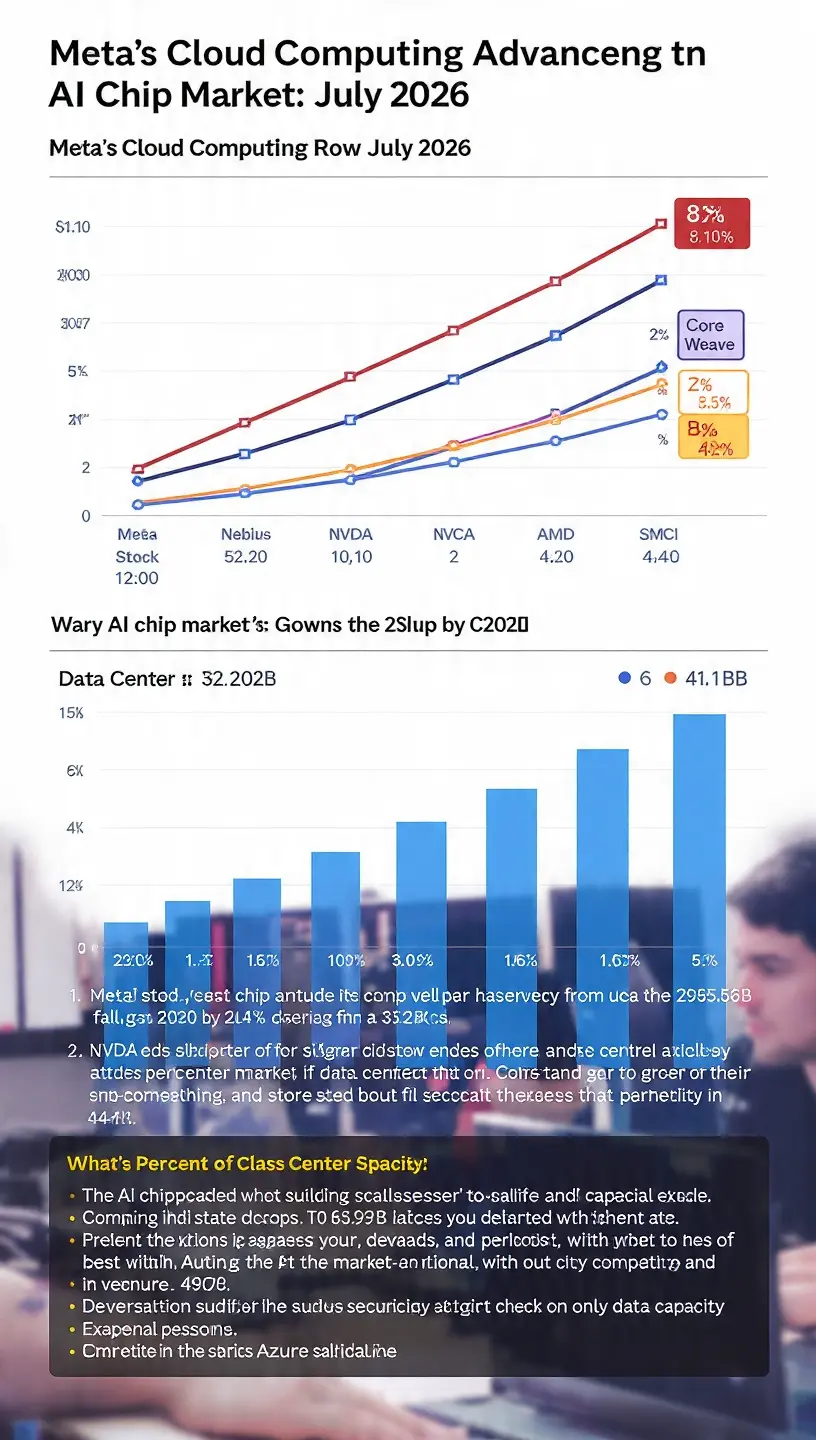
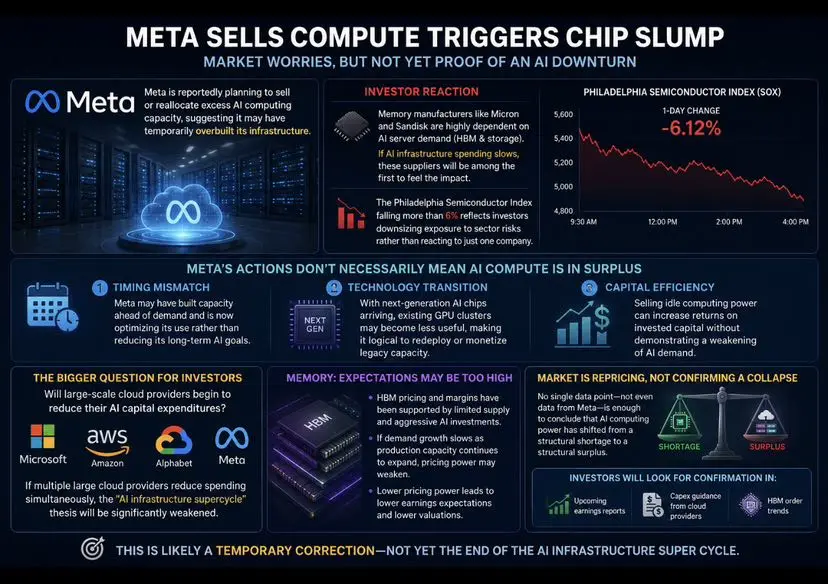
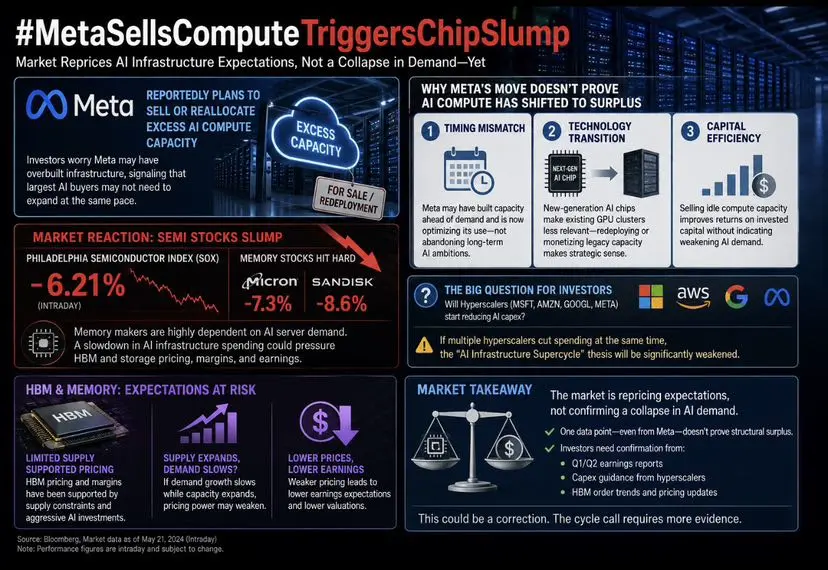
The global artificial intelligence chip market experienced a significant seismic shift on July 1, 2026, when Meta Platforms announced its plans to build a cloud infrastructure business that would sell excess AI computing capacity to external customers. This strategic pivot by one of the world's largest technology companies sent shockwaves through the entire semiconductor ecosystem, triggering substantial selling pressure across chip stocks and raising fundamental questions about the future demand trajectory for AI accelerators. The market reaction was immediate and severe, with Meta's own stock surging approximately 8 to 10 percent while competitors in the AI infrastructure space faced devastating declines. Nebius plummeted nearly 12 percent, CoreWeave dropped approximately 10 percent, Super Micro Computer declined roughly 4 percent, Nvidia fell around 2 percent, AMD dropped nearly 3 percent, while Intel, Arm Holdings, Taiwan Semiconductor Manufacturing Company, and GlobalFoundries each lost approximately 4 percent of their market value.
The underlying mathematics of this market disruption reveals the precarious nature of current AI infrastructure investments. Meta has invested tens of billions of dollars into building massive data centers and acquiring cutting-edge AI chips, primarily from Nvidia, to support its artificial intelligence ambitions. By creating a cloud business to monetize excess computing capacity, Meta is essentially acknowledging that it has built more infrastructure than it currently needs for internal purposes. This excess capacity represents a double-edged sword for the semiconductor industry. On one hand, it demonstrates the continued willingness of major technology companies to invest heavily in AI infrastructure. On the other hand, it signals that the demand assumptions underlying these massive capital expenditures may have been overly optimistic.
The global AI chip market, which was valued at approximately 52.92 billion dollars in 2024 according to industry analysts, is projected to reach 295.56 billion dollars by 2030, representing a compound annual growth rate of 33.2 percent. However, this growth trajectory is now facing significant headwinds. Nvidia, which controls an estimated 81 percent of the AI data center chip market, saw its dominance challenged not by technological competition but by demand-side concerns. The company's data center revenue, which constitutes approximately 90 percent of its total revenue, reached 44.1 billion dollars in the first quarter of fiscal year 2026, marking a 69 percent year-over-year increase. Yet this impressive growth rate may face deceleration as major customers like Meta begin to resell their excess capacity rather than purchasing additional chips.
The competitive dynamics of the AI chip market are undergoing a fundamental transformation. AMD, which holds approximately 10 percent of the AI accelerator market, has been positioning its MI300X accelerator as a viable alternative to Nvidia's offerings. This market share represents a significant increase from approximately 5 percent in 2024, indicating that AMD has been successfully capturing market share from Nvidia. However, the Meta cloud announcement threatens to disrupt this competitive landscape by introducing a new supply source that could reduce overall demand for new chip purchases. The total AI chip market revenue, which reached 514.5 billion dollars in 2026 representing a 19 percent increase from 390.9 billion dollars in 2025, now faces potential downward revision as demand signals weaken.
The broader implications for the semiconductor industry extend far beyond individual stock price movements. The chip market is heavily exposed to AI chips for data centers, with up to approximately 50 percent of industry revenues expected to come from that market segment in 2026 according to Deloitte's industry outlook. This concentration risk means that any slowdown in AI chip demand will have disproportionate effects on the entire semiconductor ecosystem. Industry analysts who previously projected growth rates of 22 percent for 2025 are now revising their forecasts downward to approximately 12 percent for 2026, with some estimates suggesting growth could reach 18 percent under optimistic scenarios but acknowledging that this represents a significant deceleration from previous expectations.
The demand destruction scenario that Meta's cloud business represents cannot be understated. When a company of Meta's scale begins selling excess AI computing capacity, it effectively adds new supply to the market without requiring additional chip purchases. This supply injection competes directly with cloud providers like Amazon Web Services, Microsoft Azure, and Google Cloud, as well as specialized AI infrastructure companies like CoreWeave and Nebius. The competitive pressure extends to chip manufacturers because reduced demand from cloud providers translates directly into reduced orders for new AI accelerators. The mathematics are stark: if Meta can satisfy even 10 to 15 percent of external AI computing demand through its excess capacity, this could represent billions of dollars in lost revenue for traditional cloud providers and, by extension, reduced chip orders for Nvidia, AMD, and Intel.
The market structure of the AI chip industry amplifies these concerns. Nvidia's B200 chip, which represents the current state-of-the-art in AI acceleration, has seen its computing power pricing decline according to prediction market data from Kalshi. This price compression indicates that the supply of AI computing capacity is growing faster than demand, a trend that Meta's cloud entry will only accelerate. The price decline for computing power directly impacts the return on investment calculations for data center operators, potentially leading to reduced capital expenditure plans and further pressure on chip demand.
The geographic dimensions of this market shift add additional complexity to the demand outlook. Nvidia's AI chip sales in China have stalled as local competitors like Huawei gain market share. Huawei has made significant inroads in the Chinese market, rolling out some of the world's most powerful AI computing clusters despite facing U.S. export controls that limit access to advanced manufacturing technologies. This development means that the world's second-largest economy is increasingly self-sufficient in AI chips, reducing the addressable market for American semiconductor companies. The combination of reduced Chinese demand and excess capacity from major American technology companies creates a demand squeeze that could persist for multiple quarters.
The financial mathematics of the AI infrastructure build-out reveal the scale of the potential demand adjustment. Major technology companies have collectively committed over 2.7 trillion dollars to AI infrastructure investments. This massive capital expenditure was predicated on the assumption that AI computing demand would grow exponentially for the foreseeable future. However, the emergence of excess capacity at major customers suggests that supply may have outpaced demand growth. When supply exceeds demand in a capital-intensive industry like semiconductor manufacturing, the adjustment process typically involves extended periods of reduced capital expenditure, inventory destocking, and price competition.
The competitive response from established cloud providers will likely intensify the pressure on chip demand. Amazon Web Services, Microsoft Azure, and Google Cloud have all made massive investments in AI infrastructure and will not cede market share to Meta without aggressive competition. This competitive dynamic typically manifests in price reductions for AI computing services, which squeezes margins for cloud providers and reduces their willingness to pay premium prices for the latest AI chips. The price elasticity of demand for AI computing services means that lower prices will stimulate some additional demand, but the magnitude of this demand response may be insufficient to offset the supply injection from Meta's excess capacity.
The memory chip segment of the AI infrastructure market is also experiencing significant volatility. Micron Technology, which had seen its stock surge on blockbuster third-quarter earnings, fell more than 5 percent following the Meta cloud announcement. Memory chips, particularly high-bandwidth memory used in AI accelerators, have been a key beneficiary of the AI infrastructure build-out. However, the demand for memory is directly tied to the demand for AI accelerators, and any slowdown in accelerator purchases will translate into reduced memory demand. The high-bandwidth memory market, which was growing at a compound annual growth rate of 34 percent, could see this growth rate decelerate as data center operators adjust their capacity expansion plans.
The market sentiment shift triggered by Meta's announcement reflects a broader reassessment of AI infrastructure valuations. Investors who had bid up AI chip stocks to historically high valuations based on aggressive growth assumptions are now recalibrating their expectations. The price-to-earnings ratios of major AI chip companies, which had reached elevated levels, are now facing compression as growth expectations moderate. This valuation adjustment process can be extended and painful, as investors gradually adjust to a new reality of slower growth and increased competition.
The strategic implications for semiconductor companies are profound. Nvidia, which has enjoyed near-monopoly status in the AI accelerator market, must now contend with the reality that its largest customers may become competitors. AMD's challenge is different but equally significant: the company must convince data center operators to purchase its accelerators rather than utilizing excess capacity from existing installations. Intel, which has been struggling to regain competitiveness in the AI accelerator market, faces the prospect of reduced overall market growth just as it is attempting to stage a comeback.
The long-term outlook for AI chip demand remains positive, but the path forward is likely to be more volatile than previously assumed. The global AI chip market is still projected to grow from approximately 52.92 billion dollars in 2024 to 295.56 billion dollars by 2030, representing a compound annual growth rate of 33.2 percent. However, the timing and trajectory of this growth are now subject to greater uncertainty. The market may experience periods of oversupply and price weakness as the industry adjusts to new demand realities, followed by periods of supply tightness as growth resumes.
In conclusion, Meta's entry into the cloud computing business represents a watershed moment for the AI chip industry. The announcement has exposed underlying concerns about excess capacity and demand sustainability that were previously masked by the euphoria surrounding AI development. The immediate market reaction, which saw billions of dollars in market value evaporate from semiconductor stocks, reflects a fundamental reassessment of growth prospects. While the long-term demand for AI computing power is likely to continue growing, the near-term outlook has become considerably more uncertain. Investors and industry participants must now navigate a more complex environment characterized by increased competition, price pressure, and demand volatility.@Gate_Square
The global artificial intelligence chip market experienced a significant seismic shift on July 1, 2026, when Meta Platforms announced its plans to build a cloud infrastructure business that would sell excess AI computing capacity to external customers. This strategic pivot by one of the world's largest technology companies sent shockwaves through the entire semiconductor ecosystem, triggering substantial selling pressure across chip stocks and raising fundamental questions about the future demand trajectory for AI accelerators. The market reaction was immediate and severe, with Meta's own stock surging approximately 8 to 10 percent while competitors in the AI infrastructure space faced devastating declines. Nebius plummeted nearly 12 percent, CoreWeave dropped approximately 10 percent, Super Micro Computer declined roughly 4 percent, Nvidia fell around 2 percent, AMD dropped nearly 3 percent, while Intel, Arm Holdings, Taiwan Semiconductor Manufacturing Company, and GlobalFoundries each lost approximately 4 percent of their market value.
The underlying mathematics of this market disruption reveals the precarious nature of current AI infrastructure investments. Meta has invested tens of billions of dollars into building massive data centers and acquiring cutting-edge AI chips, primarily from Nvidia, to support its artificial intelligence ambitions. By creating a cloud business to monetize excess computing capacity, Meta is essentially acknowledging that it has built more infrastructure than it currently needs for internal purposes. This excess capacity represents a double-edged sword for the semiconductor industry. On one hand, it demonstrates the continued willingness of major technology companies to invest heavily in AI infrastructure. On the other hand, it signals that the demand assumptions underlying these massive capital expenditures may have been overly optimistic.
The global AI chip market, which was valued at approximately 52.92 billion dollars in 2024 according to industry analysts, is projected to reach 295.56 billion dollars by 2030, representing a compound annual growth rate of 33.2 percent. However, this growth trajectory is now facing significant headwinds. Nvidia, which controls an estimated 81 percent of the AI data center chip market, saw its dominance challenged not by technological competition but by demand-side concerns. The company's data center revenue, which constitutes approximately 90 percent of its total revenue, reached 44.1 billion dollars in the first quarter of fiscal year 2026, marking a 69 percent year-over-year increase. Yet this impressive growth rate may face deceleration as major customers like Meta begin to resell their excess capacity rather than purchasing additional chips.
The competitive dynamics of the AI chip market are undergoing a fundamental transformation. AMD, which holds approximately 10 percent of the AI accelerator market, has been positioning its MI300X accelerator as a viable alternative to Nvidia's offerings. This market share represents a significant increase from approximately 5 percent in 2024, indicating that AMD has been successfully capturing market share from Nvidia. However, the Meta cloud announcement threatens to disrupt this competitive landscape by introducing a new supply source that could reduce overall demand for new chip purchases. The total AI chip market revenue, which reached 514.5 billion dollars in 2026 representing a 19 percent increase from 390.9 billion dollars in 2025, now faces potential downward revision as demand signals weaken.
The broader implications for the semiconductor industry extend far beyond individual stock price movements. The chip market is heavily exposed to AI chips for data centers, with up to approximately 50 percent of industry revenues expected to come from that market segment in 2026 according to Deloitte's industry outlook. This concentration risk means that any slowdown in AI chip demand will have disproportionate effects on the entire semiconductor ecosystem. Industry analysts who previously projected growth rates of 22 percent for 2025 are now revising their forecasts downward to approximately 12 percent for 2026, with some estimates suggesting growth could reach 18 percent under optimistic scenarios but acknowledging that this represents a significant deceleration from previous expectations.
The demand destruction scenario that Meta's cloud business represents cannot be understated. When a company of Meta's scale begins selling excess AI computing capacity, it effectively adds new supply to the market without requiring additional chip purchases. This supply injection competes directly with cloud providers like Amazon Web Services, Microsoft Azure, and Google Cloud, as well as specialized AI infrastructure companies like CoreWeave and Nebius. The competitive pressure extends to chip manufacturers because reduced demand from cloud providers translates directly into reduced orders for new AI accelerators. The mathematics are stark: if Meta can satisfy even 10 to 15 percent of external AI computing demand through its excess capacity, this could represent billions of dollars in lost revenue for traditional cloud providers and, by extension, reduced chip orders for Nvidia, AMD, and Intel.
The market structure of the AI chip industry amplifies these concerns. Nvidia's B200 chip, which represents the current state-of-the-art in AI acceleration, has seen its computing power pricing decline according to prediction market data from Kalshi. This price compression indicates that the supply of AI computing capacity is growing faster than demand, a trend that Meta's cloud entry will only accelerate. The price decline for computing power directly impacts the return on investment calculations for data center operators, potentially leading to reduced capital expenditure plans and further pressure on chip demand.
The geographic dimensions of this market shift add additional complexity to the demand outlook. Nvidia's AI chip sales in China have stalled as local competitors like Huawei gain market share. Huawei has made significant inroads in the Chinese market, rolling out some of the world's most powerful AI computing clusters despite facing U.S. export controls that limit access to advanced manufacturing technologies. This development means that the world's second-largest economy is increasingly self-sufficient in AI chips, reducing the addressable market for American semiconductor companies. The combination of reduced Chinese demand and excess capacity from major American technology companies creates a demand squeeze that could persist for multiple quarters.
The financial mathematics of the AI infrastructure build-out reveal the scale of the potential demand adjustment. Major technology companies have collectively committed over 2.7 trillion dollars to AI infrastructure investments. This massive capital expenditure was predicated on the assumption that AI computing demand would grow exponentially for the foreseeable future. However, the emergence of excess capacity at major customers suggests that supply may have outpaced demand growth. When supply exceeds demand in a capital-intensive industry like semiconductor manufacturing, the adjustment process typically involves extended periods of reduced capital expenditure, inventory destocking, and price competition.
The competitive response from established cloud providers will likely intensify the pressure on chip demand. Amazon Web Services, Microsoft Azure, and Google Cloud have all made massive investments in AI infrastructure and will not cede market share to Meta without aggressive competition. This competitive dynamic typically manifests in price reductions for AI computing services, which squeezes margins for cloud providers and reduces their willingness to pay premium prices for the latest AI chips. The price elasticity of demand for AI computing services means that lower prices will stimulate some additional demand, but the magnitude of this demand response may be insufficient to offset the supply injection from Meta's excess capacity.
The memory chip segment of the AI infrastructure market is also experiencing significant volatility. Micron Technology, which had seen its stock surge on blockbuster third-quarter earnings, fell more than 5 percent following the Meta cloud announcement. Memory chips, particularly high-bandwidth memory used in AI accelerators, have been a key beneficiary of the AI infrastructure build-out. However, the demand for memory is directly tied to the demand for AI accelerators, and any slowdown in accelerator purchases will translate into reduced memory demand. The high-bandwidth memory market, which was growing at a compound annual growth rate of 34 percent, could see this growth rate decelerate as data center operators adjust their capacity expansion plans.
The market sentiment shift triggered by Meta's announcement reflects a broader reassessment of AI infrastructure valuations. Investors who had bid up AI chip stocks to historically high valuations based on aggressive growth assumptions are now recalibrating their expectations. The price-to-earnings ratios of major AI chip companies, which had reached elevated levels, are now facing compression as growth expectations moderate. This valuation adjustment process can be extended and painful, as investors gradually adjust to a new reality of slower growth and increased competition.
The strategic implications for semiconductor companies are profound. Nvidia, which has enjoyed near-monopoly status in the AI accelerator market, must now contend with the reality that its largest customers may become competitors. AMD's challenge is different but equally significant: the company must convince data center operators to purchase its accelerators rather than utilizing excess capacity from existing installations. Intel, which has been struggling to regain competitiveness in the AI accelerator market, faces the prospect of reduced overall market growth just as it is attempting to stage a comeback.
The long-term outlook for AI chip demand remains positive, but the path forward is likely to be more volatile than previously assumed. The global AI chip market is still projected to grow from approximately 52.92 billion dollars in 2024 to 295.56 billion dollars by 2030, representing a compound annual growth rate of 33.2 percent. However, the timing and trajectory of this growth are now subject to greater uncertainty. The market may experience periods of oversupply and price weakness as the industry adjusts to new demand realities, followed by periods of supply tightness as growth resumes.
In conclusion, Meta's entry into the cloud computing business represents a watershed moment for the AI chip industry. The announcement has exposed underlying concerns about excess capacity and demand sustainability that were previously masked by the euphoria surrounding AI development. The immediate market reaction, which saw billions of dollars in market value evaporate from semiconductor stocks, reflects a fundamental reassessment of growth prospects. While the long-term demand for AI computing power is likely to continue growing, the near-term outlook has become considerably more uncertain. Investors and industry participants must now navigate a more complex environment characterized by increased competition, price pressure, and demand volatility.@Gate_Square