
#RWAMarketCapExceeds65Billion
Current Market Overview: The Historic $65B+ Breakthrough
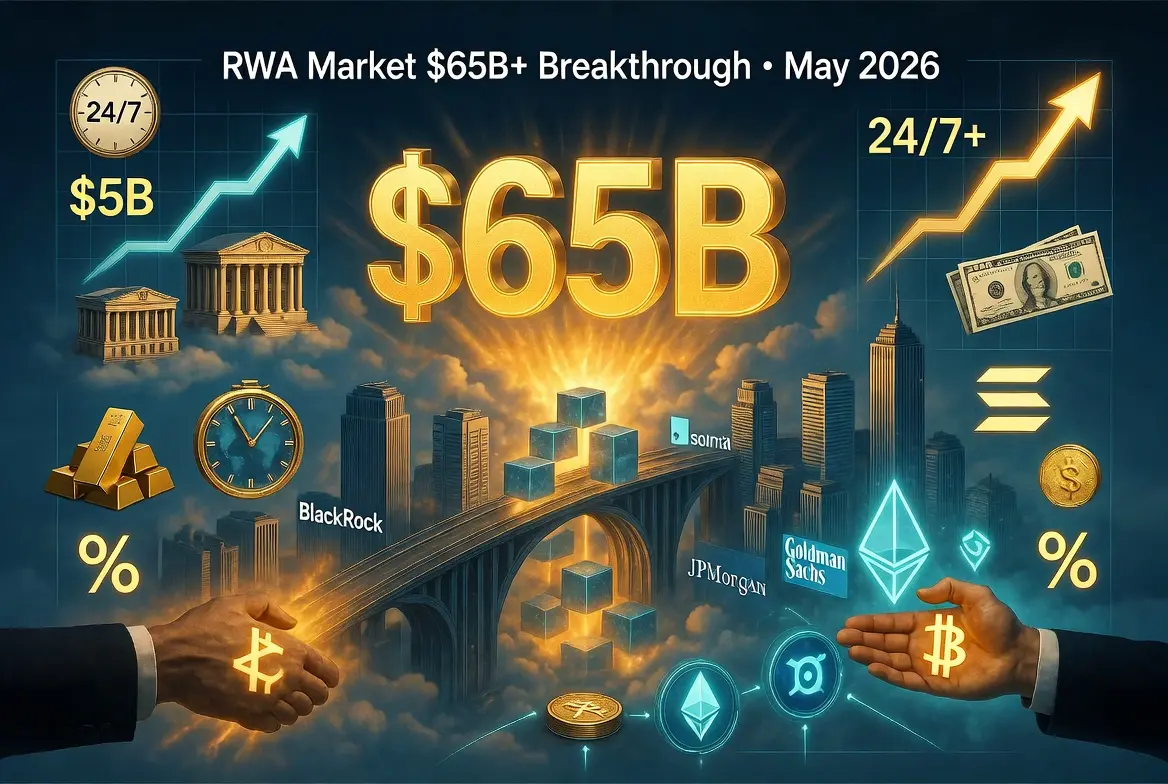
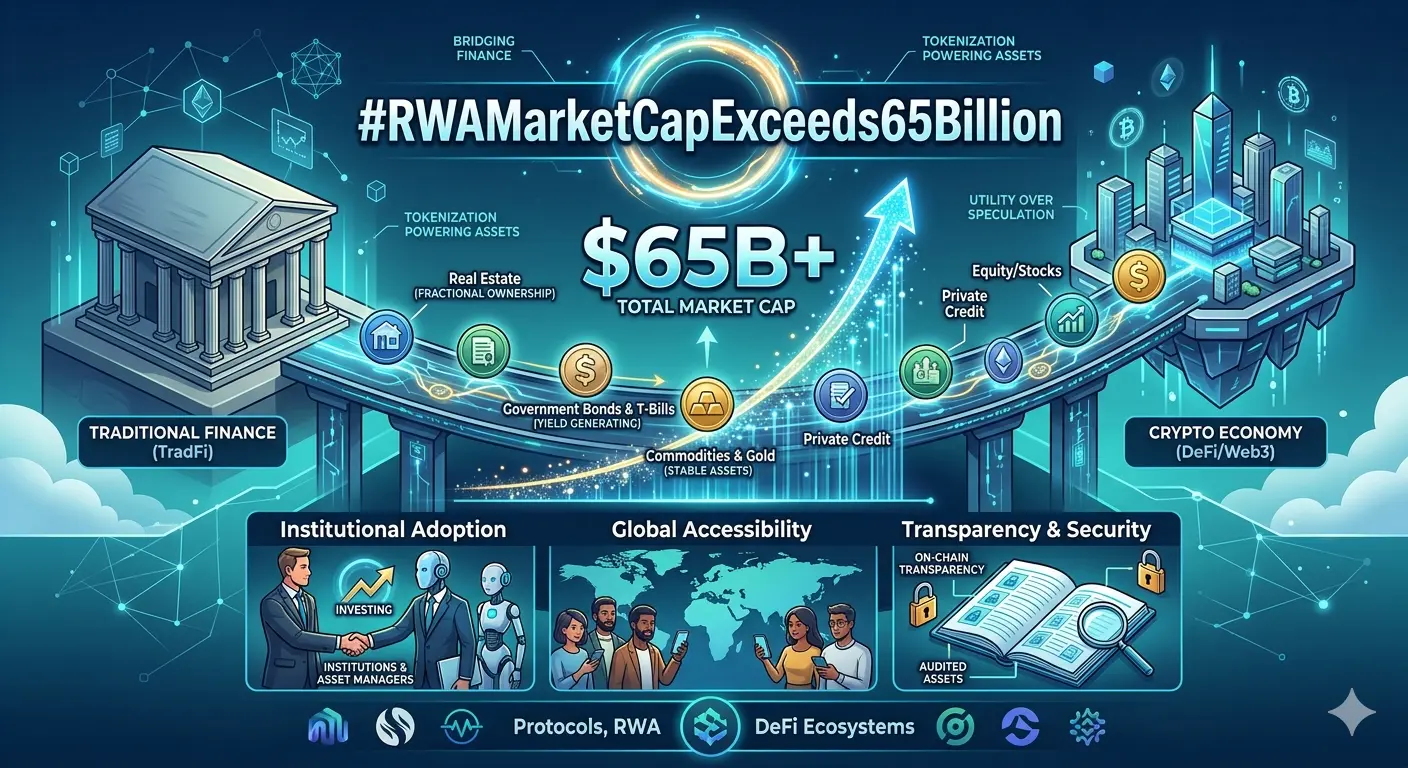
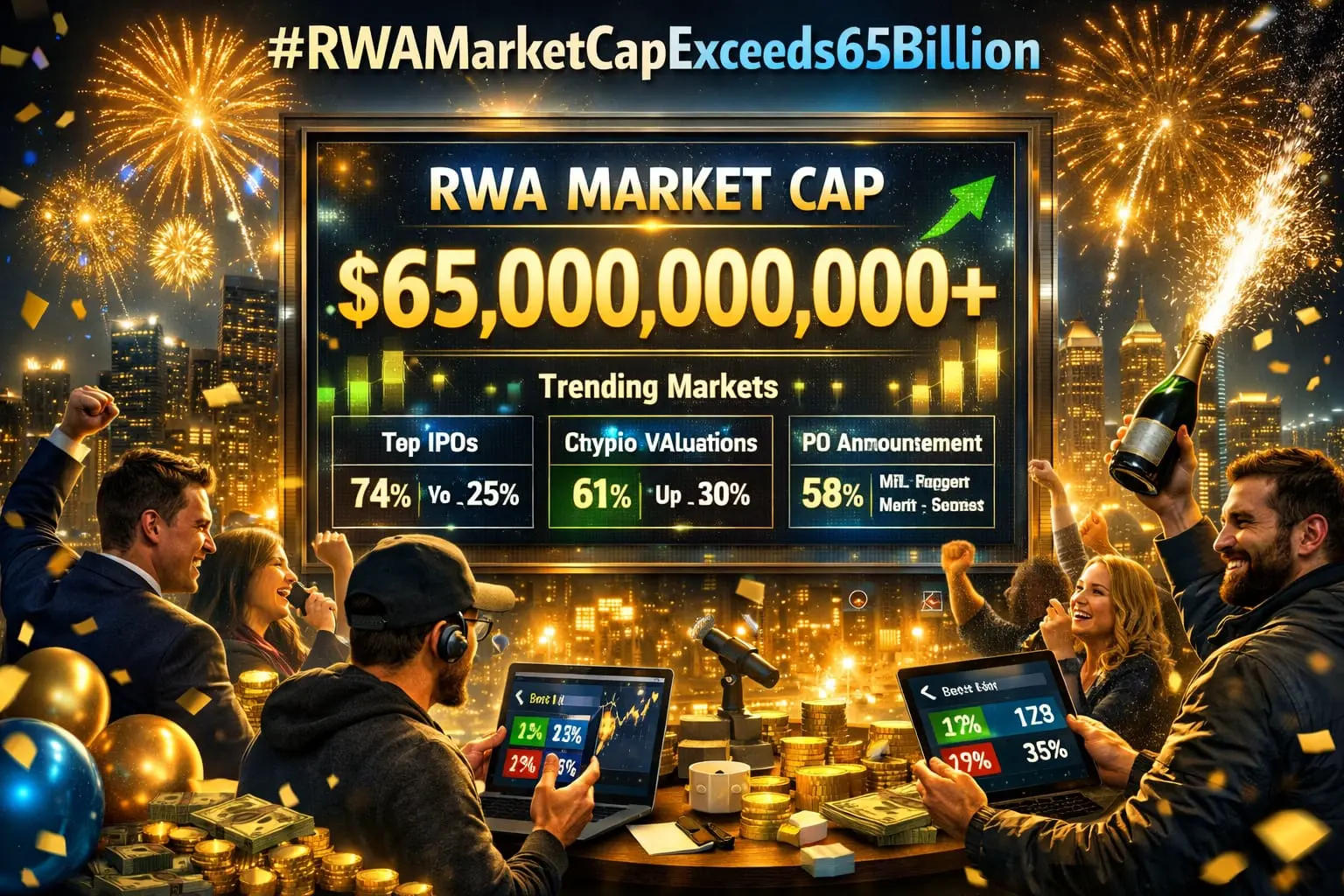
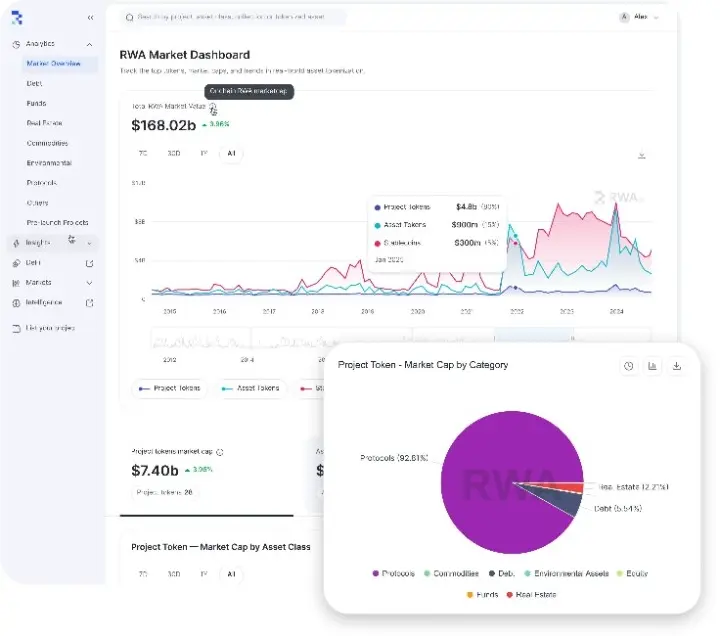
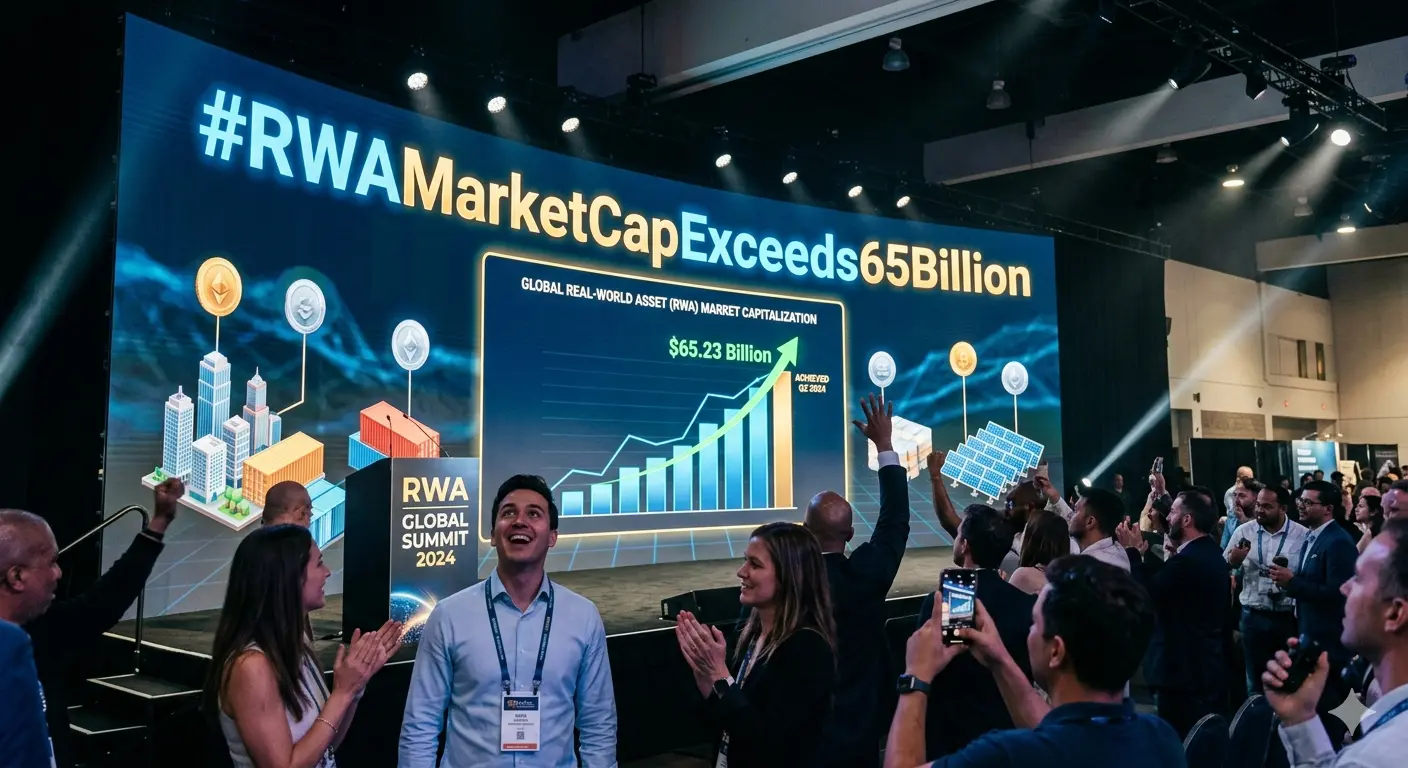
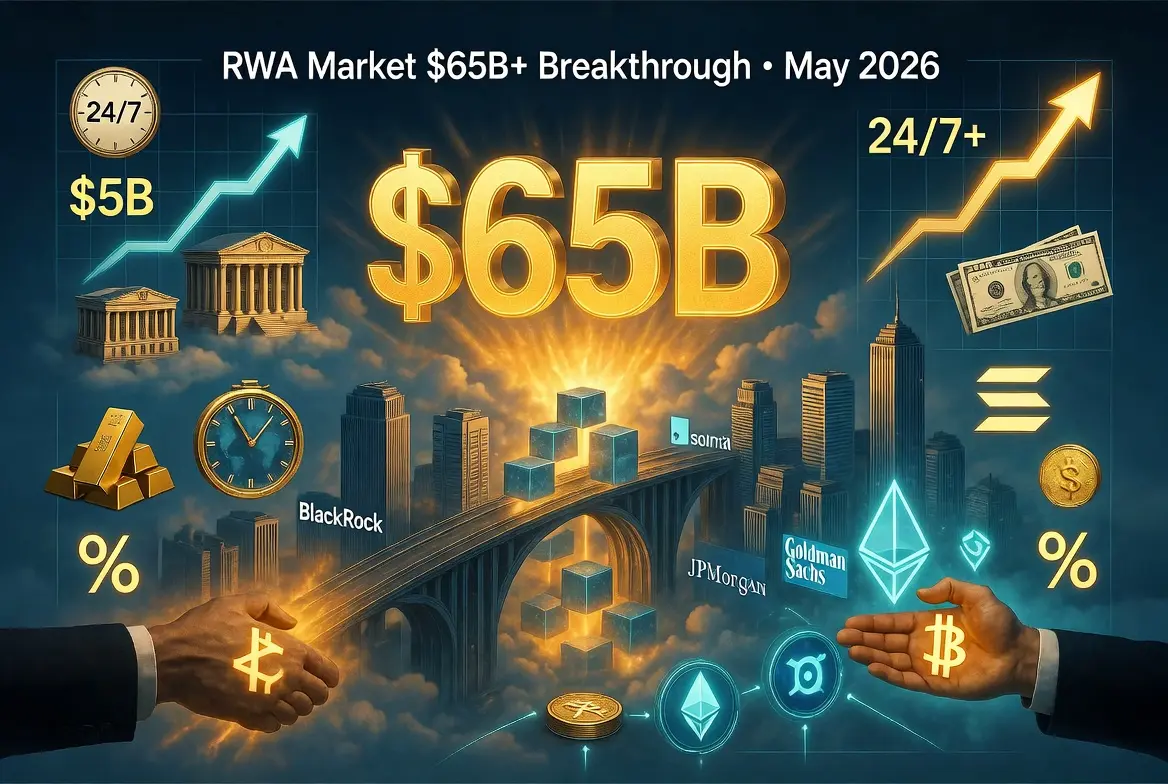
The Real World Assets (RWA) sector in crypto has officially entered a new financial era in May 2026 after crossing the $65 billion market capitalization milestone, which is widely considered one of the most important structural transitions in modern digital finance. This is not a short-term rally or a speculative spike, but a long-term transformation where traditional financial instruments are gradually being rebuilt on blockchain infrastructure.
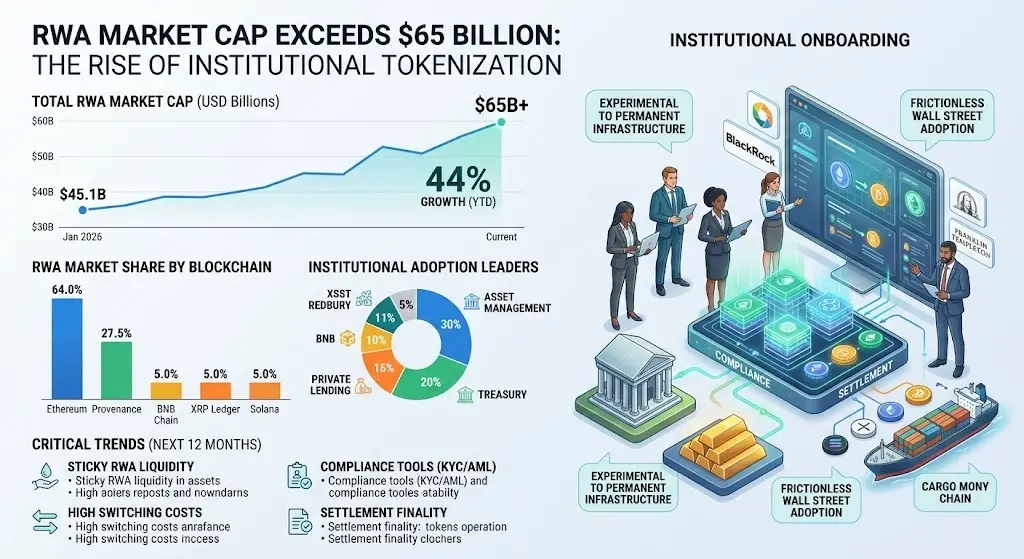
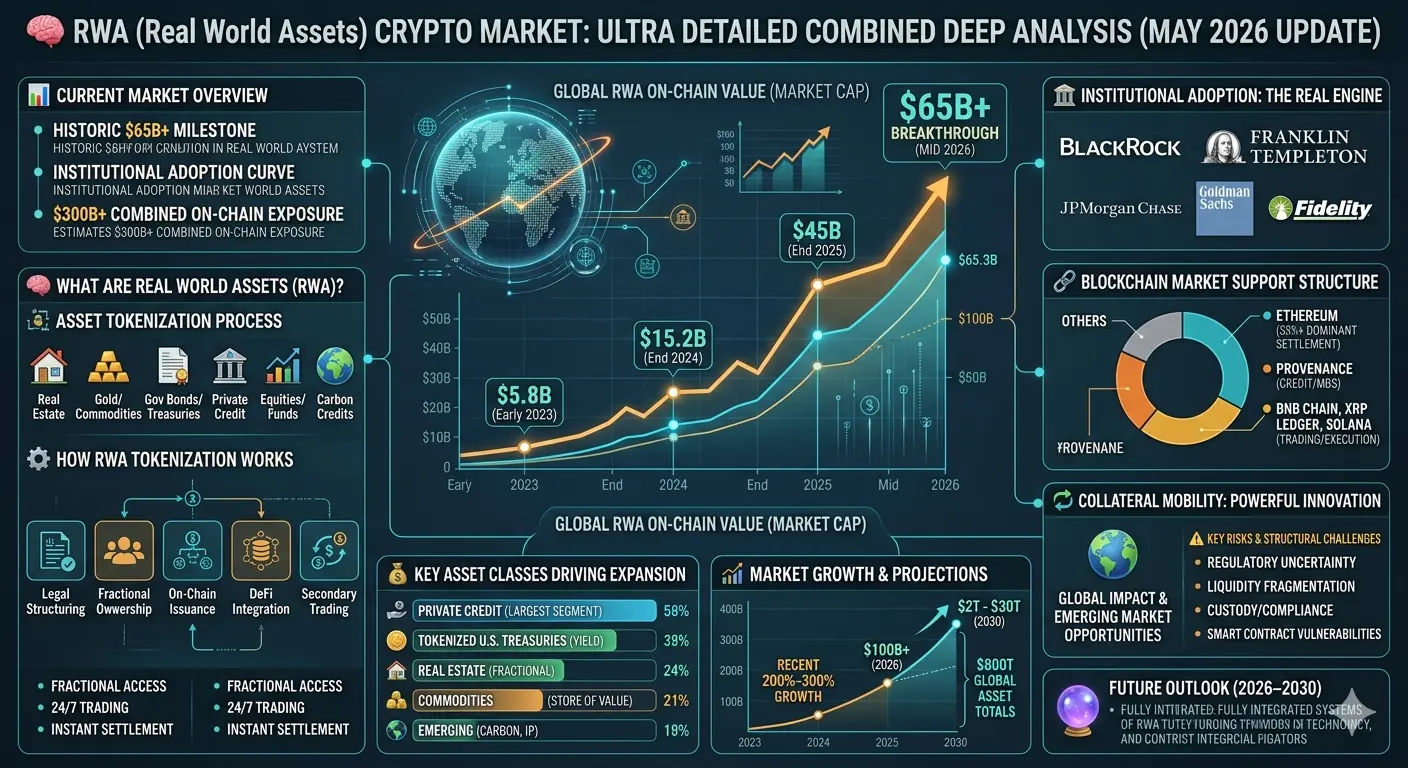
What makes this milestone so important is not just the number itself, but the speed and consistency of growth behind it. The sector has expanded from approximately $5.8B in early 2023, to around $15.2B by the end of 2024, then to nearly $45B by the end of 2025, and now reaching $65B+ in mid-2026. This type of growth reflects a compounding institutional adoption curve rather than retail-driven speculation.
At a broader structural level, analysts estimate that the total real-world asset exposure represented on-chain—including stablecoin liquidity layers, tokenized funds, and indirect financial instruments—has already crossed $300B+ in combined value representation, making RWA one of the fastest-growing intersections between traditional finance and blockchain technology.
This expansion confirms a powerful reality: RWA is no longer a narrative or experimental concept. It is becoming a fully functional financial infrastructure layer that sits between global capital markets and decentralized systems.
Deep Understanding: What Exactly Are Real World Assets (RWA)?
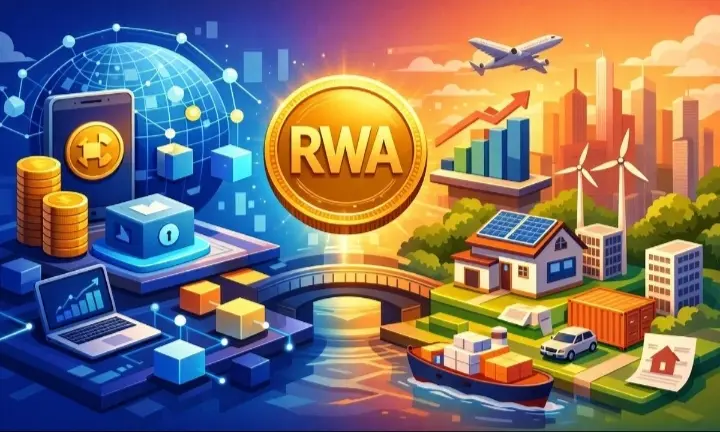
Real World Assets refer to physical, financial, and legally enforceable instruments from traditional markets that are converted into blockchain-based digital tokens through a process known as tokenization.
In simple financial terms, tokenization means converting ownership rights or cash flow rights of real assets into programmable digital units that can move freely across blockchain networks.
These assets include:
Real estate properties and land ownership structures
Gold, silver, and commodity reserves
Government bonds, treasury bills, and corporate debt instruments
Private credit portfolios and lending agreements
Equity shares, index exposure, and fund-based products
Carbon credits, invoices, and supply chain receivables
The transformation is not just technological—it is structural. It changes how ownership is recorded, how value is transferred, and how financial exposure is accessed globally.
How RWA Tokenization Actually Works in Practice
The RWA ecosystem operates through a deeply layered financial architecture that connects traditional finance with blockchain systems.
First, a real-world asset is legally structured under a compliant framework. Then ownership rights or cash-flow rights are divided into digital tokens. These tokens are issued on blockchain networks, where they can be transferred, traded, or used as collateral.
The key mechanisms include:
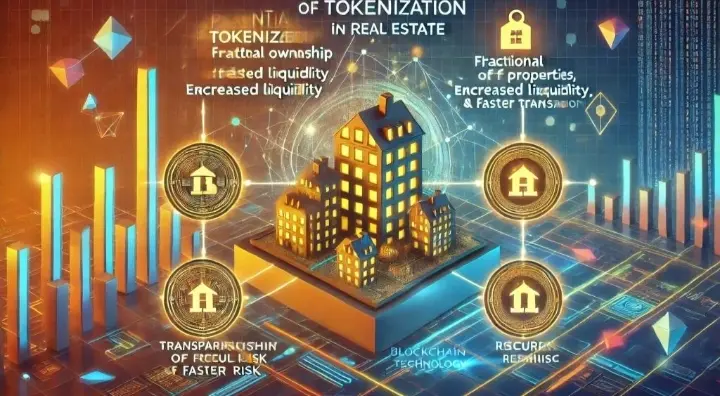
Fractional ownership allows large-scale assets such as real estate or private credit pools to be divided into small accessible units, making previously inaccessible markets available to global investors.
24/7 trading infrastructure removes traditional market hour limitations, enabling continuous liquidity flow across global time zones.
Instant settlement reduces dependency on slow banking rails and enables near real-time clearing of transactions.
Transparency layers provided by blockchain systems allow verifiable ownership tracking, reducing counterparty uncertainty.
DeFi integration enables tokenized assets to be used in lending protocols, liquidity pools, and structured yield systems.
This combination creates a financial environment where traditional assets become programmable, liquid, and globally accessible.
Institutional Adoption: The Real Engine Behind Growth
One of the most critical forces behind the rapid expansion of the RWA sector is the entry of global institutional capital. Unlike earlier crypto cycles driven mainly by retail speculation, the current RWA growth is driven by regulated financial institutions, asset managers, and banking networks.
Major institutions actively participating include:
BlackRock, which has pioneered tokenized Treasury products and is leading institutional-scale experiments in blockchain-based fund issuance.
Franklin Templeton, which has expanded tokenized money market funds and is actively distributing regulated on-chain investment products.
JPMorgan Chase, which has developed blockchain settlement systems and collateral mobility infrastructure through its Onyx platform.
Goldman Sachs, which is exploring tokenized bonds, structured credit instruments, and digital asset market integration.
Fidelity Investments, which is building digital asset custody and tokenization infrastructure for institutional clients.
The presence of these institutions signals a fundamental shift: blockchain is no longer competing with traditional finance—it is becoming part of it.
Blockchain Market Structure Supporting RWA Growth
The RWA ecosystem is not dominated by a single chain, but rather a multi-chain financial architecture where different networks serve different institutional roles.
Ethereum remains the dominant settlement layer with approximately 33%+ market share, largely due to its deep DeFi integration and institutional-grade security assumptions.
Provenance Blockchain holds a significant share due to its focus on mortgage-backed securities and structured credit products.
XRP Ledger, and Solana collectively support trading, settlement, and high-speed execution layers depending on institutional requirements.
This multi-chain structure reflects a realistic financial system design rather than a single-ecosystem monopoly.
Key Asset Classes Driving RWA Expansion
The growth of RWA is heavily concentrated in several high-value asset categories.
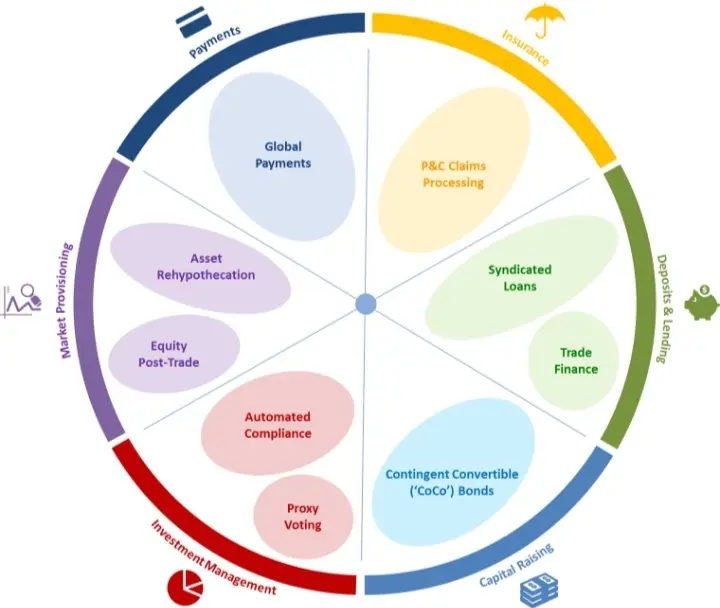
Private credit remains the largest segment, representing a major portion of total RWA value. This includes tokenized loans, structured debt, and syndicated lending markets that were previously accessible only to institutional investors.
Tokenized U.S. Treasuries represent another major growth engine, offering stable yield exposure through blockchain-based fund structures.
Real estate tokenization is expanding as legal frameworks mature, allowing fractional ownership of high-value properties.
Commodity tokenization, especially gold-backed assets, provides a stable store-of-value layer within the blockchain ecosystem.
Emerging categories such as carbon credits, intellectual property rights, and supply chain receivables are gradually expanding the boundaries of what can be tokenized.
Market Growth Dynamics and Long-Term Projections
The RWA sector is currently experiencing exponential growth rather than linear expansion. Over the past two years, the market has grown by more than 200%–300%, driven primarily by institutional inflows and infrastructure maturity.
Short-term projections suggest continued expansion toward $100B+ by the end of 2026, while long-term estimates from financial research institutions project the sector could reach anywhere between $2 trillion to $30 trillion by 2030, depending on adoption rates.
Considering that global real-world asset markets exceed approximately $800 trillion in total value, even a small percentage shift toward tokenization represents massive capital inflows into blockchain systems.
Collateral Mobility: The Most Powerful Innovation
One of the most transformative concepts within RWA is collateral mobility.
In traditional finance, assets often lose productivity when used as collateral because they must be locked, sold, or transferred into restricted systems.
In tokenized systems, the same asset can remain yield-generating while simultaneously being used as collateral for borrowing or liquidity access.
This creates a dual-layer financial system where capital efficiency increases significantly, and liquidity becomes continuously active rather than static.
Global Impact and Emerging Market Opportunities
In emerging regions such as South Asia and other developing economies, RWA introduces access to global financial instruments that were previously difficult to reach.
Investors can gain exposure to USD-based yield products, fractional real estate investments, and global credit markets without traditional banking limitations.
At the same time, cross-border settlement becomes faster and more efficient, reducing friction in international capital flows.
However, regulatory frameworks remain uneven, and compliance structures vary significantly across jurisdictions, making governance a key factor in adoption.
Key Risks and Structural Challenges
Despite strong momentum, the RWA sector still faces several structural risks.
Regulatory uncertainty remains one of the most important challenges, as global frameworks are still evolving.
Liquidity fragmentation across different chains can reduce market efficiency.
Custody, compliance, and legal enforceability require continued institutional-grade development.
Smart contract vulnerabilities also remain a technical risk factor that must be addressed through audits and insurance mechanisms.
Future Outlook: The Next Financial Evolution (2026–2030)
The future of RWA is expected to move toward full-scale integration of global financial systems into blockchain infrastructure.
We are likely to see tokenized real estate markets operating at institutional scale, AI-powered financial structuring systems, automated yield distribution mechanisms, and fully interoperable global settlement networks.
As adoption increases, RWA will likely become one of the largest and most important financial sectors in the world, reshaping how ownership, liquidity, and capital flow operate globally.
Final Conclusion: A Structural Shift in Global Finance
The crossing of the $65B RWA milestone represents a fundamental transformation rather than a temporary market trend.
Financial systems are evolving from slow, fragmented, institution-heavy structures into programmable, liquid, and globally accessible networks powered by blockchain infrastructure.
RWA is effectively bridging the gap between traditional finance and decentralized systems, creating a unified financial layer where real-world value and digital liquidity coexist.
The long-term implication is clear: this is not a cycle, but a deep structural evolution that will continue shaping global markets for decades to come.
Current Market Overview: The Historic $65B+ Breakthrough
The Real World Assets (RWA) sector in crypto has officially entered a new financial era in May 2026 after crossing the $65 billion market capitalization milestone, which is widely considered one of the most important structural transitions in modern digital finance. This is not a short-term rally or a speculative spike, but a long-term transformation where traditional financial instruments are gradually being rebuilt on blockchain infrastructure.
What makes this milestone so important is not just the number itself, but the speed and consistency of growth behind it. The sector has expanded from approximately $5.8B in early 2023, to around $15.2B by the end of 2024, then to nearly $45B by the end of 2025, and now reaching $65B+ in mid-2026. This type of growth reflects a compounding institutional adoption curve rather than retail-driven speculation.
At a broader structural level, analysts estimate that the total real-world asset exposure represented on-chain—including stablecoin liquidity layers, tokenized funds, and indirect financial instruments—has already crossed $300B+ in combined value representation, making RWA one of the fastest-growing intersections between traditional finance and blockchain technology.
This expansion confirms a powerful reality: RWA is no longer a narrative or experimental concept. It is becoming a fully functional financial infrastructure layer that sits between global capital markets and decentralized systems.
Deep Understanding: What Exactly Are Real World Assets (RWA)?
Real World Assets refer to physical, financial, and legally enforceable instruments from traditional markets that are converted into blockchain-based digital tokens through a process known as tokenization.
In simple financial terms, tokenization means converting ownership rights or cash flow rights of real assets into programmable digital units that can move freely across blockchain networks.
These assets include:
Real estate properties and land ownership structures
Gold, silver, and commodity reserves
Government bonds, treasury bills, and corporate debt instruments
Private credit portfolios and lending agreements
Equity shares, index exposure, and fund-based products
Carbon credits, invoices, and supply chain receivables
The transformation is not just technological—it is structural. It changes how ownership is recorded, how value is transferred, and how financial exposure is accessed globally.
How RWA Tokenization Actually Works in Practice
The RWA ecosystem operates through a deeply layered financial architecture that connects traditional finance with blockchain systems.
First, a real-world asset is legally structured under a compliant framework. Then ownership rights or cash-flow rights are divided into digital tokens. These tokens are issued on blockchain networks, where they can be transferred, traded, or used as collateral.
The key mechanisms include:
Fractional ownership allows large-scale assets such as real estate or private credit pools to be divided into small accessible units, making previously inaccessible markets available to global investors.
24/7 trading infrastructure removes traditional market hour limitations, enabling continuous liquidity flow across global time zones.
Instant settlement reduces dependency on slow banking rails and enables near real-time clearing of transactions.
Transparency layers provided by blockchain systems allow verifiable ownership tracking, reducing counterparty uncertainty.
DeFi integration enables tokenized assets to be used in lending protocols, liquidity pools, and structured yield systems.
This combination creates a financial environment where traditional assets become programmable, liquid, and globally accessible.
Institutional Adoption: The Real Engine Behind Growth
One of the most critical forces behind the rapid expansion of the RWA sector is the entry of global institutional capital. Unlike earlier crypto cycles driven mainly by retail speculation, the current RWA growth is driven by regulated financial institutions, asset managers, and banking networks.
Major institutions actively participating include:
BlackRock, which has pioneered tokenized Treasury products and is leading institutional-scale experiments in blockchain-based fund issuance.
Franklin Templeton, which has expanded tokenized money market funds and is actively distributing regulated on-chain investment products.
JPMorgan Chase, which has developed blockchain settlement systems and collateral mobility infrastructure through its Onyx platform.
Goldman Sachs, which is exploring tokenized bonds, structured credit instruments, and digital asset market integration.
Fidelity Investments, which is building digital asset custody and tokenization infrastructure for institutional clients.
The presence of these institutions signals a fundamental shift: blockchain is no longer competing with traditional finance—it is becoming part of it.
Blockchain Market Structure Supporting RWA Growth
The RWA ecosystem is not dominated by a single chain, but rather a multi-chain financial architecture where different networks serve different institutional roles.
Ethereum remains the dominant settlement layer with approximately 33%+ market share, largely due to its deep DeFi integration and institutional-grade security assumptions.
Provenance Blockchain holds a significant share due to its focus on mortgage-backed securities and structured credit products.
XRP Ledger, and Solana collectively support trading, settlement, and high-speed execution layers depending on institutional requirements.
This multi-chain structure reflects a realistic financial system design rather than a single-ecosystem monopoly.
Key Asset Classes Driving RWA Expansion
The growth of RWA is heavily concentrated in several high-value asset categories.
Private credit remains the largest segment, representing a major portion of total RWA value. This includes tokenized loans, structured debt, and syndicated lending markets that were previously accessible only to institutional investors.
Tokenized U.S. Treasuries represent another major growth engine, offering stable yield exposure through blockchain-based fund structures.
Real estate tokenization is expanding as legal frameworks mature, allowing fractional ownership of high-value properties.
Commodity tokenization, especially gold-backed assets, provides a stable store-of-value layer within the blockchain ecosystem.
Emerging categories such as carbon credits, intellectual property rights, and supply chain receivables are gradually expanding the boundaries of what can be tokenized.
Market Growth Dynamics and Long-Term Projections
The RWA sector is currently experiencing exponential growth rather than linear expansion. Over the past two years, the market has grown by more than 200%–300%, driven primarily by institutional inflows and infrastructure maturity.
Short-term projections suggest continued expansion toward $100B+ by the end of 2026, while long-term estimates from financial research institutions project the sector could reach anywhere between $2 trillion to $30 trillion by 2030, depending on adoption rates.
Considering that global real-world asset markets exceed approximately $800 trillion in total value, even a small percentage shift toward tokenization represents massive capital inflows into blockchain systems.
Collateral Mobility: The Most Powerful Innovation
One of the most transformative concepts within RWA is collateral mobility.
In traditional finance, assets often lose productivity when used as collateral because they must be locked, sold, or transferred into restricted systems.
In tokenized systems, the same asset can remain yield-generating while simultaneously being used as collateral for borrowing or liquidity access.
This creates a dual-layer financial system where capital efficiency increases significantly, and liquidity becomes continuously active rather than static.
Global Impact and Emerging Market Opportunities
In emerging regions such as South Asia and other developing economies, RWA introduces access to global financial instruments that were previously difficult to reach.
Investors can gain exposure to USD-based yield products, fractional real estate investments, and global credit markets without traditional banking limitations.
At the same time, cross-border settlement becomes faster and more efficient, reducing friction in international capital flows.
However, regulatory frameworks remain uneven, and compliance structures vary significantly across jurisdictions, making governance a key factor in adoption.
Key Risks and Structural Challenges
Despite strong momentum, the RWA sector still faces several structural risks.
Regulatory uncertainty remains one of the most important challenges, as global frameworks are still evolving.
Liquidity fragmentation across different chains can reduce market efficiency.
Custody, compliance, and legal enforceability require continued institutional-grade development.
Smart contract vulnerabilities also remain a technical risk factor that must be addressed through audits and insurance mechanisms.
Future Outlook: The Next Financial Evolution (2026–2030)
The future of RWA is expected to move toward full-scale integration of global financial systems into blockchain infrastructure.
We are likely to see tokenized real estate markets operating at institutional scale, AI-powered financial structuring systems, automated yield distribution mechanisms, and fully interoperable global settlement networks.
As adoption increases, RWA will likely become one of the largest and most important financial sectors in the world, reshaping how ownership, liquidity, and capital flow operate globally.
Final Conclusion: A Structural Shift in Global Finance
The crossing of the $65B RWA milestone represents a fundamental transformation rather than a temporary market trend.
Financial systems are evolving from slow, fragmented, institution-heavy structures into programmable, liquid, and globally accessible networks powered by blockchain infrastructure.
RWA is effectively bridging the gap between traditional finance and decentralized systems, creating a unified financial layer where real-world value and digital liquidity coexist.
The long-term implication is clear: this is not a cycle, but a deep structural evolution that will continue shaping global markets for decades to come.