#USIran14PointMemoLeaked
The recent leak of the 14 point draft memorandum between the United States and Iran has sent ripples through global financial markets, with significant implications for the cryptocurrency sector. This development comes at a critical juncture when Bitcoin was trading around 65750 after recovering from a low near 59000, making it essential to understand the full context and potential market consequences.
Why the 14 Point Memo Was Leaked
The draft memorandum surfaced through multiple channels in mid June 2026, with Iranian semi official media outlet Mehr being among the first to publish what it claimed were the complete 14 points. The leak appears to have been strategic, originating from sources close to Iran's negotiating team, possibly intended to gauge public and market reaction before formal commitments were made. According to reports from Bloomberg and Axios, the document outlines a framework to end hostilities and reopen the Strait of Hormuz, with both sides expected to formally sign on June 19 in Switzerland.
The timing of this leak was significant. It came after months of tensions that had kept oil prices elevated and created uncertainty across risk assets. The leak served as a confidence building measure, allowing markets to price in the potential de escalation before official confirmation. Pakistani mediators played a key role in facilitating these discussions, with Prime Minister Shehbaz Sharif announcing the deal alongside statements from President Donald Trump and Iranian officials.
Key Points of the 14 Point Draft Memorandum
The leaked document contains several critical provisions that directly impact global markets. First, it calls for an immediate and permanent ceasefire on all fronts, including Lebanon. Second, the United States commits to lifting its maritime blockade and allowing Iran to reopen the Strait of Hormuz within approximately 30 days under Iranian arrangements. Third, the US pledges to release roughly 12 to 24 billion dollars in frozen Iranian assets over a 60 day period, with some upfront access granted before deeper nuclear negotiations commence.
Other important elements include Iran reaffirming its commitment against building nuclear weapons, though detailed provisions on enrichment levels, stockpile verification, and inspection protocols remain deferred to follow on talks. The draft also includes US commitments not to interfere in Iran's internal affairs and removes explicit regime change demands. These provisions collectively represent a significant shift from previous confrontational postures.
Immediate Impact on Bitcoin and Crypto Markets
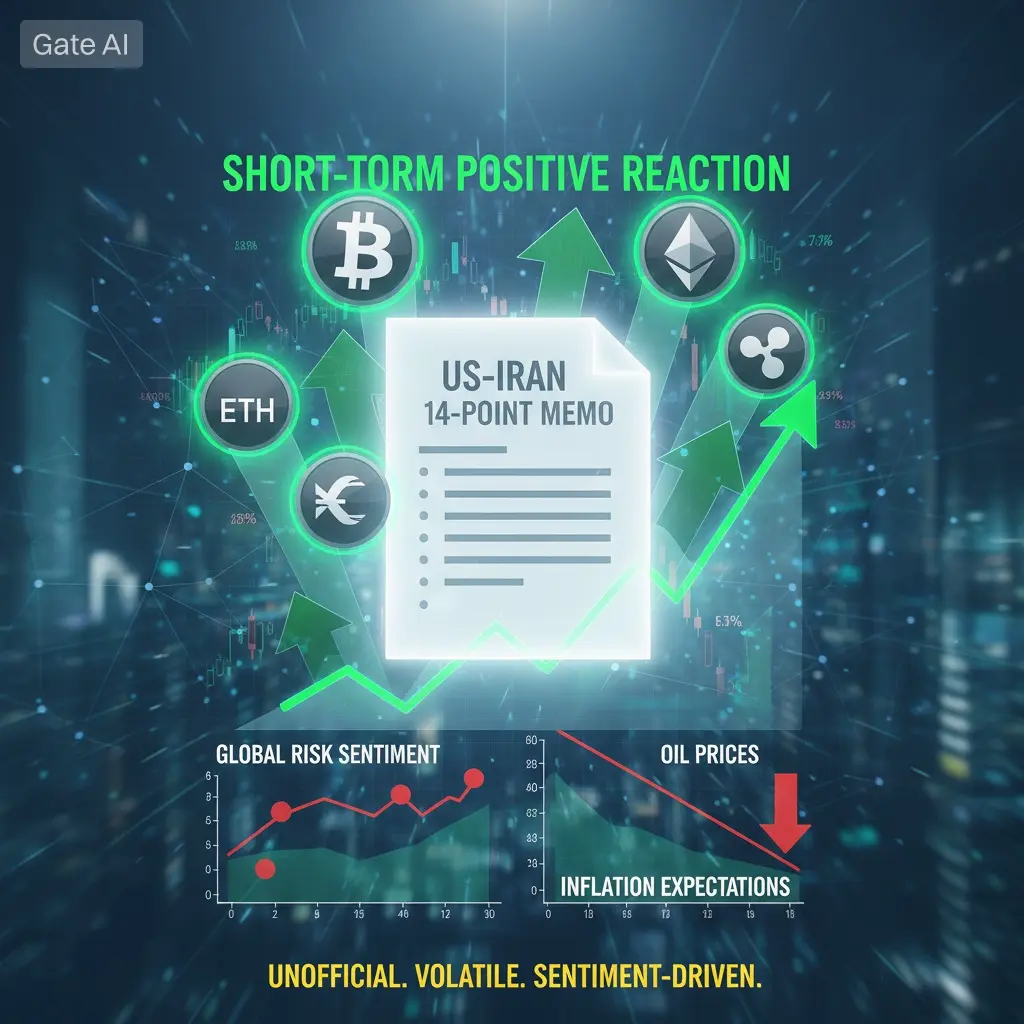
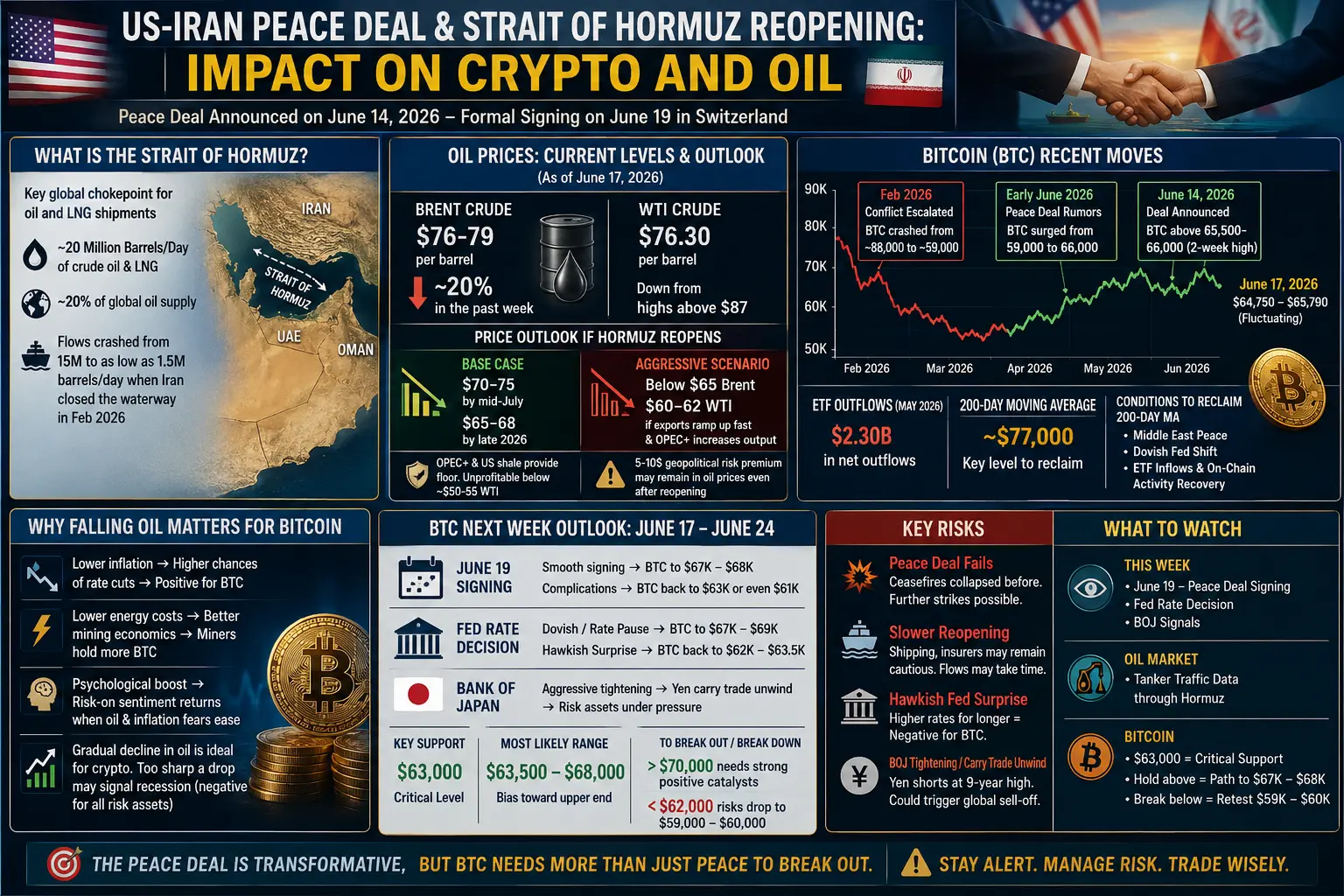
The leak triggered an immediate positive reaction across cryptocurrency markets. Bitcoin surged approximately 2% to reach 65800, marking its highest level in nearly two weeks. This rally came after the digital asset had touched a low near 63722 in early Asian trading before the news broke. The move represented a recovery of about 9% from the sub 60000 low hit the previous week, which was Bitcoin's weakest level since October 2024.
The rally was broad based across the crypto ecosystem. Ether rose 2.5% to 1721, Solana gained 3.6% to 71, and XRP added 3.2% to 1.19. Hyperliquid's HYPE token was the standout performer, up 7.5% to nearly 65. Even BNB and Dogecoin added more than 1% each. This synchronized movement indicated that the market interpreted the memo leak as a genuine risk on signal rather than isolated Bitcoin strength.
Why Crypto Markets Reacted Positively
Several interconnected factors explain the bullish reaction in cryptocurrency markets. First, the prospect of reduced geopolitical risk in the Middle East improved global risk sentiment. When major conflicts show signs of resolution, investors typically rotate capital back into risk assets, including cryptocurrencies. The removal of the energy supply fear that had weighed on markets since late February created a more favorable environment for speculative investments.
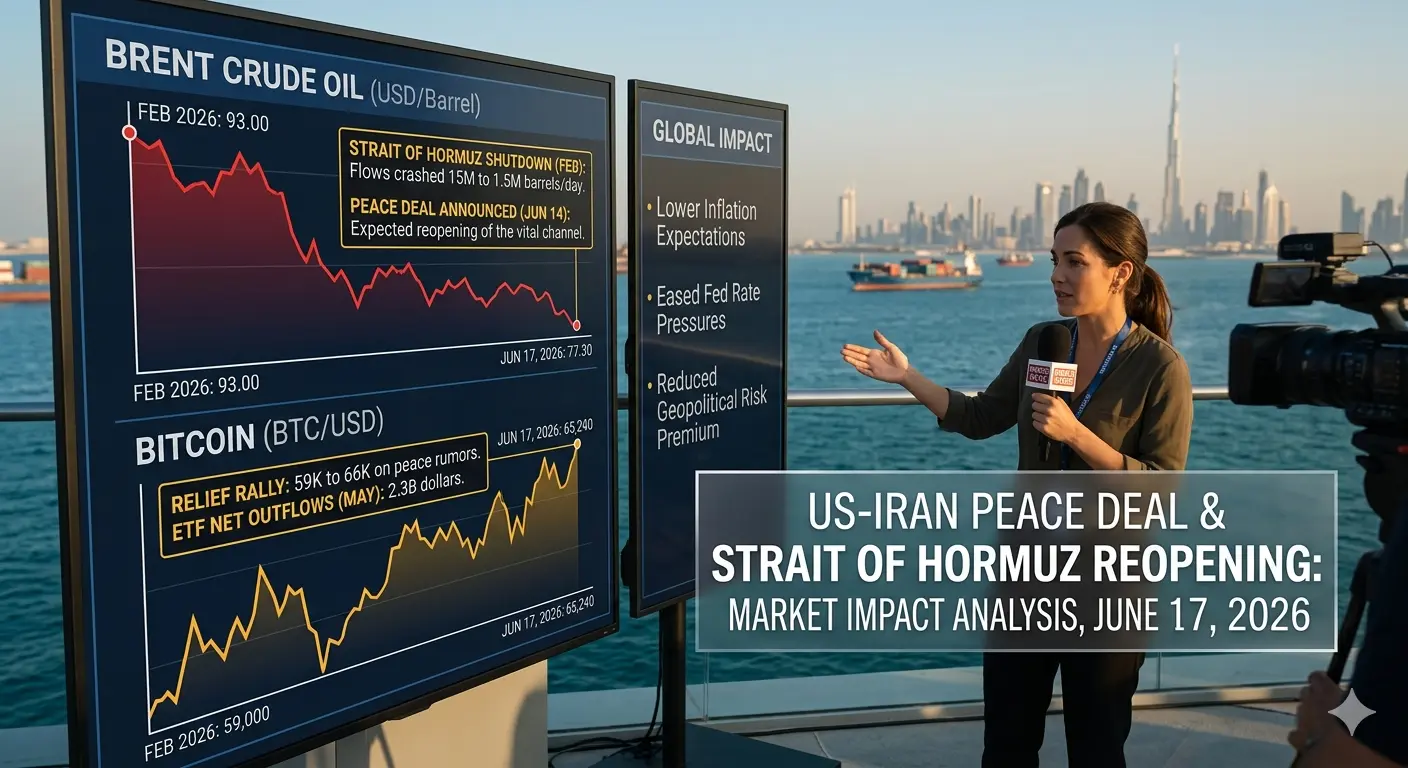
Second, the agreement's impact on oil prices indirectly benefited crypto. Brent crude slumped more than 4% toward 83 dollars per barrel as traders unwound the geopolitical premium. Lower oil prices reduce inflationary pressures, which in turn decreases the likelihood of aggressive Federal Reserve rate hikes. Since higher interest rates typically draw capital away from risk assets like Bitcoin, the prospect of a more accommodative monetary policy stance supported crypto valuations.
Third, the reopening of the Strait of Hormuz removes a major supply chain disruption risk. Approximately 20% of global oil shipments pass through this chokepoint, and its closure would have had severe economic consequences. The elimination of this tail risk allows investors to focus on fundamental factors rather than geopolitical hedging.
Historical Context and Price Action Patterns
The current price action mirrors patterns observed during previous geopolitical de escalations. When preliminary ceasefire agreements were announced in April 2026, Bitcoin experienced similar rallies. However, traders should note that when the April ceasefire collapsed and US strikes broke a second truce on June 9, Bitcoin gave back the entire move both times. This historical precedent suggests that until a deal is fully confirmed and implemented, price movements may remain volatile and potentially temporary.
Bitcoin's journey from 59000 to 65750 illustrates this volatility. The initial drop below 60000 was driven by multiple factors including Iran tensions feeding higher oil prices, which reinforced bets on higher interest rates. The subsequent recovery to 66000 represents the unwinding of these pressures. However, the sustainability of this rally depends on whether institutional flows align with the improved risk sentiment.
Limitations and Risks to the Current Rally
Despite the positive price action, several factors could limit Bitcoin's recovery. Strategy's disclosure earlier in June that it sold 32 Bitcoin to fund preferred share dividends sparked a selloff that exposed how much of crypto's bid had rested on the assumption that Michael Saylor would never sell. This event revealed underlying fragility in institutional demand that a peace deal alone cannot address.
Additionally, sustained ETF outflows have added pressure to the market. Neither of these demand questions gets answered by a peace deal alone. Analysts at Wincent noted that while the reduction in geopolitical risk drove an overnight rally, it does little to change the broader outlook. For Bitcoin to break out of its current range and reclaim its 200 day moving average near 77000, three pieces need to fall into place simultaneously: sustained institutional inflows, continued geopolitical stability, and favorable macroeconomic conditions.
The Nature of the Agreement: Draft vs Final
It is crucial to understand that the leaked 14 point document is a memorandum of understanding, not a binding peace treaty or comprehensive nuclear deal. It represents an agreement to pause hostilities and commit to further 60 day negotiations on nuclear issues. The final negotiations would not begin before the release of half of Iran's frozen assets, suspension of oil sanctions, and lifting of the naval blockade.
This distinction matters for crypto markets because draft agreements carry execution risk. President Trump himself stated on June 15 that he had instructed US negotiators not to rush into a deal and that both sides must take their time and get it right. He emphasized that the agreement had not even been fully negotiated yet. These comments introduce uncertainty that could cap upside potential until formal signatures are exchanged.
Medium to Long Term Implications for Crypto
If the memorandum is successfully implemented and leads to comprehensive nuclear negotiations, the implications for cryptocurrency markets could extend beyond the immediate price reaction. A stable Middle East reduces systemic risk in global financial markets, potentially allowing for greater institutional adoption of digital assets. The release of frozen Iranian assets could also increase liquidity in certain market segments, though direct crypto market impact would likely be limited.
However, traders should remain cautious. The crypto market's reaction to geopolitical news has historically been short lived unless accompanied by fundamental improvements in adoption or regulatory clarity. The current rally appears driven primarily by sentiment rather than structural changes in demand. Asian stocks jumped more than 3% on the news, with Japan's Nikkei 225 heading for a record close, and S&P 500 futures were up 1.2%. These moves suggest the risk on sentiment is broad based, but also that crypto may face competition for capital from traditional equities.
What to Watch Going Forward
Crypto investors should monitor several key developments in the coming weeks. First, the formal signing scheduled for June 19 in Switzerland will be a critical milestone. Any delays or complications could trigger a reversal of the current rally. Second, the 60 day negotiation period that follows will determine whether this initial agreement leads to lasting peace or merely pauses hostilities temporarily.
Third, institutional flow data will indicate whether the improved sentiment translates into actual capital deployment. Bitcoin's ability to hold above the 65000 level in the face of potential profit taking will signal whether the market believes the deal has genuine staying power. Finally, oil price movements will serve as a real time indicator of market confidence in the agreement's implementation.
Conclusion: Positive but Conditional
The US Iran 14 point memo leak represents a net positive development for cryptocurrency markets in the short term. Bitcoin's move from below 60000 to 65750 demonstrates how quickly sentiment can shift when geopolitical risks appear to diminish. The removal of energy supply fears, potential for reduced inflationary pressures, and improved global risk appetite all support higher crypto valuations.
However, the rally remains conditional on successful implementation of the agreement. Historical precedent from April and early June shows that failed ceasefires can quickly erase gains. Until the memorandum is formally signed and the 60 day negotiation process demonstrates genuine progress, traders should treat the current price levels as vulnerable to reversal. The crypto market has shown it can rally on hope, but sustainable uptrends require confirmation that this hope translates into reality.
For Bitcoin specifically, the path to reclaiming 70000 and beyond depends not just on geopolitical stability, but on resolving underlying questions about institutional demand and ETF flows. The Iran deal removes one headwind, but several others remain. Prudent investors will celebrate the current gains while maintaining awareness that in the volatile intersection of geopolitics and cryptocurrency, today's breakthrough can become tomorrow's uncertainty with remarkable speed.#MyGateTradeStory @Gate_Square
The recent leak of the 14 point draft memorandum between the United States and Iran has sent ripples through global financial markets, with significant implications for the cryptocurrency sector. This development comes at a critical juncture when Bitcoin was trading around 65750 after recovering from a low near 59000, making it essential to understand the full context and potential market consequences.
Why the 14 Point Memo Was Leaked
The draft memorandum surfaced through multiple channels in mid June 2026, with Iranian semi official media outlet Mehr being among the first to publish what it claimed were the complete 14 points. The leak appears to have been strategic, originating from sources close to Iran's negotiating team, possibly intended to gauge public and market reaction before formal commitments were made. According to reports from Bloomberg and Axios, the document outlines a framework to end hostilities and reopen the Strait of Hormuz, with both sides expected to formally sign on June 19 in Switzerland.
The timing of this leak was significant. It came after months of tensions that had kept oil prices elevated and created uncertainty across risk assets. The leak served as a confidence building measure, allowing markets to price in the potential de escalation before official confirmation. Pakistani mediators played a key role in facilitating these discussions, with Prime Minister Shehbaz Sharif announcing the deal alongside statements from President Donald Trump and Iranian officials.
Key Points of the 14 Point Draft Memorandum
The leaked document contains several critical provisions that directly impact global markets. First, it calls for an immediate and permanent ceasefire on all fronts, including Lebanon. Second, the United States commits to lifting its maritime blockade and allowing Iran to reopen the Strait of Hormuz within approximately 30 days under Iranian arrangements. Third, the US pledges to release roughly 12 to 24 billion dollars in frozen Iranian assets over a 60 day period, with some upfront access granted before deeper nuclear negotiations commence.
Other important elements include Iran reaffirming its commitment against building nuclear weapons, though detailed provisions on enrichment levels, stockpile verification, and inspection protocols remain deferred to follow on talks. The draft also includes US commitments not to interfere in Iran's internal affairs and removes explicit regime change demands. These provisions collectively represent a significant shift from previous confrontational postures.
Immediate Impact on Bitcoin and Crypto Markets
The leak triggered an immediate positive reaction across cryptocurrency markets. Bitcoin surged approximately 2% to reach 65800, marking its highest level in nearly two weeks. This rally came after the digital asset had touched a low near 63722 in early Asian trading before the news broke. The move represented a recovery of about 9% from the sub 60000 low hit the previous week, which was Bitcoin's weakest level since October 2024.
The rally was broad based across the crypto ecosystem. Ether rose 2.5% to 1721, Solana gained 3.6% to 71, and XRP added 3.2% to 1.19. Hyperliquid's HYPE token was the standout performer, up 7.5% to nearly 65. Even BNB and Dogecoin added more than 1% each. This synchronized movement indicated that the market interpreted the memo leak as a genuine risk on signal rather than isolated Bitcoin strength.
Why Crypto Markets Reacted Positively
Several interconnected factors explain the bullish reaction in cryptocurrency markets. First, the prospect of reduced geopolitical risk in the Middle East improved global risk sentiment. When major conflicts show signs of resolution, investors typically rotate capital back into risk assets, including cryptocurrencies. The removal of the energy supply fear that had weighed on markets since late February created a more favorable environment for speculative investments.
Second, the agreement's impact on oil prices indirectly benefited crypto. Brent crude slumped more than 4% toward 83 dollars per barrel as traders unwound the geopolitical premium. Lower oil prices reduce inflationary pressures, which in turn decreases the likelihood of aggressive Federal Reserve rate hikes. Since higher interest rates typically draw capital away from risk assets like Bitcoin, the prospect of a more accommodative monetary policy stance supported crypto valuations.
Third, the reopening of the Strait of Hormuz removes a major supply chain disruption risk. Approximately 20% of global oil shipments pass through this chokepoint, and its closure would have had severe economic consequences. The elimination of this tail risk allows investors to focus on fundamental factors rather than geopolitical hedging.
Historical Context and Price Action Patterns
The current price action mirrors patterns observed during previous geopolitical de escalations. When preliminary ceasefire agreements were announced in April 2026, Bitcoin experienced similar rallies. However, traders should note that when the April ceasefire collapsed and US strikes broke a second truce on June 9, Bitcoin gave back the entire move both times. This historical precedent suggests that until a deal is fully confirmed and implemented, price movements may remain volatile and potentially temporary.
Bitcoin's journey from 59000 to 65750 illustrates this volatility. The initial drop below 60000 was driven by multiple factors including Iran tensions feeding higher oil prices, which reinforced bets on higher interest rates. The subsequent recovery to 66000 represents the unwinding of these pressures. However, the sustainability of this rally depends on whether institutional flows align with the improved risk sentiment.
Limitations and Risks to the Current Rally
Despite the positive price action, several factors could limit Bitcoin's recovery. Strategy's disclosure earlier in June that it sold 32 Bitcoin to fund preferred share dividends sparked a selloff that exposed how much of crypto's bid had rested on the assumption that Michael Saylor would never sell. This event revealed underlying fragility in institutional demand that a peace deal alone cannot address.
Additionally, sustained ETF outflows have added pressure to the market. Neither of these demand questions gets answered by a peace deal alone. Analysts at Wincent noted that while the reduction in geopolitical risk drove an overnight rally, it does little to change the broader outlook. For Bitcoin to break out of its current range and reclaim its 200 day moving average near 77000, three pieces need to fall into place simultaneously: sustained institutional inflows, continued geopolitical stability, and favorable macroeconomic conditions.
The Nature of the Agreement: Draft vs Final
It is crucial to understand that the leaked 14 point document is a memorandum of understanding, not a binding peace treaty or comprehensive nuclear deal. It represents an agreement to pause hostilities and commit to further 60 day negotiations on nuclear issues. The final negotiations would not begin before the release of half of Iran's frozen assets, suspension of oil sanctions, and lifting of the naval blockade.
This distinction matters for crypto markets because draft agreements carry execution risk. President Trump himself stated on June 15 that he had instructed US negotiators not to rush into a deal and that both sides must take their time and get it right. He emphasized that the agreement had not even been fully negotiated yet. These comments introduce uncertainty that could cap upside potential until formal signatures are exchanged.
Medium to Long Term Implications for Crypto
If the memorandum is successfully implemented and leads to comprehensive nuclear negotiations, the implications for cryptocurrency markets could extend beyond the immediate price reaction. A stable Middle East reduces systemic risk in global financial markets, potentially allowing for greater institutional adoption of digital assets. The release of frozen Iranian assets could also increase liquidity in certain market segments, though direct crypto market impact would likely be limited.
However, traders should remain cautious. The crypto market's reaction to geopolitical news has historically been short lived unless accompanied by fundamental improvements in adoption or regulatory clarity. The current rally appears driven primarily by sentiment rather than structural changes in demand. Asian stocks jumped more than 3% on the news, with Japan's Nikkei 225 heading for a record close, and S&P 500 futures were up 1.2%. These moves suggest the risk on sentiment is broad based, but also that crypto may face competition for capital from traditional equities.
What to Watch Going Forward
Crypto investors should monitor several key developments in the coming weeks. First, the formal signing scheduled for June 19 in Switzerland will be a critical milestone. Any delays or complications could trigger a reversal of the current rally. Second, the 60 day negotiation period that follows will determine whether this initial agreement leads to lasting peace or merely pauses hostilities temporarily.
Third, institutional flow data will indicate whether the improved sentiment translates into actual capital deployment. Bitcoin's ability to hold above the 65000 level in the face of potential profit taking will signal whether the market believes the deal has genuine staying power. Finally, oil price movements will serve as a real time indicator of market confidence in the agreement's implementation.
Conclusion: Positive but Conditional
The US Iran 14 point memo leak represents a net positive development for cryptocurrency markets in the short term. Bitcoin's move from below 60000 to 65750 demonstrates how quickly sentiment can shift when geopolitical risks appear to diminish. The removal of energy supply fears, potential for reduced inflationary pressures, and improved global risk appetite all support higher crypto valuations.
However, the rally remains conditional on successful implementation of the agreement. Historical precedent from April and early June shows that failed ceasefires can quickly erase gains. Until the memorandum is formally signed and the 60 day negotiation process demonstrates genuine progress, traders should treat the current price levels as vulnerable to reversal. The crypto market has shown it can rally on hope, but sustainable uptrends require confirmation that this hope translates into reality.
For Bitcoin specifically, the path to reclaiming 70000 and beyond depends not just on geopolitical stability, but on resolving underlying questions about institutional demand and ETF flows. The Iran deal removes one headwind, but several others remain. Prudent investors will celebrate the current gains while maintaining awareness that in the volatile intersection of geopolitics and cryptocurrency, today's breakthrough can become tomorrow's uncertainty with remarkable speed.#MyGateTradeStory @Gate_Square