# YenHits40YearLow

2.11M

The yen fell below 162 per dollar, hitting its lowest since 1986. The BOJ just hiked rates to 1% in June, but intervention and hikes combined couldn't stop the slide — the root cause is the massive U.S.-Japan rate gap . Markets are watching for another intervention, but history shows it only offers a temporary fix .

Japan Just Gave $BTC a Major Bullish Signal
The 20% tax is not the story.
Regulatory clarity is.
For years uncertainty has been one of the biggest barriers to institutional participation.
Japan just reduced that uncertainty.
Markets often fear regulation until capital starts treating it as a foundation.
Bullish for $BTC over the long term?
#BTC #Bitcoin #Crypto #japan
BTC-0.56%
post-image
  • Reward
  • Comment
  • Repost
  • Share
Japan officially recognizes $XRP as a financial asset under the FIEA framework 🇯🇵
New crypto tax regulations are now taking shape, signaling a major step toward mainstream digital asset adoption.
Many believe this could strengthen XRP’s role in the future of global finance 👀
#XRP #Crypto #Ripple #Japan #DigitalAssets
  • Reward
  • 1
  • Repost
  • Share
sehu93:
Bull Run 🐂
🚨 HUGE:
🇯🇵 Japan’s NIKKEI just gained more than $210 BILLION in market value in a single day after inflation cooled to 1.4%, marking its lowest reading in 4 years.
This is a major macro signal because easing inflation reduces pressure on aggressive tightening and improves overall risk sentiment across global markets.
Why does this matter for crypto?
Lower inflation in Japan can support:
💴 Better liquidity conditions
📉 Lower bond yield pressure
📈 Stronger appetite for risk assets
🔥 Renewed momentum across equities and crypto
Japan plays a massive role in global liquidity and carry tra
BTC-0.56%
  • Reward
  • Comment
  • Repost
  • Share
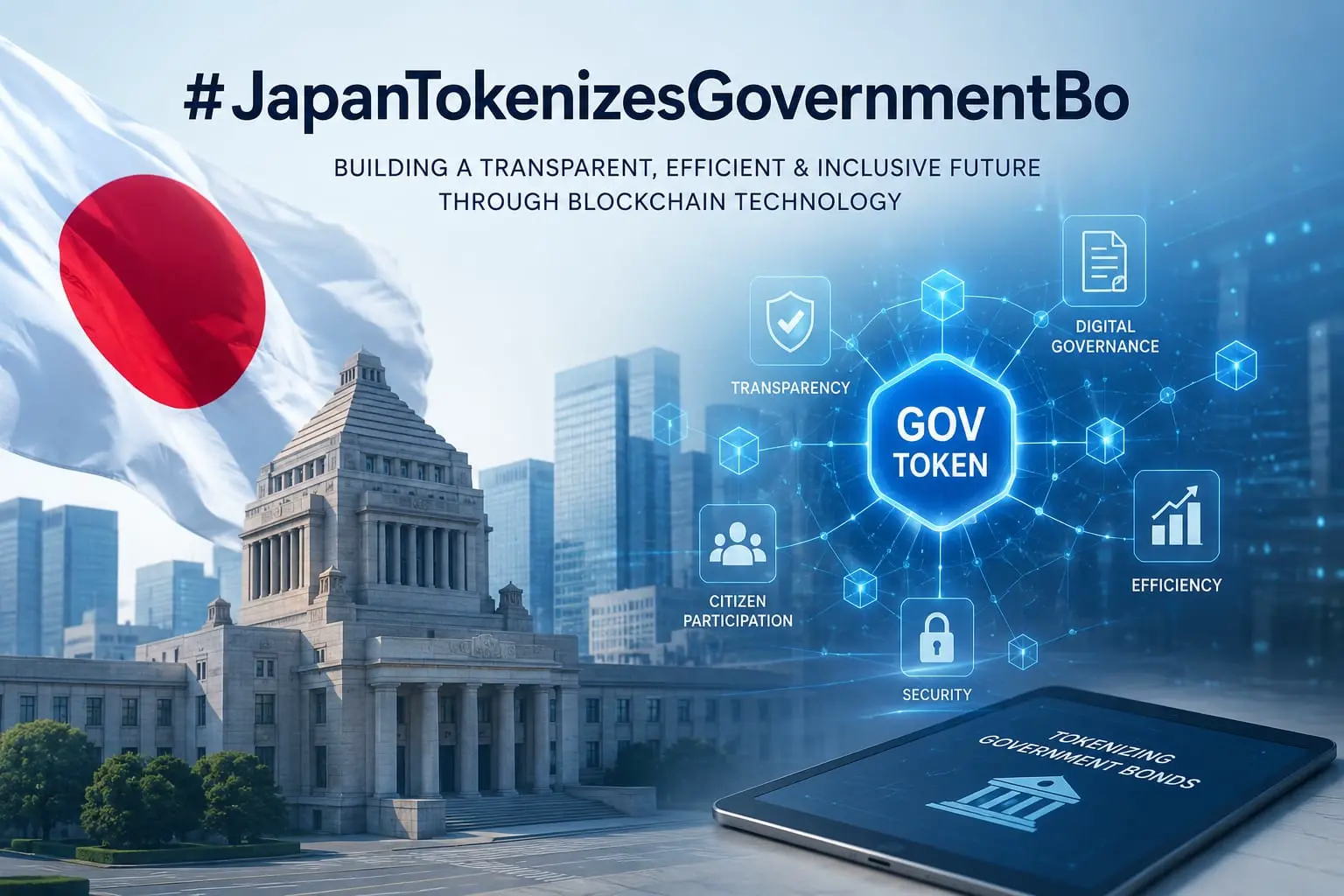
#GateSquareMayTradingShare #JapanTokenizesGovernmentBonds
🏦 Japan Just Made the Biggest RWA Move in History — And Most People Missed It
While everyone was watching Bitcoin's price and Iran headlines — something quietly historic happened in traditional finance that every crypto person needs to understand.
MUFG, Mizuho, Sumitomo Mitsui and BlackRock Japan just launched a joint study to tokenize Japanese Government Bonds on blockchain. The target — 24/7 on-chain trading and same-day settlement for the $1.6 trillion JGB repo market by end of 2026.
Let that number sink in. $1.6 trillion.
This is
RWA-2.36%
BTC-0.56%
  • Reward
  • Comment
  • Repost
  • Share
#JapanTokenizesGovernmentBonds
Japan’s accelerating move toward tokenized government bonds is not some small fintech experiment designed merely to modernize paperwork or attract temporary blockchain attention. It is a structural warning shot to the global financial system that one of the world’s most conservative and debt-heavy economies is preparing for a future where sovereign debt no longer lives entirely inside the traditional banking infrastructure. Most retail traders are completely underestimating the significance of this transition because they are distracted by short-term meme volati
  • Reward
  • Comment
  • Repost
  • Share
#JapanTokenizesGovernmentBonds
Japan’s move toward tokenizing government bonds marks a major shift in how traditional financial instruments may operate in the digital era. This development reflects a broader global trend where blockchain technology is being integrated into sovereign debt markets, aiming to improve transparency, efficiency, and accessibility for investors.
At its core, tokenization means converting real-world assets—such as government bonds—into digital tokens on a blockchain network. Each token represents a fraction of ownership or value in the underlying bond. In Japan’s cas
Vortex_King
#JapanTokenizesGovernmentBonds
Japan’s move toward tokenizing government bonds marks a major shift in how traditional financial instruments may operate in the digital era. This development reflects a broader global trend where blockchain technology is being integrated into sovereign debt markets, aiming to improve transparency, efficiency, and accessibility for investors.
At its core, tokenization means converting real-world assets—such as government bonds—into digital tokens on a blockchain network. Each token represents a fraction of ownership or value in the underlying bond. In Japan’s case, this innovation could modernize its already highly structured and stable bond market, which is one of the largest in the world.
One of the key motivations behind this transition is efficiency. Traditional bond issuance and settlement systems often involve multiple intermediaries, lengthy processing times, and higher operational costs. By moving these assets onto blockchain infrastructure, settlement times could be reduced from days to near real-time execution. This improves liquidity and makes the bond market more dynamic for institutional participants.
Another important advantage is transparency. Blockchain-based systems record all transactions on an immutable ledger, reducing the risk of discrepancies, manual errors, and hidden inefficiencies. For a government bond market like Japan’s, which attracts both domestic and international investors, this added transparency can strengthen trust and improve market participation.
From an investor perspective, tokenized government bonds may open new doors for fractional ownership. Instead of requiring large capital allocations, investors could access smaller portions of high-quality sovereign debt. This democratization of access can broaden participation from retail investors and smaller institutions, who were previously limited by high entry barriers.
Liquidity is another major improvement. Tokenized assets can potentially be traded 24/7 on digital platforms, unlike traditional bond markets that operate within fixed hours. This continuous trading environment may lead to better price discovery and more flexible portfolio management strategies.
Japan’s exploration of this space also signals a deeper alignment between traditional finance (TradFi) and decentralized finance (DeFi) principles. While government bonds remain one of the safest asset classes, their tokenized form could integrate with future digital financial ecosystems, including automated yield strategies, collateral systems, and programmable finance applications.
However, this transition is not without challenges. Regulatory frameworks must ensure investor protection, cybersecurity, and systemic stability. Japan, known for its cautious but forward-looking financial regulation, is likely to implement gradual pilot programs before full-scale adoption. This careful approach helps balance innovation with risk control.
Institutional adoption will also play a crucial role. Large banks, asset managers, and central financial institutions must integrate blockchain infrastructure into existing systems. Interoperability between traditional clearing systems and blockchain platforms will be essential for smooth functioning.
Globally, Japan’s initiative could influence other major economies. Countries observing this development may consider similar tokenization frameworks for their own sovereign debt markets. This could eventually lead to a more interconnected global bond ecosystem powered by blockchain technology.
From a market perspective, such innovation often increases interest in broader digital asset infrastructure. Blockchain networks, tokenization platforms, and institutional-grade crypto custody solutions may see increased attention as governments explore real-world asset digitization.
In summary, Japan’s move toward tokenizing government bonds represents more than just a technological upgrade. It reflects a structural evolution in global finance, where traditional instruments are being reshaped by digital innovation. If successfully implemented, it could set a benchmark for how sovereign debt markets operate in the coming decades, blending stability with modern financial efficiency.

repost-content-media
  • Reward
  • Comment
  • Repost
  • Share
#JapanTokenizesGovernmentBonds
🔥 Japan Is Bringing Government Bonds On-Chain Why This Could Become One of the Most Important Institutional Blockchain Developments in Global Finance 🔥
One of the biggest long-term crypto narratives is no longer centered only around speculation, meme coins, or retail trading cycles. The market is gradually shifting toward infrastructure-level adoption, and one of the clearest examples of this transition is now emerging from Japan.
Three of Japan’s largest megabanks — MUFG, Mizuho, and Sumitomo Mitsui — together with BlackRock Japan have launched a major study
post-image
  • Reward
  • 8
  • Repost
  • Share
ybaser:
To The Moon 🌕
View More
#JapanTokenizesGovernmentBonds
Traditional Finance Moves On-Chain — Japan Pushes Sovereign Bonds Into the Digital Era
Japan is rapidly positioning itself at the center of the next phase of financial innovation as discussions around the tokenization of Japanese Government Bonds (JGBs) continue gaining momentum across institutional and regulatory circles. This development is far bigger than a simple blockchain experiment. It represents a structural evolution in how sovereign debt markets could operate in the future.
Japan controls one of the largest government bond markets in the world. For dec
CryptoChampion
#JapanTokenizesGovernmentBonds
Traditional Finance Moves On-Chain — Japan Pushes Sovereign Bonds Into the Digital Era
Japan is rapidly positioning itself at the center of the next phase of financial innovation as discussions around the tokenization of Japanese Government Bonds (JGBs) continue gaining momentum across institutional and regulatory circles. This development is far bigger than a simple blockchain experiment. It represents a structural evolution in how sovereign debt markets could operate in the future.
Japan controls one of the largest government bond markets in the world. For decades, JGBs have been a core component of global fixed-income markets, institutional portfolios, pension systems, and central bank liquidity operations. Now, by exploring blockchain-based issuance and settlement systems, Japan is signaling that traditional finance is preparing for a long-term transition toward digital financial infrastructure.
The main concept behind tokenized government bonds is straightforward: instead of relying entirely on traditional banking rails, bond ownership and settlement can be represented digitally on blockchain networks. This allows transactions to become faster, more transparent, programmable, and potentially more efficient than legacy systems that often require multiple intermediaries.
One of the most important advantages of tokenized bonds is settlement efficiency. Traditional bond settlement can involve delays, operational complexity, and counterparty risk. Blockchain infrastructure enables near real-time settlement, reducing friction across financial markets while improving liquidity management for institutions.
Another major factor driving interest is operational cost reduction. Large-scale sovereign debt markets involve massive back-office infrastructure, compliance procedures, reconciliation systems, and clearing operations. Tokenization has the potential to automate significant portions of these processes through smart contract technology, creating a more streamlined financial architecture.
Institutional investors are watching this development very closely because sovereign bond tokenization could become a gateway toward broader adoption of tokenized real-world assets (RWAs). Global banks, asset managers, and fintech firms are increasingly viewing blockchain not as a speculative environment, but as a settlement layer for future financial markets.
Japan’s approach is particularly important because the country has historically maintained a cautious but innovation-friendly stance toward digital assets and financial regulation. Rather than pursuing uncontrolled expansion, Japanese regulators have focused on compliance, investor protection, and infrastructure stability. This gives institutional participants greater confidence in participating within regulated blockchain ecosystems.@Gate_Square
The broader market implication is massive. If large sovereign economies successfully tokenize portions of their bond markets, it could accelerate institutional adoption of blockchain technology worldwide. This would strengthen the legitimacy of digital asset infrastructure far beyond cryptocurrencies alone.
For the crypto market, this trend reinforces the growing narrative that blockchain technology is evolving into core financial infrastructure. While speculative trading cycles continue dominating headlines, institutional capital is increasingly focusing on utility, efficiency, and financial integration.
Another critical angle is liquidity accessibility. Tokenized government bonds could eventually allow more flexible fractional ownership structures, potentially increasing access to fixed-income products for a wider range of market participants. This could reshape how investors interact with sovereign debt markets over the next decade.
The global financial system is entering a transition phase where traditional finance and blockchain infrastructure are no longer operating separately. Instead, they are gradually merging into a hybrid ecosystem combining regulatory oversight with digital efficiency.
Japan’s exploration of tokenized government bonds may ultimately become one of the defining signals of how modern financial markets evolve during the next generation of institutional blockchain adoption.
#GateSquare #ContentMining
#GateSquareMayTradingShare
repost-content-media
  • Reward
  • 3
  • Repost
  • Share
ybaser:
To The Moon 🌕
View More
#JapanTokenizesGovernmentBonds
Japan’s move toward tokenizing government bonds marks a major shift in how traditional financial instruments may operate in the digital era. This development reflects a broader global trend where blockchain technology is being integrated into sovereign debt markets, aiming to improve transparency, efficiency, and accessibility for investors.
At its core, tokenization means converting real-world assets—such as government bonds—into digital tokens on a blockchain network. Each token represents a fraction of ownership or value in the underlying bond. In Japan’s cas
Vortex_King
#JapanTokenizesGovernmentBonds
Japan’s move toward tokenizing government bonds marks a major shift in how traditional financial instruments may operate in the digital era. This development reflects a broader global trend where blockchain technology is being integrated into sovereign debt markets, aiming to improve transparency, efficiency, and accessibility for investors.
At its core, tokenization means converting real-world assets—such as government bonds—into digital tokens on a blockchain network. Each token represents a fraction of ownership or value in the underlying bond. In Japan’s case, this innovation could modernize its already highly structured and stable bond market, which is one of the largest in the world.
One of the key motivations behind this transition is efficiency. Traditional bond issuance and settlement systems often involve multiple intermediaries, lengthy processing times, and higher operational costs. By moving these assets onto blockchain infrastructure, settlement times could be reduced from days to near real-time execution. This improves liquidity and makes the bond market more dynamic for institutional participants.
Another important advantage is transparency. Blockchain-based systems record all transactions on an immutable ledger, reducing the risk of discrepancies, manual errors, and hidden inefficiencies. For a government bond market like Japan’s, which attracts both domestic and international investors, this added transparency can strengthen trust and improve market participation.
From an investor perspective, tokenized government bonds may open new doors for fractional ownership. Instead of requiring large capital allocations, investors could access smaller portions of high-quality sovereign debt. This democratization of access can broaden participation from retail investors and smaller institutions, who were previously limited by high entry barriers.
Liquidity is another major improvement. Tokenized assets can potentially be traded 24/7 on digital platforms, unlike traditional bond markets that operate within fixed hours. This continuous trading environment may lead to better price discovery and more flexible portfolio management strategies.
Japan’s exploration of this space also signals a deeper alignment between traditional finance (TradFi) and decentralized finance (DeFi) principles. While government bonds remain one of the safest asset classes, their tokenized form could integrate with future digital financial ecosystems, including automated yield strategies, collateral systems, and programmable finance applications.
However, this transition is not without challenges. Regulatory frameworks must ensure investor protection, cybersecurity, and systemic stability. Japan, known for its cautious but forward-looking financial regulation, is likely to implement gradual pilot programs before full-scale adoption. This careful approach helps balance innovation with risk control.
Institutional adoption will also play a crucial role. Large banks, asset managers, and central financial institutions must integrate blockchain infrastructure into existing systems. Interoperability between traditional clearing systems and blockchain platforms will be essential for smooth functioning.
Globally, Japan’s initiative could influence other major economies. Countries observing this development may consider similar tokenization frameworks for their own sovereign debt markets. This could eventually lead to a more interconnected global bond ecosystem powered by blockchain technology.
From a market perspective, such innovation often increases interest in broader digital asset infrastructure. Blockchain networks, tokenization platforms, and institutional-grade crypto custody solutions may see increased attention as governments explore real-world asset digitization.
In summary, Japan’s move toward tokenizing government bonds represents more than just a technological upgrade. It reflects a structural evolution in global finance, where traditional instruments are being reshaped by digital innovation. If successfully implemented, it could set a benchmark for how sovereign debt markets operate in the coming decades, blending stability with modern financial efficiency.

repost-content-media
  • Reward
  • Comment
  • Repost
  • Share
#JapanTokenizesGovernmentBonds
Japan’s move toward tokenizing government bonds marks a major shift in how traditional financial instruments may operate in the digital era. This development reflects a broader global trend where blockchain technology is being integrated into sovereign debt markets, aiming to improve transparency, efficiency, and accessibility for investors.
At its core, tokenization means converting real-world assets—such as government bonds—into digital tokens on a blockchain network. Each token represents a fraction of ownership or value in the underlying bond. In Japan’s cas
TOKEN0.43%
post-image
  • Reward
  • 11
  • Repost
  • Share
ybaser:
Hop on now!🚗
View More
Load More

Join 40 M users in our growing community

⚡️ Join 40 M users in the crypto craze discussion
💬 Engage with your favorite top creators
👍 See what interests you
  • Pinned