Dragon_fly3

vip
Age 0.3 Year
Peak Tier 0
No content yet
#AnthropicReleasesFable5Model
Anthropic has officially unveiled Claude Fable 5, marking a significant milestone in artificial intelligence development. This release represents the company's most powerful publicly accessible model to date, built upon the advanced Mythos-class architecture. Here is a detailed breakdown of what this means for the AI landscape and the cryptocurrency market.
1. The Mythos-Class Architecture
Claude Fable 5 is constructed on the same foundational technology that powers the more advanced Mythos 5 model. The core architecture remains identical between both versions, b
HighAmbition
#AnthropicReleasesFable5Model
Anthropic has officially unveiled Claude Fable 5, marking a significant milestone in artificial intelligence development. This release represents the company's most powerful publicly accessible model to date, built upon the advanced Mythos-class architecture. Here is a detailed breakdown of what this means for the AI landscape and the cryptocurrency market.
1. The Mythos-Class Architecture
Claude Fable 5 is constructed on the same foundational technology that powers the more advanced Mythos 5 model. The core architecture remains identical between both versions, but Fable 5 incorporates substantial safety modifications. These modifications ensure that general users can access cutting-edge AI capabilities without encountering unnecessary risks. The model represents a new tier in Anthropic's product lineup, positioned above the traditional Opus, Sonnet, and Haiku classifications.
2. Enhanced Safety Guardrails
The defining characteristic of Fable 5 lies in its comprehensive safety framework. When users attempt to query sensitive topics such as cybersecurity vulnerabilities, dangerous biological research, or other high-risk domains, the system automatically restricts responses. Instead of providing potentially harmful information, Fable 5 either blocks the request entirely or redirects users to less capable but more secure model alternatives. This approach demonstrates Anthropic's commitment to responsible AI deployment.
3. Superior Performance Metrics
According to Anthropic's official claims, Fable 5 achieves state-of-the-art results across nearly all major AI benchmarks. The model demonstrates particular strength in software engineering tasks, scoring 80.3% on SWE-bench Pro, which evaluates real-world coding capabilities. This performance represents a substantial improvement over previous Claude iterations and positions Fable 5 competitively against other leading AI models in the market.
4. Extended Autonomous Operation
One of the most impressive capabilities of Fable 5 is its ability to maintain autonomous operation over extended periods. Unlike earlier models that required frequent human intervention for complex tasks, Fable 5 can work independently on challenging projects for longer durations. This characteristic makes it particularly valuable for professionals who need AI assistance with substantial workloads without constant oversight.
5. Target Professional Audiences
Anthropic has specifically designed Fable 5 to serve software developers, researchers, business professionals, and engineers. The model excels at managing large-scale projects that would overwhelm previous AI systems. Organizations can leverage Fable 5 for code migration, data analysis, scientific research, and complex problem-solving scenarios that demand sustained cognitive effort and precision.
6. Real-World Enterprise Applications
The practical applications of Fable 5 extend beyond theoretical capabilities. Stripe, a major payment processing company, successfully utilized Fable 5 to migrate a 50-million-line codebase in a single day. This task would have required approximately two months of work from a dedicated human team. Such demonstrations illustrate the transformative potential of advanced AI models in enterprise environments.
7. Comprehensive Safety Testing
Prior to public release, Anthropic conducted extensive safety evaluations and testing protocols for Fable 5. The company invested significant resources in identifying and mitigating potential misuse scenarios. This thorough approach reflects growing industry awareness that powerful AI systems require robust safeguards to prevent malicious applications while preserving legitimate utility.
8. Democratization of Advanced AI
The release of Fable 5 represents Anthropic's effort to make sophisticated AI capabilities accessible to broader audiences. By packaging Mythos-level technology with appropriate safety measures, the company enables general users to benefit from cutting-edge AI development. This democratization strategy balances innovation accessibility with risk management considerations.
9. Government Collaboration and Future Releases
Anthropic has established collaborative relationships with United States government agencies to ensure responsible deployment of its most advanced models. The company plans to gradually expand access to the full Mythos 5 model for select cybersecurity defenders and infrastructure providers. This measured approach suggests a long-term vision for AI development that prioritizes societal safety alongside technological progress.
Impact on the Cryptocurrency Market
The release of Claude Fable 5 carries significant implications for the cryptocurrency ecosystem. Understanding these effects requires examining both direct and indirect market dynamics.
Direct Impact on AI-Related Cryptocurrency Tokens
The AI sector within cryptocurrency markets has demonstrated notable sensitivity to developments in artificial intelligence technology. Recent market data indicates that AI-focused tokens such as Humanity Protocol and Near Protocol have experienced substantial price movements following major AI announcements. This correlation suggests that Fable 5's release could generate renewed interest in AI-cryptocurrency intersections, potentially driving capital inflows toward projects that integrate advanced AI capabilities with blockchain technology.
Trading Algorithm Evolution
Advanced AI models like Fable 5 possess the analytical sophistication necessary to enhance cryptocurrency trading strategies. The model's capabilities in pattern recognition, data analysis, and predictive modeling could enable more sophisticated algorithmic trading systems. Research indicates that AI-driven trading strategies have achieved returns exceeding 1,640% in Bitcoin markets over extended periods, significantly outperforming traditional buy-and-hold approaches. Fable 5's enhanced capabilities may accelerate this trend, making AI-powered trading more accessible and effective for institutional and retail participants alike.
Capital Rotation Dynamics
Recent market analysis from K33 Research reveals a concerning pattern of capital rotation from cryptocurrency markets into AI-related stocks. This rotation reflects investor perception that AI equities offer superior risk-adjusted returns compared to digital assets. The release of Fable 5 could intensify this dynamic in the short term, as investors seek exposure to cutting-edge AI technology through traditional equity markets. However, the integration of advanced AI with blockchain applications may eventually reverse this trend by creating compelling use cases that combine both technological domains.
Enhanced Market Analysis Capabilities
Fable 5's superior analytical capabilities could improve market sentiment analysis and price prediction models for cryptocurrency markets. The model's ability to process vast amounts of unstructured data, including social media sentiment, news articles, and technical indicators, may enable more accurate forecasting of cryptocurrency price movements. This improvement could benefit both individual traders and institutional investors seeking data-driven insights into volatile digital asset markets.
Smart Contract Development and Security
The software engineering capabilities demonstrated by Fable 5 have direct applications in cryptocurrency ecosystem development. Smart contract creation, auditing, and security analysis represent critical areas where advanced AI assistance could reduce vulnerabilities and improve code quality. As blockchain platforms increasingly compete on developer experience and security guarantees, AI-powered development tools may become significant competitive advantages.
Regulatory and Compliance Implications
Anthropic's approach to safety and responsible AI deployment may influence regulatory perspectives on cryptocurrency-AI intersections. As governments worldwide develop frameworks for both artificial intelligence and digital assets, companies that demonstrate proactive safety measures may face more favorable regulatory treatment. This dynamic could encourage cryptocurrency projects to adopt similar safety-first approaches in their AI integrations.
Institutional Adoption Catalyst
The professional-grade capabilities of Fable 5 may accelerate institutional adoption of AI-enhanced cryptocurrency services. Financial institutions that have been hesitant to engage with digital assets may find the combination of advanced AI analytics and blockchain technology more compelling than either component individually. This convergence could drive the development of new financial products that bridge traditional finance and cryptocurrency markets.
Long-Term Market Structure Evolution
Over extended time horizons, the integration of models like Fable 5 into cryptocurrency infrastructure may fundamentally alter market structures. Improved analytical capabilities could reduce information asymmetries, enhance price discovery mechanisms, and increase market efficiency. These developments would benefit sophisticated participants while potentially reducing opportunities for arbitrage and speculative gains that currently attract many cryptocurrency traders.
Conclusion
Anthropic's release of Claude Fable 5 represents a significant advancement in publicly available artificial intelligence technology. The model's combination of Mythos-class capabilities with comprehensive safety measures demonstrates that powerful AI can be deployed responsibly. For the cryptocurrency market, this release carries multifaceted implications ranging from immediate price effects on AI-related tokens to long-term structural changes in how digital assets are analyzed, traded, and developed. Investors and industry participants should monitor both the direct applications of Fable 5 in cryptocurrency contexts and the broader competitive dynamics it creates between AI and blockchain technology sectors. The convergence of these transformative technologies will likely define the next phase of digital asset evolution.#CertifiedCreatorPromotionTask @Gate_Square

repost-content-media
  • Reward
  • Comment
  • Repost
  • Share
#BlackRockReducesBTCIncreasesETH
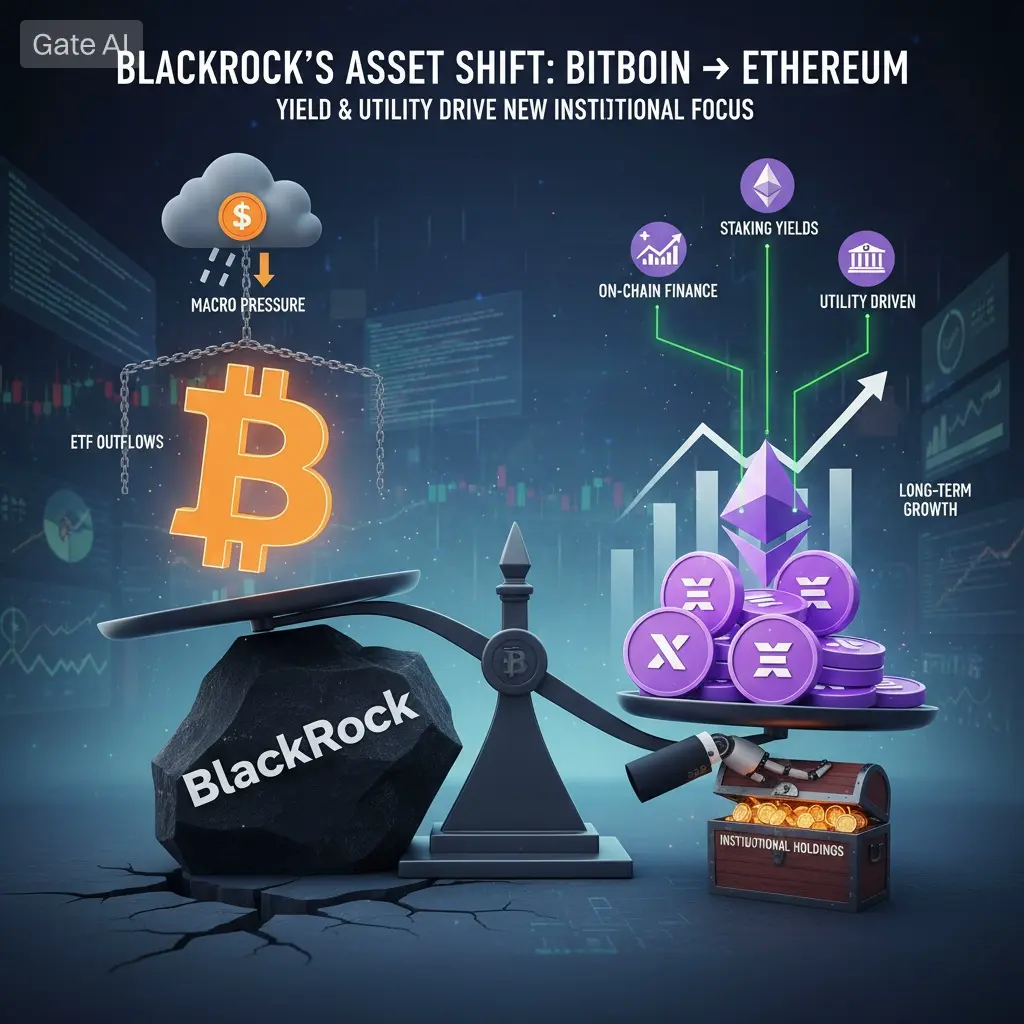
The world's largest asset manager, BlackRock, has made headlines with its recent strategic adjustment in the cryptocurrency market. According to data from Arkham Intelligence and various on-chain analytics platforms, BlackRock has been reducing its Bitcoin positions while significantly increasing its Ethereum holdings. This shift represents one of the most significant institutional reallocations in the crypto space and has profound implications for both assets.
Understanding BlackRock's Bitcoin Reduction
BlackRock's iShares Bitcoin Trust (IBIT) experienced sub
HighAmbition
#BlackRockReducesBTCIncreasesETH
The world's largest asset manager, BlackRock, has made headlines with its recent strategic adjustment in the cryptocurrency market. According to data from Arkham Intelligence and various on-chain analytics platforms, BlackRock has been reducing its Bitcoin positions while significantly increasing its Ethereum holdings. This shift represents one of the most significant institutional reallocations in the crypto space and has profound implications for both assets.
Understanding BlackRock's Bitcoin Reduction
BlackRock's iShares Bitcoin Trust (IBIT) experienced substantial outflows in recent months. According to SoSoValue data, IBIT recorded approximately 2.43 billion dollars in net outflows over nine consecutive sessions in May 2026, culminating in a massive 1.26 billion dollar dark-pool block sale on May 26. This marked the largest single-day redemption event in the fund's history since its January 2024 launch. On-chain data confirmed the transfer of approximately 6,005 BTC, equivalent to roughly 403 million dollars, from IBIT-linked custody wallets to Coinbase Prime.
The reasons behind this Bitcoin reduction are multifaceted. First, macroeconomic headwinds have created a challenging environment for risk assets. High US Treasury yields and a Federal Reserve stance perceived as constraining for risk assets have caused Bitcoin's price to drop below previous consolidation levels. Second, institutional de-risking has been a dominant theme, with many large players reducing exposure to volatile assets. Third, Bitcoin's price had been trading in a range with 74,000 dollars serving as support and the 200-day moving average as resistance, creating uncertainty about near-term direction.
Furthermore, BlackRock's crypto portfolio value declined sharply in the first quarter of 2026. Between January 1 and March 31, 2026, the combined value of BlackRock's Bitcoin and Ethereum holdings dropped from 78.36 billion dollars to 57.89 billion dollars, representing a 20.47 billion dollar decrease. While this decline was driven primarily by market conditions rather than capital exiting the portfolio, it signaled a need for strategic rebalancing.
Current Bitcoin Market Position and Price Analysis
As of early June 2026, Bitcoin opened at approximately 63,078 dollars, showing relative stability but remaining under pressure. The cryptocurrency has faced headwinds from multiple directions, including Federal Reserve policy uncertainty and shifting institutional sentiment. Bitcoin ETFs have experienced significant outflows, with the funds registering over 1.07 billion dollars in outflows during certain periods, on track to surpass previous weekly records.
The price action has been characterized by a trading range with 74,000 dollars serving as a key support level and the 200-day moving average acting as resistance. Analysts have noted that Bitcoin could revisit February lows if a major fresh catalyst does not emerge soon. The sustained ETF outflows and more hawkish Federal Reserve outlook have contributed to the market decline.
BlackRock's Ethereum Accumulation Strategy
In contrast to its Bitcoin reduction, BlackRock has been aggressively increasing its Ethereum exposure. The asset manager's iShares Ethereum Trust (ETHA) has recorded significant inflows, with the ETF hitting its highest inflows in 30 days at certain points. According to the latest data, ETHA's holdings reached over 2 million ETH, representing a major milestone for the fund.
BlackRock's staked ETH ETF (ETHB) has also seen substantial interest, pulling in 32.3 million dollars on April 24 alone. This rotation from the non-staked ETHA product into the staked ETHB product indicates a preference for yield-generating Ethereum exposure. The total assets under management for Ethereum ETFs collectively stood at approximately 30.35 billion dollars, with BlackRock controlling more than half at 17.25 billion dollars, representing roughly 3 percent of Ethereum's market capitalization.
Current Ethereum Market Position and Price Analysis
Ethereum entered mid-2026 trading in the 1,600 to 2,100 dollar range, down approximately 55 percent from its August 2025 all-time high near 4,954 dollars. The cryptocurrency faces a complex environment with strong on-chain fundamentals competing against macro-driven price drawdowns. Layer 2 networks have scaled Ethereum's capacity but have also diverted fee revenue from the mainnet, with some estimates suggesting Base alone removed 50 billion dollars from ETH's market cap.
Despite these challenges, Ethereum spot ETFs have shown resilience. While there have been periods of outflows, the overall trend indicates growing institutional interest. Ethereum DATs (Digital Asset Trusts) already hold more than 3.1 percent of the total ETH supply, and leading firms continue accumulating aggressively.
Reasons Behind BlackRock's Strategic Shift
Several factors explain BlackRock's decision to reduce Bitcoin exposure while increasing Ethereum holdings. First, Ethereum offers staking yield, providing a revenue stream that Bitcoin cannot match. BlackRock's ETHB product allows investors to earn staking rewards while maintaining ETF structure, making it attractive for institutional portfolios seeking yield in a high-interest-rate environment.
Second, Ethereum's ecosystem continues to expand with Layer 2 solutions, decentralized finance applications, and tokenization initiatives. BlackRock has shown increasing interest in tokenized assets and on-chain finance, areas where Ethereum dominates. The asset manager's involvement in projects like Securitize and tokenized securities aligns with Ethereum's capabilities.
Third, valuation considerations play a role. Bitcoin had experienced significant appreciation, and some institutional investors may view Ethereum as offering better risk-reward characteristics at current price levels. Ethereum's price decline from all-time highs has created a potentially more attractive entry point for long-term accumulation.
Fourth, diversification benefits drive the shift. As the cryptocurrency market matures, institutional investors are seeking exposure beyond just Bitcoin. Ethereum represents the second-largest cryptocurrency and offers different value propositions, including smart contract functionality and decentralized application platform capabilities.
Bitcoin Price Forecast and Trading Strategy
Analyst forecasts for Bitcoin vary widely, reflecting the uncertainty in the current market environment. Short-term targets suggest Bitcoin needs to reclaim the 74,000 dollar support level to establish a bullish trend. If this level is not defended, analysts warn of potential retests of February lows in the 55,000 to 60,000 dollar range.
Medium-term forecasts suggest Bitcoin could recover to the 80,000 to 100,000 dollar range if macroeconomic conditions improve and institutional inflows resume. However, this recovery depends on several factors, including Federal Reserve policy shifts, regulatory clarity, and renewed institutional confidence.
For trading strategy, risk management remains paramount in the current environment. Traders should consider the following approaches. First, dollar-cost averaging allows for gradual accumulation without attempting to time market bottoms. Second, maintaining stop-losses below key support levels protects against significant drawdowns. Third, monitoring ETF flow data provides insight into institutional sentiment. Sustained inflows would signal potential trend reversal, while continued outflows suggest further downside risk.
Ethereum Price Forecast and Trading Strategy
Ethereum price predictions for 2026 show considerable variation among analysts. Conservative estimates target the 1,700 to 2,000 dollar range, with some analysts projecting prices around 2,011 dollars as an average trading price. More optimistic forecasts suggest Ethereum could reach 3,175 to 7,500 dollars depending on market conditions and adoption trends.
The key factors influencing Ethereum's price include Layer 2 adoption rates, staking participation, institutional ETF inflows, and the overall health of the decentralized finance ecosystem. Ethereum's transition to a yield-bearing asset through staking has fundamentally changed its investment profile, making it attractive for income-focused institutional portfolios.
For trading strategy, Ethereum presents both opportunities and risks. The staking yield provides a cushion during price declines, as holders earn rewards regardless of price action. However, Layer 2 competition and fee revenue diversion remain concerns. Traders should monitor ETF inflow data, particularly for BlackRock's ETHA and ETHB products, as these indicate institutional sentiment. Additionally, watching Layer 2 metrics and total value locked in decentralized finance protocols provides insight into ecosystem health.
Future Outlook and Strategic Implications
BlackRock's shift from Bitcoin to Ethereum reflects broader trends in institutional cryptocurrency allocation. As the market matures, investors are moving beyond simple Bitcoin exposure to more sophisticated strategies that include yield generation and ecosystem participation.
The implications for both assets are significant. Bitcoin may face continued pressure if institutional outflows persist, though its status as digital gold and store of value remains intact. Ethereum stands to benefit from institutional adoption of staking and the growth of on-chain finance, though it must navigate challenges related to scalability and competition from Layer 2 solutions.
For investors, the key takeaway is that diversification within the cryptocurrency space is becoming increasingly important. Following institutional flows, particularly from major players like BlackRock, provides valuable insight into market direction. However, individual risk tolerance and investment horizons should guide portfolio decisions rather than simply mimicking institutional moves.
The cryptocurrency market continues to evolve rapidly, and BlackRock's strategic adjustments demonstrate that even the largest asset managers are actively managing their crypto allocations based on changing market conditions, yield opportunities, and ecosystem developments. As we move through 2026, monitoring these institutional flows will remain crucial for understanding market dynamics and identifying potential opportunities in both Bitcoin and Ethereum.
#CertifiedCreatorPromotionTask @Gate_Square
repost-content-media
  • Reward
  • Comment
  • Repost
  • Share
#SpaceX认购规模超2500亿美元
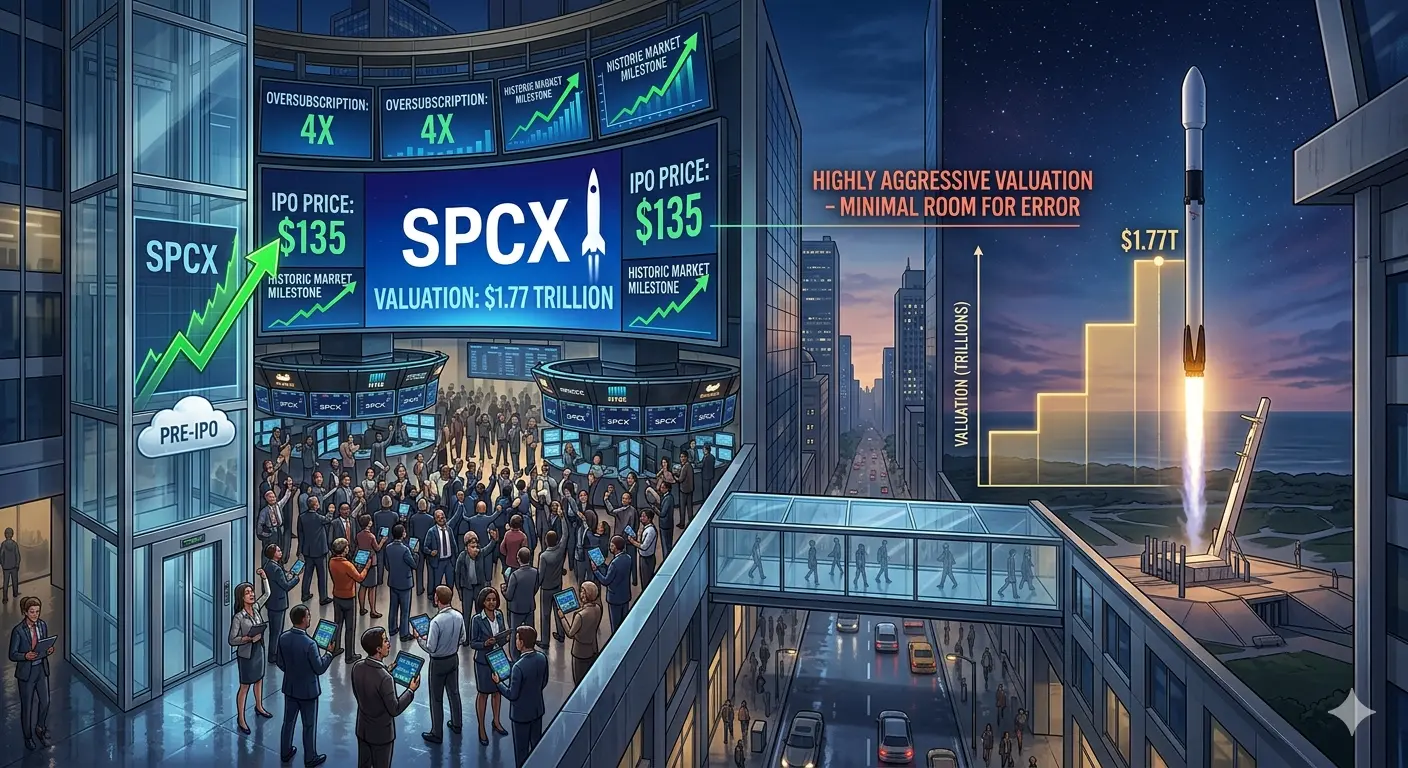
The SpaceX initial public offering represents one of the most significant financial events in recent market history. With investor demand exceeding $250 billion against a $75 billion fundraising target, the oversubscription rate of approximately 3.5 to 4 times demonstrates extraordinary market appetite for this aerospace and technology giant. The company plans to sell approximately 555.6 million shares at $135 per share, resulting in a valuation of approximately $1.77 trillion, which would position SpaceX as the seventh most valuable company in the United States and surpas
HighAmbition
#SpaceX认购规模超2500亿美元
The SpaceX initial public offering represents one of the most significant financial events in recent market history. With investor demand exceeding $250 billion against a $75 billion fundraising target, the oversubscription rate of approximately 3.5 to 4 times demonstrates extraordinary market appetite for this aerospace and technology giant. The company plans to sell approximately 555.6 million shares at $135 per share, resulting in a valuation of approximately $1.77 trillion, which would position SpaceX as the seventh most valuable company in the United States and surpass Tesla's current market capitalization of around $1.6 trillion.
SpaceX has established itself as a dominant force across multiple sectors including commercial space launch, satellite internet connectivity through Starlink, and artificial intelligence through its xAI division. The company generated approximately $15 billion in revenue during 2025, with Starlink contributing roughly 61 percent of total revenue. This diversified revenue stream provides a foundation for sustainable growth, though the recent merger with xAI has transformed the company from profitable to loss-making in the short term.
The IPO pricing at $135 per share reflects aggressive growth expectations built into the valuation. Morningstar has placed a fair value estimate of $780 billion on SpaceX, representing approximately 48 percent below the IPO target valuation. This significant discrepancy between market pricing and independent valuation estimates suggests that current pricing incorporates substantial future growth that has not yet materialized. The company has outlined ambitious plans including solar-powered data centers in space and targets a total addressable market of $28.5 trillion, with nearly $23 trillion attributed to enterprise artificial intelligence applications.
The allocation structure for this IPO includes an unusually large retail component, with approximately 30 percent of the offering reserved for individual investors. This approach leverages Elon Musk's substantial following among retail investors while broadening the ownership base. However, the massive oversubscription means that most retail participants will likely receive partial allocations rather than full subscription amounts.
From a growth perspective, SpaceX operates in sectors with substantial expansion potential. The global space economy continues to expand rapidly, with satellite internet representing a particularly attractive market given the billions of people worldwide lacking reliable internet access. The company's vertical integration and technological advantages in reusable rocket technology provide competitive moats that could sustain margins over time. Nevertheless, the valuation assumes flawless execution of ambitious projects including the fully reusable Starship vehicle and orbital artificial intelligence infrastructure.
The timing of this IPO coincides with heightened interest in artificial intelligence investments and continued enthusiasm for Elon Musk's business ventures. The listing on Nasdaq under ticker symbol SPCX is scheduled for June 12, 2026, following pricing determination on June 11. Goldman Sachs serves as lead underwriter for the offering.
For investors considering participation, several factors warrant careful evaluation. The current pricing embeds years of future growth, meaning the company must execute flawlessly to justify valuations. Competition in satellite internet is intensifying with Amazon's Project Kuiper and other entrants pursuing similar markets. Regulatory risks exist around spectrum allocation and space debris management. The company's pivot toward artificial intelligence integration introduces execution risks around technology development timelines.
The massive oversubscription indicates strong institutional confidence, but also creates potential for post-IPO volatility as initial trading may not reflect fundamental value. Historical patterns for highly anticipated IPOs often include initial price spikes followed by stabilization as supply and demand reach equilibrium. Investors should consider their time horizon and risk tolerance when evaluating position sizing.
Question One: Did you participate in the Gate SpaceX IPO subscription?
Participation in IPO subscriptions requires careful consideration of several factors including portfolio allocation, risk tolerance, and investment timeline. For those who participated through Gate's platform, the subscription process involves locking funds during the allocation period with final share distribution dependent on overall demand relative to available supply. Given the oversubscription levels, participants should expect partial fills rather than complete allocation of requested amounts.
The Gate platform provides retail access to IPO shares that would traditionally be reserved for institutional investors. This democratization of IPO access represents a significant development for individual investors seeking exposure to high-profile offerings. However, participants should understand that IPO investments carry inherent risks including price volatility and potential for immediate losses if aftermarket trading declines below subscription prices.
Question Two: What do you think the final price of SPCX will be? How much room for growth is there?
The final IPO pricing has been set at $135 per share based on available information. Post-listing price performance will depend on multiple factors including initial trading dynamics, broader market conditions, and investor sentiment toward growth stocks. Highly anticipated IPOs frequently experience initial price premiums as demand from investors who missed the allocation window enters the market through secondary trading.
Growth potential for SpaceX exists across multiple vectors. The Starlink satellite constellation continues expanding coverage and subscriber base, with potential to serve underserved markets globally. Commercial launch services benefit from increasing demand for satellite deployment and potential space tourism development. The artificial intelligence integration through xAI opens additional revenue streams though this area remains speculative with unproven monetization models.
The $28.5 trillion total addressable market cited by SpaceX represents theoretical maximum opportunity rather than near-term revenue potential. Actual growth realization depends on successful execution of ambitious technological development programs including Starship reusability, orbital data centers, and artificial intelligence infrastructure deployment. These projects carry substantial technical and financial risks that could delay or prevent achievement of projected milestones.
Analyst estimates vary considerably regarding fair value. Conservative valuations around $780 billion suggest limited upside from current pricing levels, while bullish scenarios envision SpaceX becoming the world's largest company based on successful execution of multi-planetary expansion and artificial intelligence dominance. The wide range of outcomes reflects fundamental uncertainty about timing and success of transformative projects.
Personal Perspective
From an analytical standpoint, SpaceX represents a compelling long-term investment thesis with significant near-term valuation risk. The company possesses genuine technological advantages and operates in expanding markets with substantial growth potential. However, the current valuation appears to fully discount years of successful execution, leaving limited margin for error or delays.
The massive oversubscription demonstrates market confidence but also creates potential for disappointment if post-IPO trading fails to deliver immediate gains. Historical precedent suggests that highly hyped IPOs often underperform in the months following listing as initial enthusiasm moderates and fundamental performance becomes the primary valuation driver.
For investors with long-term horizons and appropriate risk tolerance, SpaceX offers exposure to transformative technologies with potential to reshape multiple industries. However, position sizing should reflect the speculative nature of current valuations and the extended timeline required for many growth initiatives to mature. Dollar-cost averaging into positions over time may prove more prudent than concentrated initial allocations given valuation uncertainty.
The integration of artificial intelligence capabilities adds complexity to the investment thesis. While AI represents a significant growth opportunity, it also introduces competitive dynamics and capital requirements that differ from SpaceX's traditional aerospace business. Success in this area is less certain given intense competition from established technology companies and well-funded startups.
Overall, SpaceX deserves consideration as a portfolio holding for investors seeking exposure to space economy and artificial intelligence themes, but current pricing requires careful evaluation of risk-adjusted return potential relative to alternative investments in these sectors.@Gate_Square #CertifiedCreatorPromotionTask
repost-content-media
  • Reward
  • 1
  • Repost
  • Share
HighAmbition:
good information 👍
#BitmineAdds100kETH
BitMine Immersion Technologies, an Ethereum-focused treasury company chaired by Tom Lee, continues to attract strong market attention with its aggressive accumulation strategy. The firm recently added approximately 100,000 ETH, reinforcing one of the most significant institutional Ethereum buying trends in 2026. This analysis breaks down the nine key aspects of this development and its broader market implications.
Point One: Understanding BitMine and Its Strategy
BitMine Immersion Technologies is positioning itself as a major Ethereum treasury entity similar to a Bitcoin-f
ETH0.58%
HighAmbition
#BitmineAdds100kETH
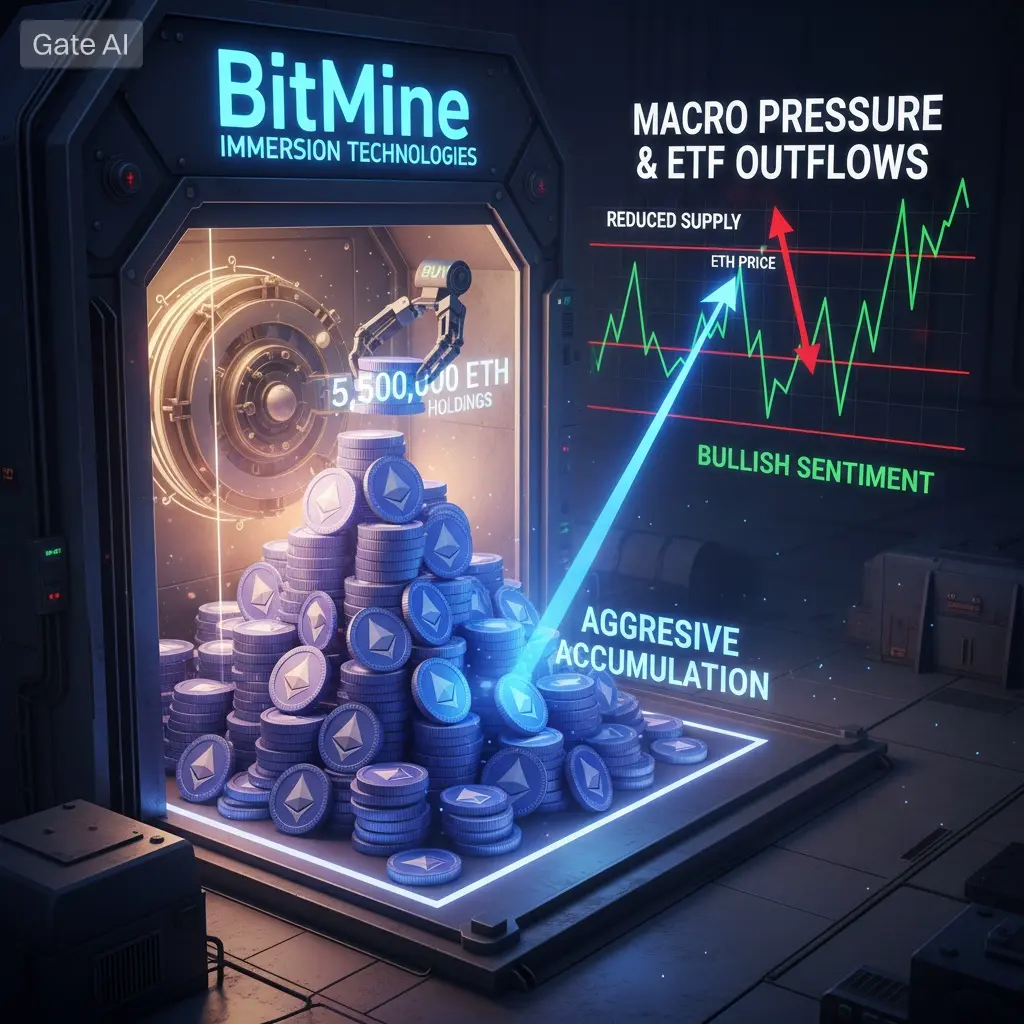
BitMine Immersion Technologies, an Ethereum-focused treasury company chaired by Tom Lee, continues to attract strong market attention with its aggressive accumulation strategy. The firm recently added approximately 100,000 ETH, reinforcing one of the most significant institutional Ethereum buying trends in 2026. This analysis breaks down the nine key aspects of this development and its broader market implications.
Point One: Understanding BitMine and Its Strategy
BitMine Immersion Technologies is positioning itself as a major Ethereum treasury entity similar to a Bitcoin-focused corporate reserve model. The company follows an aggressive accumulation strategy, consistently acquiring large ETH positions on a weekly basis.
As of June 2026, BitMine’s total holdings are estimated at over 5.5 million ETH, representing approximately 4.5%–4.6% of total circulating supply. This makes it one of the largest known Ethereum holders globally.
A significant portion—around 85% to 92%—is staked, allowing the firm to generate continuous yield while maintaining long-term exposure. The company is also preparing additional capital raises exceeding $300 million+ to further expand its ETH accumulation strategy.
Point Two: The Scale of Recent Purchases
The latest acquisition of approximately 100,000 ETH reflects a capital deployment of nearly $170 million to $200 million, depending on execution price levels.
Some recent large-scale transactions in the market suggest even higher accumulation levels, with total weekly purchases occasionally exceeding 120,000–130,000 ETH, valued at roughly $200 million to $230 million+.
This consistent buying pattern highlights institutional conviction and sustained demand pressure on Ethereum’s supply structure.
Point Three: Market Impact on Ethereum Price
Ethereum has shown controlled volatility rather than sharp upward spikes, despite heavy institutional accumulation.
Current ETH price levels are estimated around $1,900 to $2,200, with recent highs approaching $2,300+ in strong momentum phases.
While institutional buying provides a strong structural support zone, broader macro conditions and market liquidity cycles continue to influence price action. The repeated accumulation creates a long-term price floor effect, reducing deep downside risk during corrections.
Point Four: Institutional Confidence Signal
BitMine’s strategy reflects strong institutional confidence in Ethereum’s long-term role in digital finance.
The company’s treasury position—estimated at $10B+ total assets including crypto and cash equivalents—shows deep commitment to ETH as a core reserve asset.
Such large-scale accumulation signals that institutional players increasingly view Ethereum as a strategic macro asset rather than a speculative instrument, especially as staking yields provide additional structural incentives.
Point Five: Ethereum Supply Dynamics
BitMine’s control of nearly 5% of circulating ETH supply, combined with staking of the majority of holdings, significantly reduces liquid market supply.
Ethereum’s deflationary pressure is further supported by:
EIP-1559 fee burning mechanism
Increased staking participation across institutions
Long-term holding behavior from treasury entities
This combination creates a tightening supply environment where available trading liquidity becomes increasingly limited during demand surges.
Point Six: Price Forecasts and Technical Outlook
Ethereum price forecasts for 2026 vary widely depending on market conditions:
Conservative Range: $2,000 – $2,800
Moderate Bull Case: $3,200 – $5,500
Extended Bull Cycle Scenario: $6,500 – $9,000
Extreme Bull Market Projection: $10,000 – $12,000+
Technical indicators show ETH maintaining strength above long-term moving averages, with RSI levels suggesting neutral-to-bullish momentum structure.
Key macro drivers include ETF inflows, staking growth, and Layer 2 ecosystem expansion.
Point Seven: Trader Sentiment and Market Psychology
Market sentiment has become increasingly reactive to institutional accumulation signals.
Traders view BitMine’s consistent purchases as:
A structural demand anchor
A psychological support factor
A long-term bullish confirmation signal
However, sentiment remains mixed due to ETF flow fluctuations and broader macro uncertainty. Despite this, institutional accumulation continues to dominate long-term market narratives.
Point Eight: Trading Strategies for ETH Investors
Several trading approaches are emerging in the current environment:
1. Accumulation Strategy:
Gradual buying in the $1,900–$2,100 range, focusing on long-term positioning.
2. Swing Trading Strategy:
Entry: $1,850 – $2,050
Targets: $2,400 – $2,800
Extended target: $3,200+
3. Breakout Strategy:
A confirmed break above $2,400 may trigger accelerated momentum toward higher resistance zones.
Risk Management:
Protective levels generally sit below $1,700, depending on volatility conditions.
Point Nine: Future Outlook and Key Levels to Watch
Key factors influencing Ethereum’s next major move include:
Continued institutional accumulation from treasury companies
ETF inflows and macro liquidity conditions
Expansion of staking participation
Layer 2 ecosystem growth and network activity
Important price zones:
Support: $1,900 / $1,700
Resistance: $2,400 / $2,800
Mid-term breakout zone: $3,200+
Bull cycle extension range: $5,000 – $9,000
If institutional demand continues at current levels, Ethereum could enter a long-term supply squeeze phase, potentially driving accelerated price discovery.
Conclusion
BitMine’s acquisition of 100,000 ETH reinforces a powerful institutional trend shaping Ethereum’s long-term market structure. While short-term price action remains influenced by macro volatility, the underlying accumulation narrative suggests strengthening fundamentals.
If institutional demand continues expanding alongside staking growth, Ethereum may be entering a structural revaluation phase over the coming market cycle.@Gate_Square #BlackRockReducesBTCIncreasesETH
repost-content-media
  • Reward
  • Comment
  • Repost
  • Share
#MyGateTradeStory
That one trade on NVDA changed everything for me. I had been watching NVIDIA for weeks, tracking every move, every dip, every rally, but I kept hesitating. The chart was calling me, the setup was right there, yet my fingers refused to click the button. Fear of the unknown, fear of being wrong, fear of losing what I had worked so hard to build. But then something shifted.
It was a quiet afternoon, the market barely moving, most traders half asleep at their desks. NVDA had pulled back to a level I had marked on my chart days before. The support zone was clean, the volume was d
HighAmbition
#MyGateTradeStory
That one trade on NVDA changed everything for me. I had been watching NVIDIA for weeks, tracking every move, every dip, every rally, but I kept hesitating. The chart was calling me, the setup was right there, yet my fingers refused to click the button. Fear of the unknown, fear of being wrong, fear of losing what I had worked so hard to build. But then something shifted.
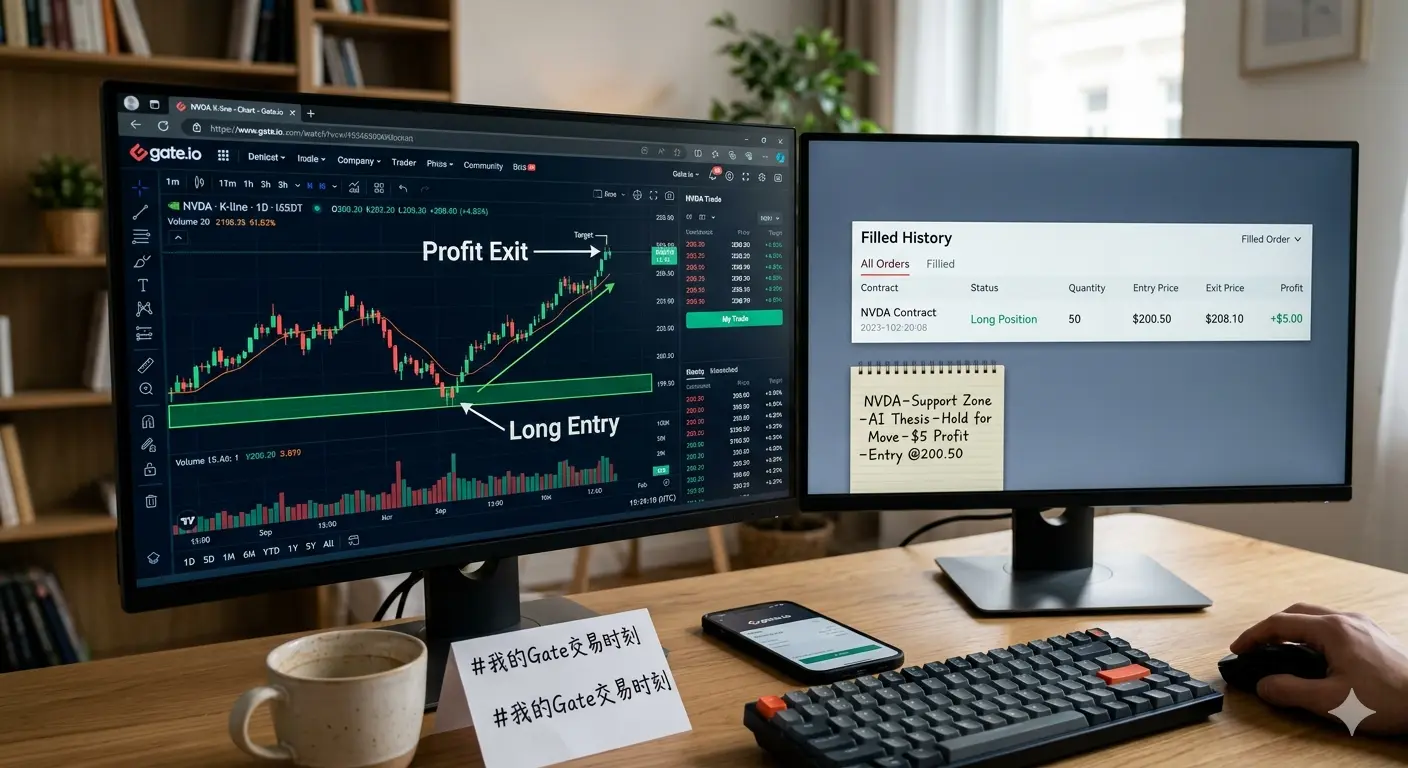
It was a quiet afternoon, the market barely moving, most traders half asleep at their desks. NVDA had pulled back to a level I had marked on my chart days before. The support zone was clean, the volume was drying up on the selling side, and the momentum indicators were whispering the same thing: this dip was running out of fuel. I remember staring at the screen for what felt like an hour, my cursor hovering over the buy button, my heart doing things it should not be doing over a trade. Then I pulled the trigger. I went long on NVDA through Gate's contract trading, sized the position carefully, not too aggressive, not too timid, just enough to make it count if the trade worked and survivable if it did not.
The first few minutes were agonizing. The price wiggled, teased, dipped a fraction lower, and I felt that familiar knot in my stomach questioning every decision I had ever made in markets. But I held. Not because I was brave, but because the logic behind the trade was solid. NVIDIA was and still is the backbone of the AI revolution. Every major tech company is building on their chips, their data centers, their ecosystem. A short-term pullback does not erase a long-term thesis, and I reminded myself of that fact over and over while the price sorted itself out.
Then the move came. It was not a dramatic rocket launch, not a screen-shaking green candle that makes you jump out of your chair. It was a steady, methodical climb, the kind of move that rewards patience and punishes impulsiveness. NVDA pushed higher, tick by tick, and my position shifted from floating in uncertainty to sitting in profit. I watched the profit counter climb, and when it hit $5, I closed the trade. Five dollars. Some would laugh at that number. Five dollars is barely a cup of coffee in most cities. But for me, that $5 was everything.
Why? Because that $5 was not about the money. It was about proof. Proof that my analysis was not just theory. Proof that I could act when the moment arrived instead of watching it pass and then drowning in regret. Proof that discipline, patience, and trusting your setup actually pays off, even in small increments. Before that NVDA trade, I was a trader who overthought everything, who second-guessed every entry, who spent more time replaying missed opportunities than executing new ones. After that trade, something broke open inside me, not recklessly, but with a quiet confidence that said: you can do this, you can read the market, you can act on what you see.
NVDA is trading around $208 right now, up nearly 5% from its April lows near $199, and the AI narrative continues to fuel momentum across the entire semiconductor space. NVIDIA is not just a stock, it is the engine behind the most transformative technology shift of our generation. Understanding that thesis gave me the conviction to enter, and the discipline to exit with a modest but meaningful profit. The best trade is not always the biggest one. Sometimes the best trade is the one that teaches you who you are as a trader.
For anyone just starting out in crypto or traditional markets, here is what I learned from that single NVDA position. First, mark your levels before the market gets there, not during the move when emotions are running hot. Second, size your trades so that even a loss does not knock you out of the game entirely. Third, let the setup breathe. Once you enter, give it room to work. A trade that dips slightly against you before heading in your direction is normal, not a failure. Fourth, take profit when your target is hit. Do not turn a good trade into a bad one by holding for a fantasy move that may never come. And fifth, remember that every profitable trade, no matter how small, is a building block. Stack enough of them and the compound effect takes care of the rest.
Trading is not about hitting home runs every day. It is about showing up, doing the work, trusting your process, and learning from every single click of that button. My $5 on NVDA was not a jackpot, but it was the trade that made me believe I belonged in this market. And that belief is worth far more than any dollar amount on a screen.
This is my Gate trading moment. That one NVDA trade turned hesitation into conviction, and that conviction is what I carry into every position I take today.
#我的Gate交易时刻
@Gate_Square
repost-content-media
  • Reward
  • Comment
  • Repost
  • Share
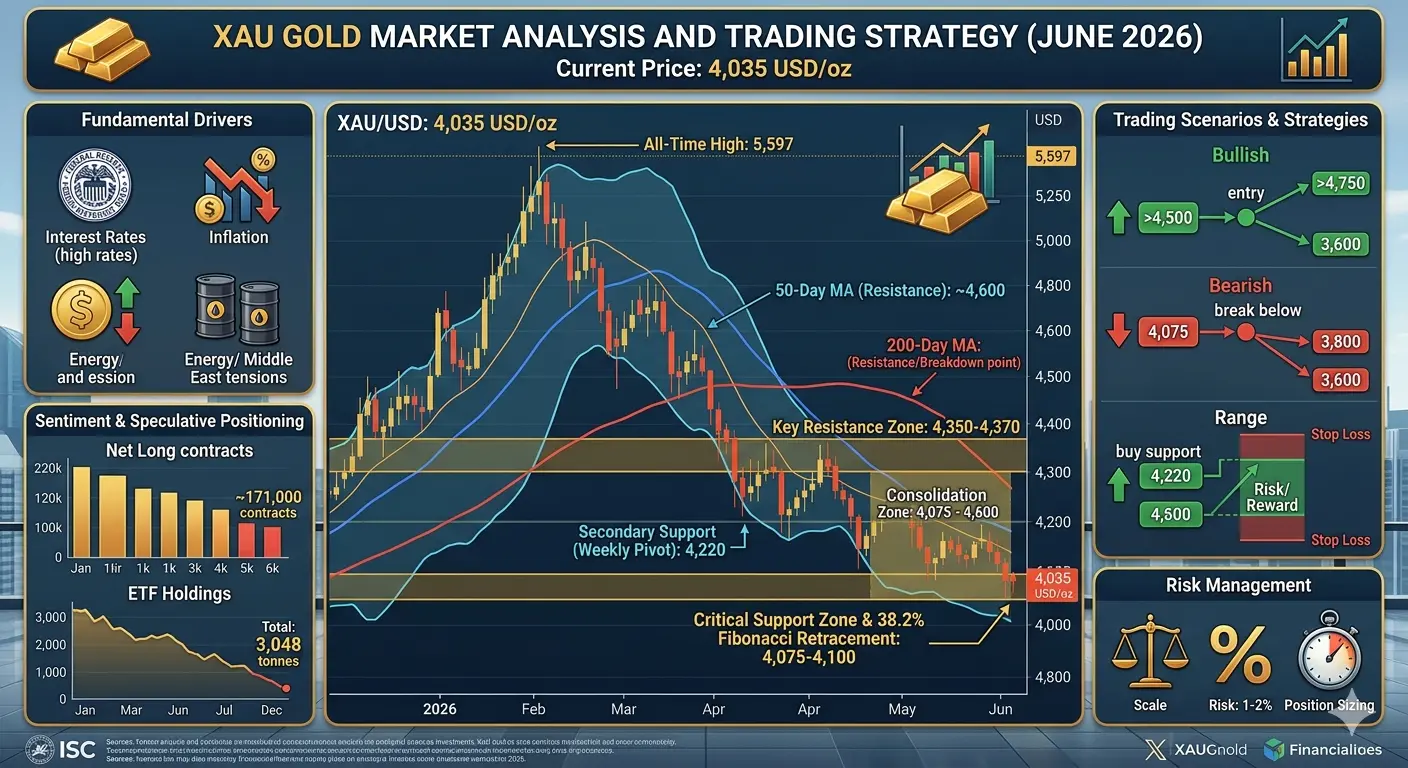
#SpotGoldFallsBelow4200Dollars
Spot gold refers to the current market price at which gold can be bought or sold for immediate delivery or settlement. This is the real-time trading price in international markets, reflecting the actual supply and demand dynamics at any given moment. Spot gold serves as the benchmark for all gold-related financial instruments including futures, CFDs, and ETFs.
What Does Falls Below $4,200 Mean
When gold prices fall below the $4,200 level, it represents a significant psychological and technical support level being broken. This threshold has been watched closely b
XAU2.22%
HighAmbition
#SpotGoldFallsBelow4200Dollars
Spot gold refers to the current market price at which gold can be bought or sold for immediate delivery or settlement. This is the real-time trading price in international markets, reflecting the actual supply and demand dynamics at any given moment. Spot gold serves as the benchmark for all gold-related financial instruments including futures, CFDs, and ETFs.
What Does Falls Below $4,200 Mean
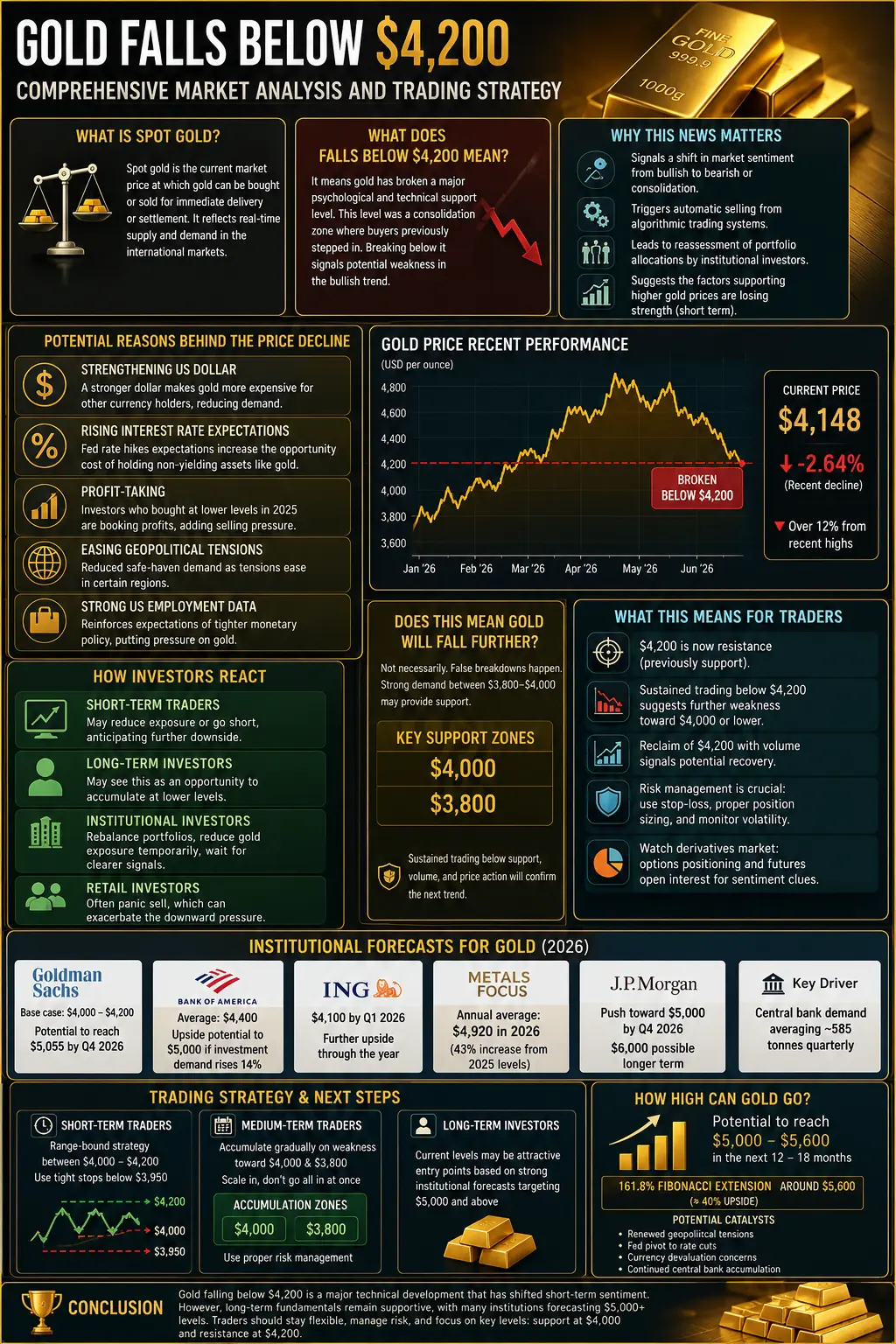
When gold prices fall below the $4,200 level, it represents a significant psychological and technical support level being broken. This threshold has been watched closely by traders and investors as it marked a consolidation zone where buying interest historically emerged. Breaking below this level signals potential weakness in the bullish trend that dominated much of 2025 and early 2026.
Why This News Matters
The breach of the $4,200 support level carries substantial importance for several reasons. First, it indicates a shift in market sentiment from bullish to potentially bearish or consolidation phase. Second, it triggers automatic selling from algorithmic trading systems programmed to exit positions when key support levels fail. Third, it may lead to a reassessment of portfolio allocations among institutional investors who view gold as a safe-haven asset. The breakdown also suggests that the factors supporting higher gold prices are losing their grip, at least in the short term.
How Investors React to This Development
Investor reactions typically diverge based on their trading horizon and risk appetite. Short-term traders often view this breakdown as a signal to reduce exposure or initiate short positions, anticipating further downside momentum. Long-term investors may see this as an opportunity to accumulate gold at lower prices, believing the fundamental drivers remain intact. Some institutional investors rebalance their portfolios, reducing gold allocations temporarily while waiting for clearer directional signals. Retail investors often panic sell during such breaks, exacerbating the downward pressure.
Potential Reasons Behind the Price Decline
Several interconnected factors have contributed to gold falling below $4,200. The strengthening US Dollar has made gold more expensive for holders of other currencies, reducing international demand. Rising interest rate expectations, particularly the possibility of Federal Reserve rate hikes rather than cuts, have increased the opportunity cost of holding non-yielding assets like gold. Profit-taking by investors who bought at lower levels in 2025 has added selling pressure. Additionally, easing geopolitical tensions in certain regions have reduced the safe-haven demand that previously supported prices. Strong US employment data has reinforced expectations of tighter monetary policy, further weighing on gold.
Does This Mean Gold Will Fall Further
A break below $4,200 does not guarantee continued decline. Markets often experience false breakdowns where prices briefly violate support before recovering. If buyers re-enter aggressively at current levels or if new catalysts emerge, prices could stabilize and reverse. Technical analysts watch for confirmation through sustained trading below support, volume patterns, and subsequent price action to determine whether this is a genuine trend change or temporary correction. The presence of strong demand zones between $3,800 and $4,000 suggests potential support areas where buying interest may emerge.
What This Means for Traders
Traders now view the $4,200 level as a critical reference point. Previously support, it now acts as resistance. Sustained trading below this level suggests further weakness toward $4,000 or lower. A reclaim of $4,200 with conviction would signal potential recovery and renewed bullish momentum. Risk management becomes crucial, with stop-loss placements and position sizing adjusted to account for increased volatility. Traders also monitor derivative markets for clues about sentiment, including options positioning and futures open interest.
Impact on Ordinary People
International gold price movements eventually affect local gold markets, though the transmission is not immediate or uniform. Local prices depend on currency exchange rates, import duties, taxes, and local supply-demand dynamics. When international prices decline, consumers may benefit from lower jewelry and investment gold prices, potentially stimulating physical demand. However, if currency depreciation occurs simultaneously, the local price impact may be muted. Central banks may also adjust their gold purchasing strategies based on these price movements.
Current Market Conditions and Forecast
As of early June 2026, gold is trading around $4,148, having declined approximately 2.64 percent recently and over 12 percent from recent highs. Despite this pullback, major financial institutions maintain bullish long-term forecasts. Goldman Sachs projects gold reaching $4,000 to $4,200 as a base case, with potential to reach $5,055 by the fourth quarter of 2026. Bank of America sees prices averaging $4,400 with upside potential to $5,000 if investment demand increases by 14 percent. ING forecasts $4,100 by the first quarter of 2026 with further upside through the year. Metals Focus predicts an annual average of $4,920 for 2026, representing a 43 percent increase from 2025 levels. J.P. Morgan expects gold to push toward $5,000 by the fourth quarter of 2026, with $6,000 possible longer term supported by central bank demand averaging approximately 585 tonnes quarterly.
Trading Strategy and Next Steps
For traders navigating this environment, several approaches merit consideration. Short-term traders might employ range-bound strategies between $4,000 and $4,200, using tight stops below $3,950. Medium-term position traders could accumulate gradually on weakness toward $4,000 and $3,800 support zones, scaling into positions rather than committing fully at once. Long-term investors may view current levels as attractive entry points given the institutional forecasts targeting $5,000 and above. Risk management remains paramount, with position sizes appropriate for volatility and clear exit strategies defined before entering trades.
How High Can Gold Go
Based on current institutional forecasts and technical analysis, gold has potential to reach $5,000 to $5,600 in the coming 12 to 18 months. The 161.8 percent Fibonacci extension level sits around $5,600, representing approximately 40 percent upside from current levels. Catalysts that could drive such moves include renewed geopolitical tensions, Federal Reserve pivoting to rate cuts, currency devaluation concerns, and continued central bank accumulation. However, the path is unlikely to be linear, with corrections and consolidation phases expected along the way.
Conclusion
Gold falling below $4,200 represents a significant technical development that has shifted short-term sentiment while long-term fundamentals remain supportive. The confluence of dollar strength, interest rate expectations, and profit-taking has created this pullback, but institutional forecasts suggest higher prices ahead. Traders should remain flexible, adapting strategies to evolving market conditions while maintaining appropriate risk management. The current environment offers both challenges for existing long positions and opportunities for patient accumulation at lower levels. Monitoring key support at $4,000 and resistance at $4,200 will guide near-term trading decisions, while the broader outlook toward $5,000 and beyond remains constructive for those with longer time horizons.@Gate_Square
repost-content-media
  • Reward
  • Comment
  • Repost
  • Share
#MyGateTradeStory
Bitcoin Market Analysis and Trading Strategy
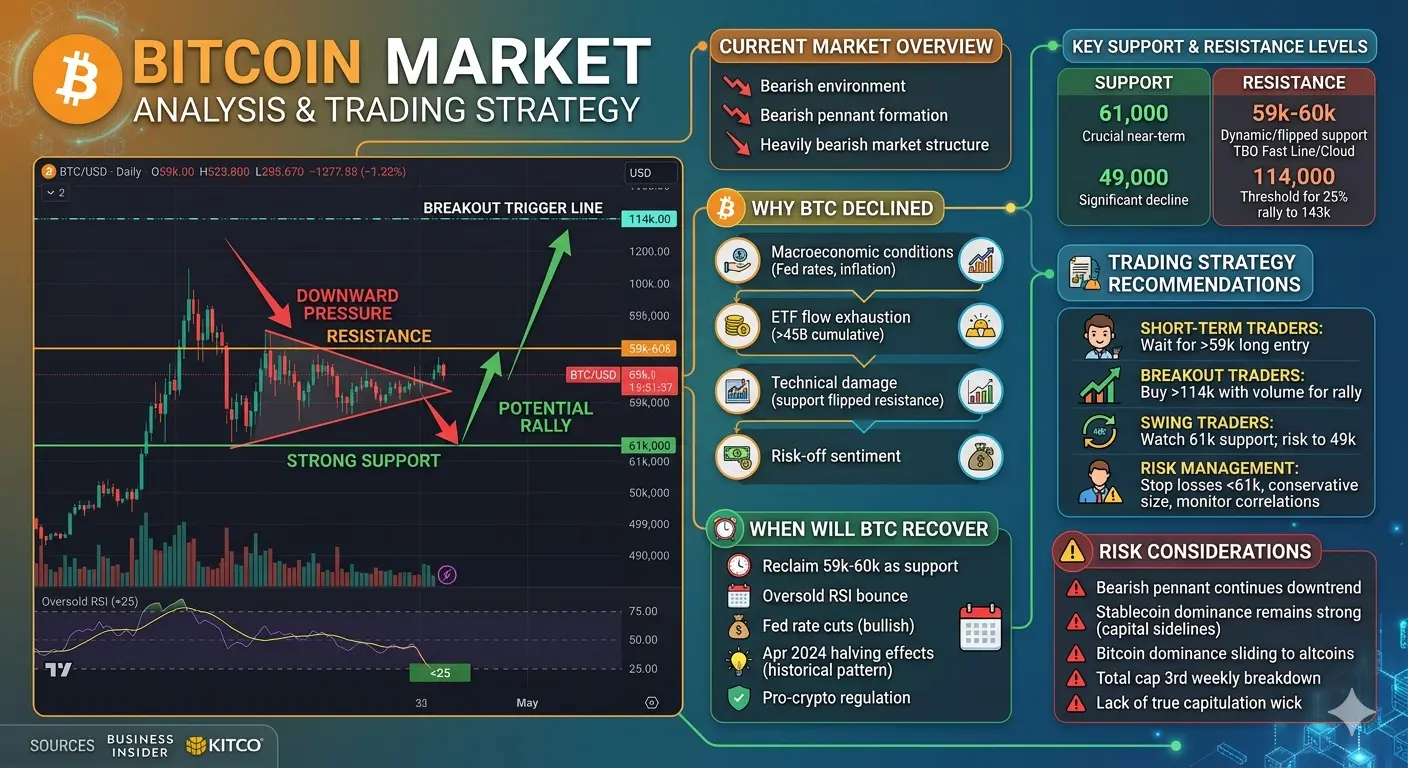
Bitcoin is currently facing significant downward pressure as it trades in a bearish technical environment. Recent price action shows BTC has formed a bearish pennant pattern on the daily chart, which is considered a continuation pattern suggesting further downside potential. The market structure remains heavily bearish with multiple technical indicators pointing toward continued weakness.
Why Bitcoin Has Declined
The recent decline in Bitcoin can be attributed to several interconnected factors. First, macroeconomic conditions have
BTC0.76%
HighAmbition
#MyGateTradeStory
Bitcoin Market Analysis and Trading Strategy
Bitcoin is currently facing significant downward pressure as it trades in a bearish technical environment. Recent price action shows BTC has formed a bearish pennant pattern on the daily chart, which is considered a continuation pattern suggesting further downside potential. The market structure remains heavily bearish with multiple technical indicators pointing toward continued weakness.
Why Bitcoin Has Declined
The recent decline in Bitcoin can be attributed to several interconnected factors. First, macroeconomic conditions have created headwinds for risk assets including cryptocurrencies. The Federal Reserve's stance on interest rates and ongoing inflation concerns have reduced appetite for speculative investments. Second, institutional flows into spot Bitcoin ETFs have shown signs of exhaustion after reaching over 45 billion dollars in cumulative inflows. Third, technical damage from previous breakdowns has not been repaired, with Bitcoin failing to reclaim former support levels that have now flipped to resistance. The failure to close back above the TBO resistance level after it flipped from support to resistance has confirmed the bearish structure. Additionally, broader risk-off sentiment in traditional markets has spilled over into crypto, with equities showing stress and the dollar remaining relatively strong.
Key Support and Resistance Levels
Understanding critical price levels is essential for any trading strategy. For Bitcoin, the immediate support level sits around 61,000 dollars. This is the most crucial near-term support that traders are watching. If this level breaks, the next artificial support target is approximately 49,000 dollars, which would represent a significant decline from current levels. On the resistance side, Bitcoin faces major hurdles. The 114,000 dollar level is identified as a key technical threshold that could unlock a larger rally of up to 25 percent toward 143,000 dollars if cleared. However, in the current bearish environment, immediate resistance is found at previous support levels that have now flipped to resistance, particularly around the 59,000 to 60,000 dollar zone. The TBO fast line and cloud structure also provide dynamic resistance levels that Bitcoin must overcome to change the bearish outlook.
When Will Bitcoin Recover
The timing of Bitcoin's recovery depends on several catalysts. From a technical perspective, Bitcoin needs to reclaim the 59,000 to 60,000 dollar zone and hold it as support to signal a potential trend reversal. The daily RSI has fallen into oversold territory below 25, which historically precedes bounces, but oversold conditions can persist in strong trends. Recovery catalysts include potential Federal Reserve rate cuts anticipated later this year, which are generally bullish for risk assets. The ongoing effects of the April 2024 halving event could still provide tailwinds, as historical patterns show rallies following halving events. Regulatory developments remain a wildcard, with pro-crypto policy developments potentially unlocking significant capital. However, until Bitcoin can break above the 114,000 dollar resistance with strong volume, any recovery should be viewed as a counter-trend bounce rather than a sustained bull run.
Trading Strategy Recommendations
For traders navigating this environment, a defensive approach is warranted. Short-term traders should consider waiting for Bitcoin to reclaim the 59,000 dollar level before entering long positions, as this would indicate a potential shift in momentum. Breakout traders might look for a decisive move above 114,000 dollars as a signal for a larger rally toward 143,000 dollars. Swing traders should watch the 61,000 dollar support level closely, as a breakdown below this level could trigger a rapid move toward 49,000 dollars. Risk management is critical in this environment, with stop losses recommended below the 61,000 dollar support for long positions. Position sizing should be conservative given the bearish technical structure and potential for rapid moves. Traders should also monitor traditional markets, as correlation between crypto and equities remains elevated during risk-off periods.
Risk Considerations
Several risks warrant attention. The bearish pennant pattern suggests continuation of the downtrend, meaning the path of least resistance remains lower. Stablecoin dominance has remained strong above the daily TBO cloud, indicating capital is waiting on the sidelines rather than flowing into crypto. Bitcoin dominance has printed a TBO close long signal and continues to slide, suggesting further loss of market share to altcoins. Total market capitalization charts confirm a third weekly TBO breakdown, with expectations for additional downside. The lack of a true capitulation volume wick means downside risk remains elevated, as markets often see climactic selling before sustainable bottoms form.
Conclusion
Bitcoin is currently in a challenging technical environment with bearish momentum dominating price action. The formation of a bearish pennant pattern, failure to reclaim key resistance levels, and oversold but not yet capitulated conditions suggest caution is warranted. Traders should focus on the 61,000 dollar support level as the line in the sand, with a breakdown opening the door to 49,000 dollars. Recovery prospects depend on reclaiming 59,000 to 60,000 dollars as support and eventually breaking above 114,000 dollars for a larger rally. Until these conditions are met, maintaining a defensive posture with strict risk management is the prudent approach. The convergence of technical weakness and macro uncertainty creates a challenging environment that rewards patience and disciplined execution over aggressive positioning.
@Gate_Square
repost-content-media
  • Reward
  • Comment
  • Repost
  • Share
#MyGateTradeStory
Ethereum Market Analysis and Trading Strategy - June 10, 2026
Ethereum is currently trading in a critical range between $1,600 and $1,700, presenting both opportunities and risks for traders. The market is showing mixed signals with a predominantly bearish short-term bias, though some analysts are identifying potential bullish divergences that could signal a recovery.
Current Price Situation
ETH has experienced a pullback from higher levels and is now consolidating near the $1,600-$1,700 zone. Recent price action shows a bounce from the $1,500-$1,550 support area, but the re
ETH0.58%
HighAmbition
#MyGateTradeStory
Ethereum Market Analysis and Trading Strategy - June 10, 2026
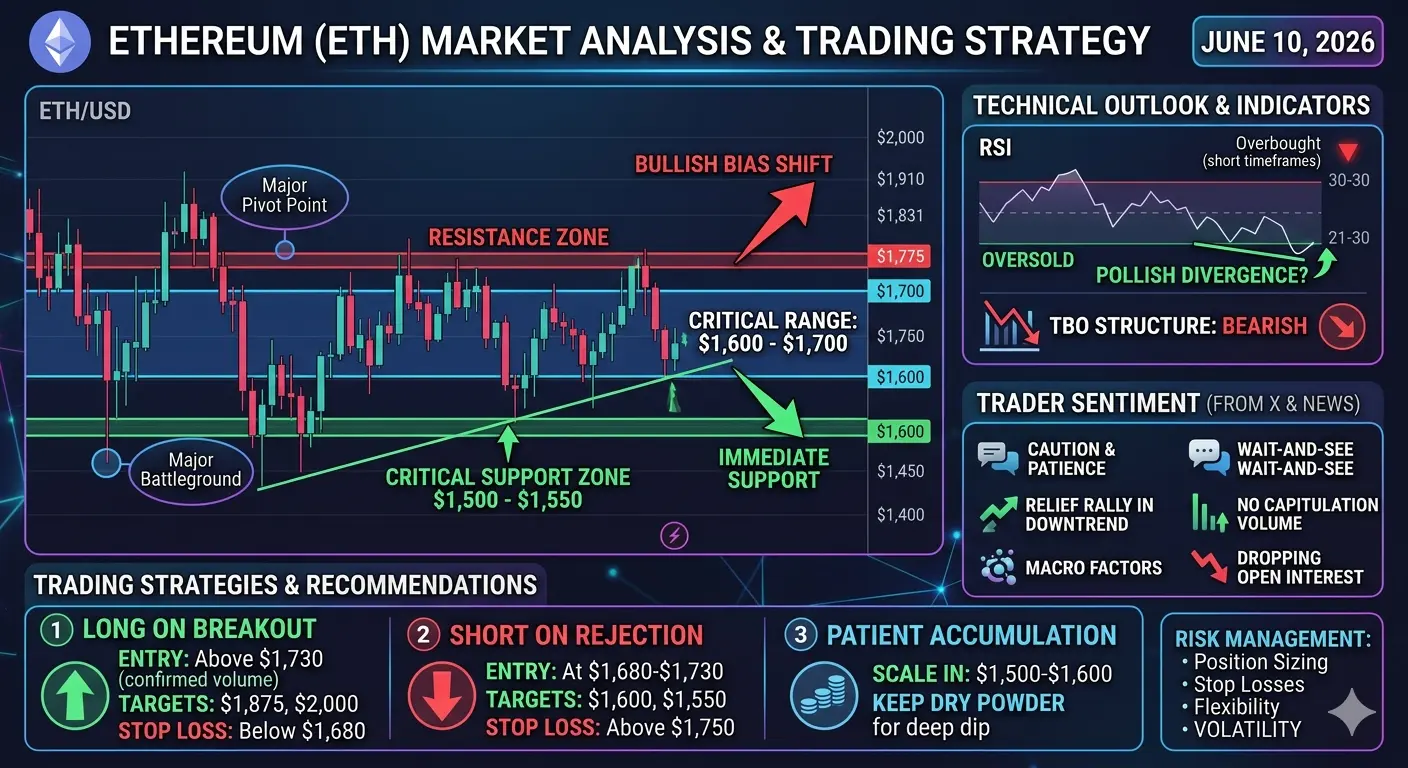
Ethereum is currently trading in a critical range between $1,600 and $1,700, presenting both opportunities and risks for traders. The market is showing mixed signals with a predominantly bearish short-term bias, though some analysts are identifying potential bullish divergences that could signal a recovery.
Current Price Situation
ETH has experienced a pullback from higher levels and is now consolidating near the $1,600-$1,700 zone. Recent price action shows a bounce from the $1,500-$1,550 support area, but the recovery faces significant overhead resistance. Traders on X are closely watching whether this bounce develops into a sustainable rally or proves to be another lower high within the ongoing downtrend.
Key Support Levels
The most critical support zone lies between $1,500 and $1,550. This area has been tested multiple times and represents a major battleground for bulls and bears. A decisive break below $1,550 could open the door for a deeper decline toward $1,450 or even the $1,400 level. The multi-year ascending trendline around current levels also provides structural support that traders are monitoring closely.
Immediate support sits at $1,600, which has acted as a pivot point in recent sessions. Below that, the $1,544-$1,547 zone represents the next line of defense before the critical $1,500 psychological level.
Key Resistance Levels
On the upside, immediate resistance is found between $1,680 and $1,730. This zone has seen repeated rejections and represents a convergence of supply where selling pressure intensifies. A clean break above $1,730 would shift the short-term bias toward bullish and could trigger a relief rally.
The next resistance targets above $1,730 include $1,775-$1,831, followed by the psychological $1,900-$1,910 zone. Stronger overhead resistance exists between $1,938 and $1,967, with the $2,000 level representing a major structural barrier that previously supported price before breaking down.
Technical Outlook and Indicators
The technical picture remains complex. Daily and weekly RSI readings show heavily oversold conditions in the 21-30 range, suggesting potential bullish divergence and the possibility of a bounce from these depressed levels. However, some analysts point to overbought readings in shorter timeframes, indicating conflicting signals across different periods.
The TBO structure remains bearish for ETH, with short-term support having broken down. Until ETH can reclaim lost support levels and reverse the bearish price structure, the overall technical outlook remains defensive and aligned with broader downside pressure in cryptocurrency markets.
Trader Sentiment Analysis
Market sentiment on X reflects caution and patience. Many experienced traders are adopting a wait-and-see approach, looking for confirmation signals before committing to directional positions. The dominant theme among active traders is that the current move represents a relief rally within a larger downtrend, with sellers maintaining control below major moving averages.
Common trader concerns include the lack of true capitulation volume, which keeps downside risk alive, and the need for bullish confirmation through a close above $1,700-$1,900 with significant volume. Open interest has been dropping, and macro factors continue to add volatility pressure to the market.
Trading Strategies and Recommendations
For short-term traders, the current environment favors a range-bound approach until a clear breakout occurs. Consider these strategies:
Strategy one involves waiting for a confirmed break above $1,730 with volume before entering long positions, targeting $1,875 and potentially $2,000. Place stop losses below $1,680 to protect against false breakouts.
Strategy two focuses on shorting rejections at the $1,680-$1,730 resistance zone, targeting a return to $1,600 and potentially $1,550. Use tight risk management with stops above $1,750.
Strategy three is a patient accumulation approach for longer-term holders, scaling into positions between $1,500 and $1,600 while maintaining dry powder for a potential breakdown toward $1,450 or lower.
Risk Management Considerations
Risk management remains paramount in current conditions. Use stops beyond recent swing points and avoid overleveraging. The market is at a critical inflection point where holding $1,500-$1,550 support could fuel a meaningful bounce, but failure at these levels risks a much deeper decline.
Consider position sizing carefully and maintain flexibility to adapt as price action develops. The conflicting technical signals suggest volatility will remain elevated, creating both opportunity and risk for active traders.
Market Outlook Summary
Ethereum faces a pivotal moment. The confluence of oversold technical conditions, critical support levels, and resistance zones creates a high-probability setup for a significant move in either direction. Traders should remain patient, wait for confirmation signals, and avoid trying to predict the outcome before price reveals its intention through volume and structure.
The path forward depends on whether bulls can defend the $1,500-$1,550 support zone and eventually reclaim $1,700-$1,730. Success here would open the door for a relief rally toward $1,900 and beyond. Failure risks a deeper decline that could test lower support levels and extend the ongoing bearish trend.
Remember that markets move quickly and analysis reflects community views only. Always conduct your own research and never risk more than you can afford to lose. The cryptocurrency market remains highly volatile and unpredictable, requiring constant vigilance and adaptive strategies.@Gate_Square
repost-content-media
  • Reward
  • Comment
  • Repost
  • Share
#MyGateTradeStory
H Token (Humanity Protocol) Technical Analysis and Trading Strategy
H token traders.
Current Market Situation
H token has experienced significant volatility recently. The price has fluctuated between approximately 0.07 and 0.25 USDT in recent sessions, with substantial downward pressure following a major security incident in early June 2026. This has created a highly uncertain trading environment that requires careful risk management.
Key Support Levels
For H token, the critical support zones to monitor are:
1. **Primary Support**: 0.07 - 0.10 USDT - This range represents t
HighAmbition
#MyGateTradeStory
H Token (Humanity Protocol) Technical Analysis and Trading Strategy
H token traders.
Current Market Situation
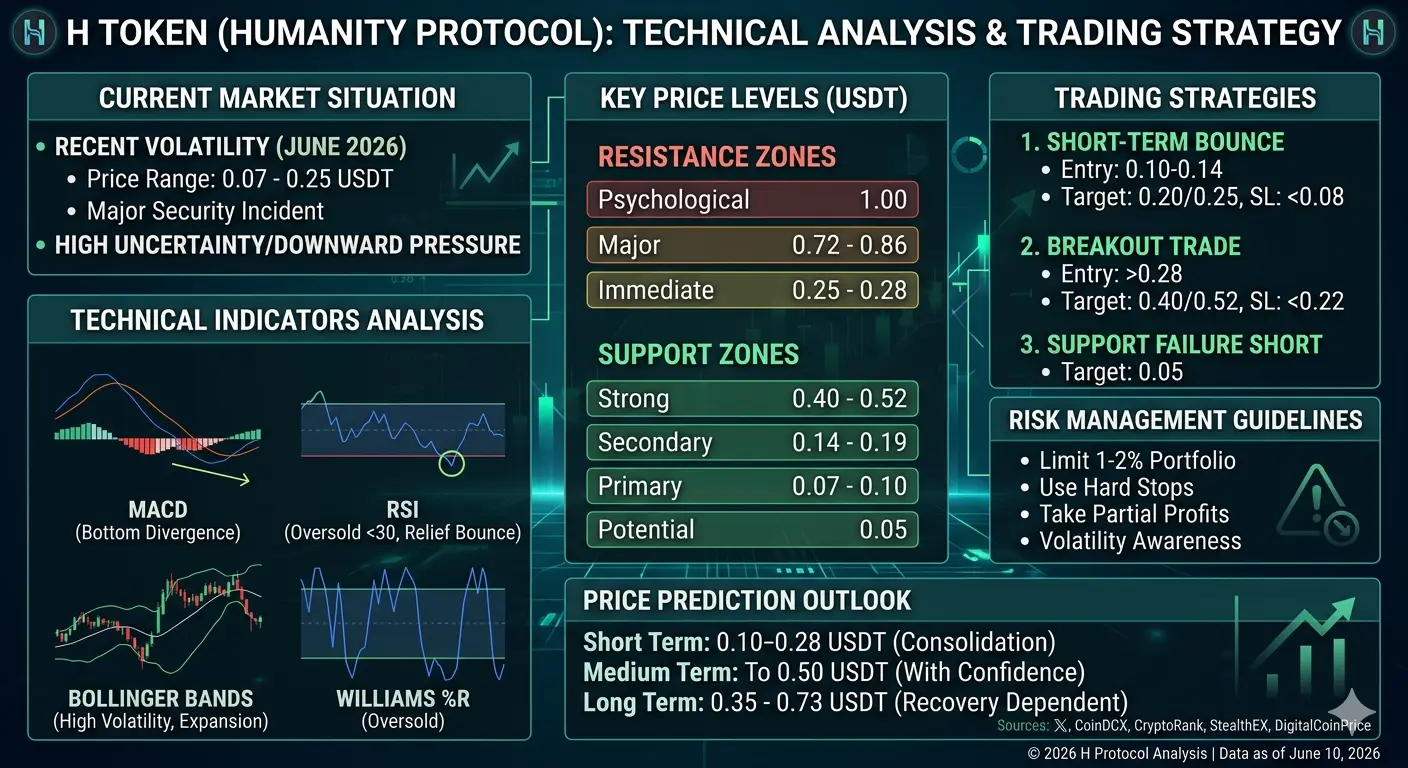
H token has experienced significant volatility recently. The price has fluctuated between approximately 0.07 and 0.25 USDT in recent sessions, with substantial downward pressure following a major security incident in early June 2026. This has created a highly uncertain trading environment that requires careful risk management.
Key Support Levels
For H token, the critical support zones to monitor are:
1. **Primary Support**: 0.07 - 0.10 USDT - This range represents the recent low where buying interest emerged following the security incident. A break below this level could see further downside toward 0.05 USDT.
2. **Secondary Support**: 0.14 - 0.19 USDT - Based on historical consolidation patterns, this zone previously acted as accumulation areas before the major price movements.
3. **Strong Support**: 0.40 - 0.52 USDT - These levels represent pre-incident support zones that may come into play if recovery momentum builds.
Key Resistance Levels
1. **Immediate Resistance**: 0.25 - 0.28 USDT - The recent rejection zone where selling pressure intensified.
2. **Major Resistance**: 0.72 - 0.86 USDT - These levels represent significant overhead supply from previous price action.
3. **Psychological Resistance**: 1.00 USDT - A major round number that previously attracted significant attention from traders.
Technical Indicators Analysis
**MACD (Moving Average Convergence Divergence)**: Currently showing bottom divergence on shorter timeframes, which could indicate potential short-term reversal opportunities. However, the overall trend remains bearish on higher timeframes.
**RSI (Relative Strength Index)**: The RSI has been in oversold territory, suggesting the possibility of a relief bounce. However, in strong downtrends, RSI can remain oversold for extended periods.
**Bollinger Bands**: The bands are showing expansion with high volatility readings, indicating that price swings may continue to be significant. The bandwidth is elevated compared to historical averages.
**Williams Percent Range (WR)**: Currently in oversold conditions, which aligns with the RSI reading and suggests potential for short-term mean reversion.
Trading Strategies for Different Scenarios
**Scenario 1: Short-Term Bounce Play**
If price holds above 0.10 USDT and shows bullish candlestick patterns:
- Entry: 0.10 - 0.14 USDT with confirmation
- Target 1: 0.20 USDT
- Target 2: 0.25 USDT
- Stop Loss: Below 0.08 USDT
- Risk/Reward: Approximately 1:2 to 1:3
**Scenario 2: Breakout Trade**
If price breaks above 0.28 USDT with volume:
- Entry: Above 0.28 USDT on confirmed breakout
- Target 1: 0.40 USDT
- Target 2: 0.52 USDT
- Stop Loss: Below 0.22 USDT
**Scenario 3: Support Failure Short**
If price breaks below 0.07 USDT:
- Avoid long positions
- Wait for price stabilization before considering entries
- Potential short-term target: 0.05 USDT or lower
Risk Management Guidelines
Given the current high volatility environment:
1. **Position Sizing**: Limit exposure to 1-2% of total portfolio per trade
2. **Stop Losses**: Always use hard stops, preferably below key support levels
3. **Take Profits**: Consider taking partial profits at each target level
4. **Volatility Awareness**: Expect 20-30% intraday moves and size positions accordingly
Market Sentiment Considerations
The recent security incident has significantly impacted trader confidence. Community sentiment has turned cautious, and many experienced traders are advising caution until security concerns are fully addressed. This means recovery may be slower and more volatile than typical market cycles.
Price Prediction Outlook
**Short Term (1-4 weeks)**: Price likely to remain in a consolidation range between 0.10 and 0.28 USDT, with potential for sharp moves in either direction based on news flow.
**Medium Term (1-3 months)**: If security issues are resolved and confidence returns, price could attempt to reclaim higher levels toward 0.50 USDT. However, this depends heavily on fundamental developments.
**Long Term**: Predictions vary widely, with some analysts suggesting potential for 0.35 to 0.73 USDT if the project recovers strongly, while others remain skeptical given recent events.
Final Recommendations for Traders
1. **Wait for Confirmation**: Do not enter positions without clear technical confirmation
2. **Monitor News**: Stay updated on security developments and official communications
3. **Use Tight Stops**: Given volatility, risk management is more important than entry precision
4. **Consider Dollar-Cost Averaging**: For long-term believers, small incremental entries may be safer than large single entries
5. **Stay Liquid**: Keep sufficient capital available for better opportunities
The current environment requires patience and discipline. Traders should focus on high-probability setups with clear risk parameters rather than trying to catch every move. The technical picture will become clearer once price establishes a stable trading range above key support levels.@Gate_Square
repost-content-media
  • Reward
  • Comment
  • Repost
  • Share
#MyGateTradeStory
GateToken (GT) is the native utility token of the Gate.io cryptocurrency exchange and the official platform token of GateChain blockchain network. Launched in 2019 and fully integrated with GateChain in 2020, GT serves as a versatile asset offering multiple benefits within the Gate ecosystem. The token operates on a Proof-of-Stake consensus mechanism, enabling users to participate in network validation and earn rewards while enjoying various platform privileges.
Current Market Position and Price Analysis
As of June 2026, GT is trading around the six dollar and thirty-one cen
GT0.15%
XAUUSD0.17%
HighAmbition
#MyGateTradeStory
GateToken (GT) is the native utility token of the Gate.io cryptocurrency exchange and the official platform token of GateChain blockchain network. Launched in 2019 and fully integrated with GateChain in 2020, GT serves as a versatile asset offering multiple benefits within the Gate ecosystem. The token operates on a Proof-of-Stake consensus mechanism, enabling users to participate in network validation and earn rewards while enjoying various platform privileges.
Current Market Position and Price Analysis
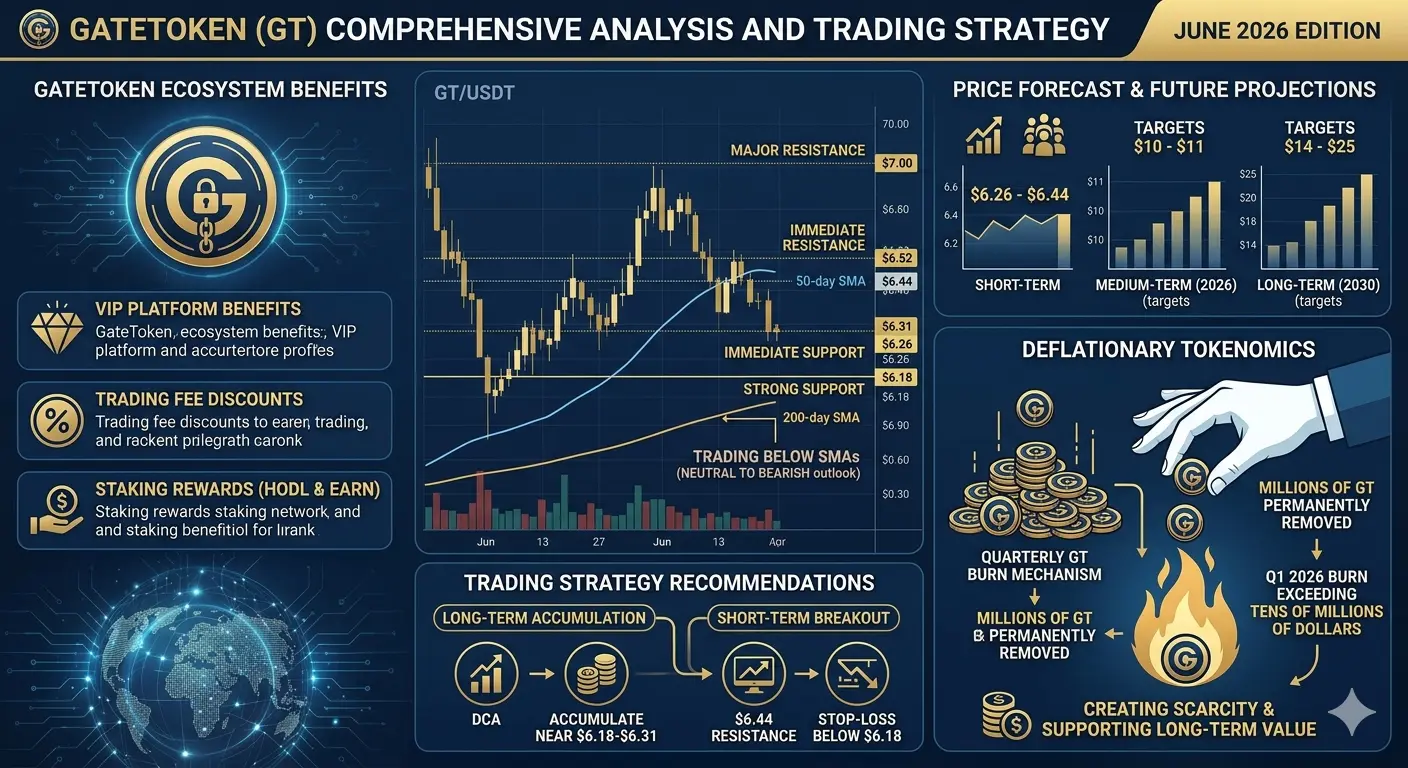
As of June 2026, GT is trading around the six dollar and thirty-one cents level, which represents a significant position within the exchange token sector. The token currently holds a market cap ranking in the top seventy-five cryptocurrencies, demonstrating its established presence in the digital asset market. Recent technical analysis indicates that GT is trading below both the fifty-day and two hundred-day simple moving averages, suggesting a neutral to slightly bearish short-term outlook according to current market indicators.
Key Support and Resistance Levels
Understanding critical price zones is essential for any trading strategy. For GT, immediate support levels are identified at six dollars and thirty-one cents, followed by six dollars and twenty-six cents, with the strongest support established at six dollars and eighteen cents. These levels represent areas where buying interest has historically emerged and where price reversals may occur. On the upside, resistance levels are positioned at six dollars and forty-four cents, six dollars and fifty-two cents, and a more significant barrier at approximately seven dollars. Breaking above these resistance zones would signal potential bullish momentum and open pathways toward higher price targets.
Price Forecast and Future Projections
Market analysts and prediction models present varying outlooks for GT price trajectory. Short-term forecasts suggest potential price movements between six dollars and twenty-six cents to six dollars and forty-four cents in the immediate trading sessions. Medium-term projections for 2026 indicate possible price targets around ten to eleven dollars, representing substantial upside potential from current levels. Long-term forecasts extending to 2030 suggest GT could reach fourteen to twenty-five dollars, depending on broader cryptocurrency market conditions and Gate ecosystem expansion. These projections are based on historical price patterns, token utility growth, and deflationary mechanisms in place.
Gate Token Utilities and Ecosystem Benefits
Gate.io has developed a comprehensive utility framework for GT holders. The primary benefit includes trading fee discounts, which can significantly reduce costs for active traders using GT on the platform. VIP tier privileges are available based on GT holdings, granting users access to enhanced services, higher withdrawal limits, and priority customer support. The token serves as the gas fee token on GateChain, required for executing transactions and smart contract interactions on the native blockchain.
Staking opportunities allow GT holders to earn passive income through various HODL and Earn programs. Users can participate in liquidity mining, yield farming, and other DeFi activities within the Gate ecosystem. Voting rights enable token holders to participate in governance decisions, including new token listings and platform feature developments. Exclusive access to token sales, airdrops, and early investment opportunities represents additional value for GT holders.
Deflationary Tokenomics and Burn Mechanism
One of the most significant value propositions for GT is its deflationary economic model. Gate.io implements a quarterly token burn mechanism that permanently removes GT from circulation. In the first quarter of 2026 alone, millions of GT tokens were burned, with values exceeding tens of millions of dollars. This consistent reduction in circulating supply creates scarcity and supports long-term price appreciation potential. The platform has demonstrated commitment to this deflationary strategy across multiple market cycles, reinforcing investor confidence in the token economic model.
Gate.io Ecosystem Development Initiatives
Gate continues to expand its ecosystem through various strategic initiatives. The platform has been developing GateChain as a robust blockchain infrastructure supporting decentralized applications and financial services. Integration of traditional finance products, including gold and forex trading, has broadened the utility scope for GT within the platform. The exchange maintains active development of trading tools, including grid trading bots and automated strategies that enhance user experience.
Recent ecosystem reconstruction efforts focus on creating a closer positive cycle between the token economic model and platform growth. Gate has been implementing structured frameworks for token burns while advancing regulatory compliance across multiple jurisdictions. The platform continues to build Web3 infrastructure, supporting the broader cryptocurrency industry toward more regulated and efficient operations.
Trading Strategy Recommendations
For traders considering GT positions, several strategic approaches are worth evaluating. Accumulation strategies near established support levels, particularly around six dollars and eighteen cents to six dollars and thirty-one cents, may offer favorable risk-reward ratios for long-term holders. Dollar-cost averaging over time can help mitigate volatility risks while building positions gradually.
Short-term traders should monitor the six dollars and forty-four cents resistance level closely, as a breakout above this zone could signal momentum toward higher targets. Setting stop-loss orders below six dollars and eighteen cents would help manage downside risks. For swing traders, targeting the ten to eleven dollar range for 2026 represents a reasonable medium-term objective based on current projections.
Risk management remains crucial, as cryptocurrency markets exhibit high volatility. Position sizing should reflect individual risk tolerance, and diversification across multiple assets is advisable. Monitoring Gate.io announcements regarding token burns, new product launches, and ecosystem developments can provide early signals for potential price movements.
Conclusion
GT represents a well-established exchange token with solid fundamentals supported by Gate.io continuous ecosystem development. The deflationary burn mechanism, comprehensive utility benefits, and expanding platform services create a foundation for potential long-term value appreciation. Current price levels near six dollars and thirty-one cents offer opportunities for both short-term trading and long-term accumulation strategies. Traders should maintain awareness of key support and resistance levels while monitoring broader cryptocurrency market trends and Gate.io specific developments for optimal timing decisions.
@Gate_Square
repost-content-media
  • Reward
  • Comment
  • Repost
  • Share
#MyGateTradeStory
LAB token is currently trading at approximately $7.86 USD, showing significant volatility in recent sessions. According to market data, LAB has experienced substantial price movements with a market cap around $2.47 billion and ranking at #202 on major cryptocurrency tracking platforms. The token has a circulating supply of approximately 310 million LAB coins with a maximum supply capped.
Price Action and Trend Analysis
LAB has demonstrated impressive bullish momentum recently, with weekly gains reaching substantial percentages. The token has shown resilience in maintaining h
LAB26.92%
HighAmbition
#MyGateTradeStory
LAB token is currently trading at approximately $7.86 USD, showing significant volatility in recent sessions. According to market data, LAB has experienced substantial price movements with a market cap around $2.47 billion and ranking at #202 on major cryptocurrency tracking platforms. The token has a circulating supply of approximately 310 million LAB coins with a maximum supply capped.
Price Action and Trend Analysis
LAB has demonstrated impressive bullish momentum recently, with weekly gains reaching substantial percentages. The token has shown resilience in maintaining higher price levels, indicating strong buyer interest at current zones. However, traders should note that the daily Connors RSI reading of 95.40 signals extreme overbought conditions, suggesting potential for short-term corrections before continuation.
The MACD indicator remains bullish with positive histogram readings, confirming that the underlying momentum still favors the upside. The Coppock Curve at elevated levels validates the long-term uptrend structure, though caution is warranted given the thin float and liquidity ratio of approximately 0.22 percent, which amplifies volatility in both directions.
Key Support Levels
Immediate support is established at $7.20, which represents a recent consolidation zone where buying interest emerged. Below this level, the next critical support sits at $6.80, coinciding with previous resistance-turned-support from earlier breakout attempts. The major support floor is located at $6.20, which aligns with the 20-day exponential moving average and previous accumulation phases.
A breakdown below $6.20 would signal a deeper correction toward $5.50, representing the 50-day moving average and a significant psychological level where institutional interest previously materialized. Traders should monitor volume confirmation at these support zones, as high volume bounces indicate genuine demand while low volume tests suggest potential breakdown risks.
Key Resistance Levels
Immediate resistance is positioned at $8.20, representing recent swing highs where profit-taking has historically emerged. The next significant resistance zone is at $8.80, which aligns with psychological round-number resistance and previous rejection points. A decisive breakout above $8.80 opens the path toward $9.50, where substantial supply is expected from early profit-booking.
The ultimate bullish target within the current cycle extends to $10.00 to $12.00, representing projected price forecasts based on momentum continuation and market sentiment analysis. However, reaching these levels requires sustained buying pressure and favorable market conditions.
Trading Strategy Recommendations
For conservative traders, consider accumulating positions near the $7.20 to $7.50 support zone with stop losses placed below $6.80. This approach offers favorable risk-reward ratios while protecting capital against adverse moves. Position sizing should remain moderate given the elevated volatility metrics.
For aggressive traders, momentum entries above $8.20 with confirmation can capture breakout moves toward higher resistance zones. However, given the overbought RSI conditions, waiting for a pullback entry presents superior risk management.
Swing traders should focus on the range between $7.20 support and $8.20 resistance, implementing buy-low-sell-high strategies within this consolidation zone. Breakout traders should await volume-confirmed moves above $8.80 or below $6.80 for directional positioning.
Risk Management Guidelines
Given LAB's thin float and elevated volatility, position sizing should never exceed 2 to 3 percent of total portfolio value per trade. Stop losses are mandatory and should be placed at logical technical levels, typically 5 to 8 percent below entry points for swing trades.
Take profit strategies should incorporate partial exits at key resistance levels, securing gains while maintaining exposure to extended moves. Trailing stops can protect profits once positions move favorably, adjusting stops to breakeven after 10 percent gains.
Market sentiment indicators suggest cautious optimism, with futures buying activity contributing to recent price appreciation. However, the investigation allegations regarding opaque loans and vesting changes highlight the importance of fundamental due diligence alongside technical analysis.
Conclusion
LAB presents both opportunity and risk at current levels. The technical structure supports continued upside potential toward $10.00 plus targets, but the overbought conditions and liquidity constraints warrant careful position management. Traders should prioritize entries near support zones, maintain strict stop losses, and scale positions gradually rather than deploying full capital at once. Monitoring volume patterns and news developments remains essential for adapting strategies to evolving market conditions.
@Gate_Square
repost-content-media
  • Reward
  • Comment
  • Repost
  • Share
#MyGateTradeStory
Gold is currently trading around 4,035 USD per troy ounce, representing a significant decline from its all-time high of 5,597 USD reached earlier in 2026. The precious metal has entered a corrective phase after an extended bull run, and traders are now assessing whether this represents a buying opportunity or signals further downside ahead.
Current Market Structure
The long-term uptrend in gold remains structurally intact when viewed from weekly and monthly timeframes. Price continues to hold above the rising 200-period moving average on these higher timeframes, which sugges
XAU2.22%
HighAmbition
#MyGateTradeStory
Gold is currently trading around 4,035 USD per troy ounce, representing a significant decline from its all-time high of 5,597 USD reached earlier in 2026. The precious metal has entered a corrective phase after an extended bull run, and traders are now assessing whether this represents a buying opportunity or signals further downside ahead.
Current Market Structure
The long-term uptrend in gold remains structurally intact when viewed from weekly and monthly timeframes. Price continues to hold above the rising 200-period moving average on these higher timeframes, which suggests the broader bullish structure has not been broken. However, the market is currently experiencing a multi-month correction that has pushed prices into a broad consolidation zone between 4,075 USD and 4,600 USD.
Recent price action shows gold trading firmly below its 200-day moving average, which constitutes an important technical setback. This break below the widely-watched trend indicator has shifted sentiment among medium and long-term investors who use this level as a trend filter. Systematic funds and momentum traders often reduce positions when price sustains below this average, which can create additional selling pressure.
Key Support Levels
The most critical support zone to monitor is the 4,075 USD to 4,100 USD range. This area marks the March correction low and coincides with the 38.2 percent Fibonacci retracement level of the powerful rally that began in 2022 and carried gold to nearly 5,600 USD earlier this year. A sustained break below this zone would shift the bias decisively bearish and open the door for deeper corrections toward 3,600 USD to 3,800 USD.
Secondary support is found at the 4,220 USD level, which has served as a multi-tested weekly pivot. This level has provided support on multiple occasions and represents a key decision point for traders. A weekly close below 4,220 USD would invalidate the bullish scenario and suggest the correction has further room to run.
Additional support zones include 4,180 USD to 4,200 USD, which aligns with the lower Bollinger Band on daily charts, and the psychological 4,000 USD level which could attract buying interest from long-term investors.
Key Resistance Levels
On the upside, the first significant resistance is located at 4,350 USD to 4,370 USD. This zone represents the recent breakdown level and would need to be reclaimed to signal any meaningful recovery attempt. Above this, the 4,442 USD level provides intermediate resistance before the more significant 4,500 USD mark.
The 4,600 USD level is crucial for bullish momentum to resume. This area coincides with the 50-day moving average and represents a major technical hurdle. According to Saxo Bank commodity strategist Ole Hansen, gold prices will need to challenge 4,600 USD before bullish momentum can return in earnest.
Further resistance is found at 4,750 USD, which aligns with the 200-period EMA on the four-hour timeframe, and the 4,855 USD swing high from April. A confirmed breakout above 4,750 USD would signal the end of the corrective wave and open the path toward retesting the all-time high.
Fundamental Drivers
Several factors are currently influencing gold price action. Higher interest rates in the United States continue to work against gold as a non-yielding asset. The Federal Reserve has maintained a hawkish stance due to persistent inflation concerns, which has strengthened the dollar and increased opportunity costs for holding gold.
Geopolitical tensions in the Middle East have created a complex dynamic for gold. While safe-haven demand would typically support prices, the conflict has also driven energy prices higher, which lifts inflation expectations and supports the dollar. This energy-driven inflation scare has caused investors to focus on interest rate risks rather than gold traditional role as a portfolio diversifier.
Central bank reserve diversification remains a long-term supportive factor. Despite recent price weakness, central banks continue accumulating gold as they seek to reduce dependence on dollar reserves. Growing fiscal debt burdens and currency debasement concerns also underpin the structural bull case for gold.
Speculative positioning has declined significantly from peak levels. COMEX gold futures net long positions have fallen to around 171,000 contracts, down from much higher levels earlier in the year. Gold ETF holdings have declined by 88 tonnes this year to 3,048 tonnes, though holdings remain 282 tonnes higher than a year ago. This reduction in speculative excess may actually support prices by removing froth from the market.
Trading Scenarios and Strategy
For bullish traders, the preferred entry strategy involves waiting for a confirmed breakout above 4,500 USD with a close above this level on the daily timeframe. This would signal that momentum is shifting back in favor of buyers. Entry on a retest of 4,500 USD as support would offer a favorable risk-reward setup, with stops placed below 4,350 USD and initial targets at 4,750 USD and ultimately the all-time high.
Alternatively, buying near current levels with a stop below 4,075 USD could work for traders with a longer-term horizon who believe the correction has run its course. This approach requires patience and willingness to weather potential volatility.
For bearish traders, a breakdown below 4,075 USD would present a shorting opportunity. Entry on a retest of this level as resistance, with stops above 4,200 USD and targets at 3,800 USD and 3,600 USD, would be the preferred approach. However, shorting gold in a secular bull market carries significant risk and should be approached with caution.
Range traders can operate within the 4,220 USD to 4,600 USD zone, buying near support and selling near resistance. This strategy works well in the current consolidation environment but requires discipline to exit when a breakout occurs.
Risk Management Considerations
Position sizing should reflect the elevated volatility in gold markets. The average true range has expanded significantly, meaning wider stops are required to avoid being stopped out by normal market noise. Traders should risk no more than one to two percent of their account on any single trade.
Correlation with the dollar index remains high, so traders should monitor dollar strength. A weakening dollar would provide tailwinds for gold, while continued dollar strength would pressure prices lower.
Geopolitical developments can cause sudden price spikes, so maintaining awareness of news flow is essential. Unexpected developments in Middle East tensions or shifts in Federal Reserve policy could quickly alter the technical picture.
Outlook and Conclusion
Gold is at a critical juncture where traders must decide whether the current correction represents a buying opportunity within an ongoing bull market or signals a more significant trend change. The technical structure suggests the former, with price holding above key long-term support levels despite short-term weakness.
For the remainder of 2026, gold is likely to remain range-bound between 4,075 USD and 4,855 USD until a catalyst emerges to drive the next directional move. A durable peace agreement in the Middle East and normalization of energy markets would likely shift focus back to the structural drivers supporting gold. Conversely, continued inflation concerns and hawkish Federal Reserve policy could pressure prices toward the lower end of the range.
Traders should remain patient and wait for clear technical confirmation before committing significant capital. The break below the 200-day moving average has damaged sentiment, and momentum will need time to rebuild. Focus on the 4,075 USD support and 4,600 USD resistance levels as the key decision points for the next major move in gold prices.@Gate_Square
repost-content-media
  • Reward
  • Comment
  • Repost
  • Share
#GateIPOAccessSpaceX
1. Gate Opens a New Investment Era with IPO Access
Gate has officially introduced IPO Access, giving eligible users a streamlined way to participate in selected IPO opportunities through its own ecosystem. The first featured company is SpaceX, one of the most valuable private technology and aerospace firms in the world. Instead of relying solely on traditional brokerage systems, users can access subscriptions directly through Gate while using digital assets such as USDT.
2. SpaceX Subscription Price and Entry Requirements
The reference intended subscription price is $135
HighAmbition
#GateIPOAccessSpaceX
1. Gate Opens a New Investment Era with IPO Access
Gate has officially introduced IPO Access, giving eligible users a streamlined way to participate in selected IPO opportunities through its own ecosystem. The first featured company is SpaceX, one of the most valuable private technology and aerospace firms in the world. Instead of relying solely on traditional brokerage systems, users can access subscriptions directly through Gate while using digital assets such as USDT.
2. SpaceX Subscription Price and Entry Requirements
The reference intended subscription price is $135 per share, making valuation transparent before allocation. Investors can begin with as little as 100 USDT, while the maximum intended subscription reaches 500,000 USDT per user.
Examples:
100 USDT = Entry-level participation
1,000 USDT = Medium-sized allocation attempt
10,000 USDT = Larger exposure
100,000 USDT = Institutional-style participation
500,000 USDT = Maximum subscription limit
This broad range allows investors with different portfolio sizes to participate.
3. Early Subscription May Increase Allocation Weight
Gate's allocation system rewards early participation. Investors who submit their intended subscription sooner receive a higher allocation weight compared with last-minute applicants.
With subscriptions already surpassing $30 million, competition for allocations has become increasingly significant. Entering earlier may improve the probability of receiving a larger share allocation.
4. Important Timeline Every Investor Should Know
Current schedule includes:
Reference subscription price: $135
Minimum participation: 100 USDT
Maximum participation: 500,000 USDT
Intended subscription fee: 5%
Subscription deadline: June 12, 2026, 12:00 UTC+8
Planning ahead before the deadline can help investors avoid congestion during the final hours.
5. Why SpaceX Continues to Attract Global Attention
SpaceX has transformed the aerospace industry through reusable rocket technology, Starlink satellite expansion, commercial launches, and government contracts.
Many analysts estimate SpaceX's private valuation well above $300 billion, making it one of the world's largest privately held technology companies. The opportunity to gain exposure through Gate has therefore generated considerable market interest.
6. USDT-Based Participation Simplifies Access
Unlike conventional IPO subscriptions that often require bank transfers and brokerage accounts, Gate allows subscriptions through USDT.
For crypto investors already holding stablecoins, this creates a familiar funding process while reducing operational complexity.
Whether participating with 100 USDT, 5,000 USDT, 50,000 USDT, or 500,000 USDT, the process remains integrated within the same platform.
7. Shares Delivered Directly to Gate Stock Accounts
After successful allocation, purchased shares are expected to be transferred directly into the user's Gate stock account.
This integrated structure removes the need for opening additional broker relationships and allows investors to manage both digital assets and stock holdings within one ecosystem.
8. Demand Already Exceeds $30 Million
Investor enthusiasm has pushed intended subscriptions beyond $30 million.
Strong demand often reflects confidence in both the featured company and the accessibility of the offering. However, higher participation can also reduce allocation percentages, meaning investors should prepare for varying outcomes.
9. Price Scenarios After Listing
Although future prices cannot be predicted with certainty, investors often evaluate multiple possibilities.
Example scenarios:
Entry reference: $135
10% appreciation → $148.50
20% appreciation → $162
30% appreciation → $175.50
50% appreciation → $202.50
100% appreciation → $270
On the downside:
10% decline → $121.50
20% decline → $108
30% decline → $94.50
These examples demonstrate why disciplined position sizing remains important.
10. Portfolio Management Strategy
Rather than committing all available capital to one opportunity, many investors prefer staged participation.
Examples:
Conservative allocation: 100–1,000 USDT
Moderate allocation: 1,000–10,000 USDT
Aggressive allocation: 10,000–100,000 USDT
Large-scale participation: Up to 500,000 USDT
Diversification across multiple asset classes can help reduce concentration risk.
11. Risk Factors Investors Should Consider
Every IPO carries uncertainty.
Key considerations include:
Allocation amounts may differ from intended subscriptions.
Market prices after listing can move above or below the reference price.
Broader economic conditions may influence valuation.
Investor sentiment can create short-term volatility.
Liquidity conditions may affect price discovery.
Maintaining reasonable expectations and using only capital that fits an individual's investment plan remains essential.
12. Overall Outlook
Gate IPO Access represents an interesting evolution in connecting digital assets with global equity opportunities.
Key figures include:
Reference subscription price: $135
Minimum participation: 100 USDT
Maximum participation: 500,000 USDT
Subscription fee: 5%
Reported intended subscriptions: Over $30 million
Deadline: June 12, 2026, 12:00 UTC+8
If adoption continues expanding and future offerings include additional major technology companies, IPO Access could become an increasingly attractive option for investors seeking diversified exposure through a single platform.
Final Conclusion
SpaceX remains one of the most closely watched technology companies globally, and Gate's IPO Access provides a new route for eligible users to participate using USDT. With a $135 reference price, 100 USDT minimum entry, 500,000 USDT maximum subscription, and demand already above $30 million, the offering has generated substantial attention. Investors should balance opportunity with disciplined risk management, evaluate allocation expectations carefully, and consider how this investment fits within their broader long-term portfolio strategy.@Gate_Square #MyGateTradeStory #GateIPOAccessSpaceX
repost-content-media
  • Reward
  • Comment
  • Repost
  • Share
#AnthropicReleasesFable5Model
Anthropic is a leading AI research company founded in 2021 by former OpenAI researchers, known for developing the Claude series of language models with a focus on safety and beneficial AI systems.
On June 9, 2026, Anthropic announced Claude Fable 5, its most advanced public model, coinciding with their confidential IPO filing with the SEC.
Fable 5 is a Mythos-class AI model representing Anthropic's most capable system, featuring superior performance in coding, reasoning, and complex task handling compared to previous versions.
Release means making the model pu
ETH0.58%
SOL2.33%
HighAmbition
#AnthropicReleasesFable5Model
Anthropic is a leading AI research company founded in 2021 by former OpenAI researchers, known for developing the Claude series of language models with a focus on safety and beneficial AI systems.
On June 9, 2026, Anthropic announced Claude Fable 5, its most advanced public model, coinciding with their confidential IPO filing with the SEC.
Fable 5 is a Mythos-class AI model representing Anthropic's most capable system, featuring superior performance in coding, reasoning, and complex task handling compared to previous versions.
Release means making the model publicly available through Claude API and various subscription plans, though with safety restrictions that route sensitive queries to less capable models.
This release matters because Fable 5 scores over 10% above Claude Opus 4.8 on benchmarks and leads in software engineering, knowledge work, and scientific research capabilities.
Compared to previous models, Fable 5 offers enhanced speed, greater accuracy, advanced reasoning, and significantly lower pricing at $10 per million input tokens and $50 per million output tokens.
Applications include chatbots, research tools, content generation, coding assistance, legal analysis, and multidisciplinary reasoning tasks across various industries.
Users benefit from smarter, more natural AI responses with better context understanding, reduced over-refusal rates, and enhanced assistance with technical tasks.
This release intensifies AI industry competition and establishes new standards for publicly available AI capabilities, potentially influencing how competitors approach model releases.
Anthropic released Claude Fable 5, a significantly more powerful AI model that surpasses previous versions in capability and sets new performance benchmarks.
Comprehensive Discussion: Anthropic Releases Fable 5 Model
Understanding the Public Release
Anthropic's release of Claude Fable 5 on June 9, 2026, marks a significant milestone as the first publicly available Mythos-class model. The company implemented a unique dual-release strategy: Fable 5 for general public use with safety safeguards, and Mythos 5 for vetted cyber defenders through Project Glasswing. This approach addresses security concerns while making advanced capabilities accessible.
Safety Architecture
Fable 5 employs sophisticated cyber classifiers that monitor for potential misuse. When queries trigger these systems in high-risk domains like cybersecurity, biology, or chemistry, the model hands off to Claude Opus 4.8 rather than refusing entirely. This mechanism allows legitimate use while preventing harmful applications. The cybersecurity classifier blocks offensive cyber tasks including reconnaissance and exploit development, successfully preventing harmful requests in testing against 30 public jailbreak techniques.
Performance and Pricing
The model establishes new standards across benchmarks including agentic coding, knowledge work, spatial reasoning, and legal analysis. Notably, the unrestricted version demonstrated capability to identify and exploit zero-day vulnerabilities in major operating systems and browsers during testing. Pricing at $10 per million input tokens and $50 per million output tokens makes these capabilities more accessible than previous versions.
Implications for Cryptocurrency Market
Smart Contract Development
Fable 5's advanced coding capabilities provide substantial value for smart contract development and auditing. Developers can leverage the model to write, review, and optimize contract code across Ethereum, Solana, and other platforms. The model's vulnerability detection capabilities can identify security flaws before deployment, potentially preventing costly exploits that have plagued DeFi protocols.
Technical Analysis and Research
The model processes vast amounts of on-chain data, news, and sentiment to provide comprehensive market analysis. Traders can use Fable 5 to identify price patterns, analyze whale wallet activities, and assess blockchain network health. Its understanding of complex financial instruments supports analysis of derivatives markets, yield farming strategies, and liquidity mechanisms.
Educational Value
Fable 5 serves as an educational resource for blockchain technology, consensus mechanisms, tokenomics, and investment risks. Its ability to explain complex concepts clearly makes crypto accessible to broader audiences and supports community building through accurate documentation and responsive support.
Regulatory Compliance
As regulatory scrutiny intensifies, Fable 5 assists with analyzing frameworks, preparing compliance documentation, and assessing legal implications of business decisions. The model's legal document processing capabilities support compliance teams navigating evolving regulations.
Risk Assessment and Due Diligence
Investors can conduct thorough due diligence using Fable 5 to analyze whitepapers, review code repositories, assess team backgrounds, and evaluate tokenomics. The model's ability to identify red flags helps investors avoid fraudulent projects and poorly constructed protocols.
Blockchain Data Analysis
Users can analyze transaction patterns, identify unusual wallet behaviors, and trace fund flows across chains. Researchers benefit from network health analysis, decentralization evaluation, and economic security assessment of proof-of-stake networks.
Content and Marketing Support
Projects leverage Fable 5 for creating documentation, educational content, and marketing materials while maintaining technical accuracy. This capability proves particularly valuable for localization and reaching non-English speaking markets.
Conclusion
Anthropic's Claude Fable 5 represents a significant advancement with substantial implications for the cryptocurrency ecosystem. From smart contract security to market analysis and educational content, the model offers capabilities that enhance efficiency and reduce risks. The thoughtful dual-release strategy manages AI risks while enabling widespread access to powerful tools that will transform how the crypto industry operates and evolves.@Gate_Square #MyGateTradeStory
repost-content-media
  • Reward
  • Comment
  • Repost
  • Share
#MyGateTradeStory
BEAT Token Trading Strategy and Price Forecast
BEAT token is currently trading at approximately $7.50, showing strong bullish momentum with a recent price increase of over 54 percent in the past 24 hours. The token has a market capitalization of approximately $2.15 billion and ranks among the top 40 cryptocurrencies by market cap. With a 24-hour trading volume exceeding $86 million, BEAT demonstrates healthy liquidity and active market participation. The circulating supply stands at 288 million tokens out of a total supply of 1 billion tokens.
Key Support and Resistance Leve
BEAT-7.94%
BTC0.76%
ETH0.58%
HighAmbition
#MyGateTradeStory
BEAT Token Trading Strategy and Price Forecast
BEAT token is currently trading at approximately $7.50, showing strong bullish momentum with a recent price increase of over 54 percent in the past 24 hours. The token has a market capitalization of approximately $2.15 billion and ranks among the top 40 cryptocurrencies by market cap. With a 24-hour trading volume exceeding $86 million, BEAT demonstrates healthy liquidity and active market participation. The circulating supply stands at 288 million tokens out of a total supply of 1 billion tokens.
Key Support and Resistance Levels
Understanding support and resistance levels is crucial for developing an effective trading strategy. Based on technical analysis and current market structure, here are the key price levels traders should monitor closely.
Immediate support levels are identified at $6.80, $6.20, and $5.50. The $6.80 level represents the first line of defense where buying interest typically emerges following minor pullbacks. The $6.20 zone acts as a stronger support level that has historically attracted significant accumulation. The critical support sits at $5.50, which if broken could signal a deeper correction toward $4.80.
On the resistance side, immediate hurdles are located at $8.00, $8.75, and $10.00. The $8.00 level represents the next psychological barrier where profit-taking may intensify. Breaking above $8.75 could open the path toward the psychological $10.00 mark, which would represent a significant milestone for the token.
Price Forecast and Trading Strategy
The current bullish momentum suggests BEAT could test the $8.00 resistance in the short term. If buying pressure continues and volume remains elevated, a breakthrough toward $8.50 to $9.00 appears plausible within the coming days. However, traders should remain cautious of potential profit-taking after such rapid appreciation.
For conservative traders, waiting for a pullback to the $6.50 to $6.80 support zone before entering long positions offers a favorable risk-to-reward ratio. Setting stop losses below $6.00 would help protect capital in case of unexpected market reversals.
For aggressive traders, current momentum favors continuation plays. Entering positions near current levels with tight stops around $7.00 could capture further upside toward $8.50. Scaling out partial positions at $8.00 and $8.75 helps secure profits while maintaining exposure to higher targets.
VIP Trading Tips and Risk Management
Professional traders emphasize the importance of position sizing and risk management. Never risk more than two percent of your trading capital on a single trade. Use proper stop loss placement to protect against adverse moves. Consider using trailing stops once positions move into profit to lock in gains while allowing room for further appreciation.
Diversification remains essential even when focusing on high-momentum assets like BEAT. Maintaining exposure across multiple assets helps reduce portfolio volatility and protects against single-asset drawdowns.
Monitor volume patterns closely as they often precede price movements. Declining volume on upward moves may signal weakening momentum and potential reversal. Conversely, increasing volume on breakouts above resistance levels confirms strength and sustainability of the move.
Market Sentiment and External Factors
The broader cryptocurrency market conditions significantly influence individual token performance. Monitor Bitcoin and Ethereum price action as they often set the tone for altcoin movements. Positive regulatory developments and institutional adoption news can provide additional catalysts for price appreciation.
Social media sentiment and community engagement also play important roles in driving short-term price movements. Following official project announcements and community discussions helps traders stay informed about potential catalysts.
Conclusion
BEAT token presents an interesting trading opportunity given its current momentum and market positioning. The key is to approach trading with discipline, proper risk management, and clear entry and exit strategies. Whether you are a conservative trader looking for pullback entries or an aggressive trader riding momentum, understanding the support and resistance levels outlined above will help you make more informed decisions.
Remember that cryptocurrency markets are highly volatile and prices can move rapidly in either direction. Always conduct your own research and never invest more than you can afford to lose. Successful trading requires patience, discipline, and continuous learning from both wins and losses.@Gate_Square #MyGateTradeStory
repost-content-media
  • Reward
  • Comment
  • Repost
  • Share
#USMayCPIHits3YearHigh
On June 10, 2026, the US Bureau of Labor Statistics released the May Consumer Price Index report that sent shockwaves through global markets. The CPI surged to an annual rate of 4.2%, up from 3.8% in April, marking the highest inflation reading since April 2023. This is not just a number on a government spreadsheet. It is a signal that the economic landscape has fundamentally shifted, and the ripple effects are already crashing into the cryptocurrency market at a time when it is already under siege from geopolitical conflict, rising interest rate expectations, and extre
HighAmbition
#USMayCPIHits3YearHigh
On June 10, 2026, the US Bureau of Labor Statistics released the May Consumer Price Index report that sent shockwaves through global markets. The CPI surged to an annual rate of 4.2%, up from 3.8% in April, marking the highest inflation reading since April 2023. This is not just a number on a government spreadsheet. It is a signal that the economic landscape has fundamentally shifted, and the ripple effects are already crashing into the cryptocurrency market at a time when it is already under siege from geopolitical conflict, rising interest rate expectations, and extreme volatility. Let us break down the ten critical points that explain what this means and how deeply it will affect crypto.
Point 1: US May CPI = 4.2% Annual Inflation Rate. The headline CPI figure of 4.2% year-over-year is the most significant inflation reading in over three years. On a monthly basis, prices rose 0.5% in May, slightly below the 0.6% monthly increase seen in April, but still a substantial acceleration. The CPI, which tracks the cost of a basket of goods and services that typical American consumers purchase, has been climbing steadily since January 2026, when the annual rate was just 2.4%. That means inflation has nearly doubled in just five months. This rapid ascent has caught the attention of every market participant from Wall Street to crypto traders, because it signals that the Federal Reserve's battle against inflation is far from won.
Point 2: CPI is the Consumer Price Index, the primary gauge that measures inflation across the US economy. It tracks price changes across hundreds of categories including housing, food, transportation, medical care, education, and recreation. When CPI rises, it means the cost of living is increasing. Every dollar you hold buys less than it did before. For investors, especially those in assets like Bitcoin and Ethereum that do not yield interest or dividends, rising CPI erodes the real value of holdings unless the asset price appreciates faster than inflation. A 4.2% CPI means that any crypto asset sitting flat is actually losing 4.2% in real purchasing power each year.
Point 3: This CPI reading hits a 3-year high, surpassing every reading since April 2023 when inflation was 4.9%. The significance of crossing the 4% threshold cannot be overstated. For the past two years, inflation had been gradually declining from its 2022 peaks, giving markets hope that the Federal Reserve would eventually cut interest rates. That hope is now shattered. The trajectory from 2.4% in January to 3.3% in March, to 3.8% in April, and now 4.2% in May shows an unmistakable upward trend that is moving in the wrong direction relative to the Fed's 2% target.
Point 4: Higher inflation means things are getting more expensive. Energy prices accounted for more than 60% of the monthly CPI increase in May. US energy inflation surged to 23.5% year-over-year, driven by gasoline prices that have skyrocketed due to the Iran war disrupting global oil supplies. The national average for unleaded gas has risen over $1.20 per gallon since the war began, reaching $4.12 per gallon according to AAA. Electricity costs have also jumped significantly. Beyond energy, "supercore" services inflation, which excludes energy services and housing, recorded its worst month-to-month surge in over two years, indicating that price pressures are spreading beyond just oil and gas into the broader economy.
Point 5: The direct impact on the stock market has been severe. On June 10, the S&P 500 dropped 1.6%, the Dow Jones Industrial Average sank 1.9%, and the Nasdaq composite lost 2%. The VIX volatility index surged 7.85% to 21.43, reflecting heightened fear among investors. Tech stocks and semiconductor shares led the decline, with the PHLX Semiconductor Index falling 5%. AI-related stocks that had been the market leaders throughout 2026 experienced a sharp sell-off. When equities fall, risk appetite shrinks, and capital tends to rotate out of speculative assets like cryptocurrencies into safer havens or cash.
Point 6: The crypto market is directly affected because digital assets are classified as risk assets, similar to tech stocks and growth equities. Bitcoin is currently trading around $62,037, down roughly 50% from its all-time high of $126,080. Ethereum has collapsed to approximately $1,645, a dramatic decline from its October 2025 level near $3,847 and its January 2026 price of $2,445. Solana is around $63, struggling to hold above critical support levels. The total crypto market is under extreme pressure, and a hot CPI report only intensifies the selling pressure by reinforcing the narrative that tighter monetary policy is ahead.
Point 7: When CPI is already elevated and rising, the probability of interest rate hikes increases dramatically. Before the May CPI data, bond traders had already begun pricing in a Fed rate hike by year-end. After the report, CME Group's FedWatch tool showed a 43% probability of a 25-basis-point rate hike by December, versus a 32% chance that rates would stay unchanged. Some FOMC members have already floated the possibility that rates may need to rise later this year. The two-year Treasury yield touched 4.18%, the highest since February 2025. Reuters reported that the Federal Reserve is now expected to hold rates unchanged into 2027, with rate cuts all but priced out for 2026. Higher interest rates make borrowing more expensive, reduce liquidity in the financial system, and make yield-bearing assets like bonds more attractive relative to non-yielding assets like Bitcoin and Ethereum.
Point 8: Market volatility is escalating across all asset classes. Oil prices are extremely volatile, with WTI crude trading around $89.82 per barrel and Brent crude around $91 to $92.55, swinging wildly on every geopolitical development. Gold, which initially saw a relief rally after the CPI data came in line with expectations, is trading around $4,142 to $4,192 per ounce, down significantly from its January peak of $5,608. Silver has plunged 44% from its high above $121 to around $67.30. The VIX is elevated, and crypto volatility is equally intense. Bitcoin has been oscillating between $61,800 and $63,000 with no clear directional trend, reflecting a market caught between macro headwinds and institutional accumulation.
Point 9: Investors are pulling money from risk assets. The data is unmistakable. Gold has shed 23% from its January 2026 peak, losing hundreds of billions in market value alongside silver, despite conditions that traditionally push precious metals higher. Crypto markets have seen similar outflows. Ethereum's monthly average price dropped from $2,445 in January to $2,256 in April, and then collapsed to approximately $1,619 in June. When inflation surges and rate hikes loom, capital allocators shift from risk-on positions to risk-off or yield-bearing alternatives. This rotation directly drains liquidity from crypto markets, suppressing prices and extending bearish trends.
Point 10: The combined effect of 3-year-high inflation and the Iran-Israel conflict creates a uniquely hostile environment for crypto. The Iran war, which reignited on June 7-8 with Iran launching missiles at Israel and Israel retaliating with airstrikes on central and western Iran, has triggered the largest oil supply disruption in history. The Strait of Hormuz, which carried about 15.6 million barrels of crude per day before the war, is now nearly paralyzed. Only about 2.1 to 2.9 million barrels per day are leaking through via clandestine routes. On June 9, Iran shot down a US Army Apache helicopter near the Strait, and the US launched retaliatory strikes on June 10. Trump warned that Iran would "pay the price" for taking too long to negotiate. The EIA projects the war will slash world petroleum production from 106.1 million barrels per day in 2025 to an average of 99 million barrels per day in 2026. Meanwhile, the SpaceX IPO on June 12 is drawing $250 billion in investor demand, potentially pulling even more capital away from crypto markets. Bitcoin at $62,250, Ethereum at $1,640, gold at $4,110, and oil near $90 paint a picture of a market under simultaneous pressure from inflation, war, monetary tightening, and capital rotation. The path forward for crypto depends on whether the Iran conflict deescalates allowing energy prices and CPI to retreat, or whether further escalation pushes inflation even higher and triggers an actual Fed rate hike that could drive Bitcoin toward the $60,000 support level and Ethereum toward $1,500 or below.
In summary, the US May CPI at 4.2% is not merely an economic data point. It is the convergence point where inflation, geopolitics, and monetary policy collide with maximum force on the crypto market. The inflation surge driven by the Iran war's energy shock, combined with rising rate hike expectations and already battered crypto prices, creates a deeply challenging environment. Traders and investors should monitor three key variables going forward: the trajectory of the Iran conflict and its impact on oil and CPI, the Federal Reserve's response at the June 17 FOMC meeting, and institutional capital flows particularly around the SpaceX IPO. Each of these factors will determine whether the crypto market stabilizes or faces further downside pressure in the weeks ahead.
@Gate_Square #MyGateTradeStory #Web3SecurityGuide #StrongNonfarmPayrollsRekindleRateHikeFear #USIranConflictEscalates
repost-content-media
  • Reward
  • Comment
  • Repost
  • Share
#USIranConflictEscalates
The geopolitical landscape has shifted dramatically as tensions between the United States and Iran have intensified to levels not seen in decades. Recent military actions, including coordinated strikes and retaliatory measures, have created ripple effects across global financial markets. Current Geopolitical Situation.
The conflict has evolved from isolated incidents into what analysts are calling the broadest Middle Eastern military confrontation in decades. The United States and Israel launched coordinated military strikes against Iranian targets, prompting swift re
HighAmbition
#USIranConflictEscalates
The geopolitical landscape has shifted dramatically as tensions between the United States and Iran have intensified to levels not seen in decades. Recent military actions, including coordinated strikes and retaliatory measures, have created ripple effects across global financial markets. Current Geopolitical Situation.
The conflict has evolved from isolated incidents into what analysts are calling the broadest Middle Eastern military confrontation in decades. The United States and Israel launched coordinated military strikes against Iranian targets, prompting swift retaliation from Tehran. The situation has been further complicated by Iran launching drones toward the Strait of Hormuz, prompting US forces to strike Iranian coastal radar installations. A third wave of airstrikes has reportedly been executed, indicating that military operations are ongoing rather than de-escalating.
The Strait of Hormuz, through which approximately 20% of global daily oil supply flows, remains a critical flashpoint. While not completely closed, shipping lanes have experienced significant disruptions, creating supply uncertainties that markets are struggling to price accurately.
Gold Market Analysis
Gold has experienced significant downward pressure despite the geopolitical turmoil, which traditionally would support safe-haven assets. Currently trading near $4,331, gold has declined approximately 23% from its January peak of $5,608 per ounce. This counterintuitive price action reflects several competing forces at play.
The primary headwind for gold has been shifting Federal Reserve expectations under Kevin Warsh's leadership. Stronger than expected payroll data, with 172,000 jobs added in May, has increased the probability of interest rate hikes. Rising real yields have made US Treasury securities more attractive relative to non-yielding assets like gold, triggering substantial Western outflows from precious metals exchange traded funds.
From a technical perspective, gold has broken below its 200-day moving average for the first time since October 2023, signaling significant weakening of the bullish structure. Key support levels are now being tested at the 78.6% Fibonacci retracement near $4,262, with additional support from the 10-period moving average at $4,246 on weekly charts.
If these support levels fail, the next downside targets include the March swing low at $4,097 and potentially the October low near $3,929. Resistance on any rebound would be encountered first at $4,366, followed by the 200-day moving average near $4,442.
Despite near term weakness, Metals Focus forecasts gold reaching an annual average of $4,920 in 2026, representing a 43% increase. Physical investment demand is expected to surpass jewelry consumption for the first time, driven by central bank acquisitions averaging approximately 585 tonnes quarterly.
Oil Market Dynamics
Oil prices have demonstrated the volatility expected during Middle East conflicts, though the magnitude of price movements has been somewhat contained relative to historical precedents. Brent crude reached approximately $93.09 per barrel, while West Texas Intermediate trades around $99.85. These levels represent a significant retreat from March peaks near $120 when conflict fears were at their highest.
The apparent disconnect between supply disruptions and price levels reflects complex market dynamics. Goldman Sachs estimates that 4-5 million barrels per day of global oil demand has been destroyed since April, representing a 4-5% reduction in global consumption. This demand destruction has partially offset the supply constraints from Strait of Hormuz disruptions.
The Energy Information Administration reports that the de facto closure of the Strait has now exceeded three months, representing the largest oil supply disruption in history. Trading houses like Trafigura have capitalized on these conditions, reporting net profits of $4.1 billion for the period from October 2025 through March 2026.
Looking forward, Goldman Sachs maintains Q4 2026 forecasts of $90 for Brent and $83 for West Texas Intermediate, though they acknowledge two-sided risks to these projections. The critical factor remains whether military escalation expands to threaten regional oil infrastructure or triggers broader conflict that would fundamentally alter supply calculations.
Bitcoin and Cryptocurrency Markets
Bitcoin has exhibited resilience relative to other risk assets, recovering from $59,000 lows to trade near $62,072. However, technical indicators suggest caution remains warranted. Bitcoin has formed a bearish pennant pattern on daily charts, defined by higher lows and lower highs creating a triangular consolidation after the prior decline.
Key support resides near $61,000, with a break below this level potentially triggering a rapid move toward $49,000. Daily RSI has fallen below 25 into oversold territory, while both On Balance Volume and Trend Breakout indicators remain strongly bearish without meaningful trend structure changes.
Ethereum has already confirmed Trend Breakout breakdowns and trades with short term support broken, targeting $1,385 as the next artificial support level. The total cryptocurrency market capitalization excluding stablecoins is also working on daily Trend Breakout breakdowns, with February 6th levels at $1.77 trillion representing critical support.
Bitcoin dominance has remained relatively stable near 60%, which has historically provided some insulation for the broader cryptocurrency market during risk off periods. However, rising stablecoin dominance above 13% would signal capital flight from risk assets and potentially trigger broader altcoin weakness.
Comparative Analysis: Gold vs Oil vs Bitcoin
Each asset class is responding to the conflict through different mechanisms, creating distinct trading opportunities and risks.
Gold represents the traditional safe haven, yet it is currently underperforming due to monetary policy headwinds. The metal faces the paradox of geopolitical support conflicting with interest rate pressures. Historical patterns suggest that if military escalation expands to ground operations or threatens major supply routes, gold could rapidly reclaim its safe haven status regardless of Federal Reserve policy.
Oil embodies the immediate economic impact of Middle East conflicts through supply disruption channels. However, demand destruction has complicated the typical wartime premium narrative. The commodity remains highly sensitive to any escalation affecting production facilities or export terminals, with potential for rapid price spikes if infrastructure comes under threat.
Bitcoin occupies an evolving position in crisis markets. While initially conceived as digital gold, correlations with risk assets have increased during recent volatility. The cryptocurrency has shown some decoupling tendencies during this conflict, outperforming equities while remaining vulnerable to broad risk off sentiment. Institutional adoption and regulatory developments continue shaping its crisis response characteristics.
Scenario Analysis and Price Targets
Three primary scenarios warrant consideration for trading strategy development.
In a de-escalation scenario where diplomatic channels reopen and military operations wind down, gold could stabilize near current levels before gradually recovering toward $4,600. Oil would likely retreat toward $85 for Brent as the geopolitical risk premium deflates. Bitcoin might consolidate in the $55,000-$65,000 range as risk sentiment improves.
Under the current baseline scenario of continued low intensity conflict without major infrastructure damage, gold faces continued pressure toward $4,000 unless Federal Reserve policy shifts. Oil maintains an elevated trading range between $90-$105 reflecting ongoing supply uncertainty. Bitcoin tests the $61,000 support with downside risk toward $50,000 if technical breakdowns confirm.
A severe escalation scenario involving ground military operations or threats to major oil facilities would trigger significant repricing across all markets. Gold could rapidly advance toward $5,000 as traditional safe haven demand overwhelms interest rate concerns. Oil might spike above $120 temporarily as supply fears intensify. Bitcoin would face conflicting pressures between risk off liquidation and potential safe haven positioning, likely testing $50,000 support before determining direction.
Trading Strategy Recommendations
For gold traders, current conditions favor defensive positioning with tight risk management. Short positions on rallies toward $4,400 with stops above $4,500 target initial support at $4,200. Long positions should await confirmation of support holding with entries near $4,100 and stops below $4,000. Position sizing should account for potential volatility expansion during weekend gaps when geopolitical developments often occur.
Oil traders should monitor Strait of Hormuz shipping data and military communications closely. Long positions remain justified on dips below $90 for Brent with stops near $85, targeting $110 on escalation. However, demand destruction concerns warrant caution on extended rallies above $105. Calendar spreads may offer better risk reward than outright directional positions given the contango structure in futures markets.
Bitcoin traders face the challenge of technical breakdown risk against potential geopolitical hedging demand. Defensive positioning is warranted with stops below $61,000 for long positions. Short term traders might consider range trading between $59,000 and $63,000 until directional clarity emerges. Longer term accumulators should prepare for potential tests of $49,000-$50,000 support levels before considering significant position building.
Risk Management Considerations
Volatility across all three markets has expanded significantly, requiring adjustments to position sizing and leverage. Geopolitical events frequently occur during illiquid trading hours, creating gap risk that stop losses may not effectively manage. Traders should consider options strategies or reduced position sizes to account for these tail risks.
Correlation breakdowns during crisis periods can invalidate traditional portfolio diversification assumptions. Assets that typically move independently may exhibit temporary synchronization during stress events, compounding portfolio risk. Monitoring cross asset correlations in real time becomes essential during conflict periods.
Liquidity conditions warrant attention as institutional participants may reduce market making activity during uncertainty. Wider bid ask spreads and increased slippage can impact execution quality, particularly for larger position sizes.
Conclusion
The US-Iran conflict represents a complex market environment where traditional relationships between geopolitical risk and asset prices are being tested. Gold faces unusual headwinds from monetary policy despite conflict support. Oil balances supply disruption against demand destruction in unprecedented ways. Bitcoin continues defining its role in crisis markets somewhere between risk asset and alternative store of value.
Traders should maintain flexible strategies with clear risk management protocols, recognizing that rapid repricing remains possible as military developments unfold. The current equilibrium appears fragile, with potential for significant moves in either direction depending on whether diplomacy or escalation dominates the coming weeks. Monitoring real time developments while maintaining disciplined position management will be essential for navigating these uncertain markets successfully.
@Gate_Square #MyGateTradeStory #Web3SecurityGuide
repost-content-media
  • Reward
  • Comment
  • Repost
  • Share
#BitminePlans300MPreferredStockOffering
BitMine Immersion Technologies (BMNR) has announced a major capital raising initiative of approximately $300 million through a Series A Perpetual Preferred Stock issuance. The structure includes 3 million shares priced at $100 each, offering a 9.5% annual cumulative dividend, paid weekly when declared. While this appears to be a conventional financial instrument on the surface, the real market interpretation is far more significant: it is increasingly being viewed as a large-scale institutional liquidity pipeline potentially directed toward cryptocurren
HighAmbition
#BitminePlans300MPreferredStockOffering
BitMine Immersion Technologies (BMNR) has announced a major capital raising initiative of approximately $300 million through a Series A Perpetual Preferred Stock issuance. The structure includes 3 million shares priced at $100 each, offering a 9.5% annual cumulative dividend, paid weekly when declared. While this appears to be a conventional financial instrument on the surface, the real market interpretation is far more significant: it is increasingly being viewed as a large-scale institutional liquidity pipeline potentially directed toward cryptocurrency accumulation.
This development arrives at a critical stage for global markets where Bitcoin, Ethereum, gold, and oil are all reacting to a combination of macroeconomic stress, geopolitical instability, and shifting institutional capital flows. The importance of BitMine’s action is not only in the size of the raise, but in the strategic signal it sends regarding long-term crypto demand from publicly traded companies.
1. Current Market Environment (Macro + Crypto + Commodities)
At the time of analysis, global markets are positioned in a highly sensitive equilibrium:
Bitcoin (BTC): $63,200
Ethereum (ETH): $1,684
Gold (XAU/USD): $4,320
WTI Crude Oil: $94.50
Each of these assets is responding to overlapping macro forces:
Key macro drivers:
Persistent inflation pressure in the US economy
Strong labor market data reducing expectations of near-term rate cuts
Elevated Treasury yields tightening global liquidity
US Federal Reserve maintaining restrictive policy stance
Iran–Israel geopolitical conflict increasing risk premiums
Oil supply disruption fears via the Strait of Hormuz
Mixed institutional flows in crypto ETFs
This environment creates a “dual-pressure market” where:
Risk assets struggle due to liquidity tightening
Safe-haven assets gain from uncertainty
Commodities react to geopolitical disruption
2. BitMine Strategic Positioning (Core Business Shift)
BitMine is no longer functioning as a traditional technology or mining-focused firm in market perception. Instead, it is increasingly classified as a crypto treasury accumulation entity.
Current reported holdings include:
ETH: 4,000,000+ ETH (approx. $6.7B+ value at $1,684)
BTC: ~192 BTC (approx. $12M+)
Total crypto + cash exposure: ~$13.4B
Additional equity exposure in crypto-linked firms
This places BitMine among the largest institutional crypto holders globally, comparable in strategic influence (not structure) to early Bitcoin treasury adopters.
The central strategy is:
Increase crypto holdings per share over time, using capital markets as a funding engine.
This model creates a self-reinforcing structure: capital raise → crypto accumulation → balance sheet expansion → market revaluation → further capital access
3. Structure of the $300M Preferred Offering (Financial Breakdown)
Total raise: $300,000,000
Security type: Series A Perpetual Preferred Stock
Units: 3,000,000 shares
Price per share: $100
Dividend: 9.5% annually (cumulative)
Payment schedule: weekly (conditional on declaration)
This structure is significant because:
9.5% yield implies $28.5M annual dividend obligation
Likely requires yield generation via staking + treasury strategies
Creates incentive for productive capital deployment rather than passive holding
This makes the instrument effectively:
part fixed income product
part crypto-linked yield instrument
part leveraged digital asset accumulation vehicle
4. Bitcoin Market Structure and Price Context
Bitcoin Current Market: $63,200
Recent price structure:
Recent low: $59,160
Recovery zone: $60,000 – $63,500
Previous high cycle: $126,000 (2025 peak)
Market condition:
Approx. -50% from cycle peak
High volatility compression phase
Institutional accumulation zone forming
Key Bitcoin dynamics:
(A) Supply Scarcity Effect
Bitcoin supply is capped at 21 million coins. Institutional treasury accumulation reduces circulating liquidity, especially when assets are moved into long-term custody.
At current price:
$300M = approx. 4,700 BTC
Total circulating supply impact appears small numerically
But liquidity impact is amplified due to OTC accumulation behavior
(B) ETF + Treasury Dual Demand
Market now has two structural demand engines:
Spot ETFs (passive institutional inflow)
Corporate treasuries (active accumulation)
This dual structure creates sustained demand pressure even during corrections.
(C) Liquidity Sensitivity
Bitcoin is highly sensitive to:
US dollar strength
Treasury yields (currently ~4%+ region)
Fed rate expectations
Global liquidity cycles
5. Ethereum Market Structure (Key Focus Asset)
Ethereum Current Price: $1,684
Ethereum is strategically more important in this specific narrative due to BitMine’s accumulation bias.
Ethereum strengths in this context:
Proof-of-stake yield generation (staking rewards)
Reduced supply via locked staking contracts
Increasing institutional infrastructure adoption
Tokenization and real-world asset integration trend
If even a moderate portion of $300M flows into ETH:
potential ETH absorption: ~170,000 ETH to 200,000 ETH equivalent
significant short-term liquidity compression possible
Ethereum market structure:
Major support: $1,600 / $1,550 / $1,450
Resistance: $1,750 / $1,850 / $2,000
ETH tends to outperform BTC in percentage terms during capital inflow phases due to lower market cap elasticity.
6. Gold Market Position (Safe-Haven Dynamics)
Gold Current Price: $4,320
Gold remains structurally strong despite short-term corrections:
Historical peak: ~$5,598 earlier cycle high
Yearly performance: +40% to +41%
Current phase: consolidation after macro-driven rally
Gold is reacting to:
geopolitical tension demand
inflation hedge positioning
central bank accumulation behavior
USD volatility cycles
Key levels:
Support: $4,300 / $4,200 / $4,000
Resistance: $4,500 / $4,600 / $4,800
Gold and Bitcoin currently operate in parallel but different narratives:
Gold = traditional safety hedge
Bitcoin = digital liquidity + speculative hedge
7. Oil Market Shock (Geopolitical Supply Risk)
Oil Current Price: $94.50
Oil is the most directly impacted asset due to the Iran–Israel conflict and Strait of Hormuz disruption risks.
Key structural issue:
~20% of global oil passes through Hormuz
~20% LNG flow affected
Supply stress implications:
global inflation pressure increases
transportation costs rise
manufacturing input costs increase
central bank policy becomes more restrictive
Oil scenarios:
Upside breakout: $100 → $105 → $110
Downside correction: $90 → $85
Oil at elevated levels directly impacts Bitcoin and risk assets through inflation and liquidity tightening channels.
8. Market Interconnection Model (Critical Insight)
All major assets are now interconnected:
If oil rises:
inflation rises
Fed remains hawkish
BTC & ETH face liquidity pressure
If gold rises:
risk-off sentiment increases
capital shifts away from equities/crypto
If BTC rises:
risk-on sentiment returns
ETH typically follows with higher beta movement
If institutional crypto raises increase:
long-term structural bullish cycle strengthens
9. Risk Factors for Crypto Impact
Despite bullish structural signals, key risks remain:
No confirmation that full $300M will go into BTC or ETH
Heavy allocation may go to Ethereum only
ETF outflows remain inconsistent
High interest rate environment suppresses liquidity
Geopolitical escalation can trigger sudden sell-offs
Treasury company valuations already under pressure
Recent data shows:
crypto treasury sector lost significant market value in recent months
market is transitioning from hype phase to consolidation phase
10. Full Trading Structure Summary
Bitcoin (BTC)
Current: $63,200
Bull case: $65,000 → $68,000 → $70,000 → $75,000
Bear case: $60,000 → $59,160 → $57,000 → $55,000
Ethereum (ETH)
Current: $1,684
Bull case: $1,750 → $1,850 → $2,000 → $2,200
Bear case: $1,600 → $1,550 → $1,450
Oil (WTI)
Current: $94.50
Bull case: $100 → $105 → $110
Bear case: $90 → $85
Gold
Current: $4,320
Bull case: $4,500 → $4,600 → $4,800
Bear case: $4,200 → $4,000
11. Final Conclusion (Core Market Message)
BitMine’s $300M preferred stock offering is not an isolated corporate financing event—it is part of a broader structural transformation where institutional capital markets are increasingly being used to fund direct exposure to digital assets.
The key implications are:
Bitcoin gains structural support through treasury accumulation narrative
Ethereum may receive disproportionate benefit due to BitMine’s historical strategy
Liquidity conditions remain the primary macro driver of all crypto assets
Oil-driven inflation risk continues to shape Federal Reserve policy
Gold remains the macro hedge against uncertainty
Ultimately, this development reinforces one central theme:
Crypto markets are increasingly being driven not by retail speculation alone, but by structured institutional capital flows that operate through corporate balance sheets, ETFs, and treasury expansion models.
The next phase of price action across Bitcoin and Ethereum will depend not only on market sentiment—but on how aggressively institutional capital deployment accelerates following this and similar capital raises.@Gate_Square #ShareYourUSStocksWinNvidia #TradeCFDWinGold
repost-content-media
  • Reward
  • Comment
  • Repost
  • Share
#BitminePlans300MPreferredStockOffering
BitMine Immersion Technologies (BMNR) has announced a major capital raising initiative of approximately $300 million through a Series A Perpetual Preferred Stock issuance. The structure includes 3 million shares priced at $100 each, offering a 9.5% annual cumulative dividend, paid weekly when declared. While this appears to be a conventional financial instrument on the surface, the real market interpretation is far more significant: it is increasingly being viewed as a large-scale institutional liquidity pipeline potentially directed toward cryptocurren
HighAmbition
#BitminePlans300MPreferredStockOffering
BitMine Immersion Technologies (BMNR) has announced a major capital raising initiative of approximately $300 million through a Series A Perpetual Preferred Stock issuance. The structure includes 3 million shares priced at $100 each, offering a 9.5% annual cumulative dividend, paid weekly when declared. While this appears to be a conventional financial instrument on the surface, the real market interpretation is far more significant: it is increasingly being viewed as a large-scale institutional liquidity pipeline potentially directed toward cryptocurrency accumulation.
This development arrives at a critical stage for global markets where Bitcoin, Ethereum, gold, and oil are all reacting to a combination of macroeconomic stress, geopolitical instability, and shifting institutional capital flows. The importance of BitMine’s action is not only in the size of the raise, but in the strategic signal it sends regarding long-term crypto demand from publicly traded companies.
1. Current Market Environment (Macro + Crypto + Commodities)
At the time of analysis, global markets are positioned in a highly sensitive equilibrium:
Bitcoin (BTC): $63,200
Ethereum (ETH): $1,684
Gold (XAU/USD): $4,320
WTI Crude Oil: $94.50
Each of these assets is responding to overlapping macro forces:
Key macro drivers:
Persistent inflation pressure in the US economy
Strong labor market data reducing expectations of near-term rate cuts
Elevated Treasury yields tightening global liquidity
US Federal Reserve maintaining restrictive policy stance
Iran–Israel geopolitical conflict increasing risk premiums
Oil supply disruption fears via the Strait of Hormuz
Mixed institutional flows in crypto ETFs
This environment creates a “dual-pressure market” where:
Risk assets struggle due to liquidity tightening
Safe-haven assets gain from uncertainty
Commodities react to geopolitical disruption
2. BitMine Strategic Positioning (Core Business Shift)
BitMine is no longer functioning as a traditional technology or mining-focused firm in market perception. Instead, it is increasingly classified as a crypto treasury accumulation entity.
Current reported holdings include:
ETH: 4,000,000+ ETH (approx. $6.7B+ value at $1,684)
BTC: ~192 BTC (approx. $12M+)
Total crypto + cash exposure: ~$13.4B
Additional equity exposure in crypto-linked firms
This places BitMine among the largest institutional crypto holders globally, comparable in strategic influence (not structure) to early Bitcoin treasury adopters.
The central strategy is:
Increase crypto holdings per share over time, using capital markets as a funding engine.
This model creates a self-reinforcing structure: capital raise → crypto accumulation → balance sheet expansion → market revaluation → further capital access
3. Structure of the $300M Preferred Offering (Financial Breakdown)
Total raise: $300,000,000
Security type: Series A Perpetual Preferred Stock
Units: 3,000,000 shares
Price per share: $100
Dividend: 9.5% annually (cumulative)
Payment schedule: weekly (conditional on declaration)
This structure is significant because:
9.5% yield implies $28.5M annual dividend obligation
Likely requires yield generation via staking + treasury strategies
Creates incentive for productive capital deployment rather than passive holding
This makes the instrument effectively:
part fixed income product
part crypto-linked yield instrument
part leveraged digital asset accumulation vehicle
4. Bitcoin Market Structure and Price Context
Bitcoin Current Market: $63,200
Recent price structure:
Recent low: $59,160
Recovery zone: $60,000 – $63,500
Previous high cycle: $126,000 (2025 peak)
Market condition:
Approx. -50% from cycle peak
High volatility compression phase
Institutional accumulation zone forming
Key Bitcoin dynamics:
(A) Supply Scarcity Effect
Bitcoin supply is capped at 21 million coins. Institutional treasury accumulation reduces circulating liquidity, especially when assets are moved into long-term custody.
At current price:
$300M = approx. 4,700 BTC
Total circulating supply impact appears small numerically
But liquidity impact is amplified due to OTC accumulation behavior
(B) ETF + Treasury Dual Demand
Market now has two structural demand engines:
Spot ETFs (passive institutional inflow)
Corporate treasuries (active accumulation)
This dual structure creates sustained demand pressure even during corrections.
(C) Liquidity Sensitivity
Bitcoin is highly sensitive to:
US dollar strength
Treasury yields (currently ~4%+ region)
Fed rate expectations
Global liquidity cycles
5. Ethereum Market Structure (Key Focus Asset)
Ethereum Current Price: $1,684
Ethereum is strategically more important in this specific narrative due to BitMine’s accumulation bias.
Ethereum strengths in this context:
Proof-of-stake yield generation (staking rewards)
Reduced supply via locked staking contracts
Increasing institutional infrastructure adoption
Tokenization and real-world asset integration trend
If even a moderate portion of $300M flows into ETH:
potential ETH absorption: ~170,000 ETH to 200,000 ETH equivalent
significant short-term liquidity compression possible
Ethereum market structure:
Major support: $1,600 / $1,550 / $1,450
Resistance: $1,750 / $1,850 / $2,000
ETH tends to outperform BTC in percentage terms during capital inflow phases due to lower market cap elasticity.
6. Gold Market Position (Safe-Haven Dynamics)
Gold Current Price: $4,320
Gold remains structurally strong despite short-term corrections:
Historical peak: ~$5,598 earlier cycle high
Yearly performance: +40% to +41%
Current phase: consolidation after macro-driven rally
Gold is reacting to:
geopolitical tension demand
inflation hedge positioning
central bank accumulation behavior
USD volatility cycles
Key levels:
Support: $4,300 / $4,200 / $4,000
Resistance: $4,500 / $4,600 / $4,800
Gold and Bitcoin currently operate in parallel but different narratives:
Gold = traditional safety hedge
Bitcoin = digital liquidity + speculative hedge
7. Oil Market Shock (Geopolitical Supply Risk)
Oil Current Price: $94.50
Oil is the most directly impacted asset due to the Iran–Israel conflict and Strait of Hormuz disruption risks.
Key structural issue:
~20% of global oil passes through Hormuz
~20% LNG flow affected
Supply stress implications:
global inflation pressure increases
transportation costs rise
manufacturing input costs increase
central bank policy becomes more restrictive
Oil scenarios:
Upside breakout: $100 → $105 → $110
Downside correction: $90 → $85
Oil at elevated levels directly impacts Bitcoin and risk assets through inflation and liquidity tightening channels.
8. Market Interconnection Model (Critical Insight)
All major assets are now interconnected:
If oil rises:
inflation rises
Fed remains hawkish
BTC & ETH face liquidity pressure
If gold rises:
risk-off sentiment increases
capital shifts away from equities/crypto
If BTC rises:
risk-on sentiment returns
ETH typically follows with higher beta movement
If institutional crypto raises increase:
long-term structural bullish cycle strengthens
9. Risk Factors for Crypto Impact
Despite bullish structural signals, key risks remain:
No confirmation that full $300M will go into BTC or ETH
Heavy allocation may go to Ethereum only
ETF outflows remain inconsistent
High interest rate environment suppresses liquidity
Geopolitical escalation can trigger sudden sell-offs
Treasury company valuations already under pressure
Recent data shows:
crypto treasury sector lost significant market value in recent months
market is transitioning from hype phase to consolidation phase
10. Full Trading Structure Summary
Bitcoin (BTC)
Current: $63,200
Bull case: $65,000 → $68,000 → $70,000 → $75,000
Bear case: $60,000 → $59,160 → $57,000 → $55,000
Ethereum (ETH)
Current: $1,684
Bull case: $1,750 → $1,850 → $2,000 → $2,200
Bear case: $1,600 → $1,550 → $1,450
Oil (WTI)
Current: $94.50
Bull case: $100 → $105 → $110
Bear case: $90 → $85
Gold
Current: $4,320
Bull case: $4,500 → $4,600 → $4,800
Bear case: $4,200 → $4,000
11. Final Conclusion (Core Market Message)
BitMine’s $300M preferred stock offering is not an isolated corporate financing event—it is part of a broader structural transformation where institutional capital markets are increasingly being used to fund direct exposure to digital assets.
The key implications are:
Bitcoin gains structural support through treasury accumulation narrative
Ethereum may receive disproportionate benefit due to BitMine’s historical strategy
Liquidity conditions remain the primary macro driver of all crypto assets
Oil-driven inflation risk continues to shape Federal Reserve policy
Gold remains the macro hedge against uncertainty
Ultimately, this development reinforces one central theme:
Crypto markets are increasingly being driven not by retail speculation alone, but by structured institutional capital flows that operate through corporate balance sheets, ETFs, and treasury expansion models.
The next phase of price action across Bitcoin and Ethereum will depend not only on market sentiment—but on how aggressively institutional capital deployment accelerates following this and similar capital raises.@Gate_Square #ShareYourUSStocksWinNvidia #TradeCFDWinGold
repost-content-media
  • Reward
  • Comment
  • Repost
  • Share
Great
Dubai_Prince
#Gate广场小课堂
THE REAL BATTLE IN CRYPTO IS NOT ONLY ABOUT PICKING THE RIGHT COIN — IT IS ABOUT SURVIVING LONG ENOUGH TO LET YOUR STRATEGY WORK.
Most traders enter the market believing profits come from speed, hype, and emotional reactions, but after enough exposure to volatile price action, liquidation cascades, fake breakouts, whale manipulation, and news-driven panic, they eventually discover a painful truth: markets reward discipline more than excitement.
This is where understanding DCA, Maker orders, and Taker orders becomes critical, because these are not just technical trading terms. They represent entirely different psychological approaches to risk, patience, execution, and survival.
A large percentage of retail traders lose money not because they lack intelligence, but because they enter the market without understanding how execution mechanics silently destroy profitability over time. They chase candles, pay unnecessary fees, overtrade during volatility, and confuse movement with opportunity. Meanwhile, experienced participants focus on cost efficiency, liquidity positioning, and controlled exposure.
That difference changes everything.
STEP 1 — UNDERSTANDING THE REAL PURPOSE OF DCA
Dollar-Cost Averaging is often misunderstood as a “safe beginner strategy,” but that interpretation is shallow and incomplete.
In reality, DCA is a capital preservation framework designed to reduce emotional decision-making during uncertain market conditions.
Instead of deploying all capital at one price level and becoming immediately exposed to market timing risk, DCA distributes entries across multiple phases. This creates flexibility during volatility and reduces the psychological pressure attached to a single position.
For example, when traders invest all capital during euphoria, they become emotionally trapped if the market declines. Fear replaces logic. Patience disappears. Risk management collapses.
DCA solves part of this problem because the trader accepts uncertainty before entering the market.
That mindset shift is extremely important.
The market does not reward certainty.
The market rewards adaptability.
A trader using DCA understands that no one consistently buys exact bottoms or sells exact tops. Instead of gambling on precision, they build exposure gradually while protecting mental stability.
This becomes especially powerful during bearish environments where volatility creates fear across the market.
Weak traders panic.
Strategic traders accumulate.
STEP 2 — WHY MOST PEOPLE USE DCA INCORRECTLY
Here is the uncomfortable truth most trading influencers avoid discussing:
DCA is not magical.
A bad asset with DCA can still destroy capital slowly.
Many traders blindly average down into fundamentally weak projects without analyzing liquidity, tokenomics, macro conditions, unlock schedules, developer activity, or institutional interest. They think averaging automatically guarantees recovery.
That is dangerous thinking.
DCA works best when:
• The asset has long-term survival probability
• Market structure remains fundamentally healthy
• The trader maintains risk limits
• Capital allocation is controlled
• Entries are planned instead of emotional
Without those factors, DCA becomes delayed loss realization.
This is why professional traders combine DCA with market structure analysis instead of emotional hope.
STEP 3 — MAKER VS TAKER: THE HIDDEN WAR MOST RETAIL TRADERS IGNORE
Now we enter one of the most underestimated topics in crypto trading:
Execution efficiency.
Most traders obsess over finding the “perfect coin” while completely ignoring how their order execution impacts profitability over hundreds or thousands of trades.
This is where Maker and Taker mechanics matter.
A Maker adds liquidity to the market.
This means the trader places an order into the order book and waits for price to reach it naturally. The order does not execute instantly. Instead, it becomes part of the market structure itself.
A Taker removes liquidity from the market.
The trader immediately accepts an existing order because they want instant execution.
At first glance this seems like a minor technical detail.
It is not.
It directly affects:
• Trading fees
• Slippage
• Scalping efficiency
• Long-term profitability
• Emotional control
• Risk exposure during volatility
STEP 4 — THE PSYCHOLOGY OF MAKER TRADERS
Maker traders usually operate with patience and planning.
They define entries before emotional volatility begins. They allow the market to come to them instead of chasing movement impulsively.
This creates several advantages:
• Lower fees
• Better entry positioning
• Reduced emotional mistakes
• More calculated execution
But there is also a tradeoff.
Patience sometimes means missed opportunities.
A Maker order may never execute if the market reverses before reaching the target zone.
This frustrates inexperienced traders because they fear “missing the move.”
However, experienced traders understand something critical:
Missing one trade is less dangerous than entering a bad trade emotionally.
That single principle separates disciplined market participants from emotional gamblers.
STEP 5 — THE PSYCHOLOGY OF TAKER TRADERS
Taker traders prioritize speed.
They want immediate market exposure and instant execution.
This approach becomes useful during:
• Breakout confirmations
• High momentum continuation
• Emergency exits
• Fast-moving news volatility
• Short-term scalping opportunities
In these moments, waiting can cost more than fees.
But aggressive Taker behavior also creates problems.
Many traders become addicted to instant execution because emotionally it feels productive. They continuously click buy and sell without structured planning.
Over time:
• Fees compound
• Slippage increases
• Emotional fatigue grows
• Risk discipline weakens
This is why many overactive traders slowly bleed capital even during strong market conditions.
The market rewards efficiency, not activity.
STEP 6 — MARKET LIQUIDITY IS A WEAPON
Most beginners see the order book as a simple list of prices.
Professionals see it as a battlefield of liquidity.
Every visible order represents intention, manipulation, defense, or opportunity.
Large players understand how retail psychology behaves near support and resistance zones. They know where fear accumulates. They know where stop losses cluster. They know where emotional breakout buyers become vulnerable.
Maker orders often allow experienced traders to position themselves strategically before emotional volatility eruates.
Taker traders usually react after momentum becomes visible.
This timing difference is massive.
In crypto, reacting late can completely change risk-to-reward ratios.
STEP 7 — DCA + MAKER STRATEGY: A POWERFUL COMBINATION
One of the most intelligent approaches during uncertain markets is combining DCA with Maker execution.
Why?
Because this method:
• Reduces emotional entries
• Improves fee efficiency
• Builds structured exposure gradually
• Prevents impulsive buying
• Maintains long-term flexibility
Instead of panic-buying green candles, the trader places planned liquidity zones below current price levels and allows volatility to work in their favor.
This transforms volatility from a threat into an opportunity.
Most retail traders fear red candles.
Professional accumulators often welcome them.
That mindset difference changes portfolio outcomes dramatically over multiple cycles.
STEP 8 — THE BIGGEST MISTAKE RETAIL TRADERS MAKE
The majority of losing traders operate without a process.
They buy because social media becomes bullish.
They sell because fear becomes viral.
They enter because candles move quickly.
They exit because volatility becomes uncomfortable.
No framework.
No execution discipline.
No liquidity understanding.
No emotional control.
Then they blame manipulation.
But markets are designed to exploit emotional inconsistency.
If your strategy changes every hour, the market will eventually consume your capital.
This is why understanding trading mechanics matters more than motivational hype.
STEP 9 — WHY MARKET EDUCATION MATTERS MORE THAN SIGNALS
Signals may create temporary excitement, but education creates long-term survival.
A trader who understands:
• Liquidity
• Market structure
• Position sizing
• DCA mechanics
• Maker/Taker execution
• Volatility psychology
will always outperform traders dependent entirely on external opinions.
This is why Gate Square classroom discussions matter.
The goal is not simply finding trades.
The goal is developing a framework capable of surviving different market environments:
• Bull markets
• Bear markets
• Sideways consolidation
• Liquidity crises
• News-driven volatility
• Institutional rotation phases
Anyone can appear intelligent during euphoric conditions.
Real skill appears during uncertainty.
STEP 10 — FINAL MARKET TRUTH
Crypto markets are not emotional support systems.
They are competitive environments where discipline, patience, execution quality, and psychological control determine survival.
DCA is not weakness.
Patience is not weakness.
Using Maker orders is not weakness.
In many situations, they represent strategic maturity.
The trader constantly chasing instant gratification often becomes liquidity for someone more disciplined.
Meanwhile, the trader building structured entries with calculated execution slowly develops something far more valuable than temporary hype:
Consistency.
And in financial markets, consistency is one of the rarest advantages possible.
The future winners of crypto will not necessarily be the loudest traders, the fastest traders, or the most emotional traders.
They will be the traders who understand how to control risk while everyone else loses control of themselves.
That is the real lesson behind DCA, Maker orders, and Taker orders.
Not just how to trade.
But how to survive long enough to win.
#Gate广场五月交易分享 Go ahead and publish your first post now 👉 https://www.gate.com/post
🗓 The event runs until May 15th, the earlier you participate, the better your chances on the leaderboard!
Details: https://www.gate.com/announcements/article/50981
#BTC #ETH #GT
repost-content-media
  • Reward
  • Comment
  • Repost
  • Share
  • Pinned