WishToAccumulateBitcoinBy2026

vip
Age 0.2 Year
Peak Tier 0
No content yet
#Gate广场五月交易分享
#Polymarket每日热点
Last night during the US stock market opening, NVIDIA's stock price rose another 2.85%, closing at $227.08, hitting a new all-time high. However, given the current short-term rally in US stocks and the risk of a tech stock pullback, I choose to bet that NVIDIA (NVDA) will reach $224 by May 2026. The reasons are as follows:
1. Overbought technical conditions in US stocks and NVIDIA
‌RSI approaching overbought threshold‌: The current daily RSI is at 72 (data source: CNBC quotes), and historically, when this indicator breaks above 70, it often triggers a 3%-5% tec
NVDA1.47%
NVDAX1.46%
NVDAON1.67%
View Original
post-image
What will NVIDIA (NVDA) hit in May 2026?
↑ $232
1.05x
95%
↑ $224
1.28x
78%
$69.75K Vol+12 more
  • Reward
  • Comment
  • Repost
  • Share
#Gate广场五月交易分享
#Polymarket每日热点
On May 13th, after experiencing a sharp decline due to bearish CPI data last night, I believe ETH will mainly fluctuate today, staying above 2200. The analysis logic is as follows:
1. Technical Indicators
Currently, ETH price is quoted at $2,299.77, down 0.56% over 24 hours, indicating a short-term weak trend. It has slightly increased by 0.38% over 7 days, but declined by 0.98% over 30 days, with a mid-term sideways consolidation. Technical signals show a complex pattern of both bulls and bears. The daily SAR indicator is at $2,256.65, indicating a bullish tre
View Original
post-image
Ethereum above ___ on May 13?
2,900
No
2,300
No
$141.54K Vol+9 more
  • Reward
  • Comment
  • Repost
  • Share
#Gate广场五月交易分享
#Polymarket每日热点
As the Lakers trail 0-3 to the Thunder and face the risk of being swept out, will LeBron James retire before the next NBA season? It has also become a popular betting topic, and my wager is that he will not. The reasons are as follows:
1. No retirement notice received by the league and team: NBA Commissioner Adam Silver has publicly stated that the league has not received any news about James planning to retire. This indicates that his career is still progressing normally.
2. Clear statement from his agent: James's agent, Rich Paul, publicly declared that James
View Original
Will LeBron James retire before next NBA season?
Yes 14%
No 87%
$2.44K Vol
  • Reward
  • Comment
  • Repost
  • Share
💌 Mother's Day Confession: Love in the moment, gifts in the square!
This Mother's Day, what small surprise would you like to prepare for your mom? Your gift, sponsored by the square!
🎁 Draw 5 lucky friends, each receives 5 tokens
✅ Quick participation:
1️⃣ Follow @GateSquare_Official
2️⃣ Like, share, and tag 3 friends
3️⃣ Reply in the comment: The gift you want to give your mom
⌛ Deadline: May 12th, 12:00 PM (UTC+8)
@北派二哥@Crypto24pro@JS大鲨鱼
View Original
Gate广场_Official
💌 Mother’s Day Confession: Love in the moment, gifts in the square!
This Mother’s Day, what small surprise would you like to prepare for your mom?
Your gift, sponsored by the square!
🎁 Draw 5 lucky friends, each receives 5 tokens
✅ Quick participation:
1️⃣ Follow @GateSquare_Official
2️⃣ Like, share, and tag 3 friends
3️⃣ Reply in the comment section: The gift you want to give your mom
⌛ Deadline: May 12th, 12:00 PM (UTC+8)
repost-content-media
  • Reward
  • Comment
  • Repost
  • Share
#Polymarket每日热点
The Atlantic cruise hantavirus incident has drawn attention, and virus prevention and control are once again warning bells. Regarding whether a pandemic will break out in 2026 as a result, I believe not, with the following prediction logic:
1. Official risk clarification calms market panic
In early May, the short-term spike in hantavirus probability (above 30%) was mainly influenced by the "Honduras" cruise ship outbreak. The cruise ship reported 8 infection cases (including 3 deaths) from April to early May, triggering global concern.
Subsequently, the World Health Organizat
View Original
post-image
Hantavirus pandemic in 2026?
Yes 7.3%
No 93%
$856.01K Vol
  • Reward
  • Comment
  • Repost
  • Share
#Gate广场五月交易分享 How to control trading impulses? - You need to control yourself!
At 2 a.m., the cold light from your phone screen reflects on your face.
A certain coin's candlestick suddenly surges, and the group chat starts flooding with "It's taking off."
Your heartbeat instantly speeds up, and your fingers uncontrollably open the exchange, looking at the funds that just broke even in your account,
a voice in your mind frantically shouting: "Go all in, this time I can turn it around."
If this scene sounds familiar, then you have already fallen prey to the most common professional di
View Original
LittleGodOfWealthPlutus
#Gate广场五月交易分享
How to resist trading impulses? - You need to control yourself!
At two in the early morning, the cold light from the phone screen reflects on your face. The K-line of a certain coin suddenly surges, and the group chat starts flooding with "Taking off." Your heartbeat instantly speeds up, and your fingers uncontrollably open the exchange, looking at the funds that just broke even in your account, a voice in your mind frantically shouting: "Go all in, this time I can turn it around."
If this scene sounds familiar to you, then you have already fallen into the most common professional disease in the crypto world—trading impulsiveness. It’s not your fault; it’s a trap carefully designed by the market. Every big bullish candle stimulates your dopamine release, every sharp drop triggers your fear instinct. In this 24-hour sleepless casino, your opponent is yourself.
To control trading impulses, you must first admit a harsh truth: you cannot seize every opportunity. There are coins that surge every day, stories of getting rich overnight every day. But those stories are like lottery jackpot news—you only see the winners, not the millions of silent losers who lost all their capital. Accepting “missing out” as normal allows you to have bullets when your opportunity finally arrives.
What exactly should you do? I’ve set three iron rules for myself, which still serve me well.
First, physical separation.
Delete all market apps, check prices only at fixed times. For example, look at the prices twice a day, at 10 a.m. and 3 p.m., and keep your phone in “crypto silence” at other times. Don’t overestimate your self-control, don’t believe in the nonsense of “I just look, no action.” Not seeing the K-line reduces half of your impulses.
Second, establish a decision cooling-off period.
Any single trade exceeding 5% of your account balance, force yourself to wait 24 hours before executing. During these 24 hours, you can write down your reasons for buying on paper, then review them calmly—most reasons won’t stand scrutiny. Impulsiveness is like a high fever; after the fever subsides, you might even wonder why you were so hyped at the time.
Third, shift your focus outside the market.
Many people trade frequently because their lives are too idle. When your sense of value and achievement only come from your account figures, you become a slave to the market. Go exercise, learn something new, develop a side business that generates cash flow. When your outside income is strong enough, the market’s volatility can no longer fundamentally hurt you.
Finally, I want to say that controlling impulses doesn’t mean turning into an emotionless machine, but learning to negotiate with your desires. Every time you resist chasing highs, every time you stick to your planned stop-loss, you are reclaiming control over your life. The crypto market doesn’t close, opportunities are always there, but your principal only has one chance. Protect it as you would your eyes.
repost-content-media
  • Reward
  • Comment
  • Repost
  • Share
Red envelopes are running out—hurry to the plaza to claim yours!
🧧 Post to receive: Your first post as a new user has a 100% chance to win—no more playing second fiddle!
💰 How to claim the best value?
1️⃣ First post guaranteed: Publish your first-ever post in the plaza, and the red envelope goes straight to your account!
2️⃣ Posting boost: Share your May trading strategies. The more posts you make, the better the content—your red envelope will be bigger!
3️⃣ Leaderboard: Prizes are up for grabs for the Top 100, including Gate X RedBull building block racing gift boxes, quick-dry sports sets,
View Original
post-image
  • Reward
  • Comment
  • Repost
  • Share
#Gate广场五月交易分享 ‍# US-Iran Conflict Escalates Again: U.S. Breaks Promises, How Will the Financial Markets Be Affected by the Escalation?
In the early hours of May 8th, U.S. forces violated the ceasefire agreement and launched airstrikes against Iranian coastal areas and oil tankers.
Iranian armed forces immediately retaliated, using ballistic missiles, anti-ship cruise missiles, and drones to strike U.S. naval vessels east of the Strait of Hormuz.
The Iranian Revolutionary Guard claimed to have repelled three U.S. destroyers and caused "significant losses."
Once again, the US-Iran conf
BTC-1.98%
View Original
LittleGodOfWealthPlutus
#Gate广场五月交易分享
# US-Iran Conflict Escalates Again
The U.S. reneges on its commitments, how will the escalating conflict impact the financial markets?
On the early morning of May 8th, U.S. forces violated the ceasefire agreement and launched airstrikes against Iranian coastal areas and oil tankers. Iran's armed forces immediately retaliated, using ballistic missiles, anti-ship cruise missiles, and drones to strike U.S. naval vessels east of the Strait of Hormuz. The Iranian Revolutionary Guard claimed to have repelled three U.S. destroyers and caused "significant damage." Once again, the US and Iran are at war—what is the potential impact on financial markets? Let Little Wealthy tell you.
Bitcoin may face short-term pressure but could rebound; gold faces rate suppression but still retains its long-term safe-haven properties. The U.S. maintaining a "ceasefire agreement" in name while conducting targeted strikes on Iran indicates that geopolitical tensions have entered a "low-intensity, high-sustainability" phase, which will have structural effects on financial markets.
Impact on Bitcoin
Short-term volatility intensifies: The escalation of geopolitical conflict triggers risk-averse sentiment in the markets. Investors tend to sell off high-risk assets for liquidity in the short term. As a risk asset highly correlated with tech stocks, Bitcoin often faces selling pressure initially.
Strengthening of long- and medium-term safe-haven narratives: If the conflict persists, some funds will view Bitcoin as "digital gold" for allocation, especially in regions where traditional financial channels are restricted or fiat currency confidence is damaged. Its decentralized, cross-border transfer features highlight its value.
Liquidity environment constraints: Currently, the Federal Reserve maintains high interest rates due to soaring energy inflation, leading to tight market liquidity and suppressing Bitcoin's upward momentum. However, if geopolitical risks become prolonged and inflation remains high, it could instead drive funds toward inflation-hedging assets, benefiting Bitcoin's medium- and long-term performance.
Impact on Gold
Traditional safe-haven logic is hindered: Although geopolitical conflict should boost gold, rising oil prices increase inflation expectations, prompting the Fed to delay rate cuts. Actual interest rates rise, suppressing the performance of non-yielding assets like gold.
Dollar strength drains liquidity: During market panic, the dollar, as the world's primary safe-haven currency, becomes more favored. Funds flow from gold into the dollar, creating a "strong dollar, weak gold" pattern.
Long-term support remains: If the U.S. becomes embroiled in a prolonged military conflict, the dollar's credibility could suffer. Gold, as the ultimate store of value, will regain importance, and the fourth major upward wave may begin.
repost-content-media
  • Reward
  • Comment
  • Repost
  • Share
#Gate广场五月交易分享 Bitcoin drops below 80,000 again, what’s the future outlook? After the frenzy of breaking through 82,000 earlier this week, the market has quickly turned around in the past two days. The U.S. targeted bombing of Iran was like a lightning bolt, causing bears to gather in force. How will the market develop next? Should you chase the short or bottom fish? Let’s hear what Xiao Caishen has to say:
1. Core Suppression Factors
Liquidity contraction and waning confidence
The current market depth has fallen over 30% from its peak (approaching the level of the FTX collapse in 2022),
BTC-1.98%
View Original
LittleGodOfWealthPlutus
#Gate广场五月交易分享
Bitcoin breaks 80,000 again, what’s next?
After the market experienced a frenzy early in the week breaking through 82,000, the recent trend has quickly reversed. The U.S. targeted bombing of Iran was like a piercing arrow through the clouds, causing bears to gather in force. How will the market develop next? Should you chase the short or bottom fish? Let’s hear what the little fortune teller has to say:
1. Core Suppression Factors
‌Liquidity contraction and confidence fatigue‌
Currently, market depth has fallen over 30% from its peak (approaching the level of the FTX collapse in 2022), with selling pressure mainly due to lack of buying interest and weakened conviction (source credibility relatively high). Bitcoin’s reaction to traditional positives like geopolitical risks and a weakening dollar is sluggish; funds have not significantly rotated into crypto assets, and short-term momentum may continue to be weak and volatile.
‌Macroeconomic policy suppression‌
U.S. employment data exceeding expectations (such as April’s ADP adding 109k jobs) reinforces the Federal Reserve’s stance of “higher interest rates for longer” (source credibility relatively high), with rate cut expectations cooling down. If upcoming non-farm payroll data (to be released in May) shows resilience, it could further suppress risk asset valuations.
2. Potential Support Forces
‌ETF capital inflow resilience‌
Despite falling prices, spot Bitcoin ETFs still recorded over $1.1 billion in net inflows in a single week (source credibility moderate). If institutional buying continues, it may slow the decline. But beware: if ETF inflow momentum weakens, resistance around $82,000, represented by the 200-day moving average, will be harder to break.
‌Key technical support levels‌
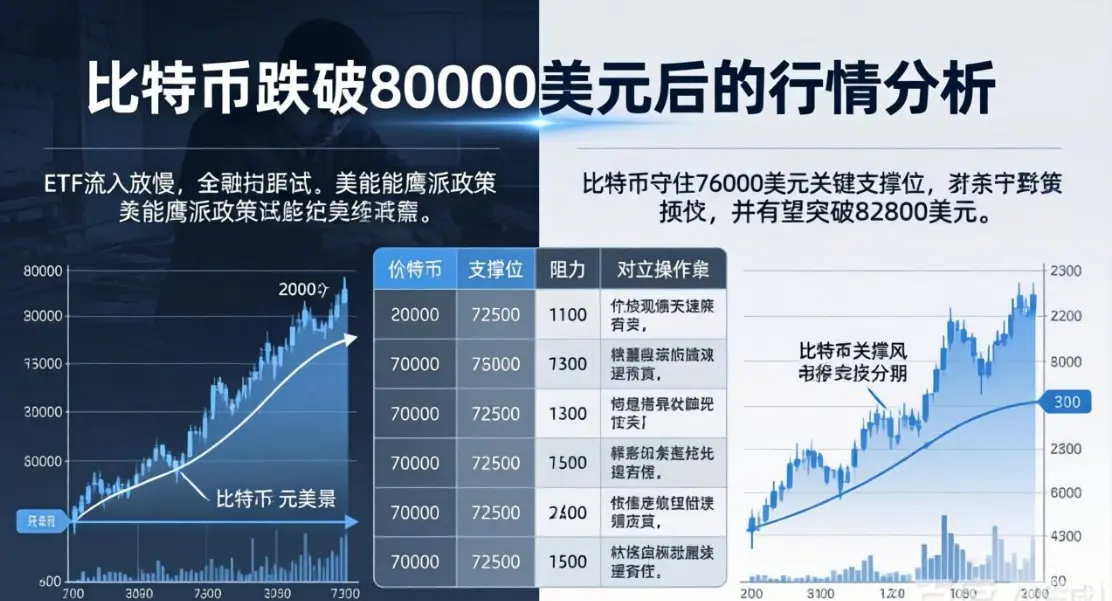
‌Strong support zone: $76,000–$78,500‌ (tested multiple times recently; holding this area could trigger a rebound).
‌Breakdown risk points‌: If falling below $76,000, the next support levels are $70,000–$72,500 (50-day moving average and lower channel boundary).
3. Future Catalysts
‌May non-farm payroll data‌ (key node)
If employment data weakens significantly, it could reignite expectations of rate cuts, which would be bullish for Bitcoin; conversely, strong data would boost rate hike expectations and increase selling pressure.
‌Market sentiment recovery signals‌
Monitor on-chain data (such as long-term holder position changes), exchange liquidity depth recovery, and whether Bitcoin can break through resistance zones at $80,000–$82,800.
4. Market Outlook—Short-term volatile and bearish, macro turning expected
‌Pessimistic scenario‌: If ETF inflows slow down combined with hawkish signals from the Fed, Bitcoin could test support at $70,000–$72,500.
‌Optimistic scenario‌: Holding above $76,000 and breaking through resistance at $82,800 could restart the rally toward $85,000.
‌Strategy suggestion‌: Focus on the $76,000 support level; remain cautious before breaking $82,800. Long-term investors can consider phased deployment but should be alert to macro policy and liquidity risks.
repost-content-media
  • Reward
  • Comment
  • Repost
  • Share
#Gate广场五月交易分享 5.8 Afternoon Gold Outlook
The overall news sentiment is quiet, with the market waiting for tonight's unemployment data, and sentiment leaning towards caution. The US dollar index is fluctuating little, and gold has no clear short-term direction.
On the technical side, Bollinger Bands are narrowing, with the upper band pressing down, and obvious resistance above. The bullish momentum is insufficient, maintaining a range-bound pattern.
Suggestion:
Pullbacks to 4695-4675 can be bought on dips; if the decline is stronger, buy on dips at 4665-4645; if it moves upward directl
View Original
LittleGodOfWealthPlutus
#Gate广场五月交易分享
5.8 Afternoon Gold Outlook
The overall news sentiment is calm, with the market waiting for tonight's unemployment benefit data. Sentiment is cautious, the US dollar index is not fluctuating much, and gold has no clear short-term direction.
Technically, the Bollinger Bands are narrowing, with the upper band pressing down, and there is obvious resistance above. The bullish momentum is insufficient, maintaining a range-bound pattern.
Suggestions:
A pullback to 4695-4675 can be bought on dips; if the decline is stronger, consider adding on dips at 4665-4645; if it moves upward directly, follow at 4705, with a target above 4730.
At the same time, watch for a rebound after a spike, and consider short positions around 4735-50, initially targeting 4710-4700.
repost-content-media
  • Reward
  • Comment
  • Repost
  • Share
#Gate广场五月交易分享 Are you still relying on news hype? A self-deluding digital gamble The recent financial markets have been filled with news flying everywhere, a single statement from Trump can make oil and gold prices swing by 10 points, and the crypto world is no exception. So many small investors start trading based on news, believing that returns won't be too high. Little gods want to say, you can predict news, but never chase after news, or you might fall into the trap set by the main players:
News is not a signal, but a disguise for noise
Ninety percent of "major news" in the market is
BTC-1.98%
ETH-2.84%
LAB-4.27%
View Original
LittleGodOfWealthPlutus
#Gate广场五月交易分享
Are you still relying on news hype? A self-induced digital gambling game
Recently, the financial markets have been full of rumors, with a single statement from Trump causing oil and gold prices to fluctuate by 10 points, and the crypto world is no exception. So many friends have started trading based on news, believing that returns won't be too high. Little财神 wants to say, you can predict news, but never chase after news, or you might fall into the trap set by the big players:
‌News is not a signal, but a wrapper of noise‌
Ninety percent of "major news" in the market is just an echo of emotion—a tweet, a KOL's call, a clipped interview—repeatedly spread and dressed up as "inside information." What you believe is not the fact, but the narrative you want to believe. When everyone is sharing "a new coin will be listed soon," the real whales have already been quietly selling off.
‌FOMO is an accomplice of news‌
The power of news lies not in its truthfulness, but in its urgency. "Skyrocket at 8 pm tonight!" "The central bank is about to recognize Bitcoin!"—these phrases precisely trigger the threat-reward loop in your brain. You're not trading; you're escaping anxiety. The result is often: buy before the news, crash after, and still comfort yourself with "Next time, I’ll follow."
‌Information overload destroys judgment‌
Scrolling through 100 crypto news updates daily is less effective than reading a white paper carefully. When your brain is bombarded with fragmented news, cognitive resources are drained, and rational analysis deteriorates. You start replacing "what did someone say yesterday" with "does this project have real demand," and "Twitter hype" with "on-chain address activity." This is not investing; it's a circus of information.
‌News is a weapon for manipulators‌
Project teams, market makers, big influencers—have already standardized "news releases" as part of their harvesting process: first leak, then pump, then dump. The "good news" you see might be a carefully crafted script. In 2023, a certain altcoin surged 300% due to rumors of being purchased by a certain country's central bank—later confirmed to be forged documents—and you are the last to take the bait.
‌True traders never chase news‌
They focus on:
- Whether on-chain data shows continuous net inflow
- Whether trading volume is gradually increasing with price
- Whether project development activity remains stable
- Whether their positions are within manageable risk levels
News can serve as‌ auxiliary verification‌, but is never‌ a decision-making basis‌. When you can calmly ask, "Does this news change my underlying logic for holding?"—you have truly broken free from the gambler's track.
‌Don’t let news think for you‌
The market never rewards those who know the most,
only rewards‌ the clearest-headed‌. $BTC $ETH $LAB
repost-content-media
  • Reward
  • Comment
  • Repost
  • Share
#Gate广场五月交易分享 Non-farm data beats expectations—how will the financial market drama unfold?
Last night, the U.S. released non-farm payroll data of 115k actual jobs, far exceeding expectations (62k). After a slight dip, the market rebounded. So, what will happen to the gold and BTC market next? Let’s hear what Xiao Caishen has to say:
1. Core contradictions in the data: strong employment vs. weak wages
- Surging new jobs: The actual figure of 115k far exceeds expectations (62k). On top of that, the prior figure was revised upward to 185k, showing resilience in the labor market.
- Slowing
BTC-1.98%
View Original
LittleGodOfWealthPlutus
#Gate广场五月交易分享
US non-farm data beats expectations—how will the financial markets play out?
Last night, the US released non-farm data of 115k, well above expectations (62k). After a slight dip, the market rebounded. So where will gold and Big Ben (BTC) go next? Let’s hear what Xiao Caishen has to say:
1. The core contradiction in the data: strong employment vs weak wages‌
‌A surge in new jobs‌: The actual figure of 115k far exceeded expectations (62k). Combined with an upward revision of the prior value to 185k, it shows resilience in the labor market.
‌Wage growth slows‌: Average hourly earnings rose by only 0.2% month over month (expected 0.3%), and by 3.6% year over year (expected 3.8%). This significantly eases inflation pressure.
‌A split in market interpretation‌: Concerns about an overheated economy (pushing back rate cuts) vs worries about stagflation (high employment + low wage growth).
‌2. Gold: a tug-of-war between safe-haven demand and rate-cut expectations‌
‌Logic behind the sharp jump in the short term‌:
‌Contradictory data triggers two-way positioning‌: Strong employment delays rate cuts (bearish for gold), but weak wages weaken inflation threats (bullish for gold).
‌Geopolitical safe-haven takes the lead‌: The US-Iran conflict escalates (oil tanker attacks, missile exchanges). Spot gold breaks above 4720 USD/oz, and silver skyrockets 3.22% in a single day.
‌Long-term factors that suppress‌:
‌The Fed’s policy anchor‌: If CPI rebounds in the future, the fading of rate-cut expectations will weigh on gold prices.
‌Key technical levels‌: Breaking above 4744 USD opens upside space. Losing 4685 USD or lower may trigger a long squeeze.
‌Gold strategy‌: In the short term, lightly chase longs using safe-haven sentiment, but closely watch the US dollar and US Treasury yields movement 1 hour after the non-farm data.
3. Bitcoin: a battle over liquidity and divergence in institutional behavior‌
‌Unusual strength after the data release‌: Despite strong non-farm data, Bitcoin breaks through 80,000 (Material 5). There are three main reasons:
‌US equities transmission effect‌: The Nasdaq has risen for six straight weeks (Material 6), and optimistic sentiment in tech stocks spills over.
‌Weak wages buffer‌: Low inflation data weakens aggressive rate-hike expectations, supporting the valuation of risk assets.
‌On-chain whale support‌: Addresses holding 1000+ BTC increased holdings week over week to a new intrayear high (Material 7).
‌Institutional capital undercurrents‌:
‌ETF polarization‌: BlackRock’s IBIT pulled in 532 million USD in a single day (Material 1), but overall net inflows slowed.
‌Hedge fund arbitrage‌: Using CME futures to position for a long-vs-short showdown around the 84,000 USD gap (open interest reaches 25 billion USD).
‌Bitcoin alert‌: If tech stocks pull back after the US stock market opens, it could trigger a chain liquidation of leveraged longs (support level to watch closely at 78,500 USD).
Summary: At present, a strong BTC pattern has already formed. After last night’s slight dip, it quickly recovered. This week, the weekly chart is very likely to stay above the middle band of the Bollinger Bands. The non-farm news has only a moderate impact on the crypto market. The market has effectively “dulled” the bearish sentiment. Combined with institutional inflows and technical support, there is strong upward momentum. Family, it’s still best to buy on dips, and try not to bet on short positions.
repost-content-media
  • Reward
  • Comment
  • Repost
  • Share
#Gate广场五月交易分享 Weekly Bitcoin Market Summary
This week, Bitcoin's price fluctuated around $80k, showing a pattern of rising sharply and then pulling back, with increased market debate between bulls and bears.
Early-week surge: On May 4th, Bitcoin briefly broke through $80,594, reaching a new high since February 2026. Driven by continuous institutional fund inflows and easing US-Iran tensions, market risk appetite increased.
Pullback after hitting $80k: On May 5th, the price stabilized above $80k, reaching a high of $81,323, but then declined. On the 7th, it briefly fell below $80k to $79
BTC-1.98%
View Original
LittleGodOfWealthPlutus
#Gate广场五月交易分享
This Week's Bitcoin Market Summary
This week, Bitcoin prices fluctuated around $80k, showing a pattern of rising sharply and then pulling back, with increased market debate between bulls and bears.
Strong surge at the start of the week: On May 4th, Bitcoin briefly broke through $80,594, reaching a new high since February 2026. Continued inflows of institutional funds and easing US-Iran tensions boosted market risk appetite.
Pullback after hitting $80k: On May 5th, prices stabilized above $80k, reaching a high of $81,323, but then declined. On the 7th, it briefly fell below $80k to $79,498, indicating heavy selling pressure above.
Clear institutional support: US spot Bitcoin ETF funds continued to flow in net, with major products like BlackRock's IBIT attracting over $500 million in a single day. Institutional holdings surpassed 7%, serving as a key support for the price.
Technical key levels under debate: Currently, prices are oscillating around the weekly support level of $78,500. Holding this level could allow another challenge of the $82k–$84k range; losing it might lead to a retest of $75k.
Macroeconomic influences intertwined: Non-farm payroll data showed strong employment, but slowing wage growth reduced inflation concerns. Coupled with expectations of a Federal Reserve leadership change, market views on rate cuts remain divided, creating complex impacts on Bitcoin.
Core conclusion for this week: Bitcoin remains in a volatility-driven, institution-led sideways upward channel. Short-term fluctuations reflect active switching between bulls and bears. The medium- to long-term trend depends on sustained ETF fund inflows and global liquidity expectations.
repost-content-media
  • Reward
  • Comment
  • Repost
  • Share
#Gate广场五月交易分享 Weekly Gold Market Summary
This week, international gold prices fluctuated and trended upward, breaking above the key level of $4,700 per ounce, as the market rose amid a tug-of-war between geopolitical conflicts and expectations of Fed interest-rate cuts.
Early in the week faced pressure and pulled back: On May 4, international gold saw a one-day plunge of more than $90, driven by the intensification of the Middle East situation, a surge in oil prices, and a stronger U.S. dollar. New York gold futures briefly fell below $4,548 per ounce, while spot gold dropped to $4,537.8
View Original
LittleGodOfWealthPlutus
#Gate广场五月交易分享
## This Week’s Gold Market Summary
This week, international gold prices fluctuated and moved higher, breaking above the key level of $4,700 per ounce. The market rose amid a standoff between geopolitical conflict and expectations of Federal Reserve rate cuts.
**Early-Week Pressure and Pullback:** On May 4, as Middle East tensions escalated, oil prices surged, and the U.S. dollar strengthened, international gold prices plunged by more than $90 in a single day. New York gold futures briefly fell below $4,548 per ounce, and spot gold dropped to $4,537.8. Risk-off sentiment temporarily shifted toward the U.S. dollar and energy assets.
**Mid-Week Stabilization and Rebound:** As the conflict between Iran and the U.S. did not further escalate, the market began pricing in the logic of “geopolitical easing—oil price decline—rate cut expectations strengthening.” Gold rebounded from its lows. On May 6, New York gold futures recovered to above $4,600, with a gain of 0.71%.
**Strong Breakthrough After Non-Farm Payrolls:** On May 8, the U.S. released its non-farm payroll data. Although employment growth came in above expectations, slowing wage growth eased concerns about inflation. Combined with ongoing central bank gold purchases, spot gold broke through $4,700 per ounce. COMEX gold futures closed at $4,723.70 per ounce.
**Central Bank Demand as the Main Support:** The People’s Bank of China has increased its gold holdings for 18 consecutive months. In April, it added 8.1 tons—its fastest pace since December 2024. The global central bank “gold-buying rush” continues to provide bottom support for gold prices.
**Technical Picture Enters a Critical Range:** Gold is currently trading within the $4,700–$4,744 range. If it breaks above $4,744, it will open up upside room. Short-term support is at $4,685; if it falls below that level, it may retest $4,600.
**Core Conclusion for the Week:** Gold has shifted from being “data-driven” to being driven by both “expectations and positioning/allocation.” Geopolitical risk, central bank gold purchases, and rate cut expectations together build a strong setup. In the short term, it may continue with a consolidation-to-firm trend.
repost-content-media
  • Reward
  • Comment
  • Repost
  • Share
#Gate广场五月交易分享 Weekly Crude Oil Market Summary
This week, international crude oil prices fluctuated at high levels, showing a pattern of rising and then pulling back, as the market repeatedly oscillated between expectations of easing geopolitical conflicts and the reality of tight supply.
Early in the week, the market remained strong:
Affected by disruptions in shipping through the Strait of Hormuz and escalating US-Iran tensions, crude oil prices experienced eight consecutive days of gains from April 28 to 30, with Brent crude briefly reaching $126.41 per barrel, a four-year high, and W
View Original
LittleGodOfWealthPlutus
#Gate广场五月交易分享
This Week's Crude Oil Market Summary
This week, international crude oil prices fluctuated at high levels, showing a pattern of rising and then pulling back overall, as the market repeatedly grapples between expectations of easing geopolitical conflicts and the reality of tight supply.
Early in the week, strength continued: influenced by disruptions in shipping through the Strait of Hormuz and escalating US-Iran tensions, the crude oil market experienced eight consecutive days of gains from April 28 to 30, with Brent crude briefly surging to $126.41 per barrel, a four-year high, and WTI breaking through $107.93 per barrel.
Midweek rapid decline: as Iran submitted new negotiation proposals, the UAE withdrew from OPEC+, and signals of easing US-Iran tensions appeared, geopolitical risk premiums quickly diminished, with WTI prices falling from highs to around $102, fluctuating, and Brent retreating to $114 per barrel.
Inventory data supports the fundamentals: as of the week ending May 1, US EIA crude inventories decreased by 2.31M barrels, and strategic petroleum reserve inventories significantly dropped by 5.22M barrels, indicating continued tight supply and supporting oil prices.
Weekend rally again: despite rising expectations of geopolitical easing, actual passage through the Strait of Hormuz has not resumed, and Iran unilaterally established a navigation control mechanism, causing market concerns over ongoing supply disruptions. On May 6, WTI prices rebounded to around $100.08 per barrel.
Current core contradiction: in the short term, oil prices are dominated by sentiment, with geopolitical risk premiums repeatedly released and spot supply remaining tight, leading to high volatility. WTI trades mainly in the $98–$108 range, while Brent fluctuates at high levels between $110–$120 per barrel.
Key conclusion this week: the crude oil market has shifted from a "single geopolitical driver" to a "geopolitical + fundamentals + capital" three-dimensional game. Short-term corrections do not alter the overall high-level pattern, and future trends depend on US-Iran negotiations and global demand resilience.
repost-content-media
  • Reward
  • Comment
  • Repost
  • Share
#Gate广场五月交易分享 Non-farm payrolls are back in action again—how should the script be written this time?
Today’s market is calm. Not only Bitcoin and ETH, but even altcoins are unnervingly quiet. This so-called “calm before the storm” may all be for waiting for the U.S. April non-farm employment population data to be released tonight at 20:30, which is expected to have a major impact on the market. The little money god will give everyone a preview first:
## 1. Key expectations benchmark
- **New jobs**: Market median expectation **62.0k** (far below the previous **178k**)
- **Unemployment rate**
BTC-1.98%
ETH-2.84%
View Original
LittleGodOfWealthPlutus
#Gate广场五月交易分享
Non-farm payrolls are coming again. How should the script be prepared this time?
Today’s market is calm and uneventful, not only for Bitcoin and altcoins, but even the altcoins are eerily quiet. The so-called "calm before the storm," perhaps all of this is just waiting for the U.S. April non-farm employment data to be announced at 8:30 PM, which is expected to have a huge impact on the market. The big fortune teller will give everyone a preview:
1. Key Expectations Benchmark
‌New Jobs‌: Market median expectation ‌62k‌ (far below the previous 178k)
‌Unemployment Rate‌: Expected to remain ‌4.3%‌
‌Hourly Wage Growth‌: Expected YoY ‌3.8%‌ (previous 3.5%)
If the data significantly deviates from expectations, it will trigger market re-pricing
2. Asset Impact Scenarios
Scenario 1: Overall weak data (New jobs < 60k + Unemployment rate ≥ 4.3% + Hourly wages ≤ 3.8%)
Gold reaction:
Short-term jump ‌1.5%-2.5%‌ (about $70-$120), due to "stagflation trading" activation:
→ Weak economy reinforces rate cut expectations, actual real interest rates decline
→ Sticky inflation (wages not worsening) boosts anti-inflation demand
→ Technical test of ‌$4,750‌ key resistance
Bitcoin reaction:
First drop, then rise: initially dragged down by concerns over dollar liquidity tightening, but later supported by "risk asset easing expectations"
If the data is extremely weak (e.g., new jobs < 40k), it may trigger a rebound in the ‌75,000−78,000‌ range
Scenario 2: Overall strong data (New jobs > 80k + Unemployment rate ≤ 4.2% + Hourly wages ≥ 4.0%)
Gold reaction:
Plunge ‌2.0%-3.0%‌ (about $90-$140), due to "rate hike expectations reignited": → The probability of Fed rate cuts this year approaches zero, even pricing in rate hikes → U.S. dollar index surges, pressuring gold prices, with the ‌$4,500‌ support level under test
Bitcoin reaction:
Accelerated breakdown: liquidity tightening expectations hit high-risk assets
‌75,000‌ becomes a strong resistance; if broken, downside target is $70,000-$72,000, with technical support zones
Scenario 3: Mixed signals (Weak employment + high wages)
Gold reaction:
Increased volatility but with a bullish bias: stagflation logic dominates, oscillating in the ‌$4,600−4,700‌ range
Hedge funds may increase allocations to hedge against "economic slowdown + stubborn inflation" combo
Bitcoin reaction:
Significant pressure: higher-than-expected wages reinforce tightening expectations, offsetting the easing benefits of weak employment
Continues to oscillate weakly in the ‌$75,000−80,000‌ range, awaiting CPI data guidance
3. Institutional Behavior Predictions
Gold market:
If data is weak, CTA strategies will trigger buy orders above ‌$4,700‌
Central banks (especially emerging markets) may buy gold on dips, limiting downside
Bitcoin market:
Miner selling pressure is significant above ‌$78,000‌, derivatives funding rates turning negative indicate bearish sentiment
Macro hedge funds may short Bitcoin/gold hedge portfolios, betting on policy divergence
4. Practical Trading Advice: Avoid chasing within 15 minutes after data release, focus on:
‌Whether the U.S. dollar index can break through 106.5 (year-to-date high)
‌Degree of divergence between gold and real yields on U.S. Treasuries
‌Direction of funding rate changes in Bitcoin perpetual contracts
These three will verify the market’s true pricing of Federal Reserve policies.
repost-content-media
  • Reward
  • Comment
  • Repost
  • Share
Trump: It’s just “a small punishment”! The result: global markets were scared into breaking out in cold sweat first.
What have Trump’s recent remarks been increasingly like? Like clickbait short-video headlines. With just one line—“a small punishment”—the entire global market is completely thrown off.
After tensions in the Hormuz situation tightened again, Donald Trump said the conflict does not affect the overall effectiveness of the ceasefire. The problem is that the capital markets have now developed PTSD. As soon as the Middle East starts smoking, money immediately rushes toward gold.
Beca
BTC-1.98%
View Original
CoinWay
Trump: Just a "small punishment"! As a result, the global markets were scared half to death first
Recently, Trump's statements are becoming more like what?
Like clickbait headlines for short videos.
A single "small punishment,"
directly disrupts the entire global market.
After the Strait of Hormuz situation became tense again, Donald Trump said the conflict does not affect the overall effectiveness of the ceasefire.
The problem is,
the capital markets have now developed PTSD.
As soon as there is smoke in the Middle East,
funds immediately rush into gold.
Because everyone knows:
the biggest fear in energy markets is not full-scale war,
but "the possibility of escalation at any time."
This kind of uncertainty,
will make all risk assets nervous.
The most obvious recent change is:
oil price volatility has increased again.
And when oil swings,
global inflation expectations immediately jump.
So the Federal Reserve's pressure is back.
The market originally thought:
economic slowdown → rate cuts → asset appreciation.
But now suddenly there's an insertion:
rising oil prices → repeated inflation → delayed rate cuts.
The entire logical chain instantly stalls.
The funniest thing is,
investors now act like they’re watching a soap opera every day.
In the morning, they focus on the Middle East,
in the afternoon, they study the Federal Reserve,
at night, they watch Bitcoin.
The amount of information is as large as three jobs.
And Trump’s greatest skill is:
with just one sentence,
he can make the market automatically imagine ten thousand words.
What does "small punishment" really mean?
Is it a controllable situation?
Or a prelude to bigger actions?
No one knows.
But the market has already started to hedge first.
That’s also why gold has become more resilient recently.
Because global funds are now entering a typical mood:
"Save my life first, then make money."
And this atmosphere,
often means volatility will continue to rise.
In the future, markets may become more like:
optimistic during the day,
panicked at night.
The biggest enemy for investors,
may not be the market trend,
but the speed of emotional switching.
repost-content-media
  • Reward
  • Comment
  • Repost
  • Share
#Gate广场五月交易分享 Non-Farm Night Gold Bullish and Bearish Battle Preview How will Non-Farm data influence gold trends? Analysis of medium- and long-term logic Friday, May 8, Asian hours. Spot gold (XAU/USD) remains steadily around $4,700 per ounce. Volatility narrows, candlesticks flatten, trading volume slightly decreases—all signals point to the same fact: the market is waiting for the U.S. April Non-Farm Employment Report to be released.
1. What is the market waiting for? A “not-so-good-looking” Non-Farm The real concern for the market is: recent U.S. economic data has shown clear divergence
View Original
Ryakpanda
#Gate广场五月交易分享 Non-Farm Night Gold Bullish and Bearish Battle Preview
How does non-farm data influence gold trends? Analysis of medium- and long-term logic
Friday, May 8th, Asian session. Spot gold (XAU/USD) remains steady around $4,700 per ounce. Volatility narrows, candlesticks flatten, trading volume slightly shrinks— all signals point to the same fact: the market is waiting for the U.S. April non-farm employment report to be released.
1. What is the market waiting for? A “not-so-good-looking” non-farm report
The real concern for the market is: recent U.S. economic data has shown clear divergence. Manufacturing PMI weakens, consumer credit growth slows, and corporate investment faces pressure in a high-interest-rate environment.
The Federal Reserve’s biggest fear now is not slightly higher inflation, nor slightly weaker employment, but that policy judgments lag behind the curve.
Therefore, this Friday’s non-farm report is not just about the numbers; it’s about whether it can answer two core questions:
Has the U.S. labor market shifted from “resilient” to “fading”?
Has the suppression of the real economy by high interest rates reached a critical point?
Different answers lead to completely different directions for gold.
2. The core logic of gold: rate cut expectations vs. safe-haven demand
The current pricing framework for gold is actually very simple, yet extremely complex.
The simplicity lies in the fact that it is dominated by only two variables:
Federal Reserve rate cut expectations
Global safe-haven demand
The complexity is that these two variables often conflict.
And the most challenging situation right now, which is also the most likely scenario for the market, is: data is just average.
If non-farm payrolls fall within the expected range of 50,000 to 80k jobs, the market will be more conflicted— the reasons for rate cuts are not strong enough, and safe-haven sentiment is not intense enough. Gold is likely to remain in a high-level oscillation, waiting for the next catalyst.
In other words, the real risk on non-farm night is not a big surge or plunge, but an unclear direction.
3. Another overlooked main line: Has Middle East risk really diminished?
Recently, there has been a noticeable change in the gold market: geopolitical safe-haven sentiment has cooled.
The cause is the U.S. Trump administration’s push for negotiations to reopen the Strait of Hormuz, which caused international oil prices to fall sharply, and market fears of Middle East oil supply disruptions have significantly eased.
Objectively speaking, the probability of a full-scale conflict has indeed decreased. This is a short-term negative for gold, which previously relied heavily on safe-haven premiums.
But a word of caution: risk cooling does not mean risk disappearance.
Iran’s stance on nuclear issues remains firm, and substantial disagreements between Iran and the U.S. are far from resolved. How far negotiations can progress, no one can guarantee. As one analyst said: there are almost no signs that both sides’ negotiating positions have converged.
In the coming days or weeks, the market is likely to see more negative headlines that trigger volatility.
Interestingly, this high level of uncertainty actually provides a fertile ground for the dollar to strengthen. If the dollar gains strength, the upward pressure on gold will increase.
Therefore, gold currently faces a “triple pressure”:
Uncertainty in non-farm data
Geopolitical uncertainty
The dollar also seeks a rebound amid uncertainty
With these three layers of uncertainty, the most rational choice is to do nothing for now—wait until the picture becomes clearer.
4. Why remain optimistic in the medium and long term?
After discussing two irreversible short-term trends, let’s talk about the long-term.
The bullish trend of gold on the daily chart has not been broken at all. The moving averages are aligned in a bullish formation, MACD is running high, and after breaking through key resistance levels at $4,600 and $4,650, the market’s focus has steadily shifted upward.
This is technical.
On the fundamental side, I see two trends as irreversible:
First, central banks worldwide are increasing their gold holdings, and this is not a short-term move.
An increasing number of emerging market central banks are systematically raising their gold reserve ratios. The logic is simple: long-term credit risk of the dollar is rising, global debt levels are expanding, and gold, as an “uncounterparty risk” asset, is being revalued strategically.
Second, growth momentum in major economies in Europe and America is slowing, shifting from expectations to reality.
Whether it’s the high-interest-rate pressure in the U.S. or structural weakness in Europe, they point to the same direction: major global central banks will eventually enter a rate-cutting cycle. The only question is when, not if.
And each increase in rate cut expectations directly lowers real interest rates, reducing the opportunity cost of holding gold.
These two trends combined make the medium- and long-term support for gold solid. Short-term corrections are more technical adjustments rather than trend reversals.
5. Trading strategy: Don’t bet on data, bet on response
The biggest mistake on non-farm night is to bet on the direction before the data is released.
The most prudent strategy tonight is not to guess whether it will go up or down, but to wait until the data is out and observe the market’s real reaction:
If the data is weak, and gold breaks above $4,750 and holds, that signals a continuation of the bullish trend.
If the data is strong, and gold dips to around $4,650 but quickly recovers, that indicates support is effective.
If the data is ambiguous, and gold oscillates between $4,680 and $4,730, then continue to wait—avoid forcing trades.
For ordinary investors, more important than tonight’s move is: do you hold enough medium- and long-term gold positions to cope with the potential inflation and risks from a global monetary easing cycle over the next year?
Non-farm is just one battle.
And this big cycle of gold has far from finished.
(Disclaimer: This article is for market analysis and logical discussion only and does not constitute any investment advice. Markets are risky; invest cautiously.)
repost-content-media
  • Reward
  • Comment
  • Repost
  • Share
#Gate广场五月交易分享 #Polymarket每日热点 As a seasoned "pseudo-football fan," Little God of Wealth also predicts who will win the 2026 World Cup. I believe the champion belongs to France, based on the following logic:
1. Historical performance and stability in major tournaments
France's performance in the last three World Cups has been dominant: champions in 2018, runners-up in 2022, reaching the final twice in a row. As the defending runner-up, their tournament experience, resilience under pressure, and stability in knockout stages far surpass other teams. In the past 40 years of World Cup knocko
View Original
LittleGodOfWealthPlutus
#Gate广场五月交易分享
#Polymarket每日热点
As a seasoned “pseudo-football fan,” Little God of Wealth also wants to predict who will win the 2026 World Cup. I believe the title should go to France. My reasoning is as follows:
‌1. Historical performance and stability in major tournaments‌
France’s performance in the last three World Cups has been dominant: champions in 2018, runners-up in 2022—reaching the final in two consecutive editions. As the defending runners-up, their experience in major tournaments, ability to handle pressure, and stability in knockout matches far surpass those of other teams. In nearly 40 years of World Cup knockout history, they have suffered only 1 defeat within 90 minutes (from 1986 to the present).
‌2. A peak lineup and terrifying depth‌
Core players in their golden period‌: Mbappé (27 years old) is in the prime of his career. He has scored 12 World Cup goals (just 4 short of the all-time record). His hat-trick in the 2022 final showed his ability to rise to the occasion on the biggest stage. Chouaméni (26 years old), Saliba (24 years old), and other key midfield and backline starters are all in their mature years.
‌ Unmatched squad depth‌: The team’s total squad value is about 870 million euros. The bench includes top-level starters from major clubs such as Camavinga, Dembélé, and Konaté. Their strength is comparable to the starting lineups of most national teams, and under a packed match schedule, the advantage is especially clear.

3. A mature and efficient tactical system‌
Deschamps’ coaching system focuses on quick counterattacks as the core, combined with high-intensity physical duels—making the team’s balance between attack and defense excellent. The team can also control possession to suppress opponents, or instantly tear the back line apart with Mbappé’s pace. This is evidenced by the fact that, in the 2022 knockout stage, they averaged 2.3 goals per game.
‌4. A favorable schedule and qualification path‌
As a seeded team, France’s qualification from the group stage is virtually beyond doubt (with limited threats from Norway and Senegal in the same group). In the knockout stage, their bracket avoids strong rivals such as Argentina and England. If they advance according to the predicted path, their biggest challenge before the semifinals’ four-team stage will be Brazil or the Netherlands—against both, they have the upper hand in historical head-to-head records.
‌5. Data models and professional institutions’ backing‌
A U.S. bank global research report shows: 40% of analysts predict France will win the tournament, and Mbappé is supported by nearly half of respondents to become the Golden Boot.
UK Quantum big data simulations: France defeats Spain in the final to lift the trophy. This model previously accurately predicted the top four in 2022.
repost-content-media
  • Reward
  • Comment
  • Repost
  • Share
Institutions Increase Bets, Legislation Clarified—Does Bitcoin Have the Confidence to Once Again Target 80,000? After a small dip during the day, Bitcoin surged again in the evening, broke through the $80,000 mark, and then pulled back—this time, will it be able to hold its ground?
Listen to what Xiao Caishen has to say.
## 1. Core driving forces behind this round of rally
### 1) Institutional funds continue to increase bets
U.S. Bitcoin spot ETFs have posted net inflows for three consecutive days totaling $1.18 billion (with a $532 million inflow on May 6). BlackRock’s IBIT and Fidelity’s FBT
BTC-1.98%
View Original
LittleGodOfWealthPlutus
#Gate广场五月交易分享
Institutional Accumulation and Clear Legislation—Is Bitcoin's Confidence to Rebound to 80,000 Strong Enough?
After experiencing a small dip during the day, Bitcoin surged again in the evening and broke through the $80,000 mark, then pulled back. Can it stabilize this time? Let’s hear what the little financial wizard has to say.
1. The Core Drivers of This Round of Rally
‌1. Institutional Funds Continually Increasing‌
The US Bitcoin spot ETF has seen net inflows of $1.18 billion over three consecutive days (with a single-day inflow of $532 million on May 6), with BlackRock’s IBIT and Fidelity’s FBTC contributing over 90% of the growth.
Institutional holdings have surpassed 7%, and on-chain data shows long-term holders have increased their holdings by nearly 330k BTC (about $330k) in the past month, forming a strong support.
Cumulative spot trading volume Delta (CVD) surged by 199%, with buyer strength dominating market depth.
‌2. Regulatory and Macro Environment Improvements‌
The US bipartisan agreement on the “Digital Asset Regulatory Clarity Act” reduces policy uncertainty.
Traditional financial institutions like Morgan Stanley and Goldman Sachs are accelerating their deployment of Bitcoin ETFs and custody services.
Easing US-Iran tensions have boosted global risk appetite, with funds shifting from safe-haven assets to cryptocurrencies.
‌3. Technical Breakthrough Signals‌
A bullish flag pattern has formed on the daily chart, effectively breaking through the $77,500 resistance level.
There is a CME futures gap at $84,000, which is a key target for bulls.
The weekly MACD has shown a bullish golden cross, strengthening the medium- and long-term trend.
2. Potential Impact Pathways of Tonight’s Non-Farm Payroll Data
‌▶ If the data is strong (new jobs > 200k, hourly wages MoM > 0.3%)‌
The market will expect the Federal Reserve to delay rate cuts, strengthening the dollar and suppressing risk assets.
Bitcoin may experience a short-term correction to the support zone of $77,000–75,000.
ETF fund inflows may slow down, and leveraged long positions face increased liquidation risk (current open interest is $25 billion).
‌▶ If the data is weak (new jobs < 150k, unemployment rate > 4%)‌
Expectations for rate cuts will rise, boosting liquidity preference, and Bitcoin could break through $82,000.
The upward target points to the technical pattern measurement of $94,800 (bullish flag target).
Institutions may accelerate ETF accumulation, creating a linked rally with gold.
3. Key Observation Points on Institutional Fund Movements
‌ETF Flow Continuity‌: If net inflows exceed $300 million for five consecutive days, it will confirm institutional FOMO sentiment.
‌BlackRock/Fidelity Holdings Changes‌: These two institutions account for 76% of total ETF inflows, and their movements serve as leading indicators.
‌On-Chain Whale Addresses‌: Addresses holding 1,000+ BTC have increased their holdings to a new high for the year, signaling potential profit-taking.
‌Tonight’s Strategy Focus‌:
Monitor the reactions of gold and Nasdaq futures within one hour after the non-farm payroll release—if both rise together, the probability of Bitcoin breaking through increases significantly; if the US dollar index surges rapidly, beware of short-term liquidations triggered by leveraged positions.
Under institutional-led markets, chasing rallies or selling on dips carries very high risk. The key support level on the weekly chart is $78,500.
repost-content-media
  • Reward
  • Comment
  • Repost
  • Share
  • Pinned