MasterChuTheOldDemonMasterChu

vip
Age 0.5 Year
Peak Tier 6
On-Chain Evangelist | Liquidity Builder | Diamond Hands
📉【In-Depth】From "Liquidity Fuel" to "Sweeping Monk": My Survival Position Theory
Flipping through the old book "Demi-Gods and Semi-Devils," seeing Qiao Feng’s gathering of heroes at the Jiu Xian Zhuang, I suddenly realize a brutal truth while staring at the candlestick chart:
The difference between me and Qiao Feng isn’t in martial arts skill, but in him living in a novel, while I live in a contract.
Three months ago, I was that person who thought he was the protagonist, a "Qiao Feng":
BTC 50x leverage, full position, no stop-loss.
When the margin call came, and the liquidation line sliced th
ETH-0.25%
BTC0.36%
View Original
post-image
  • Reward
  • 34
  • Repost
  • Share
Miss_1903:
2026 GOGOGO 👊
View More
Thanks for sharing! This insight about Bitcoin's short-term pullback and long-term bull market signals coexisting has been very enlightening for me, especially your mention of CryptoQuant issuing its first early bull market signal since March 2023, and the logic behind the $82k key resistance level, which made me think of the current market's typical "rising to resistance, taking profits" rhythm~
Based on the latest market situation, Bitcoin is indeed repeatedly fighting over the $80k mark, and the market share rising back to 58.5% also confirms the trend of funds concentrating into leading as
BTC0.35%
View Original
Ryakpanda
#Gate广场五月交易分享 Increasing Volatility! Bitcoin once dropped below $80k, and a bullish signal has appeared. Why is there still a pullback?
The crypto market is experiencing intense fluctuations again, with Bitcoin (BTC) showing a "rollercoaster" pattern! On one side, CryptoQuant issued its first early bull market signal since March 2023, while on the other side, there is a short-term price correction and a dip below key levels, coupled with Bitcoin’s market share rising back to 58.5%. What exactly is happening in the current crypto market?
1. Real-time Market Update: Briefly fell below $80k, 24H volatility under pressure As of press time, Bitcoin’s short-term volatility has slightly rebounded, but signs of correction are evident. Core market data shows: Current price: $80,628.49 24H high: $81,615.67 24H low: $79,843.59 24H change: -2.06% (Data from the evening report at 00:46 on May 13, with a low of $79,953.15) 24H trading volume: $80,000
Looking at the trend, Bitcoin quickly retreated after reaching a high of $81,615.67, briefly breaking the $80,000 round number. It then slightly rebounded to the current level, with intense battle between bulls and bears in the short term. This correction happened right after CryptoQuant issued a bull market signal the day before, creating a stark contrast between the "bullish signal and short-term pullback."
2. Key News Analysis: Bull market signals emerge, market share rebounds, there’s a hidden story behind the correction
1 CryptoQuant’s Major Signal: First time entering early bull territory since March 2023 According to CoinDesk, CryptoQuant released a key signal on May 12, indicating its market cycle indicator officially entered a bullish zone. This is the first time since March 2023 that Bitcoin has been placed in early bull territory, suggesting the crypto market may have exited the bear phase. This indicator is not based on a single dimension but combines CryptoQuant’s profit and loss index, which includes three core on-chain metrics: MVRV ratio (measuring market valuation by comparing market value and realized value to assess over- or under-valuation), NUPL (unrealized profit and loss ratio), and SOPR ratio of long-term versus short-term holders (measuring holder profitability or loss).
CryptoQuant’s research director Julio Moreno clearly states that this shift "usually indicates that the worst phase of correction has passed and the market structure is beginning to recover." Notably, when the bull market signal flips, Bitcoin’s price has already exceeded $80,000, rebounding about 35% from the February low of $60,000. The rebound momentum is clear. Additionally, continuous inflows of institutional funds support the bull case—April saw ETF inflows into spot Bitcoin products reaching $2.44 billion, the strongest monthly institutional inflow since October 2025, reflecting long-term confidence in Bitcoin. However, CryptoQuant emphasizes that the validity of the bull signal still needs confirmation: Bitcoin must break through the $82,000 resistance level to officially confirm the early bull pattern. Otherwise, it may still face consolidation. This is one of the main reasons for the current short-term correction—market pressure at the $82,000 resistance level and profit-taking trigger the pullback.
2. Bitcoin market share rises to 58.5%, funds concentrate in leading assets Another key news is that Bitcoin’s market dominance has rebounded from around 55% to 58.5%. This change reveals the current flow of funds within the crypto market.
Historical data shows that Bitcoin’s market share fluctuations often reflect capital rotation: when dominance rises, it usually coincides with market consolidation, during which Bitcoin outperforms altcoins, and funds flow back from altcoins to Bitcoin.
Looking back, Bitcoin’s market share peaked at 62-63% in mid-2025, then fell back to around 54% by late 2025. The recent rebound to 58.5% indicates funds are once again concentrating in the leading asset, and market risk appetite has decreased. Analysts further point out that the relationship between market share and price is crucial: if Bitcoin’s price stagnates at current levels and market share declines, it could signal rotation into higher-beta assets (altcoins). Conversely, if both price and market share continue to rise together, it indicates sustained capital concentration in Bitcoin, further solidifying its dominant position. Currently, the rebound in market share and the price correction form a brief divergence; future focus should be on their combined movement.
3. Market Evening Report Confirmation: Brief dip below $80,000, short-term pressure evident According to the latest market evening report released by CoinDesk at 00:46 on May 13, data from XBIT Wallet shows Bitcoin once dropped to $79,953.15, breaking the $80,000 round number. The 24H decline was 2.06%, with a trading volume of $80,000.
As a key infrastructure for crypto trading, XBIT Wallet not only provides market data monitoring but also has an integrated intelligent risk control system that tracks market fluctuations in real time. The recent dip below $80,000 is seen as a signal of short-term profit-taking. Given the current environment, the main reason for the correction is that Bitcoin approached the $82,000 resistance level without sustained buying support. Early profit-taking by traders led to price pressure. Additionally, doubts about the validity of the bull market signal persist, causing some investors to stay on the sidelines, further amplifying short-term volatility.
3. Dissecting the Logic of Price Movements: Short-term correction vs. long-term bull market, the core behind the contradiction
The core contradiction in the current market is between "short-term correction pressure" and "long-term bull signals." Combining institutional views and market data, we can clarify the underlying logic:
From a long-term perspective, the appearance of bull signals, ongoing institutional inflows, and rising market share all point to a positive outlook for the crypto market. CryptoQuant’s bull market indicator suggests the market structure is beginning to recover, and the worst phase of correction has passed. April’s ETF inflows hit a nearly 7-month high, indicating sustained institutional demand for Bitcoin. The market share rebound to 58.5% also reflects recognition of Bitcoin as the leading asset, consistent with the trend of steadily increasing Bitcoin market share since 2023, reinforcing its core position in the crypto space.
In the short term, corrections are normal market adjustments.
On one hand, Bitcoin has rebounded about 35% from its February lows, accumulating profit-taking pressure. Before reaching the $82,000 resistance, profit-taking is inevitable.
On the other hand, the bull market signal’s validity has yet to be confirmed; the market needs time to digest sentiment, and short-term consolidation is highly likely. Additionally, RYOEX institutional analysts suggest Bitcoin may fluctuate between $78,000 and $85,000 in the near term, with direction more likely driven by institutional trading behavior. The current correction is part of this range-bound movement.
4. Future Trend Predictions: Support in the short term, resistance in the medium term, bull market in the long term
Based on the current market structure, bull signals, and institutional insights, a rational outlook on Bitcoin’s future trend from short, medium, and long-term perspectives:
1. Short-term (1-3 days): Consolidation, testing $80,000 support In the short term, Bitcoin is likely to continue consolidating, primarily testing the support at $80,000. If it holds, and trading volume gradually increases, a slight rebound toward $81,500–$82,000 could occur. If it breaks below $80,000 without quick recovery, it may further decline to around $79,500–$79,800 (near the 24H low), but the correction should be limited—since the bull market signals are present, market panic is relatively controlled, and long-term holders and miners’ positions remain stable, with no significant deterioration in market structure.
2. Medium-term (1-4 weeks): Key focus on breaking the $82,000 resistance The main factor for the medium-term trend is whether Bitcoin can break through the $82,000 resistance—this is critical for confirming the validity of CryptoQuant’s early bull signal. According to RYOEX analysts, market makers hold short gamma positions near $82,000. If the price successfully breaks this resistance, it could trigger hedge buying, further pushing the price higher, with potential targets around $85,200. If it fails to break through, Bitcoin may remain in a $80,000–$82,000 range, possibly experiencing a secondary correction, but with limited downside—likely not falling below $76,000. The trend of market share will also influence the medium-term direction: if price and market share move together upward, it indicates sustained capital concentration in Bitcoin, supporting higher prices; if market share declines, funds may rotate into altcoins, putting short-term pressure on Bitcoin.
3. Long-term (1-6 months): Bull market outlook with caution for phase corrections If Bitcoin successfully breaks above $82,000 and confirms CryptoQuant’s early bull signal, a new bull cycle could begin. Historical data shows Bitcoin’s market share has steadily increased since 2023, averaging 59.3% in 2025, close to the 12-year average of 62.5%, indicating its dominant position remains strong. Coupled with ongoing institutional inflows and increasing spot ETF support, a long-term bull market is promising. However, investors should remain cautious: bull markets are not always smooth, and phase corrections may occur. CryptoQuant’s signal only indicates that “the worst correction phase has passed,” not that short-term pullbacks are impossible. Macroeconomic uncertainties and regulatory changes could also impact the market. Rational investing and avoiding chasing highs blindly are advised.
All data and analysis in this article are sourced from CoinDesk, XBIT Wallet, CryptoQuant, RYOEX, and other public sources and do not constitute investment advice.

repost-content-media
  • Reward
  • 45
  • 1
  • Share
ferit81:
To The Moon 🌕
View More
#Gate广场五月交易分享 #特朗普5月13日访华 The Fed’s leadership reshuffle is happening at the same time as Trump’s visit to China—where will Bitcoin go next?
As the Federal Reserve is set to change leadership and geopolitical conditions are in flux, what’s the next move for Bitcoin?
A new week starts, and the U.S.–Iran issue saw no agreement in the early session as the market kept stabbing up and down. So this week’s two major macro events are: on May 15, Fed vice chair Waller will take the reins from Powell, becoming the 17th Chair; Waller’s personal views lean toward abolishing the dot plot, and he clearly s
BTC0.35%
ETH-0.25%
View Original
Ryakpanda
#Gate广场五月交易分享 #特朗普5月13日访华 The Fed’s leadership change coincides with Trump’s visit to China—where will Bitcoin go next?
With the Federal Reserve set to change its leadership and geopolitical conditions taking a turn for the worse, how will Bitcoin move next?
In the new week, the Iran-U.S. issue has not reached an agreement in early trading, and price action keeps stabbing back and forth. So, this week’s two major macro events are: on May 15, Fed chief Wash will take over the reins from Powell and become the 17th Chair; Wash’s subjective views lean toward abolishing the dot plot, and he clearly supports the AI industry. As a result, lately AI and other high-tech U.S. stocks have been setting new highs one after another—unfortunately, however, Bitcoin has recently been dragging badly relative to the U.S. stock trend. At the same time, from May 13 to 15, Trump will begin his visit to China, which is highly likely to bring some improvement on geopolitical issues!
BTC switches its daily/weekly chart at the open; the price rebounds to fill the gap above the daily line, and then starts to fall back. The 4-hour candlestick chart shows a bearish engulfing pattern while probing the middle-band support. During the day, it retraces to test support at 8020. If the daily close breaks below this level, the bullish pattern will be completely ruined. For intraday short-term trades, the focus is mainly on rebounding first, then going short at higher levels.
For shorts targeting the 81400-81800 range, defend 82600; targets are a break of 80200, then look down to 79100-78000.
ETH shorts around 2365-2382, defend 2428; if 2318 breaks, look down to 2280-2231.
The above is for reference only and does not constitute any investment advice!
repost-content-media
  • Reward
  • 44
  • Repost
  • Share
Luna_Star:
Ape In 🚀
View More
#Gate广场五月交易分享
The "script" of U.S. crypto legislation in 2026! Will the CLARITY Act officially become law before July 4th?
Patrick Witt, the White House digital asset advisor, provided a clear timeline at the Miami Consensus Conference: before July 4th, the CLARITY Act (H.R.3633) will officially become law!
His statement indicates this is an achievable timeline—cautiously worded, no guarantees, but it’s the most specific legislative commitment Washington has made so far. 2026 marks the 250th anniversary of the founding of the United States; signing the bill at this milestone carries strong s
BTC0.35%
View Original
LittleGodOfWealthPlutus
#Gate广场五月交易分享
The "script" of U.S. cryptocurrency legislation in 2026! Will the CLARITY Act become law before July 4th?
Patrick Witt, the White House digital asset advisor, provided a clear timeline at the Miami Consensus Conference: before July 4th, the CLARITY Act (H.R.3633) will officially become law!
His words suggest this is an achievable timeline—cautiously worded, no guarantees, but it’s the most specific legislative commitment Washington has made so far. 2026 marks the 250th anniversary of the founding of the United States; signing the bill at this milestone carries strong symbolic meaning.
The bill itself isn’t new; the CLARITY Act (H.R.3633) was passed by the U.S. House of Representatives in July 2025 with a bipartisan vote of 294 to 134, and is now stuck in the Senate.
The core framework is clear: the U.S. Securities and Exchange Commission (SEC) regulates securities-type digital assets, the Commodity Futures Trading Commission (CFTC) oversees commodity-type digital assets, and exchanges are guided by corresponding regulatory directives based on the traded products.
It directly replaces the previous enforcement approach of SEC Chair Gary Gensler—shoot first, ask questions later—with a transparent set of rules.
Patrick Witt straightforwardly states that those days are over. For the crypto industry, this is indeed a turning point—the biggest part of compliance costs isn’t how strict the rules are, but how vague they are.
The reality is more complex than the logic chain of market surges following the bill’s passage. Polymarket currently predicts a 78% chance of the CLARITY Act becoming law in 2026, but not 100%. There will likely be some uncertainties and unforeseen events along the way.
Senator Kirsten Gillibrand, at the same Consensus event, directly said: if there are no ethics clauses, she will not support the vote.
Her demand is clear—prohibit the President, Vice President, members of Congress, and senior officials from profiting from the crypto industry through their internal positions.
Her exact words: "This is the worst form of quid pro quo, the worst campaign finance violations, and unconstitutional. If ethics clauses are not included in the bill, it will die outright in the Senate vote."
The White House digital asset advisor Patrick Witt said comprehensive rules are acceptable, but explicitly rejected clauses targeting specific officials or families.
Criminal concerns
Senate Judiciary Committee Chairman Chuck Grassley is reviewing the wording related to Section 1960 of Title 18 of the U.S. Code (unlicensed money transmission business). The issue isn’t regulation but criminal liability—will Safe Harbor protections shield developers who knowingly assist in money laundering?
This involves enforcement-sensitive areas like sanctions evasion, mixing services, and ransomware payments. Grassley and Durbin jointly opposed similar clauses in January. The outcome of his review will directly impact whether the bill can reach the finish line with substantial DeFi protections.
Currently, there are two main market logic layers:
First is the catalyst effect
Regardless of whether it ultimately passes, the bill’s progress itself fuels market sentiment—every committee update in May, every senator’s statement, could stir market emotions.
Bitcoin broke $80,000 on May 4th, and the Wall Street Bitcoin spot ETF saw a single-day net inflow of $630 million on May 1st (a recent high). These are no coincidences. The process of reducing regulatory uncertainty is inherently positive, even if the outcome remains uncertain.
The second is the actual impact
If the bill is enacted, the jurisdiction boundaries of the SEC and CFTC are expected to be clarified, ending the situation where control over a token depends solely on subjective judgment.
For institutional investors, a clear framework is indeed a prerequisite for entry (not all institutions are waiting on the sidelines, but a significant portion of funds are waiting for this signal)—once institutional money enters, it will lock in long-term, reducing circulating supply and logically supporting prices.
repost-content-media
  • Reward
  • 39
  • Repost
  • Share
Luna_Star:
LFG 🔥
View More
#BTCBreaks82000
Note Tuesday and Wednesday ⚠
📅 May 11, Monday
🇹🇷 10:00 — Turkey Retail Sales (Monthly)
🇺🇸 17:00 — United States Existing Home Sales
📅 May 12, Tuesday
🇩🇪 09:00 — Germany CPI (Monthly)
🇺🇸 15:30 — United States CPI (Monthly)
🇺🇸 15:30 — United States CPI (Yearly)
🇺🇸 15:30 — United States Core CPI (Monthly)
📅 May 13, Wednesday
🇺🇸 15:30 — United States PPI (Monthly)
🇺🇸 17:30 — Crude Oil Inventories
📅 May 14, Thursday
🇬🇧 09:00 — United Kingdom GDP (Yearly)
🇬🇧 09:00 — United Kingdom GDP (Monthly)
🇬🇧 09:00 — United Kingdom GDP (Quar
BTC0.35%
GT0.82%
XRP1.39%
View Original
FenerliBaba
#BTCBreaks82000
Attention Tuesday and Wednesday ⚠️
📅 Monday, May 11
🇹🇷 10:00 — Turkey Retail Sales (Monthly)
🇺🇸 17:00 — US Existing Home Sales
📅 Tuesday, May 12
🇩🇪 09:00 — Germany CPI (Monthly)
🇺🇸 15:30 — US CPI (Monthly)
🇺🇸 15:30 — US CPI (Annual)
🇺🇸 15:30 — US Core CPI (Monthly)
📅 Wednesday, May 13
🇺🇸 15:30 — US PPI (Monthly)
🇺🇸 17:30 — Crude Oil Inventories
📅 May 14 Thursday
🇬🇧 09:00 — UK GDP (Annual)
🇬🇧 09:00 — UK GDP (Monthly)
🇬🇧 09:00 — UK GDP (Quarterly)
🇺🇸 15:30 — US Retail Sales
🇺🇸 15:30 — US Core Retail Sales
🇺🇸 15:30 — Unemployment Claims
⚠️ US data to be released especially on Tuesday and Thursday;
Could increase volatility in the Dollar Index (DXY), Gold (in ounces), Nasdaq, BTC and currency pairs.
$BTC $GT $XRP
repost-content-media
  • Reward
  • 47
  • Repost
  • Share
Luna_Star:
Ape In 🚀
View More
#WCTCAI梗图挑战
Borrow 10U to turn it around?
Old Demon Chu, I only believe in one thing:
Money borrowed, blows up faster than anyone else.
The crypto circle brothers are doing "borrowing arrows with straw boats" 🛶🎯
I am "picking a white wolf with empty hands" 🐺💨
I don't ask you to lend me 10U
Just ask you to watch and give a like 👍
Let me go to the Gate event to grab some wool...
Oh, it's not turning it around, it's "investment."
It's really a loss, just consider it as me giving you a lesson. 📖😈
View Original
post-image
  • Reward
  • 49
  • 1
  • Share
Luna_Star:
2026 GOGOGO 👊
View More
The core of RWA lies in transforming off-chain real-world assets such as stocks, bonds, and real estate into tradable digital tokens through blockchain technology, thereby bridging traditional finance (TradFi) and decentralized finance (DeFi) and improving asset liquidity and trading efficiency. This sector is seeing explosive growth, gradually moving from early concept validation to mainstream infrastructure development.
📈 Explosive growth: a trillion-dollar opportunity
The RWA market is experiencing unprecedented rapid expansion:
· Market size: As of the first quarter of 2026, the total siz
ONDO2.84%
AAVE0.49%
View Original
FatYa888
The core of RWA is transforming off-chain real-world assets such as stocks, bonds, and real estate into tradable digital tokens through blockchain technology, aiming to connect traditional finance (TradFi) with decentralized finance (DeFi), thereby enhancing asset liquidity and trading efficiency. This sector is experiencing explosive growth, gradually moving from early concept validation to mainstream infrastructure development.
📈 Explosive growth: a trillion-dollar opportunity
The RWA market is undergoing unprecedented rapid expansion:
· Market size: By the first quarter of 2026, the total tokenized RWA market has surpassed $90.9 billion, more than doubling from $29.5 billion in June 2025; bonds are the absolute “ballast,” accounting for 60.2% of the on-chain RWA total value (about $16 billion).
· Growth drivers: The core market driver has shifted from simple “asset onboarding” to more valuable “income tokenization,” meaning investors can directly access and trade the income streams of traditional assets on the chain.
🌍 Multi-party game: the “ecological map” of RWA
Four main roles are driving market development within the ecosystem:
· Wall Street giants: represented by firms like BlackRock, Franklin Templeton, etc., tokenizing compliant government bonds, funds, and other traditional products, lowering entry barriers and bringing massive and stable market funds.
· Crypto-native innovators: represented by Ondo (TVL over $1 billion, holding 61% of tokenized stocks), MakerDAO, Aave, etc., not only introducing traditional assets but also innovatively using them as collateral for DeFi lending, activating new asset uses.
· Technology pioneers: represented by Ant Group’s digital tech arm, Mastercard, etc., applying RWA technology to specific scenarios, such as completing cross-border financing pilot projects for new energy physical assets in Hong Kong.
· Traditional financial giants: represented by NYSE, Nasdaq, DTCC, etc., actively developing new rules for tokenized securities trading and settlement, indicating a major upgrade in securities operation methods.
⚖️ National “regulatory competition”: compliance is the ticket to entry
The development of RWA heavily depends on policies. Globally, a “multi-dimensional competition” in regulation is emerging:
· United States: currently regulated indirectly through securities laws, but policy trends are shifting from strict enforcement to actively promoting compliant development.
· European Union: establishing a unified compliance framework for RWA through the comprehensive MiCA regulation, promoting institutional progress.
· Hong Kong, China: leading in regulatory innovation with measures like the “Stablecoin Regulations,” actively building a hub connecting traditional finance and the crypto world.
· Singapore: encouraging large-scale standardized pilots through initiatives like the “Guardians Project.”
· Japan: exemplified by projects like Progmat, which promotes 24-hour trading of government bonds on the chain, serving as a typical case of institutional exploration. #Gate广场五月交易分享
repost-content-media
  • Reward
  • 45
  • Repost
  • Share
Luna_Star:
Ape In 🚀
View More
#GateSquareMayTradingShare
The digital asset market is entering a critical phase where price action is no longer driven purely by hype, panic, or short-term speculation. May 2026 is beginning to look like the month where confidence slowly returned to crypto markets through disciplined accumulation, stronger institutional positioning, and selective altcoin expansion.
Bitcoin is currently trading near $80,350 and continues defending one of the most important psychological zones in the entire market. After weeks of volatility, macro uncertainty, and aggressive liquidation events, BTC holding abo
BTC0.35%
ETH-0.25%
SOL-1.02%
CryptoChampion
#GateSquareMayTradingShare
The digital asset market is entering a critical phase where price action is no longer driven purely by hype, panic, or short-term speculation. May 2026 is beginning to look like the month where confidence slowly returned to crypto markets through disciplined accumulation, stronger institutional positioning, and selective altcoin expansion.
Bitcoin is currently trading near $80,350 and continues defending one of the most important psychological zones in the entire market. After weeks of volatility, macro uncertainty, and aggressive liquidation events, BTC holding above the $80K region signals that buyers are still controlling the broader market structure.
What makes this move important is not just the price itself — @Gate_Square it is the stability behind the move.
Instead of a sudden vertical rally followed by panic selling, Bitcoin is grinding higher through controlled momentum, healthier consolidation, and improving market participation. This type of structure often appears during the early stages of stronger trend continuation phases.
📊 Current Market Snapshot: • BTC: $80,350
• ETH: $2,315
• SOL: $93
Ethereum is also showing improving strength as traders continue watching the smart contract sector closely. ETH trading above $2,300 keeps the broader Ethereum ecosystem stable while Layer 2 projects, DeFi platforms, and staking narratives slowly regain momentum.
Although Ethereum has not yet produced the explosive breakout many traders expected earlier this year, its ability to remain structurally strong during volatile conditions is becoming increasingly important for long-term market confidence.
Meanwhile, Solana continues acting as one of the highest-momentum major altcoins in the market. SOL reclaiming the $93 zone reflects strong trader interest, growing ecosystem activity, and continued participation across meme coins, DeFi, and on-chain trading activity.
Solana’s volatility continues attracting aggressive traders searching for faster opportunities beyond Bitcoin and Ethereum. If SOL successfully maintains strength above the current range, many traders will begin watching for another expansion toward higher resistance zones in the coming sessions.
The broader market environment is now entering a fascinating transition phase: • Bitcoin provides stability
• Ethereum provides infrastructure strength
• Solana provides momentum and volatility
This combination is creating one of the healthiest market structures crypto has seen in months.
At the same time, traders remain cautious because macroeconomic uncertainty, interest rate pressure, and global geopolitical tensions still create sudden volatility spikes across risk assets.
That is why the smartest strategy right now is not emotional overtrading — it is disciplined positioning, selective rotation, and patience during volatility.
🔥 Key Market Levels Traders Are Watching: • BTC Resistance: $81K+
• BTC Support: $79K
• ETH Resistance: $2,350
• SOL Resistance: $95
The market is no longer rewarding blind speculation. It is rewarding strategy, timing, and risk management.
May 2026 is slowly becoming the month where crypto shifted from fear-driven survival back toward controlled expansion and rebuilding confidence across the entire digital asset ecosystem.
#GateSquare #ContentMining
repost-content-media
  • Reward
  • 43
  • Repost
  • Share
Luna_Star:
2026 GOGOGO 👊
View More
#GateSquareMayTradingShare
XAUT (Tether Gold) is currently trading at approximately $4,709.2, maintaining a stable intraday structure after recovering from recent macro-driven volatility. The token recorded a slight +0.19% increase for the day, while its broader weekly performance remains strong at around +4.23%. Despite the short-term rebound, the larger trend still shows some correction pressure, with a decline of about -0.31% over the past 30 days and nearly -6.1% over the past 90 days. This indicates to traders that XAUT is currently transitioning from a correction phase back into an accu
XAUT0.12%
View Original
post-image
HighAmbition
#GateSquareMayTradingShare
XAUT (Tether Gold) is currently trading around $4,709.2, holding a stable intraday structure after recovering from recent macro-driven volatility. The token posted a modest +0.19% daily gain, while the broader weekly performance remains stronger at approximately +4.23%. Despite the short-term rebound, the larger trend still reflects some correction pressure with roughly -0.31% over the last 30 days and nearly -6.1% across the past 90 days. This tells traders that XAUT is currently transitioning from a correction phase back toward accumulation territory rather than entering a full bullish expansion cycle immediately.
The current 24-hour trading range remains extremely tight between $4,697.8 and $4,710.7 — a spread of only around 0.27%. Such low volatility is typical for physically-backed gold assets and makes XAUT fundamentally different from highly volatile cryptocurrencies. Instead of rapid speculative swings, XAUT primarily reacts to macroeconomic shifts including inflation expectations, central bank reserve diversification, geopolitical instability, bond market pressure, real interest rates, and currency devaluation concerns.
XAUT’s market capitalization currently fluctuates around $2.79B–$3.3B depending on circulating supply adjustments and gold valuation changes. Daily spot volume remains relatively thin near $1.07M, which is significantly smaller compared to major crypto assets. Thin liquidity means large market orders may experience noticeable slippage during volatile sessions. Traders should therefore focus on limit execution strategies rather than aggressive market entries, especially during macro headline events.
One of the most important structural developments is Tether’s massive gold reserve expansion. Tether now reportedly controls approximately 154 tons of gold combined: • Around 132 tons backing USDT reserve structures • Approximately 22 tons directly backing XAUT circulation
This places Tether among the world’s top sovereign-level gold holders, ranking near national reserve holders like Brazil. XAUT reserves alone reportedly expanded toward 707,747 ounces during Q1 2026, reflecting nearly +36% reserve growth year-over-year.
However, the pace of accumulation has slowed: • Q4 2025 additions: ~27 tons • Q1 2026 additions: ~6 tons
This slowdown is important. It does not necessarily indicate weakness, but it suggests reserve growth is entering a more controlled institutional phase rather than aggressive accumulation. Traders should monitor whether future reserve expansion reaccelerates because that could strongly influence long-term market confidence.
From a macro perspective, global central banks continue accumulating physical gold aggressively. Roughly 863 tonnes of gold were reportedly purchased globally during 2025, making it one of the strongest annual accumulation years on record. This broader gold demand creates a structural tailwind for assets like XAUT because digital gold products benefit from rising investor preference toward hard assets during uncertain economic conditions.
Gold itself remains in a long-term bullish macro cycle despite recent corrections. After reaching all-time highs earlier in 2026, spot gold corrected roughly 16%, which directly affected XAUT pricing. However, the recent +4% weekly recovery suggests buyers are gradually returning near major support zones. If macro uncertainty increases again, XAUT could revisit higher resistance regions around: • $4,750 • $4,820 • $4,900 • Psychological $5,000 area
On the downside, key support zones traders are monitoring include: • $4,650 • $4,580 • $4,500 • Major structural support near $4,320
A breakdown below $4,500 would increase medium-term bearish pressure, while stabilization above $4,700 keeps the short-term recovery structure intact.
One of XAUT’s strongest differentiators versus traditional gold exposure is its growing role inside decentralized finance ecosystems. Unlike physical bullion stored passively, tokenized gold can generate additional yield opportunities. Recent market data showed XAUT perpetual futures funding rates reaching approximately +12.4% annualized. This is significantly higher than competing gold-backed assets and even exceeds funding levels sometimes seen in BTC or ETH during quiet market phases.
This elevated funding creates opportunities for: • Cash-and-carry arbitrage • Delta-neutral hedging • Yield-enhanced gold exposure • Stable collateral strategies
For advanced traders, this transforms XAUT from merely a “safe-haven asset” into a capital efficiency instrument capable of generating layered returns.
Additionally, DeFi integrations are increasing: • Gold-backed vault systems • Lending collateral frameworks • Yield distribution mechanisms • Liquidity farming incentives • Tokenized commodity collateralization
Some XAUT vaults are reportedly distributing approximately 33.5K incentive tokens weekly, creating an additional passive reward layer beyond gold appreciation itself. This hybrid structure — combining gold stability with blockchain-native yield mechanics — is becoming one of XAUT’s strongest institutional narratives.
Social sentiment currently remains moderately bullish: • Bullish sentiment: ~67% • Bearish sentiment: nearly 0% • Discussion activity: declining nearly -60% over recent days
Lower social activity is not necessarily bearish for XAUT. Unlike meme coins or speculative altcoins, XAUT is largely driven by institutional flows, macro positioning, and defensive portfolio allocation rather than retail hype cycles. Fear & Greed metrics around 38 still reflect cautious market psychology, which historically benefits gold-related assets as investors rotate toward defensive exposure.
For traders, XAUT behaves differently from standard crypto pairs: • Lower volatility • Smaller percentage swings • Stronger macro correlation • Reduced emotional retail activity • Greater reaction to economic headlines
This means technical analysis should focus more on: • Macro support/resistance • Gold futures correlation • Dollar index movement • Treasury yields • Inflation data • Central bank activity
Momentum indicators currently suggest stabilization rather than explosive upside acceleration. RSI structures across higher timeframes remain relatively neutral after cooling from earlier overbought conditions. Volume recovery remains limited, meaning confirmation of a larger bullish continuation would require sustained inflows and broader commodity strength.
There are also important risks traders must monitor carefully.
Reserve Transparency Risk Quarterly attestations exist, but reserve transparency still trails some competitors in terms of real-time auditing depth and insurance disclosure clarity.
Liquidity Risk Daily turnover remains relatively low. During sudden volatility spikes, spreads may widen sharply.
Macro Reversal Risk If inflation cools faster than expected or central banks shift toward aggressive monetary easing, gold demand could weaken temporarily.
Yield Compression Risk The current 12.4% funding environment may normalize quickly if arbitrage participation increases.
Correlation Risk XAUT is not immune to broader crypto liquidity contractions even though it tracks gold.
Institutionally, tokenized gold is becoming an increasingly important sector. The combination of: • Physical reserve backing • Blockchain settlement • Cross-border transferability • Yield integration • Inflation hedging • Digital custody flexibility
creates a unique market category positioned between traditional commodities and decentralized finance.
For short-term traders: • Watch $4,700 closely • Momentum improves above $4,750 • Stronger bullish continuation above $4,820 • Weakness increases below $4,650
For swing traders: • $4,500–$4,580 remains a key accumulation region • $5,000 remains the major psychological upside target • Macro volatility will likely remain the primary driver
For long-term investors: XAUT continues evolving into a strategic digital gold reserve instrument rather than a speculative crypto asset. As institutional diversification into commodities expands, tokenized gold exposure may continue gaining adoption globally.
Overall, XAUT currently represents a low-volatility, macro-sensitive, institutionally-backed digital commodity asset with growing DeFi utility, expanding reserve infrastructure, improving adoption metrics, and increasing relevance during uncertain global financial conditions.
repost-content-media
  • Reward
  • 37
  • Repost
  • Share
Luna_Star:
Ape In 🚀
View More
#Gate广场五月交易分享 RWA Big Explosion: Behind the $19.3 Billion Traditional Finance is Quietly "On-Chain"
While the crypto community is still debating market trends, a quieter and more disruptive revolution is happening: traditional financial assets are being tokenized in large volumes, and RWA (Real-World Asset Tokenization) is experiencing explosive growth.
$19.3 Billion: A Milestone for RWA
By the end of Q1 2026, the global tokenized RWA market reached $19.3 billion, a growth of over 250% from $5.42 billion at the beginning of 2025. This is not a bubble but a real signal of traditional fina
RWA-1.07%
View Original
post-image
Ryakpanda
#Gate广场五月交易分享 RWA Big Explosion: Behind the $19.3 Billion Traditional Finance Is Quietly "On-Chain"
While the crypto community is still debating market trends, a quieter, more disruptive revolution is taking place: traditional financial assets are being tokenized in large volumes, and RWA (Real-World Asset Tokenization) is experiencing explosive growth.
$19.3 Billion: RWA's Milestone Moment
By the end of Q1 2026, the global tokenized RWA market reached $19.3 billion, a growth of over 250% from $5.42 billion at the beginning of 2025. This is not a bubble but a real signal of traditional finance "moving" on-chain:
Tokenized U.S. Treasuries: accounting for 67.2%, with a scale exceeding $13 billion, becoming the dominant force in RWA;
Tokenized Gold: valued at $5.5 billion, with a Q1 trading volume of $90.7 billion, surpassing the entire 2025 annual volume;
Tokenized Stocks / ETFs: reaching $500 million and $300 million respectively, with tech stocks leading.
Big Players Enter: From "Watching" to "Heavy Holdings"
The core driver of this explosion is not retail crypto investors but Wall Street and global traditional financial giants:
BlackRock: launched tokenized U.S. Treasury products, managing over $3.5 billion, openly stating "Tokenization is the future of finance";
JPMorgan and Goldman Sachs: accelerating the tokenization of money market funds and bonds, allowing institutional clients to subscribe and redeem directly on the blockchain;
Domestic Pilot: Shenzhen Futian Investment Holdings issued ¥500 million in RWA digital bonds, with on-chain assets such as charging stations and office building income rights, with interest rates as low as 2.62%.
Why RWA? The "On-Chain Dividend" of Traditional Finance
Tokenizing traditional assets fundamentally addresses three major pain points:
Liquidity Revolution: U.S. Treasuries starting at $100k can be split into $100 units, bought and sold on-chain at any time, increasing turnover by 400%;
Cost Reduction and Efficiency: Smart contracts automatically settle transactions, turning T+2 into instant delivery, saving significant intermediary costs;
Transparency and Trustworthiness: Asset certificates on-chain are tamper-proof, with full visibility of fund flows and income distribution, greatly reducing trust costs.
Trillions in the Future: Not a Choice, But a Must-Answer
According to Boston Consulting Group, by 2030, the global RWA market will reach $16 trillion, accounting for 10% of global GDP. From U.S. Treasuries and gold to real estate and private equity, almost all traditional assets are being tokenized.
This is not just crypto hype but a deep integration of traditional finance and blockchain technology. When $19.3 billion is just the starting point, you will realize: in the future, all assets may be "on-chain."
repost-content-media
  • Reward
  • 31
  • Repost
  • Share
Luna_Star:
DYOR 🤓
View More
I'm currently looking for good trades 😂 Do you have any reliable, profitable, or high-cost-performance projects/resources? Feel free to send them to me, and I'll take a look. If I like it, I'll buy.
View Original
  • Reward
  • 33
  • Repost
  • Share
Luna_Star:
Ape In 🚀
View More
#WCTCTradingKingPK
👑 Chronicle of the Trading King — Surviving and Thriving in Market Adversity
Every trader dreams of capturing the perfect trend—clean breakouts, smooth upward trends, textbook-style setups that can accurately deliver everything the chart promises. But by 2026, the reality of cryptocurrency trading is completely different from that dream. Geopolitical conflicts make the oil market swing 7% in a single day. Treasury yields compete with risk assets, reaching 5%. Bitcoin falls below a key psychological level, while military vessels clash near the Strait of Hormuz.
This is the
BTC0.35%
View Original
post-image
post-image
Crypto_Buzz_with_Alex
#WCTCTradingKingPK
👑 Trading King Chronicles — Surviving and Thriving When Markets Are Against You
Every trader dreams of catching the perfect trend — the clean breakout, the smooth uptrend, the textbook setup that delivers exactly what the chart promised. But the reality of crypto trading in 2026 looks nothing like that dream. Geopolitical conflicts are moving oil markets 7% in single sessions. Treasury yields are competing with risk assets at 5%. Bitcoin is breaking below critical psychological levels while military vessels exchange fire near the Strait of Hormuz.
This is the environment where Trading Kings are made — not in the easy markets, but in the brutal ones.
🌍 Trading in a World That Is Actively Against You
Let me be completely honest about what the current market environment is demanding from every serious trader.
This is not a market that rewards aggression. It is not a market that rewards overconfidence. It is not a market where the trader with the best technical setup wins automatically. Right now, the market rewards one thing above everything else — adaptability.
The traders who built their entire strategy around Bitcoin's clean uptrend from $70,000 to $81,000 got blindsided when Iran-U.S. military escalation shattered ceasefire hopes overnight. The traders who were positioned for oil staying below $90 got destroyed when airstrikes sent crude snapping back above that level within hours. The traders who were running maximum leverage on altcoins heading into macro uncertainty are now managing catastrophic drawdowns.
And the Trading Kings? They adapted. They reduced. They protected. And now they are patiently waiting with dry powder for the opportunities that chaos always eventually creates.
📊 The 5 Principles That Define a Trading King in Brutal Markets
Principle 1 — Capital Preservation Is Profit
In normal markets, protecting capital feels boring. In markets like this one — where geopolitical headlines can move prices 10% in either direction before your next cup of coffee — capital preservation is the most aggressive, intelligent, and profitable strategy available.
Every dollar you protect during chaos is a dollar available to deploy when clarity returns. And clarity always returns eventually.
A Trading King does not measure success in brutal markets by how much they made. They measure it by how much they did not lose.
Principle 2 — Conviction Must Be Earned, Not Assumed
In calmer markets, experienced traders can carry high conviction on technical setups with reasonable confidence. In the current environment — where a single military headline can invalidate six weeks of technical structure in thirty minutes — conviction must be earned through multiple confirming signals rather than assumed from a single indicator.
Before entering any position right now, a Trading King asks:
📌 Does my technical analysis align with macro conditions?
📌 Does my macro view align with on-chain data?
📌 Does on-chain data align with real-world news flow?
If all three do not point in the same direction — the trade does not happen. Period.
Principle 3 — The Best Trade Is Sometimes No Trade
This is the hardest principle for active traders to internalize — but it is the one that separates professionals from gamblers in challenging environments.
When oil is swinging 7% on ceasefire rumors and snapping back on airstrikes within 48 hours. When Bitcoin is testing $80,000 from both sides with no clear resolution. When Polymarket shows near 50-50 probabilities on the most consequential macro outcomes — the market is telling you something important.
It is telling you that nobody knows what comes next. And when nobody knows what comes next, the intellectually honest response is not to manufacture conviction you do not genuinely possess. It is to wait. Watch. And prepare.
Principle 4 — Macro Awareness Is Non-Negotiable in 2026
The crypto traders who are struggling most right now are those who still believe crypto trades in isolation from global macro dynamics. They are focused exclusively on Bitcoin's chart while ignoring Treasury yields at 5%. They are analyzing altcoin setups while dismissing the Strait of Hormuz conflict as irrelevant to digital assets.
A Trading King in 2026 understands that crypto is now deeply integrated into global financial markets. What happens in oil markets, bond markets, central bank meeting rooms, and military conflicts directly determines the liquidity conditions and risk appetite that drive crypto price action.
Your trading edge in 2026 is not just chart reading. It is macro literacy.
Principle 5 — Community Knowledge Compounds Like Interest
This is why platforms like Gate Square and challenges like #WCTCTradingKingPK matter so much beyond the competition aspect. Every trader who shares their honest analysis, their real strategy, and their genuine lessons contributes to a collective intelligence that every member of the community benefits from.
The trader who shares their macro framework helps someone who only understands technicals. The trader who explains on-chain data helps someone who only reads news. The trader who honestly discusses their losses teaches lessons that no profitable trade ever could.
A Trading King is not just skilled. They are generous with their knowledge — because they understand that a stronger community creates a stronger trading environment for everyone.
💰 What a Trading King's Week Actually Looked Like
Let me share what disciplined Trading King behavior looked like across this week's extraordinary market conditions — not as a brag, but as a practical framework.
Monday to Tuesday — Positioning for Ceasefire Optimism
When oil dropped 7% on ceasefire rumors, the smart play was not to aggressively buy crypto on the relief rally. It was to take partial profits on existing positions and raise cash levels. Ceasefire rumors in active military conflicts have a poor track record of becoming permanent reality. Partial profit-taking on the relief rally — rather than adding new positions — was the disciplined choice.
Early May 8th — Responding to Escalation Without Panic
When U.S. airstrikes shattered the ceasefire and oil snapped back above $90, the Trading King response was not to panic sell everything at the worst possible moment. Positions had already been partially reduced. Leverage was already minimal. The escalation was painful but manageable because risk had been reduced proactively rather than reactively.
Post-Escalation — Building the Watchlist
With Bitcoin testing critical support levels and geopolitical uncertainty at peak intensity, the Trading King mindset shifts from trading to preparation. Identifying key buy levels — $76,000 and $77,500 for Bitcoin, specific altcoins at their historical accumulation zones — and preparing limit orders that will be waiting when fear peaks.
The goal is not to catch the absolute bottom. It is to be ready, funded, and calm when maximum fear creates maximum opportunity.
Now — Patience and Monitoring
Watch oil prices as the leading macro indicator. Monitor Polymarket for probability shifts on key outcomes. Track on-chain accumulation data for signs of institutional buying. And maintain the discipline to do nothing — absolutely nothing — until the signals align clearly enough to justify action.
This is what Trading King behavior looks like in practice. Not glamorous. Not exciting. But effective.
🏆 The Trading King Community Challenge — Why Your Voice Matters
The #WCTCTradingKingPK challenge is not just about finding the best trader. It is about building the most knowledgeable, most disciplined, most honest trading community on Gate Square.
Every post you share under this hashtag — whether it is a winning trade breakdown, an honest loss analysis, a macro perspective, or a risk management framework — makes this community more valuable for every member. The collective wisdom of hundreds of serious traders sharing honestly is more valuable than any single trading signal or price prediction.
The Trading King title is earned not just through profitable trades. It is earned through contribution — to your own growth and to the growth of everyone around you.
What defines your Trading King standard? What principle has protected your capital and guided your decisions during this extraordinary week of geopolitical chaos and market volatility?
Share your honest experience below — because the best trading lesson this community learns today might come from you. 👇
#GateSquare @Gate_Square
repost-content-media
  • Reward
  • 51
  • Repost
  • Share
Luna_Star:
Diamond Hands 💎
View More
#IranUSConflictEscalates
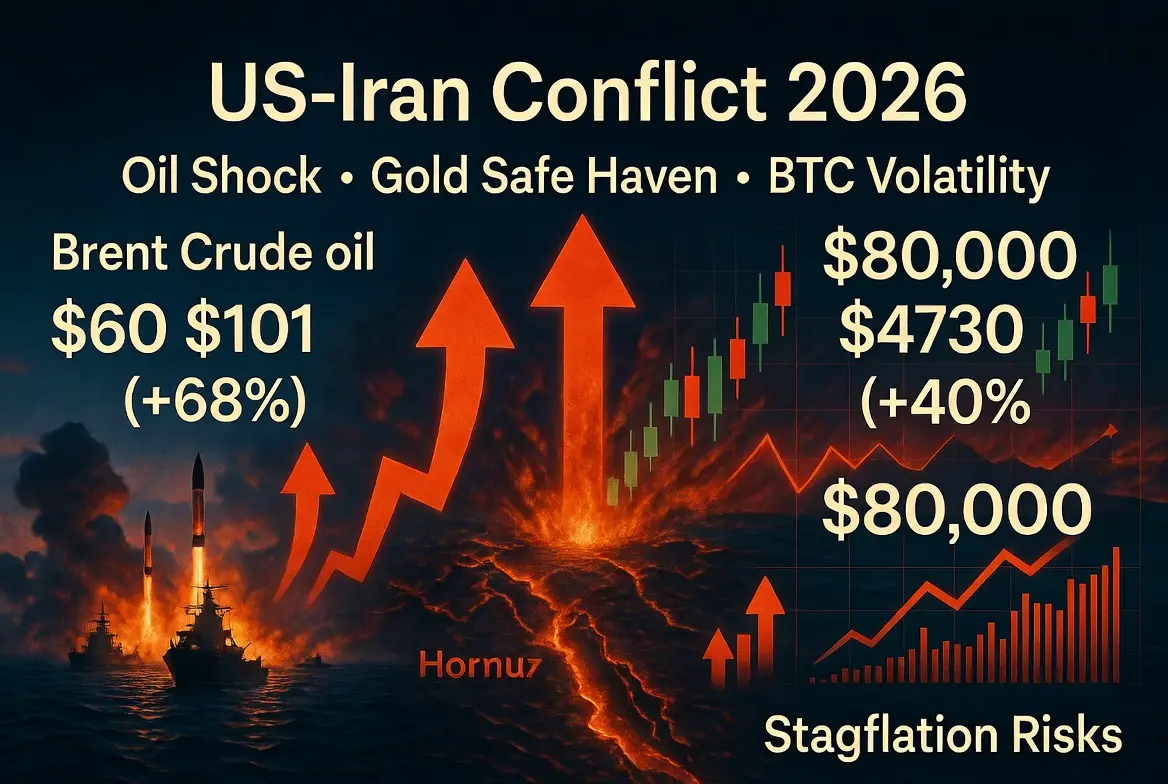
The US-Iran Conflict in 2026:
The US-Iran conflict has evolved into one of the most significant macroeconomic and geopolitical events of 2026. Initially driven by diplomatic pressure, sanctions disputes, and failed nuclear negotiations, it has now transformed into a large-scale confrontation involving military strikes, naval operations, cyber incidents, energy disruptions, and intense financial market volatility.
This is no longer just a political issue in the Middle East. It now directly impacts oil prices, inflation expectations, central bank decisions, global trade
BTC0.35%
PAXG0.09%
GLDX-0.56%
View Original
post-image
post-image
HighAmbition
#IranUSConflictEscalates
US–Iran Conflict 2026:
The US–Iran conflict has evolved into one of the most important macroeconomic and geopolitical events of 2026. What began as diplomatic pressure, sanctions disputes, and failed nuclear negotiations has transformed into a large-scale confrontation involving military strikes, naval operations, cyber incidents, energy disruptions, and severe financial market volatility.
This is no longer just a Middle East political issue. It is now directly influencing oil prices, inflation expectations, central-bank decisions, global trade, gold demand, cryptocurrency markets, equity performance, supply chains, and currency stability.
Every new headline now moves global markets within minutes. Traders, hedge funds, institutions, and central banks are all reacting to developments across the Gulf region because the conflict sits at the center of the global energy system.
THE ROOTS OF THE ESCALATION
Tensions intensified after renewed nuclear negotiations collapsed. The US demanded stricter controls, tighter verification systems, and broader regional security commitments, while Iran rejected several core conditions. Sanctions pressure increased throughout 2025, especially on banking channels, oil exports, and strategic infrastructure.
During mid-2025, Iranian-linked regional activity increased, shipping incidents rose across Gulf waters, oil-market fears began returning, and tanker insurance premiums jumped sharply.
By late-2025 and early-2026, the situation escalated dramatically. Military facilities and strategic infrastructure were targeted, missile and drone operations intensified, naval deployments increased, cyber warfare expanded, and maritime security deteriorated.
The conflict eventually shifted from indirect confrontation toward direct regional military escalation.
OVERNIGHT DEVELOPMENTS — WHY MARKETS REMAIN NERVOUS
Fresh overnight fighting again shocked financial markets. Explosions and air-defense activity were reported near strategic Gulf areas, naval tensions near the Strait of Hormuz intensified, tanker movement disruptions increased, missile interception systems were activated, and military responses from both sides raised fears of broader escalation.
Even temporary clashes now trigger immediate reactions across oil, gold, Bitcoin, equities, bond markets, and forex markets.
This is because investors understand that any disruption near Hormuz can rapidly impact global energy flows.
THE STRAIT OF HORMUZ — THE WORLD’S MOST IMPORTANT ENERGY CHOKEPOINT
The Strait of Hormuz remains the central risk point in the entire conflict.
Approximately 20-21 million barrels of oil move through Hormuz daily, around 20% of global oil trade depends on this route, and nearly one-third of seaborne crude exports pass through the area.
Even partial disruption creates massive global consequences.
Current impacts include tanker insurance spikes of 150-220%, shipping delays of 10-16 days, freight-cost increases of 25-45%, and increased fuel and operational costs globally.
Some shipping operators have already rerouted vessels entirely, increasing delivery times, supply-chain instability, and transportation inflation.
Worst-case market scenarios estimate Brent crude above $130-150, severe inflation acceleration, global recession fears, and major equity corrections.
OIL MARKET — THE CORE OF THE GLOBAL MACRO SHOCK
Oil remains the biggest macro driver of 2026.
Current prices: WTI/XTI around $94 Brent crude around $100-102
Compared to pre-conflict averages, oil remains roughly 50-70% higher.
At peak escalation, Brent surged above $115 while WTI futures briefly approached $150-160 during panic pricing.
Oil volatility has become extreme. Daily moves of 5-10% are common as traders react instantly to military headlines and supply fears dominate sentiment.
Higher oil prices increase transportation costs, airline expenses, manufacturing costs, food distribution expenses, and global inflation pressure.
This creates a chain reaction across the world economy.
GLOBAL INFLATION PRESSURE
The oil surge is spreading inflation globally.
Energy-linked increases include: Jet fuel up 45-65% Diesel up 35-55% Marine shipping fuel up 40-70% Fertilizer costs up 30-50% Petrochemical feedstocks up 25-45%
Supply-chain consequences include rising shipping costs, rapidly increasing logistics expenses, more expensive food transportation, and shrinking manufacturing margins.
Consumer-level impact includes rising airline ticket prices, accelerating grocery inflation, and increasing industrial costs globally.
Economists increasingly warn about stagflation risks involving slower economic growth, persistent inflation, and tight financial conditions.
Global growth forecasts for 2026 have already been revised lower in several regions.
CENTRAL BANKS FACE A MAJOR PROBLEM
The conflict created a difficult environment for central banks.
If rates stay high, economic slowdown risks increase, credit conditions tighten, and liquidity weakens.
If rates are cut too early, inflation may surge further, oil-driven price pressure intensifies, and currency stability weakens.
Markets now face higher-for-longer uncertainty.
This explains why gold remains extremely strong, Bitcoin volatility remains elevated, and equity markets struggle after rallies.
GOLD — THE BIGGEST SAFE-HAVEN WINNER
Gold has become one of the strongest-performing macro assets of 2026.
Current Gold Price: Around $4,714
Earlier in 2026, gold traded near $3,300-3,400.
This means gold rallied roughly 35-40% during the conflict phase.
Drivers behind gold strength include geopolitical fear, inflation hedging, central-bank accumulation, safe-haven demand, and long-term currency concerns.
Institutional demand for gold increased sharply as ETF inflows accelerated, physical bullion demand surged, and sovereign accumulation expanded.
If tensions worsen, $5,000 gold scenarios become increasingly realistic.
If diplomacy improves, gold may cool temporarily toward lower consolidation zones.
BITCOIN — RESILIENT BUT EXTREMELY VOLATILE
Current BTC Price: $80,170
Bitcoin has experienced major volatility during the conflict including sharp selloffs during military escalation, rapid recoveries during ceasefire optimism, and high liquidation activity.
At one stage BTC dropped toward the low $70K range before recovering back toward $80K+.
This shows Bitcoin is behaving as part macro risk asset and part geopolitical hedge.
Bullish arguments include hedging against fiat uncertainty, alternative settlement networks, active institutional adoption, and continued ETF inflows.
Bearish arguments include heavy dependence on liquidity conditions, strong correlation with equities during panic, and sensitivity to macro tightening.
BTC key levels: Support around $79,200-80,000 Resistance around $81,300-82,000
If BTC breaks higher, $85K, $90K, and $95K become possible.
If support fails, $77K-76K becomes possible quickly.
Current trader behavior includes lower leverage, faster scalping, larger stablecoin allocations, and tighter stop-loss usage.
ALTCOINS CONTINUE UNDER PRESSURE
While Bitcoin remains relatively stable, ETH continues underperforming BTC, meme coins remain highly volatile, AI-themed tokens suffered sharp corrections, and small-cap liquidity weakened significantly.
Many altcoins remain 30-60% below local highs and highly sensitive to risk-off sentiment.
Capital rotation currently favors Bitcoin, gold, energy assets, and defensive positioning.
CRYPTO IN THE SANCTIONS AND GEOPOLITICAL ENVIRONMENT
Crypto increasingly became part of the geopolitical landscape itself.
Observed developments include growth in peer-to-peer settlement activity, increased cross-border transfers, and rising interest in decentralized payment channels.
At the same time, regulatory pressure increased, wallet monitoring intensified, and blockchain surveillance expanded.
This conflict accelerated debates around financial sovereignty, stablecoin regulation, CBDCs, and alternative settlement systems.
STABLECOINS — STABLE BUT TESTED
Major stablecoins largely maintained their pegs despite volatility.
However, inflation reduced real purchasing power while traders increasingly discussed commodity-backed alternatives and gold-linked digital assets.
Stablecoins still remain central to crypto liquidity, rapid portfolio rotation, and risk management strategies.
EQUITY MARKETS AND GLOBAL SENTIMENT
Global equity markets reacted negatively during major escalation phases.
Strong sectors included energy companies, defense industries, commodity producers, and gold miners.
Weak sectors included airlines, consumer discretionary, logistics firms, and manufacturing industries.
Investors increasingly shifted toward defensive assets, lower-risk positioning, and cash preservation.
MARKET PSYCHOLOGY — HEADLINE-DRIVEN VOLATILITY
Markets are currently moving based on missile headlines, naval incidents, diplomatic leaks, ceasefire rumors, and military deployments.
Algorithms and institutional trading systems react within seconds.
This creates sudden liquidations, violent intraday swings, and fast reversals.
For traders, emotional reactions have become extremely dangerous.
TRADING STRATEGIES IN THIS ENVIRONMENT
Professional traders are focusing on capital protection, reduced leverage, news monitoring, position scaling, and liquidity management.
Many portfolios now hold 30-50% stablecoins or cash alongside smaller trade sizes, faster trade execution, and defensive allocation strategies.
Current market rewards discipline, patience, flexibility, and risk management.
FINAL CONCLUSION
The US–Iran conflict has become one of the defining macroeconomic events of 2026.
It now directly impacts oil markets, inflation, gold, Bitcoin, global growth, interest-rate expectations, supply chains, and worldwide risk sentiment.
Oil at $94 confirms markets still fear prolonged instability.
Gold at $4,714 shows safe-haven demand remains extremely strong.
Bitcoin at $80,170 demonstrates resilience, but volatility remains elevated.
A diplomatic breakthrough could trigger relief rallies in crypto, lower oil prices, reduced inflation fears, and stronger risk appetite globally.
But further escalation risks higher inflation, slower growth, recession fears, and extreme market volatility.
For traders and investors, this is now a macro-driven, headline-sensitive environment where survival depends on discipline, adaptability, and strong risk management.
repost-content-media
  • Reward
  • 48
  • Repost
  • Share
Luna_Star:
2026 GOGOGO 👊
View More
May 9, 2026, tensions between Iran and the United States further escalated. Reports confirmed the implementation of new sanctions, and maritime activity in the Gulf region increased. Officials from both sides issued firm statements. Oil transportation routes through the strait remain open, but risk premiums in energy markets have risen.
Why this matters to global markets
1. Energy prices: The Gulf region accounts for a significant portion of global oil supply. Rising tensions typically push up crude oil and natural gas prices. Higher energy costs may drive inflation data higher and influence p
BTC0.35%
PAXG0.09%
View Original
post-image
post-image
discovery
#IranUSConflictEscalates
Tension between Iran and the US rose further on May 9, 2026. Reports confirm new sanctions were placed and naval activity in the Gulf increased. Officials from both sides issued firm statements. Oil routes through the Strait remain open, but risk premiums rose across energy markets.
Why It Matters For Global Markets
1. Energy Prices: The Gulf region moves a large share of global oil supply. Higher tension often lifts crude and gas prices. Energy cost rises can push price growth data higher, which affects policy rate outlooks. 2. Risk Sentiment: When geopolitical risk rises, capital often moves from high risk assets to safer assets. Equity indexes in Asia and Europe opened lower. Gold and the dollar index saw buy flows. 3. Supply Chains: Shipping and insurance costs for cargo in the region are being repriced. Delays or route changes add to input costs for goods.
How Crypto Is Affected
1. Short Term Volatility: Bitcoin is trading at 80273 after a volatile session. News driven moves pushed price to both 81000 and 79500 within hours. High speed headlines raise liquidations in derivatives. 2. Safe Haven Debate: Some buyers view Bitcoin as a hedge when trust in local money falls. Others sell crypto with other risk assets when fear rises. The result is sharp moves both ways until a clear trend forms. 3. Mining And Hash Rate: Energy cost is a key input for proof of work mining. If oil and power costs rise in some regions, miner margins tighten. This can slow hash rate growth or lead to coin sales by miners to cover costs. 4. Stablecoin Flows: Onchain data shows higher movement of stablecoins to trading venues. This often means capital is parked on the sidelines, ready to enter or exit fast based on news.
How The Market Could React Next
1. Headline Driven Trading: Price may react fast to new statements, military moves, or talks of de-escalation. Low liquidity periods can see larger gaps. 2. Correlation Shifts: Crypto has shown periods of both high and low link with stocks. During sharp risk events, the link to equities tends to rise for a short time. 3. Levels To Watch: For Bitcoin, the 79500 area was defended on the last dip. A hold above 80000 keeps buyers active. A daily close under 78000 would show sellers in control. For the total crypto market, the 2.3 trillion value area is a key zone many watch.
Points To Watch
1. Oil And Energy: Track crude price and shipping costs. A fast rise in energy often lifts cost forecasts and can weigh on growth assets. 2. Policy Response: Central banks watch energy driven price growth. If data shifts, rate outlooks shift. Rate outlooks drive liquidity, and liquidity drives risk assets. 3. Onchain Behavior: Watch coins moving to and from trading venues. Large inflows often come before sell pressure. Outflows to cold storage show long term holding. 4. Funding And Leverage: Funding rates across derivatives are near flat. A rise in negative funding with falling price shows shorts paying longs, often near short term lows. 5. News Verification: False or unconfirmed reports move price fast. Rely on several trusted sources before acting. Avoid reacting to single posts or rumors.
Risk Control Ideas
1. Use smaller position size during news heavy periods. 2. Place limit orders instead of market orders to avoid slippage. 3. Set clear exit rules before entering a trade. 4. Keep some capital in stable value to use on sharp dips if your plan allows. 5. Review exposure across the full portfolio, not only crypto.
Outlook
Escalation in the Iran US conflict adds risk premium to all markets. Crypto will likely see higher volatility with fast moves in both directions. Clear talks toward easing tension would help risk assets. Further escalation would keep buyers cautious.
Focus on verified data, manage risk, and avoid emotional moves during headline driven sessions.
#GateSquareMayTradingShare
#Gate广场五月交易分享
repost-content-media
  • Reward
  • 40
  • Repost
  • Share
Luna_Star:
Ape In 🚀
View More
#Gate广场五月交易分享
Altcoin Season 2026: Is the Long-Term Chart Repeating 2017 and 2021? Data Shows Differences
The long-term altcoin market cap chart is repeating patterns seen before the previous two altcoin seasons. However, the altcoin season index remains at 35, still within the Bitcoin season zone.
Two technical indicators point to an upcoming altcoin rebound. Yet, a key real-time data point contradicts this expectation. The chart suggests that after Bitcoin dominance breaks out of its accumulation zone, it may replay the scenarios of 2017 or 2021.
Altcoin Market Cap Follows Patterns
BTC0.35%
DOGE3.23%
BONK-0.34%
SIN-6.67%
View Original
post-image
post-image
ybaser
#Gate广场五月交易分享
Altcoin Season 2026: Is the Long-Term Chart Repeating 2017 and 2021? Data Says Differently
The long-term altcoin market cap chart is repeating the pattern seen before the last two altcoin seasons. However, the Altcoin Season Index remains at 35, still within the Bitcoin Season zone.
Two technical indicators point to an impending altcoin rally. However, a key real-time data point contradicts this expectation. The chart hints at a possible repetition of the 2017 or 2021 scenario as Bitcoin dominance breaks out of its accumulation zone.
Altcoin Market Cap Follows Pattern Seen Before 2017 and 2021 Rallies
The total altcoin market cap, excluding Bitcoin, is currently around $1.06 trillion.
The initial formation occurred in 2015 and 2016. Altcoins formed an accumulation base, moved along an ascending trend line, and made a fakeout below this line in late 2016. This fakeout was the low point just before the parabolic altcoin rally of 2017.
The second pattern occurred in 2019 and 2020. A squeeze along a falling trendline culminated in a fakeout during the March 2020 Covid crash. This fakeout was followed by an altseason explosion in 2020 and 2021.
The current structure has been charting a similar course since 2023. Altcoins formed a base, moved along an ascending trendline throughout 2024, and recently staged a fakeout at the upper limit.
Wouldn't it be incredible if altcoins repeated the story of 2016/2017 and 2020/2021? It seems this possibility is becoming increasingly likely.
Bitcoin Dominance Breakdown Challenges Bullish Expectations
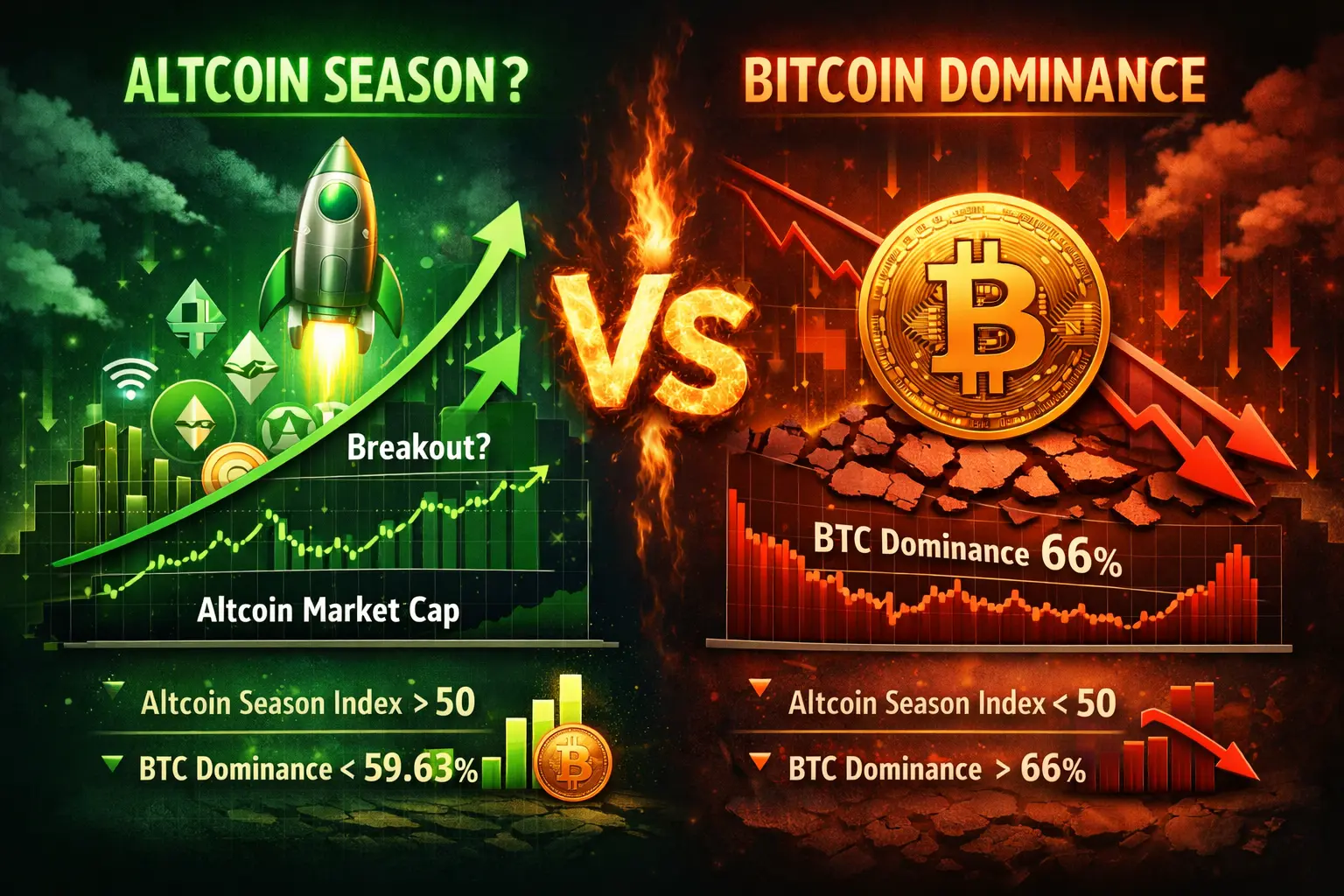
For a bullish scenario to materialize, Bitcoin dominance needs to decline. But the opposite has happened. Bitcoin dominance closed at 60.88% on the daily chart, breaking above an accumulation range that has lasted for eight months.
This range held BTC.D between 58% and 60% from August 2025 to April 2026. The breakout signals a continuation of the upward movement: the 66.06% level seen in the previous cycle is the next resistance zone.
The 61% region has repeatedly acted as resistance. The BTC.dominance chart was rejected here on October 10, 2025 and November 5, 2025. Both rejections occurred near the parallel ascending channel at the beginning of the cycle.
Momentum indicators are signaling exhaustion. The Relative Strength Index (RSI) has reversed from the bullish zone and is weakening. The Moving Average Convergence Divergence (MACD) has formed a bearish crossover.
If this rejection is permanent, the first support is at 59.63%: the long-term 0.236% Fibonacci retracement level. The next support is at 55.66%, the 0.382% Fibonacci zone. A drop below 59.63% would open the door for altcoins to perform better.
Altcoin Season Index 35: Altcoins Still in Bitcoin's Shadow
While technical indicators hint at an impending turnaround, live data suggests that this turnaround has not yet begun. The Altcoin Season Index is at 35, clearly indicating that it is in Bitcoin Season.
The index measures how many of the top 50 cryptocurrencies have outperformed Bitcoin in the last 90 days. Stablecoins and asset-backed tokens are excluded from this calculation. A reading of 75 or more indicates an altcoin season, while 25 or less points to a Bitcoin season.
The current value of 35 suggests that roughly that many of the top 50 altcoins have surpassed Bitcoin. In the past, altcoin season peaks on the chart pushed the index above 90. The current level is less than half of that altcoin season threshold.
Bitcoin's share of the total cryptocurrency market is approximately 60.3% as of May 2026. Capital flow is still favoring Bitcoin, particularly with ongoing institutional purchases.
The balance here is very clear: the scenario gains strength if Bitcoin dominance loses 59.63% and the Altcoin Season Index rises above 50. However, if the BTC dominance graph moves to 66% and the index remains below 50, the structure breaks down.
$DOGE $BONK $SIN
repost-content-media
  • Reward
  • 35
  • 1
  • Share
Luna_Star:
2026 GOGOGO 👊
View More
#Gate广场五月交易分享 Is the rebound ignited by the Federal Reserve pausing rate hikes a genuine purchasing power or a liquidity illusion?
On a macro level, the Federal Reserve's decision to pause rate hikes at the April 29 FOMC meeting immediately led to a four-day, over $400 million outflow from ETFs—this proves that institutional funds remain highly sensitive to policy signals. The current price stabilization above $80K is not a confirmation of macro liquidity easing but more a temporary breather amid policy expectation battles. The stablecoin market cap reached a historic high of $31.5-31.6 bill
BTC0.35%
ETH-0.25%
SOL-1.02%
View Original
post-image
post-image
Ryakpanda
#Gate广场五月交易分享 Is the rebound ignited by the Federal Reserve pausing interest rate hikes real purchasing power or liquidity illusion?
On the macro level, the Federal Reserve's decision to pause rate hikes at the FOMC meeting on April 29 immediately led to a four-day, over $400 million outflow from ETFs—this proves that institutional funds remain highly sensitive to policy signals. The current price stabilizing above $80K is not a confirmation of macro liquidity easing but more a temporary breather amid policy expectation battles. The stablecoin market cap reached a historic high of $31.5-31.6 billion in Q1 2026, indicating that capital has not truly left the crypto ecosystem but has defensively shifted into dollar-pegged instruments awaiting directional signals. This firepower provides genuine marginal buying support for any future price breakthroughs.
At the spot and derivatives level, the surge in open interest when breaking through $78K is mainly driven by leveraged longs rather than spot purchases, indicating that a significant portion of this rebound involves contract forces. However, on-chain data offers important hedging evidence: over the past 30 days, whales have net accumulated about 270k BTC, exchange reserves have fallen to a seven-year low, and BlackRock's IBIT holdings are about 812k BTC, accounting for roughly 3.8% of the total supply. Institutions continue to lock BTC into structured investment portfolios via ETFs, creating sustained buy-side support in the spot market. Their "suction" efficiency far exceeds that of retail-dominated order books in the past. But retail behavior is quite different: the number of coin-holding addresses is declining at the fastest rate in nearly two years, and retail investors are taking profits. This suggests that the current price support is driven by institutional, structural factors rather than retail-driven emotional peaks.
Regarding ETH/BTC and ecosystem liquidity, ETH is currently around $2,372, with futures open interest about $5 billion, and a funding rate of -0.002%, close to neutral slightly bearish. The Altcoin Season Index is only 22/100, deep in Bitcoin season territory, reflecting that market risk appetite has yet to shift systematically from BTC to Ethereum or broader altcoins. The ETH/BTC ratio remains under pressure. Before the $80K support for BTC has been tested over time, expecting ETH to lead an alt season lacks effective catalysts. The recent ecosystem narratives—such as SOL's Alpenglow consensus upgrade and ETH's Glamsterdam upgrade—are expected events, but without on-chain TVL or Gas data showing significant changes, they do not support a fundamental-driven rotation logic.
In terms of narrative verification, BTC has broken through key cost basis levels, with funding rates shifting from negative to neutral. Options dealers hold short gamma positions near $82K, and their delta hedging mechanisms will generate additional buy orders on price increases—these three signals align, forming a technically bullish short-term pattern. The Bull Market Support Band has been reclaimed for the first time in six months; historically, each successful reclaim often triggers a sustained rally. Previously, attempts to rebound around $79K repeatedly failed. But it’s important to recognize that the immediate catalyst for breaking $82K on May 9 was Trump’s announcement to halt the Hormuz Strait operations, causing oil prices to plummet and geopolitical risk premiums to shrink. This event-driven force led to a massive short squeeze, not a trend driven by continuous capital inflows. The most dangerous blind spot now is the overpricing of leveraged longs on the ETF "structural support" narrative. The main lesson from the Q1 2026 market is that when derivatives-to-spot ratio hits a record 9.6x, any macro surprises triggering chain liquidations can exceed what fundamentals can explain. Currently, open interest is again accumulating after the breakout, and funding rates have just normalized from deep negative levels. If the Fed signals a hawkish shift or geopolitical risks reverse risk appetite, forced liquidations of leveraged longs could rapidly transmit through ETF redemption mechanisms to institutional holders. The widely held belief that "institutions provide a floor" will face a fatal reflexive collapse under conditions where ETF redemptions force BlackRock and others to sell BTC in the market, creating negative feedback loops in spot liquidity at the most concentrated institutional price levels. A clear falsification point is the 200-day EMA around $82,228; if daily closes cannot hold above this level, the current rebound is merely a technical correction from $63K rather than a trend reversal, and the Bull Market Support Band below $79K will once again become a key short target. 
The essence of the current trend is a tug-of-war between the structural bottom built by institutions through ETFs and the over-sensitivity of leveraged longs to macro signals. The only critical benchmark for judging the nature of this rebound is the daily close above $82K.
repost-content-media
  • Reward
  • 35
  • 1
  • Share
Luna_Star:
LFG 🔥
View More
Robot burns $1.14 million to go after V God, and the HYPE treasury suffers a massive loss of 165 million; ETH is nearing the 5% life-or-death line 🔥
📉 Tom Lee opens up: BitMine holds 4.29% ETH, and after reaching 5% within six weeks it may slow down
🤖 MEV robots are going wild: spending $1.14 million in gas just to front-run and trap Vitalik for a few bucks—huge loss
💸 HYPE blows up: the treasury has a net loss of 165.4 million over nine months, and BIT-related addresses dump another 200,000 tokens
🐵 Meme tide ebbs: USDUC plunges 66% from its peak, as funds flee for their lives
⚖️ A regul
HYPE5.7%
ETH-0.25%
View Original
post-image
  • Reward
  • 38
  • 1
  • Share
Luna_Star:
2026 GOGOGO 👊
View More
Is it a real fight or a performance? Overnight clashes at Hormuz, and Trump’s one-line “light punishment” cranks up the drama 💣
On May 7, three U.S. Navy destroyers passed through Hormuz. The two sides nearly fired on each other, and the U.S. bombed targets along Iran’s coast. Then, Trump turned around and set the tone:
• The ceasefire is still on;
• This is just a “gentle warning”;
• If no denuclearization agreement is signed, there’s more—“stronger” to come.
The market is acting too: oil prices jumped, then fell back, and BTC joined in with choppy trading.
So, do you think this time they’re
BTC0.35%
View Original
post-image
  • Reward
  • 36
  • Repost
  • Share
Luna_Star:
Ape In 🚀
View More
#Gate广场五月交易分享
# ADP Employment Surpasses Expectations, Rate Cut Delayed Again
"Small Non-Farm" Surpasses Expectations, Tonight's "Big Non-Farm" Could Decide the Outcome
U.S. April ADP employment increased by 109k, far exceeding the expected 99k, reaching a 15-month high. Meanwhile, March PCE inflation rose to 3.5% year-on-year, and market expectations suggest the Federal Reserve's rate cut may be postponed. Barclays' latest forecast: the next rate cut might not happen until March 2027, which will undoubtedly suppress gold and Bitcoin prices:
Gold Market: Short-term Pressure but Limited Downsi
BTC0.35%
View Original
post-image
LittleGodOfWealthPlutus
#Gate广场五月交易分享
# ADP Employment Surpasses Expectations, Rate Cut Delayed Again
"Small Non-Farm" Surpasses Expectations, Tonight's "Big Non-Farm" Could Decide the Outcome
U.S. April ADP employment increased by 109k, far exceeding the expected 99k, hitting a 15-month high. Meanwhile, March PCE inflation rose to 3.5% year-over-year, and the market expects the Federal Reserve's rate cut to be pushed back. Barclays' latest forecast: the next rate cut may not happen until March 2027, which will undoubtedly suppress gold and Bitcoin prices:
Gold Market: Short-term Pressure but Limited Downside Space
‌Reactive Response Diminished
Although ADP data hit a 15-month high (109k new jobs), gold prices showed no significant volatility (spot gold on May 6 remained in the 4,693–4,700 range). This indicates that gold's sensitivity to employment data has decreased, mainly because‌ geopolitical conflicts (Middle East situation) hedge against rate cut expectations, offsetting the negative impact.
‌Delayed Rate Cut Suppression Effect
Better-than-expected employment data reinforce the Fed's stance of "higher for longer" interest rates, with the market pushing the first rate cut to March 2027 (expected only a 25 basis point cut). In theory, rising real interest rates are negative for gold.
‌Key Support Factors
‌Inflation Stickiness‌: The Middle East conflict has driven up energy prices, with March CPI year-over-year reaching 3.3%, and PCE inflation rising to 3.5%, weakening the dollar's purchasing power, highlighting gold's inflation-hedging properties.
‌Safe-Haven Demand‌: If tonight's non-farm payroll data intensifies concerns about economic overheating (e.g., wage growth exceeding expectations), it could increase stagflation risk expectations, potentially boosting gold buying.
‌Cryptocurrency: Short-term volatility intensifies, long-term supported by AI narratives
‌Liquidity Tightening Expectations Impact
Delayed rate cuts imply that market liquidity remains tight, putting pressure on high-risk assets. If tonight's non-farm payroll remains strong, cryptocurrencies may face short-term sell-offs.
‌Structural Bullish Divergences
‌AI Investment Boom‌: Tech giants (Microsoft, Amazon, etc.) are increasing AI capital expenditures dramatically (potentially exceeding $1.1 trillion by 2027), boosting the prosperity of the computing power industry chain, and cryptocurrencies, as part of tech risk assets, may benefit.
‌Capital Rotation Opportunities‌: If gold rises due to stagflation fears, some safe-haven funds might shift into Bitcoin (historically, scenarios where Bitcoin's correlation with gold increases).
‌Key Watchpoints
If non-farm payroll data shows accelerated wage growth (current job-holder wage growth at 4.4%), it could reinforce concerns about the "wage-inflation spiral," increasing market volatility. However, cryptocurrencies are more focused on tech earnings reports and AI commercialization progress.
The Little Wealth God suggests that everyone should closely watch tonight's "Big Non-Farm" data, which could determine the short-term direction of financial markets:
‌Potential Scenarios for Tonight's Non-Farm Data
1. Non-Farm Surpasses Expectations (>62k)
Impact on gold: Negative, breaking below $4,650 support
Impact on cryptocurrencies: Negative, may continue to fluctuate downward, watch support near 76,500 on the weekly chart
2. Non-Farm Below Expectations (<50k)
Impact on gold: Positive, may break through the small resistance at $4,750
Impact on cryptocurrencies: Positive, watch for a possible upward breakthrough again at $82,000
repost-content-media
  • Reward
  • 40
  • Repost
  • Share
Luna_Star:
LFG 🔥
View More
#Gate广场五月交易分享 As Bitcoin, the "bellwether" of the cryptocurrency market, broke below the key level of $80,000, it has triggered a chain reaction across the entire crypto market. The core impacts are mainly reflected in two aspects: on one hand, mainstream cryptocurrencies are moving weaker in sync. Except for Ethereum, coins like XRP, BNB, and others have experienced varying degrees of decline. The overall market shows a broad decline, but the drop has not exceeded 3%, and there has been no large-scale liquidation wave like in October 2025, indicating that market sentiment, while cautious, has
BTC0.35%
ETH-0.25%
XRP1.39%
BNB1.02%
View Original
Ryakpanda
#Gate广场五月交易分享 Bitcoin, as the "bellwether" of the cryptocurrency market, has fallen below the critical threshold of $80,000, triggering a chain reaction across the entire crypto market. The core impacts are mainly reflected in two aspects: On one hand, mainstream cryptocurrencies are moving weaker in sync. Except for Ethereum, coins like XRP, BNB, and others have experienced varying degrees of decline. The overall market shows a broad decline, but the drops have not exceeded 3%, and there has been no large-scale liquidation wave like in October 2025, indicating that market sentiment, while cautious, has not turned to extreme panic, and short-term selling pressure remains relatively manageable. On the other hand, institutional attitudes are becoming more conservative. Previously, Wall Street asset management giants that drove Bitcoin's rise are now mostly in a wait-and-see stance. Although firms like Morgan Stanley and Goldman Sachs have long-term optimism about Bitcoin, they have not increased their positions in the short term; some institutions have even reduced their holdings to realize profits, further intensifying short-term volatility.
Future trend forecast
Based on the latest news developments, capital flows, and market sentiment, an objective prediction of Bitcoin's subsequent trend is provided, balancing short-term fluctuations and long-term trends, without overhyping good news or avoiding risks, aligning with the current market reality:
(1) Short-term (1-3 days): Volatility consolidation, testing the support at $80,000
In the short term, Bitcoin is likely to maintain a state of oscillation and consolidation, primarily testing the critical support level of $80,000. If this level holds, a slight rebound to the $81,000–81,500 range is possible; if it fails to hold, further correction to the $79,000–79,500 range may occur, possibly even dropping below $79,000, but a sharp decline is less likely—after all, current market sentiment is neutral, and ETF capital inflows are still ongoing, providing some support for prices.
(2) Medium-term (1-2 weeks): Trend depends on capital and policy, difficult to see a one-sided move
In the medium term, Bitcoin's trend will mainly depend on two core variables: first, the inflow of ETF capital. If subsequent inflows continue to recover and offset previous outflows, it could push the price back above $82,000; second, macro policies and regulatory developments. If expectations of rate cuts reignite and regulatory frameworks are implemented with clear market expectations, it could boost market sentiment. Conversely, if these factors do not materialize, the trend may remain oscillating downward. Overall, a one-sided upward or downward trend is unlikely in the medium term; consolidation remains the main theme.
(3) Long-term (1-6 months): Institutional allocation logic remains unchanged, long-term trend still in focus
In the long term, institutional investors' allocation logic toward cryptocurrencies has not changed. The net inflow into the US spot Bitcoin ETF has reached $58.72 billion. Major players like Morgan Stanley and Goldman Sachs are still advancing crypto-related product innovations. Goldman Sachs has even launched a Bitcoin covered call ETF targeting conservative capital allocations such as pensions and insurance funds. Additionally, the improvement of regulatory frameworks may provide compliant support for Bitcoin's long-term development, with some institutions even projecting Bitcoin could rise to $225k in the long run. However, potential risks such as macro policy changes, tightening regulations, and capital outflows should be carefully watched.
repost-content-media
  • Reward
  • 36
  • Repost
  • Share
Vortex_King:
LFG 🔥
View More
  • Pinned