

Bitcoin continues to push higher, but beneath the surface, its structure is becoming more fragile.
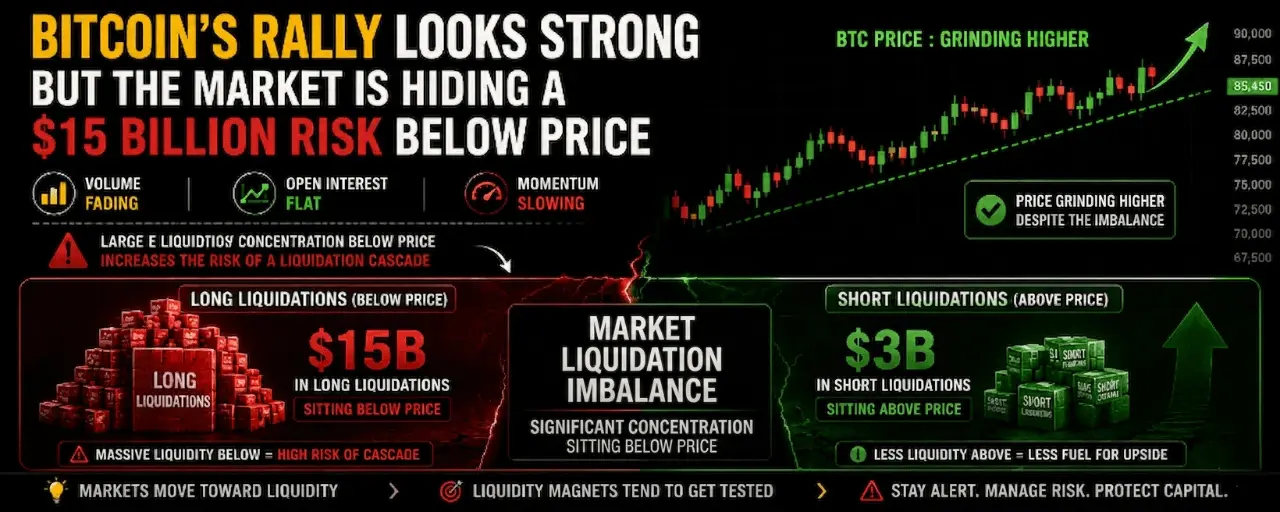
Currently, nearly $15 billion in long liquidations are stacked below the current market price, while only about $3 billion in short liquidations remain above.
That imbalance is more significant than many traders realize.
The market is no longer moving solely based on pure momentum.
It moves based on positions.
At first glance, BTC still looks healthy.
Prices keep rising, spot demand hasn't fully disappeared, and short positions are still under pressure.
However, after examining the details, the picture changes.
Volume is fading.
Open interest is flat.
Momentum is slowing down.
This usually tells us one thing: the rally is becoming less supported by new conviction and more reliant on existing positions.
That's where the danger begins.
Markets naturally move toward liquidity, and currently, the largest liquidity concentration is below the price.
If Bitcoin loses momentum and starts to decline, overly leveraged long positions could be liquidated quickly.
One wave of forced selling could easily trigger another, creating a cascade that turns a small correction into a savage wipeout.
What makes this setup even more interesting is that BTC continues to rise despite the imbalance.
It indicates that short liquidations have funded the upward movement.
But short squeezes eventually weaken if new shorts stop entering the market.
And when that fuel runs out, market makers often shift their focus to heavier liquidity zones.
Below.
Another important signal is the behavior of CVD and open interest together.
Spot CVD still shows active buyers, which is constructive for bullishness, but its speed has slowed significantly.
Meanwhile, flat open interest tells us that large leveraged positions are not aggressively supporting a breakout.
This creates a market environment where prices can still move higher temporarily, while internally becoming weaker at the same time.
That combination rarely remains stable for long.
The next big move may depend on whether Bitcoin can again attract real spot demand, rather than relying on leverage-driven momentum.
If buyers fail to step in strongly, the market could eventually turn toward the large liquidity zones below the current price.
And historically, liquidity magnets tend to be tested.
The most important thing traders need to understand right now is this:
A market can look bullish while quietly becoming unstable underneath.
That’s why Bitcoin’s current structure deserves attention.
Do you think BTC will continue to rise higher first, or sweep the liquidity below before the next major expansion move?
This is for educational purposes only, not financial advice.
$BTC #GateSquareMayTradingShare
Currently, nearly $15 billion in long liquidations are stacked below the current market price, while only about $3 billion in short liquidations remain above.
That imbalance is more significant than many traders realize.
The market is no longer moving solely based on pure momentum.
It moves based on positions.
At first glance, BTC still looks healthy.
Prices keep rising, spot demand hasn't fully disappeared, and short positions are still under pressure.
However, after examining the details, the picture changes.
Volume is fading.
Open interest is flat.
Momentum is slowing down.
This usually tells us one thing: the rally is becoming less supported by new conviction and more reliant on existing positions.
That's where the danger begins.
Markets naturally move toward liquidity, and currently, the largest liquidity concentration is below the price.
If Bitcoin loses momentum and starts to decline, overly leveraged long positions could be liquidated quickly.
One wave of forced selling could easily trigger another, creating a cascade that turns a small correction into a savage wipeout.
What makes this setup even more interesting is that BTC continues to rise despite the imbalance.
It indicates that short liquidations have funded the upward movement.
But short squeezes eventually weaken if new shorts stop entering the market.
And when that fuel runs out, market makers often shift their focus to heavier liquidity zones.
Below.
Another important signal is the behavior of CVD and open interest together.
Spot CVD still shows active buyers, which is constructive for bullishness, but its speed has slowed significantly.
Meanwhile, flat open interest tells us that large leveraged positions are not aggressively supporting a breakout.
This creates a market environment where prices can still move higher temporarily, while internally becoming weaker at the same time.
That combination rarely remains stable for long.
The next big move may depend on whether Bitcoin can again attract real spot demand, rather than relying on leverage-driven momentum.
If buyers fail to step in strongly, the market could eventually turn toward the large liquidity zones below the current price.
And historically, liquidity magnets tend to be tested.
The most important thing traders need to understand right now is this:
A market can look bullish while quietly becoming unstable underneath.
That’s why Bitcoin’s current structure deserves attention.
Do you think BTC will continue to rise higher first, or sweep the liquidity below before the next major expansion move?
This is for educational purposes only, not financial advice.
$BTC #GateSquareMayTradingShare