BabaJi

vip
Age 1.2 Year
Peak Tier 5
Web3 Content Creator Active in Global Crypto Events & Campaigns Airdrops • Trading • Research • Community Growth
#AnthropicTapsSamsungForAIchips
ANTHROPIC TAPS SAMSUNG FOR AI CHIPS — THE AI HARDWARE RACE JUST ENTERED A NEW PHASE
The artificial intelligence industry is no longer competing only through better models—it is now fighting for the computing power that makes those models possible. Reports that Anthropic is turning to Samsung for AI chip manufacturing highlight a major shift in the global AI ecosystem. This isn't just another business partnership; it reflects how access to advanced semiconductor production has become one of the most valuable strategic assets in the technology world.
For years,
2In1
#AnthropicTapsSamsungForAIchips
ANTHROPIC TAPS SAMSUNG FOR AI CHIPS — THE AI HARDWARE RACE JUST ENTERED A NEW PHASE
The artificial intelligence industry is no longer competing only through better models—it is now fighting for the computing power that makes those models possible. Reports that Anthropic is turning to Samsung for AI chip manufacturing highlight a major shift in the global AI ecosystem. This isn't just another business partnership; it reflects how access to advanced semiconductor production has become one of the most valuable strategic assets in the technology world.
For years, AI development was measured by the quality of algorithms and research breakthroughs. Today, the conversation has changed. The biggest challenge is securing enough high-performance chips to train and deploy increasingly sophisticated AI systems. Every new generation of large language models demands exponentially more computational power, making chip manufacturing capacity one of the industry's biggest competitive advantages.
Samsung's role in this partnership is particularly significant. As one of the world's leading semiconductor manufacturers, the company brings advanced fabrication capabilities that could help Anthropic expand its AI infrastructure while reducing dependence on limited manufacturing capacity elsewhere. Diversifying production is becoming a strategic necessity as demand for AI accelerators continues to outpace global supply.
This move also reflects a broader trend across the AI industry. Leading AI companies are investing heavily in custom hardware rather than relying solely on off-the-shelf solutions. Purpose-built AI chips can improve efficiency, reduce operating costs, and optimize performance for increasingly complex workloads. Hardware is rapidly becoming as important as software in determining who leads the next generation of artificial intelligence.
The partnership could also reshape competition across the semiconductor sector. Every major technology company is racing to secure reliable chip production, while manufacturers are expanding advanced fabrication capabilities to meet unprecedented demand. The AI boom is creating opportunities not only for software developers but also for the companies building the physical infrastructure behind modern computing.
For investors and market observers, this development reinforces an important reality: the AI revolution extends far beyond chatbots and applications. Semiconductor manufacturing, cloud infrastructure, memory technology, and supply chain resilience are becoming critical pillars of the digital economy. Companies that control these layers may hold long-term strategic advantages as AI adoption continues to accelerate.
At the same time, partnerships like this demonstrate how interconnected the global technology ecosystem has become. Innovation now depends on collaboration between AI developers, chip designers, foundries, cloud providers, and enterprise customers. No single company can dominate every layer of the AI stack alone.
As AI continues evolving, the race will no longer be won solely by the smartest models—it will also be won by those with the strongest infrastructure. The future of artificial intelligence will be shaped not only by brilliant software engineers but also by the silicon, factories, and manufacturing partnerships powering the next generation of intelligent systems.
The next chapter of AI leadership isn't just about intelligence—it's about who controls the hardware that makes intelligence possible.

repost-content-media
  • Reward
  • 2
  • Repost
  • Share
Yusfirah:
LFG 🔥
View More
#Get2SharesOfSKHynixAtZeroCost
𝗛𝗼𝘄 𝗦𝗞 𝗛𝘆𝗻𝗶𝘅 𝗜𝘀 𝗕𝗲𝗻𝗲𝗳𝗶𝘁𝗶𝗻𝗴 𝗙𝗿𝗼𝗺 𝗧𝗵𝗲 𝗚𝗿𝗼𝘄𝗶𝗻𝗴 𝗔𝗜 𝗥𝗲𝘃𝗼𝗹𝘂𝘁𝗶𝗼𝗻 𝗔𝗻𝗱 𝗪𝗵𝘆 𝗔𝗱𝘃𝗮𝗻𝗰𝗲𝗱 𝗠𝗲𝗺𝗼𝗿𝘆 𝗧𝗲𝗰𝗵𝗻𝗼𝗹𝗼𝗴𝘆 𝗜𝘀 𝗕𝗲𝗰𝗼𝗺𝗶𝗻𝗴 𝗢𝗻𝗲 𝗢𝗳 𝗧𝗵𝗲 𝗠𝗼𝘀𝘁 𝗜𝗺𝗽𝗼𝗿𝘁𝗮𝗻𝘁 𝗣𝗮𝗿𝘁𝘀 𝗢𝗳 𝗧𝗵𝗲 𝗚𝗹𝗼𝗯𝗮𝗹 𝗧𝗲𝗰𝗵 𝗜𝗻𝗱𝘂𝘀𝘁𝗿𝘆
Artificial Intelligence is changing almost every part of the technology world. From chatbots and smart assistants to self-driving systems and scientific research, AI needs powerful hardware to process huge amounts of information. Behind every advanced AI model is a
EagleEye
#Get2SharesOfSKHynixAtZeroCost
𝗛𝗼𝘄 𝗦𝗞 𝗛𝘆𝗻𝗶𝘅 𝗜𝘀 𝗕𝗲𝗻𝗲𝗳𝗶𝘁𝗶𝗻𝗴 𝗙𝗿𝗼𝗺 𝗧𝗵𝗲 𝗚𝗿𝗼𝘄𝗶𝗻𝗴 𝗔𝗜 𝗥𝗲𝘃𝗼𝗹𝘂𝘁𝗶𝗼𝗻 𝗔𝗻𝗱 𝗪𝗵𝘆 𝗔𝗱𝘃𝗮𝗻𝗰𝗲𝗱 𝗠𝗲𝗺𝗼𝗿𝘆 𝗧𝗲𝗰𝗵𝗻𝗼𝗹𝗼𝗴𝘆 𝗜𝘀 𝗕𝗲𝗰𝗼𝗺𝗶𝗻𝗴 𝗢𝗻𝗲 𝗢𝗳 𝗧𝗵𝗲 𝗠𝗼𝘀𝘁 𝗜𝗺𝗽𝗼𝗿𝘁𝗮𝗻𝘁 𝗣𝗮𝗿𝘁𝘀 𝗢𝗳 𝗧𝗵𝗲 𝗚𝗹𝗼𝗯𝗮𝗹 𝗧𝗲𝗰𝗵 𝗜𝗻𝗱𝘂𝘀𝘁𝗿𝘆
Artificial Intelligence is changing almost every part of the technology world. From chatbots and smart assistants to self-driving systems and scientific research, AI needs powerful hardware to process huge amounts of information. Behind every advanced AI model is a combination of processors, storage, and memory working together. This is why semiconductor companies are receiving more attention than ever before.
One company that has benefited from this trend is SK Hynix. As demand for AI hardware continues to increase, the company has become one of the leading suppliers of advanced memory solutions. Investors have started paying close attention because memory is no longer just another computer component—it has become a key part of modern AI infrastructure.
𝗪𝗵𝗮𝘁 𝗜𝘀 𝗛𝗶𝗴𝗵 𝗕𝗮𝗻𝗱𝘄𝗶𝗱𝘁𝗵 𝗠𝗲𝗺𝗼𝗿𝘆?
High Bandwidth Memory, often called HBM, is designed to move data much faster than traditional memory. AI models constantly process enormous datasets, and that requires memory that can deliver information quickly and efficiently. Faster memory allows powerful processors to work at their best without waiting for data.
As AI applications continue to grow, the demand for HBM is expected to remain strong. Building this technology is complex, so supply cannot always increase as quickly as demand. This balance between supply and demand has made HBM one of the most important technologies in today's semiconductor industry.
𝗪𝗵𝘆 𝗦𝗞 𝗛𝘆𝗻𝗶𝘅 𝗜𝘀 𝗚𝗮𝗶𝗻𝗶𝗻𝗴 𝗔𝘁𝘁𝗲𝗻𝘁𝗶𝗼𝗻
SK Hynix has invested heavily in advanced memory technology over the years. Those investments are now becoming more valuable as AI companies require better hardware for training and running large AI models. Strong demand has helped improve the company's market position and attracted interest from investors around the world.
This also shows how quickly industries can change. A few years ago, many people focused mainly on software companies. Today, hardware manufacturers that provide essential technology for AI are becoming equally important.
𝗧𝗵𝗲 𝗕𝗶𝗴𝗴𝗲𝗿 𝗣𝗶𝗰𝘁𝘂𝗿𝗲
The growth of AI is creating opportunities across the entire technology ecosystem. Chip designers, memory manufacturers, cloud service providers, networking companies, and data center operators all benefit when AI adoption increases.
Instead of looking at only one company, it is often helpful to understand how the entire industry works. Companies supporting different parts of the AI supply chain may all experience growth as businesses continue investing in artificial intelligence.
𝗠𝘆 𝗜𝗻𝘀𝗶𝗴𝗵𝘁
One of the biggest lessons from the AI boom is that innovation creates opportunities in unexpected places. While many people focus on AI applications, the companies building the hardware behind those applications are just as important.
Learning about semiconductors, memory technology, and AI infrastructure helps investors and technology enthusiasts better understand why certain companies attract so much attention during periods of rapid innovation.
𝗜𝗻𝘃𝗲𝘀𝘁𝗶𝗻𝗴 𝗪𝗶𝘁𝗵 𝗔 𝗟𝗼𝗻𝗴-𝗧𝗲𝗿𝗺 𝗠𝗶𝗻𝗱𝘀𝗲𝘁
Strong share price performance often creates excitement, but successful investing should always be based on research rather than emotion. Understanding a company's products, financial health, competitive advantages, and future growth opportunities is more important than simply following market trends.
Diversification and patience remain valuable principles. Markets can move up and down, but informed decisions are usually built on knowledge instead of short-term excitement.
𝗚𝗹𝗼𝗯𝗮𝗹 𝗔𝗰𝗰𝗲𝘀𝘀 𝗧𝗼 𝗡𝗲𝘄 𝗠𝗮𝗿𝗸𝗲𝘁𝘀
As investment platforms continue expanding, more people can explore companies listed in international markets. This gives investors an opportunity to learn about businesses outside their home countries and understand how different economies contribute to global technological progress.
Access to international stocks also encourages people to study industries such as semiconductors, robotics, renewable energy, and artificial intelligence from a broader perspective.
𝗙𝗶𝗻𝗮𝗹 𝗧𝗵𝗼𝘂𝗴𝗵𝘁𝘀
Artificial intelligence is still developing, and its future will depend on both software and hardware. Companies that produce advanced memory and semiconductor technology play a critical role in making AI faster, smarter, and more efficient.
Whether you are interested in technology or investing, following developments in the semiconductor industry can provide valuable knowledge about where innovation is heading. The most successful learners and investors are often those who stay curious, continue researching, and make decisions based on facts instead of market hype.
repost-content-media
  • Reward
  • 2
  • Repost
  • Share
ybaser:
2026 GOGOGO 👊
View More
#PredictionMarketsHitRecordVolume
Prediction Markets Hit Record Volume: Gate Leads the Next Generation of Event Markets
Prediction markets have rapidly evolved into one of the fastest-growing sectors of the digital asset industry. What was once a niche blockchain application focused on election forecasts has expanded into a global ecosystem covering sports, cryptocurrencies, financial markets, macroeconomic events, technology, artificial intelligence, entertainment, and major world events. As adoption continues to accelerate, these markets have become an important source of real-time sentimen
BTC-0.79%
ETH-0.66%
HighAmbition
#PredictionMarketsHitRecordVolume
Prediction Markets Hit Record Volume: Gate Leads the Next Generation of Event Markets
Prediction markets have rapidly evolved into one of the fastest-growing sectors of the digital asset industry. What was once a niche blockchain application focused on election forecasts has expanded into a global ecosystem covering sports, cryptocurrencies, financial markets, macroeconomic events, technology, artificial intelligence, entertainment, and major world events. As adoption continues to accelerate, these markets have become an important source of real-time sentiment and probability discovery.
According to multiple industry reports, prediction market activity reached record levels during the first quarter of 2026. Monthly trading activity climbed to approximately $25.7 billion in March 2026, representing an increase of 10.6% from February. Other industry datasets reported activity near $23.7 billion, compared with roughly $1.9 billion during the same period in 2025, highlighting more than 12x year-over-year growth.
Industry momentum continues to strengthen. Following approximately $64 billion in activity during 2025, several market analysts estimate that annual prediction market volume could exceed $300 billion during 2026 if current trends continue. Longer-term forecasts from industry research suggest the sector has the potential to approach $1 trillion in annual activity over the coming years as institutional participation, AI-powered analytics, and broader adoption expand.
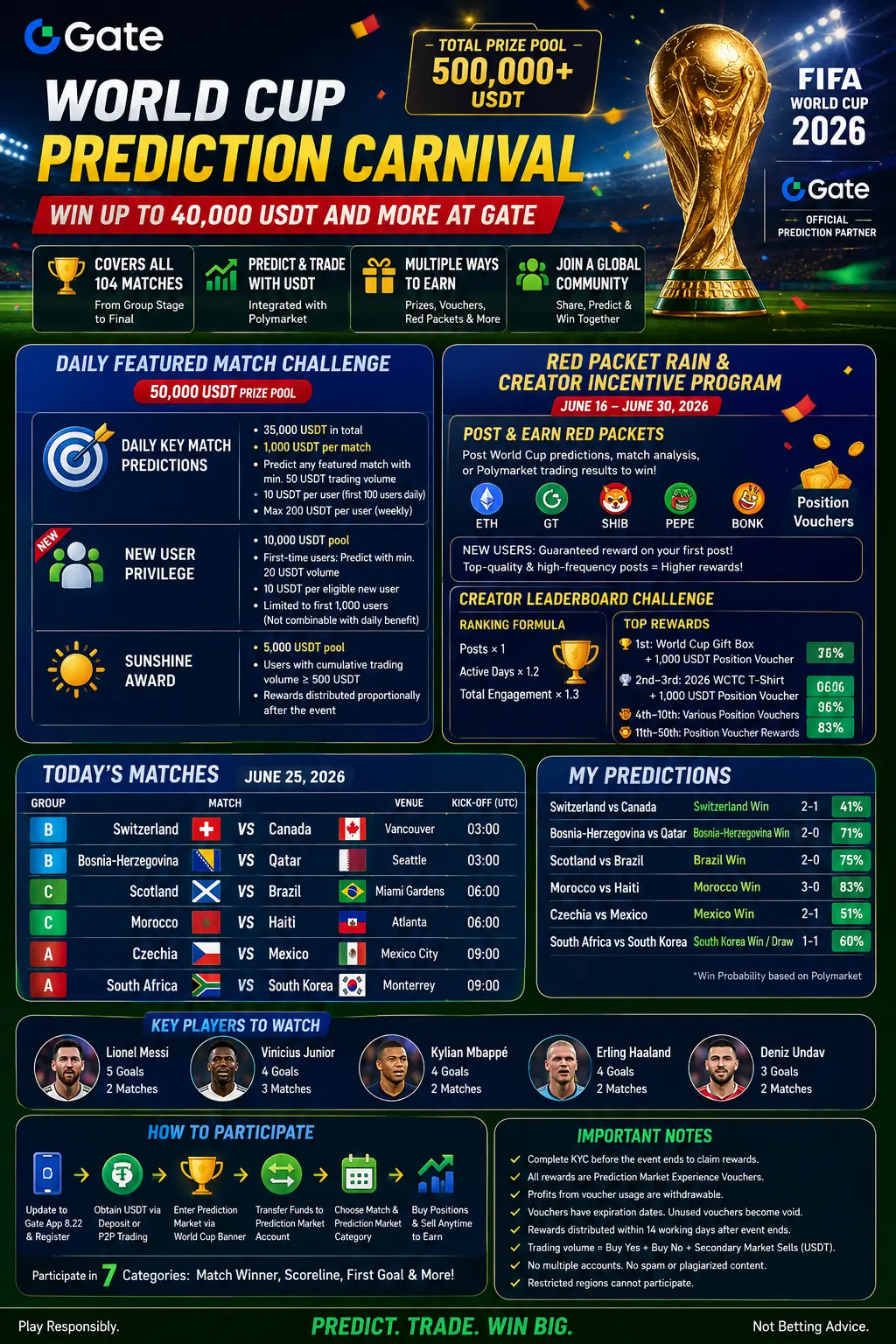
One of the biggest catalysts has been the 2026 FIFA World Cup. Global football events have generated exceptionally high engagement, with markets covering match results, tournament progression, goal totals, player performance, and championship outcomes. Public market data indicates that sports-related prediction activity exceeded $7 billion during the tournament's opening stages, while weekly industry activity climbed to approximately $10.8 billion, setting new records for event-based markets.
Digital asset markets continue to contribute significantly to industry growth. Bitcoin-related prediction markets attracted hundreds of thousands of participants and generated more than $5.4 billion in reported activity during the first quarter of 2026. Ethereum-related markets exceeded $1.1 billion, while growing interest in AI, macroeconomics, technology, and financial events continues to expand the overall market.
Amid this rapid growth, Gate has continued enhancing its prediction market ecosystem by integrating Polymarket into its platform. The integration simplifies access for eligible users, allowing them to explore prediction markets through a familiar exchange interface using supported digital assets.
Gate has also introduced a wide range of platform improvements designed to enhance market discovery and user experience. Intelligent search, personalized recommendations, trending event categories, comprehensive portfolio management, transaction history, and improved market navigation help users follow developments across sports, crypto, finance, and technology more efficiently.
One of the platform's standout additions is the Smart Money analytics system. Public market data, historical performance metrics, portfolio allocation insights, and market activity indicators provide users with additional analytical tools for understanding market behavior. AI-generated summaries, probability analytics, market sentiment indicators, and detailed event statistics further strengthen the research experience.
The trading interface has also been upgraded with improved order execution, enhanced sports event pages, tournament navigation, live event monitoring, professional charting tools, and integrated analytics. Prediction Market Live brings together liquidity trends, market activity, and analytical insights into a unified dashboard, giving users a clearer view of changing market conditions.
For users who prefer on-chain participation, Gate also offers a DEX Prediction Market built on Polygon infrastructure. The platform supports self-custodial access, transparent settlement, advanced charting, professional order books, and analytical tools while maintaining compatibility with the broader prediction market ecosystem.
Supporting these developments is Gate Research, which regularly publishes reports exploring prediction market structure, AI-assisted forecasting models, liquidity dynamics, digital asset trends, and the long-term evolution of event markets. These reports examine how artificial intelligence and blockchain technology are reshaping information discovery across global markets.
Looking ahead, the outlook for prediction markets remains strong. Continued innovation, expanding institutional participation, growing retail interest, improvements in AI-powered analytics, and increasing integration across digital finance are expected to support further growth throughout 2026 and beyond.
With ongoing investment in platform development, analytics, research, user experience, and market infrastructure, Gate continues to strengthen its position within the evolving prediction market ecosystem. As event-based markets continue expanding across sports, digital assets, technology, and global events, the platform remains focused on delivering accessible tools and innovative solutions for users around the world.
repost-content-media
  • Reward
  • 2
  • Repost
  • Share
Yusfirah:
To The Moon 🌕
View More
#USMayPCEInflationRisesTo4.1%HighestIn3Years
The United States Personal Consumption Expenditures (PCE) Price Index, the Federal Reserve's preferred inflation gauge, accelerated to 4.1% year-over-year in May 2026, rising from 3.8% in April and marking the highest inflation reading in more than three years. The stronger-than-expected report immediately changed market expectations for future monetary policy, as investors now anticipate interest rates remaining higher for longer. This shift has strengthened the U.S. dollar, pushed Treasury yields sharply higher, tightened global liquidity conditi
HighAmbition
#USMayPCEInflationRisesTo4.1%HighestIn3Years
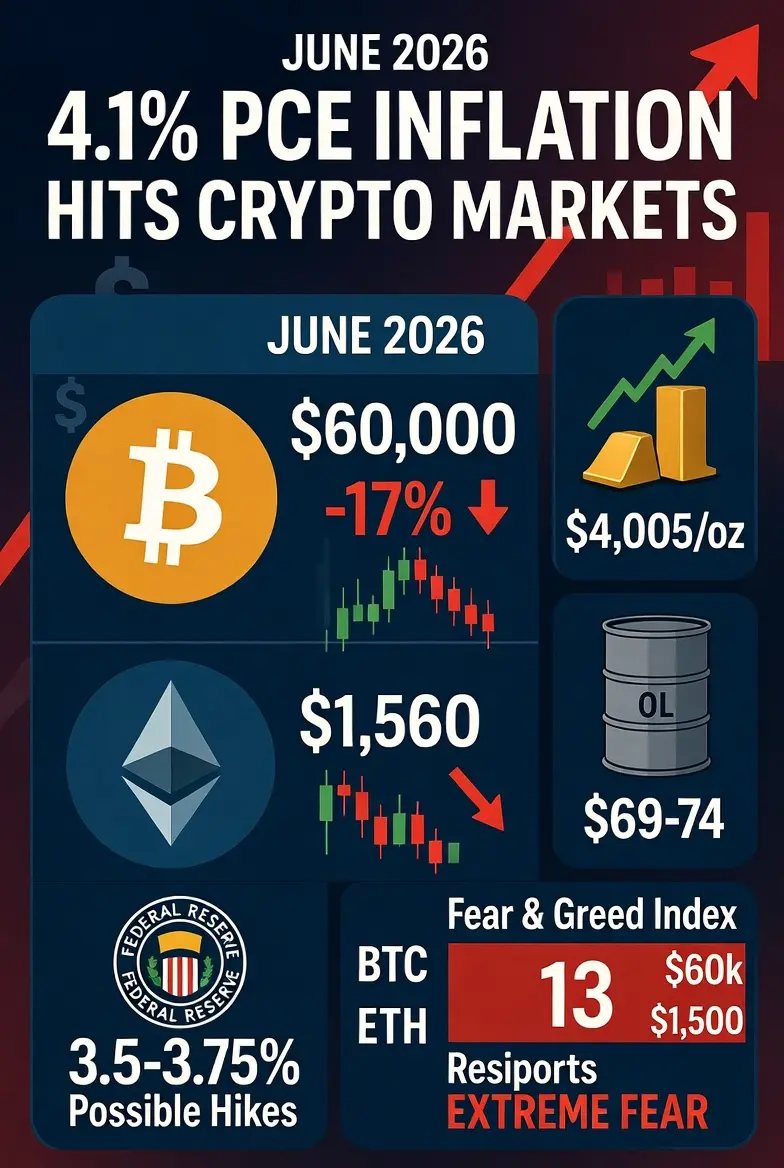
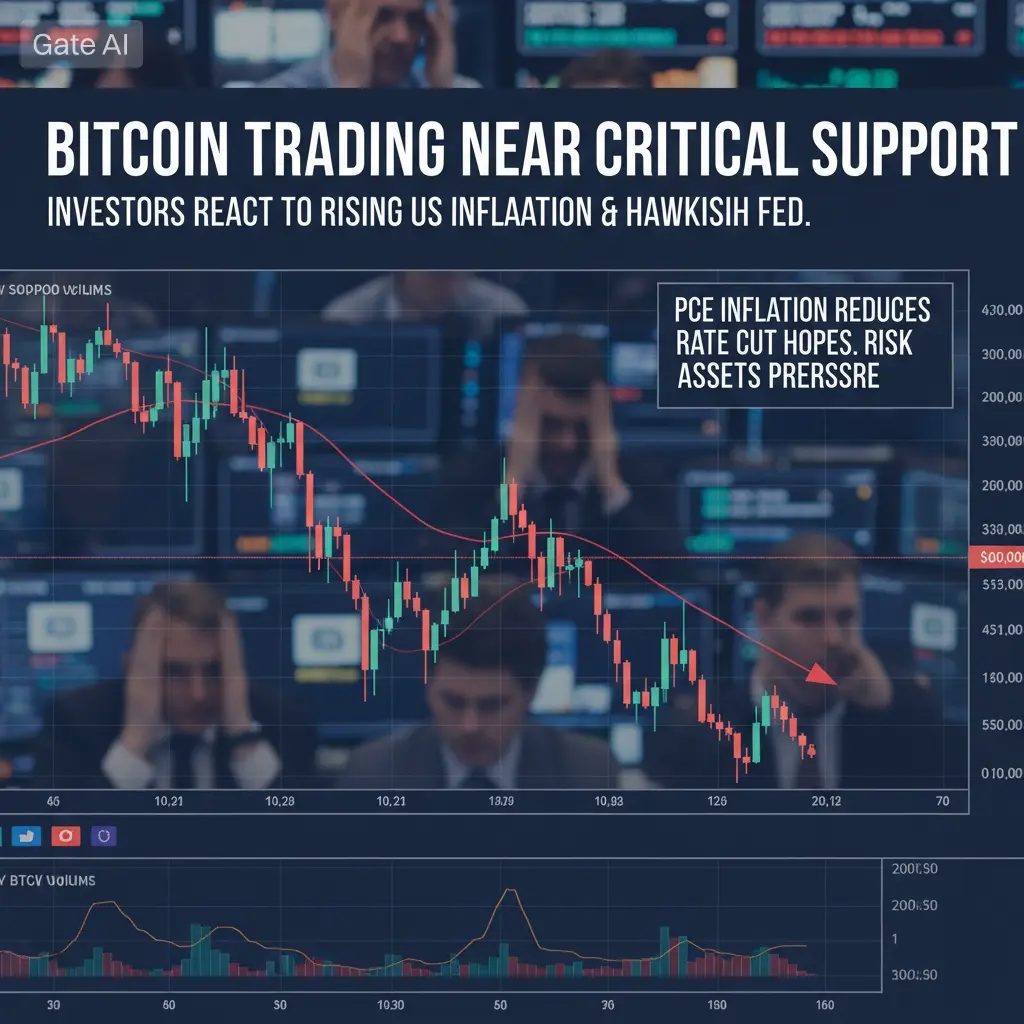
The United States Personal Consumption Expenditures (PCE) Price Index, the Federal Reserve's preferred inflation gauge, accelerated to 4.1% year-over-year in May 2026, rising from 3.8% in April and marking the highest inflation reading in more than three years. The stronger-than-expected report immediately changed market expectations for future monetary policy, as investors now anticipate interest rates remaining higher for longer. This shift has strengthened the U.S. dollar, pushed Treasury yields sharply higher, tightened global liquidity conditions, and triggered broad-based selling across cryptocurrencies, while defensive assets such as gold continued attracting capital.
Unlike previous inflation surprises, this report arrived when cryptocurrency markets were already experiencing weakening momentum, declining institutional demand, and persistent ETF outflows. As a result, the inflation data accelerated an already fragile market structure, increasing volatility and forcing traders to reassess both short-term positioning and long-term portfolio allocation.
Understanding the Inflation Data
Headline PCE inflation increased to 4.1%, compared with 3.8% in April, while monthly inflation rose 0.3%. At the same time, Core PCE, which excludes food and energy prices and is closely monitored by Federal Reserve policymakers, climbed to 3.4% from 3.3%, representing its highest level since October 2023. These figures confirm that inflation remains significantly above the Federal Reserve's long-term 2% target, making immediate monetary easing increasingly unlikely.
For financial markets, persistent inflation is not simply an economic statistic—it directly influences borrowing costs, liquidity availability, investor confidence, and overall risk appetite.
Every additional month of elevated inflation increases the probability that interest rates will remain restrictive, limiting the flow of capital into speculative assets such as cryptocurrencies while improving the attractiveness of government bonds and other yield-generating investments.
Current Market Performance
The inflation surprise produced an immediate reaction across global financial markets. Bitcoin traded between $59,547 and $60,895, recording a 24-hour decline of 2.8%, a 7-day loss of 8.4%, a 30-day decline of 14.7%, and a 90-day correction of 26.3%, leaving the world's largest cryptocurrency approximately 68% below its all-time high near $108,000. Ethereum underperformed even further, trading between $1,556 and $1,572, falling 4.1% in 24 hours, 12.6% over seven days, 21.3% during the last month, and 38.7% over the previous ninety days, remaining almost 92% below its historical peak of $4,878.
While cryptocurrencies weakened, Gold climbed to approximately $4,005 per ounce, after touching an intraday high of $4,067, gaining 0.9% in 24 hours, 2.4% in one week, 6.8% over thirty days, and 18.4% over ninety days, reflecting continued investor demand for traditional inflation hedges. Meanwhile, WTI crude oil traded near $69.45 per barrel and Brent crude near $74.02, both extending recent declines as easing geopolitical tensions reduced supply concerns. U.S. Treasury yields also moved sharply higher, with the 10-Year yield reaching 4.412%, up 11 basis points following the PCE release, while the 2-Year yield stood at 4.148%, reinforcing expectations of tighter financial conditions.
Liquidity, Trading Volume and Institutional Positioning
One of the most important developments following the inflation report was the significant deterioration in cryptocurrency market liquidity.
Bitcoin's 24-hour spot trading volume surged to approximately $48.7 billion, representing a 58% increase above its thirty-day average, while the seven-day average daily volume reached $41.2 billion, up 47%. However, despite stronger trading activity, Bitcoin futures open interest declined to $31.4 billion, falling 17.34% during the previous month, indicating that much of the increased volume resulted from liquidation and position reduction rather than fresh bullish capital entering the market.
Market liquidity also weakened considerably. Bid-ask spreads on major exchanges widened by 42% around the critical $60,000 price level, while buy-side market depth across the ten largest exchanges declined by 26% within 2% of spot price. This combination of higher trading volume and lower market depth suggests that relatively modest sell orders are now capable of producing significantly larger price movements, increasing the probability of sharp intraday volatility and flash crashes during periods of negative macroeconomic news.
Ethereum displayed even greater weakness.
Spot trading volume climbed to $28.9 billion, approximately 71% above average, while the seven-day average reached $24.6 billion, increasing 64%. Despite higher activity, Ethereum futures open interest fell to $14.8 billion, declining 19.7% over the last month, while long liquidations totaled approximately $1.12 billion during the previous seven days, representing nearly 78% of all cryptocurrency liquidations. Across the broader digital asset market, total 24-hour trading volume expanded to roughly $118 billion, increasing 52% after the PCE release, whereas the overall crypto market capitalization declined to approximately $2.18 trillion, falling 9.4% during the previous month.
Bitcoin dominance remained stable at 52.8%, indicating that investors continued rotating capital away from higher-risk altcoins toward relatively safer large-cap assets.
Institutional positioning also remained weak.
Bitcoin Spot ETFs recorded cumulative outflows of approximately $6.39 billion, with 26 of the previous 30 trading sessions showing net withdrawals, while Ethereum ETFs experienced nearly $412 million in outflows during the last fourteen days. Persistent ETF redemptions suggest that institutional investors remain cautious and continue reducing exposure until inflation shows a convincing downward trend.
Bitcoin and Ethereum Technical Outlook
From a technical perspective, Bitcoin remains under heavy pressure near the psychologically important $60,000 level. Immediate support is located between $60,000 and $59,500, followed by stronger structural support between $57,000 and $58,000, while the broader long-term support zone extends between $50,000 and $55,000. On the upside, major resistance remains at $63,100, followed by $65,000, $67,200-$67,500, while the 200-week moving average currently stands near $62,457.
Momentum indicators continue favoring sellers, with the Daily RSI at 39, Weekly RSI at 34, and Monthly RSI at 41, while the MACD remains bearish across both daily and weekly timeframes. Retail positioning also shows approximately 70.5% of traders remaining long, historically acting as a contrarian bearish signal whenever excessive optimism persists during declining markets.
Ethereum continues exhibiting even higher volatility because of its greater sensitivity to risk sentiment. The $1,500 level represents the primary psychological and technical support, followed by additional support between $1,400 and $1,450, while a deeper correction could extend toward $1,200-$1,300. Resistance remains near $1,600, followed by $1,708 and $1,750, with Ethereum needing to reclaim and hold above $1,750 before a sustainable recovery can be considered technically credible.
Market Outlook and Investment Strategy
If inflation remains above 4% and upcoming economic reports continue surprising to the upside, the Federal Reserve may maintain restrictive monetary policy for longer than markets currently expect. Under this bearish scenario, Bitcoin could revisit the $50,000-$55,000 region, while Ethereum could decline toward $1,200-$1,400 as institutional investors continue reducing exposure and liquidity conditions remain weak. A more neutral outcome would likely keep Bitcoin trading between $55,000 and $65,000 and Ethereum between $1,400 and $1,800, allowing markets to consolidate while waiting for additional inflation data. A bullish recovery would require a significantly softer June PCE report, renewed ETF inflows, improving liquidity, and growing expectations that the Federal Reserve may eventually begin easing monetary policy, potentially allowing Bitcoin to recover above $67,000 while Ethereum advances toward $2,000.
For investors, disciplined risk management remains essential. Long-term participants may continue gradual Dollar-Cost Averaging while reducing position sizes until a confirmed market bottom develops. Short-term traders should prioritize high-liquidity support and resistance zones, avoid excessive leverage, and maintain strict stop-loss strategies because thinner liquidity can produce unusually sharp price swings. Maintaining portfolio diversification, including a 10-20% allocation to gold as an inflation hedge together with adequate cash reserves, may help reduce overall portfolio volatility during this uncertain macroeconomic environment.
The 4.1% PCE inflation reading has clearly reinforced the bearish short-term outlook for cryptocurrency markets. Rising trading volumes accompanied by declining futures open interest, persistent ETF outflows, weakening market depth, and reduced institutional participation collectively suggest that investors remain defensive despite periodic relief rallies. Although the long-term fundamentals supporting Bitcoin and Ethereum adoption remain intact, current price action continues to be driven primarily by macroeconomic conditions rather than blockchain-specific developments.
The next major catalyst will be the June 2026 PCE report, scheduled for release in late July. A meaningful decline below 3.8% could improve market confidence, weaken the U.S. dollar, reduce Treasury yields, and encourage renewed institutional participation. However, another elevated inflation reading would likely strengthen expectations for prolonged monetary tightening, intensify selling pressure across digital assets, and extend the current correction. Until inflation shows a sustained path toward the Federal Reserve's 2% objective, investors should prioritize capital preservation, disciplined portfolio management, and careful risk control while preparing for continued volatility across Bitcoin, Ethereum, gold, oil, and the broader global financial markets.@Gate_Square
repost-content-media
  • Reward
  • 3
  • Repost
  • Share
Yusfirah:
To The Moon 🌕
View More
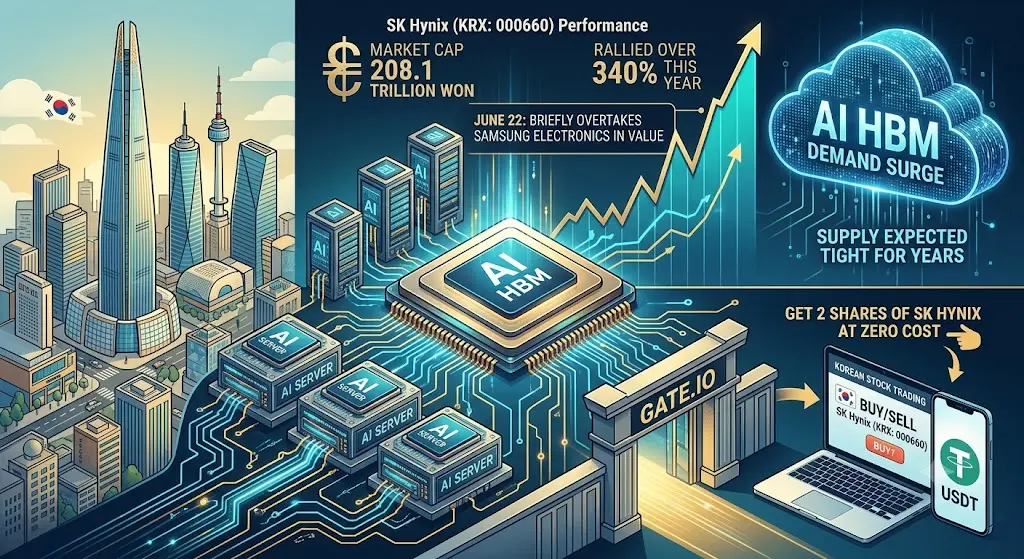
#Get2SharesOfSKHynixAtZeroCost
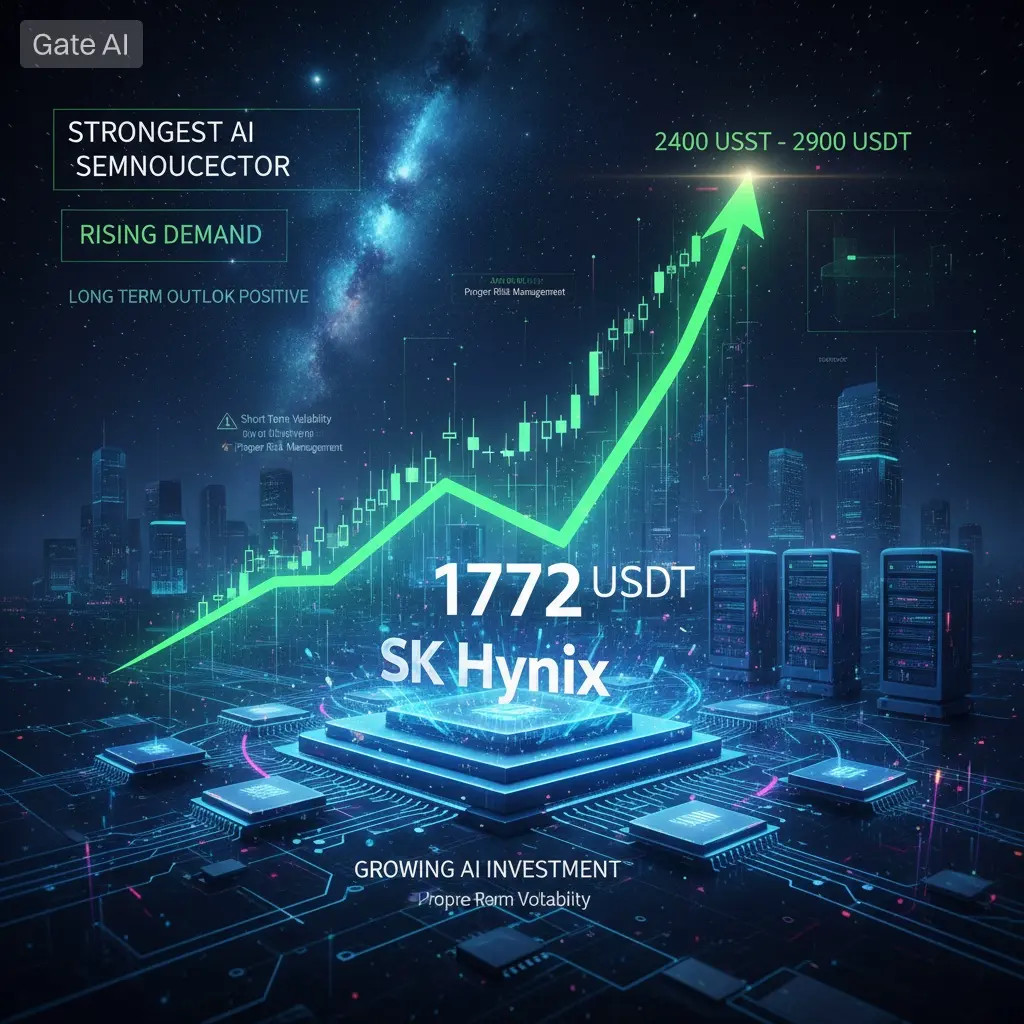
SK Hynix stands as one of the most compelling semiconductor investments in the current market environment. Trading at approximately 1772 USDT, this South Korean memory chip giant has captured significant attention from institutional and retail traders alike. The company currently holds the position as the world's second-largest memory chip manufacturer and has emerged as a critical supplier to the booming artificial intelligence industry.
Current Market Position and Price Action
SK Hynix has demonstrated remarkable strength in recent trading sessions. The stock
HighAmbition
#Get2SharesOfSKHynixAtZeroCost
SK Hynix stands as one of the most compelling semiconductor investments in the current market environment. Trading at approximately 1772 USDT, this South Korean memory chip giant has captured significant attention from institutional and retail traders alike. The company currently holds the position as the world's second-largest memory chip manufacturer and has emerged as a critical supplier to the booming artificial intelligence industry.
Current Market Position and Price Action
SK Hynix has demonstrated remarkable strength in recent trading sessions. The stock gained 0.98 percent on the last trading day, rising from 1772 USDT to 1790 USDT. Over the past two weeks, the price has surged by an impressive 25.98 percent, with gains recorded in nine out of the last ten trading days. This momentum reflects the market's growing confidence in the company's AI-driven growth trajectory.
The stock has experienced notable volatility, with intraday fluctuations reaching 10.19 percent, ranging from a day low of 1680 USDT to a high of 1850 USDT. Such volatility presents both opportunities and risks for traders, requiring careful position management and risk control measures.
Fundamental Analysis and Growth Drivers
The primary catalyst driving SK Hynix's valuation remains its dominant position in High Bandwidth Memory (HBM) production. As AI applications expand exponentially, demand for HBM chips has outpaced supply, creating a favorable pricing environment. SK Hynix has secured major supply contracts with leading AI chip manufacturers, ensuring revenue visibility through multi-year agreements.
The company recently unveiled its AIN (AI NAND) Family strategy at the 2025 OCP Global Summit, targeting rapidly growing AI inference workloads with NAND solutions optimized for performance, bandwidth, and density. Additionally, SK Hynix has completed development of HBM4, the next-generation high-bandwidth memory for ultra-high performance AI applications, featuring industry-leading speed and power efficiency.
Analyst sentiment remains overwhelmingly positive. Wall Street analysts have raised their average one-year price target for SK Hynix to 1772 USDT, with high forecasts reaching 2900 USDT. Goldman Sachs maintains a buy rating with a target of 2400 USDT, representing approximately 35 percent upside potential. Nomura has set an even more bullish target of 2700 USDT, suggesting 52 percent upside from current levels. Hanwha recently raised their price target to 2900 USDT, arguing the company has evolved beyond pure cyclical memory plays thanks to long-term agreements and HBM leadership.
Technical Analysis and Key Levels
From a technical perspective, SK Hynix presents mixed signals. The short-term moving average currently indicates a sell signal, while the long-term moving average provides a buy signal. Since the short-term average remains above the long-term average, the overall technical outlook remains constructive.
Critical support levels to monitor include the 1680 USDT zone, which has recently acted as a floor during volatile sessions. A more significant structural support zone exists between 1050 and 1060 USDT, representing a potential accumulation area on deeper pullbacks.
Resistance levels are forming around the recent high of 1850 USDT. A sustained breakout above this level could open the path toward the 2100 USDT psychological barrier and eventually the analyst consensus target zone of 2400 to 2900 USDT.
According to short-term trend analysis, the stock shows potential for substantial appreciation over the next three months, with projections suggesting possible gains of 190.33 percent. Statistical models indicate a 90 percent probability of the price holding between 4500 USDT and 5800 USDT by the end of this three-month period, though traders should treat such projections with appropriate caution.
Market Sentiment and Trader Psychology
Social media sentiment on platforms like X reflects broadly constructive views on SK Hynix's prospects. Traders and analysts emphasize the AI infrastructure story, with reports indicating HBM capacity is sold out into next year. The company's planned US Nasdaq ADR listing around July 10 has generated additional excitement, expected to boost visibility and liquidity among global investors.
However, some traders have expressed caution following recent sharp intraday drops triggered by Korean regulatory crackdowns on leveraged ETFs. These mechanical selling events created temporary pressure but do not reflect underlying fundamental weakness. Korea's June export data, showing growth exceeding 85 percent year-over-year, supports the bullish case for upcoming earnings strength.
Risk Factors and Bearish Considerations
Despite the positive outlook, several risks warrant attention. Competition from Samsung in HBM4 market share could pressure margins and prompt modest de-rating. The company's market cap briefly surpassed Samsung for the first time since 2000, which some technical analysts interpret as a potential overheating signal.
Broader macroeconomic factors including US dollar strength and potential rotation away from technology stocks could weigh on the shares. The semiconductor industry remains cyclical, and any slowdown in AI capital expenditure could impact demand expectations.
Trading Strategy Recommendations
For conservative investors, accumulating positions on dips toward the 1680 to 1720 USDT support zone offers a favorable risk-reward profile. Stop-losses should be placed below 1650 USDT to protect against deeper corrections.
For active traders, the current volatility environment supports range-trading strategies between 1680 and 1850 USDT until a clear directional breakout emerges. Breakout traders should watch for sustained moves above 1850 USDT with volume confirmation as a signal to initiate long positions targeting 2100 USDT initially.
Risk management remains paramount given the stock's demonstrated volatility. Position sizing should reflect individual risk tolerance, with appropriate diversification across sectors and asset classes.
Gate Get2Shares Promotion Details
Gate Exchange is currently running an exceptional promotion that allows users to receive up to 2 shares of SK Hynix at zero cost. This represents approximately 3400 USDT in value based on current prices.
The promotion runs from June 23, 2026, at 09:00 UTC through June 30, 2026, at 16:00 UTC. Participation requires trading within the Gate Stocks section, specifically focusing on Korean stocks including SK Hynix and Samsung Electronics.
To qualify for the maximum reward of 2 SK Hynix shares, users must achieve cumulative trading volume of 10000 USDT across eligible stocks. For every 10000 USDT in trading volume, participants receive random SK Hynix airdrops ranging from 0.01 to 0.5 shares equivalent. The total prize pool consists of 200 shares distributed by trading volume ranking.
New users who have never traded stocks before can participate in the registration prize pool, with the first 2000 registrants sharing 3400 USDT equivalent in SK Hynix fractional shares. Additionally, first-time traders of SK Hynix and Samsung Electronics who reach 500 USDT cumulative trading volume receive 5 to 17 USDT equivalent in SK Hynix rewards.
To participate, users must click the Register Now button on the event page. On the web platform, navigate to Stocks then Korean Stocks section. On the mobile application version 8.25.0 or higher, access through TradFi, then Stocks, then Markets, then Korean Stocks.
Rewards are credited within 14 business days after the event concludes. The minimum fractional share unit is 0.01 shares, with any smaller amounts distributed as USDT instead.
Conclusion and Outlook
SK Hynix represents a compelling investment opportunity driven by the structural AI memory demand supercycle. The company's technological leadership in HBM, combined with long-term supply agreements and expanding AI applications, supports a bullish multi-year outlook.
Near-term volatility from leveraged ETF flows and competitive dynamics may create entry opportunities for patient investors. The current price around 1772 USDT offers exposure to a transformative technology trend with substantial upside potential toward analyst targets of 2400 to 2900 USDT.
Traders should maintain disciplined risk management while positioning for the continued AI infrastructure buildout. The Gate Get2Shares promotion provides an excellent opportunity to acquire SK Hynix exposure at zero cost through active trading participation.
For those seeking exposure to the AI revolution through a leading memory chip manufacturer with demonstrated technological superiority and strong earnings momentum, SK Hynix warrants serious consideration. The combination of fundamental strength, technical setup, and promotional incentives creates a favorable environment for both short-term traders and long-term investors.
@Gate_Square #Get2SharesOfSKHynixAtZeroCost
repost-content-media
  • Reward
  • 3
  • Repost
  • Share
Yusfirah:
2026 GOGOGO 👊
View More
#MicronOvertakesMetaInMarketValue
Micron Technology is one of the world's leading semiconductor companies, headquartered in Boise, Idaho, United States. Founded in 1978, Micron specializes in designing and manufacturing memory and storage solutions, including DRAM (Dynamic Random Access Memory), NAND flash, and HBM (High Bandwidth Memory) chips. These components are essential building blocks for computers, smartphones, data centers, automotive systems, and increasingly, artificial intelligence infrastructure. Micron operates globally with manufacturing facilities in the United States, Japan,
HighAmbition
#MicronOvertakesMetaInMarketValue
Micron Technology is one of the world's leading semiconductor companies, headquartered in Boise, Idaho, United States. Founded in 1978, Micron specializes in designing and manufacturing memory and storage solutions, including DRAM (Dynamic Random Access Memory), NAND flash, and HBM (High Bandwidth Memory) chips. These components are essential building blocks for computers, smartphones, data centers, automotive systems, and increasingly, artificial intelligence infrastructure. Micron operates globally with manufacturing facilities in the United States, Japan, Singapore, and other regions, employing thousands of engineers and technicians. The company trades on NASDAQ under the ticker symbol MU and has transformed from a traditional cyclical memory chip manufacturer into one of the most strategically valuable companies in the AI era, commanding market positions that were once reserved for software and platform giants.
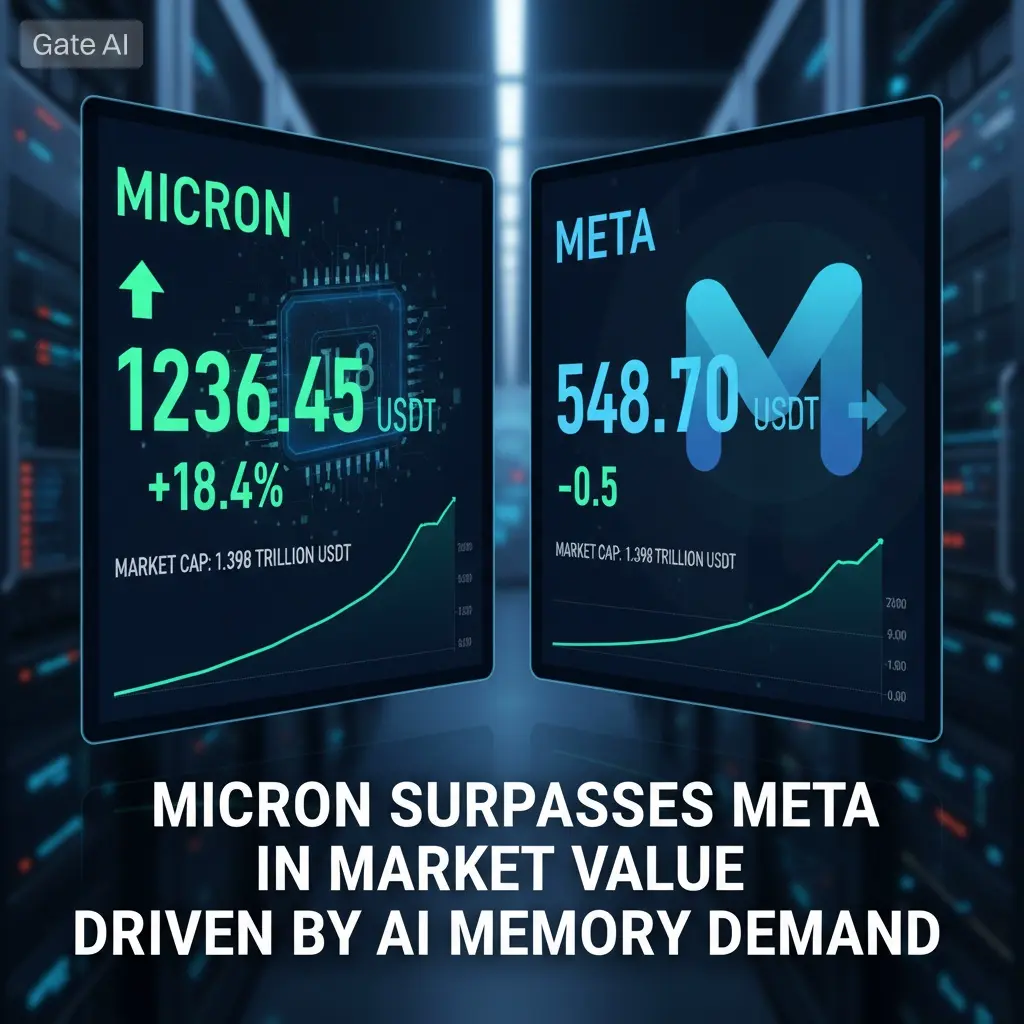
On June 25, 2026, Micron Technology achieved a historic milestone by overtaking Meta Platforms in market capitalization for the first time ever. Micron's stock surged approximately 18.4% to reach $1,236 per share, pushing its market value to roughly $1.398 trillion. Meta Platforms, meanwhile, held a market capitalization of approximately $1.392 trillion. The difference between the two stood at around $6 billion, a narrow but symbolically powerful gap that signaled a fundamental shift in how investors value technology companies in the AI era. Micron even briefly surpassed Tesla's market value of $1.4 trillion during the same trading session, further underscoring the magnitude of this achievement.
Market value, also known as market capitalization, refers to the total monetary worth of a publicly traded company, calculated by multiplying the current share price by the total number of outstanding shares. When Micron's share price rose dramatically, the multiplication effect caused its overall valuation to leap past Meta's, even though Meta has far more diversified revenue streams and billions of users across its platforms. This crossover demonstrates that investor sentiment and strategic positioning in emerging technology sectors can rapidly reshape market hierarchies.
The primary driver behind Micron's extraordinary ascent has been the explosive demand for HBM chips used in AI data centers. Every advanced AI accelerator, including those produced by Nvidia, requires HBM stacks positioned alongside the processing units to handle the massive data throughput that AI models demand. Micron's HBM3E and upcoming HBM4 products have become critical components in this supply chain, making the company an indispensable partner for the world's largest technology corporations building AI infrastructure.
Micron's fiscal third-quarter earnings report, released on June 24, 2026, provided the immediate catalyst for the stock surge. Revenue reached $41.46 billion, representing a more than fourfold increase from $9.3 billion in the same quarter one year earlier. This 346% revenue growth rate is among the highest ever recorded by a major American technology company, reflecting how dramatically the AI boom has expanded Micron's business. The company forecast fourth-quarter revenue of approximately $50 billion, compared to just $11.3 billion in the prior year period, indicating that growth momentum continues to accelerate rather than plateau.
The most remarkable financial metric was Micron's gross margin expansion. Gross margins climbed to 84.9%, more than doubling from 39% in the same quarter a year ago. This figure surpassed Nvidia's gross margin of 75% and Meta's gross margin of 81.9%, making Micron the new margin king among all major U.S. technology companies. CFO Mark Murphy confirmed on the earnings call that fiscal Q3 gross margin was a new company record and the highest percentage among top-tier American tech firms. This margin improvement reflects the pricing power that Micron now commands in the HBM market, where supply constraints and long-term contracts have shifted the dynamics favorably toward manufacturers.
Micron has also secured its revenue trajectory through 16 long-term agreements with customers spanning data centers, automotive, and other sectors. These contracts range from three to five years and have locked in approximately $22 billion in committed financial arrangements. CEO Sanjay Mehrotra stated that Micron is investing at record levels in technology, products, and supply to address customers' rapidly growing demand. This unprecedented revenue visibility substantially reduces the cyclical risk that has historically plagued memory chip investing and provides investors with confidence that the current growth trajectory is sustainable beyond a single quarter.
While Micron has been surging, Meta Platforms has faced significant headwinds that have compressed its valuation. Meta's stock traded in the $542 to $555 range during late June 2026, with the stock generating sell signals from both short-term and long-term moving averages. Meta has fallen in 7 of the last 10 trading sessions, declining approximately 3.96% over that period. Daily trading volume has been moderate, ranging between 5 million and 17 million shares, compared to Micron's 70 million to 85 million shares daily. The core challenge facing Meta is investor skepticism about its massive capital expenditure commitments. Meta has allocated between $125 billion and $145 billion for capital spending in 2026, a figure that raises serious questions about when these investments will generate measurable returns. Reality Labs, Meta's metaverse and hardware division, continues to burn approximately $4 billion per quarter on revenue of just $402 million, creating a persistent drag on overall profitability. As analyst Dan Ives noted, Meta and Microsoft are being treated by investors like they are wearing winter jackets to the beach in the summer, a vivid metaphor for growing impatience with AI buildout costs that have not yet translated into visible growth.
This market cap crossover underscores that AI infrastructure and semiconductor companies are commanding the greatest attention and investment flows in the current market. Memory chip manufacturers have transitioned from commodity businesses subject to boom-bust cycles into indispensable infrastructure providers for the AI revolution. Samsung Electronics joined the $1 trillion market cap club earlier in 2026, and SK Hynix has filed for a massive $29.4 billion Nasdaq ADR listing, the second-largest U.S. listing on record after SpaceX. These developments confirm that the entire memory chip sector is being re-rated by investors who recognize the strategic importance of these companies in enabling the AI economy.
For Micron, current price stands around $1,213 per share with a 52-week range of $103 to $1,255. The stock has delivered 268% year-to-date returns and approximately 763% over the trailing twelve months. Beta is 2.98, indicating extreme volatility relative to the broader market. Short-term support levels are located in the $1,038 to $1,050 zone where the stock recently bounced during pullbacks. Long-term support sits at approximately $880 based on moving averages. Resistance is established at $1,255, the 52-week high, and a decisive breakout above this level could open the path toward $1,300 and potentially higher. However, some analytical models flag caution, with targets around $731 suggesting approximately 30% downside potential if AI momentum falters and margins normalize from peak levels. The consensus analyst rating is Buy with 30 analysts covering the stock.
For Meta, current price trades around $542 to $555 with a 52-week range of $520 to $796. The stock holds sell signals from both short-term and long-term moving averages, creating a bearish technical picture in the near term. Support levels begin around $520 to $540, representing the 52-week low and current floor. Stronger structural support exists between $488 and $500, which would likely attract buyers if tested. Resistance levels are positioned at $600, then $650 to $700, and ultimately at $796, the annual high. Despite the weak technical picture, analyst consensus remains overwhelmingly bullish with 57 buy ratings and zero sells. Several models project a 12-month target of $801, implying nearly 48% upside from current levels, driven by accelerating advertising revenue, expanding AI product offerings, and a forward P/E ratio in the mid-teens that represents a meaningful discount to historical valuations.
Trading strategy for Micron requires careful risk management given the elevated volatility. A prudent approach involves scaling into positions during pullbacks toward the $1,050 to $1,100 support zone rather than chasing the stock at elevated levels. Position sizing should reflect the 2.98 beta and the possibility of 8% to 13% daily price swings. Stop-loss placement below $1,000 provides reasonable protection while allowing room for normal volatility. Investors should monitor quarterly margin guidance closely, as the 84.9% gross margin represents peak conditions that may normalize if supply constraints ease or competition intensifies from Samsung and SK Hynix.
Trading strategy for Meta presents a contrarian opportunity at current levels. Gradual accumulation in the $520 to $540 zone with stop-loss protection below $500 captures the potential upside to analyst targets of $700 to $800 while limiting downside exposure. The forward P/E ratio in the mid-teens provides valuation support even if near-term earnings face pressure from elevated capital expenditures. Dollar-cost averaging is appropriate given the ongoing volatility, and investors should watch for catalysts including the September Connect conference, consumer AI product launches, and enterprise AI revenue disclosures that could shift sentiment positively.
The broader implications of this market cap crossover extend well beyond Micron and Meta individually. It signals that investors are fundamentally reassessing which companies hold the most strategic value in the AI era. Companies that supply the physical infrastructure enabling AI development are commanding premium valuations, while companies spending heavily on AI deployment face questions about return timelines. The four largest technology companies, Amazon, Microsoft, Meta, and Google, collectively plan to spend approximately $650 billion on AI infrastructure in 2026, representing a roughly 60% increase over their combined 2025 spending. This unprecedented concentration of capital expenditure directly benefits Micron and other memory manufacturers, creating a feedback loop where Big Tech spending drives memory demand, which drives Micron revenue, which drives Micron stock price, which ultimately pushes Micron's market cap above the very companies that are fueling its growth.
The coming quarters will be decisive in determining whether Micron can sustain its market position above Meta or whether Meta's underlying business strengths enable it to reclaim market value leadership. Earnings execution, guidance updates, competitive dynamics in the HBM market, and broader investor sentiment toward AI investments will all drive relative performance. Both companies remain essential holdings for technology-focused portfolios, though their distinct risk profiles demand different position sizing and risk management approaches. Micron offers exposure to the AI infrastructure buildout with higher volatility and momentum characteristics, while Meta provides diversified technology exposure at a potentially attractive value entry point.
@Gate_Square #MicronOvertakesMetaInMarketValue
repost-content-media
  • Reward
  • 3
  • Repost
  • Share
Yusfirah:
2026 GOGOGO 👊
View More
Growth point lottery Round 2️⃣0️⃣ is ongoing, come to Gate Square and be a lucky charm!
New and existing users can complete simple interaction tasks for a 100% winning rate!
Gate World Cup gift box and trading package worth $10,000U are waiting for you to draw! 💰
Seize the luck 👉 https://www.gate.com/zh/activities/pointprize?now_period=20
🎁 How to "snatch" the luck?
- Do tasks: Post and comment in the Square to easily earn points.
- Draw: Click the post button [+] to enter the [Activity Center] and draw.
👉https://www.gate.com/post
Details 👉 https://www.gate.com/announcements/article/10036
BTC-0.79%
ETH-0.66%
SPCX0.83%
HighAmbition
Growth point lottery Round 2️⃣0️⃣ is ongoing, come to Gate Square and be a lucky charm!
New and existing users can complete simple interaction tasks for a 100% winning rate!
Gate World Cup gift box and trading package worth $10,000U are waiting for you to draw! 💰
Seize the luck 👉 https://www.gate.com/zh/activities/pointprize?now_period=20
🎁 How to "snatch" the luck?
- Do tasks: Post and comment in the Square to easily earn points.
- Draw: Click the post button [+] to enter the [Activity Center] and draw.
👉https://www.gate.com/post
Details 👉 https://www.gate.com/announcements/article/100364
#BTC #ETH #SPCX
repost-content-media
  • Reward
  • 3
  • Repost
  • Share
Yusfirah:
LFG 🔥
View More
#BTCProbes60KKeySupportLevel
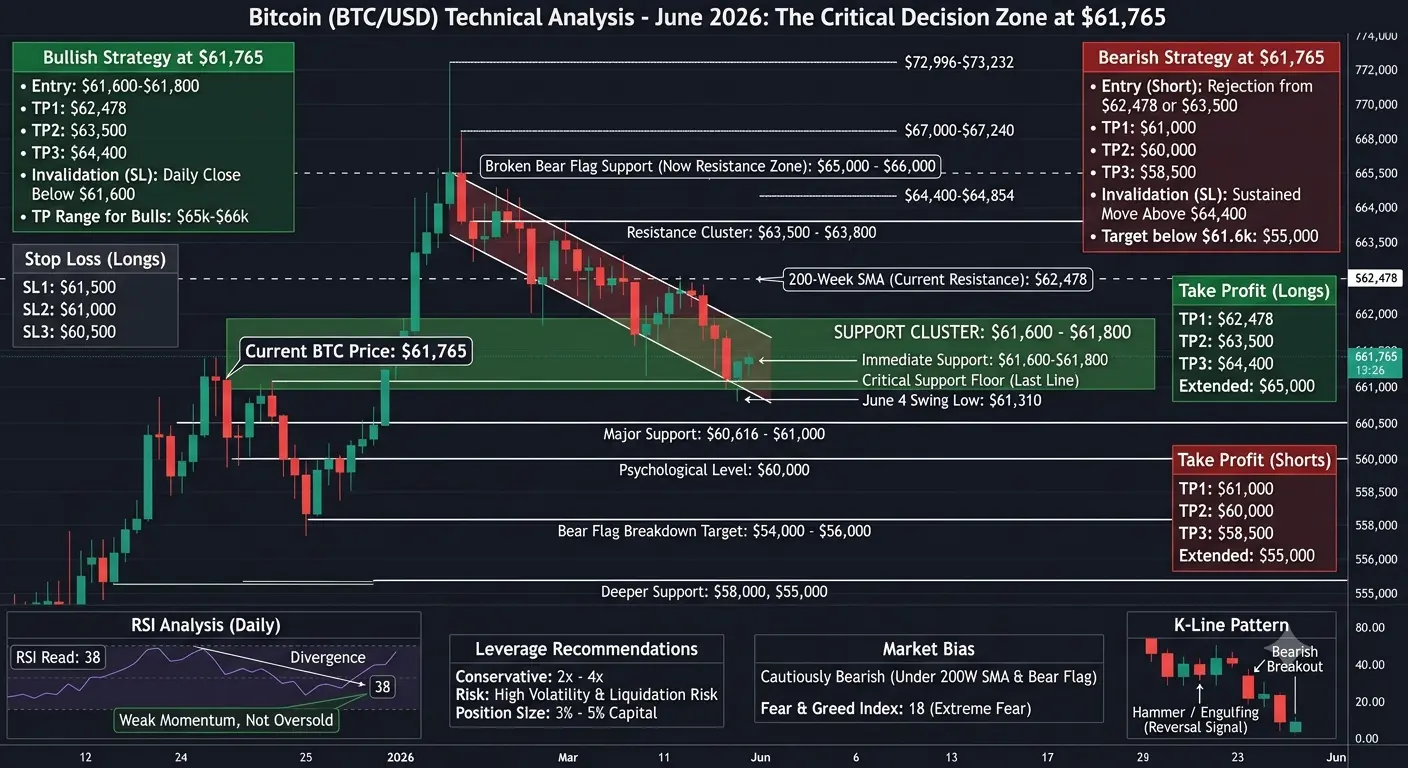
Bitcoin is currently trading at approximately $60,250, a critical juncture that places the world's leading cryptocurrency right at its key psychological support level of $60,000. This price point represents more than just a number; it embodies a battleground where macroeconomic forces, geopolitical developments, and technical market structures converge. Understanding why Bitcoin has declined to these levels requires examining multiple interconnected factors that have created sustained downward pressure on the cryptocurrency market.
The PCE Inflation Data Impact: A
HighAmbition
#BTCProbes60KKeySupportLevel
Bitcoin is currently trading at approximately $60,250, a critical juncture that places the world's leading cryptocurrency right at its key psychological support level of $60,000. This price point represents more than just a number; it embodies a battleground where macroeconomic forces, geopolitical developments, and technical market structures converge. Understanding why Bitcoin has declined to these levels requires examining multiple interconnected factors that have created sustained downward pressure on the cryptocurrency market.
The PCE Inflation Data Impact: A Major Catalyst for Decline
The most significant recent driver of Bitcoin's price weakness has been the Personal Consumption Expenditures (PCE) inflation data released for May 2026. The headline PCE inflation surged to 4.1% year-over-year, marking the first time inflation has broken above the 4.0% threshold in three years since April 2023. This reading was exactly in line with economist expectations but represented a notable acceleration from April's 3.8% figure. On a month-over-month basis, the PCE price index climbed 0.4% in May, matching April's increase and indicating persistent inflationary momentum.
The core PCE inflation, which excludes volatile food and energy components and represents the Federal Reserve's preferred inflation gauge, rose to 3.4% year-over-year in May, up from 3.3% in April. This persistent elevation in core inflation has fundamentally altered market expectations regarding Federal Reserve policy and has created significant headwinds for risk assets including Bitcoin.
When inflation runs hot at 4.1%, it signals that the Federal Reserve's battle against rising prices remains far from complete. Higher inflation erodes purchasing power and typically prompts central banks to maintain restrictive monetary policy, which reduces liquidity in financial markets. For Bitcoin, which thrives in environments of abundant liquidity and loose monetary conditions, this inflationary persistence has been distinctly bearish. The cryptocurrency has historically demonstrated strong sensitivity to real yields and liquidity conditions, making the elevated inflation print particularly damaging to price sentiment.
Federal Reserve Policy Stance: Rate Cut Expectations Diminish
The Federal Reserve's response to this inflationary environment has been equally impactful for Bitcoin's price trajectory. At its June 2026 meeting, the Federal Open Market Committee (FOMC) held interest rates steady in the range of 3.50% to 3.75%, but more importantly, signaled that rate cuts have become increasingly unlikely in the near term. Newly appointed Federal Reserve Chairman Kevin Warsh presided over his first meeting, and the central bank's updated quarterly projections indicated that policymakers now expect to potentially raise borrowing costs this year rather than cutting them.
This shift in policy expectations has been devastating for Bitcoin's price outlook. Markets had previously priced in the possibility of rate cuts that would inject liquidity into the financial system and provide a tailwind for risk assets. Instead, the Fed's hawkish pivot has created an environment where monetary policy remains restrictive. Financial markets are now pricing in approximately only a 30% chance of a rate hike at the July 28-29 meeting, but the September meeting remains very much in play for potential tightening.
The implications for Bitcoin are substantial. Higher interest rates increase the opportunity cost of holding non-yielding assets like Bitcoin, as investors can earn attractive returns in risk-free government securities. Additionally, tighter monetary conditions reduce the speculative capital that typically flows into cryptocurrency markets. The Fed's indication that inflation remains well above its 2% target and that price pressures are not dissipating has created a risk-off environment that has pressured Bitcoin lower.
Geopolitical Developments: US-Iran Talks and Market Uncertainty
Geopolitical factors have added another layer of complexity to Bitcoin's price action. Recent developments in US-Iran relations have created significant market volatility. Reports indicate that high-level diplomatic meetings have been ongoing, with negotiators traveling to Switzerland for discussions regarding Iran's nuclear program and regional de-escalation strategies. While initial reports suggested a potential peace deal that would reopen the Strait of Hormuz, subsequent developments have created uncertainty about the durability of any agreement.
The Strait of Hormuz represents one of the world's most critical oil transit chokepoints, and any disruption to its operations can cause significant volatility in global energy markets. When geopolitical tensions rise, Bitcoin often experiences selling pressure as investors seek safety in traditional safe-haven assets like the US dollar and gold. The ongoing uncertainty regarding US-Iran relations has contributed to risk-off sentiment that has weighed on cryptocurrency prices.
However, it is worth noting that Bitcoin did experience brief rallies on news of potential diplomatic breakthroughs, with prices approaching $66,000 following reports of a preliminary agreement. These moves proved unsustainable as skepticism about the deal's durability emerged, and Bitcoin subsequently retreated to current levels around $60,250. This price action demonstrates that while geopolitical relief can provide temporary bounces, the underlying macroeconomic headwinds remain dominant in determining Bitcoin's price trajectory.
Technical Analysis: The $60,000 Support Level Under Pressure
From a technical perspective, Bitcoin's current price of $60,250 places it at a critically important support level that has been tested multiple times in recent weeks. The $60,000 level represents both psychological significance and technical importance as a key support zone that has historically attracted buying interest. However, the repeated testing of this level raises concerns about its durability.
Multiple technical indicators suggest that Bitcoin is in a precarious position. The cryptocurrency has declined significantly from its recent highs near $124,000, representing a drawdown of approximately 51% from peak to current levels. This magnitude of decline indicates a bear market structure rather than a simple correction. The fact that Bitcoin has repeatedly tested the $60,000 level without mounting a sustained recovery suggests that selling pressure remains dominant.
Key support levels below the current price include the $59,000 zone, which some analysts identify as the true support level rather than $60,000. A breakdown below $59,000 could potentially open the door to much lower levels, with some analysts pointing to $57,000 as the next significant support zone. The May low near $59,130 represents a critical level that, if broken, could accelerate selling pressure and trigger stop-loss orders from leveraged positions.
On the resistance side, Bitcoin faces significant hurdles before any meaningful recovery can take hold. The $62,000 level has already been tested and rejected, and above that, the $65,000 to $67,000 zone represents a major resistance area where significant selling interest is likely to emerge. The 200-day moving average, currently situated near $77,000, represents a long-term trend indicator that Bitcoin would need to reclaim to signal a potential trend reversal.
On-Chain Data and Market Structure
Despite the price weakness, some on-chain metrics suggest that long-term holders continue to accumulate Bitcoin at current levels. This behavior is historically consistent with market bottoms, as sophisticated investors tend to increase positions during periods of fear and capitulation. However, the divergence between price action and on-chain accumulation patterns can persist for extended periods, and this data alone does not guarantee an imminent price recovery.
Open interest in Bitcoin derivatives has remained elevated, suggesting that leveraged positions remain active in the market. This elevated leverage creates the potential for significant volatility in either direction, as forced liquidations can accelerate price moves. Funding rates have remained relatively muted, indicating that aggressive directional bets are not currently dominating the market.
Macroeconomic Context: The Broader Picture
Bitcoin's decline must be understood within the broader context of global macroeconomic conditions. The combination of sticky inflation, restrictive monetary policy, and geopolitical uncertainty has created a challenging environment for risk assets across the board. Traditional equity markets have also experienced volatility, though Bitcoin's decline has been more pronounced due to its higher beta to risk sentiment.
The US dollar has strengthened in this environment, creating additional headwinds for Bitcoin. As the dollar appreciates, dollar-denominated assets like Bitcoin become more expensive for international buyers, reducing demand. Additionally, a stronger dollar typically signals tighter global financial conditions, which reduces the availability of speculative capital.
Outlook and Key Levels to Watch
Looking ahead, several critical factors will determine Bitcoin's price trajectory. The next major catalyst will be upcoming inflation data releases, including the next CPI and PCE reports. If inflation shows signs of cooling, market expectations for Fed policy could shift, potentially providing relief for Bitcoin. Conversely, continued inflationary pressure would likely maintain the current bearish environment.
The July 28-29 Federal Reserve meeting represents another key event risk. While markets currently expect rates to remain unchanged, any shift in the Fed's guidance or rhetoric could significantly impact Bitcoin prices. Chairman Warsh's communication style and policy preferences remain relatively unknown, creating uncertainty about how the central bank might respond to evolving economic conditions.
From a technical perspective, traders should monitor the $59,000 to $60,000 support zone closely. A sustained breakdown below this area could trigger accelerated selling toward $57,000 and potentially lower levels. On the upside, reclaiming $62,000 would be the first step toward a potential recovery, with $65,000 and $67,000 representing major resistance levels that would need to be overcome for a more significant rally to develop.
Conclusion
Bitcoin's current price of $60,250 reflects a confluence of bearish factors including elevated PCE inflation at 4.1%, diminished expectations for Federal Reserve rate cuts, ongoing geopolitical uncertainty surrounding US-Iran relations, and challenging technical market structure. The $60,000 level represents a critical support zone that has been repeatedly tested, and its durability remains uncertain.
Investors should remain cautious in this environment, as the combination of macroeconomic headwinds and technical weakness suggests that further downside risk remains present. However, the presence of long-term holder accumulation and the potential for policy shifts if inflation cools provide reasons to monitor the market closely for signs of a potential bottoming process. The coming weeks will be critical in determining whether Bitcoin can hold its key support levels or whether a more significant decline is in store.
@Gate_Square #BTCProbes60KKeySupportLevel
repost-content-media
  • Reward
  • 3
  • Repost
  • Share
Yusfirah:
LFG 🔥
View More
#USNetCapitalInflowsHitRecord884B
The financial world is witnessing a seismic shift that every investor needs to understand. United States net capital inflows have surged to an unprecedented $884 billion in the 12 months ending April 2026, nearly tripling since the start of 2025 and more than doubling the previous 2021 peak of approximately $400 billion. This is not just a number on a spreadsheet. This figure represents a fundamental restructuring of where global money is flowing, and the consequences are already being felt across every asset class from Bitcoin to gold to the US dollar itself
HighAmbition
#USNetCapitalInflowsHitRecord884B
The financial world is witnessing a seismic shift that every investor needs to understand. United States net capital inflows have surged to an unprecedented $884 billion in the 12 months ending April 2026, nearly tripling since the start of 2025 and more than doubling the previous 2021 peak of approximately $400 billion. This is not just a number on a spreadsheet. This figure represents a fundamental restructuring of where global money is flowing, and the consequences are already being felt across every asset class from Bitcoin to gold to the US dollar itself. The world's investors, both private and institutional, are voting with their wallets, and they are voting overwhelmingly for American financial assets.
Let us break down what this $884 billion actually means. Net capital inflows measure the difference between foreign money entering the United States and American money leaving for overseas investments. When global investors purchase US stocks, bonds, real estate, and other financial instruments in amounts far exceeding what US investors send abroad, the surplus is recorded as positive net capital inflows. The current figure tells us that $884 billion more entered the American financial system than left it during the measured period. Within this total, private purchases of US equities exploded to $763 billion in April 2026 alone, an all-time high that demonstrates massive institutional and individual demand for American stocks. Meanwhile, official institutions such as central banks and sovereign wealth funds poured in $121 billion, more than doubling their allocation since the start of 2025. These official institutional flows are particularly significant because they represent government-level confidence in the US financial system, not merely speculative private capital chasing returns.
The implications for the US dollar are profound. When $884 billion of foreign capital needs to be converted into dollars to purchase American assets, the demand for the greenback intensifies dramatically. The Dollar Index, which measures the US currency against major foreign currencies, has responded accordingly, climbing above 100 and now threatening a major breakout from a 13-month trading range. A stronger dollar creates a cascading effect across global markets. Every asset priced in dollars becomes more expensive for international buyers, reducing demand. Every alternative asset that competes with dollar-denominated investments faces a headwind. The Federal Reserve's hawkish stance, with markets now pricing in a more than 70% probability of an interest rate hike later this year, further strengthens the dollar by making US interest-bearing investments even more attractive relative to non-yielding alternatives.
Now let us examine what this means for Bitcoin and the cryptocurrency market, because the impact has been severe. Bitcoin is currently trading around $59,175 to $60,214, having crashed from its October 2025 peak of $126,000. The decline has been brutal, with Bitcoin dropping approximately 23% over the past month alone and more than 5% in a single 24-hour period on June 24. The Fear and Greed Index sits at just 13 out of 100, indicating extreme fear conditions that approach capitulation-like sentiment. This is not random volatility. The record US capital inflows are directly connected to the crypto market's distress through multiple transmission channels.
The first channel is ETF outflows. US spot Bitcoin ETFs have recorded net outflows of approximately $6.39 billion over the past 30 days, with 26 out of 30 days showing negative flows. This represents the strongest bearish institutional signal in the ETF era. When capital is rushing toward traditional US equities yielding strong returns, institutional managers are de-risking their crypto allocations. Hedge funds are reducing gross exposure. Macro managers are shifting into cash. Investment advisors are trimming risk positions. The ETF mechanism now transmits that caution directly into the Bitcoin market with unprecedented speed and volume. The cumulative ETF outflow streak of $2.97 billion over 10 consecutive sessions earlier in June was the longest withdrawal run on record, and it included a rapid exit of a $1.2 billion position that sent shockwaves through the market.
The second channel is the dollar strength connection. Bitcoin and the Dollar Index are moving in precisely opposite directions. As DXY rises toward breakout levels, Bitcoin has been rejected from bear-flag support levels and is now testing the critical $59,000 to $60,000 zone. The 200-week simple moving average sits at approximately $62,258, which has served as a key macro pivot. Bitcoin's failure to hold above this level signals deeper structural weakness. Technical analysis shows the bear flag pattern remains active, with projected downside targets potentially extending toward $47,000 if current support fails. The probability of Bitcoin falling below $50,000 in 2026 has jumped to 64% according to Polymarket data, while odds of a move below $45K stand at 46%.
The third channel is the opportunity cost argument. When $763 billion of private capital is chasing US equities that offer both income and appreciation potential in the world's most stable financial system, the relative appeal of a volatile, non-yielding digital asset diminishes considerably. The AI-driven rally in US technology stocks has created compelling alternative returns that draw capital away from speculative crypto positions. Higher US interest rates make bonds and savings instruments more competitive, further eroding Bitcoin's attractiveness as a risk-on alternative.
Adding to the crypto market pressure, Strategy Inc. (formerly MicroStrategy) disclosed in a June 1 filing that it sold 32 Bitcoin between May 26 and 31 at an average price of $77,135, raising approximately $2.5 million. This was its first Bitcoin sale since December 2022, breaking the "never sell" narrative that had been a cornerstone of Bitcoin's bullish thesis. The symbolic significance cannot be overstated. When the most prominent corporate Bitcoin advocate begins liquidating holdings, questions arise about whether further sales will follow to meet preferred dividend obligations, potentially creating sustained selling pressure. Open interest across the crypto market has fallen 17.34% to $46.41 billion, indicating that leverage has been flushed out. While this reduces cascade risk, it also signals that speculative capital is departing. Retail long positions stubbornly remain at 70.5% despite the price weakness, which contrarian analysis interprets as a warning for further downside potential. Over $1 billion in cryptocurrency positions were liquidated in a single 24-hour period as Bitcoin fell to $59,000, demonstrating the severity of the current market stress.
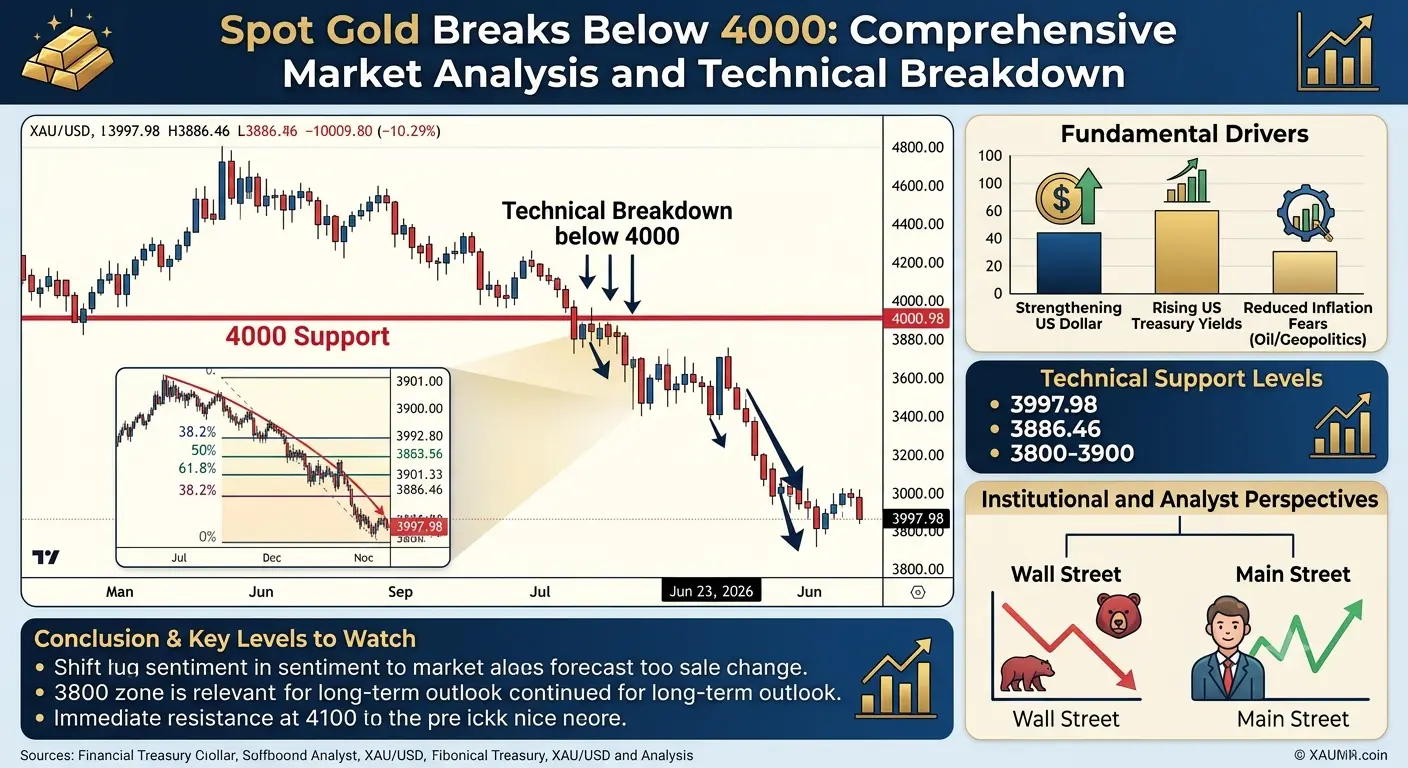
Now let us turn to gold, because the precious metal faces its own set of pressures from the record capital inflows. Gold is currently trading at approximately $4,033 to $4,087 per troy ounce, representing a dramatic retreat from its January 2026 all-time high above $5,500. Over the past month, gold has declined approximately 8.28%, though it remains up roughly 25% on a longer timeframe. Gold recently tested the key $4,000 support level, with analysts estimating a 60% to 70% probability that this zone represents a bottom. However, the strong dollar environment and hawkish Federal Reserve posture create substantial headwinds.
The relationship between US capital inflows and gold price pressure operates through three primary mechanisms. First, dollar strength makes gold more expensive for international buyers since the metal is priced in dollars, naturally reducing global demand. Second, rising US interest rates increase the opportunity cost of holding non-yielding gold compared to interest-bearing dollar assets. Third, the massive flow of capital into US equities creates competing returns that draw investment away from safe-haven metals. When $884 billion is flooding into American financial markets, gold's appeal as a defensive asset temporarily diminishes because the very act of massive capital entering the US system signals confidence in that system, reducing the fear-based demand that typically drives gold purchases.
However, gold's longer-term narrative remains constructive. Central banks around the world have continued their gold accumulation programs, recognizing the metal's role as a reserve asset independent of any single nation's financial system. The geopolitical environment, including tensions involving Iran and broader global uncertainties, provides ongoing safe-haven demand that could reassert itself rapidly if conditions deteriorate. Gold's retreat from $5,500 to approximately $4,000 represents a correction of roughly 27%, which in historical context is a significant but not unprecedented drawdown for a metal that has delivered decades of long-term appreciation. Year-over-year, gold remains up approximately 25%, and its 2026 year-to-date performance still shows gains of roughly 17.4% despite the recent pullback.
The broader macro picture reveals an economy attracting unprecedented global investment, a strengthening dollar that punishes alternative assets, and a Federal Reserve signaling potential rate increases that further tip the scales toward traditional US financial instruments. For crypto investors, this environment demands heightened caution. The $59,000 to $60,000 zone represents critical support, and failure here opens the path to significantly lower levels. For gold investors, the current zone around $4,000 tests whether the correction is a healthy pullback within a longer uptrend or the beginning of a deeper decline driven by dollar dominance.
For those looking to navigate these turbulent conditions, Gate stands as the premier exchange platform offering comprehensive tools for both crypto and commodity market participants. Whether managing Bitcoin positions through the current volatility or exploring gold-related trading opportunities, Gate provides the infrastructure, liquidity, and market access needed to respond effectively to these macro shifts. As the record $884 billion capital inflow story continues to unfold, having access to real-time data, professional-grade trading tools, and a trusted platform becomes more essential than ever. Gate delivers all of these capabilities with zero internal transfer fees and instant execution, ensuring investors can position themselves quickly as market conditions evolve.
The $884 billion question remains: will this unprecedented flow of foreign capital into US markets continue to expand, or will global conditions eventually redirect money back toward alternative assets? The current data suggests the trend has significant momentum, with net capital inflows having nearly tripled in just over a year. Until the dollar weakens, ETF flows reverse, or macro conditions shift meaningfully, both crypto and gold face ongoing pressure from the most powerful capital migration the modern financial world has ever recorded.@Gate_Square #USNetCapitalInflowsHitRecord884B
repost-content-media
  • Reward
  • 1
  • Repost
  • Share
Yusfirah:
2026 GOGOGO 👊
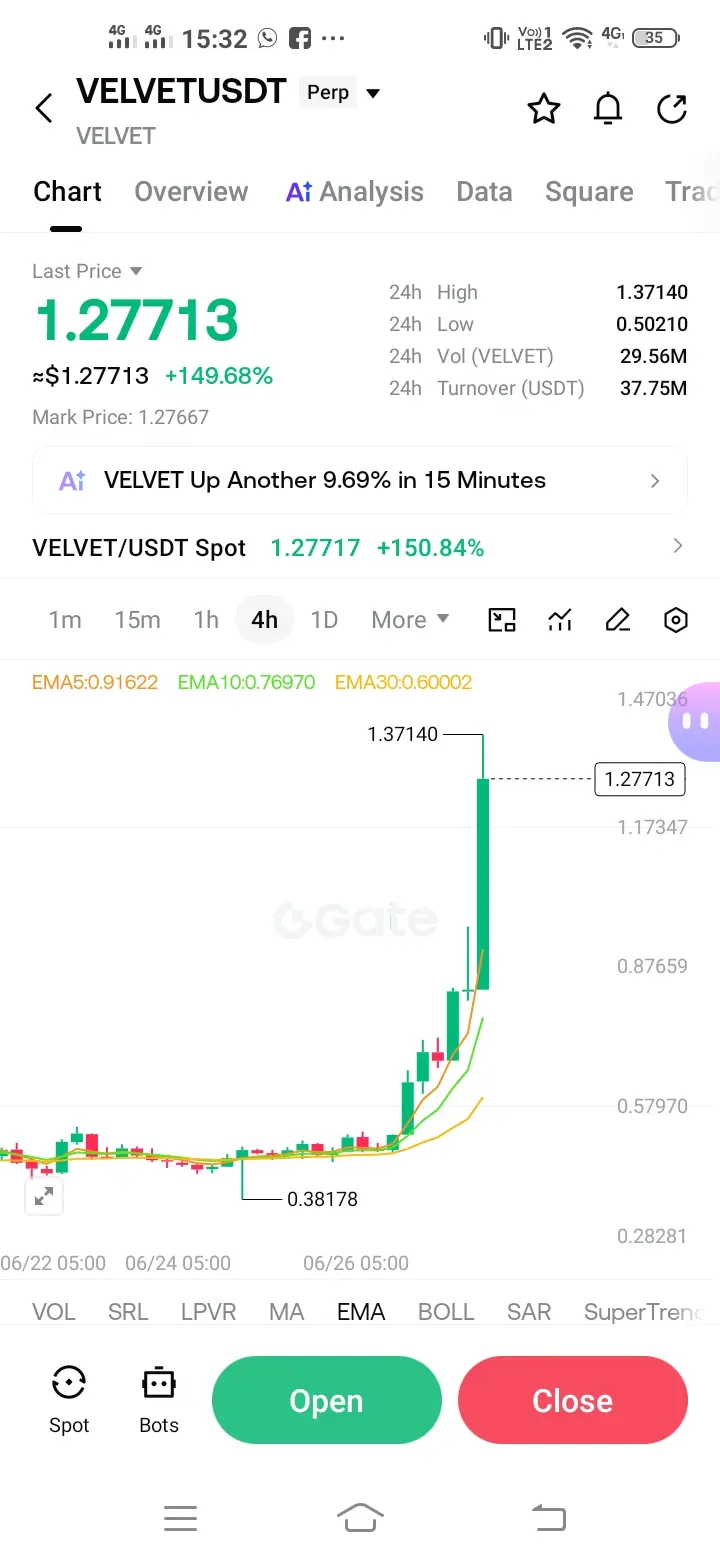
#AGLD
AGLD Technical Analysis and Trading Strategy
Adventure Gold (AGLD) is currently trading at $0.2087, showing significant volatility with a 24-hour range between $0.123 and $0.2693. The token has demonstrated strong bullish momentum with gains exceeding 80% in the past 24 hours, reaching a high of $0.2693.
Key Support and Resistance Levels
Immediate support is established at $0.1800, with stronger support zones at $0.1500 and $0.123. On the resistance side, immediate resistance sits at $0.2693 (recent high), followed by $0.3000 and $0.3250. Breaking above $0.2693 could open the path towar
AGLD-5.10%
HighAmbition
#AGLD
AGLD Technical Analysis and Trading Strategy
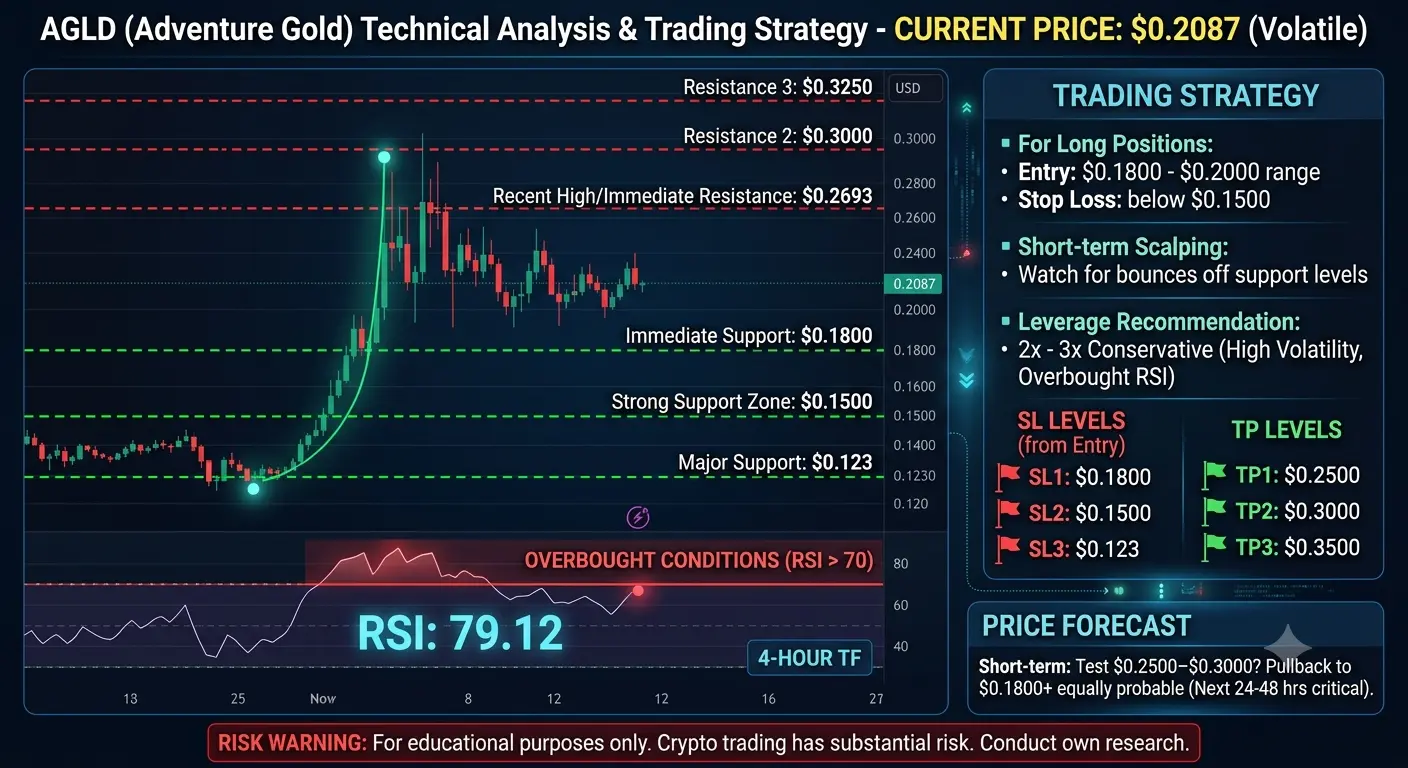
Adventure Gold (AGLD) is currently trading at $0.2087, showing significant volatility with a 24-hour range between $0.123 and $0.2693. The token has demonstrated strong bullish momentum with gains exceeding 80% in the past 24 hours, reaching a high of $0.2693.
Key Support and Resistance Levels
Immediate support is established at $0.1800, with stronger support zones at $0.1500 and $0.123. On the resistance side, immediate resistance sits at $0.2693 (recent high), followed by $0.3000 and $0.3250. Breaking above $0.2693 could open the path toward $0.3000, while a failure to hold $0.1800 support may trigger a pullback to $0.1500.
RSI Analysis
The RSI on the 4-hour timeframe is currently at 79.12, indicating overbought conditions. This suggests caution as the price has moved into territory where profit-taking and potential corrections are likely. When RSI exceeds 70, it typically signals that the asset may be due for a pullback or consolidation phase.
Trading Plan and Strategy
For long positions, consider entering near the $0.1800 to $0.2000 range with a stop loss below $0.1500. For short-term scalping, watch for bounces off support levels. The current price action shows extreme volatility, making risk management essential.
Stop Loss and Take Profit Levels
For a long position from current levels: SL1 at $0.1800, SL2 at $0.1500, and SL3 at $0.123. Take profit targets include TP1 at $0.2500, TP2 at $0.3000, and TP3 at $0.3500. These levels account for the recent high and potential continuation of bullish momentum if market sentiment remains positive.
Leverage Recommendation
Given the high volatility and overbought RSI conditions, conservative leverage of 2x to 3x is recommended. Higher leverage increases liquidation risk significantly in such volatile conditions. The 80% daily gain indicates strong momentum but also elevated risk of sharp corrections.
**Price Forecast**
AGLD could test $0.2500 to $0.3000 in the short term if bullish momentum continues and volume supports the move. However, with RSI in overbought territory, a pullback to $0.1800 or lower is equally probable before any sustainable uptrend continues. The next 24 to 48 hours will be critical in determining whether this is a breakout or a bull trap scenario.
Risk Warning
This analysis is for educational purposes only. Cryptocurrency trading carries substantial risk of loss. Always conduct your own research and never invest more than you can afford to lose. The overbought RSI suggests caution at current levels.
repost-content-media
  • Reward
  • 2
  • Repost
  • Share
Yusfirah:
LFG 🔥
View More
#Solana
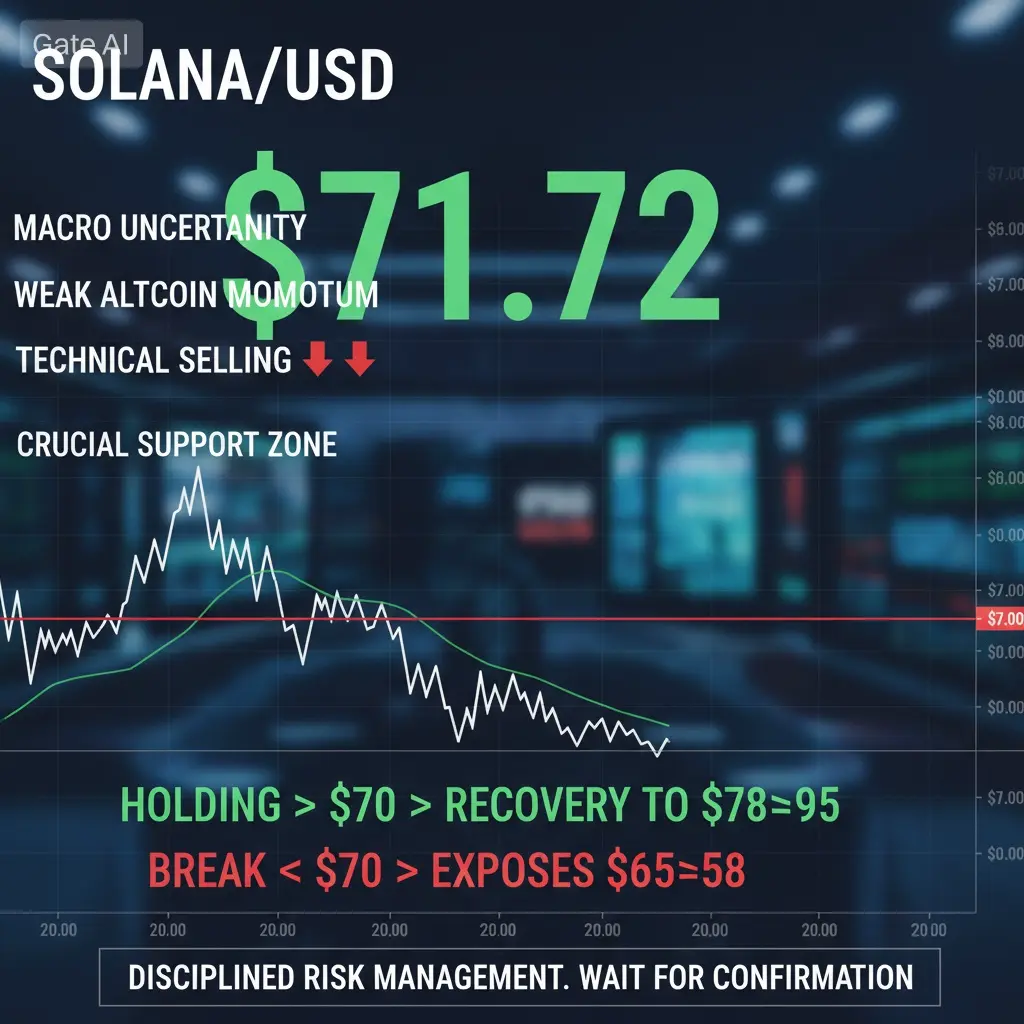
Solana is currently trading at $71.72, which represents a significant decline from its 2025 highs above $293. The price action shows SOL is under considerable bearish pressure, trading in a zone that reflects broader market weakness and specific technical breakdowns. Understanding the key factors affecting Solana's price and establishing proper trading levels is essential for navigating this challenging environment.
Current Market Factors Affecting Solana
Several fundamental and technical factors are currently pressuring Solana's price. First, the broader cryptocurrency market has exp
HighAmbition
#Solana
Solana is currently trading at $71.72, which represents a significant decline from its 2025 highs above $293. The price action shows SOL is under considerable bearish pressure, trading in a zone that reflects broader market weakness and specific technical breakdowns. Understanding the key factors affecting Solana's price and establishing proper trading levels is essential for navigating this challenging environment.
Current Market Factors Affecting Solana
Several fundamental and technical factors are currently pressuring Solana's price. First, the broader cryptocurrency market has experienced risk-off sentiment with institutional outflows and macroeconomic uncertainty weighing on altcoins. Bitcoin's price action continues to dictate overall market direction, and when BTC faces selling pressure, high-beta assets like Solana typically experience amplified moves to the downside.
Second, Solana's DeFi ecosystem metrics have shown some contraction. While Total Value Locked remains substantial, the growth rate has slowed compared to previous quarters. Network activity and daily transaction volumes, while still robust compared to many competitors, have not provided the bullish catalyst needed to reverse the current downtrend.
Third, technical selling has accelerated as key support levels broke down. The breach of the $120 and $100 psychological levels triggered stop-losses and liquidations, creating a cascade effect that pushed prices toward current levels. This technical damage means recovery will require significant buying pressure and time to repair the chart structure.
Fourth, regulatory concerns continue to cast a shadow over the entire cryptocurrency sector. While Solana has not faced specific regulatory actions, the overall environment of uncertainty keeps institutional capital on the sidelines, reducing the inflows needed to support higher prices.
Technical Analysis and Key Levels
The current price of $71.72 sits within a critical support zone that has historical significance. This area represents a major accumulation zone from previous market cycles and will likely determine whether Solana can stabilize or faces further downside.
Support Levels:
The primary support level is located at $70.00, which represents a psychological round number and aligns with previous price action from early 2024. A breakdown below this level could trigger a move toward the secondary support at $65.00, which marks a significant technical support zone from the previous accumulation period. The ultimate support level sits at $58.00, representing the last major defense before potentially testing the $50 psychological level.
Resistance Levels:
Immediate resistance is found at $78.00, which corresponds to recent rejection points and the descending trendline that has capped rallies over the past several weeks. The secondary resistance level is positioned at $85.00, marking the previous breakdown point that now acts as overhead supply. The major resistance level is located at $95.00, which would need to be reclaimed to suggest a meaningful trend reversal is underway.
Trading Strategy Recommendations
For traders looking to engage with Solana at current levels, a structured approach with defined risk parameters is essential given the volatile conditions.
Entry Strategy:
Consider scaling into positions rather than deploying full capital at once. Current price action suggests waiting for confirmation of support holding at $70 before establishing full positions. Aggressive traders might consider entries near current levels with tight stops, while conservative traders should wait for a break above $78 with volume confirmation before entering long positions.
Stop Loss Levels:
SL1 at $68.50 provides a tight stop for aggressive entries, protecting against immediate breakdown below the $70 support. SL2 at $63.00 offers a wider stop that accommodates normal market volatility while protecting against a sustained move below major support. SL3 at $55.00 represents a catastrophic stop that would only trigger in the event of a major market collapse, preserving capital for better opportunities.
Take Profit Levels:
TP1 at $82.00 targets the first significant resistance cluster and offers a favorable risk-reward ratio for short-term trades. TP2 at $92.00 aims for the major resistance zone and would represent a substantial recovery from current levels. TP3 at $105.00 is an extended target that would require a full trend reversal and reclaiming of key technical levels, suitable for longer-term position trades.
Risk Management Considerations
Position sizing should reflect the elevated volatility in the current market environment. Consider reducing position sizes by 30 to 50 percent compared to normal trading conditions. The Average True Range has expanded significantly, meaning wider stops are necessary to avoid being stopped out by normal market noise.
Leverage should be used cautiously, if at all. The current market structure favors spot positions over leveraged trades, as the risk of liquidation increases substantially during periods of high volatility and unclear directional bias.
Diversification across multiple timeframes can help manage risk. Consider splitting entries across different price levels and time periods rather than concentrating all capital at a single entry point.
Market Outlook and Timeline
The question of when Solana will stabilize depends on several converging factors. In the immediate term, the $70 support level will be critical to watch. A successful defense of this zone with building volume could mark a local bottom formation over the next 2 to 4 weeks. However, if this support fails, the market could face an extended period of consolidation in the $55 to $70 range lasting several months.
For a sustainable recovery, Solana would need to see renewed institutional interest, positive developments in the broader crypto regulatory environment, and technical repair including reclaiming the $95 level. This process typically takes 1 to 3 months under favorable conditions.
The current market structure suggests patience is warranted. Rather than forcing trades in an unclear environment, waiting for definitive technical signals such as a break above descending resistance with volume expansion or a confirmed double bottom formation with bullish divergence on momentum indicators would provide higher probability setups.
Additional Trading Tips
Monitor funding rates across perpetual futures markets. Extremely negative funding can signal capitulation and potential reversal points, while consistently positive funding during declines suggests further downside potential.
Watch for divergences between price and momentum indicators such as RSI and MACD. Bullish divergences forming at these support levels often precede significant bounces, even within broader downtrends.
Pay attention to Bitcoin's price action as the primary market leader. Solana will struggle to rally independently if Bitcoin remains under pressure. Correlation remains high, so BTC stability is a prerequisite for SOL recovery.
Consider dollar-cost averaging for long-term positions rather than timing exact bottoms. The current price zone offers attractive entry points for investors with multi-month to multi-year time horizons, provided they can withstand short-term volatility.
Keep abreast of Solana ecosystem developments. Major protocol upgrades, institutional partnerships, or significant DeFi growth could provide fundamental catalysts that shift market sentiment independent of technical factors.
Conclusion
Solana at $71.72 presents both risk and opportunity. The technical damage from the recent decline means caution is warranted, but the price has reached levels that historically preceded significant rebounds. The key is respecting the technical levels, managing risk appropriately, and waiting for confirmation before committing significant capital. The $70 support zone is the immediate battleground that will determine whether stabilization occurs or further downside unfolds. Traders should remain flexible and prepared to adjust strategies as market conditions evolve, always prioritizing capital preservation in this challenging environment.@Gate_Square #
repost-content-media
  • Reward
  • 1
  • Repost
  • Share
Yusfirah:
To The Moon 🌕
#VELVET
VELVET is currently trading at 1.27 USDT after an explosive 133% rally within the past 24 hours, with price action ranging between 0.5 and 1.23 USDT. This dramatic surge indicates strong bullish momentum but also signals potential overbought conditions that traders must consider carefully.
Technical indicators paint a concerning picture for immediate continuation. The 15-minute RSI stands at 81.8 while the 4-hour RSI has reached 89.4, both firmly in overbought territory. The KDJ indicator has钝化 to 110, suggesting momentum exhaustion. Price has broken above the daily Bollinger Upper Ba
VELVET0.12%
HighAmbition
#VELVET
VELVET is currently trading at 1.27 USDT after an explosive 133% rally within the past 24 hours, with price action ranging between 0.5 and 1.23 USDT. This dramatic surge indicates strong bullish momentum but also signals potential overbought conditions that traders must consider carefully.
Technical indicators paint a concerning picture for immediate continuation. The 15-minute RSI stands at 81.8 while the 4-hour RSI has reached 89.4, both firmly in overbought territory. The KDJ indicator has钝化 to 110, suggesting momentum exhaustion. Price has broken above the daily Bollinger Upper Band at 1.08 USDT with significantly increased volume, which typically precedes either consolidation or sharp corrections.
Key support levels to monitor include immediate support at 0.96 USDT, strong support at 0.74 USDT, and critical support at 0.53 USDT. Resistance levels are positioned at 1.40 USDT as the first major hurdle, followed by psychological resistance at 1.50 USDT and extended resistance near 2.20 USDT based on Fibonacci extensions.
For stop loss placement, consider SL1 at 1.08 USDT representing the Bollinger Band breach point, SL2 at 0.96 USDT marking immediate support, and SL3 at 0.74 USDT aligning with strong historical support. Take profit targets should include TP1 at 1.40 USDT for a conservative 10% gain, TP2 at 1.60 USDT capturing extended momentum, and TP3 at 2.20 USDT for ambitious positioning toward the 2040 forecast projection.
Leverage recommendations suggest conservative 3x to 5x leverage given the extreme volatility and overbought readings. Higher leverage significantly increases liquidation risk during the anticipated pullback phase. Risk management remains paramount as VELVET has already doubled from its lows and parabolic moves typically correct sharply.
Market sentiment currently favors bulls but with caution flags waving. The token shows buy signals on longer timeframes despite short-term overbought conditions. Price predictions suggest VELVET could reach 0.90 USDT by 2027 representing 74% growth, though current prices already exceed this target indicating potential overheating.
Traders should watch for volume confirmation on any breakout above 1.40 USDT or breakdown below 1.08 USDT. The high volume rally suggests genuine interest but also creates vulnerability to profit-taking cascades. Consider scaling into positions rather than entering fully at current levels, and maintain strict stop discipline as meme coins can reverse violently without warning.
@Gate_Square
repost-content-media
  • Reward
  • 1
  • Repost
  • Share
Yusfirah:
To The Moon 🌕
#PredictionMarketsHitRecordVolume
Prediction markets have entered a new era of global adoption, reaching an unprecedented $10.8 billion in weekly trading volume during June 2026. This milestone is more than just another record—it represents the rapid evolution of decentralized forecasting into one of the fastest-growing sectors of the digital asset industry. What was once considered a niche blockchain application has now become a global marketplace where millions of participants use information, research, and market sentiment to forecast the outcomes of real-world events.
The continued rise i
HighAmbition
#PredictionMarketsHitRecordVolume
Prediction markets have entered a new era of global adoption, reaching an unprecedented $10.8 billion in weekly trading volume during June 2026. This milestone is more than just another record—it represents the rapid evolution of decentralized forecasting into one of the fastest-growing sectors of the digital asset industry. What was once considered a niche blockchain application has now become a global marketplace where millions of participants use information, research, and market sentiment to forecast the outcomes of real-world events.
The continued rise in trading activity reflects growing confidence in prediction markets as transparent, data-driven platforms that aggregate collective expectations across finance, sports, politics, economics, entertainment, technology, and cryptocurrency.
As infrastructure improves and participation expands worldwide, prediction markets are becoming an increasingly important part of the digital economy.
The Numbers Behind the Historic Milestone
The latest $10.8 billion weekly trading volume comfortably surpassed the previous record of $8.7 billion, highlighting the extraordinary pace of growth throughout 2026. Open interest has climbed to approximately $1.48 billion, while overall market participation has expanded several times compared with the previous year.
Industry estimates suggest annual prediction market volume could approach $240 billion during 2026 if current trends continue. Longer-term projections indicate the sector has the potential to expand substantially over the coming years as adoption broadens across retail users, institutions, and blockchain ecosystems.
Monthly performance has also remained impressive. March 2026 generated approximately $25.7 billion in trading volume, representing continued month-over-month growth. The first quarter alone produced roughly $75 billion in total volume, significantly exceeding comparable periods from previous years and demonstrating consistent expansion rather than isolated spikes.
Why Prediction Markets Are Growing So Quickly
Several factors are contributing to this remarkable momentum.
The first is global accessibility. Blockchain technology enables participants from many regions to access prediction markets with greater efficiency than traditional forecasting platforms.
Second is the increasing availability of real-time information. Social media, AI-powered analytics, on-chain data, and global news coverage allow participants to react quickly as events unfold.
Third is market diversity. Modern prediction markets now cover an enormous range of subjects, including sports tournaments, elections, macroeconomic indicators, cryptocurrency prices, entertainment awards, technology announcements, and major geopolitical developments.
Finally, improvements in user experience, mobile applications, liquidity, and transaction speed have made prediction markets more accessible to both experienced traders and newcomers.
Platform Leadership and Market Development
Leading platforms continue driving innovation across the industry by expanding available markets, improving liquidity, and enhancing user experience.
Competition among major platforms has accelerated technological development while encouraging broader market participation.
Better pricing efficiency, deeper order books, and improved blockchain infrastructure have helped prediction markets become increasingly reliable for participants following global events.
The growing presence of institutional liquidity providers has also contributed to more efficient markets and greater trading depth across major events.
The 2026 FIFA World Cup: A Major Growth Catalyst
The 2026 FIFA World Cup has become one of the largest catalysts for prediction market activity ever recorded.
As the first World Cup featuring 48 national teams and 104 matches, the tournament has created an unprecedented number of forecasting opportunities across every stage of the competition.
Hosted jointly by the United States, Canada, and Mexico, the tournament has attracted enormous global attention. Championship predictions, group-stage qualification markets, individual match outcomes, Golden Boot races, and numerous player performance markets have collectively generated billions of dollars in trading activity.
The combination of worldwide football fandom and blockchain-powered prediction markets has introduced millions of new users to decentralized forecasting.
Expanding User Participation
Prediction markets continue attracting participants with diverse backgrounds.
Retail users remain a significant portion of overall activity, while professional traders, analysts, researchers, and institutions are becoming increasingly active as liquidity improves.
Cryptocurrency prediction markets continue generating substantial trading volume alongside sports, politics, economics, and entertainment.
This diversification reduces dependence on any single category and supports long-term ecosystem growth.
The broad range of available markets allows participants to focus on subjects where they possess expertise, creating a more informed and competitive marketplace.
Institutional Interest Continues to Increase
Institutional participation has accelerated throughout 2026.
Professional trading firms, liquidity providers, fintech companies, and digital asset platforms are paying closer attention to prediction markets as infrastructure continues maturing.
Increasing regulatory clarity in several jurisdictions has also encouraged additional market development, helping prediction markets evolve into a more established segment of the digital asset ecosystem.
As institutional involvement expands, liquidity, efficiency, and overall market quality are expected to improve further.
Technology Driving the Next Phase
Blockchain scalability, faster settlement, improved mobile applications, AI-assisted analytics, and decentralized finance integration are transforming how prediction markets operate.
Developers continue introducing new tools that simplify participation while reducing transaction costs and improving overall user experience.
Prediction market data is increasingly being explored for research, forecasting, and information discovery, demonstrating applications beyond trading alone.
Looking Ahead
The record-breaking trading volume seen during June 2026 may represent only the beginning of a much larger growth cycle.
Upcoming international sporting events, elections, economic announcements, cryptocurrency developments, and technological innovations are expected to provide continuous opportunities for prediction market participation.
@
As blockchain adoption expands globally and digital finance becomes increasingly mainstream, prediction markets are positioned to play a growing role in how people interpret information and express expectations about future events.
Gate and the Future of Digital Markets
Gate continues supporting innovation across the digital asset ecosystem by providing users with access to a broad range of blockchain products and emerging market opportunities.
By focusing on platform development, security, user experience, and ecosystem expansion, Gate remains committed to helping users explore the rapidly evolving world of digital finance and decentralized technologies.
Conclusion
The $10.8 billion weekly trading volume achieved in June 2026 represents a defining milestone for prediction markets. It demonstrates increasing global participation, stronger infrastructure, expanding liquidity, and growing interest in decentralized forecasting.
As technology advances, adoption continues to rise, and major global events generate sustained engagement, prediction markets are expected to remain one of the most closely watched segments of the blockchain industry throughout the years ahead.
What are your thoughts on the future of prediction markets? Will they become a mainstream part of global finance, or are we only seeing the beginning of an even larger transformation?
@Gate_Square
repost-content-media
  • Reward
  • 2
  • Repost
  • Share
Yusfirah:
2026 GOGOGO 👊
View More
#SpotGoldBreaksBelow400
The precious metals market has witnessed a significant technical event as spot gold prices have decisively broken below the psychologically critical 4000 dollar support level, triggering widespread concern among investors and traders who have been monitoring this key threshold for months. This breakdown represents more than just a numerical breach, it signals a fundamental shift in market sentiment and structural dynamics that could have far reaching implications for the gold market in the coming weeks and months.
Understanding the Price Movement and Magnitude of Decli
HighAmbition
#SpotGoldBreaksBelow400
The precious metals market has witnessed a significant technical event as spot gold prices have decisively broken below the psychologically critical 4000 dollar support level, triggering widespread concern among investors and traders who have been monitoring this key threshold for months. This breakdown represents more than just a numerical breach, it signals a fundamental shift in market sentiment and structural dynamics that could have far reaching implications for the gold market in the coming weeks and months.
Understanding the Price Movement and Magnitude of Decline
Gold prices have experienced a dramatic descent from their recent highs, with the precious metal plunging by 73.15 dollars or approximately 1.75 percent to hit a daily low of 4090.93 dollars on June 23, 2026, before continuing the downward trajectory toward the 4000 level. This decline has been part of a broader correction that has seen gold retreat significantly from its record highs above 4380 dollars reached earlier in 2026. The magnitude of this decline represents one of the most substantial corrections in recent gold market history, with prices falling from peaks near 4380 dollars to levels testing the 4000 dollar psychological barrier.
The percentage decline from the 2026 highs to current levels represents a correction of approximately 8 to 9 percent, which while significant, remains within the bounds of a healthy pullback in the context of the broader bull market that has been in place since 2022. However, the breach of the 4000 level carries substantial technical significance that extends beyond simple percentage calculations, as this level has served as a critical support zone and psychological anchor for market participants.
Technical Analysis and Support Level Dynamics
From a technical perspective, the decline has driven gold back into a vital swing area between 4006.99 dollars and 4098.74 dollars, with prices stalling just above the 38.2 percent retracement level of 4079.35 dollars calculated from the September 2022 low. This retracement level represents a key Fibonacci support zone that has historically provided meaningful support during corrections within larger uptrends.
The 4000 dollar level itself represents far more than a round number, it serves as a critical psychological threshold that has been established through multiple tests over the past several months. Market technicians have identified this zone as a make or break level that would determine whether gold's rally was losing structural integrity or merely experiencing a temporary correction. The fact that sellers have managed to keep gold trading below its 200 day moving average for approximately 13 consecutive sessions indicates sustained selling pressure and weakening bullish momentum.
Technical analysis reveals that a break below 4006.99 dollars could trigger a cascade of selling as buyers who entered at higher levels convert into sellers, potentially accelerating downward momentum toward deeper support zones. The next significant support levels below 4000 include the 3997.98 dollar level, followed by more substantial support near 3886.46 dollars, which represents a deeper correction zone that could attract value oriented buyers.
Volume and Liquidity Considerations
Trading volume during this decline has been elevated, indicating that the breakdown below 4000 has occurred with meaningful participation rather than thin market conditions. The gold market maintains deep liquidity across multiple trading venues, with the London Bullion Market Association reporting substantial daily trading volumes that provide efficient price discovery and execution capabilities for market participants.
The transition between major trading sessions, including Tokyo, London, and New York, continues to dictate the rhythm of gold price volatility and market liquidity. High volume during this breakdown ensures tighter spreads and efficient execution for those looking to exit positions or establish new shorts. However, liquidity conditions can shift dramatically during off peak hours, potentially trapping traders in low volatility consolidation with wider spreads.
Market participants should note that gold futures volume on major exchanges such as the COMEX has shown increased activity during this decline, with open interest data suggesting that new short positions are being established alongside long liquidations. This combination of technical selling and fresh short interest has created a self reinforcing downward pressure on prices.
Fundamental Drivers Behind the Decline
Several interconnected factors have contributed to gold's breakdown below the 4000 support level. The primary driver has been the resurgence of the United States dollar, which has strengthened significantly following the Federal Reserve's hawkish stance during their June meeting. The Fed signaled that rate hikes remain on the table for 2026, contrary to market expectations of sustained dovish policy, triggering a repricing of interest rate expectations that has weighed heavily on non yielding assets like gold.
Rising United States Treasury yields have compounded the pressure on gold, with the benchmark 10 year yield trading near the 4.4 percent area, making fixed income investments more attractive relative to precious metals. The inverse relationship between gold prices and real yields has reasserted itself, with higher yields increasing the opportunity cost of holding gold.
Additionally, easing fears regarding oil supply disruptions following progress in United States Iran peace talks have reduced the immediate inflation shock premium that had been supporting gold prices. With crude oil prices under pressure and geopolitical risk premiums diminishing, gold has lost one of its key supportive narratives.
The shift in market focus from geopolitical hedging to interest rate and dollar sensitivity has fundamentally changed how gold trades, with the precious metal now behaving more as a rate and dollar asset rather than a pure safe haven hedge against geopolitical instability.
Institutional and Analyst Perspectives
Major financial institutions have responded to this decline by adjusting their gold price forecasts. ING has lowered its gold price forecast for the second half of 2026, citing surging momentum in the United States dollar and elevated bond yields as primary headwinds. However, analysts note that despite the challenging near term environment, gold's structural fundamentals remain intact, suggesting that this correction may prove temporary before prices stabilize and potentially resume their longer term uptrend.
Market sentiment surveys indicate a divergence between Wall Street and Main Street perspectives. While Wall Street bears have regained control following the Fed's hawkish outlook, Main Street sentiment has remained surprisingly resilient, with retail investors maintaining bullish positions despite gold's slide below 4200 dollars and now the 4000 level.
Analysts at major banks have maintained long term gold targets well above current levels, with some institutions projecting prices toward 6000 dollars by year end under specific macroeconomic scenarios. However, these targets appear increasingly unlikely in the near term as markets would need to fully price out rate hike expectations for such levels to be achieved.
The Road Ahead: Support Levels and Potential Scenarios
Looking forward, the technical landscape for gold presents several critical scenarios. In the immediate term, bears' next near term downside price objective is a sustained break below 4000 dollars, with deeper downside targets at 3997.98 dollars and subsequently 3886.46 dollars. A move toward the 3886 level would represent a more substantial correction of approximately 11 to 12 percent from recent highs, potentially attracting significant value oriented buying interest.
For bullish scenarios to regain traction, gold needs to reclaim the 4100 to 4180 dollar resistance zone, with a sustained move above this area targeting 4221 dollars and subsequently 4350 dollars. However, given the current technical damage and bearish momentum, such a recovery would require a fundamental catalyst, potentially in the form of renewed geopolitical tensions, weaker economic data prompting dovish Fed repricing, or a reversal in dollar strength.
The 3800 to 3900 dollar zone represents a critical longer term support area that aligns with previous consolidation zones and would likely attract substantial institutional buying interest if tested. Market participants should monitor volume characteristics during any further declines, as capitulation selling accompanied by extreme volume often marks important intermediate term bottoms.
Risk Management and Trading Considerations
For traders and investors navigating this environment, risk management has become paramount. The breakdown below 4000 has invalidated previous bullish structures, requiring a reassessment of position sizing and stop loss levels. Those maintaining long positions should consider whether their investment thesis remains intact or if the technical damage warrants reducing exposure.
Short term traders may find opportunities in the volatility, but should remain cognizant of the potential for sharp counter trend rallies within the broader downtrend. The gold market has demonstrated a tendency for sharp, short lived spikes even within corrective phases, making strict risk management essential.
Investors with longer term horizons may view this decline as a potential accumulation opportunity, particularly if prices approach the 3800 to 3900 dollar support zone. However, dollar cost averaging strategies should be employed with caution given the potential for further downside before a sustainable bottom forms.
Conclusion
The breakdown of spot gold below the 4000 dollar support level represents a significant technical event that has shifted market sentiment from cautiously optimistic to distinctly bearish in the near term. The confluence of dollar strength, rising yields, and diminishing geopolitical risk premiums has created a challenging environment for precious metals, with technical indicators confirming the deterioration in bullish momentum.
While the decline has been substantial, with prices falling approximately 8 to 9 percent from 2026 highs, the longer term structural bull market that has been in place since 2022 remains technically intact unless prices break below the 3800 dollar zone. Market participants should remain vigilant for signs of capitulation selling or bullish divergence that could signal an approaching bottom, while maintaining strict risk management protocols in this volatile environment.
The coming weeks will be critical in determining whether this breakdown below 4000 represents a temporary overshoot within a broader correction or the beginning of a more sustained downtrend. Key levels to monitor include the immediate support near 3997 dollars, the critical 3886 dollar support zone, and resistance levels at 4100 and 4180 dollars that would need to be reclaimed to restore bullish confidence.@Gate_Square
repost-content-media
  • Reward
  • Comment
  • Repost
  • Share
#RippleStablecoinRLUSDApprovedInJapan
Ripple RLUSD Stablecoin Receives Official Approval in Japan:
The cryptocurrency landscape has witnessed a significant milestone as Ripple's RLUSD stablecoin officially secured regulatory approval in Japan. This development, announced on June 24, 2026, represents a pivotal moment for both Ripple and the broader stablecoin ecosystem. The Japan Financial Services Agency (JFSA) has granted authorization for RLUSD to operate as a new type of electronic payment instrument under Japan's Payment Services Act, marking the stablecoin's official debut in one of the
HighAmbition
#RippleStablecoinRLUSDApprovedInJapan
Ripple RLUSD Stablecoin Receives Official Approval in Japan:
The cryptocurrency landscape has witnessed a significant milestone as Ripple's RLUSD stablecoin officially secured regulatory approval in Japan. This development, announced on June 24, 2026, represents a pivotal moment for both Ripple and the broader stablecoin ecosystem. The Japan Financial Services Agency (JFSA) has granted authorization for RLUSD to operate as a new type of electronic payment instrument under Japan's Payment Services Act, marking the stablecoin's official debut in one of the world's most sophisticated and well-regulated digital asset markets.
Understanding the Regulatory Framework
Japan has long been recognized as a global leader in digital asset adoption, characterized by robust regulatory frameworks and financial innovation. The JFSA's approval of RLUSD falls under a specific category designed for foreign-issued stablecoins that meet stringent safety and regulatory standards required under Japanese law. This classification ensures that RLUSD adheres to the highest levels of compliance, transparency, and consumer protection, making it suitable for both institutional and retail users within the Japanese market.
The approval process involved comprehensive audits to verify compliance with anti-money laundering protocols and other regulatory requirements. Japan's approach to stablecoin regulation has evolved significantly, with the country taking proactive steps to integrate digital assets into its formal financial infrastructure while maintaining rigorous oversight standards.
The Strategic Partnership with SBI Group
The Japan launch is being executed through a strategic partnership with SBI Group, one of Japan's largest and most respected financial services conglomerates. SBI VC Trade Co., Ltd., a licensed Electronic Payment Instruments Exchange Service Provider and subsidiary of SBI Holdings, will facilitate RLUSD access through its VCTRADE platform. This collaboration builds upon a decade-long relationship between Ripple and SBI Group, dating back to 2016, during which both entities have worked together to advance blockchain-based financial infrastructure across Japan and the broader Asia-Pacific region.
SBI VC Trade brings substantial credibility and infrastructure to this partnership. As a Crypto Asset Exchange Service Provider, Type 1 Financial Instruments Service Provider, and Electronic Payment Instruments Exchange Service Provider, the company operates under a comprehensive security framework. SBI VC Trade was also the first in Japan to begin handling USDC, demonstrating its pioneering role in the stablecoin space.
Market Significance and Implications
Japan represents one of the world's largest and most organized cryptocurrency markets. The country's regulatory clarity and sophisticated financial infrastructure make it an ideal environment for regulated stablecoin adoption. The approval of RLUSD in Japan sends a strong signal to the global market about the increasing acceptance of compliant stablecoins within traditional financial systems.
This development is particularly significant because it unlocks access to RLUSD for both institutional and retail participants in Japan. Financial institutions can now leverage RLUSD for payments, tokenization, and collateral management, while individual consumers gain access to a transparent, regulated USD-backed stablecoin for everyday transactions and digital asset activities.
The launch aligns with Ripple's broader strategy of expanding RLUSD's global footprint. Prior to the Japan approval, Ripple had already secured partnerships in other major markets, including a recent expansion into Türkiye through collaborations with BiLira, Bitexen, and Bitlo. These strategic moves demonstrate Ripple's commitment to establishing RLUSD as a leading enterprise-grade stablecoin across diverse geographical markets.
RLUSD Technical and Fundamental Overview
RLUSD is an enterprise-grade stablecoin built with trust, liquidity, and compliance at its core. Issued by Standard Custody and Trust Company, LLC, a wholly owned subsidiary of Ripple Labs, RLUSD maintains a 1:1 backing by U.S. dollar deposits, short-term U.S. Treasuries, and other cash equivalents. Monthly attestations enhance transparency and regulatory alignment, ensuring that users can verify the stablecoin's reserves at regular intervals.
A distinctive feature of RLUSD is its multichain architecture. The stablecoin is available natively on both the XRP Ledger and Ethereum, providing users with the benefits of both ecosystems. The XRP Ledger offers fast, low-cost transactions, while Ethereum provides composability with smart contracts and decentralized finance applications. This multichain approach ensures RLUSD remains accessible wherever developers and users choose to build, enabling real-world payments, on-chain liquidity, and cross-network interoperability at scale.
Current Market Data and Performance
As of June 2026, RLUSD has demonstrated impressive market traction. The stablecoin's market capitalization has reached approximately $1.7 billion, reflecting strong demand from users, developers, and institutions seeking a transparent, interoperable stablecoin built for real-world use cases. The circulating supply stands at approximately 1.585 billion RLUSD tokens.
The current price of RLUSD maintains its peg to the U.S. dollar, trading at approximately $1.00. On various exchanges, RLUSD shows slight variations around this peg, with prices ranging from $0.9948 to $1.0012 depending on the trading venue and market conditions. The 24-hour trading volume across multiple platforms indicates healthy liquidity and active market participation.
Gate, a leading cryptocurrency exchange, has listed RLUSD with multiple trading pairs including BTC/RLUSD, ETH/RLUSD, XRP/RLUSD, and RLUSD/USDT. The platform has also introduced various incentive programs to promote RLUSD adoption, including a CandyDrop airdrop event with a prize pool of 262,500 RLUSD and zero-fee withdrawal promotions for users.
Ten Key Points About RLUSD Japan Approval
First, the JFSA approval represents the first time a foreign-issued stablecoin has been formally recognized under Japan's Payment Services Act as a legitimate electronic payment instrument, setting a precedent for future stablecoin approvals in the country.
Second, the approval process involved extensive regulatory scrutiny, including compliance verification with anti-money laundering protocols, consumer protection standards, and financial stability requirements, demonstrating RLUSD's adherence to the highest regulatory standards.
Third, the partnership with SBI Group provides RLUSD with immediate access to Japan's established financial infrastructure, including banking relationships, institutional clients, and a large retail user base through the VCTRADE platform.
Fourth, Japan's approval signals growing global acceptance of regulated stablecoins, potentially encouraging other jurisdictions to develop similar frameworks for integrating stablecoins into their financial systems.
Fifth, the launch enables Japanese businesses to utilize RLUSD for cross-border payments, reducing settlement times and costs compared to traditional correspondent banking systems.
Sixth, institutional investors in Japan now have access to a compliant USD-backed stablecoin for treasury management, collateral management, and other financial operations, expanding their digital asset capabilities.
Seventh, the approval strengthens Ripple's position in the competitive stablecoin market, where RLUSD competes with established players like USDT, USDC, and other regulated alternatives.
Eighth, the multichain nature of RLUSD means Japanese users can access the stablecoin on both the XRP Ledger and Ethereum, providing flexibility for different use cases and integration scenarios.
Ninth, the launch supports Ripple's broader mission of modernizing global financial infrastructure through blockchain technology, with Japan serving as a key market for demonstrating enterprise-grade stablecoin utility.
Tenth, the approval comes at a time when global demand for regulated stablecoins is increasing, driven by institutional adoption, decentralized finance growth, and the need for efficient cross-border payment solutions.
Future Outlook and Market Impact
The Japan approval is expected to have significant positive implications for the cryptocurrency market. As one of the world's major economies and a leader in digital asset regulation, Japan's acceptance of RLUSD validates the stablecoin model and may encourage similar approvals in other jurisdictions. The development also reinforces the trend toward regulated stablecoins gaining preference over unregulated alternatives in institutional and enterprise settings.
For Ripple, the Japan launch represents a major milestone in its stablecoin strategy. The company has invested $150 million into LMAX to push RLUSD into institutional trading infrastructure, demonstrating its commitment to building comprehensive liquidity and distribution networks for the stablecoin. This investment, combined with the Japan approval, positions RLUSD for continued growth and adoption across global markets.
The partnership with SBI Group is expected to evolve beyond simple trading access, with both entities exploring additional use cases and services built around RLUSD. These may include programmable trade settlements, supply chain finance applications, and other enterprise-grade financial services that leverage the stablecoin's compliance and interoperability features.
For investors and market participants, the Japan approval provides additional confidence in RLUSD's long-term viability and regulatory standing. As stablecoins continue to play an increasingly important role in the digital asset ecosystem, regulatory approvals in major markets like Japan serve as important validation of a stablecoin's quality and compliance.
Conclusion
The approval of Ripple's RLUSD stablecoin in Japan marks a watershed moment for the regulated stablecoin sector. By securing authorization from the Japan Financial Services Agency and partnering with the prestigious SBI Group, Ripple has demonstrated that enterprise-grade stablecoins can meet the stringent requirements of major financial jurisdictions while delivering practical value to users and institutions.
With a market capitalization of approximately $1.7 billion and growing adoption across multiple markets, RLUSD is positioned to become a significant player in the global stablecoin landscape. The Japan approval not only expands RLUSD's accessible market but also validates the broader trend toward regulated, transparent stablecoins as essential infrastructure for the future of finance.
As the cryptocurrency market continues to mature, developments like the RLUSD Japan approval will likely become increasingly common, with regulated stablecoins serving as bridges between traditional finance and the digital asset ecosystem. For investors, institutions, and everyday users, this represents a positive evolution toward a more integrated, efficient, and compliant financial system.
@Gate_Square
repost-content-media
  • Reward
  • Comment
  • Repost
  • Share
#广场预测世界杯赢40000U
World Cup Prediction Carnival - Win Up to 40,000 USDT and More at Gate
Gate has launched its most ambitious World Cup prediction product to date, creating a dedicated World Cup Hub within its Prediction Market that covers all 104 matches of the 2026 FIFA World Cup tournament. The total prize pool for this event exceeds 500,000 USDT, giving users multiple ways to participate and earn rewards throughout the tournament period.
World Cup Prediction Carnival Overview
The World Cup Prediction Carnival is accessible through Gate App version 8.22 and allows users to follow all 104 tou
HighAmbition
#广场预测世界杯赢40000U
World Cup Prediction Carnival - Win Up to 40,000 USDT and More at Gate
Gate has launched its most ambitious World Cup prediction product to date, creating a dedicated World Cup Hub within its Prediction Market that covers all 104 matches of the 2026 FIFA World Cup tournament. The total prize pool for this event exceeds 500,000 USDT, giving users multiple ways to participate and earn rewards throughout the tournament period.
World Cup Prediction Carnival Overview
The World Cup Prediction Carnival is accessible through Gate App version 8.22 and allows users to follow all 104 tournament matches with integrated fixtures, live standings, match calendars, reminders, and Polymarket-based prediction activities. Gate became the first centralized exchange to integrate Polymarket services, enabling users to participate in prediction trading directly with USDT. The platform offers tens of thousands of World Cup-related prediction markets covering group-stage matches, knockout rounds, qualification outcomes, and trending topics.
Daily Featured Match Challenge - 50,000 USDT Prize Pool
Gate is running a Daily Featured Match Challenge throughout the tournament covering 35 selected key matches. The total prize pool for this challenge is 50,000 USDT distributed across three benefit tiers. For the daily key match predictions, there is 35,000 USDT allocated with 1,000 USDT prize pool per match. Users who participate in any featured match prediction and achieve a minimum 50 USDT trading volume receive 10 USDT per user, with the first 100 users each day getting rewards on a first-come first-served basis. The maximum cumulative reward per user is 200 USDT distributed weekly.
For new users, there is a 10,000 USDT privilege pool. First-time prediction market users who complete any World Cup key match prediction with a minimum 20 USDT trading volume receive 10 USDT per eligible new user, limited to the first 1,000 eligible users. This cannot be combined with the daily prediction benefit.
The Sunshine Award allocates 5,000 USDT for users who achieve cumulative World Cup prediction trading volume of 500 USDT or more, with rewards distributed proportionally based on cumulative trading volume after the event ends.
Red Packet Rain and Creator Incentive Program
Gate Square is running a Creator Incentive Program Edition 9 specifically for the World Cup event from June 16 to June 30, 2026. Users who post World Cup predictions, match analysis, or Polymarket trading results receive red packet rewards. The reward pool includes ETH, GT, SHIB, PEPE, BONK, and high-value Position Vouchers. New users are guaranteed a reward on their first post, with single posts earning up to 10 USDT in ETH. Higher post frequency and better quality content increase winning chances.
The Creator Leaderboard Challenge runs separately for Chinese and International communities with a ranking formula based on posts multiplied by 1, active days multiplied by 1.2, and total engagement multiplied by 1.3. Top rewards include a Gate World Cup Gift Box plus 1,000 USDT Position Voucher for first place, Gate 2026 WCTC T-Shirt plus 1,000 USDT Position Voucher for second and third places, and various Position Voucher amounts for ranks 4 through 50.
Todays Matches and Predictions
Based on the latest data from June 25, 2026, here are the key matches scheduled for today:
Group B Matches:
Switzerland faces Canada at Vancouver with kickoff at 03:00 UTC. Bosnia-Herzegovina plays Qatar at Seattle also at 03:00 UTC. Switzerland enters this match having already secured their position with 7 points from 3 matches, while Canada has 4 points from 3 matches.
Group C Matches:
Scotland versus Brazil takes place at Miami Gardens with kickoff at 06:00 UTC. Morocco faces Haiti at Atlanta also at 06:00 UTC. Brazil leads Group C with 7 points from 3 matches and has already secured advancement, while Morocco follows with 7 points from 3 matches. Scotland has 3 points from 3 matches and needs a strong performance to maintain any hope of advancing as one of the best third-place teams.
Group A Matches:
Czechia plays Mexico at Mexico City with kickoff at 09:00 UTC. South Africa faces South Korea at Monterrey also at 09:00 UTC. Mexico leads Group A with 9 points from 3 matches having won all their matches, while South Africa has 4 points from 3 matches.
My Analysis and Predictions
Based on current form, standings, and Polymarket odds, here are my predictions for todays matches:
Switzerland vs Canada: Switzerland has been in excellent form with 7 points from 3 matches and a goal difference of plus 4. They have shown consistency and tactical discipline throughout the tournament. Canada has 4 points but has struggled with a negative goal difference of minus 1. I predict Switzerland will win this match, likely with a scoreline of 2-1 or 2-0. Switzerland has a 41% chance according to prediction markets, with draw at 32% and Canada at 29%.
Bosnia-Herzegovina vs Qatar: Bosnia-Herzegovina has 4 points from 3 matches with a negative goal difference of minus 1, while Qatar has only 1 point from 3 matches with a goal difference of minus 8. Bosnia-Herzegovina dominates on paper with a 71% win probability according to Polymarket data. I predict Bosnia-Herzegovina will win this match comfortably, likely 2-0 or 3-1.
Scotland vs Brazil: Brazil is the heavy favorite with 75% win probability according to prediction markets. They have 7 points from 3 matches with a goal difference of plus 3. Scotland has only 3 points with a negative goal difference of minus 3. Brazil has already secured advancement and may rotate players, but their depth is superior. I predict Brazil will win 2-0 or 3-1, though Scotland could make it competitive if Brazil rests key players.
Morocco vs Haiti: Morocco has been impressive with 7 points from 3 matches and a goal difference of plus 3. Haiti has 0 points from 3 matches with a goal difference of minus 6. Morocco has an 83% win probability according to Polymarket data. I predict Morocco will dominate this match with a scoreline of 3-0 or 4-1.
Czechia vs Mexico: Mexico leads Group A with 9 points from 3 matches and has shown strong attacking prowess. Czechia has only 1 point from 3 matches with a goal difference of minus 4. Mexico has a 51% win probability with draw at 25% and Czechia at 26%. I predict Mexico will win 2-1 or 3-1, though Czechia could make it interesting given the close odds.
South Africa vs South Korea: South Africa has 4 points from 3 matches while South Korea has 3 points from 3 matches. This is a crucial match for both teams third-place hopes. South Korea has a 60% win probability according to prediction markets. However, South Africa has shown resilience and already secured a place in the round of 32 according to recent results. I predict a draw or narrow South Korea win, possibly 1-1 or 1-0 to South Korea.
Key Players to Watch
Lionel Messi leads the Golden Boot race with 5 goals from 2 matches, followed by Vinicius Junior with 4 goals from 3 matches, Kylian Mbappe with 4 goals from 2 matches, Erling Haaland with 4 goals from 2 matches, and Deniz Undav with 3 goals from 2 matches. These players have been instrumental in their teams success and will be crucial in determining todays outcomes.
How to Participate
To join the World Cup Prediction Carnival, users need to update to Gate App version 8.22 and ensure they have a registered account with Gate. Obtain USDT through on-chain deposit or P2P trading, then enter the Prediction Market via the World Cup Banner on the Gate App home screen. Transfer funds to the Prediction Market Account, access the daily schedule, and participate in seven prediction categories including Match Winner, Scoreline, and First Goal. Users can buy positions and sell anytime to capture probability appreciation.
All rewards are issued as Prediction Market Experience Vouchers which are non-withdrawable and limited to prediction market trading only. Profits from voucher usage are withdrawable, but vouchers have expiration dates and unused vouchers become void. Rewards are distributed within 14 working days after the event ends. Users must complete registration and identity verification before participating, and trading volume is calculated as buy Yes shares plus buy No shares plus secondary market sells in USDT.
Important Notes
Complete KYC before the event ends to claim rewards. Posts must be original, and plagiarism, spam, or prohibited content results in disqualification. Physical rewards are shipped within 60 days, and winners must submit shipping information within 30 days on Gate Shop. Position Vouchers have 7-day activation validity and 72-hour usage validity. Multiple accounts under the same user or KYC are not allowed. Users from restricted regions cannot participate.
@Gate_Square
repost-content-media
  • Reward
  • Comment
  • 1
  • Share
#广场预测世界杯赢40000U
Tunisia vs Netherlands – Match Prediction (Based on Current Form, Group Situation, and Market Expectations)
The Netherlands enter this match as the clear favorite. Looking at Group F performances so far, the Dutch have collected 4 points from two matches, drawing 2-2 against Japan and then producing an impressive 5-1 victory over Sweden. Tunisia, on the other hand, have struggled heavily, suffering a 5-1 defeat against Sweden followed by a 4-0 loss to Japan, conceding 9 goals in just two games.
My Prediction
Netherlands Win Probability: 75% Draw Probability: 17% Tunisia Win P
HighAmbition
#广场预测世界杯赢40000U
Tunisia vs Netherlands – Match Prediction (Based on Current Form, Group Situation, and Market Expectations)
The Netherlands enter this match as the clear favorite. Looking at Group F performances so far, the Dutch have collected 4 points from two matches, drawing 2-2 against Japan and then producing an impressive 5-1 victory over Sweden. Tunisia, on the other hand, have struggled heavily, suffering a 5-1 defeat against Sweden followed by a 4-0 loss to Japan, conceding 9 goals in just two games.
My Prediction
Netherlands Win Probability: 75% Draw Probability: 17% Tunisia Win Probability: 8%
Why Netherlands Are Favorites
The Dutch attack has looked dangerous throughout the tournament. Their 5-1 win over Sweden demonstrated the quality they possess in transition, possession, and finishing. Players such as Cody Gakpo have been among the standout performers, while the team still has motivation because finishing first in Group F could provide a more favorable knockout-stage path.
Tunisia are already eliminated and have conceded nine goals in two matches. While they will be playing for pride, their defensive organization has completely collapsed compared with their qualification campaign.
Coach Herve Renard has openly stated that the team wants to leave the tournament with dignity, but facing a confident Dutch side is an extremely difficult challenge.
Key Match Factors
Netherlands are unbeaten in the group stage.
Tunisia have lost both matches by large margins.
The Dutch need a strong result to maximize their chances of finishing top of Group F.
Tunisia have scored only 1 goal while conceding 9.
Netherlands have scored 7 goals in two matches and look far more balanced offensively and defensively.
Expected Match Scenario
I expect the Netherlands to control possession from the opening whistle and create most of the dangerous chances. Tunisia may sit deep and attempt counterattacks, but their defense has struggled against high-quality opposition. If the Dutch score early, the match could become one-sided.
Predicted Score
Netherlands 3-0 Tunisia
Alternative outcomes:
Netherlands 2-0 Tunisia
Netherlands 4-1 Tunisia
Draw 1-1 (unlikely but possible if Netherlands rotate heavily)
Final Verdict
According to current form, group standings, and overall squad quality, Netherlands are the strongest pick and should win this match comfortably. Tunisia can compete with pride, but the Dutch have more quality, more momentum, and greater motivation to secure top position in Group F.
repost-content-media
  • Reward
  • Comment
  • Repost
  • Share
#BTCProbes60KKeySupportLevel
BTC PROBES 60K KEY SUPPORT LEVEL
Bitcoin is currently probing the 60,000 key support level at a price of 61,765, and this zone is the single most important battleground in the entire crypto market right now. The 60,000 level is not just a round number on a chart. It represents a critical psychological and technical floor that has been tested repeatedly over the past several weeks, and whether Bitcoin holds or breaks here will define the next major trend for the entire cryptocurrency space.
WHAT DOES PROBING 60K MEAN FOR BUYERS
For buyer traders, the 60,000 key sup
HighAmbition
#BTCProbes60KKeySupportLevel
BTC PROBES 60K KEY SUPPORT LEVEL
Bitcoin is currently probing the 60,000 key support level at a price of 61,765, and this zone is the single most important battleground in the entire crypto market right now. The 60,000 level is not just a round number on a chart. It represents a critical psychological and technical floor that has been tested repeatedly over the past several weeks, and whether Bitcoin holds or breaks here will define the next major trend for the entire cryptocurrency space.
WHAT DOES PROBING 60K MEAN FOR BUYERS
For buyer traders, the 60,000 key support level being probed means the market is offering a potential accumulation zone with historically favorable risk-reward ratios. The Fear and Greed Index currently sits at 18, indicating extreme fear, and this level of sentiment has historically preceded major bottom formations in previous cycles. Buyers watching the 60,000 to 61,800 zone should look for confirmation signals before entering. A hammer candlestick formation at 61,600, a bullish engulfing pattern on the 4-hour or daily chart, or a volume spike above average at support would all serve as strong entry confirmations. The RSI reading in the 35 to 40 range on the daily timeframe suggests momentum is weak but approaching levels where reversal bounces have historically occurred. Buyers should enter in the 61,600 to 61,800 zone with TP1 at 62,478, TP2 at 63,500, TP3 at 64,400, and an extended target at 65,000. Stop losses should be placed at SL1 61,500, SL2 61,000, and SL3 60,500 to protect against breakdowns. Conservative leverage of 2x to 4x is recommended for buyer positions given the proximity to critical support. Position sizing should be limited to 3 to 5 percent of total trading capital.
WHAT DOES PROBING 60K MEAN FOR SELLERS
For seller traders, the probing of the 60,000 key support level presents an opportunity to position for potential breakdown if the floor fails. The bear flag pattern remains intact on higher timeframes, and the recent rejection from the 65,000 to 66,000 resistance zone confirms that sellers maintain structural control. Sellers should watch for bearish confirmation signals including a breakdown below 61,600 on daily close, bearish engulfing patterns at resistance, or declining volume on attempted bounces. Entry zones for seller positions include any rejection from 62,478 or 63,500 with candlestick confirmation. Seller targets are TP1 at 61,000, TP2 at 60,000, TP3 at 58,500, with extended targets at 55,000 if the bear flag breakdown accelerates. Stop losses for seller positions should be placed at SL1 62,600, SL2 63,500, SL3 64,500. Leverage of 3x to 5x is recommended for seller positions since the trend structure currently favors downside continuation.
WHY THE 60K KEY SUPPORT LEVEL IS CRITICAL
The 60,000 key support level carries massive significance across multiple dimensions. On the psychological front, 60,000 is a round number that acts as a mental anchor for millions of traders and investors worldwide. On the technical front, this zone aligns closely with the 200-week moving average at 62,457, which has historically served as a major accumulation zone during bear market corrections. The 60,000 level also represents the floor of the famous Rainbow Chart, and Bitcoin has just broken below it into the zone historically labeled as the area where the market declares BTC is dead. On the structural front, the swing low at 61,310 established on June 4 and the cycle low of 59,023 recorded on June 24 both sit within or near this support cluster, making the entire 59,000 to 62,000 range a high-density zone of previous buying interest. On the macro front, prediction markets are pricing in an 80 percent probability of Bitcoin falling below 60,000 before year-end, while some analysts see a 64 percent chance of BTC dropping below 50,000 in 2026, meaning the entire market is watching this level with intense focus.
KEY RESISTANCE LEVELS ABOVE 60K
Above the 60,000 key support level, Bitcoin faces multiple resistance barriers that must be cleared for any meaningful recovery. The immediate resistance sits at 62,478, which is the 200-week SMA that price is currently trading below. The next resistance cluster appears at 63,500 to 63,800, a zone where institutional buying has previously been observed. Above this, resistance at 64,400 to 64,854 represents the local range high and the 2021 all-time high pivot. The 65,000 to 66,000 zone is where the broken bear flag support now acts as resistance, and this is the level that buyers must reclaim with strong volume to shift the market bias from bearish to neutral. Higher resistance targets include 67,000 to 67,240, then 72,996 to 73,232, and ultimately 76,794 to 77,250 where the 50-day SMA currently sits.
KEY SUPPORT LEVELS BELOW 60K
If the 60,000 key support level fails to hold, the next defense lines are clearly defined. Below 61,600 to 61,800, the 60,616 to 61,000 zone provides initial cushion. Below this, the psychological 60,000 level itself becomes the focus. If 60,000 breaks on daily close, the next support cluster at 58,000 to 58,500 becomes the target, followed by 55,000 as a deeper correction zone. The bear flag breakdown target points to 54,000 to 56,000, with an extreme scenario targeting 49,000 to 50,000 if institutional selling accelerates alongside continued ETF outflows that have already totaled 6.23 billion over the past 30 days.
RSI AND K-LINE ANALYSIS AT THE 60K PROBE
The RSI at current levels around 61,765 reads approximately 35 to 40 on the daily timeframe, indicating weak momentum but not yet deeply oversold. The weekly RSI near 34 confirms the bearish higher-timeframe structure. However, some analysts note potential bullish divergence forming on daily charts, where price makes lower lows while RSI forms higher lows, which historically signals upcoming reversals. Traders should not act on RSI alone without price confirmation. The K-line structure at the 60,000 probe shows Bitcoin forming compression patterns near the lower boundaries of recent ranges, with price hugging the lower Bollinger Band. Key candlestick patterns to watch include hammer formations at 61,600, bullish engulfing candles on bounce attempts, and long lower wicks indicating buying pressure at support. Conversely, bearish engulfing patterns or clean breakdowns below 61,600 with expanding volume would confirm continuation of the downtrend and invalidate the bullish thesis.
TRADER HAZRAAT BULL OR BEAR ROUT
The current market structure favors the bear rout on higher timeframes, but the proximity to the 60,000 key support level creates conditions where a bull reversal bounce is equally possible. Trader hazraat should approach this zone with neutrality and flexibility. The bear rout is supported by the intact bear flag pattern, persistent ETF outflows of 6.23 billion over 30 days, RSI readings below 40, and price trading below the 200-week SMA at 62,478. The bull rout possibility is supported by the extreme fear reading of 18 on the Fear and Greed Index, potential bullish RSI divergence, proximity to historically significant accumulation zones, and the fact that Bitcoin has bounced from the 59,023 cycle low. Trader hazraat who lean bullish should treat positions as counter-trend and use tight stops. Trader hazraat who lean bearish should wait for rejection confirmation at resistance before entering. The safest approach is to remain neutral until price either reclaims 62,478 with volume for a bullish shift or breaks below 61,600 on daily close for bearish confirmation.
LEVERAGE RECOMMENDATION
At the 60,000 key support level probe, leverage should be kept conservative. Buyer positions should use 2x to 4x leverage maximum given the proximity to critical support where breakdowns can trigger liquidation cascades. Seller positions can use 3x to 5x leverage since the trend structure favors downside, but position sizes should still be limited to 3 to 5 percent of total capital. No trader should use leverage above 10x in this environment. The risk of sharp moves in either direction is extremely elevated at this decision zone, and excessive leverage can result in total position loss even if the directional thesis is ultimately correct.
HOW HIGH CAN BTC GO IF 60K SUPPORT HOLDS
If Bitcoin successfully defends the 60,000 key support level and begins a recovery, the upside targets are substantial. The immediate bounce target is 62,478 to 63,500, representing a 2 to 3 percent recovery from current levels. A stronger bounce could reach 64,400 to 65,000, representing approximately 4 to 5 percent upside. If buyers can reclaim the 65,000 to 66,000 resistance with volume, the next target becomes 67,000 to 67,240, a 7 to 8 percent move. Above this, 72,996 to 73,232 represents a 16 to 18 percent recovery, and 76,794 to 77,250 would mark a 24 to 25 percent rally from current levels. The ultimate recovery target if the bullish thesis fully materializes is 80,000 and beyond, representing a 30 percent or greater move from the current 61,765 price.
BTC PROBES 60K KEY SUPPORT LEVEL - THE BOTTOM LINE
Bitcoin probing the 60,000 key support level at 61,765 represents the most critical technical juncture in the current market cycle. This is the zone where the next major trend direction will be determined. Buyer traders have accumulation opportunities with historically favorable risk-reward ratios if confirmation signals appear. Seller traders have trend-aligned positioning opportunities if the floor fails. All trader hazraat should use conservative leverage, tight stops, and disciplined position sizing. The 60,000 level is the line in the sand, and price action here over the coming days will set the trajectory for Bitcoin through the remainder of 2026.@Gate_Square
repost-content-media
  • Reward
  • Comment
  • Repost
  • Share
#Get2SharesOfSKHynixAtZeroCost
Gate, the best exchange in the global market, has officially launched its Semiconductor Stocks Benefits Event, giving every user a rare opportunity to earn SK Hynix fractional shares as rewards without paying anything out of pocket for the reward shares themselves. This is an exceptional chance where you can participate in the booming semiconductor sector and receive up to 2 full shares of SK Hynix purely as event rewards. Whether you are a new investor taking your first steps, an experienced trader seeking additional value, or someone exploring stock trading on
HighAmbition
#Get2SharesOfSKHynixAtZeroCost
Gate, the best exchange in the global market, has officially launched its Semiconductor Stocks Benefits Event, giving every user a rare opportunity to earn SK Hynix fractional shares as rewards without paying anything out of pocket for the reward shares themselves. This is an exceptional chance where you can participate in the booming semiconductor sector and receive up to 2 full shares of SK Hynix purely as event rewards. Whether you are a new investor taking your first steps, an experienced trader seeking additional value, or someone exploring stock trading on Gate for the first time, this event has been designed specifically for you. Let us walk through every detail so you understand exactly what this event is, how SK Hynix fits into the global market, what price levels matter, what the company fundamentals look like, and what steps you must take to claim your free shares.
Point 1 — What Is This Event About
Gate has introduced the Semiconductor Stocks Benefits Event to encourage users to explore stock trading on its platform. When you buy or trade stocks through Gate's Stock section, you become eligible to receive SK Hynix shares as bonus rewards. SK Hynix is one of the world's largest and most important semiconductor companies, and Gate is giving away fractional shares of this premium stock to participants. The phrase "Get 2 Shares of SK Hynix at Zero Cost" means that if you meet the event conditions, you can receive 2 full SK Hynix shares as a reward without spending your own money to purchase those reward shares. However, you still need to complete specific participation steps such as registration, first stock purchase, or reaching a trading volume threshold to qualify for these rewards. Zero cost refers to the reward shares themselves, not to a situation where anyone can simply claim two shares without doing anything.
Point 2 — Three Types of Rewards Available
There are three distinct reward categories in this event. The first is the Registration Bonus, where users who register for the event can share a prize pool of SK Hynix Fractional Shares worth 3,400 USDT. This means even signing up puts you in contention for a portion of SK Hynix ownership. The second is the New User Special Bonus, designed for first-time stock buyers on Gate. New users who complete their very first stock purchase become eligible to share a prize pool of SK Hynix shares worth 17,000 USDT. This is the largest pool in the event, specifically rewarding newcomers who take their first step into stock trading. The third category is the Trading Bonus, where active stock traders can earn up to 2 full shares of SK Hynix based on their trading activity and volume. The more you trade, the closer you get to earning those 2 full shares at zero cost to you for the reward portion.
Point 3 — SK Hynix Current Price and Market Position
SK Hynix is currently trading at approximately 1766 USDT per share, representing its value on global markets. The stock has experienced extraordinary growth, with the company now commanding a market capitalization approaching 1.3 trillion USDT equivalent, making it one of the most valuable semiconductor companies in the world. SK Hynix has surged over 300 percent in recent years, fueled by the AI boom and massive demand for high bandwidth memory chips. The company recently achieved a milestone by overtaking Samsung Electronics as South Korea's most valuable company, a historic shift in the Korean corporate landscape. This makes SK Hynix one of the hottest semiconductor stocks globally, and getting 2 shares of it for free through Gate is an opportunity that serious investors should not overlook. At the current price of 1766 USDT per share, 2 full shares would represent a holding worth approximately 3,532 USDT.
Point 4 — Key Support Levels for SK Hynix
For traders and investors watching SK Hynix, understanding support levels is crucial for making informed decisions. The primary support zone sits at approximately 1,500 USDT equivalent, which represents a historical accumulation level where buying interest has stepped in to prevent further declines. A secondary support level exists around 1,350 USDT equivalent, providing an additional floor if the stock experiences a pullback. In a broader bear case scenario, analysts discuss the 1,200 USDT equivalent level as a major structural support that would need to hold to prevent a more serious downturn. These support levels matter because they represent price zones where SK Hynix has historically found buyers, and they serve as reference points for setting stop-loss orders or planning entry positions if you are trading the stock on Gate.
Point 5 — Key Resistance Levels and Price Targets
On the upside, SK Hynix faces resistance as it pushes toward new highs. The stock recently touched all-time highs, and analysts from major institutions have set ambitious price targets. Daiwa raised its target price to 2,500 USDT equivalent with a Buy rating, while JPMorgan maintains an Overweight rating with a target of 2,100 USDT equivalent. In bullish scenarios where HBM demand stays strong and support levels hold, analysts discuss potential moves toward 2,000 to 2,200 USDT equivalent, and even beyond toward the 2,500 USDT equivalent zone. The technical rating from multiple analysis platforms currently stands at Strong Buy, with 8 buy signals versus 1 sell signal on daily indicators, suggesting that the upward momentum remains intact and resistance levels may continue to be challenged.
Point 6 — Why SK Hynix Is So Important Right Now
SK Hynix is the undisputed global leader in high bandwidth memory, or HBM, which is the critical memory technology powering AI data centers and advanced computing worldwide. The company has secured a multi-year technology partnership with Nvidia to advance memory for AI factories, a deal that cements SK Hynix's position as the primary supplier for the most demanding AI workloads. Big tech firms including Microsoft, Meta, Google, and Oracle are placing unprecedented orders for SK Hynix's HBM chips to run their AI infrastructure. The AI chip supercycle has generated such extraordinary profits that SK Hynix employees could reportedly receive average bonuses of roughly 477,000 USD this year and nearly 900,000 USD next year, based on projected operating profits approaching 169 billion USD for 2026. The company has also received a license from the United States to ship chip equipment to China for 2026, removing a significant geopolitical risk from its outlook. Furthermore, SK Hynix is planning a US stock listing via ADR that could raise up to 14 billion USD, expected in the second half of 2026, which would dramatically increase its global investor base and liquidity. All of these factors make SK Hynix one of the most compelling semiconductor investments available today.
Point 7 — What You Need to Do as a New User or Investor
If you are new to Gate and have never traded stocks on the platform before, the path to earning free SK Hynix shares is straightforward. First, create and verify your Gate account. Second, register for the Semiconductor Stocks Benefits Event through the event page. Third, navigate to Gate's Stock section and complete your first stock purchase, which can be any stock available on the platform, not just SK Hynix. By completing this first trade, you automatically qualify for the New User Special Bonus pool worth 17,000 USDT in SK Hynix fractional shares. You also become eligible for the Registration Bonus pool of 3,400 USDT. Gate is the best exchange to start your stock trading journey because it allows you to trade Korean stocks like SK Hynix, Samsung Electronics, and Hyundai Motor directly using USDT, without needing a local brokerage account in Korea. This seamless access is what makes Gate stand out from every other platform.
Point 8 — What Existing Traders Need to Do
If you are already a Gate user with trading experience, the Trading Bonus category is your primary target. To earn up to 2 full SK Hynix shares at zero cost, you need to actively trade stocks on Gate during the event period. This includes trading via stock contracts or CFDs in the Stock section. The more trading volume you accumulate, the higher your reward tier, with the maximum reward being 2 full SK Hynix shares. You should also register for the event even if you are an existing user, because the Registration Bonus pool of 3,400 USDT is available to all registered participants. Active trading combined with registration gives you access to multiple reward streams simultaneously, maximizing your chances of earning the full 2 shares of SK Hynix without spending extra money on the reward shares.
Point 9 — Understanding Fractional Shares and How They Work
Gate distributes SK Hynix rewards as fractional shares, which means you receive a proportionate slice of a full SK Hynix share rather than needing to own a complete share worth 1766 USDT. Fractional shares allow Gate to distribute the 3,400 USDT and 17,000 USDT prize pools across many participants fairly, so even small contributions to the event can yield meaningful ownership stakes in SK Hynix. If you earn enough through the Trading Bonus tier, you can accumulate up to 2 full shares, which at the current price of 1766 USDT per share would represent a holding worth approximately 3,532 USDT. The fractional share system ensures that everyone, from beginners making a small first trade to high-volume traders, can walk away with real SK Hynix ownership as a reward from Gate. Gate's fractional share system starts from as little as 1 USDT, making it accessible to all investors regardless of budget size.
Point 10 — Final Summary and Why You Should Act Now
The Gate Semiconductor Stocks Benefits Event is a time-limited opportunity that combines three powerful reward pools totaling over 20,400 USDT in SK Hynix fractional share value, plus the chance to earn 2 full SK Hynix shares through active trading. SK Hynix is currently trading at 1766 USDT with a Strong Buy technical rating, massive analyst price targets up to 2,500 USDT equivalent, and fundamental catalysts including the AI memory supercycle, the Nvidia multi-year partnership, a US chip export license, and an upcoming US stock listing that could raise 14 billion USD. The semiconductor industry is entering its biggest supercycle in history, with Gartner forecasting semiconductor revenue to grow 64 percent in 2026 and memory revenue expected to increase threefold. Gate is the best exchange to participate because it offers direct access to Korean semiconductor stocks using USDT with no local brokerage requirement, supports pre-market and after-hours trading, and provides a unified account system where you can manage digital assets and global securities in one place. Whether you are a complete beginner or an experienced trader, the steps are clear: register for the event, complete your stock trades on Gate, and qualify for your share of SK Hynix rewards. The "Get 2 Shares of SK Hynix at Zero Cost" promise is real, but it requires you to take action by participating in the event and meeting the stated conditions. Do not wait, because this event will not last forever and the prize pools are shared among all qualified participants. The combination of free SK Hynix shares, the best exchange platform, and exposure to the AI semiconductor boom makes this an opportunity you cannot afford to miss.@Gate_Square #MyGateTradeStory
repost-content-media
  • Reward
  • 1
  • Repost
  • Share
HighAmbition:
2026 GOGOGO 👊
#Get2SharesOfSKHynixAtZeroCost
🔥 Buy stocks and get free shares — get 2 shares of SK Hynix at zero cost!
Gate, a globally recognized exchange platform, has officially launched its Semiconductor Stocks Benefits Event, creating a unique opportunity for users to participate in global equity markets and earn fractional stock rewards. Through this campaign, users can gain exposure to one of the most important semiconductor companies in the world while potentially receiving up to 2 full SK Hynix shares as promotional rewards.
This event is designed for all types of investors — beginners exploring
HighAmbition
#Get2SharesOfSKHynixAtZeroCost
🔥 Buy stocks and get free shares — get 2 shares of SK Hynix at zero cost!
Gate, a globally recognized exchange platform, has officially launched its Semiconductor Stocks Benefits Event, creating a unique opportunity for users to participate in global equity markets and earn fractional stock rewards. Through this campaign, users can gain exposure to one of the most important semiconductor companies in the world while potentially receiving up to 2 full SK Hynix shares as promotional rewards.
This event is designed for all types of investors — beginners exploring stock markets for the first time, experienced traders looking for additional incentives, and crypto-native users transitioning into global equities through USDT-based trading.
At its core, the event combines stock trading activity with reward distribution, meaning your participation directly increases your eligibility for SK Hynix share rewards.
Semiconductor Stocks Benefits Event — How It Works
Gate’s Semiconductor Stocks Benefits Event is structured around activity-based participation. Users are not required to directly purchase SK Hynix shares to receive rewards; instead, they qualify by engaging in stock trading activities on the platform.
The phrase “Get 2 Shares of SK Hynix at Zero Cost” refers specifically to the reward mechanism, meaning users can receive up to 2 full shares worth of SK Hynix as bonuses if they meet the event conditions. However, participation steps such as registration, first stock purchase, or trading volume thresholds are required.
This structure ensures that rewards are distributed fairly among active participants rather than being randomly assigned.
🔥 Triple Rewards System Explained
The event is divided into three major reward layers, each designed for different types of users:
🔹 1. Registration Reward Pool — $3,400 USDT Equivalent
Every user who registers for the event gains access to a shared pool of SK Hynix fractional shares valued at approximately 3,400 USDT. Even basic participation in registration gives users eligibility for proportional rewards, making it the easiest entry point.
🔹 2. New User First Order Bonus — $17,000 USDT Pool
New users who complete their first stock trade on Gate are eligible for a significantly larger reward pool valued at $17,000 USDT in SK Hynix shares. This bonus is designed to encourage new investors to take their first step into global stock trading.
This is the most rewarding category for beginners and can provide substantial fractional ownership depending on participation volume.
🔹 3. Trading Volume Reward — Up to 2 Full SK Hynix Shares
Active traders who continuously trade stocks during the event period can unlock the highest tier reward: up to 2 full shares of SK Hynix.
The reward scale depends on trading activity, meaning higher engagement leads to higher reward potential. This tier is designed for serious traders who actively participate in market movements during the campaign.
Why SK Hynix Is a Global Market Leader
SK Hynix is one of the most powerful players in the global semiconductor industry, particularly in the High Bandwidth Memory (HBM) segment. HBM technology is essential for artificial intelligence systems, large-scale data centers, and advanced computing applications.
The company plays a central role in the global AI infrastructure ecosystem, supplying memory chips that power next-generation GPUs and AI models.
Key Strengths of SK Hynix:
Global leadership in HBM (AI memory technology)
Strong demand from AI data centers and cloud infrastructure companies
Strategic partnerships within the semiconductor ecosystem
Tight supply conditions supporting long-term pricing strength
Positioning at the core of AI-driven computing growth
As artificial intelligence continues to expand globally, demand for high-performance memory is increasing rapidly, placing SK Hynix in a strong strategic position within the semiconductor supercycle.
Market Performance and Access Through Gate
SK Hynix has recently experienced strong upward momentum driven by AI-related demand and long-term industry growth expectations. The company’s performance reflects broader strength in the semiconductor sector, especially memory chips used in AI infrastructure.
Through Gate, users can access global stock markets using USDT, eliminating the need for traditional brokerage accounts or local market restrictions. This allows users to trade fractional shares, participate in international equities, and access Korean stocks directly from a unified platform.
This integration of crypto-based funding with traditional stock exposure creates a hybrid investment environment that is accessible globally.
Important Participation Flow
To take part in the event and become eligible for rewards, users generally follow these steps:
Register for the Semiconductor Stocks Benefits Event
Open a Gate account and complete verification
Make a first stock purchase (any listed stock qualifies)
Participate in stock trading activity during the event period
Accumulate eligibility for SK Hynix fractional or full-share rewards
Each step increases participation level and improves reward eligibility, especially for users targeting the higher-tier 2-share reward.
Risk Awareness and Market Reality
While the event provides attractive incentives, it is still tied to real market activity. Stock prices can fluctuate, and semiconductor equities are known for volatility due to global demand cycles, geopolitical factors, and technological competition.
Therefore, users should understand that:
Rewards depend on participation and eligibility conditions
Market volatility may affect stock valuations
High-growth sectors can experience rapid price movements in both directions
The promotional nature of the event does not eliminate market risk.
The Gate Semiconductor Stocks Benefits Event combines real stock trading with reward-based incentives, offering users a structured opportunity to earn fractional ownership or up to 2 full shares of SK Hynix.
With three layered reward pools — registration bonuses, new user incentives, and trading-based rewards — the event is designed to encourage participation across all user levels.
Gate provides simplified access to global equities using USDT, making it easier for users to engage in international markets while benefiting from promotional campaigns.
In essence, this is a time-sensitive opportunity where participation can lead to exposure in one of the most important AI semiconductor companies in the world, combined with potential share-based rewards.
repost-content-media
  • Reward
  • 1
  • Repost
  • Share
HighAmbition:
that's good 👍
  • Pinned