Abstract
In 2026, global capital markets are entering an unprecedented “IPO supercycle.” Leading private technology companies including SpaceX, OpenAI, and Anthropic are successively advancing their initial public offering (IPO) plans. Among them, SpaceX is targeting a valuation of up to $2 trillion and plans to raise $75 billion, potentially making it the largest IPO in history. At the same time, both OpenAI and Anthropic have reached or approached $1 trillion valuations in private markets. This unprecedented capital event is poised not only to reshape traditional financial markets, but also to exert profound influence on the cryptocurrency industry.
This report explores the multidimensional impact of this macro event on the crypto market. First, it analyzes the potential short-term liquidity pressures caused by the massive capital absorption effect of mega IPOs. Second, it examines how the crypto industry is leveraging innovative mechanisms such as Real-World Asset (RWA) tokenization and Special Purpose Vehicles (SPVs) to provide on-chain access to Pre-IPO investments in top-tier technology companies for both retail and institutional investors. Finally, the report compares Gate’s Pre-IPO product framework and discusses the long-term implications of this trend for the future trading landscape.
1. The Supercycle of Global Capital Markets
The capital markets of 2026 are destined to be remembered in financial history. After years of high interest rates and valuation resets in private markets, the world’s three most influential private technology companies — SpaceX, OpenAI, and Anthropic — are accelerating their IPO plans. This wave of mega IPOs, often referred to as an “IPO supercycle,” is expected not only to break historical fundraising records, but also to fundamentally reshape the pricing logic of global risk assets, including cryptocurrencies.
1.1 SpaceX: The Space Giant Targeting a $2 Trillion Valuation
SpaceX is a U.S. commercial aerospace company founded by Elon Musk. Its core businesses include reusable rocket launches, the Starlink satellite internet network, deep-space exploration, and crewed spaceflight missions. On April 1, 2026, SpaceX confidentially submitted IPO registration documents to the U.S. SEC, officially initiating its listing process. Subsequently, on May 20, 2026, the company publicly disclosed its S-1 filing, further clarifying its IPO timeline. Market expectations suggest that SpaceX could debut on the Nasdaq as early as June 2026 under the ticker symbol “SPCX.”
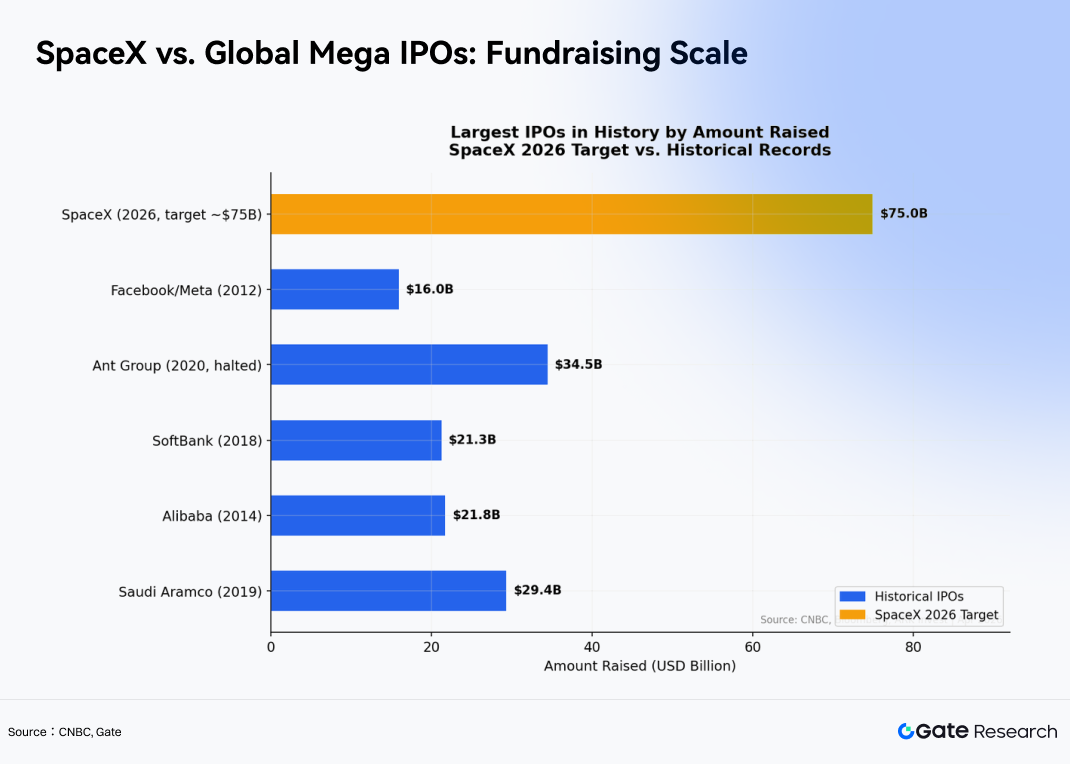
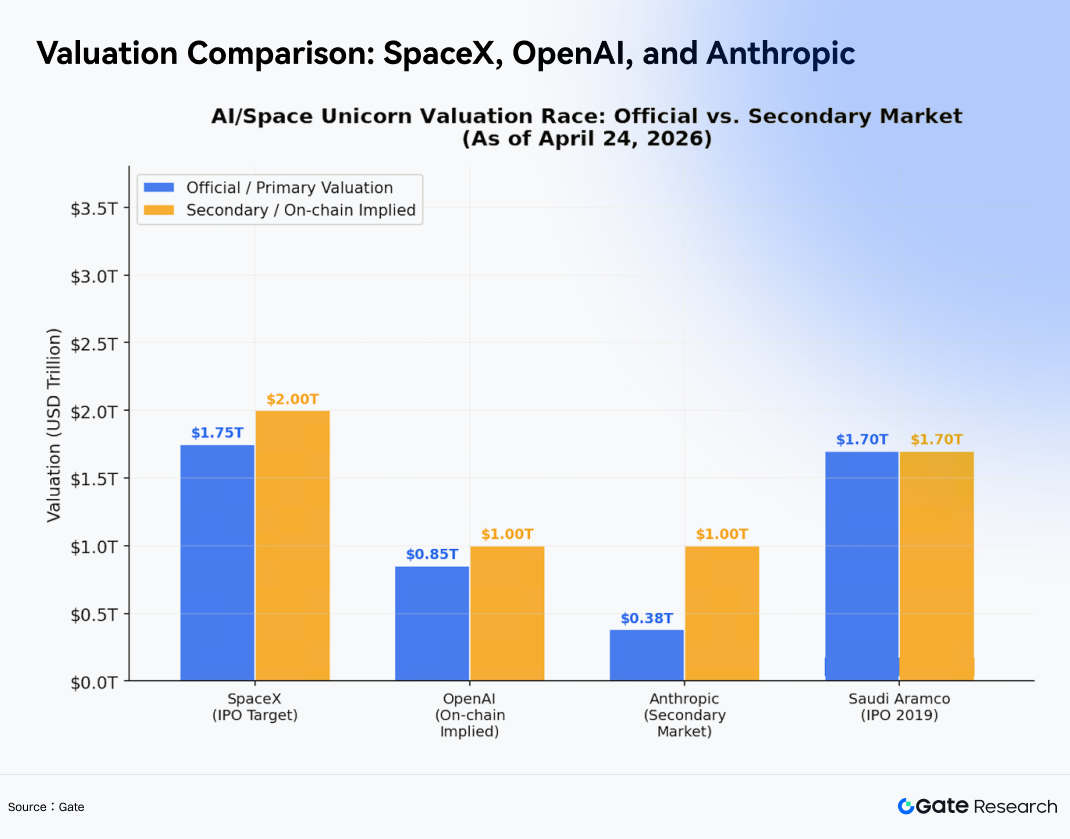
SpaceX’s IPO could become the largest public offering in global history. Multiple reports indicate a potential fundraising size of approximately $75 billion, with an estimated valuation range between $1.75 trillion and $2 trillion, while some market discussions even point to valuations exceeding $2 trillion.
If achieved, SpaceX’s IPO would overwhelmingly surpass the $29.4 billion fundraising record set by Saudi Aramco in 2019. In comparison, SpaceX’s expected $75 billion fundraising scale would make it one of the most iconic IPOs in the history of global capital markets.
The extraordinary valuation is supported by the strong growth and vertical integration of SpaceX’s three core business segments:
-
Starlink: SpaceX’s global satellite internet business, providing high-speed broadband connectivity worldwide through low-Earth orbit satellite networks.
-
Launch Services (Falcon Rockets / Starship): SpaceX’s aerospace launch division responsible for satellite deployment, cargo transportation, crewed missions, and deep-space launches, serving as one of the company’s core revenue drivers.
-
Starshield: SpaceX’s military and government-focused aerospace division, offering satellite communications, remote sensing, and national security infrastructure services.
Among these, Starlink has become the world’s fastest-growing satellite internet service, surpassing 10 million active users by early 2026. Its annual revenue is expected to exceed $20 billion in 2026, while having already achieved cash flow breakeven in 2023. In launch services, SpaceX completed 165 orbital launches in 2025 and deployed approximately 85% of the world’s spacecraft, while reducing Falcon 9 launch costs to below $1,000 per kilogram.
In the AI sector, SpaceX merged with Musk’s AI company xAI in February 2026, integrating aerospace launches, global communications, and AI infrastructure under a unified corporate entity. Musk has also proposed an ambitious vision of deploying 100 gigawatts of AI computing capacity annually.
1.2 OpenAI and Anthropic: The Twin AI Giants Approaching Trillion-Dollar Valuations
While SpaceX advances toward its IPO, two major AI companies — OpenAI and Anthropic — are also competing intensely in capital markets.
OpenAI is an AI company focused on the development of Artificial General Intelligence (AGI), with flagship products including ChatGPT, the GPT model series, and multimodal AI platforms. OpenAI’s commercialization growth has been exceptionally rapid, with annualized revenue surging from approximately $200 million in 2022 to over $10 billion by 2025. Based on trading data from Jupiter’s on-chain SPV tokenized assets, OpenAI’s implied valuation reached $1 trillion in April 2026, representing a 163% increase from October 2025. OpenAI is currently expected to pursue an IPO as early as the fourth quarter of 2026.
Anthropic, founded by former OpenAI members, focuses on developing the Claude series of large language models with an emphasis on safety, controllability, and long-term alignment. Anthropic’s valuation surge has been equally remarkable. In February 2026, the company achieved a post-money valuation of $380 billion in its Series G financing round. However, just three months later, data from secondary market platforms such as Forge Global indicated that Anthropic’s valuation had surged to approximately $1 trillion, surpassing OpenAI for the first time in secondary market trading (with OpenAI trading at approximately $880 billion on Forge).
This dramatic increase was primarily driven by the widespread adoption of Anthropic’s enterprise coding product, Claude Code, which boosted annualized revenue from $9 billion at the end of 2025 to $30 billion by March 2026 — a quarterly increase of 233%. Market expectations currently suggest that Anthropic could launch its IPO as early as October 2026, with fundraising potentially exceeding $60 billion.
The concentrated public listings of these three giants imply that assets totaling nearly $4 trillion in value will gradually enter public markets, and the resulting capital reallocation effect is likely to spread across various risk assets, including the cryptocurrency market.
2. Profound Impact on Crypto Market Liquidity and Trading Structure
As high-certainty, high-growth hard-tech assets such as SpaceX, OpenAI, and Anthropic enter public markets, a large-scale capital reallocation becomes inevitable. This process may create short-term liquidity outflows from the crypto market, while simultaneously serving as a long-term catalyst for the evolution of crypto asset pricing frameworks and infrastructure integration.
2.1 Short-Term Liquidity Drain Effect and Transmission Mechanism
In the short term, during the subscription periods and early trading stages of these mega IPOs (expected in the second half of 2026), institutional investors and high-net-worth individuals will likely need to raise substantial amounts of cash in order to secure allocation shares. This liquidity demand could trigger capital outflows from high-risk assets such as cryptocurrencies, particularly among crypto funds and family offices that accumulated significant profits during the previous bull market. Many may choose to partially realize crypto gains and reallocate capital into these once-in-a-generation technology unicorns.
To estimate the potential scale of this liquidity siphoning effect, it is necessary to anchor expectations to the fundraising size of the three IPOs. Based on current secondary market valuations, SpaceX is valued at approximately $2 trillion, while OpenAI and Anthropic are each valued near $1 trillion. Even assuming a conservative public float ratio of only 10–15%, the combined issuance size of newly listed shares could still reach $400–600 billion. If insider share sales are included, actual capital demand could become even larger.
Institutional participation in mega IPOs does not rely on idle cash reserves alone; instead, it follows a systematic liquidity management process. First, IPO allocation systems typically require institutions to deposit margin or full subscription capital with underwriters during the subscription period, creating a lock-up window that usually spans from T-5 to T+1. Second, for highly oversubscribed IPOs, institutions often submit orders well above their target allocations, further amplifying short-term cash demand. Third, family offices and hedge funds commonly treat risk assets — including crypto assets — as liquidity reserves, making them among the first positions to be reduced when cash needs surge.
This transmission chain can be simplified as follows:
IPO subscription demand surges → Institutions raise cash → Net selling of crypto assets → Increased fiat withdrawals from exchanges and pressure on stablecoin market capitalization → One-way liquidity flow toward equity markets
Although historical precedents of comparable scale are limited, several partial analogues provide useful reference points. For example, Coinbase reached a historical high near $64,000 in April 2021 on the day of its listing before subsequently declining by more than 50%. Some analysts viewed this as a classic “sell-the-news” event, where institutions concentrated on profit realization after the event rather than sustained accumulation.
Similarly, during Alibaba Group’s IPO in 2014, emerging markets experienced noticeable short-term capital outflows. Prior to Facebook’s IPO in 2012, the Nasdaq — particularly technology growth stocks — saw a structural correction of approximately 5% during the two weeks leading into the subscription window, which markets largely attributed to institutional portfolio rebalancing and cash preparation.
2.2 Long-Term Wealth Effects and Sector Rotation Within Crypto
From a long-term perspective, the IPOs of SpaceX and major AI companies will transform previously illiquid equity holdings owned by early investors, founders, and employees into highly liquid and monetizable wealth. Historical experience suggests that once post-IPO lock-up periods expire, such large-scale wealth realization often generates substantial spillover effects. Part of this newly unlocked capital is likely to seek fresh high-growth opportunities, with AI-related crypto assets, decentralized computing networks such as Render and Akash Network, as well as high-performance blockchains like Solana emerging as preferred destinations.
Taking SpaceX as an example, the company employs more than 13,000 people. Public information suggests that employee stock options and restricted stock units (RSUs) account for roughly 8–10% of total equity. At a $2 trillion valuation, employee holdings alone would represent approximately $160–200 billion in value. Once the lock-up period expires — typically 180 days after listing — this wealth would shift from illiquid equity into deployable cash. Combined with partial exits from early institutional investors such as Founders Fund, Google, and Fidelity Investments, total wealth realization could reach several hundred billion dollars.
Historical precedents are instructive. Google’s 2004 IPO directly fueled the rise of angel investing activity in the San Francisco Bay Area, while after Facebook’s post-IPO lock-up expiration in 2012, Silicon Valley venture capital deal volume reportedly increased by more than 40% year-over-year.
However, not all crypto assets are likely to benefit equally from this wealth spillover. Capital allocation tends to follow “cognitive anchoring” principles: investors who profit from AI-related equities are more inclined to redeploy wealth into sectors with familiar narratives and adjacent technological logic. Based on this framework, crypto assets can broadly be divided into three categories:
-
Primary beneficiaries: AI infrastructure tokens such as Bittensor, Render, Akash, and io.net are directly tied to the large-model computing narrative and therefore possess the strongest cognitive migration pathway. High-performance blockchains such as Solana and NEAR Protocol may also receive infrastructure premiums due to their growing role in hosting AI applications and DePIN projects. Decentralized storage projects including Filecoin and Arweave may benefit from the expansion of AI data infrastructure demand.
-
Neutral sectors: Major cryptocurrencies such as Bitcoin and Ethereum may receive passive inflows from newly created wealth, though their narrative correlation remains limited. They primarily function as entry assets into the broader crypto ecosystem.
-
Potentially disadvantaged sectors: Meme coins, GameFi projects, and legacy DeFi protocols lacking connection to AI or hard-tech narratives could face relative liquidity pressure during capital reallocation.
Once this sector divergence begins driving price appreciation, it may further reinforce market narratives, attract retail participation, and create a positive reflexive cycle. AI-related tokens, for instance, have already demonstrated strong empirical correlation with NVIDIA stock performance, with correlations exceeding 0.7 at times during 2023–2024. If the IPOs of OpenAI and Anthropic reignite enthusiasm around the AI computing cycle, related crypto assets could experience valuation premiums far exceeding what fundamentals alone would justify.
Combining these two-stage effects reveals a relatively clear timeline structure:
-
Short term (approximately 4–6 weeks around the IPO subscription period): Net capital outflow pressure dominates, placing overall stress on crypto markets, while sector divergence begins to emerge.
-
Medium term (3–6 months after IPO, before lock-up expirations): Markets enter a digestion phase and begin searching for new narrative anchors.
-
Long term (after lock-up expirations): Wealth spillover effects become dominant, bringing structural capital inflows into AI-related crypto assets.
This temporal structure offers investors a relatively clear strategic framework: avoid short-term liquidity shocks, accumulate high-conviction AI infrastructure tokens during market pullbacks, and complete positioning before the broader wealth-unlock cycle begins.
3. On-Chain Pre-IPO Mechanisms: How Crypto Is Reshaping Investment Access
Traditionally, investment opportunities in super unicorns such as SpaceX and OpenAI before their IPOs were almost entirely monopolized by top-tier venture capital firms (VCs), sovereign wealth funds, and a very small group of ultra-high-net-worth individuals. Ordinary investors and retail participants could only gain exposure after listing, often by purchasing shares in the secondary market at significantly higher valuations.
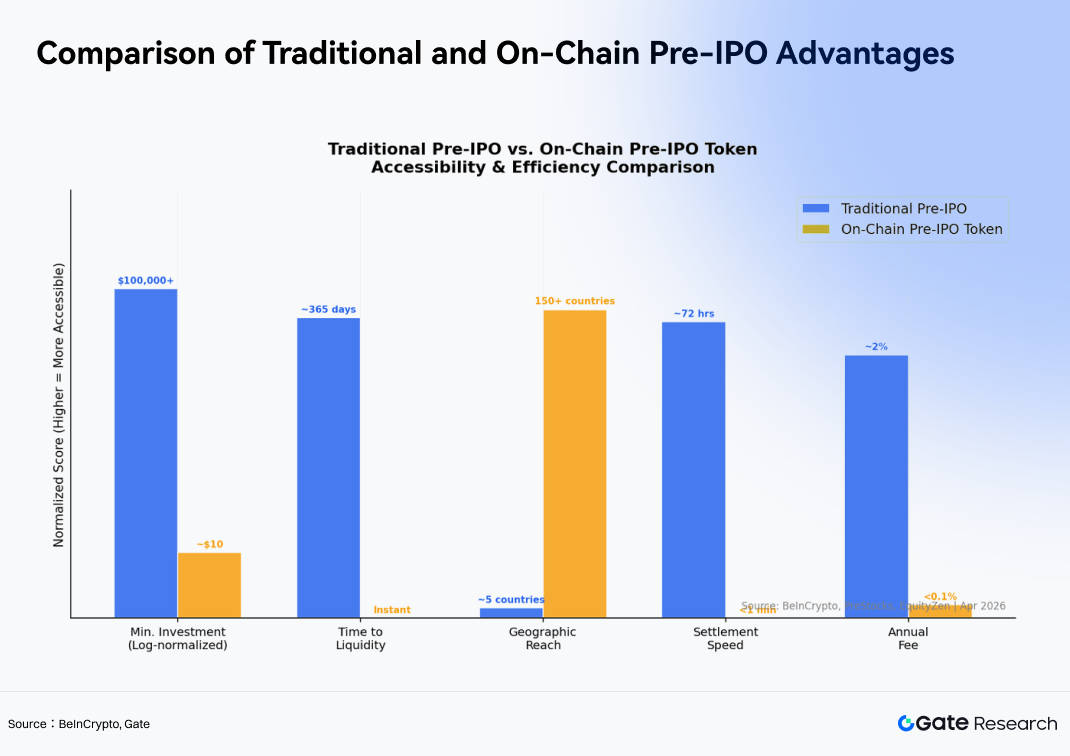
However, in 2026, the crypto market is fundamentally breaking down this barrier through Pre-IPO tokenization mechanisms. Taking Gate as an example, the minimum investment threshold for its SpaceX-related token product is as low as $0.01, while traditional Pre-IPO investments accessible through VC/PE channels often require a minimum subscription size of at least $1 million.
3.1 The Rapid Expansion of the RWA Tokenization Sector
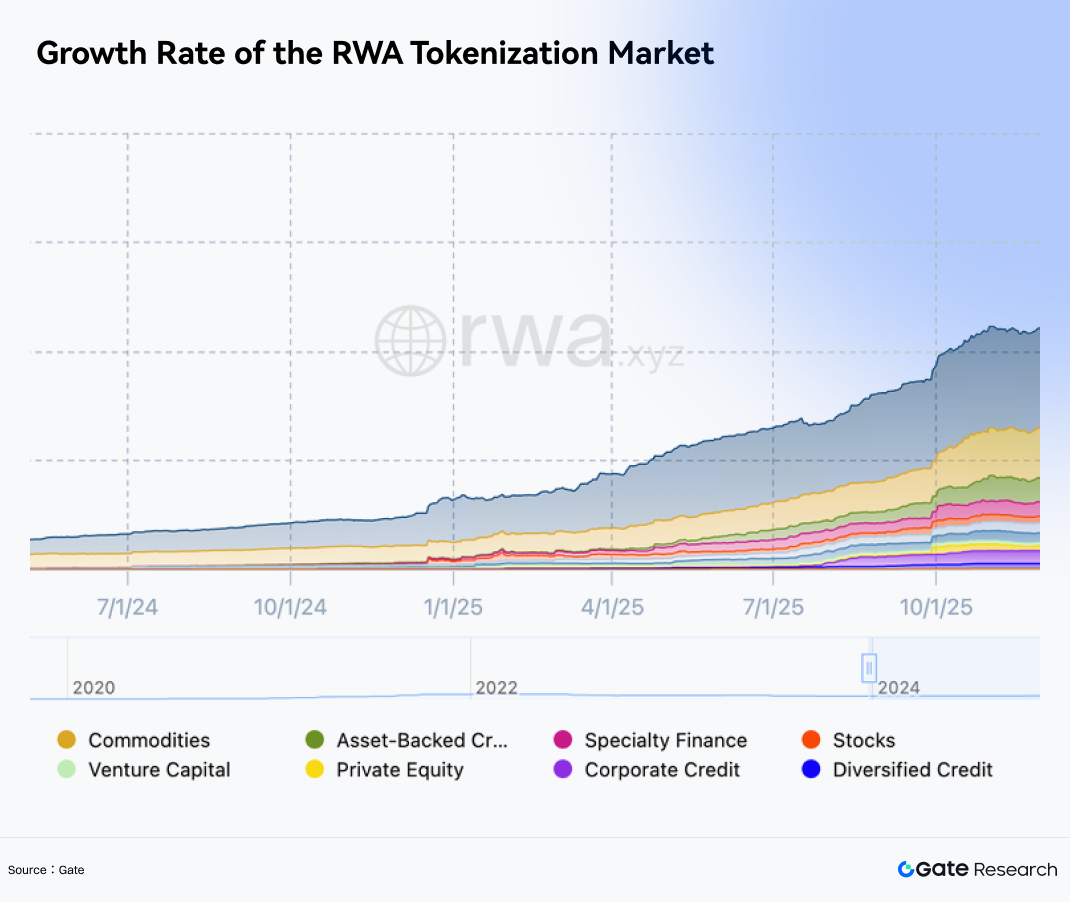
The rise of Pre-IPO tokens is a natural result of the maturation of the broader Real-World Asset (RWA) tokenization infrastructure.
According to an April 2026 report by Chainalysis, excluding stablecoins, the on-chain RWA market achieved approximately 30% quarter-over-quarter growth in Q1 2026, with total market size approaching $30 billion. Among all RWA categories, Pre-IPO tokenization has emerged as one of the fastest-growing and most narrative-driven segments.
Institutional-grade assets — including asset-backed private credit and tokenized U.S. Treasuries — remain the primary drivers of growth, but tokenized Pre-IPO equity exposure is rapidly becoming one of the most dynamic subcategories. Chainalysis research further shows that institutional-grade RWA assets require only 6.1 months on average to grow from initial on-chain issuance to a $1 billion market capitalization, significantly faster than the 36.2 months typically required for retail-oriented commodity tokenization products. This suggests that major financial institutions are integrating RWA tokenization into their asset allocation frameworks at an unprecedented pace.
For retail investors, reducing the investment threshold from the traditional $1 million level to as little as $100 — combined with globally accessible 24/7 instant settlement — represents an advantage that traditional financial systems struggle to replicate.
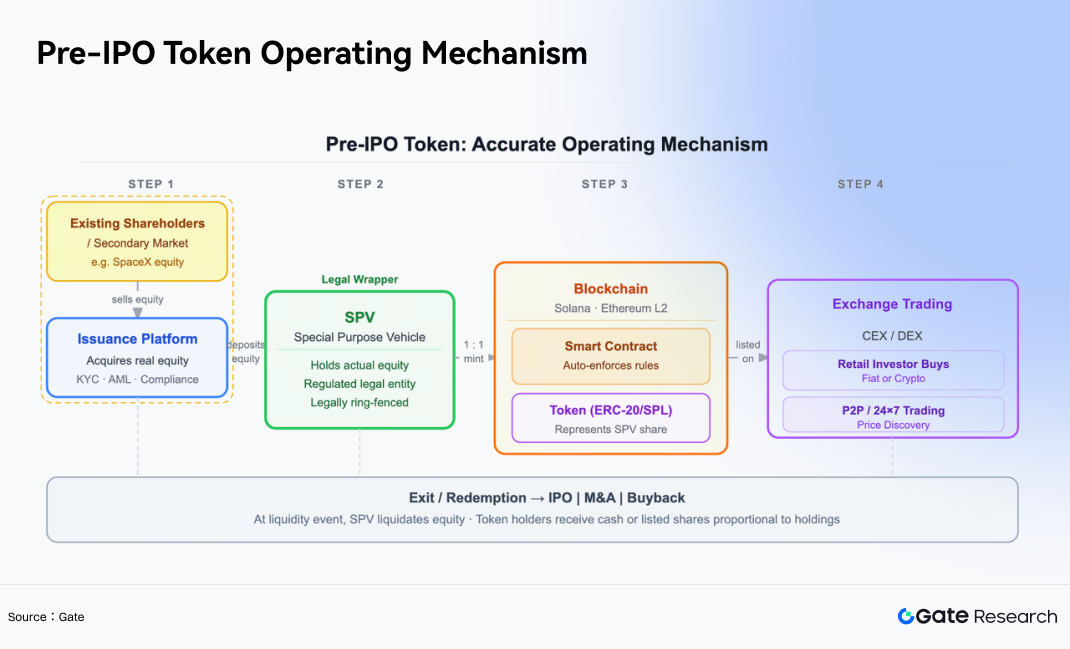
3.2 Operating Mechanism: Combining SPVs With Tokenization
Pre-IPO tokens are blockchain-based digital assets designed to provide retail investors with economic exposure to the pre-IPO valuations of private companies.
Their core operational framework typically includes the following steps:
-
Asset Acquisition: The platform acquires real equity exposure in target companies (such as SpaceX) through private secondary markets or existing shareholders.
-
SPV Establishment: These shares are placed into a regulated Special Purpose Vehicle (SPV), which legally holds the underlying assets on behalf of investors.
-
On-Chain Minting: The platform mints blockchain-based tokens — typically on networks such as Solana or Ethereum Layer 2 ecosystems — at a 1:1 ratio representing ownership interests in the SPV structure.
-
Exchange Trading: Investors can freely buy and sell these tokens on cryptocurrency exchanges.
It is important to emphasize that these tokens generally do not grant holders direct equity ownership, voting rights, or dividend entitlements in the underlying company. Instead, they function primarily as economic instruments tracking changes in the company’s valuation.
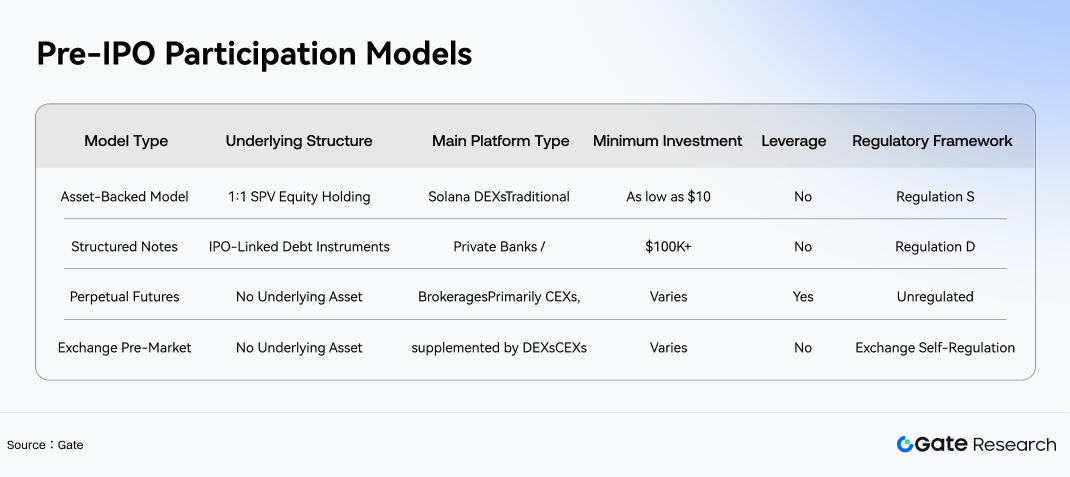
As the market rapidly evolves, the industry has gradually developed four major Pre-IPO participation models, each with distinct risk-return characteristics.
4. Evolution of Trading Structure: A New Battleground for Crypto Exchanges
In the race to capture the benefits of the “IPO supercycle,” major global cryptocurrency exchanges are increasingly viewing this sector as a core battlefield for attracting both traditional incremental capital and retail users.
4.1 Industry Exploration of Pre-IPO Products and the Gate Pre-IPOs Model
Since April 2026, Pre-IPO assets have gradually evolved from a niche concept into a productized category explored by trading platforms and Web3 gateways. Several models have emerged in the market. One category packages equity exposure to highly sought-after private companies such as SpaceX into tradable assets through compliant investment platforms, structured notes, or SPV frameworks. Another category lowers participation barriers for ordinary users through on-chain tokens or wallet aggregation interfaces.
Against this backdrop, Gate’s Pre-IPOs offer a more trading-oriented and efficiency-focused participation model. Its underlying mechanism differs from both asset-backed tokens and perpetual futures. Through a “subscription + pre-market trading” structure, it forms a distinct category among the four major Pre-IPO models and is, in essence, closest to a structured note framework.
Gate does not issue on-chain SPV-backed equity tokens. Instead, it utilizes a structure called a Mirror Note, which maps the market value of a company before and after its IPO into a tradable digital certificate. Using the initial SpaceX offering as an example, the corresponding SPCX certificate tracks changes in SpaceX’s market valuation rather than representing direct ownership of SpaceX shares.
Gate may hold SpaceX equity exposure or related derivatives in the OTC market as hedging reserves, but this does not constitute a strict 1:1 SPV-backed equity structure. Investors are therefore participating in a value-mapping instrument rather than directly owning the underlying stock.
From a participation perspective, the product adopts a two-stage structure consisting of subscription and pre-market circulation. Users subscribe using Tether (USDT) or GUSD, with a minimum threshold of 100 USDT and a subscription price of $590 per SPCX unit. After distribution, the tokens enter a 24/7 pre-market trading environment.
The product offers:
This clearly differentiates it from perpetual futures products.
Compared with asset-backed token structures, Gate’s model offers several advantages:
At the same time, the note-based structure provides equity-like price exposure while preserving the liquidity and operational simplicity of crypto assets, making it more aligned with the trading habits of crypto derivatives users.
4.2 Core Features of Gate Pre-IPOs
-
Low Entry Barrier: Traditional Pre-IPO transactions often require investments exceeding $10 million per ticket, while Gate Pre-IPOs can be accessed with as little as 100 USDT.
-
100% Unlocked Distribution: After subscription, asset certificates are fully unlocked and distributed directly into users’ spot accounts without any lock-up period.
-
24/7 Pre-Market Trading: Once distributed, users can trade freely around the clock, allowing them to exit or adjust positions before the company officially goes public.
-
Dual-Currency Subscription: Supports subscription using both USDT and GUSD.
-
Risk Characteristics: No leverage, 1:1 holding structure, and no liquidation risk.
-
Holding Costs: No funding fees.
-
Participation Flow: Subscription → Asset certificate distributed to spot account → Entry into pre-market trading → Free trading or holding until official IPO.
4.3 Three Dimensions Reshaping the Trading Landscape
This wave of Pre-IPO tokenization is fundamentally reshaping the crypto market across three major dimensions:
- Liquidity Competition: Crypto exchanges are attempting to retain retail capital within the crypto ecosystem — capital that might otherwise flow toward Nasdaq-listed equities or traditional U.S. brokerage platforms.
Traditionally, retail investors had extremely limited access to high-profile IPOs and could often only buy shares after listing at significantly inflated valuations. The emergence of Pre-IPO tokens has transformed crypto exchanges into one-stop investment gateways for retail users seeking early-stage exposure.
-
Cross-Market Integration: The boundaries between crypto markets and traditional equity markets are gradually blurring. Investors can now seamlessly switch between exposure to Bitcoin and SpaceX using USDT within the same wallet infrastructure. This convergence of asset classes may encourage more traditional finance investors to enter the crypto ecosystem while simultaneously providing crypto-native users with access to high-quality traditional assets.
-
Regulatory Stress Testing: These innovative products are also testing the limits of global regulatory frameworks. Because most Pre-IPO token products are not available to U.S. users, crypto exchanges operating outside the United States are currently benefiting from this regulatory gap. However, as scrutiny intensifies following the IPOs of companies such as SpaceX, this regulatory window may not remain open indefinitely.
5. Risks and Future Outlook
5.1 Risk Considerations
Although the convergence of the mega IPO wave and crypto markets presents an exciting vision, both retail and institutional investors must remain aware of several core risks.
Regulatory Uncertainty: Regulatory uncertainty represents the largest systemic risk. Analysis from BeInCrypto noted that the U.S. SEC explicitly stated in January 2026 that it would closely monitor the compliance status of RWA tokenization products.
Pricing Deviations and Oracle Risks: Pricing divergence and oracle risks should not be underestimated. Private company valuations update infrequently, and in the absence of mature market-making and arbitrage mechanisms, on-chain token prices may deviate significantly from underlying fundamentals due to retail speculation. For example, Anthropic’s implied on-chain valuation once approached $1 trillion, while its official IPO target valuation range remained only $400–500 billion. Such large discrepancies themselves constitute a major source of risk.
Liquidity and Exit Risks: After companies officially go public, liquidity and exit mechanisms become critical considerations.
Different platforms employ different redemption structures for converting tokens into actual equity or cash settlements. Under extreme market conditions, SPV-based structures could face liquidity shortages, making it difficult for investors to exit positions smoothly.
5.2 Conclusion
The public listings of SpaceX, OpenAI, and Anthropic represent not only milestones in technology history, but also a profound restructuring of global capital markets.
For the crypto industry, this is simultaneously:
Through Pre-IPO tokenization mechanisms, the crypto industry is using technological innovation to achieve a form of “financial democratization” that traditional Wall Street structures have long failed to deliver.
In this supercycle, investors capable of effectively managing risks while embracing innovation may be positioned to capture substantial returns.
Traditional IPO investing is typically restricted to institutions or high-net-worth individuals, requiring brokerage accounts, complex procedures, and extremely high capital thresholds, while private equity positions are often locked for years without liquidity. Gate Pre-IPOs lower these barriers through digitalized structures and liquidity support, enabling ordinary users to participate in primary market opportunities.
From a broader historical perspective, the true significance of Pre-IPO tokenization may not lie in the success or failure of any individual product today, but rather in the direction it opens for financial markets:
-
Redistributing access to private-market pricing power away from a small group of institutions
-
Allowing global retail investors to participate transparently and tradably in key moments of technological wealth creation
The IPOs of SpaceX, OpenAI, and Anthropic will likely become the most symbolic milestones in this convergence process. Their valuation dynamics, post-listing performance, and post-lock-up capital flows will provide the first real-world datasets testing whether the logic of Pre-IPO tokenization can truly sustain itself.
Reference:
-
CNBC, https://www.cnbc.com/2026/04/01/spacex-confidentially-files-for-ipo.html
-
Bloomberg / ARK Invest, https://www.ark-invest.com/articles/analyst-research/spacex-ipo-guide
-
ARK Invest, https://www.ark-invest.com/articles/analyst-research/spacex-starlink-revenue-analysis
-
Decrypt, https://decrypt.co/anthropic-openai-secondary-market-valuation
-
TechCrunch, https://techcrunch.com/2026/04/14/anthropic-rise-openai-investors-second-thoughts/
-
Reuters, https://www.reuters.com/markets/deals/biggest-ipo-wave-history-promises-3-trillion-value-no-profits-2026-04-23/
-
Investing.com, https://www.investing.com/news/cryptocurrency-news/bitcoin-short-squeeze-supports-price-but-trend-remains-unconfirmed-2026
-
Forbes, https://www.forbes.com/sites/2026/04/06/bitcoin-price-prediction-bloomberg-warns-10k-crash/
-
BeInCrypto, https://beincrypto.com/learn/pre-ipo-tokens-tokenized-equity/
-
Chainalysis, https://www.chainalysis.com/blog/tokenized-rwa-institutional-capital-2026/
-
Yahoo Finance, https://finance.yahoo.com/news/binance-launches-pre-ipo-token-trading-2026.html
Gate Research is a comprehensive blockchain and cryptocurrency research platform that provides deep content for readers, including technical analysis, market insights, industry research, trend forecasting, and macroeconomic policy analysis.
Disclaimer
Investing in cryptocurrency markets involves high risk. Users are advised to conduct their own research and fully understand the nature of the assets and products before making any investment decisions. Gate is not responsible for any losses or damages arising from such decisions.