ASMATCH vs ZIL: A Comprehensive Comparison of Two Leading Matching Algorithm Platforms

Introduction: Investment Comparison Between ASMATCH and ZIL
In the cryptocurrency market, the comparison between ASMATCH and ZIL has become a topic that investors cannot overlook. The two differ significantly in market capitalization ranking, application scenarios, and price performance, representing distinct positioning within the crypto asset landscape.
AsMatch (ASMATCH): Launched in December 2023, it has gained market recognition as the first Social Layer on Manta Network, powered by Polygon CDK and Celestia DA, focusing on democratizing SocialFi with a community-first approach.
Zilliqa (ZIL): Since its launch in January 2018, it has been recognized as a high-throughput public blockchain platform that addresses transaction speed and scalability challenges through innovative sharding technology.
This article will comprehensively analyze the investment value comparison between ASMATCH and ZIL from the perspectives of historical price trends, supply mechanisms, technological ecosystems, and future predictions, attempting to answer the question that investors care about most:
"Which is the better buy right now?"
I. Historical Price Comparison and Current Market Status
ASMATCH (Coin A) and ZIL (Coin B) Historical Price Trends
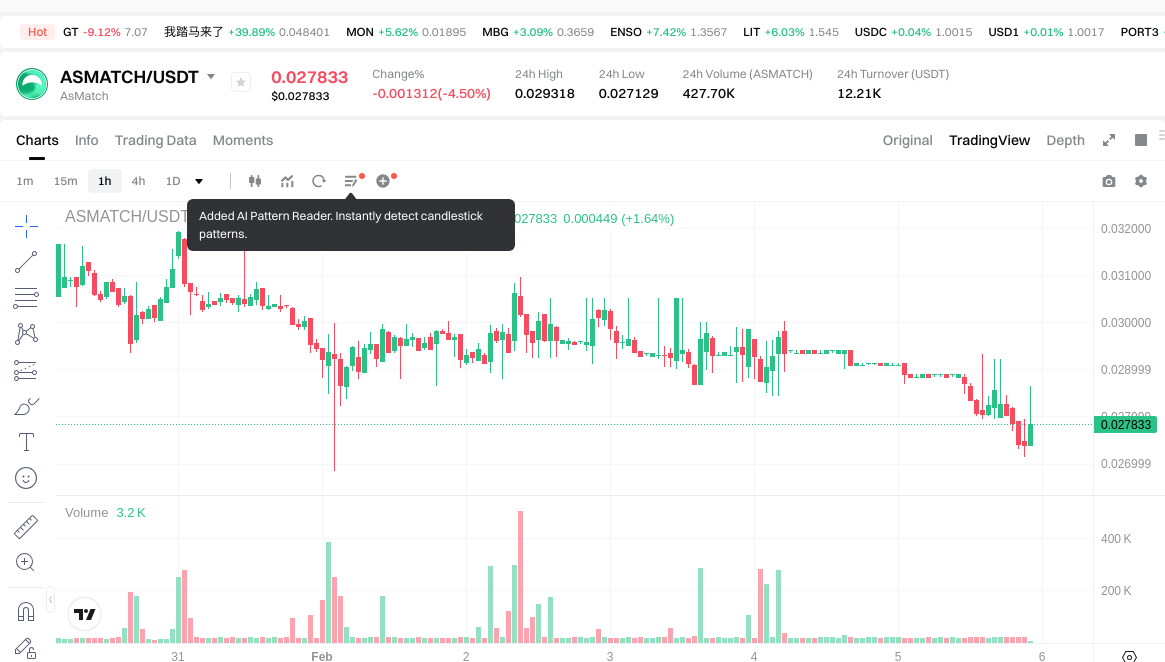
- 2025: ASMATCH experienced notable volatility, reaching a historical high of $4.8026 on May 22, 2025, followed by a sharp decline to a historical low of $0.00728 on June 13, 2025.
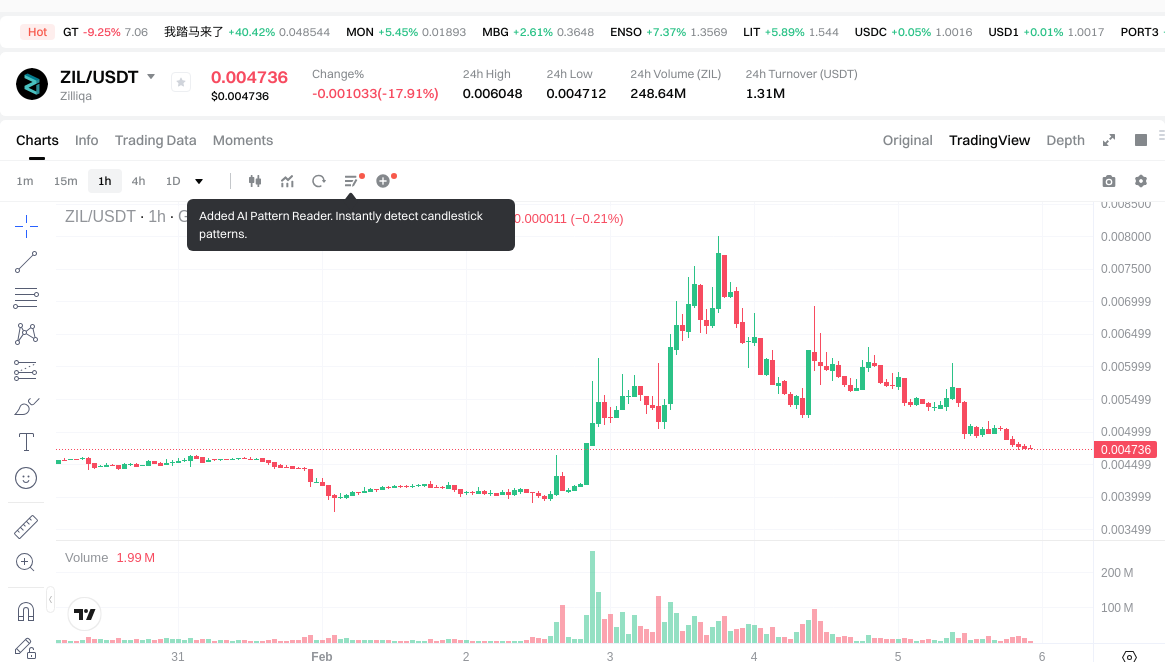
- 2021: ZIL reached its historical high of $0.255376 on May 7, 2021, during a period of broader cryptocurrency market expansion. The token hit its historical low of $0.00239616 on March 13, 2020.
- Comparative Analysis: During the recent market cycle, ASMATCH fell from its peak of $4.8026 to its current level of $0.027384, representing a decline of approximately 99.4%. Meanwhile, ZIL declined from $0.255376 to $0.004748, reflecting a drop of approximately 98.1%.
Current Market Status (February 5, 2026)
- ASMATCH current price: $0.027384
- ZIL current price: $0.004748
- 24-hour trading volume: ASMATCH recorded $12,246.54 versus ZIL's $1,316,335.44
- Market sentiment index (Fear & Greed Index): 12 (Extreme Fear)
View real-time prices:
- View ASMATCH current price Market Price
- View ZIL current price Market Price
II. Core Factors Influencing ASMATCH vs ZIL Investment Value
Supply Mechanism Comparison (Tokenomics)
- ASMATCH: The token economic structure features a circulating supply of 18,022,590.59 tokens, representing 18.02% of the total token supply. This limited circulation relative to total supply may influence scarcity dynamics in the market.
- ZIL: Supply mechanism details were not available in the provided materials.
- 📌 Historical Pattern: Supply mechanisms play a role in shaping price cycles through scarcity effects and token release schedules.
Institutional Adoption and Market Application
- Institutional Holdings: Information regarding institutional preference between the two assets was not available in the materials.
- Enterprise Adoption: ASMATCH positions itself as a SocialFi application on Calamari and Manta Pacific, integrating artificial intelligence for purposes including dating, social networking, and professional networking. ZIL's enterprise applications were not detailed in the available materials.
- National Policy: Regulatory attitudes toward these specific assets across different jurisdictions were not covered in the provided materials.
Technical Development and Ecosystem Building
- ASMATCH Technical Development: The project integrates AI technology within its SocialFi framework, operating on Calamari and Manta Pacific networks. This integration aims to enhance user experience across social and professional networking use cases.
- ZIL Technical Development: Technical upgrade details were not available in the provided materials.
- Ecosystem Comparison: ASMATCH focuses on the SocialFi sector, combining social networking functionalities with blockchain technology. Comparative details regarding DeFi, NFT, payment systems, and smart contract implementations for both projects were not comprehensively covered in the available materials.
Macroeconomic and Market Cycles
- Performance in Inflationary Environments: Comparative anti-inflation properties between ASMATCH and ZIL were not addressed in the provided materials.
- Macroeconomic Monetary Policy: The impact of interest rates and dollar index fluctuations on these specific assets was not detailed in the available materials.
- Geopolitical Factors: Cross-border transaction demand and international situation impacts on ASMATCH and ZIL were not covered in the provided materials.
III. 2026-2031 Price Prediction: ASMATCH vs ZIL
Short-term Prediction (2026)
- ASMATCH: Conservative $0.027-$0.029 | Optimistic $0.029-$0.034
- ZIL: Conservative $0.0035-$0.0047 | Optimistic $0.0047-$0.0070
Mid-term Prediction (2028-2029)
- ASMATCH may enter a consolidation phase, with estimated price range of $0.019-$0.038
- ZIL may enter a growth phase, with estimated price range of $0.0041-$0.0093
- Key drivers: institutional capital inflows, ETF developments, ecosystem expansion
Long-term Prediction (2030-2031)
- ASMATCH: Baseline scenario $0.036-$0.043 | Optimistic scenario $0.043-$0.052
- ZIL: Baseline scenario $0.0048-$0.0087 | Optimistic scenario $0.0087-$0.0095
Disclaimer: Price predictions are based on historical data analysis and market trends. Cryptocurrency markets are highly volatile and subject to various unpredictable factors. These projections should not be considered as investment advice.
ASMATCH:
| Year | Predicted High Price | Predicted Average Price | Predicted Low Price | Price Change |
|---|---|---|---|---|
| 2026 | 0.03351231 | 0.028643 | 0.02721085 | 4 |
| 2027 | 0.0354285267 | 0.031077655 | 0.02579445365 | 13 |
| 2028 | 0.0375759926605 | 0.03325309085 | 0.0189542617845 | 21 |
| 2029 | 0.044622322611615 | 0.03541454175525 | 0.018769707130282 | 29 |
| 2030 | 0.045621012689113 | 0.040018432183432 | 0.036816957608757 | 46 |
| 2031 | 0.052240061372252 | 0.042819722436272 | 0.036396764070831 | 56 |
ZIL:
| Year | Predicted High Price | Predicted Average Price | Predicted Low Price | Price Change |
|---|---|---|---|---|
| 2026 | 0.00702556 | 0.004747 | 0.00346531 | 0 |
| 2027 | 0.0067103592 | 0.00588628 | 0.0042969844 | 23 |
| 2028 | 0.00692815156 | 0.0062983196 | 0.005605504444 | 32 |
| 2029 | 0.0093246621678 | 0.00661323558 | 0.0041002060596 | 39 |
| 2030 | 0.009483049159941 | 0.0079689488739 | 0.00478136932434 | 67 |
| 2031 | 0.009075038977597 | 0.00872599901692 | 0.008115179085736 | 83 |
IV. Investment Strategy Comparison: ASMATCH vs ZIL
Long-term vs Short-term Investment Strategies
- ASMATCH: May appeal to investors focused on emerging SocialFi applications and AI-integrated social networking ecosystems. The project's positioning in the social layer infrastructure space suggests potential alignment with investors interested in early-stage protocol development.
- ZIL: May suit investors interested in established blockchain infrastructure with a focus on scalability solutions through sharding technology. The project's longer operational history since 2018 may appeal to those seeking more mature network fundamentals.
Risk Management and Asset Allocation
- Conservative Investors: ASMATCH 20-30% vs ZIL 70-80%
- Aggressive Investors: ASMATCH 50-60% vs ZIL 40-50%
- Hedging Tools: Stablecoin allocation, options strategies, cross-asset portfolio diversification
Portfolio allocation should be adjusted based on individual risk tolerance, investment horizon, and overall market conditions.
V. Potential Risk Comparison
Market Risks
- ASMATCH: The token experienced significant volatility, declining approximately 99.4% from its peak of $4.8026 to current levels. Limited circulating supply (18.02% of total) may contribute to liquidity constraints and price volatility. The 24-hour trading volume of $12,246.54 suggests relatively lower market liquidity compared to more established assets.
- ZIL: The asset declined approximately 98.1% from its historical high of $0.255376. With a 24-hour trading volume of $1,316,335.44, the token demonstrates relatively higher liquidity compared to ASMATCH, though still subject to broader cryptocurrency market volatility patterns.
Technical Risks
- ASMATCH: The project operates on Calamari and Manta Pacific networks with AI integration. Technical risks may include dependencies on underlying network infrastructure, smart contract vulnerabilities, and the nascent stage of SocialFi protocol development.
- ZIL: As a sharding-based blockchain platform, technical considerations may include network coordination complexity, consensus mechanism stability, and validator network distribution.
Regulatory Risks
- Global regulatory frameworks for cryptocurrency assets continue to evolve across jurisdictions. Both ASMATCH and ZIL may face varying degrees of regulatory scrutiny depending on classification as utility tokens, securities, or other asset categories. SocialFi applications like ASMATCH may encounter additional regulatory considerations related to data privacy and social platform governance. Established infrastructure projects like ZIL may face regulatory examinations related to decentralization metrics and network governance structures.
VI. Conclusion: Which Is the Better Buy?
📌 Investment Value Summary:
- ASMATCH Characteristics: The project positions itself within the emerging SocialFi sector, integrating AI technology for social networking applications. Operating on Manta Network infrastructure with a focus on community-driven development. Current low trading volume and high volatility from peak levels suggest early-stage market positioning.
- ZIL Characteristics: The platform has maintained operational continuity since 2018, focusing on blockchain scalability through sharding technology. Demonstrates relatively higher trading volume and established network infrastructure compared to ASMATCH.
✅ Investment Considerations:
- Beginning Investors: Consider allocating a smaller portion of portfolio to higher-volatility assets like ASMATCH (10-20%) while maintaining larger positions in more established assets with higher liquidity. Prioritize understanding fundamental technology and use cases before investment.
- Experienced Investors: May explore diversified exposure across both assets based on risk tolerance. ASMATCH may fit into higher-risk, early-stage protocol allocations, while ZIL may serve as infrastructure exposure with longer operational history. Regular portfolio rebalancing and risk monitoring recommended.
- Institutional Investors: Conduct comprehensive due diligence on network security, code audits, team backgrounds, and regulatory compliance frameworks. Consider liquidity requirements, custody solutions, and integration with existing portfolio management systems.
⚠️ Risk Disclosure: The cryptocurrency market exhibits high volatility. This analysis does not constitute investment advice. Investors should conduct independent research and consult qualified financial advisors before making investment decisions.
VII. FAQ
Q1: What are the main differences in market maturity between ASMATCH and ZIL?
ZIL demonstrates significantly greater market maturity, having launched in January 2018 with over 8 years of operational history, while ASMATCH launched in December 2023 and remains in early-stage development. This maturity gap manifests in trading volume metrics, where ZIL records $1,316,335.44 in 24-hour volume compared to ASMATCH's $12,246.54, indicating substantially deeper liquidity. Additionally, ZIL's established sharding technology and longer track record provide more historical data for risk assessment, whereas ASMATCH's SocialFi positioning represents emerging protocol infrastructure with limited market validation.
Q2: How do the supply mechanisms of ASMATCH and ZIL affect their investment characteristics?
ASMATCH currently has only 18.02% of its total token supply in circulation (18,022,590.59 tokens), creating potential scarcity dynamics but also indicating significant future unlock events that could impact price stability. This limited circulation relative to total supply may contribute to higher volatility and liquidity constraints observed in its low trading volumes. In contrast, detailed supply mechanism information for ZIL was not available in the reference materials, making direct tokenomics comparison challenging. Investors should carefully evaluate unlock schedules and inflation rates when assessing long-term holding strategies for either asset.
Q3: What are the primary use case differences between ASMATCH and ZIL?
ASMATCH focuses specifically on the SocialFi sector, integrating AI technology for social networking, dating, and professional networking applications on Calamari and Manta Pacific networks, representing a specialized vertical within blockchain applications. ZIL, conversely, operates as a high-throughput public blockchain platform addressing fundamental scalability challenges through sharding technology, positioning it as infrastructure-layer technology rather than application-specific functionality. This distinction means ASMATCH's value proposition depends on SocialFi adoption trends, while ZIL's utility extends across multiple application categories that can build upon its scalability infrastructure.
Q4: How have ASMATCH and ZIL performed during recent market downturns?
Both assets experienced severe corrections from their respective peaks: ASMATCH declined approximately 99.4% from its May 2025 high of $4.8026 to current levels of $0.027384, while ZIL dropped approximately 98.1% from its May 2021 peak of $0.255376 to $0.004748. Despite similar percentage declines, the timing differs significantly—ASMATCH's peak occurred during 2025 amid its launch period volatility, whereas ZIL's historical high coincided with the broader 2021 cryptocurrency market expansion. Current market sentiment stands at 12 on the Fear & Greed Index (Extreme Fear), indicating widespread risk aversion affecting both assets.
Q5: What portfolio allocation approaches are recommended for ASMATCH versus ZIL?
Conservative investors should consider asymmetric allocation favoring ZIL's established infrastructure (70-80%) over ASMATCH's early-stage positioning (20-30%), prioritizing liquidity and operational track record. Aggressive investors with higher risk tolerance may increase ASMATCH exposure to 50-60% to capture potential early-stage protocol upside, while maintaining 40-50% in ZIL for portfolio stability. These allocations should be complemented with stablecoin reserves and cross-asset diversification strategies, with regular rebalancing based on market conditions and individual risk parameters. Investors must recognize that ASMATCH's low trading volume may create exit challenges during market stress periods.
Q6: What are the key technological risks specific to each project?
ASMATCH faces technological dependencies on underlying Calamari and Manta Pacific network infrastructure, smart contract security considerations inherent in AI integration, and execution risks associated with nascent SocialFi protocol development. The project's reliance on emerging Layer 2 solutions and data availability layers introduces additional technical complexity. ZIL's sharding architecture, while addressing scalability, presents coordination challenges across multiple shards, consensus mechanism stability requirements, and validator network distribution considerations. Both projects require ongoing technical maintenance and upgrades, with ASMATCH facing greater uncertainty due to its earlier development stage and less battle-tested infrastructure.
Q7: How should investors interpret the price predictions for 2026-2031?
Price predictions indicate ASMATCH may reach $0.029-$0.034 (optimistic) in 2026 and $0.043-$0.052 by 2031, representing modest upside from current levels, while ZIL projections suggest $0.0047-$0.0070 (optimistic) in 2026 and $0.0087-$0.0095 by 2031. However, these forecasts are based on historical data analysis and market trend extrapolation, carrying significant uncertainty given the high volatility both assets have demonstrated. Investors should treat these projections as potential scenarios rather than guaranteed outcomes, recognizing that cryptocurrency markets remain subject to technological developments, regulatory changes, competitive dynamics, and macroeconomic factors not fully captured in historical patterns. Independent research and risk assessment remain essential regardless of prediction models.
Q8: What regulatory considerations should investors monitor for ASMATCH and ZIL?
Both assets operate in evolving regulatory environments where classification as utility tokens, securities, or other categories varies across jurisdictions and directly impacts compliance requirements. ASMATCH's SocialFi focus introduces additional regulatory dimensions related to data privacy regulations, user-generated content governance, and social platform compliance frameworks that may differ from traditional cryptocurrency regulation. ZIL, as infrastructure-layer technology, faces scrutiny regarding decentralization metrics, network governance structures, and potential classification determinations that could affect its operational model. Investors should monitor regulatory developments in key markets including the United States, European Union, and Asia-Pacific regions, as regulatory clarity or restrictions could materially impact both projects' viability and market access.
Share
Content
Introduction: Investment Comparison Between ASMATCH and ZIL
I. Historical Price Comparison and Current Market Status
II. Core Factors Influencing ASMATCH vs ZIL Investment Value
III. 2026-2031 Price Prediction: ASMATCH vs ZIL
IV. Investment Strategy Comparison: ASMATCH vs ZIL
V. Potential Risk Comparison
VI. Conclusion: Which Is the Better Buy?
VII. FAQ
How to Buy Cryptocurrency


Trending Cryptocurrencies



How to Make Money on TikTok: 10 Real Ways to Earn in 2025

How does SocialFi empower creators: monetization, tokens, and community governance

What is SocialFi? Explore the future of decentralized social media in the field of crypto assets

Top 5 SocialFi projects to watch in 2025: the intersection of crypto assets and social interaction

What Is the Correlation Between Bitcoin's Social Media Followers and Its Environmental Impact?

DDD Token: Challenging medical insurance injustice with blockchain technology

What Is Risk to Reward Ratio and How to Use It Effectively

Comprehensive Guide to Phil Konieczny: Cryptocurrency Education, Investment Solutions, and Financial Freedom

What are NFT games?
Latest Corporate Rankings: Bitcoin & Cryptocurrency Holdings

What Is Polkadot? How Does It Work? Investment Analysis