DAO: Everything About Decentralized Autonomous Organizations

What Is a DAO?
When one person holds exclusive governing power over others, moral hazard emerges. A Decentralized Autonomous Organization (DAO) has emerged as an alternative solution to this age-old problem.
Imagine a hundred survivors stranded on a barren island. To survive, they must cooperate, and cooperation requires following basic rules. Having rules means there must be people who establish and enforce them. This is where the 'principal-agent problem' arises. Those who make decisions on behalf of others are called 'agents,' while those who must follow these decisions are called 'principals.' When agents make decisions, they distribute the risks of those decisions to others, which creates greater risks for the principals who must bear the full consequences.
Moreover, agents often prioritize their personal interests over those of the principals. This occurs because principals cannot perfectly track and control all actions of the agents. In traditional organizations, legal contracts and court systems mitigate these moral hazards, but decentralized autonomous organizations significantly reduce both these risks and management costs.
Blockchain technology can reduce trust issues between agents and principals by providing transparent and immutable records. This ultimately helps organizations operate more efficiently and fairly, creating a new paradigm for organizational governance.
How DAOs Work
A Decentralized Autonomous Organization (DAO) is an organization that uses blockchain to facilitate self-executing rules or protocols. Smart contracts on the blockchain store these rules, and the network's tokens enable users to protect the network and vote on these rules.
There are three major steps to creating a decentralized autonomous organization:
-
Smart Contract Development: Developers must fully understand the governance problems they aim to solve to create successful smart contracts that form the foundation of the DAO. This requires careful analysis of organizational needs and potential challenges.
-
Tokenomics Definition: Developers define the token economics of governance, including revenue generation methods and establishing the right balance between rewards and penalties for malicious behavior. This economic model is crucial for long-term sustainability.
-
Blockchain-Based DAO Launch: Ideally, developers launch the DAO with the same token stake as other stakeholders, ensuring no power imbalance. However, most developers gradually release their stakes over time to promote decentralization.
Decentralized autonomous organizations possess both transparency and autonomy. The number of tokens held determines the size of voting rights, enabling the creation of new governance structures. However, proposed agendas must be approved by a majority of stakeholders before execution, ensuring democratic decision-making processes.
The Birth of DAOs
In the past, the first decentralized autonomous organization called 'The DAO' was created on the Ethereum blockchain. However, security vulnerabilities were discovered in the early development stages. A hacker attacked the network and stole a significant portion of the funds invested in The DAO, equivalent to $150 million worth of Ethereum.
To resolve this situation, controversy arose between the Ethereum community and developers. Opinions were divided on whether leaving the money with the hacker aligned with blockchain's immutability principle, or whether intervening in the network to recover investors' losses was preferable.
Ultimately, developers and the community decided to perform a 'hard fork' that rolled back Ethereum's records to a state before the hacker stole the Ethereum. The chain born from this hard fork became the current Ethereum, while the unchanged original chain was classified as Ethereum Classic.
This decision was controversial among community members. However, the majority of Ethereum users and developers supported the new chain, resulting in the current state. This incident sparked debate about one of blockchain technology's important issues: 'governance in distributed systems,' highlighting the challenges of maintaining decentralization while addressing critical security concerns.
Understanding DAOs Through Comparison
The best way to understand decentralized autonomous organization implementation is to compare various cases of the most popular cryptocurrencies and decentralized finance protocols:
-
Bitcoin – Shows the most basic example of a DAO. Essentially, the blockchain is a P2P (peer-to-peer) network that allows open access for users to execute transactions, validate them, and add new blocks. In other words, Bitcoin is an organization of autonomous and decentralized nodes. However, Bitcoin is not a decentralized autonomous organization because it lacks the complex governance rules characteristic of DAOs.
-
Ethereum – Represents second-generation blockchain by providing smart contract functionality. Smart contracts are essential elements for enabling DAOs. However, Ethereum itself is not a DAO but rather a framework for developing DAO projects, much like Unreal Engine 4 is not a game but a framework for creating video games.
-
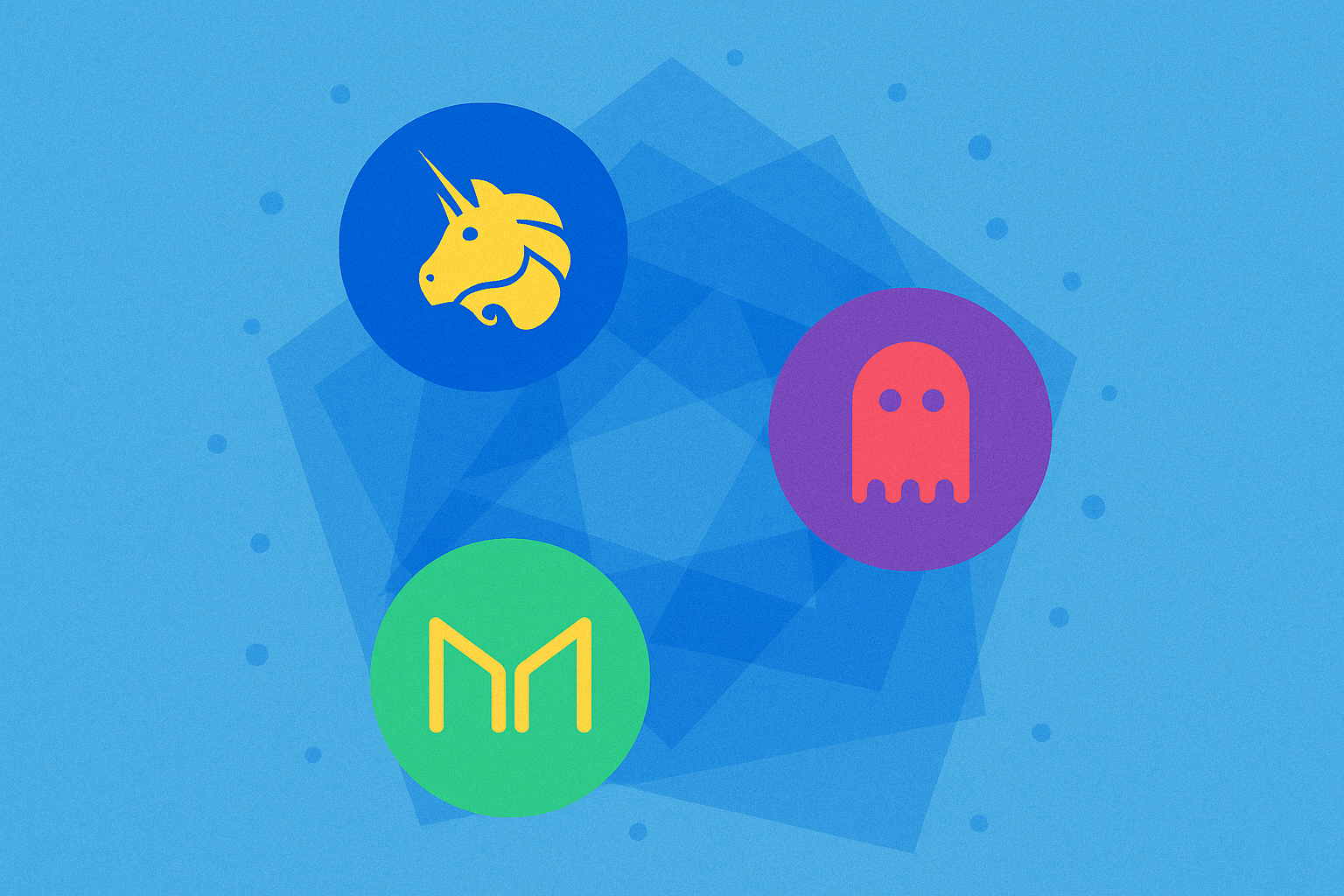
Uniswap – The first decentralized finance protocol to pioneer automated market makers, becoming the most popular decentralized exchange. Currently, Uniswap has liquidity providers (yield farmers) holding $6.8 billion in TVL (Total Value Locked) in liquidity pools. The network has its own governance token, UNI, used for voting on improvements and funding liquidity pools. While Uniswap is a complete DAO, proposing new governance rules or adjusting existing ones requires owning 1% of the total UNI supply.
-
MakerDAO – The most representative example of a DAO. Similar to Uniswap or Compound as a DeFi protocol, it operates on Ethereum for lending. MakerDAO holds two tokens: the stablecoin DAI and the governance token MKR. The MakerDAO Foundation has been distributing MKR to incentivize contributors, promote voter participation, and decentralize the governance process. As a result, the MakerDAO Foundation has already dissolved, completing its role and transferring all operations to the fully decentralized MakerDAO community. This transition set up the Maker Protocol to be completely self-sustaining, with all decisions and operations made by a global distributed community.
DAOs: A Complex and Diverse World
Comparing Uniswap and MakerDAO reveals that rules make all the difference. Uniswap's protocol introduced a requirement to own 1% of UNI, effectively prohibiting over 90% of users from participating in leading network development. In contrast, MakerDAO's foundation completed its original role and transferred all operations to the fully decentralized MakerDAO community, enabling all decisions and operations to be driven by a global distributed community.
A proper decentralized autonomous organization can be described as complete decentralization without central oversight. Accordingly, DAOs start in a semi-centralized state. First, the core developer team must manage the protocol as it grows and more users participate. The more users there are, the larger the stakeholder pool becomes, gaining momentum toward complete decentralization.
DAO Operating Principles
Suppose you work for a company that designs video games. This field is work that heavily depends on technical and artistic talent. Moreover, video game development often suffers from so-called 'feature creep' due to its complexity.
This refers to the phenomenon where unplanned features or changes are gradually added during project or product development, increasing complexity. This often blurs the focus of goals and causes project delays or cost increases.
To prevent these problems, game development companies can set fundraising rules through a DAO operating on the Ethereum blockchain. For example, they can set budget limits and lock smart contract fund pools. Each task—3D modeling, programming, sound, voice acting, etc.—is then automatically calculated against the budget according to current rates used by the organization.
Accordingly, each team member receives tokens to vote on additional work. Team leaders receive proportionally more tokens. If the team leader's vote exceeds the budget limit, the vote fails. As a result, the team becomes aware of the development scale they can achieve cost-effectively.
Similarly, the same DAO can be used to remove company representatives, hire suppliers or freelancers, and pool resources for bonuses, demonstrating the versatility of DAO governance structures.
Advantages and Disadvantages of DAOs
First, voting rights in DAOs cannot be exercised equally. To understand why, we need to look at the Pareto principle. Economist Vilfredo Pareto discovered a pattern that repeats across all areas of the economy in his research.
The Pareto principle created the 80/20 rule, meaning 80% of results derive from 20% of causes. From an organizational perspective, 20%—the 'vital few'—create successful outcomes. Most people who have done group projects in school or college already know this fact.
Therefore, DAOs must consider that not all votes are counted equally. This can be interpreted to mean that some users will hold more tokens than the majority, potentially weakening decentralization. MIT Technology Review reached a similar conclusion in the past.
Another potential disadvantage of DAOs is that rules can apply across multiple legal jurisdictions. If problems arise that cannot be resolved through token voting, lengthy and complex legal proceedings may be necessary.
Nevertheless, through well-designed smart contracts, DAOs present a way for organizations to manage institutions transparently and easily. This is especially true in organizations where most members don't know each other. This scenario is best demonstrated at the national level, the largest organization where people don't know each other. Blockchain decentralized autonomous organizations for voting can protect the transparency and legitimacy of elections, which is widely accepted.
Top 5 DAOs
Besides MakerDAO, the decentralized autonomous organization mentioned earlier, here are other notable DAOs worth introducing:
1. Gitcoin
Unlike standard DeFi protocols, Gitcoin aims not to facilitate yield farming but to gather blockchain developers, serving as a blockchain-specific platform similar to Upwork or Fiverr. To facilitate their fundraising, Gitcoin launched Gitcoin Grants, which uses EIP 1337 tokens for quadratic voting to match all donations received.
Each donation is weighted according to the number of donors to blockchain projects. This is another example of creative DAO utilization. Gitcoin Grants favors projects with high community engagement rather than preferring projects funded by a few wealthy donors.
2. Aragon
Aragon is a platform for creating custom DAOs. It's very useful for users without advanced programming knowledge. Aragon manages smart contract types and interfaces, allowing users to decide how to manage their organizations.
Additionally, Aragon offers Aragon Fundraising for crowdfunding. The main feature is the bonding smart contract, an AMM that allows users to deposit collateral in exchange for organization-specific tokens. This has made Aragon a DAO ecosystem with a wide range of use cases.
3. Digix
Have you ever wondered how to own gold? Digix presents a solution by tokenizing gold holdings. Each token is worth 1g of gold. Digix was one of the first projects to start as an ICO on Ethereum and has a long track record.
Gold is stored in Safe House vaults in Singapore and audited by the independent Bureau Veritas. In addition to DGX tokens representing gold ownership, DGD tokens are used to vote on how the company uses funds for further development. As a result, users receive DGD as quarterly dividends.
4. MolochDAO
MolochDAO is a decentralized autonomous organization that funds projects that improve and support the Ethereum network. This organization uses a unique governance mechanism called 'ragequit' to encourage members to reach consensus. MolochDAO is continuously active, and this system plays an important role in promoting healthy growth of the Ethereum ecosystem.
5. Aave
Aave is a top-tier DeFi lending protocol currently holding over $15 billion in TVL (Total Value Locked). The protocol lends money by issuing (minting) ERC-20 Aave tokens at a 1:1 ratio with deposited assets. This allows users to receive stable compound interest. Additionally, Aave supports flash loans where borrowing and repayment occur within the same transaction.
Developers can experiment by combining flash loans with new DeFi uses suitable for their purposes. Aave's governance token, LEND, is used for both fee reductions and voting on Aave Improvement Proposals. The latter can be performed even when LEND tokens are locked as collateral.
Are DAOs Truly Decentralized?
DAOs are theoretically decentralized. This is because they have a structure operated by the consensus of all network participants, rather than individual members or single institutions. However, in actual operation, multiple token holders or initial members can exercise significant influence, making it difficult to view them as perfectly decentralized in some cases.
Ideal decentralization, where all members' opinions are equally reflected in the decision-making process, is difficult to achieve, and inequality or centralization tendencies may appear even within DAO structures. Therefore, while DAOs aim for decentralization, there are several challenges to realizing perfect decentralization in practice.
FAQ
What is a DAO (Decentralized Autonomous Organization) and how does it fundamentally differ from traditional companies?
A DAO is an organization governed by smart contracts without traditional CEOs or executives. All decisions are made collectively by members following transparent, coded rules. Unlike centralized traditional companies, DAOs operate democratically and transparently on blockchain networks.
How do DAOs operate? How do members participate in decision-making and governance?
DAOs operate through blockchain smart contracts. Members participate in governance by voting with their tokens, with voting power proportional to token holdings. Proposals are submitted, voted on-chain, and automatically executed upon approval, ensuring transparent and decentralized decision-making.
How to join or create a DAO? What conditions and qualifications are needed?
To join a DAO, simply hold relevant tokens and participate in governance. To create a DAO, define your mission, establish governance rules, choose a blockchain platform, and build community support. No formal qualifications required.
What is the role of DAO tokens? What does holding tokens mean?
DAO tokens grant holders voting rights to participate in governance and decision-making. Holding tokens means you have influence over the organization's direction, including resource allocation and strategic proposals.
What are the risks of participating in DAOs? Is my capital safe?
DAO participation carries legal risks, including potential classification as business partners. Capital safety is not guaranteed. Unclear regulatory status and legal frameworks require careful personal risk assessment before participation.
What are some famous DAO projects and how have they succeeded?
Notable DAOs include MakerDAO, Uniswap, and Aave. They succeeded through decentralized governance tokens, community voting power, smart contract innovation, and transparent decision-making that enabled rapid protocol adoption and user participation in management.
What is the relationship between DAO and smart contracts?
DAOs are decentralized autonomous organizations built on smart contracts and blockchain technology. Smart contracts automatically execute the organization's rules and decisions, while DAOs use token-based voting to enable community governance. Smart contracts are the core infrastructure that makes DAOs function transparently and autonomously.
What legal regulations do DAOs need to comply with? What is their legal status in different countries?
DAOs must comply with financial regulations including KYC/AML and securities laws. Legal status varies by jurisdiction: Wyoming, Utah, and Marshall Islands provide specific DAO frameworks. Most DAOs use legal wrappers like LLCs or foundations to establish clear entity status, limit member liability, and ensure regulatory compliance across different countries.
Share
Content
How to Buy Cryptocurrency


Trending Cryptocurrencies



What will be the market capitalization of USDC in 2025? Analysis of the stablecoin market landscape.

How is DeFi different from Bitcoin?

What is DeFi: Understanding Decentralized Finance in 2025
USDC stablecoin 2025 Latest Analysis: Principles, Advantages, and Web3 Eco-Applications

Development of Decentralized Finance Ecosystem in 2025: Integration of Decentralized Finance Applications with Web3
2025 USDT USD Complete Guide: A Must-Read for Newbie Investors
What is MCRT: A Comprehensive Guide to Monte Carlo Radiative Transfer in Astrophysics
What is HELLO: A Comprehensive Guide to Understanding This Universal Greeting and Its Global Impact
Play-to-Earn Games: Leading GameFi Projects

What is LIKE: A Comprehensive Guide to SQL Pattern Matching and Wildcard Queries
What is OVL: A Comprehensive Guide to Understanding Oval Token and Its Role in the Cryptocurrency Ecosystem