What is LIKE: A Comprehensive Guide to SQL Pattern Matching and Wildcard Queries

Only1's Positioning and Significance
In 2021, the Only1 team launched Only1 (LIKE), aiming to address the challenges of creator monetization and fan engagement in traditional social media platforms.
As a pioneering NFT-based social media platform integrating blockchain technology, Only1 plays a key role in the creator economy and NFT markets.
As of 2026, Only1 has established itself as an innovative platform in the Web3 social space, with 38,066 token holders and an active community. This article will provide an in-depth analysis of its technical architecture, market performance, and future potential.
Origin and Development History
Birth Background
Only1 was created by the Only1 team in 2021, aiming to solve the monetization difficulties faced by content creators and the lack of direct engagement mechanisms between creators and fans.
It emerged during the NFT boom and the rapid development of blockchain technology, with the goal of empowering creators with direct monetization tools and enabling fans to invest in and earn from their favorite creators' content to transform the status quo.
The launch of Only1 brought new possibilities to content creators and their communities.
Important Milestones
- August 2021: Official token launch, enabling NFT minting and trading functionality on the platform.
- The platform introduced Genesis NFT minting and LIKE-based bidding for Star NFTs, expanding creator monetization options.
- 2021-2026: Continuous ecosystem development with the holder base growing to over 38,000 participants.
With the support of the community and development team, Only1 continues to optimize its technology, security, and real-world applications.
How Does Only1 Work?
No Central Control
Only1 operates on the decentralized Solana blockchain network, freeing itself from centralized platform control.
The distributed nodes collaborate to validate transactions, ensuring system transparency and attack resistance, granting users greater autonomy and enhancing network resilience.
Blockchain Core
Only1's infrastructure leverages Solana's blockchain, a public and immutable digital ledger that records every transaction.
Transactions are grouped into blocks and linked through cryptographic hashes to form a secure chain.
Anyone can view the records, establishing trust without intermediaries.
Solana's high-performance architecture provides the scalability needed for social media interactions and NFT operations.
Ensuring Fairness
Only1 utilizes Solana's Proof of Stake (PoS) consensus mechanism to validate transactions and prevent fraudulent activities such as double-spending.
Validators maintain network security through token staking and transaction verification, earning rewards in the process.
Its innovation includes leveraging Solana's high throughput capabilities for seamless social media experiences.
Secure Transactions
Only1 employs public-private key cryptography to protect transactions:
- Private keys (like secret passwords) are used to sign transactions
- Public keys (like account numbers) are used to verify ownership
This mechanism ensures fund security while transactions maintain pseudonymous privacy.
The platform integrates wallet functionality for secure NFT minting, trading, and LIKE token transactions.
Only1 (LIKE) Market Performance
Circulating Supply Overview
As of February 4, 2026, Only1 (LIKE) has a circulating supply of 395,108,022 tokens, with a total supply of 500,000,000 LIKE tokens. The maximum supply is capped at 500,000,000 tokens, representing a fixed supply model. The current circulating supply accounts for approximately 79.02% of the total supply. The token distribution and issuance mechanisms follow the project's predetermined allocation structure, which influences the supply-demand dynamics in the market.
Price Fluctuations
Only1 (LIKE) reached its peak price of $1.041 on September 7, 2021, during a period of heightened market activity and growing interest in NFT and social media integration projects. The token experienced its lowest price point of $0.00133134 on August 6, 2023, reflecting broader market downturns and decreased momentum in the NFT sector. As of the latest data, LIKE is trading at $0.00201, representing significant volatility from its historical peaks. Over the past year, the token has experienced a decline of approximately 90.52%, while shorter timeframes show a 34.91% decrease over 30 days and an 18.85% decline over 7 days. These fluctuations reflect changing market sentiment, adoption patterns, and external market conditions affecting the broader cryptocurrency ecosystem.
Click to view the current LIKE market price
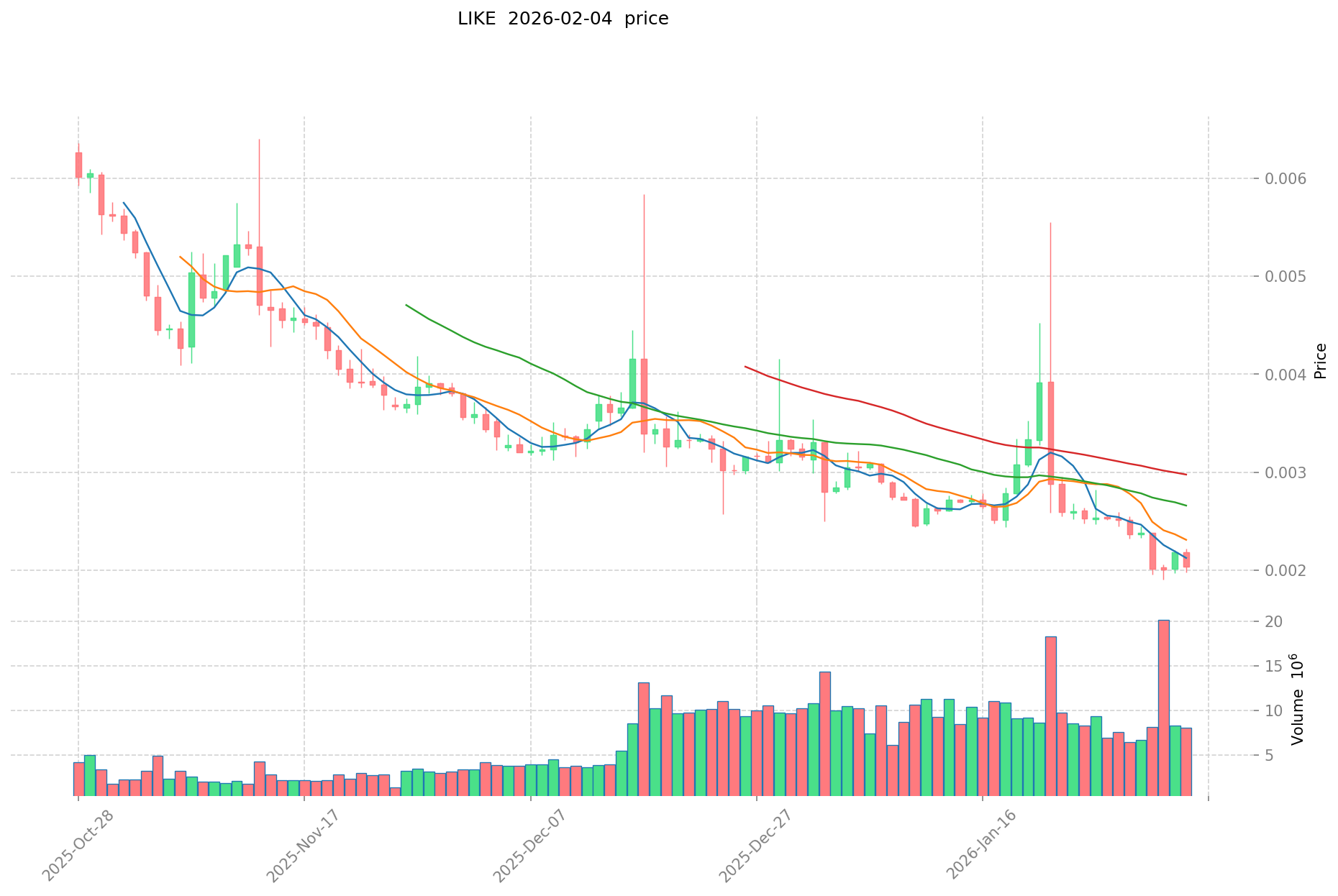
On-Chain Metrics
- Holder Count: Approximately 38,066 addresses hold LIKE tokens, demonstrating the distribution across the user base
- 24-Hour Trading Volume: $18,198.72, indicating current market liquidity and trading activity
- Market Capitalization: $794,167.12 based on circulating supply, representing the current market valuation
- Fully Diluted Valuation: $1,005,000, reflecting the potential market cap if all tokens were in circulation
Only1 Ecosystem Applications and Partners
Core Use Cases
Only1's ecosystem supports multiple applications:
- Social Media & NFT Integration: Only1 platform enables creators to mint Genesis NFTs and allows fans to bid on Star NFTs using LIKE tokens, providing decentralized content creation and fan engagement.
- Creator Economy: The platform facilitates direct interaction between creators and their communities, driving innovative reward mechanisms based on participation and NFT collection.
Strategic Collaborations
While specific partnership details are not extensively documented in available materials, Only1's Solana-based infrastructure positions it within the broader Solana ecosystem, potentially benefiting from network effects and technical synergies.
Challenges and Controversies
Only1 faces several challenges:
- Market Performance: The token has experienced substantial price decline, with a 90.52% decrease over the past year
- Liquidity Concerns: Daily trading volume of approximately $18,198 indicates relatively limited market activity
- Competitive Pressure: The social media and NFT platform space includes numerous competitors, requiring continuous innovation to maintain relevance
These factors have contributed to community discussions about the project's long-term viability and market positioning.
Only1 Community and Social Media Atmosphere
Community Engagement
Only1's community demonstrates notable participation, with 38,066 token holders as of February 2026. The platform's social media presence centers on its functionality combining content creation, NFT minting, and fan interaction.
Social Media Sentiment
Sentiment on X and other platforms shows mixed perspectives:
- Supporters highlight Only1's innovative approach to creator monetization and direct fan engagement, viewing it as a novel solution for content creators seeking independence from traditional platforms.
- Critics focus on significant price volatility and market capitalization decline, raising questions about long-term sustainability.
Recent trends reflect the challenges faced by many social-focused crypto projects in maintaining momentum during market downturns.
Trending Topics
X users discuss Only1's creator economy model, NFT functionality, and position within the Solana ecosystem, showcasing both its innovative potential and the obstacles in achieving mainstream adoption.
More Information Sources for Only1
- Official Website: Visit Only1 Official Website for features, use cases, and latest updates.
- X Presence: On X platform, Only1 maintains an active presence at @only1nft, sharing updates about platform features, creator success stories, and NFT launches.
- Blockchain Explorer: Track LIKE token activity on Solana Explorer
How to Participate in Only1?
- Purchase Options: Acquire LIKE tokens on Gate.com and other supporting exchanges
- Storage Solutions: Use Solana-compatible wallets such as Phantom or Solflare for secure storage
- Platform Engagement: Create content, mint NFTs, or collect creator NFTs through the Only1 platform
- Community Involvement: Follow official channels to stay updated on platform developments and opportunities
Summary
Only1 represents an innovative approach to combining social media with blockchain technology, offering direct creator-fan interaction, NFT minting capabilities, and participation-based rewards. Its integration with the Solana blockchain provides technical foundation for scalability and efficiency. Despite facing significant market challenges including price decline and limited liquidity, Only1's unique positioning in the creator economy space demonstrates the ongoing experimentation in decentralized social platforms. Whether you're a content creator or crypto enthusiast, Only1's model offers insights into the evolving intersection of social media and blockchain technology.
FAQ
What exactly is cryptocurrency and how does it work?
Cryptocurrency is a digital currency secured by cryptography, operating on decentralized blockchain networks. It uses advanced encryption to verify and record transactions without requiring traditional intermediaries, enabling peer-to-peer transfers globally.
What are the main characteristics of crypto compared to traditional money?
Crypto is decentralized, operates 24/7 without intermediaries, uses blockchain technology for security, and enables peer-to-peer transactions. Traditional money is centralized, government-regulated, and requires banks for transfers. Crypto offers faster global transactions and financial accessibility, though with price volatility and varying adoption rates.
What are the common types of cryptocurrencies and what are they used for?
Common cryptocurrencies include Bitcoin for payments, Ethereum for smart contracts, stablecoins for price stability, and utility tokens for platform services. They enable transactions, decentralized applications, and value storage.
What are the risks and benefits of investing in cryptocurrency?
Benefits include high return potential, 24/7 market access, and portfolio diversification. Risks involve extreme volatility, regulatory uncertainty, and security vulnerabilities. Cryptocurrency suits investors with substantial risk tolerance and long-term perspectives.
How do blockchain and cryptography secure cryptocurrencies?
Blockchain uses cryptographic hashing and asymmetric encryption to secure transactions. Private keys protect your funds while public keys verify ownership. This combination creates an immutable, tamper-proof ledger that prevents fraud and unauthorized access to cryptocurrencies.
Is cryptocurrency legal and regulated in different countries?
Cryptocurrency legality varies globally. Some countries like Mauritius and Uruguay regulate it as virtual assets, while others like Cuba have approved its use with specific regulations. Many nations, including India, are developing regulatory frameworks. Overall, crypto regulation is evolving and differs significantly by jurisdiction.
Share
Content
Only1's Positioning and Significance
Origin and Development History
How Does Only1 Work?
Only1 (LIKE) Market Performance
Only1 Ecosystem Applications and Partners
Challenges and Controversies
Only1 Community and Social Media Atmosphere
More Information Sources for Only1
How to Participate in Only1?
Summary
FAQ
How to Buy Cryptocurrency


Trending Cryptocurrencies



What Is a Phantom Wallet: A Guide for Solana Users in 2025

Solana Price in 2025: SOL Token Analysis and Market Outlook

How Does Solana's Proof of History Work?
Solana (SOL) : Low Fees, Memecoins, and the way to moon

Is Solana a Good Investment?
Solana in 2025: Ecosystem Growth and DeFi Dominance
Is LIORA (LIORA) a good investment?: A Comprehensive Analysis of Price, Technology, and Market Potential in 2024
Is Hyperbot (BOT) a good investment?: A Comprehensive Analysis of Price, Tokenomics, and Future Potential
LIORA vs STX: A Comprehensive Comparison of Two Leading Enterprise Solutions
BOT vs LINK: Which Blockchain Oracle Solution Offers Better Performance and Reliability for Smart Contracts?
MTV vs MANA: A Comprehensive Comparison of Two Revolutionary Blockchain-Based Entertainment Platforms