Is ArtMeta (MART) a good investment?: A Comprehensive Analysis of the Digital Art Platform's Potential Returns and Market Viability
Introduction: ArtMeta (MART)'s Investment Position and Market Outlook
MART is a notable asset in the cryptocurrency sector, functioning as the native token of the ArtMeta platform since its launch in 2022. The platform focuses on bridging traditional art galleries, artists, and collectors with the NFT market through digital tools and infrastructure. As of February 9, 2026, MART maintains a market capitalization of approximately $170,800, with a circulating supply of 100,000,000 tokens and a current trading price around $0.001708. With its positioning as a platform connecting fine art and blockchain technology, MART has become a subject of interest among investors exploring "Is ArtMeta (MART) a good investment?" This article provides a comprehensive analysis of MART's investment characteristics, historical price movements, future price considerations, and associated risks to serve as a reference for investors.
The token operates on the Polygon network and has experienced notable price fluctuations since its initial offering at $0.30. Recent data shows mixed short-term performance, with a 0.05% increase over 24 hours but declining trends over 7-day (-11%), 30-day (-25.86%), and 1-year (-28.92%) periods. The fully diluted valuation matches the current market cap at $170,800, indicating complete token circulation. With approximately 2,484 holders and daily trading volume of around $8,808, MART represents a smaller-cap asset within the broader digital asset ecosystem. This introduction sets the foundation for examining the token's value proposition, market dynamics, and risk factors in subsequent sections.
I. MART Price History Review and Investment Value Status
MART Historical Price Movement and Investment Returns (ArtMeta (MART) Investment Performance)
- 2022: MART reached a peak in July following its launch phase → Early adopters experienced substantial gains during initial trading activity
- 2024-2025: Extended market consolidation period → MART declined from prior elevated levels to lower valuation ranges, reflecting broader market conditions
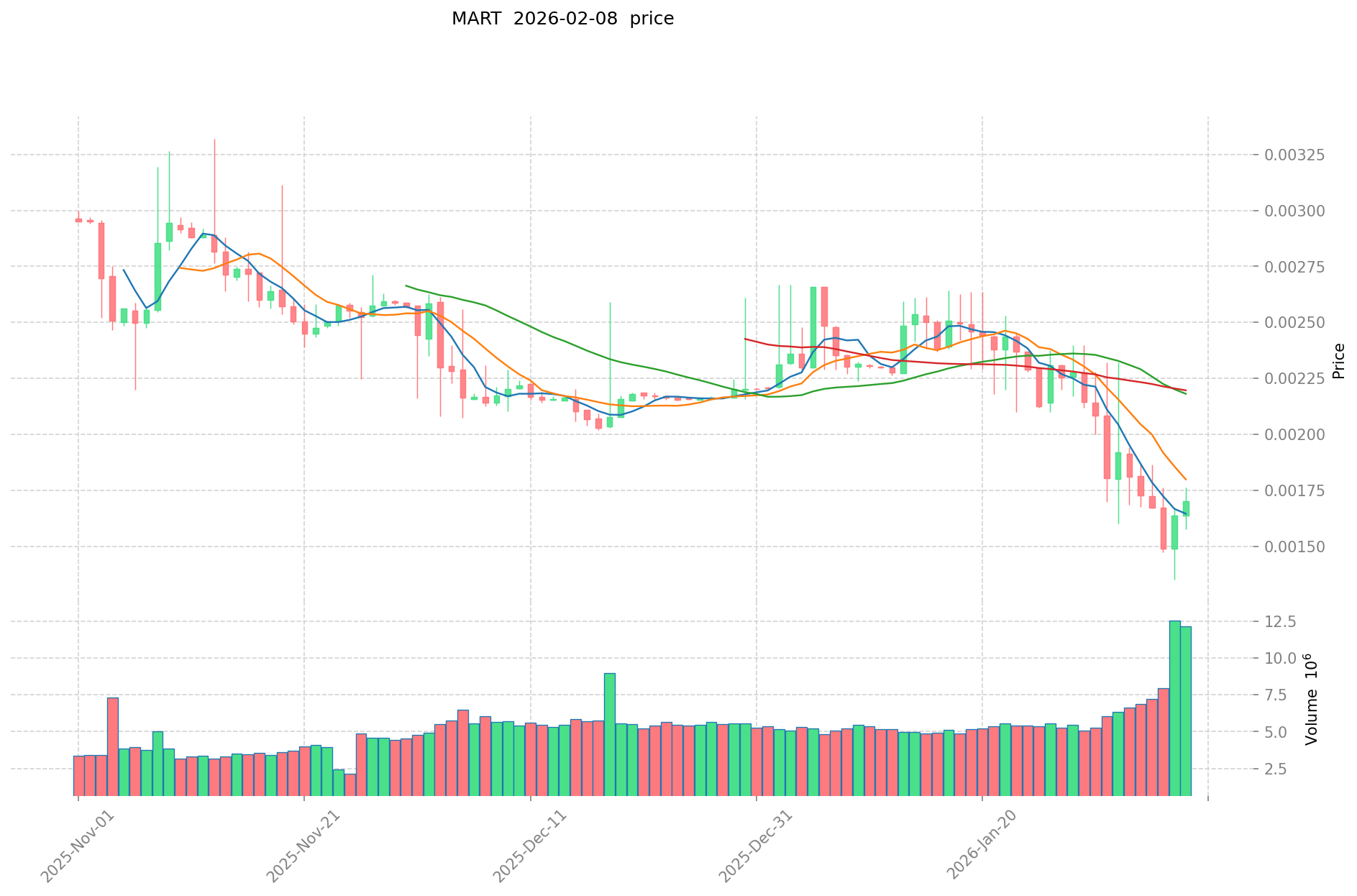
- Current cycle: Price movement between $0.001298 and $0.003808 (current level at $0.001708) → The token has experienced notable fluctuation relative to its launch valuation of $0.3
Current MART Investment Market Status (February 2026)
- Current MART price: $0.001708
- 24-hour price change: +0.05% (modest upward movement)
- 24-hour trading volume: $8,808.67
- Market capitalization: $170,800 (representing 100 million MART in circulation)
- Market sentiment: Trading activity remains relatively limited compared to major digital assets, with moderate liquidity levels
Click to view real-time MART market price
II. Core Factors Influencing Whether MART Is a Good Investment (Is ArtMeta(MART) a Good Investment)
Supply Mechanism and Scarcity (MART investment scarcity)
- Fixed supply model → Influences price and investment value
- ArtMeta has a maximum supply of 100,000,000 MART tokens, with 100% already in circulation
- Investment significance: The fully circulating supply eliminates future inflation risk, though scarcity alone does not guarantee value appreciation
Institutional Investment and Mainstream Adoption (Institutional investment in MART)
- The token has 2,484 holders as of February 2026, indicating a limited holder base
- No specific institutional adoption data is available in the provided materials
- Mainstream adoption remains limited, with the token listed on only one exchange
Macroeconomic Environment's Impact on MART Investment
- Broader cryptocurrency market sentiment affects MART's investment appeal
- Market volatility: MART has experienced notable price fluctuations, with a 25.86% decline over 30 days and an 11% drop over 7 days
- The token's small market cap of approximately $170,800 makes it susceptible to macroeconomic shifts and liquidity challenges
Technology and Ecosystem Development (Technology & Ecosystem for MART investment)
- Platform integration: ArtMeta provides tools for artists and galleries to participate in the NFT market, connecting art and cryptocurrency ecosystems
- Ecosystem applications: The platform focuses on digital art exhibitions, NFT sales, and virtual gallery experiences
- Limited technical upgrade information is available, though the platform's emphasis on NFT market infrastructure may support long-term ecosystem growth
III. MART Future Investment Forecast and Price Outlook (Is ArtMeta(MART) worth investing in 2026-2031)
Short-term Investment Forecast (2026, short-term MART investment outlook)
- Conservative estimate: $0.00158565 - $0.001705
- Neutral estimate: $0.001705 - $0.002167055
- Optimistic estimate: $0.002167055 - $0.0025234
Mid-term Investment Outlook (2027-2028, mid-term ArtMeta(MART) investment forecast)
- Market phase expectation: Consolidation phase with gradual recovery, influenced by broader crypto market sentiment and platform ecosystem development
- Investment return forecast:
- 2027: $0.001289662 - $0.00221991
- 2028: $0.00192867895 - $0.0028171715
- Key catalysts: Platform adoption rate, NFT market recovery trends, partnership expansions with art galleries, and overall cryptocurrency market conditions
Long-term Investment Outlook (Is MART a good long-term investment?)
- Baseline scenario: $0.002266577 - $0.0029865485 (assuming steady platform growth and moderate NFT market recovery)
- Optimistic scenario: $0.00282655484815 - $0.004013707884373 (assuming accelerated adoption by art institutions and favorable regulatory environment)
- Risk scenario: Below $0.001345741155 (under adverse market conditions or platform development setbacks)
View MART long-term investment and price forecast: Price Prediction
2026-02-09 - 2031 Long-term Outlook
- Base scenario: $0.001705 - $0.0026665611775 (corresponding to steady progress and gradual mainstream application improvement)
- Optimistic scenario: $0.00249211325 - $0.004013707884373 (corresponding to large-scale adoption and favorable market environment)
- Transformative scenario: Above $0.004013707884373 (such as breakthrough ecosystem progress and mainstream popularization)
- 2031-12-31 predicted high: $0.004013707884373 (based on optimistic development assumptions)
Disclaimer: Price predictions are based on historical data analysis and market trend projections. Cryptocurrency investments involve substantial risk, and actual performance may differ significantly from forecasts. This analysis does not constitute investment advice.
| Year | Predicted High Price | Predicted Average Price | Predicted Low Price | Price Change |
|---|---|---|---|---|
| 2026 | 0.0025234 | 0.001705 | 0.00158565 | 0 |
| 2027 | 0.00221991 | 0.0021142 | 0.001289662 | 23 |
| 2028 | 0.0028171715 | 0.002167055 | 0.00192867895 | 26 |
| 2029 | 0.002841009105 | 0.00249211325 | 0.001345741155 | 45 |
| 2030 | 0.0029865485188 | 0.0026665611775 | 0.002266577000875 | 56 |
| 2031 | 0.004013707884373 | 0.00282655484815 | 0.00169593290889 | 65 |
IV. ArtMeta Investment Strategy and Risk Management (How to invest in NFT art platforms)
Investment Methodology (ArtMeta investment strategy)
-
Long-term holding (HODL ArtMeta): Suitable for conservative investors
Long-term holding strategy involves acquiring MART tokens and maintaining positions through market cycles. This approach may be appropriate for investors who believe in the fundamental value proposition of connecting traditional art galleries with NFT infrastructure. Given the project's focus on providing tools for artists and galleries to participate in the NFT market, long-term holders typically focus on the platform's adoption metrics and partnership developments rather than short-term price movements.
-
Active trading: Relies on technical analysis and swing operations
Active trading strategies for MART involve analyzing price patterns, volume trends, and market momentum. With a 24-hour trading volume of approximately $8,808.67 and notable price volatility (ranging from $0.001681 to $0.001708 in the past 24 hours), traders may identify opportunities for swing trading. Technical indicators such as support and resistance levels, moving averages, and volume analysis can inform entry and exit points. However, the relatively limited exchange availability (listed on 1 exchange) may impact liquidity considerations for active trading strategies.
Risk Management (Risk management for ArtMeta investment)
-
Asset allocation ratio: Conservative / Aggressive / Professional investors
Conservative investors: May consider allocating 1-3% of their cryptocurrency portfolio to MART, with the majority held in more established assets. This approach limits exposure while maintaining participation in the NFT art platform sector.
Aggressive investors: Could allocate 5-10% to MART as part of a diversified NFT and metaverse-focused portfolio. This strategy accepts higher volatility in exchange for potential growth opportunities.
Professional investors: May employ dynamic allocation strategies based on market conditions, technical indicators, and fundamental developments. Professional approaches often include position sizing based on risk-reward ratios and correlation analysis with other portfolio holdings.
-
Risk hedging solutions: Multi-asset portfolio + hedging tools
Diversification across multiple asset classes remains a fundamental hedging approach. Investors may consider:
- Combining MART with established cryptocurrencies to balance portfolio volatility
- Including stablecoins to provide liquidity buffers during market downturns
- Diversifying across different NFT and metaverse projects to reduce single-project risk
- Utilizing stop-loss orders to limit downside exposure in volatile market conditions
-
Secure storage: Hot and cold wallets + hardware wallet recommendations
Given that MART operates on the Polygon (MATIC) network, secure storage options include:
- Cold storage: Hardware wallets compatible with Polygon network (such as Ledger or Trezor devices) provide enhanced security for long-term holdings by keeping private keys offline
- Hot wallets: Software wallets with Polygon support (such as MetaMask or Trust Wallet) offer convenience for active trading while maintaining user control of private keys
- Security practices: Implementing multi-signature wallets, regular security audits of wallet software, and maintaining separate wallets for different purposes (trading vs. long-term storage)
V. ArtMeta Investment Risks and Challenges (Risks of investing in NFT art platforms)
-
Market risks: High volatility, price manipulation
MART exhibits significant price volatility, with notable fluctuations across different timeframes. The token has experienced a -0.06% change over 1 hour, +0.05% over 24 hours, -11% over 7 days, -25.86% over 30 days, and -28.92% over 1 year. The current price of $0.001708 represents a substantial decline from its historical high of $0.380768 recorded on July 14, 2022. With a relatively modest market capitalization of approximately $170,800 and limited exchange availability, the token may be susceptible to price volatility influenced by trading activity. The concentration of holdings among 2,484 holders could potentially impact price stability.
-
Regulatory risks: Policy uncertainty across different jurisdictions
The NFT and digital art sectors face evolving regulatory frameworks across different jurisdictions. Regulatory developments may impact:
- Classification of NFTs as securities or commodities in various regions
- Tax treatment of NFT transactions and digital art sales
- Intellectual property rights and copyright considerations in digital art spaces
- Cross-border transaction compliance and reporting requirements
- Platform licensing and operational requirements for NFT marketplaces
These regulatory uncertainties may affect the platform's operational model and token utility.
-
Technical risks: Network security vulnerabilities, upgrade failures
Technical risks associated with MART include:
- Smart contract vulnerabilities on the Polygon network that could potentially be exploited
- Dependency on Polygon network performance and security
- Integration risks between traditional art gallery systems and blockchain infrastructure
- Platform scalability challenges as user adoption grows
- Potential technical issues during platform upgrades or feature implementations
- Risks associated with cross-chain interoperability if the platform expands beyond Polygon
VI. Conclusion: Is NFT art platform a Good Investment?
-
Investment value summary: ArtMeta presents an interesting proposition in connecting traditional art galleries with NFT infrastructure, though the token has experienced significant price contraction from its historical levels. The platform's focus on providing tools for artists and galleries to participate in the NFT market addresses a specific niche within the broader digital art ecosystem.
-
Investor recommendations:
✅ Beginners: Consider dollar-cost averaging (DCA) approach + secure wallet storage
- Start with small, regular investments to average out price volatility
- Prioritize learning about Polygon network and secure wallet management
- Focus on understanding the NFT art market fundamentals before larger commitments
✅ Experienced investors: Swing trading + portfolio allocation
- Monitor technical indicators and volume patterns for trading opportunities
- Maintain diversified exposure across multiple NFT and art-related projects
- Track platform development milestones and partnership announcements
✅ Institutional investors: Strategic long-term allocation
- Conduct comprehensive due diligence on platform technology and team
- Evaluate market positioning within the NFT art infrastructure landscape
- Consider allocation as part of broader digital art and metaverse investment thesis
⚠️ Notice: Cryptocurrency investment carries substantial risks. This content is provided for informational purposes only and does not constitute investment advice. Investors should conduct independent research and consider their risk tolerance before making investment decisions.
VII. FAQ
Q1: What is the current market performance of MART, and how does it compare to its historical price?
MART is currently trading at approximately $0.001708 with a market capitalization of $170,800 and 100 million tokens in circulation. This represents a significant decline from its historical high of $0.380768 reached on July 14, 2022. The token has experienced notable price contraction across multiple timeframes, with declines of 11% over 7 days, 25.86% over 30 days, and 28.92% over the past year. The current price level reflects extended market consolidation following its initial launch period, with daily trading volume of approximately $8,808.67 indicating limited liquidity compared to major digital assets.
Q2: What makes ArtMeta's platform unique in the NFT ecosystem?
ArtMeta operates on the Polygon network and focuses specifically on bridging traditional art galleries, artists, and collectors with the NFT market through digital tools and infrastructure. The platform provides resources for digital art exhibitions, NFT sales, and virtual gallery experiences, distinguishing itself by targeting the intersection of fine art institutions and blockchain technology. This niche positioning addresses the specific needs of traditional art market participants seeking to engage with digital asset markets, though the platform's adoption remains in early stages with approximately 2,484 token holders as of February 2026.
Q3: Is MART suitable for long-term investment, and what are the price projections?
Long-term investment suitability depends on individual risk tolerance and portfolio allocation strategy. Price projections suggest a baseline scenario of $0.001705 to $0.0026665611775 through 2030, with an optimistic scenario reaching $0.004013707884373 by 2031 under favorable conditions. However, investors should note that MART has experienced 28.92% decline over the past year, and the token's small market capitalization of $170,800 makes it susceptible to volatility. Conservative investors may consider 1-3% portfolio allocation, while aggressive investors might allocate 5-10% as part of a diversified NFT-focused strategy. These projections are based on assumptions of steady platform adoption and market recovery, and actual performance may differ significantly.
Q4: What are the primary risks associated with investing in MART?
MART investment carries several significant risks: (1) Market risk - high price volatility with substantial decline from historical highs, limited liquidity with only one exchange listing, and concentration among 2,484 holders potentially impacting price stability; (2) Regulatory risk - evolving frameworks for NFTs across jurisdictions affecting classification, tax treatment, intellectual property rights, and platform operational requirements; (3) Technical risk - smart contract vulnerabilities on Polygon network, platform scalability challenges, integration risks between traditional art systems and blockchain infrastructure, and potential upgrade failures. The token's modest market cap and limited mainstream adoption amplify these risk factors.
Q5: How should different investor types approach MART investment?
Investment approach should align with experience level and risk profile. Beginners should employ dollar-cost averaging (DCA) with small, regular investments to mitigate volatility, prioritize learning about Polygon network security and wallet management, and focus on understanding NFT art market fundamentals before larger commitments. Experienced investors may consider swing trading strategies based on technical indicators and volume patterns, maintain diversified exposure across multiple NFT projects, and actively track platform development milestones. Institutional investors should conduct comprehensive due diligence on platform technology and team composition, evaluate market positioning within the NFT art infrastructure landscape, and consider allocation as part of a broader digital art and metaverse investment thesis.
Q6: What security measures should MART holders implement?
Security implementation varies based on holding strategy and time horizon. For long-term storage, hardware wallets compatible with Polygon network (such as Ledger or Trezor devices) provide enhanced security by keeping private keys offline and protecting against online threats. Active traders may utilize software wallets with Polygon support (such as MetaMask or Trust Wallet) for convenient access while maintaining control of private keys. Recommended security practices include implementing multi-signature wallets for larger holdings, conducting regular security audits of wallet software, maintaining separate wallets for different purposes (trading versus long-term storage), and avoiding storage of significant amounts on exchange platforms where users do not control private keys.
Q7: What factors could drive MART price appreciation in the future?
Several catalysts could potentially support price appreciation: (1) Platform adoption metrics - increased onboarding of art galleries, artists, and collectors utilizing ArtMeta's NFT infrastructure tools; (2) NFT market recovery - broader market sentiment improvement in the digital art and collectibles sector; (3) Partnership expansions - strategic collaborations with established art institutions and galleries; (4) Ecosystem development - successful implementation of new features and technical upgrades enhancing platform utility; (5) Regulatory clarity - favorable regulatory frameworks providing certainty for NFT platforms and digital art markets. However, given the token's significant decline from historical levels and limited current adoption with 2,484 holders, these catalysts would need substantial materialization to drive meaningful price appreciation.
Q8: How does MART's tokenomics structure affect investment considerations?
MART has a fixed maximum supply of 100,000,000 tokens with 100% already in circulation, resulting in a fully diluted valuation that matches the current market capitalization of approximately $170,800. This complete circulation eliminates future inflation risk from additional token releases, providing clarity on supply dynamics. However, scarcity alone does not guarantee value appreciation, and the token's investment merit depends primarily on platform adoption, utility development, and broader market conditions. The absence of unlocking schedules or future emissions removes potential selling pressure from team or investor allocations, though the concentrated holder base of 2,484 participants may impact liquidity and price stability during periods of trading activity.
Share
Content
Introduction: ArtMeta (MART)'s Investment Position and Market Outlook
I. MART Price History Review and Investment Value Status
II. Core Factors Influencing Whether MART Is a Good Investment (Is ArtMeta(MART) a Good Investment)
III. MART Future Investment Forecast and Price Outlook (Is ArtMeta(MART) worth investing in 2026-2031)
IV. ArtMeta Investment Strategy and Risk Management (How to invest in NFT art platforms)
V. ArtMeta Investment Risks and Challenges (Risks of investing in NFT art platforms)
VI. Conclusion: Is NFT art platform a Good Investment?
VII. FAQ
How to Buy Cryptocurrency


Trending Cryptocurrencies



Treasure NFT Marketplace: A 2025 Guide for Web3 Gamers and Investors

What are the new trends in the NFT market in 2025?

NFT Treasure Hunting: Top Strategies for Web3 Collectors in 2025
How to Create and Sell NFTs: A Step-by-Step Guide for Beginners

The technical principles and application scenarios of 2025 NFTs

How to Create an NFT in 2025: A Step-by-Step Guide

What is AIX9: A Comprehensive Guide to the Next Generation of Enterprise Computing Solutions

What is KLINK: A Comprehensive Guide to Understanding the Revolutionary Communication Platform

What is ART: A Comprehensive Guide to Understanding Assisted Reproductive Technology and Its Impact on Modern Fertility Treatment
What is KAR: A Comprehensive Guide to Knowledge and Reasoning Systems in Modern Technology

What is MART: A Comprehensive Guide to Multi-Agent Reinforcement Learning Through Time