What is KAR: A Comprehensive Guide to Knowledge and Reasoning Systems in Modern Technology

Karura's Positioning and Significance
In 2021, the Acala Network team launched Karura (KAR), aiming to address inefficiencies in decentralized finance access and cross-chain interoperability within the Kusama ecosystem. As Kusama's decentralized financial hub and Acala's sister platform, Karura plays a crucial role in DeFi innovation and cross-chain asset management.
As of 2026, Karura has established itself as a key infrastructure project within the Kusama ecosystem, supporting efficient and cost-effective financial applications with an active development community. This article will analyze its technical architecture, market performance, and future potential.
Origin and Development History
Background
Karura was created by the Acala Network team in 2021, aiming to solve limitations in DeFi scalability, cross-chain asset utilization, and transaction costs. It emerged during the rapid expansion of the Polkadot and Kusama ecosystems, with the goal of providing a fast, user-friendly platform for decentralized financial applications and transforming the status quo. Karura's launch brought new possibilities to DeFi users and developers seeking efficient cross-chain solutions.
Key Milestones
- 2021: Secured Kusama parachain slot and launched mainnet, enabling cross-chain DeFi functionality and multi-collateral stablecoin support.
- 2021: Introduced decentralized exchange (DEX) capabilities and trustless staking derivatives, expanding liquidity release mechanisms.
- Ongoing: Continuous ecosystem development with growing adoption of DeFi protocols and cross-chain applications.
With support from the Acala Foundation and the Kusama community, Karura continues to optimize its technology, security, and real-world applications.
How Does Karura Work?
No Central Control
Karura operates on a decentralized network of computers (nodes) distributed globally, independent of banks or governments. These nodes collaborate to validate transactions, ensuring system transparency and attack resistance, granting users greater autonomy and enhancing network resilience.
Blockchain Core
Karura's blockchain is a public, immutable digital ledger that records every transaction. Transactions are grouped into blocks and linked through cryptographic hashes to form a secure chain. Anyone can view the records, establishing trust without intermediaries. As a Kusama parachain, Karura leverages shared security and cross-chain communication capabilities to enhance performance and interoperability.
Ensuring Fairness
Karura utilizes Kusama's Nominated Proof-of-Stake (NPoS) consensus mechanism to validate transactions and prevent fraud such as double-spending. Validators and nominators maintain network security through staking and block production, earning KAR rewards. Its innovation includes efficient parachain architecture enabling faster and more cost-effective transactions.
Secure Transactions
Karura employs public-private key cryptography to protect transactions:
- Private keys (like secret passwords) are used to sign transactions
- Public keys (like account numbers) are used to verify ownership
This mechanism ensures fund security while maintaining pseudonymous transaction privacy. Additional security features include integration with Kusama's shared security model and multi-signature support for enhanced protection.
Karura (KAR)'s Market Performance
Circulation Overview
As of February 09, 2026, Karura (KAR) has a circulating supply of 116,666,660 tokens, with a total supply of 160,000,000 tokens. The maximum supply is capped at 160,000,000 tokens, indicating a fixed supply model.
The circulating supply represents approximately 72.92% of the total supply, with the remaining tokens potentially allocated for future ecosystem development, team reserves, or community incentives.
Price Volatility
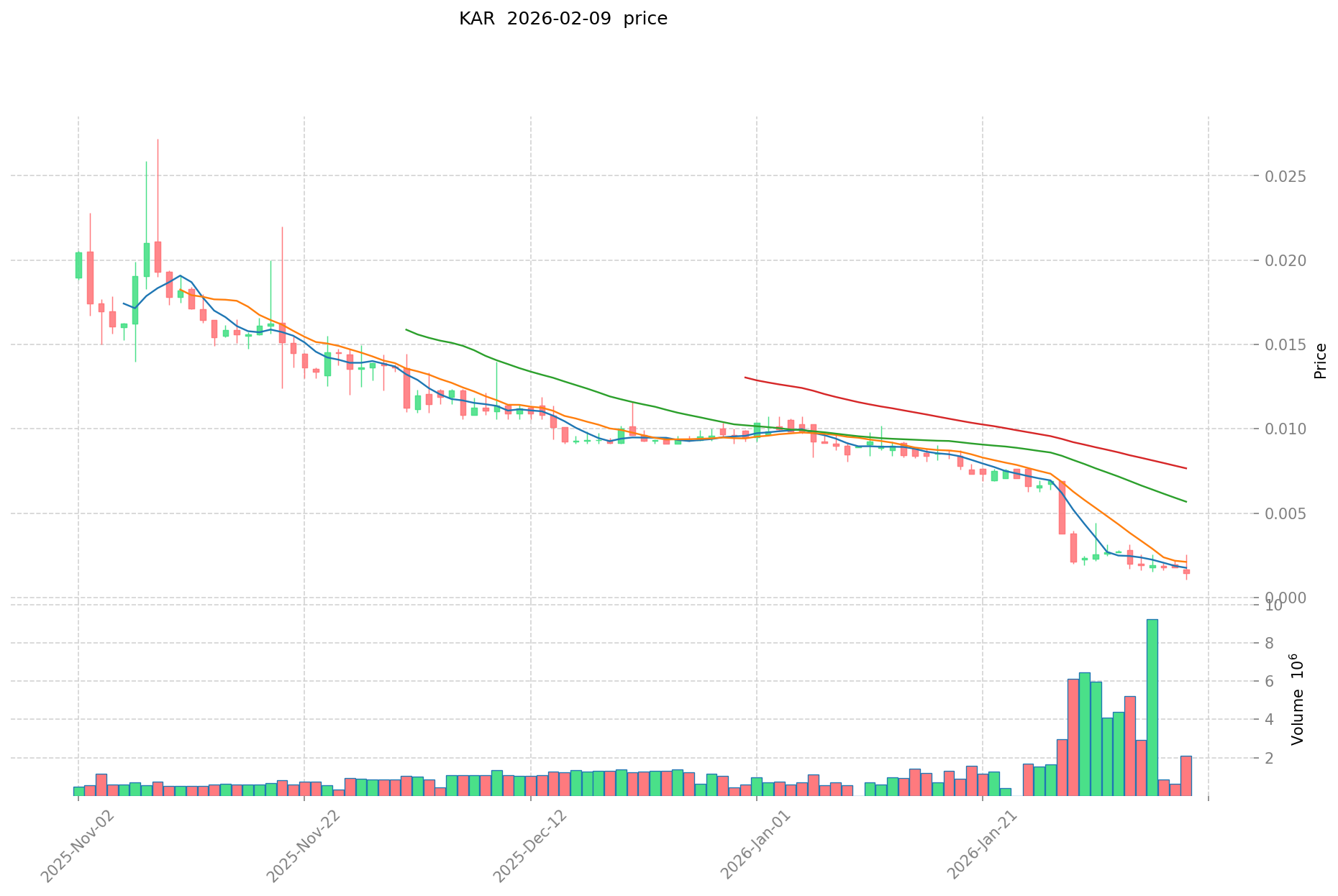
Karura (KAR) reached its all-time high of $13.20 on September 16, 2021, during a period of heightened interest in the Kusama parachain ecosystem and broader DeFi market expansion.
The token recorded its lowest price of $0.00147133 on February 06, 2026, reflecting significant market correction and changing sentiment in the cross-chain DeFi sector.
Recent price movements show notable volatility:
- 1-hour change: -4.83%
- 24-hour change: -17.26%
- 7-day change: -50.68%
- 30-day change: -83.76%
- 1-year change: -97.64%
These fluctuations reflect evolving market sentiment, adoption patterns, and broader cryptocurrency market dynamics.
Click to view current KAR market price
On-Chain Metrics
- 24-hour Trading Volume: $3,579.77 (indicating current market activity levels)
- Market Capitalization: $169,166.66 (reflecting the token's current market valuation)
- Fully Diluted Valuation: $232,000.00 (representing the potential market cap if all tokens were in circulation)
Karura Ecosystem Applications and Strategic Partners
Core Use Cases
Karura's ecosystem supports multiple applications:
- DeFi: As Kusama's decentralized financial hub, Karura provides decentralized exchange (DEX) functionality, enabling efficient cross-chain asset trading.
- Stablecoin Infrastructure: The platform offers multi-collateralized stablecoins backed by cross-chain assets including Kusama and Bitcoin, facilitating stable value transfer across the network.
- Liquid Staking Derivatives: Karura enables trustless staking derivatives, unlocking liquidity while maintaining staking rewards.
Strategic Partnerships
As the sister platform of Acala, Karura leverages shared technology and ecosystem relationships to enhance its capabilities within the Kusama network. These connections provide a foundation for Karura's ecosystem expansion and interoperability with other parachains.
Challenges and Controversies
Karura faces several challenges:
- Market Volatility: The token has experienced significant price fluctuations, with a substantial decline over recent periods.
- Competitive Pressure: Competition from other DeFi platforms and parachains within the Kusama and broader Polkadot ecosystem.
- Liquidity Concerns: Limited trading volume and exchange availability compared to larger DeFi platforms.
These issues have prompted ongoing discussions within the community about platform development and market positioning.
Karura Community and Social Media Atmosphere
Community Engagement
Karura maintains an active community presence through its connection to the Acala Network. The platform's GitHub repository demonstrates ongoing development activity, reflecting technical commitment to the project's evolution.
Social Media Presence
On X platform, Karura shares updates through the @AcalaNetwork handle, covering:
- Technical developments related to the Karura parachain
- DeFi innovations within the Kusama ecosystem
- Cross-chain functionality improvements
Community sentiment reflects both enthusiasm for the platform's DeFi capabilities and concerns about market performance and adoption rates.
Discussion Topics
X users frequently discuss Karura's role in the Kusama DeFi ecosystem, cross-chain interoperability features, and market positioning relative to other DeFi platforms, highlighting both its technical potential and adoption challenges.
More Information Sources for Karura
- Official Website: Visit Karura's official website for features, use cases, and latest updates.
- Blockchain Explorer: Track on-chain activity through Karura Subscan for transaction data and network statistics.
- X Updates: Karura maintains presence through @AcalaNetwork on X platform, sharing updates about technical upgrades, ecosystem developments, and community initiatives.
- Development Resources: Access technical documentation through the Acala Network GitHub for development guides and code repositories.
How to Participate in Karura?
- Purchase Options: Trade KAR on Gate.com and other supported exchanges
- Storage Solutions: Store KAR tokens securely using compatible Polkadot ecosystem wallets
- Ecosystem Participation: Utilize Karura's DeFi features including DEX trading, stablecoin minting, and liquid staking
- Development Contributions: Visit the GitHub repository to contribute to platform development or build applications on Karura
Summary
Karura represents Kusama's dedicated DeFi hub, offering decentralized exchange functionality, multi-collateralized stablecoins, and liquid staking derivatives through its parachain infrastructure. The platform's shared codebase with Acala provides technical robustness while enabling fast, cost-effective financial applications.
Despite facing market volatility and competitive pressures within the broader DeFi landscape, Karura's focus on cross-chain interoperability and comprehensive DeFi tooling positions it as a notable platform within the Kusama ecosystem. Its integration with Kusama's parachain architecture and ongoing development activity demonstrate continued commitment to advancing decentralized finance capabilities.
Whether you're exploring DeFi opportunities or researching cross-chain financial infrastructure, Karura offers a platform worth monitoring within the Kusama network.
FAQ
What is KAR cryptocurrency? What are its main functions and uses?
KAR is the token of Karura, the first DeFi project in the Polkadot ecosystem. It provides cross-chain financial services including lending, liquidity mining, and decentralized finance solutions within the Polkadot network.
How to buy and store KAR tokens? Which exchanges are supported?
Purchase KAR through decentralized exchanges like Uniswap or crypto wallets. Store KAR in non-custodial wallets such as MetaMask for full security control. Multiple platforms support KAR trading with competitive fees and strong liquidity.
What are the technical characteristics of the KAR project? How does it differ from other cryptocurrencies?
KAR is the native asset on Karura chain, Acala's parachain. It enables trustless asset reserve management and decentralized governance. Unlike traditional cryptocurrencies, KAR supports decentralized financial infrastructure with cross-chain interoperability through Polkadot ecosystem integration.
What are the risks of investing in KAR? What security issues should I pay attention to?
KAR investment involves market volatility, technology risks, and regulatory uncertainty. Ensure platform security, use strong passwords, enable two-factor authentication, and verify addresses before transactions. Consult financial advisors before investing.
What is the development prospect of KAR? What is the team background and project roadmap?
KAR has broad development prospects, with a team focused on enhancing performance management. The roadmap includes continuous optimization and implementation of advanced performance tools to drive ecosystem growth and user adoption.
What is the total supply of KAR? How is the tokenomics designed?
KAR has a total supply of 160,000,000 tokens with 116,666,660 currently in circulation. The tokenomics is designed to balance ecosystem incentives and sustainable value distribution across network participants and stakeholders.
Share
Content
Karura's Positioning and Significance
Origin and Development History
How Does Karura Work?
Karura (KAR)'s Market Performance
Karura Ecosystem Applications and Strategic Partners
Challenges and Controversies
Karura Community and Social Media Atmosphere
More Information Sources for Karura
How to Participate in Karura?
Summary
FAQ
How to Buy Cryptocurrency


Trending Cryptocurrencies



2025 SUI coin: price, buying guide, and Staking rewards
How to Buy Crypto: A Step-by-Step Guide with Gate.com

HNT Price in 2025: Helium Network Token Value and Market Analysis
What is SwissCheese (SWCH) and How Does It Democratize Investment?

Cardano (ADA) Price Analysis and Outlook for 2025

How to Invest in Metaverse Crypto

What is AIX9: A Comprehensive Guide to the Next Generation of Enterprise Computing Solutions

What is KLINK: A Comprehensive Guide to Understanding the Revolutionary Communication Platform

What is ART: A Comprehensive Guide to Understanding Assisted Reproductive Technology and Its Impact on Modern Fertility Treatment

What is MART: A Comprehensive Guide to Multi-Agent Reinforcement Learning Through Time
2026 BSCS Price Prediction: Expert Analysis and Market Forecast for the Upcoming Year