This comprehensive analysis evaluates Eesee (ESE) as a potential investment opportunity, examining its raffle-based liquidity protocol for digital assets and real-world assets (RWAs). The article reviews ESE's price history since its 2024 launch, current market status with a capitalization of approximately $557,255, and key investment factors including token scarcity and ecosystem adoption. It provides short-term, mid-term, and long-term price forecasts ranging from conservative to optimistic scenarios through 2031. The guide outlines investment strategies for different investor types, risk management approaches including allocation ratios and secure storage recommendations for this ERC-20 token on Ethereum. Critical risk factors such as high volatility, regulatory uncertainties, and market concentration are thoroughly analyzed. ESE is trading on Gate.com and other exchanges with daily volume of $77,164, positioning it as a niche infrastructure token requiring careful due diligence before investment.
Introduction: Eesee (ESE) Investment Position and Market Prospects
ESE is a digital asset in the cryptocurrency field. Since its launch in 2024, it has been designed as a liquidity solution for digital assets, tokens, and real-world assets (RWAs) through a raffle-based protocol. As of February 5, 2026, Eesee has a market capitalization of approximately $557,254.68, with a circulating supply of around 651,988,628.53 tokens, and the current price is approximately $0.0008547. With its positioning as a "one-stop liquidity solution for sellers," ESE has gradually become a subject of discussion among investors evaluating "Is Eesee (ESE) a good investment?" This article will comprehensively analyze ESE's investment value, historical price trends, future price forecasts, and investment risks to provide reference for investors.
I. Eesee (ESE) Price History Review and Current Investment Value
- 2024: ESE launched at $0.018, providing early investment opportunities → The token experienced significant volatility during its initial trading period
- 2024: ESE reached a notable price level of $0.29157 in April → Market conditions led to subsequent price adjustments
- 2025: Market cycle evolution → Price declined from previous levels to $0.000783 in early February
Current ESE Investment Market Status (February 2026)
- ESE Current Price: $0.0008547
- 24-hour Trading Volume: $77,164.04
- Market Capitalization: $557,254.68
- Circulating Supply: 651,988,628.53 ESE (65.20% of total supply)
Click to view real-time ESE market price
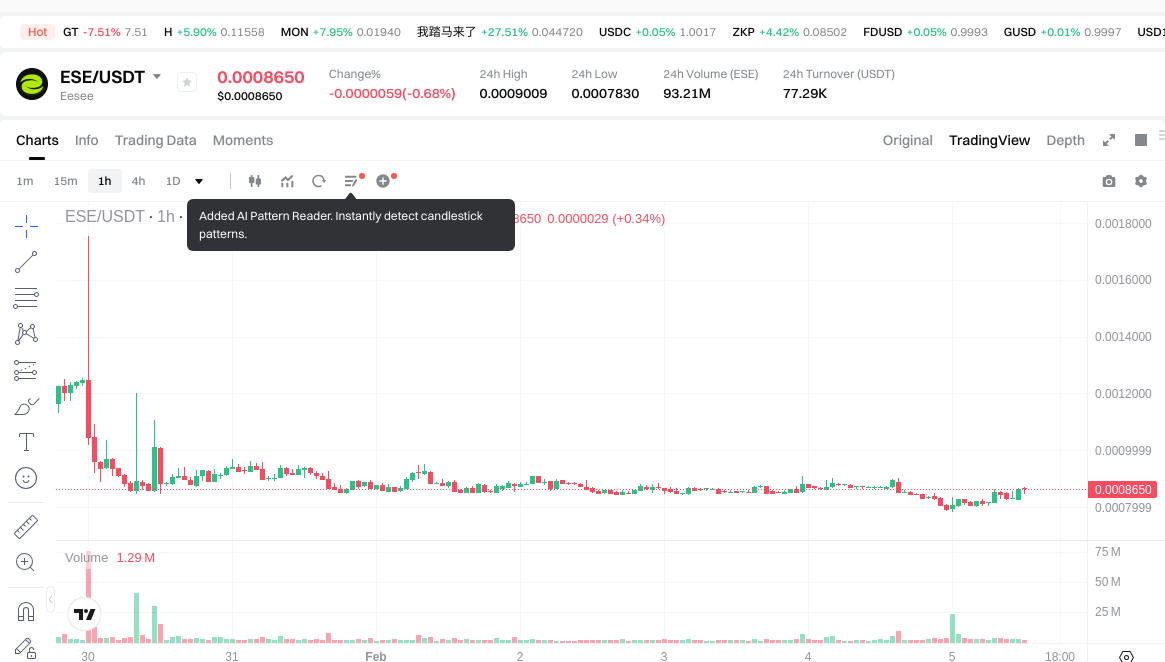
II. Core Factors Influencing Whether ESE is a Good Investment
Supply Mechanism and Scarcity (ESE Investment Scarcity)
- Total supply: 1,000,000,000 ESE tokens, with a max supply capped at 1,000,000,000 ESE
- Current circulating supply: approximately 651,988,628 ESE (65.2% of total supply)
- The fixed maximum supply establishes a scarcity framework that may influence long-term value dynamics
- Market cap to fully diluted valuation ratio stands at 65.2%, indicating a significant portion of tokens already in circulation
- Investment consideration: The predetermined supply ceiling creates a structured scarcity model, which historically has been a factor in digital asset valuation frameworks
Institutional Investment and Mainstream Adoption (Institutional Investment in ESE)
- Current holder count: 3,262 addresses
- ESE is listed on 5 exchanges, with trading available on Gate.com
- The project focuses on providing liquidity solutions for digital assets, tokens, and real-world assets (RWAs), positioning itself within emerging market infrastructure
- Adoption dynamics: eesee's raffle-based liquidity protocol targets artists and sellers in the web3 ecosystem, aiming to lower entry barriers and accelerate asset turnover
- Market presence remains relatively niche, with a market dominance of 0.000033%
Macroeconomic Environment's Impact on ESE Investment
- Broader cryptocurrency market conditions continue to influence ESE's trading patterns and liquidity
- As a lower market cap digital asset, ESE may exhibit heightened sensitivity to shifts in risk appetite and regulatory developments
- The token's utility within a liquidity and raffle protocol may provide some structural demand, though correlation with general market trends remains present
- Economic uncertainty and evolving digital asset adoption trends could affect investor interest in niche protocol tokens
Technology and Ecosystem Development (Technology & Ecosystem for ESE Investment)
- ESE operates as an ERC-20 token on the Ethereum network (contract address: 0x908dDb096BFb3AcB19e2280aAD858186ea4935C4)
- Core functionality: eesee provides a raffle-based liquidity mechanism designed to accelerate sales and enhance market liquidity for digital assets and RWAs
- The protocol aims to reduce cost barriers for web3 market participation through its unique raffle system
- Ecosystem positioning: The project targets artists, sellers, and traders seeking alternative liquidity solutions beyond traditional marketplace models
- Technical infrastructure leverages Ethereum's established network, benefiting from existing security and interoperability standards
III. ESE Future Investment Forecast and Price Outlook (Is Eesee(ESE) Worth Investing in 2026-2030)
Short-Term Investment Forecast (2026, Short-Term ESE Investment Outlook)
- Conservative Forecast: $0.000609 - $0.00087
- Neutral Forecast: $0.00087 - $0.0008961
- Optimistic Forecast: $0.001279 - $0.00188
Mid-Term Investment Outlook (2027-2028, Mid-Term Eesee(ESE) Investment Forecast)
- Market Stage Expectation: The token may enter a potential growth cycle, with price fluctuations reflecting market sentiment and ecosystem development progress.
- Investment Return Forecast:
- 2027: $0.000600474 - $0.001183287
- 2028: $0.00072321795 - $0.001374114105
- Key Catalysts: Market adoption trends, ecosystem expansion, and broader cryptocurrency market conditions.
Long-Term Investment Outlook (Is ESE a Good Long-Term Investment?)
- Baseline Scenario: $0.001088994468436 - $0.001739562592438 (assuming steady ecosystem development and stable market conditions)
- Optimistic Scenario: $0.001434997710908 - $0.002144611963555 (assuming accelerated adoption and favorable market environment)
- Risk Scenario: Below $0.000609 (under adverse market conditions or significant ecosystem setbacks)
Click to view ESE long-term investment and price prediction: Price Prediction
2026-02-05 - 2031 Long-Term Outlook
- Baseline Scenario: $0.001088994468436 - $0.001739562592438 (corresponding to steady progress and gradual mainstream application growth)
- Optimistic Scenario: $0.001434997710908 - $0.002144611963555 (corresponding to large-scale adoption and favorable market environment)
- Transformative Scenario: Above $0.002144611963555 (such as breakthrough ecosystem progress and mainstream popularization)
- 2031-12-31 Forecast High: $0.002144611963555 (based on optimistic development assumptions)
Disclaimer: Price predictions are subject to market volatility and uncertainties. These forecasts are for informational purposes only and should not be considered as investment advice.
| Year |
Predicted High Price |
Predicted Average Price |
Predicted Low Price |
Price Change |
| 2026 |
0.0008961 |
0.00087 |
0.000609 |
1 |
| 2027 |
0.001183287 |
0.00088305 |
0.000600474 |
3 |
| 2028 |
0.001374114105 |
0.0010331685 |
0.00072321795 |
20 |
| 2029 |
0.001624915758375 |
0.0012036413025 |
0.0010592043462 |
40 |
| 2030 |
0.001739562592438 |
0.001414278530437 |
0.001088994468436 |
65 |
| 2031 |
0.002144611963555 |
0.001576920561437 |
0.001434997710908 |
84 |
IV. Eesee Investment Strategy and Risk Management (How to invest in Eesee)
Investment Strategy (Eesee investment strategy)
Long-term Holding (HODL Eesee)
Long-term holding represents a conservative approach suitable for risk-averse investors seeking exposure to Eesee's liquidity solution platform. This strategy involves acquiring ESE tokens and maintaining positions through market fluctuations, with the expectation that the protocol's adoption in digital assets, tokens, and real-world asset (RWA) markets may drive value appreciation over extended periods. Investors employing this method typically focus on fundamental developments rather than short-term price movements.
Active Trading
Active trading strategies rely on technical analysis and swing trading techniques to capitalize on ESE's price volatility. Given the token's historical price range between $0.000783 and $0.29157, traders may identify potential entry and exit points through chart patterns, volume analysis, and momentum indicators. The 24-hour trading volume of approximately $77,164 suggests moderate liquidity for tactical trading operations, though participants should assess depth and slippage before executing positions.
Risk Management (Risk management for Eesee investment)
Asset Allocation Ratios
- Conservative investors: May consider allocating 1-3% of their crypto portfolio to ESE, maintaining majority holdings in established assets
- Aggressive investors: Could allocate 5-10% to ESE as part of a higher-risk, higher-reward strategy
- Professional investors: Might integrate ESE within diversified blockchain infrastructure portfolios at 3-7% allocation, depending on risk tolerance and market conditions
Risk Hedging Solutions
Implementing multi-asset portfolios can help mitigate concentration risk associated with ESE investment. Combining ESE holdings with established cryptocurrencies, stablecoins, and traditional assets may reduce overall portfolio volatility. Additionally, investors might consider hedging instruments or maintaining adequate cash reserves to manage position sizing during market downturns.
Secure Storage
ESE operates on the Ethereum blockchain as an ERC-20 token (contract address: 0x908dDb096BFb3AcB19e2280aAD858186ea4935C4). Security-conscious investors should consider:
- Cold wallets: Hardware wallets such as Ledger or Trezor for long-term storage
- Hot wallets: Reputable software wallets like MetaMask for active trading, maintaining only necessary amounts
- Multi-signature wallets: For institutional or high-value holdings requiring enhanced security protocols
V. Eesee Investment Risks and Challenges (Risks of investing in Eesee)
Market Risks
ESE demonstrates considerable price volatility, with year-to-date performance showing a decline of approximately 95.72% from its historical high of $0.29157 recorded on April 11, 2024. The 24-hour price fluctuation between $0.000783 and $0.0009009 illustrates ongoing market instability. The relatively modest market capitalization of approximately $557,255 and trading volume may expose investors to heightened volatility and potential price manipulation risks common in smaller-cap digital assets.
Regulatory Risks
Cryptocurrency regulatory frameworks vary significantly across jurisdictions and continue evolving. ESE investors face uncertainty regarding:
- Classification of tokens under securities regulations
- Platform compliance requirements for raffle and liquidity protocols
- Potential restrictions on cross-border token transfers
- Tax treatment variations across different markets
Changes in regulatory approaches could materially impact ESE's utility, trading availability, and market valuation.
Technical Risks
As an ERC-20 token integrated with a raffle-based liquidity protocol, ESE faces several technical considerations:
- Smart contract vulnerabilities: Potential exploits in protocol code could compromise user funds or platform functionality
- Ethereum network dependencies: Gas fee fluctuations and network congestion may affect transaction costs and user experience
- Protocol upgrade risks: Implementation of platform updates or modifications could introduce unexpected issues
- Integration challenges: Dependencies on third-party services or protocols may create additional points of failure
With approximately 3,262 holders, the relatively concentrated token distribution may present governance and decentralization considerations.
VI. Conclusion: Is Eesee a Good Investment?
Investment Value Summary
Eesee presents a specialized approach to liquidity solutions in the digital asset space, targeting sellers of NFTs, tokens, and RWAs through its raffle-based protocol. The platform's focus on reducing cost barriers and accelerating sales addresses specific market needs. However, the token has experienced substantial price decline since launch, with current trading approximately 99.7% below its historical peak. The market capitalization to fully diluted valuation ratio of 65.2% indicates partial token circulation, which may influence future supply dynamics.
Investor Recommendations
✅ Beginners: Consider dollar-cost averaging (DCA) strategies to mitigate entry timing risks, combined with secure cold wallet storage. Limit initial exposure to amounts comfortable for potential total loss given the asset's volatility profile.
✅ Experienced Investors: May explore swing trading opportunities leveraging technical analysis, while maintaining diversified portfolio positions. Consider the platform's fundamental developments and ecosystem adoption metrics when evaluating position sizing.
✅ Institutional Investors: Could assess ESE as a component of strategic NFT and RWA infrastructure exposure, subject to thorough due diligence on protocol mechanics, team credentials, and competitive positioning within the liquidity solutions sector.
⚠️ Notice: Cryptocurrency investments carry substantial risk, including potential complete loss of capital. This content serves informational purposes only and does not constitute financial advice. Investors should conduct independent research and consult qualified financial professionals before making investment decisions.
VII. FAQ
Q1: What is Eesee (ESE) and how does its liquidity protocol work?
Eesee is a raffle-based liquidity protocol designed to provide solutions for digital assets, tokens, and real-world assets (RWAs). It operates as an ERC-20 token on the Ethereum network with the contract address 0x908dDb096BFb3AcB19e2280aAD858186ea4935C4. The platform aims to accelerate sales and enhance market liquidity by offering an alternative mechanism to traditional marketplace models, specifically targeting artists, sellers, and traders seeking to lower entry barriers and reduce transaction costs in the web3 ecosystem.
Q2: What has been ESE's price performance since launch?
ESE launched in 2024 at $0.018 and reached a historical peak of $0.29157 in April 2024. However, the token has experienced significant price decline, trading at approximately $0.0008547 as of February 5, 2026, representing a decrease of approximately 99.7% from its all-time high. The year-to-date performance shows a decline of approximately 95.72%, reflecting substantial market volatility and price adjustment from previous levels.
Q3: What are the key factors that could influence ESE's future value?
Several factors may influence ESE's future value, including: the token's fixed maximum supply of 1,000,000,000 ESE establishing a scarcity framework; ecosystem adoption among artists and sellers in the web3 space; broader cryptocurrency market conditions and risk appetite; regulatory developments affecting raffle-based protocols; technical developments and platform upgrades; and the token's integration within the NFT and RWA markets. The current circulating supply of approximately 651,988,628 ESE (65.2% of total supply) also impacts supply dynamics.
Q4: What is the investment risk profile for ESE?
ESE carries substantial investment risks, including high price volatility evidenced by its 99.7% decline from peak levels; market risks associated with its relatively small market capitalization of approximately $557,255; regulatory uncertainties surrounding raffle and liquidity protocols; technical risks related to smart contract vulnerabilities and Ethereum network dependencies; and concentration risks with approximately 3,262 holders. The modest 24-hour trading volume of $77,164 may also expose investors to liquidity constraints and potential price manipulation risks common in smaller-cap digital assets.
Q5: What storage and security measures should ESE investors consider?
As an ERC-20 token, ESE can be stored in various Ethereum-compatible wallets. Security-conscious investors should consider cold wallet storage solutions such as hardware wallets (Ledger or Trezor) for long-term holdings; hot wallets like MetaMask for active trading while maintaining only necessary amounts; and multi-signature wallets for institutional or high-value holdings requiring enhanced security protocols. Investors should verify the correct contract address (0x908dDb096BFb3AcB19e2280aAD858186ea4935C4) before any transactions to avoid potential scams or phishing attempts.
Q6: What allocation strategies are appropriate for different investor types?
Conservative investors may consider allocating 1-3% of their crypto portfolio to ESE while maintaining majority holdings in established assets. Aggressive investors could allocate 5-10% as part of a higher-risk, higher-reward strategy. Professional investors might integrate ESE within diversified blockchain infrastructure portfolios at 3-7% allocation, depending on risk tolerance and market conditions. All investors should limit exposure to amounts they are comfortable potentially losing entirely, given the asset's high volatility profile and substantial decline from historical levels.
Q7: Where can ESE be traded and what is its market liquidity?
ESE is currently listed on 5 exchanges, with trading available on Gate.com. The token has a 24-hour trading volume of approximately $77,164.04, which suggests moderate liquidity for tactical trading operations. However, this relatively modest trading volume may result in wider bid-ask spreads and potential slippage on larger orders. The market dominance stands at 0.000033%, indicating a niche market presence. Investors should carefully assess liquidity depth before executing positions, particularly for larger transaction sizes.
Q8: What are the long-term price projections for ESE?
Long-term price forecasts for ESE vary by scenario: the baseline scenario projects $0.001088994468436 - $0.001739562592438 by 2030-2031, assuming steady ecosystem development; the optimistic scenario forecasts $0.001434997710908 - $0.002144611963555, assuming accelerated adoption and favorable market conditions; while risk scenarios could see prices remain below $0.000609 under adverse conditions. These projections are subject to substantial uncertainty and market volatility, including ecosystem adoption rates, regulatory developments, and broader cryptocurrency market trends. Investors should note that these forecasts are for informational purposes only and should not be considered as investment advice.
* The information is not intended to be and does not constitute financial advice or any other recommendation of any sort offered or endorsed by Gate.