ETHS, the core token of Facet protocol, is a decentralized Ethereum Layer 1 scaling solution supported by the Ethereum Foundation. Currently trading at $0.04098 with a market cap of $860,580, ETHS presents both opportunities and challenges for investors. This comprehensive analysis examines ETHS's investment characteristics including its fixed 21-million token supply eliminating dilution concerns, institutional validation from the Ethereum Foundation, and role in next-generation blockchain infrastructure. The article evaluates historical price performance, current market status with notable 24-hour and 7-day declines, and detailed price scenarios through 2031 across conservative, neutral, and optimistic projections. Key investment strategies include long-term holding for ecosystem believers and active trading for technical analysts, balanced with risk management through portfolio diversification and secure storage solutions. Critical risks encompass significant volatility, limited liquidity, regulatory uncert
Introduction: The Investment Position and Market Prospects of Ethscriptions (ETHS)
ETHS represents a notable asset in the cryptocurrency sector, serving as the core token of Facet, a decentralized Ethereum L1 scaling protocol that has received support from the Ethereum Foundation as an Unstoppable Rollup initiative. As of February 04, 2026, ETHS maintains a market capitalization of approximately $860,580, with a circulating supply of 21,000,000 tokens and a current price around $0.04098. Positioned as a pioneering asset driving the next generation of data and value layers while empowering secure expansion of the Ethereum mainnet, ETHS has become a subject of interest among investors exploring "Is ETHS (ETHS) a good investment?" This article provides a comprehensive analysis of ETHS's investment characteristics, historical price movements, future price projections, and associated investment risks to serve as a reference for potential investors.
I. ETHS Price History Review and Current Investment Value
- 2023: Token launch phase → Initial trading activity commenced, establishing early market presence
- 2024: Price appreciation cycle → ETHS experienced upward movement, reaching elevated price levels during Q1
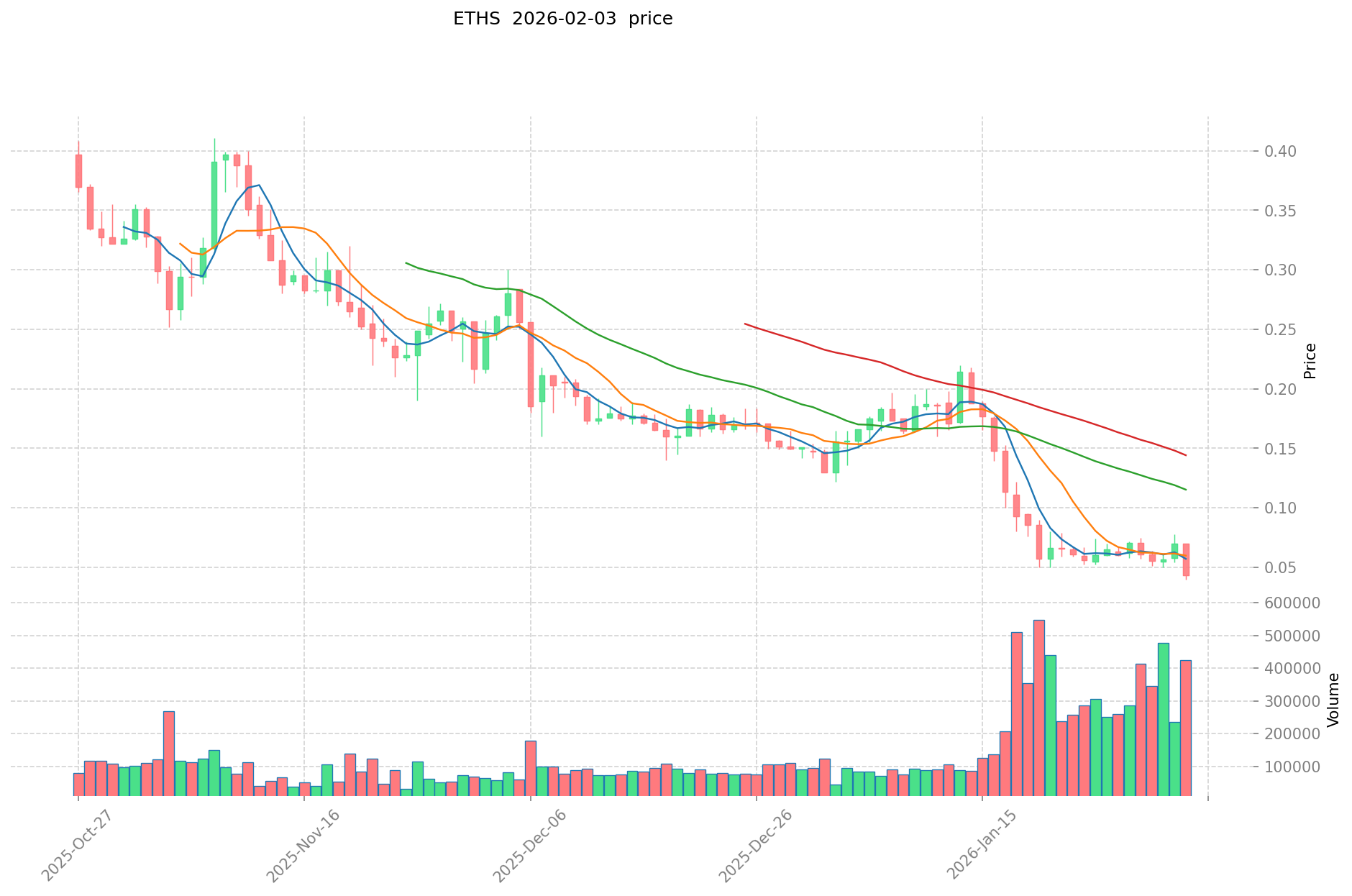
- 2025-2026: Market correction phase → Price declined from higher levels to $0.04098, reflecting broader market adjustment patterns
Current ETHS Investment Market Status (February 2026)
- ETHS current price: $0.04098
- Market sentiment: Data indicates recent volatility with 24-hour decline of 11.49% and 7-day decline of 34.19%
- 24-hour trading volume: $16,118.15
- Market capitalization: $860,580.00
- Circulating supply: 21,000,000 ETHS (100% of total supply)
- Total supply: 21,000,000 ETHS
- Maximum supply: 21,000,000 ETHS
Click to view real-time ETHS market price
II. Core Factors Influencing Whether ETHS is a Good Investment
Supply Mechanism and Scarcity (ETHS Investment Scarcity)
- Fixed supply cap of 21,000,000 tokens with 100% already in circulation
- The maximum supply mechanism creates a deflationary structure that may support price stability over time
- Full circulation of the total supply eliminates future dilution concerns, potentially offering clearer valuation metrics for investors
- Investment significance: The finite supply model aligns with scarcity principles that have historically supported long-term value in digital assets
Institutional Investment and Mainstream Adoption (Institutional Investment in ETHS)
- ETHS functions as the core asset of Facet protocol, which has received funding from the Ethereum Foundation as an Unstoppable Rollup
- Recognition by the Ethereum Foundation may indicate institutional validation of the underlying technology
- The protocol's positioning as a decentralized Ethereum L1 scaling solution could attract development activity within the Ethereum ecosystem
- Limited exchange availability (currently listed on 1 exchange according to available data) may constrain institutional access and liquidity
Macroeconomic Environment Impact on ETHS Investment
- As a digital asset within the Ethereum ecosystem, ETHS may be influenced by broader cryptocurrency market trends and regulatory developments
- Market sentiment toward Ethereum scaling solutions could affect investor interest in related assets
- The asset's relatively small market capitalization ($860,580) may result in higher sensitivity to macroeconomic shifts compared to larger-cap cryptocurrencies
Technology and Ecosystem Development (Technology & Ecosystem for ETHS Investment)
- Core integration with Facet protocol: Positioned as infrastructure for Ethereum mainnet scaling, which could benefit from increasing demand for Layer 1 solutions
- Role in next-generation data and value layers: The project describes ETHS as a pioneering asset in emerging blockchain infrastructure
- BRC20 algorithm implementation: Technical framework that may influence interoperability and use cases
- Ecosystem maturity considerations: As a relatively newer asset (published December 2023), the development stage of surrounding applications and infrastructure may impact investment timelines
III. ETHS Future Investment Predictions and Price Outlook (Is ETHS(ETHS) worth investing in 2026-2031)
Short-term Investment Prediction (2026, short-term ETHS investment outlook)
Based on current market conditions and the token's circulating supply of 21,000,000 units, short-term price projections for 2026 suggest the following scenarios:
- Conservative Prediction: $0.038931 - $0.04098
- Neutral Prediction: $0.04098 - $0.0489711
- Optimistic Prediction: $0.04098 - $0.0569622
The short-term outlook reflects ongoing market volatility, with the token currently trading significantly below its historical high of $13.9. Market participants should consider the token's recent 24-hour decline of 11.49% and 7-day decline of 34.19% when evaluating near-term positions.
Mid-term Investment Outlook (2027-2029, mid-term ETHS(ETHS) investment forecast)
-
Market Stage Expectations: The mid-term period may witness gradual recovery patterns, contingent upon broader Ethereum ecosystem developments and Layer 1 scaling solution adoption trends.
-
Investment Return Predictions:
- 2027: $0.043094568 - $0.070028673
- 2028: $0.038674926225 - $0.074374858125
- 2029: $0.039493049664375 - $0.082332967944375
-
Key Catalysts: Potential mid-term price drivers include the ongoing implementation of EIP-1559, institutional participation in Ethereum-based assets, and the development trajectory of the Facet protocol ecosystem. Macroeconomic factors, particularly monetary policy adjustments, may also influence market sentiment.
Long-term Investment Outlook (Is ETHS a good long-term investment?)
- Base Scenario: $0.048512860583484 - $0.091054907556693 (assuming steady ecosystem development and moderate adoption of Layer 1 scaling solutions)
- Optimistic Scenario: $0.063790679908775 - $0.091129542726822 (assuming enhanced institutional participation and favorable market conditions for Ethereum-based assets)
- Risk Scenario: Below $0.038931 (under conditions of prolonged market downturn or significant technical setbacks)
View ETHS long-term investment and price predictions: Price Prediction
2026-02-04 to 2031 Long-term Outlook
- Base Scenario: $0.048512860583484 - $0.074635170128437 (corresponding to steady progress and gradual mainstream application enhancement)
- Optimistic Scenario: $0.063790679908775 - $0.091129542726822 (corresponding to large-scale adoption and favorable market environment)
- Transformative Scenario: Above $0.091129542726822 (subject to breakthrough developments in the ecosystem and mainstream adoption)
- 2031-12-31 Predicted High: $0.091129542726822 (based on optimistic development assumptions)
Disclaimer: The predictions presented herein are for informational purposes only and do not constitute investment advice. Cryptocurrency markets involve substantial risk, including potential loss of principal. Past performance does not guarantee future results. Market participants should conduct thorough research and consider their risk tolerance before making investment decisions. Price predictions are subject to change based on market conditions, technological developments, regulatory changes, and other unforeseen factors. ETHS is associated with the Facet protocol, a decentralized Ethereum Layer 1 scaling solution, and its long-term value is closely tied to Ethereum ecosystem development and the adoption rate of scaling solutions.
| Year |
Predicted High Price |
Predicted Average Price |
Predicted Low Price |
Price Change |
| 2026 |
0.0569622 |
0.04098 |
0.038931 |
0 |
| 2027 |
0.070028673 |
0.0489711 |
0.043094568 |
19 |
| 2028 |
0.074374858125 |
0.0594998865 |
0.038674926225 |
45 |
| 2029 |
0.082332967944375 |
0.0669373723125 |
0.039493049664375 |
63 |
| 2030 |
0.091054907556693 |
0.074635170128437 |
0.048512860583484 |
82 |
| 2031 |
0.091129542726822 |
0.082845038842565 |
0.063790679908775 |
102 |
IV. ETHS Investment Strategy and Risk Management (How to invest in ETHS)
Investment Methodology (ETHS investment strategy)
-
Long-term holding (HODL ETHS): This approach may be suitable for conservative investors who believe in the long-term development of Ethereum scaling solutions and the Facet protocol ecosystem. Given ETHS's role as a core asset in a decentralized Ethereum L1 scaling protocol, long-term holders might focus on the potential growth of the protocol's adoption and utility.
-
Active trading: Traders may utilize technical analysis and swing trading strategies to capitalize on price movements. Given the current market data showing 24-hour price volatility and trading volume of approximately 16,118 units, active traders could monitor key support and resistance levels, with recent 24-hour range between 0.03377 and 0.05096.
Risk Management (Risk management for ETHS investment)
V. ETHS Investment Risks and Challenges (Risks of investing in ETHS)
-
Market risks: ETHS has demonstrated substantial price volatility, with 24-hour fluctuations of -11.49%, 7-day changes of -34.19%, and 30-day movements of -73.52%. The asset's trading range spans from 0.03377 to historical levels significantly higher, indicating potential for sharp price movements. Market capitalization of approximately 860,580 suggests relatively limited liquidity compared to major cryptocurrencies.
-
Regulatory risks: As with many crypto assets, ETHS faces uncertain regulatory treatment across different jurisdictions. The evolving regulatory landscape for Layer 1 scaling solutions and their associated tokens could impact accessibility, trading venues, and overall market dynamics.
-
Technical risks:
- Protocol development risks associated with the Facet protocol's ongoing evolution
- Network security considerations related to the underlying Ethereum infrastructure
- Smart contract risks inherent in blockchain-based systems
- Potential technical challenges in maintaining decentralized scaling functionality
VI. Conclusion: Is ETHS a Good Investment?
-
Investment value summary: ETHS represents an emerging asset within the Ethereum scaling ecosystem, supported by its association with the Facet protocol. The asset has experienced substantial price fluctuations, with year-to-date performance showing -77.36% change. While the protocol's focus on Ethereum mainnet expansion and recognition by development communities may offer long-term potential, short-term price movements remain highly volatile.
-
Investor recommendations:
✅ Beginners: Consider dollar-cost averaging (DCA) strategies + secure wallet storage. Start with small allocations to understand market dynamics before increasing exposure.
✅ Experienced investors: May explore swing trading opportunities + portfolio diversification. Monitor protocol development updates and on-chain metrics to inform timing decisions.
✅ Institutional investors: Evaluate strategic long-term positioning based on comprehensive due diligence of the Facet protocol ecosystem and broader Layer 1 scaling landscape.
⚠️ Important notice: Cryptocurrency investments carry substantial risk. Price volatility, regulatory uncertainty, and technical challenges can result in significant losses. This content is for informational purposes only and does not constitute investment advice. Conduct thorough research and consider consulting with financial professionals before making investment decisions.
VII. FAQ
Q1: What is ETHS and what makes it different from other Ethereum-related tokens?
ETHS is the core token of the Facet protocol, a decentralized Ethereum Layer 1 scaling solution that has received support from the Ethereum Foundation as an Unstoppable Rollup initiative. Unlike many Ethereum-related tokens, ETHS features a fixed maximum supply of 21,000,000 tokens with 100% already in circulation, eliminating future dilution concerns. Its primary distinction lies in its role as infrastructure for Ethereum mainnet expansion through next-generation data and value layers, positioning it as a pioneering asset in blockchain scaling technology rather than a simple utility or governance token.
Q2: Is ETHS suitable for beginners or more appropriate for experienced investors?
ETHS presents challenges for all investor categories but requires different approaches. Beginners should approach with extreme caution due to substantial volatility (24-hour declines of -11.49% and 7-day drops of -34.19%) and limited liquidity (market cap of approximately $860,580). For beginners, dollar-cost averaging (DCA) strategies starting with small allocations (1-3% of crypto portfolio) combined with secure wallet storage are recommended. Experienced investors may find opportunities in swing trading and portfolio diversification strategies, while institutional investors should focus on comprehensive due diligence of the Facet protocol ecosystem before considering strategic long-term positions.
Q3: What are the main risks associated with investing in ETHS?
The primary risks include significant market volatility (30-day decline of -73.52% demonstrates extreme price fluctuations), limited liquidity with trading volume of approximately $16,118 in 24 hours, and protocol development uncertainties. Additional risks encompass regulatory uncertainty affecting Layer 1 scaling solutions, technical challenges related to the Facet protocol's ongoing evolution, and smart contract vulnerabilities inherent in blockchain systems. The asset's relatively small market capitalization makes it particularly sensitive to macroeconomic shifts and market sentiment changes.
Q4: What is the long-term price outlook for ETHS through 2031?
Based on available projections, the long-term outlook presents three scenarios. The base scenario forecasts a range of $0.048512860583484 to $0.074635170128437 by 2030-2031, assuming steady ecosystem development and moderate adoption of Layer 1 scaling solutions. The optimistic scenario projects $0.063790679908775 to $0.091129542726822 under conditions of enhanced institutional participation and favorable market conditions. However, risk scenarios suggest prices could remain below $0.038931 under prolonged market downturns. These projections are subject to significant uncertainty and depend on factors including Ethereum ecosystem development, regulatory changes, and technological breakthroughs.
Q5: How should investors store ETHS tokens securely?
Investors should implement a storage strategy based on their investment approach and holding period. For long-term holdings, cold wallet storage using hardware wallets provides the highest security level by keeping private keys offline. Active traders may maintain limited amounts in hot wallets for immediate trading access while storing the majority in cold storage. Institutional or large holders should consider multi-signature wallet solutions requiring multiple authorizations for transactions. Never store significant amounts on exchanges for extended periods, and always maintain backup recovery phrases in secure, separate physical locations.
Q6: What factors could drive ETHS price appreciation in the medium term (2027-2029)?
Medium-term price catalysts include broader Ethereum ecosystem developments, particularly increasing demand for Layer 1 scaling solutions as network congestion issues persist. The ongoing implementation of Ethereum improvement proposals, institutional participation in Ethereum-based assets, and the development trajectory of the Facet protocol ecosystem represent key drivers. Additional factors include potential partnerships with established blockchain projects, enhanced utility within the Facet protocol, and favorable macroeconomic conditions including monetary policy adjustments that support risk assets. However, these catalysts remain speculative and dependent on successful execution by development teams.
Q7: How does ETHS's fixed supply of 21,000,000 tokens impact its investment potential?
The fixed maximum supply creates a deflationary structure that may support long-term value preservation, similar to Bitcoin's capped supply model. With 100% of tokens already in circulation, investors face no future dilution risk from new token emissions, providing clearer valuation metrics compared to inflationary token models. This scarcity principle historically has supported price stability in digital assets during periods of increasing demand. However, the fixed supply does not guarantee price appreciation and must be balanced against other factors including protocol adoption, market sentiment, and competitive landscape within Ethereum scaling solutions.
Q8: What percentage of a cryptocurrency portfolio should be allocated to ETHS?
Portfolio allocation should be determined by individual risk tolerance and investment objectives. Conservative investors focused on capital preservation might consider allocating 1-3% of their crypto portfolio to ETHS, treating it as a speculative position within a diversified holdings structure. Aggressive investors with higher risk tolerance may allocate 5-10% based on conviction in the Facet protocol's development trajectory. Professional investors could implement dynamic allocation strategies adjusting positions based on market conditions, protocol milestones, and technical indicators. Regardless of investor category, ETHS should represent only a portion of overall crypto exposure given its volatility and relatively early development stage.
* The information is not intended to be and does not constitute financial advice or any other recommendation of any sort offered or endorsed by Gate.