LayerEdge introduces EDGEN, a revolutionary people-powered zero-knowledge verification layer built on Bitcoin's security foundation. Launched in 2025, it addresses blockchain verification centralization by transforming ordinary devices into verification nodes through edgenOS. With over 1 million users and 4,312 token holders, LayerEdge enables individuals to participate in network security while earning rewards. This guide explores EDGEN's technical architecture, tokenomics, market performance, and ecosystem applications. As of February 2026, EDGEN trades at approximately $0.002512 on Gate and other exchanges. Whether seeking decentralized infrastructure opportunities or network participation, this comprehensive overview covers LayerEdge's positioning, challenges, and long-term vision for democratizing blockchain verification.
LayerEdge's Positioning and Significance
In 2025, the LayerEdge team launched LayerEdge (EDGEN), aiming to address the centralization and high cost of blockchain verification, as well as barriers to participation in network security.
As the world's first people-powered zero-knowledge verification layer, LayerEdge plays a key role in blockchain infrastructure and Web3 security.
As of 2026, LayerEdge has established itself as an innovative verification infrastructure project, with over 1 million users and a growing ecosystem built on Bitcoin's security foundation.
This article will provide an in-depth analysis of its technical architecture, market performance, and future potential.
Origin and Development History
Birth Background
LayerEdge was created by its founding team in 2025, aiming to solve the centralization of blockchain verification and the inability of ordinary users to participate in network security while earning rewards.
It emerged during the rapid expansion of Web3 infrastructure, with the goal of democratizing blockchain verification through ordinary devices and leveraging Bitcoin's security foundation to transform the status quo.
LayerEdge's launch brought new possibilities for Web3 users and blockchain security infrastructure.
Important Milestones
- 2025: Platform launched, enabling ordinary devices to become verification nodes and introducing the edgenOS concept.
- 2025: The EDGEN token began trading, with initial price reaching notable levels in early market activity.
- 2026: The ecosystem continues to expand, with the user base surpassing 1 million participants contributing to distributed verification.
With support from its community and development team, LayerEdge continues to optimize its technology, security features, and real-world applications.
How LayerEdge Works
No Central Control
LayerEdge operates on a decentralized network of devices distributed globally, free from control by banks or governments.
These nodes collaborate to verify transactions, ensuring system transparency and attack resistance, granting users greater autonomy and enhancing network resilience.
Blockchain Core
LayerEdge's blockchain infrastructure creates a public, immutable digital ledger that records verification activities.
Transactions are processed through zero-knowledge verification mechanisms, grouped into blocks, and linked through cryptographic hashing to form a secure chain.
Anyone can view records without intermediaries, establishing trust.
The edgenOS system transforms ordinary devices into verification nodes, further enhancing decentralization and accessibility.
Ensuring Fairness
LayerEdge employs zero-knowledge verification technology to validate transactions and prevent fraudulent activities.
Verification node operators maintain network security through running the edgenOS system on their devices, earning EDGEN rewards.
Its innovation includes enabling millions of ordinary users to participate in blockchain verification at minimal cost.
Secure Transactions
LayerEdge uses public-private key cryptography to protect transactions:
- Private keys (like secret passwords) are used to sign transactions
- Public keys (like account numbers) are used to verify ownership
This mechanism ensures fund security while maintaining appropriate privacy levels.
The platform builds on Bitcoin's security foundation, leveraging its established security model while introducing distributed verification capabilities.
Circulation Overview
As of February 05, 2026, LayerEdge (EDGEN) has a circulating supply of 260,300,000 tokens, with a total supply of 1,000,000,000 EDGEN and a maximum supply capped at 1,000,000,000 tokens, indicating a fixed supply model.
The circulating supply represents approximately 26.03% of the total supply, suggesting a controlled token release schedule that may impact supply and demand dynamics over time.
Price Volatility
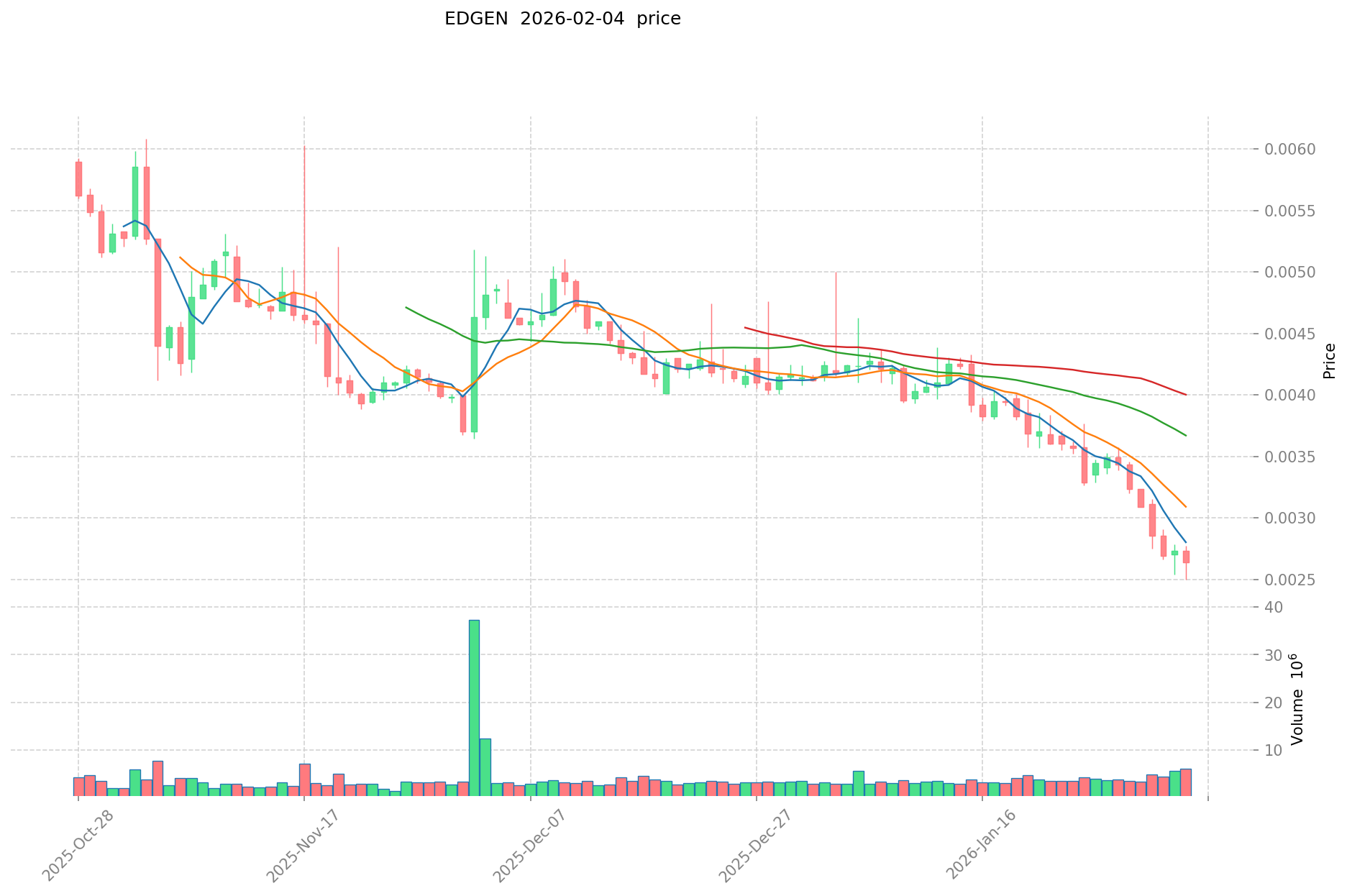
EDGEN reached a notable price level of $0.08 on June 02, 2025, driven by early market enthusiasm and initial adoption momentum.
The token experienced its lowest price of $0.002451 on February 04, 2026, reflecting broader market corrections and evolving market sentiment.
As of February 05, 2026, EDGEN is trading at approximately $0.002512, showing short-term volatility with a -0.27% change over 1 hour, -4.55% over 24 hours, -26.87% over 7 days, -40.19% over 30 days, and -93.82% over the past year. These fluctuations reflect market sentiment, adoption trends, and external factors impacting the broader cryptocurrency ecosystem.
Click to view current EDGEN market price
On-Chain Metrics
- Market Capitalization: Approximately $653,873.6 (reflecting current market valuation)
- 24-Hour Trading Volume: $17,702.54 (indicating current trading activity levels)
- Token Holders: 4,312 addresses (demonstrating community distribution and user participation)
- Exchange Listings: Available on 8 cryptocurrency exchanges (showing market accessibility)
LayerEdge Ecosystem Applications and Partners
Core Use Cases
LayerEdge's ecosystem supports multiple applications:
- Verification Infrastructure: edgenOS transforms ordinary devices into verification nodes, providing decentralized zero-knowledge verification services.
- Network Security: The platform enables everyday users to participate in blockchain security, distributing verification across participants while earning rewards.
Strategic Partnerships
LayerEdge leverages Bitcoin's security foundation to enhance its technical capabilities and market position. The platform's approach to building a people-verified infrastructure provides a foundation for ecosystem expansion.
Challenges and Considerations
LayerEdge faces the following challenges:
- Market Volatility: The token has experienced price fluctuations, with a 93.82% decline over one year
- Competitive Landscape: Operating in the evolving blockchain verification and infrastructure space
- Adoption Progress: Building user base and node participation across the network
These factors drive ongoing innovation and community engagement within the LayerEdge ecosystem.
LayerEdge's community demonstrates active participation, with over 1 million users and 4,312 token holders. The platform emphasizes democratizing blockchain verification through user-driven participation. Community activity centers around network security contributions and ecosystem development.
Sentiment on X platform shows diverse perspectives:
- Supporters praise LayerEdge's approach to decentralized verification and Bitcoin-backed security, viewing it as infrastructure for Web3's future.
- Discussion topics include verification technology, network participation, and ecosystem growth potential.
Community conversations reflect interest in the platform's vision for people-powered blockchain verification.
Key Topics
X users discuss LayerEdge's verification layer technology, tokenomics, and network participation model, highlighting both the innovation potential and the journey toward broader adoption.
- Official Website: Visit LayerEdge Official Site for features, use cases, and latest updates.
- White Paper: LayerEdge White Paper details the technical architecture, objectives, and vision for edgenOS.
- X Updates: LayerEdge maintains an active presence on X platform at @layeredge, sharing updates on technical developments, community activities, and ecosystem news.
LayerEdge Future Roadmap
- Network Development: Expansion of edgenOS verification layer capabilities and node infrastructure
- Ecosystem Goals: Growing user participation in network security and verification processes
- Long-term Vision: Establishing a foundation for people-verified, Bitcoin-backed internet infrastructure
How to Participate in LayerEdge?
I. Purchase Options: Acquire EDGEN on Gate.com and other supporting exchanges
II. Storage Solutions: Use compatible ERC-20 wallets to securely store tokens
III. Network Participation: Transform devices into verification nodes within the edgenOS ecosystem
IV. Ecosystem Contribution: Explore opportunities to participate in network security and earn rewards
Summary
LayerEdge introduces an innovative approach to blockchain verification through its people-powered zero-knowledge layer, edgenOS. The platform offers decentralized verification, Bitcoin-backed security, and user participation opportunities. With over 1 million users, LayerEdge aims to democratize blockchain security by transforming ordinary devices into verification nodes. Despite facing market volatility and adoption challenges, LayerEdge's vision for distributed verification and clear development direction position it as a notable project in decentralized infrastructure. Whether you're new to crypto or an experienced participant, LayerEdge presents an interesting approach to blockchain verification worth exploring.
FAQ
What is EDGEN? What are its main functions and uses?
EDGEN is an AI-driven market intelligence platform that optimizes trading models through advanced AI algorithms for multi-asset, short-term trading. Its main function is to adapt to dynamic market conditions, enabling profitable trading strategies across various cryptocurrency assets and market scenarios.
How to buy and trade EDGEN tokens? Which exchanges support trading?
You can purchase and trade EDGEN tokens through major cryptocurrency exchanges. Create an account, complete verification, deposit funds, and search for EDGEN to begin trading. Compare exchange options for the best liquidity and trading volume.
What are the team background and technical characteristics of the EDGEN project?
EDGEN is the native token of LayerEdge, combining Bitcoin security with zero-knowledge proof technology to build a universal verification layer for Web3. Its technical strengths lie in efficient verification mechanisms and robust security architecture.
What are the risks of investing in EDGEN? What should I pay attention to?
EDGEN investment risks include market volatility and fraud concerns. Verify project legitimacy, team transparency, and official channels. Conduct thorough due diligence before investing to ensure compliance and authenticity of promises.
What distinguishes EDGEN from other similar cryptocurrency projects?
EDGEN differentiates itself through LayerEdge's multi-chain verification infrastructure, combining zero-knowledge proof technology with Bitcoin security. It focuses on cross-chain verification mechanisms to enhance efficiency and security significantly.
* The information is not intended to be and does not constitute financial advice or any other recommendation of any sort offered or endorsed by Gate.