Is Ithaca Protocol (ITHACA) a good investment?: A Comprehensive Analysis of Its Technology, Market Position, and Future Potential

Introduction: Ithaca Protocol (ITHACA)'s Investment Position and Market Outlook
Ithaca Protocol (ITHACA) is a non-custodial, composable options protocol operating on Arbitrum, with planned expansion to Base and Solana. Backed by notable market participants Cumberland and Wintermute, the protocol has established itself within the decentralized finance ecosystem, ranking among top protocols on DeFiLlama. As of February 8, 2026, ITHACA is trading at approximately $0.003133, with a circulating market capitalization of $201,295.25 and a circulating supply of 64,250,000 tokens. The protocol's modular infrastructure enables the creation and market-making of options, option strategies, and structured product markets across various underlying assets. With a total supply of 1,000,000,000 tokens and a current circulation ratio of 6.43%, ITHACA represents a developing asset within the crypto derivatives space. This article examines ITHACA's investment characteristics, historical price movements, future price scenarios, and associated risks to provide analytical insights for market participants considering whether Ithaca Protocol (ITHACA) aligns with their portfolio strategies.
I. Ithaca Protocol (ITHACA) Price History Review and Current Investment Value
ITHACA Historical Price Movement and Investment Performance
- December 2024: Token listing on exchanges → Initial price discovery phase with trading commencing at relatively elevated levels
- December 19, 2024: Price activity around $0.1456 level → Notable early volatility following market debut
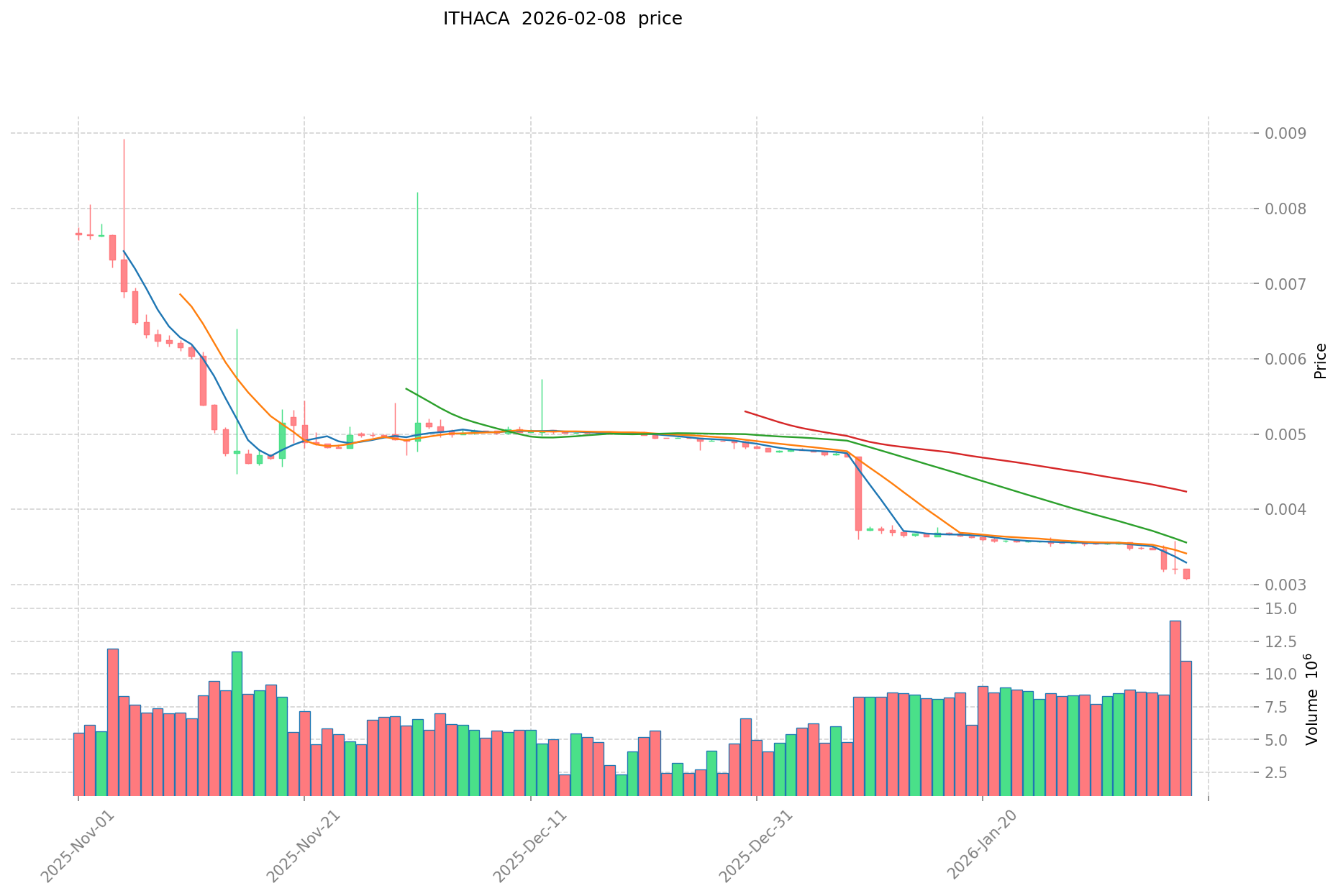
- February 2026: Market adjustment period → Price declined to $0.003133 area, reflecting broader market conditions and token distribution dynamics
Current ITHACA Investment Market Status (February 2026)
- ITHACA current price: $0.003133
- Market sentiment (Fear & Greed Index): Data not provided in reference materials
- 24-hour trading volume: $30,978.60
- Institutional investor holdings: Backed by Cumberland and Wintermute as noted in project materials; specific holding data not disclosed
Click to view real-time ITHACA market price
II. Core Factors Influencing Whether ITHACA is a Good Investment
Supply Mechanism and Scarcity (ITHACA Investment Scarcity)
- Supply structure: ITHACA has a maximum supply of 1,000,000,000 tokens, with a circulating supply of 64,250,000 tokens as of February 8, 2026, representing approximately 6.43% of total supply → significant future supply expansion potential may impact price dynamics
- Market capitalization to fully diluted valuation ratio: Current market cap stands at $201,295.25, while fully diluted valuation reaches $3,133,000.00, indicating substantial unlocked supply that could affect scarcity perception
- Investment implication: The relatively low circulation ratio suggests potential dilution concerns, which investors should consider when evaluating long-term scarcity dynamics
Institutional Investment and Mainstream Adoption (Institutional Investment in ITHACA)
- Institutional backing: Ithaca Protocol is supported by Cumberland and Wintermute, two recognized entities in the crypto market, providing credibility to the project
- Market positioning: Ithaca consistently ranks in the Top 3 on DeFiLlama, indicating notable presence within the DeFi options trading sector
- Adoption trajectory: As of February 2026, the protocol has 1,236 token holders, suggesting early-stage adoption that may expand as the platform develops across Arbitrum, Base, and Solana networks
Macroeconomic Environment Impact on ITHACA Investment
- Crypto market correlation: ITHACA's 24-hour trading volume of $30,978.60 and market dominance of 0.00012% indicate sensitivity to broader crypto market conditions and risk appetite
- Volatility context: The token experienced a 95.06% decline over one year and a 20.14% decrease over 30 days, reflecting exposure to market-wide downturns and sector-specific challenges
- Risk assessment: Price fluctuations between historical high of $0.1456 (December 19, 2024) and historical low of $0.003062 (February 7, 2026) demonstrate significant volatility that investors should weigh against macroeconomic uncertainty
Technology and Ecosystem Development (Technology & Ecosystem for ITHACA Investment)
- Modular infrastructure: Ithaca Protocol employs a non-custodial, composable options protocol that enables rapid deployment of options, option strategies, and structured product markets on any underlying asset
- MEV-resistant framework: The platform utilizes an auction-based algorithmic market clearing mechanism designed to resist Miner Extractable Value exploitation, potentially enhancing user trust and adoption
- Multi-chain expansion: The protocol operates on Arbitrum with planned expansion to Base and Solana networks, which may broaden market reach and increase ecosystem integration opportunities
- AI integration: Ithaca incorporates AI agents through Telegram and X platforms for investor engagement and interaction via IthacaGPT, representing technological differentiation in user experience
III. ITHACA Future Investment Forecast and Price Outlook (Is Ithaca Protocol (ITHACA) worth investing in 2026-2031)
Short-term Investment Forecast (2026, short-term ITHACA investment outlook)
- Conservative forecast: $0.00207 - $0.00267
- Neutral forecast: $0.00267 - $0.00313
- Optimistic forecast: $0.00313 - $0.00335
Mid-term Investment Outlook (2027-2029, mid-term Ithaca Protocol (ITHACA) investment forecast)
-
Market phase expectation: The token may experience gradual development as the protocol expands its presence across multiple blockchain networks and refines its auction-based option trading mechanism. Token holder concentration remains a notable factor that could influence price stability during this period.
-
Investment return forecast:
- 2027: $0.00266 - $0.00370
- 2028: $0.00257 - $0.00399
- 2029: $0.00268 - $0.00492
-
Key catalysts: Multi-chain expansion plans to Base, BNB Chain, and Solana; protocol adoption by professional and retail users; development of the modular DeFi infrastructure for options and structured products; backing from Cumberland and Wintermute; integration of AI agents for user engagement.
Long-term Investment Outlook (Is ITHACA a good long-term investment?)
- Base scenario: $0.00268 - $0.00435 (assuming steady protocol development and moderate user adoption)
- Optimistic scenario: $0.00435 - $0.00545 (assuming successful multi-chain expansion and increased liquidity)
- Risk scenario: Below $0.00268 (under conditions of heightened market volatility or protocol setbacks)
Click to view ITHACA long-term investment and price forecast: Price Prediction
2026-2031 Long-term Outlook
- Base scenario: $0.00268 - $0.00435 (corresponding to steady progress and gradual mainstream application enhancement)
- Optimistic scenario: $0.00435 - $0.00545 (corresponding to large-scale adoption and favorable market environment)
- Transformative scenario: Above $0.00545 (if the ecosystem achieves breakthrough developments and mainstream adoption)
- 2031-12-31 forecast high: $0.00699 (based on optimistic development assumptions)
Disclaimer: Cryptocurrency markets are highly volatile. These forecasts are based on available data and historical trends and should not be considered financial advice. Token holder concentration and smart contract risks remain inherent considerations. Investors should conduct thorough research and assess their risk tolerance before making investment decisions.
| Year | Predicted High Price | Predicted Average Price | Predicted Low Price | Price Change |
|---|---|---|---|---|
| 2026 | 0.00335124 | 0.003132 | 0.00206712 | 0 |
| 2027 | 0.0036954468 | 0.00324162 | 0.0026581284 | 3 |
| 2028 | 0.00398881341 | 0.0034685334 | 0.002566714716 | 10 |
| 2029 | 0.0049218488946 | 0.003728673405 | 0.0026846448516 | 19 |
| 2030 | 0.005449829048748 | 0.0043252611498 | 0.002681661912876 | 38 |
| 2031 | 0.006989189491961 | 0.004887545099274 | 0.004349915138353 | 56 |
IV. ITHACA Investment Strategy and Risk Management (How to invest in ITHACA)
Investment Methodology (ITHACA investment strategy)
Long-term Holding (HODL ITHACA)
Long-term holding may be suitable for investors who believe in the protocol's fundamental value proposition as a non-custodial, composable options infrastructure. Given ITHACA's position as a modular DeFi protocol with backing from established market makers like Cumberland and Wintermute, this approach focuses on the potential growth of the options trading ecosystem on platforms like Arbitrum, with planned expansion to Base and Solana.
Investors considering this strategy should evaluate:
- The protocol's ranking performance on DeFiLlama (consistently Top 3 in its category)
- The development roadmap for multi-chain deployment
- Growth in total value locked and user adoption metrics
- The evolution of DeFi derivatives markets
Active Trading
Active trading of ITHACA involves technical analysis and price action monitoring. Key considerations include:
- Volatility Profile: ITHACA has demonstrated significant price movements, with 7-day changes of -11.46% and 30-day changes of -20.14%
- Liquidity Considerations: With a 24-hour trading volume of approximately $30,978.60 and market capitalization around $201,295.25, traders should be aware of potential slippage
- Technical Levels: Historical price range from an all-time high of $0.1456 (December 19, 2024) to an all-time low of $0.003062 (February 7, 2026)
- Market Cap to FDV Ratio: At 6.43%, the current circulating supply represents a relatively small portion of total supply (64.25 million out of 1 billion tokens), indicating potential future dilution
Risk Management (Risk management for ITHACA investment)
Asset Allocation Ratios
Conservative Investors: Given ITHACA's micro-cap status (ranking #3938) and high volatility profile, conservative portfolios might limit exposure to 0.5-1% of total portfolio value.
Moderate Investors: Those with higher risk tolerance and understanding of DeFi protocols might allocate 2-5% to speculative DeFi assets like ITHACA.
Specialized DeFi Investors: Experienced participants in decentralized derivatives markets might maintain larger positions (5-10%) as part of a diversified DeFi portfolio, particularly if actively using the protocol's options infrastructure.
Risk Hedging Approaches
- Diversified Portfolio Construction: Combining ITHACA with established cryptocurrencies and traditional assets to reduce concentration risk
- Position Sizing: Using smaller position sizes relative to more established assets to limit downside exposure
- Stop-Loss Implementation: Setting predetermined exit points to manage potential losses, considering the token's price volatility
- Correlation Analysis: Monitoring ITHACA's price movements relative to broader DeFi sector trends and major cryptocurrencies
Secure Storage Solutions
Hot Wallet Options: For active traders requiring frequent access
- MetaMask (compatible with BSC network where ITHACA is deployed)
- Trust Wallet
- Exchange wallets for short-term trading positions
Cold Storage Recommendations: For long-term holdings
- Hardware wallets supporting BEP-20 tokens (contract address: 0x49f1d4db3ea1a64390e990c6debeac88eac007ca on BSC)
- Ledger devices with BSC network support
- Trezor hardware wallets with appropriate firmware
Security Best Practices:
- Verify contract addresses before transactions
- Enable multi-signature requirements for large holdings
- Regular backup of wallet recovery phrases
- Separate wallets for trading and long-term storage
V. ITHACA Investment Risks and Challenges (Risks of investing in ITHACA)
Market Risks
High Volatility: ITHACA exhibits substantial price fluctuations, with year-to-date performance showing -95.06% from its all-time high. The 24-hour price range ($0.003062 to $0.003204) and recent weekly decline of -11.46% illustrate ongoing volatility.
Liquidity Constraints: With relatively modest 24-hour trading volume ($30,978.60) and availability on limited exchanges (1 exchange), investors may face challenges executing large orders without significant price impact.
Market Capitalization Considerations: As a micro-cap asset with market capitalization around $201,295.25 and market dominance of 0.00012%, ITHACA is subject to price movements that may not correlate with broader cryptocurrency market trends.
Token Supply Dynamics: The current circulating supply represents only 6.43% of maximum supply (64.25 million of 1 billion tokens), which could lead to dilution concerns as additional tokens enter circulation.
Regulatory Risks
Derivatives Protocol Classification: As an options protocol, ITHACA operates in a space that may face particular regulatory scrutiny regarding derivatives trading platforms and securities classification.
Multi-Jurisdictional Considerations: The protocol's operation across multiple blockchain networks (Arbitrum, with planned expansion to Base and Solana) involves navigating different regulatory frameworks.
DeFi Protocol Uncertainty: Regulatory approaches to decentralized finance protocols continue to evolve, with potential implications for non-custodial options platforms.
Compliance Evolution: Changes in securities laws, derivatives regulations, or cryptocurrency-specific legislation could impact protocol operations or token utility.
Technical Risks
Smart Contract Vulnerabilities: As a protocol deploying complex financial instruments (options, strategies, and structured products), smart contract security is essential. Any undiscovered vulnerabilities could potentially affect user funds or protocol functionality.
Network Dependencies: ITHACA's operation on Arbitrum (and planned expansion to other chains) creates dependency on underlying blockchain infrastructure, including potential network congestion or security issues.
Protocol Upgrade Risks: The development and deployment of new features, such as multi-chain expansion, involves technical implementation risks that could temporarily affect protocol functionality.
Integration Complexity: The protocol's modular infrastructure and composability features introduce technical complexity that may present operational challenges.
MEV Considerations: While the protocol employs an auction-based, MEV-resistant market clearing framework, the broader DeFi ecosystem's MEV dynamics could still impact user experience.
VI. Conclusion: Is ITHACA a Good Investment?
Investment Value Assessment
ITHACA represents a specialized DeFi protocol focused on options and structured products infrastructure. The protocol's backing from established market makers (Cumberland and Wintermute), consistent ranking on DeFiLlama, and innovative approach to composable options markets indicate potential within the decentralized derivatives sector. However, current metrics show significant challenges, including substantial price decline from all-time high (-95.06%), limited liquidity, and micro-cap status with associated volatility.
The protocol's modular infrastructure for deploying options markets across multiple assets and planned multi-chain expansion (Arbitrum, Base, Solana) suggest development activity. The low circulating supply ratio (6.43% of maximum supply) and limited exchange availability (1 exchange) present both opportunity and risk factors that require careful consideration.
Investor Recommendations
✅ Newcomers to Cryptocurrency
- Approach with Caution: ITHACA's micro-cap status, high volatility, and specialized DeFi focus make it unsuitable as a primary holding for beginners
- Education First: Before considering investment, develop understanding of DeFi protocols, options trading concepts, and blockchain infrastructure
- Secure Storage: If participating, utilize hardware wallets or secure software wallets supporting BEP-20 tokens on BSC network
- Position Sizing: Limit exposure to very small percentages of portfolio (under 1%)
✅ Experienced Investors
- DeFi Sector Context: Evaluate ITHACA within broader DeFi derivatives landscape and against competing protocols
- Technical Monitoring: Track protocol metrics including TVL, user growth, and multi-chain deployment progress
- Risk-Adjusted Positioning: Consider position sizing relative to liquidity constraints and volatility profile
- Portfolio Integration: Incorporate as part of diversified DeFi exposure rather than concentrated holding
✅ Institutional Investors
- Due Diligence: Conduct comprehensive assessment of protocol architecture, security audits, and team credentials
- Liquidity Assessment: Evaluate trading depth and execution capabilities given current market conditions
- Strategic Evaluation: Consider protocol's role in institutional DeFi derivatives strategies
- Regulatory Monitoring: Stay informed about evolving regulatory frameworks affecting decentralized derivatives platforms
⚠️ Important Notice: Cryptocurrency investments carry substantial risk, including potential complete loss of capital. ITHACA's micro-cap status, limited liquidity, and high volatility amplify these risks. This analysis provides informational context only and does not constitute investment advice, financial guidance, or recommendation to buy, sell, or hold any asset. Investors should conduct independent research, assess personal risk tolerance, and consult qualified financial professionals before making investment decisions.
VII. FAQ
Q1: What makes Ithaca Protocol different from other DeFi options platforms?
Ithaca Protocol distinguishes itself through its modular, non-custodial infrastructure that enables rapid deployment of options, option strategies, and structured products across any underlying asset. The protocol employs an auction-based algorithmic market clearing mechanism specifically designed to resist MEV (Miner Extractable Value) exploitation, which enhances user protection compared to traditional automated market makers. Additionally, Ithaca's composable architecture allows for flexible integration across multiple blockchain networks (currently Arbitrum, with planned expansion to Base and Solana), while its backing from established market makers Cumberland and Wintermute provides institutional credibility. The protocol also incorporates AI agents through IthacaGPT for enhanced user engagement, representing technological innovation in the DeFi derivatives space.
Q2: Why has ITHACA's price declined significantly since launch?
ITHACA has experienced a substantial 95.06% decline from its all-time high of $0.1456 (December 19, 2024) to its current price around $0.003133, reflecting several factors. The initial price discovery phase following token listing led to elevated early valuations that subsequently corrected as market participants reassessed fundamental value. The low circulating supply ratio of only 6.43% (64.25 million of 1 billion total tokens) creates concerns about future dilution as additional tokens enter circulation. Limited liquidity with modest 24-hour trading volume ($30,978.60) and availability on only one exchange contributes to price volatility. Additionally, broader cryptocurrency market conditions and the challenges faced by micro-cap DeFi protocols in early development stages have influenced the price trajectory.
Q3: Is ITHACA suitable for long-term investment?
Long-term suitability depends on individual risk tolerance and investment objectives. ITHACA presents both opportunities and significant challenges for long-term holders. On the positive side, the protocol demonstrates development activity through its multi-chain expansion plans, institutional backing, and consistent DeFiLlama ranking performance. The modular infrastructure for options and structured products addresses a specialized market niche within DeFi. However, considerable risks include micro-cap status (market capitalization around $201,295), high volatility, limited liquidity, substantial unlocked token supply (93.57% of total supply), and uncertain regulatory landscape for decentralized derivatives platforms. Conservative investors should limit exposure to 0.5-1% of portfolio value, while even experienced DeFi participants should carefully assess these risk factors before committing to long-term positions.
Q4: What are the main risks associated with investing in ITHACA?
ITHACA presents multiple investment risks across several categories. Market risks include extreme volatility (weekly decline of -11.46%, yearly decline of -95.06%), liquidity constraints with limited trading volume and single exchange availability, and dilution concerns from low circulating supply ratio. Technical risks involve smart contract vulnerabilities inherent in complex financial instruments, dependency on underlying blockchain infrastructure, and integration complexity from modular architecture. Regulatory risks stem from evolving frameworks for DeFi derivatives platforms and multi-jurisdictional compliance requirements. Additionally, the token's micro-cap status (market dominance of 0.00012%) makes it susceptible to significant price fluctuations unrelated to fundamental developments. Concentration risk exists with only 1,236 token holders as of February 2026.
Q5: How should investors approach position sizing for ITHACA?
Position sizing should align with risk profile and investment experience. Conservative investors with limited cryptocurrency experience should restrict ITHACA exposure to 0.5-1% of total portfolio value due to micro-cap status, high volatility, and specialized DeFi focus. Moderate investors comfortable with higher risk and possessing understanding of DeFi protocols might allocate 2-5% to speculative assets like ITHACA as part of diversified cryptocurrency holdings. Specialized DeFi investors with active protocol engagement and experience in decentralized derivatives markets could maintain 5-10% positions within a diversified DeFi portfolio. All investors should implement risk management techniques including stop-loss orders, diversification across asset classes, and separation of trading positions from long-term holdings. Given ITHACA's liquidity constraints and volatility profile, gradual position building through dollar-cost averaging may be preferable to large single purchases.
Q6: What factors could drive ITHACA price appreciation in the future?
Several catalysts could potentially influence ITHACA's price trajectory positively. Successful multi-chain expansion to Base and Solana would broaden market reach and increase ecosystem integration opportunities, potentially attracting new users and liquidity. Growth in protocol adoption metrics including total value locked, active users, and trading volume would demonstrate product-market fit in the DeFi derivatives sector. Enhanced liquidity through additional exchange listings and market maker participation could reduce volatility and facilitate larger transactions. Development partnerships and integration with other DeFi protocols would expand utility and use cases. Favorable regulatory clarity for decentralized derivatives platforms might increase institutional participation. Technological advancements in the MEV-resistant auction mechanism and AI-powered user engagement features could provide competitive differentiation. However, investors should note that price appreciation remains uncertain and contingent upon successful execution of development roadmap and favorable market conditions.
Q7: Where can investors securely store ITHACA tokens?
ITHACA tokens (BEP-20 contract address: 0x49f1d4db3ea1a64390e990c6debeac88eac007ca on BSC network) can be stored through various wallet solutions depending on usage requirements. For active trading requiring frequent access, hot wallet options include MetaMask (compatible with BSC network), Trust Wallet, and exchange wallets for short-term positions. Long-term holders should prioritize cold storage solutions including hardware wallets supporting BEP-20 tokens such as Ledger devices with BSC network support or Trezor hardware wallets with appropriate firmware. Security best practices include verifying contract addresses before transactions, enabling multi-signature requirements for substantial holdings, maintaining regular backups of wallet recovery phrases, and separating wallets for active trading versus long-term storage. Given ITHACA's relatively low market capitalization and limited liquidity, security measures are particularly important to protect against potential vulnerabilities.
Q8: How does ITHACA's institutional backing affect its investment profile?
Institutional backing from Cumberland and Wintermute provides several implications for ITHACA's investment profile. These established market makers bring credibility to the protocol, potentially facilitating liquidity provision and professional market-making services that can reduce volatility and improve trading conditions. Their involvement may indicate institutional validation of the protocol's technical architecture and market opportunity within decentralized derivatives. However, investors should note that backing does not guarantee price appreciation or eliminate investment risks. The protocol's micro-cap status (market capitalization $201,295), limited exchange availability, and substantial price decline (-95.06% from all-time high) persist despite institutional support. Additionally, specific holding amounts and lock-up arrangements for institutional backers are not disclosed in available materials. While institutional backing represents a positive factor, it should be evaluated alongside comprehensive risk assessment including liquidity constraints, token supply dynamics, and competitive positioning within the DeFi derivatives landscape.
Share
Content
Introduction: Ithaca Protocol (ITHACA)'s Investment Position and Market Outlook
I. Ithaca Protocol (ITHACA) Price History Review and Current Investment Value
II. Core Factors Influencing Whether ITHACA is a Good Investment
III. ITHACA Future Investment Forecast and Price Outlook (Is Ithaca Protocol (ITHACA) worth investing in 2026-2031)
IV. ITHACA Investment Strategy and Risk Management (How to invest in ITHACA)
V. ITHACA Investment Risks and Challenges (Risks of investing in ITHACA)
VI. Conclusion: Is ITHACA a Good Investment?
VII. FAQ
How to Buy Cryptocurrency


Trending Cryptocurrencies



2025 SUI coin: price, buying guide, and Staking rewards

How to Buy Crypto: A Step-by-Step Guide with Gate.com

HNT Price in 2025: Helium Network Token Value and Market Analysis
What is SwissCheese (SWCH) and How Does It Democratize Investment?

Cardano (ADA) Price Analysis and Outlook for 2025

How to Invest in Metaverse Crypto

What is KAR: A Comprehensive Guide to Knowledge-Assisted Retrieval Systems

What is FOR: A Comprehensive Guide to Understanding Its Purpose and Applications

2026 RECT Price Prediction: Expert Analysis and Market Outlook for Rectified Token's Future Value

2026 PDEX Price Prediction: Expert Analysis and Market Forecast for Polkadex Token's Future Value

7 Leading NFT Artists to Watch