Overlay Protocol (OVL) is a decentralized data derivatives token offering counterparty-free trading on real-world metrics with a dynamic mint-and-burn mechanism. Currently priced at $0.05708 (February 2026) with $811,844 market cap, OVL presents a specialized but high-risk investment opportunity. The token demonstrates extreme volatility: 89.46% 1-year decline offset by 56% recent 30-day gains. With only 14.22 million circulating tokens (18.12% of total supply) across 7 exchanges including Gate, OVL faces liquidity constraints and concentrated ownership risks. This comprehensive analysis examines historical price movements, tokenomics fundamentals, 2026-2031 price forecasts ranging from $0.033 to $0.079, and critical risk factors including regulatory uncertainty and smart contract vulnerabilities. Investment strategies vary by risk tolerance: conservative investors should allocate 1-3% crypto exposure with long-term holding, while experienced traders may explore swing opportunities. Essential considerations i
Introduction: Overlay Protocol (OVL)'s Investment Position and Market Outlook
OVL is a notable asset in the cryptocurrency sector, launched in 2025 as the native token of a decentralized data derivatives protocol. As of February 2026, OVL has a market capitalization of approximately $811,844.62, with a circulating supply of about 14.22 million tokens, and a current price around $0.05708. Positioned as a counterparty-free trading solution for real-world data streams, OVL has garnered attention from investors exploring "Is Overlay Protocol (OVL) a good investment?" This article provides a comprehensive analysis of OVL's investment characteristics, historical price movements, future price projections, and associated risks to serve as a reference for investors.
Overlay Protocol distinguishes itself by enabling on-chain trading of diverse real-world metrics—from Ethereum burn rates to gaming trends and content platform statistics—without requiring bilateral liquidity. The protocol employs a dynamic mint-and-burn mechanism built around the $OVL token, addressing liquidity challenges that have historically constrained long-tail assets and heterogeneous markets. With 2,310 holders and availability on 7 exchanges, OVL currently ranks #2,661 in market capitalization, representing 0.00018% market dominance. The token operates on the BSC network and has experienced notable price fluctuations, including a 56% increase over the past 30 days, though it has declined 6.38% in the last 24 hours and 10.42% over the past week.
I. OVL Price History Review and Current Investment Value
- 2025: OVL reached a notable price level of $0.5 on August 14, 2025 → The token demonstrated substantial appreciation during this period
- 2026: Market correction phase → Price declined from elevated levels to $0.03171 on January 5, 2026
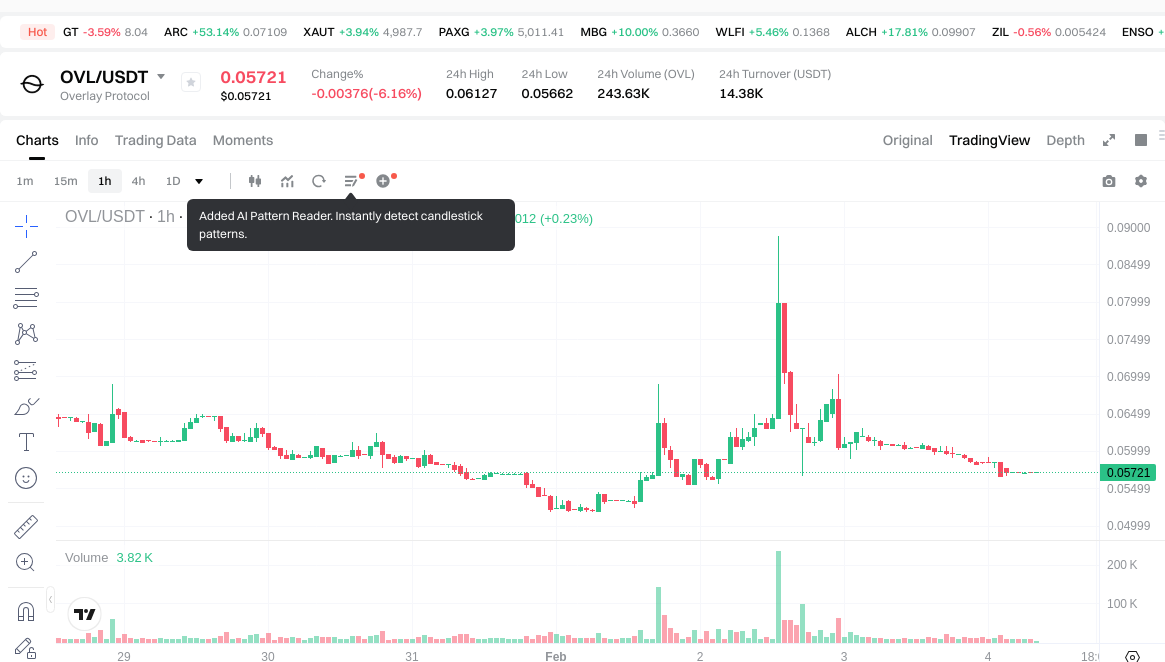
- Recent Performance: As of February 4, 2026 → Price trading at $0.05708, showing recovery from recent lows with 30-day gains of approximately 56%
Current OVL Market Status (February 2026)
- OVL Current Price: $0.05708
- Market Sentiment (Fear & Greed Index): Data indicates cautious optimism with recent short-term volatility
- 24-Hour Trading Volume: $14,364.28
- Market Capitalization: $811,844.62 with circulating supply of 14,222,926 tokens
Click to view real-time OVL market price
II. Core Factors Affecting Whether OVL is a Good Investment (Is Overlay Protocol(OVL) a Good Investment)
Supply Mechanism and Scarcity (OVL investment scarcity)
- Dynamic Mint/Burn Model → Influences price and investment value
- The protocol employs a unique mint/burn mechanism built around the $OVL token, where tokens are minted or burned to settle profits and losses from trades, directly impacting circulating supply
- Current circulation stands at 14,222,926 OVL (18.12% of total supply), with a maximum supply of 100,000,000 tokens, suggesting potential for future supply expansion
- Investment significance: The controlled supply mechanism and relatively low circulation ratio may contribute to scarcity dynamics that support long-term investment considerations
- Price volatility patterns: OVL experienced significant price fluctuations, with a 1-year decline of 89.46% and a 30-day increase of 56.00%
- Historical price range: The token traded between $0.03171 and $0.5 since launch
- Market metrics: Current market capitalization of approximately $811,844.62 with 24-hour trading volume of $14,364.28, indicating relatively limited liquidity
- Exchange availability: Listed on 7 exchanges with Gate.com trading support
Technology and Ecosystem Development (Technology & Ecosystem for OVL investment)
- Counterparty-free trading mechanism: The protocol enables users to trade directly against the protocol itself rather than requiring traditional counterparties or liquidity pools
- Data derivatives innovation: Overlay Protocol facilitates on-chain trading of real-world metrics including ETH burn rates, gaming statistics, and various data streams
- Collateral functionality: OVL tokens serve as collateral for opening long or short positions across various markets within the protocol
- Governance rights: Token holders may participate in protocol governance decisions
- The entire OVL token supply functions as collective liquidity for all trades, representing a distinctive approach to decentralized trading infrastructure
Risk Factors and Investment Considerations
- High-risk classification: Reference materials explicitly categorize Overlay Protocol as a high-risk blockchain asset
- Limited holder base: Approximately 2,310 holders suggest relatively concentrated ownership
- Market dominance: 0.00018% market share indicates minimal presence in the broader cryptocurrency market
- Price predictions vary: Projections for 2026 range from $0.06252 to potentially $0.5, though such forecasts carry substantial uncertainty
- Contract deployment: Token operates on BSC (BEP-20 standard) at address 0x1f34c87ded863fe3a3cd76fac8ada9608137c8c3
III. OVL Future Investment Forecast and Price Outlook (Is Overlay Protocol (OVL) worth investing in 2026-2031)
Short-term Investment Forecast (2026, short-term OVL investment outlook)
- Conservative forecast: $0.033 - $0.043
- Neutral forecast: $0.045 - $0.057
- Optimistic forecast: $0.058 - $0.064
Mid-term Investment Outlook (2027-2028, mid-term Overlay Protocol (OVL) investment forecast)
- Market stage expectation: OVL may enter a gradual growth phase as the protocol continues optimizing its infrastructure and expanding its data derivatives ecosystem.
- Investment return forecast:
- 2027: $0.040 - $0.065
- 2028: $0.040 - $0.068
- Key catalysts: Protocol upgrades focusing on security enhancements and trading mechanism improvements, expansion of supported data sources, and broader adoption of decentralized data derivatives.
Long-term Investment Outlook (Is OVL a good long-term investment?)
- Base scenario: $0.042 - $0.074 (assuming steady ecosystem development and moderate market acceptance)
- Optimistic scenario: $0.065 - $0.081 (assuming accelerated adoption of data derivatives and favorable market conditions)
- Risk scenario: $0.034 - $0.048 (under challenging market conditions or slower-than-expected protocol development)
Click to view OVL long-term investment and price forecast: Price Prediction
2026-02-04 - 2031 Long-term Outlook
- Base scenario: $0.042 - $0.074 (corresponding to steady progress and gradual mainstream application growth)
- Optimistic scenario: $0.065 - $0.081 (corresponding to large-scale adoption and favorable market environment)
- Transformative scenario: Above $0.081 (in case of breakthrough ecosystem developments and mainstream adoption)
- 2031-12-31 forecast high: $0.079 (based on optimistic development assumptions)
Disclaimer: Price forecasts are subject to market volatility and various external factors. Historical performance does not guarantee future results. Investors should conduct their own research and consider their risk tolerance before making investment decisions.
| Year |
Predicted High Price |
Predicted Average Price |
Predicted Low Price |
Price Change |
| 2026 |
0.0640752 |
0.05721 |
0.0326097 |
0 |
| 2027 |
0.064887582 |
0.0606426 |
0.040024116 |
6 |
| 2028 |
0.06841394919 |
0.062765091 |
0.03954200733 |
9 |
| 2029 |
0.0695248913007 |
0.065589520095 |
0.0341065504494 |
14 |
| 2030 |
0.08106864683742 |
0.06755720569785 |
0.047965616045473 |
18 |
| 2031 |
0.078771701843693 |
0.074312926267635 |
0.042358367972551 |
30 |
IV. OVL Investment Strategy and Risk Management (How to invest in Overlay Protocol)
Investment Methodology (OVL investment strategy)
Long-term Holding (HODL OVL): Suitable for Conservative Investors
Long-term holding represents a passive investment approach focused on capturing the potential value appreciation of OVL over extended periods. This strategy typically involves acquiring OVL tokens and maintaining positions through market cycles, regardless of short-term price fluctuations. Conservative investors may consider this approach based on their assessment of Overlay Protocol's fundamental value proposition in the decentralized data derivatives sector.
Active Trading: Relying on Technical Analysis and Swing Operations
Active trading involves more frequent position adjustments based on technical indicators, price patterns, and market sentiment analysis. Given OVL's 24-hour price volatility (recorded at -6.38% as of February 4, 2026) and 7-day movement (-10.42%), swing traders may identify potential entry and exit points. The token's 24-hour high of $0.06127 and low of $0.05662 illustrate the intraday price ranges that active traders might utilize for tactical positioning.
Risk Management (Risk management for OVL investment)
Asset Allocation Ratios: Conservative / Aggressive / Professional Investors
Asset allocation should reflect individual risk tolerance and investment objectives:
- Conservative approach: Limiting OVL exposure to a small percentage of overall portfolio (potentially 1-3% of crypto allocation)
- Aggressive approach: Higher concentration in OVL within the crypto portfolio segment (potentially 5-10%)
- Professional investor approach: Strategic allocation based on comprehensive due diligence and portfolio diversification models
With OVL's current circulating supply of 14,222,926 tokens (representing 18.12% of total supply) and market capitalization of approximately $811,845, investors should consider liquidity constraints when determining position sizes.
Risk management strategies may include:
- Portfolio diversification: Combining OVL with established cryptocurrencies and traditional assets to reduce correlation risk
- Position sizing: Limiting individual token exposure relative to total portfolio value
- Rebalancing protocols: Establishing predetermined rules for adjusting positions based on price movements or allocation drift
Given OVL's 30-day price change of +56.00%, periodic portfolio rebalancing may help manage position concentration risk.
Secure Storage: Hot/Cold Wallets + Hardware Wallet Recommendations
Secure storage practices are fundamental to cryptocurrency investment:
- Cold storage solutions: Hardware wallets (such as Ledger or Trezor devices) provide offline security for long-term holdings
- Hot wallet usage: Exchange or software wallets may be suitable for actively traded portions, with awareness of custodial risks
- Multi-signature arrangements: Advanced users may implement multi-sig solutions for enhanced security
- Backup procedures: Maintaining secure backups of private keys and recovery phrases in physically separate locations
As OVL operates on the BSC network (contract address: 0x1f34c87ded863fe3a3cd76fac8ada9608137c8c3), investors should ensure their chosen storage solution supports BEP-20 tokens.
V. OVL Investment Risks and Challenges (Risks of investing in Overlay Protocol)
Market Risk: High Volatility and Price Manipulation
OVL exhibits characteristics common to smaller-cap cryptocurrencies:
- Price volatility: Historical data shows significant price movements, with 1-year performance at -89.46%
- Limited liquidity: 24-hour trading volume of approximately $14,364 may result in wider bid-ask spreads and potential slippage
- Market depth concerns: With 2,310 holders and presence on 7 exchanges, concentrated ownership or limited order book depth could amplify price movements
- Manipulation susceptibility: Lower market capitalization tokens may face increased vulnerability to coordinated trading activities
Regulatory Risk: Policy Uncertainty Across Different Jurisdictions
Regulatory considerations include:
- Jurisdictional variations: Different countries maintain distinct regulatory frameworks for cryptocurrency derivatives and decentralized protocols
- Classification uncertainty: The regulatory treatment of data derivatives protocols may evolve as authorities develop frameworks for novel crypto asset categories
- Compliance requirements: Potential future regulations could impact protocol operations, token utility, or accessibility in certain markets
- Exchange listing risk: Regulatory developments may affect OVL's availability on trading platforms in specific jurisdictions
Technical Risk: Network Security Vulnerabilities and Upgrade Failures
Technical risks inherent to blockchain-based protocols:
- Smart contract vulnerabilities: Potential bugs or exploits in protocol contracts could affect token functionality or user funds
- Network dependency: As a BEP-20 token, OVL's operation relies on BSC network stability and security
- Protocol upgrade risks: Implementation of protocol changes or improvements may encounter technical challenges
- Oracle dependencies: Data derivatives protocols typically rely on external data feeds, introducing potential oracle-related risks
- Scalability considerations: Network congestion or technical limitations could impact user experience and protocol performance
VI. Conclusion: Is Overlay Protocol a Good Investment?
Investment Value Summary
OVL presents a specialized investment opportunity within the decentralized data derivatives sector. The token has demonstrated both significant upside potential (30-day gain of +56.00%) and substantial volatility (1-year decline of -89.46%). With a circulating market capitalization of approximately $811,845 and presence on 7 exchanges, OVL represents an emerging project in the derivatives protocol space. The limited circulating supply (18.12% of total) introduces both scarcity dynamics and future supply expansion considerations.
Investor Recommendations
✅ Newcomers: Consider dollar-cost averaging strategies combined with secure wallet storage practices. Prioritize understanding Overlay Protocol's mechanism and risk profile before establishing positions.
✅ Experienced Investors: May explore swing trading opportunities based on technical analysis, while maintaining diversified portfolio construction that limits concentration risk in smaller-cap tokens.
✅ Institutional Investors: Could evaluate strategic allocation opportunities based on comprehensive due diligence, including protocol architecture assessment, competitive positioning analysis, and liquidity considerations.
⚠️ Notice: Cryptocurrency investment carries substantial risk, including the potential for complete loss of capital. This content is provided for informational purposes only and does not constitute investment advice, financial guidance, or a recommendation to buy, sell, or hold any cryptocurrency. Investors should conduct independent research and consult qualified financial advisors before making investment decisions.
VII. FAQ
Q1: What is the current price of OVL (Overlay Protocol) and where can I purchase it?
As of February 4, 2026, OVL is trading at approximately $0.05708. The token is available on 7 cryptocurrency exchanges, with Gate.com being one of the primary platforms supporting OVL trading. Investors can purchase OVL through these exchanges by creating an account, completing necessary verification procedures, and depositing funds. The token operates on the Binance Smart Chain (BSC) network as a BEP-20 token, with the contract address 0x1f34c87ded863fe3a3cd76fac8ada9608137c8c3.
Q2: How volatile has OVL been historically, and what does this mean for potential investors?
OVL has exhibited significant price volatility throughout its trading history. The token experienced a 1-year decline of 89.46%, falling from a notable peak of $0.5 on August 14, 2025, to as low as $0.03171 on January 5, 2026. However, recent performance shows a 30-day increase of approximately 56%. This high volatility indicates substantial risk and potential reward, suggesting that OVL may be more suitable for risk-tolerant investors who can withstand significant price fluctuations rather than conservative investors seeking stable returns.
Q3: What makes Overlay Protocol's mechanism unique compared to traditional cryptocurrency trading platforms?
Overlay Protocol distinguishes itself through its counterparty-free trading mechanism, enabling users to trade directly against the protocol rather than requiring bilateral liquidity or traditional counterparties. The protocol facilitates on-chain trading of diverse real-world data metrics—from Ethereum burn rates to gaming statistics—using a dynamic mint-and-burn mechanism built around the OVL token. This approach addresses liquidity challenges that have historically constrained long-tail assets and heterogeneous markets, with the entire OVL token supply functioning as collective liquidity for all trades.
Q4: What are the key risk factors investors should consider before investing in OVL?
Several significant risk factors characterize OVL investment: (1) High volatility risk, with historical price movements showing substantial fluctuations; (2) Limited liquidity, evidenced by a 24-hour trading volume of approximately $14,364 and only 2,310 holders; (3) Regulatory uncertainty surrounding data derivatives protocols across different jurisdictions; (4) Technical risks including smart contract vulnerabilities, network dependencies on BSC, and oracle-related risks inherent to data derivatives protocols; (5) Market concentration risk due to relatively small market capitalization ($811,845) representing 0.00018% market dominance.
Q5: What is the predicted price outlook for OVL from 2026 to 2031?
Price forecasts for OVL vary significantly across different scenarios. For 2026, projections range from $0.033 (conservative) to $0.064 (optimistic). By 2031, the predicted high reaches approximately $0.079 under optimistic development assumptions, with average prices estimated around $0.074. Mid-term forecasts for 2027-2028 suggest ranges of $0.040-$0.065 and $0.040-$0.068 respectively. However, these predictions carry substantial uncertainty and depend on multiple factors including protocol adoption, ecosystem development, and overall market conditions. Historical performance does not guarantee future results.
Q6: How should different types of investors approach OVL allocation in their portfolios?
Investment approach should align with individual risk tolerance levels: Conservative investors might limit OVL exposure to 1-3% of their cryptocurrency allocation, focusing on long-term holding strategies. Aggressive investors could allocate 5-10% within their crypto portfolio segment, potentially incorporating active trading strategies based on technical analysis. Professional investors may determine strategic allocation through comprehensive due diligence and sophisticated portfolio diversification models. Given OVL's high volatility and relatively low liquidity, all investor categories should prioritize secure storage using hardware wallets for long-term holdings and implement appropriate risk management protocols including position sizing and portfolio rebalancing.
Q7: What is the token supply structure of OVL and how might it affect future price movements?
OVL has a maximum supply of 100,000,000 tokens, with current circulation at 14,222,926 tokens, representing only 18.12% of total supply. This relatively low circulation ratio suggests potential for future supply expansion, which could exert downward pressure on price if additional tokens enter circulation without corresponding demand growth. The protocol employs a dynamic mint-and-burn mechanism where tokens are minted or burned to settle profits and losses from trades, directly impacting circulating supply. This unique supply mechanism introduces both scarcity dynamics that may support prices and uncertainty regarding future token emission rates.
Q8: What security considerations should OVL investors prioritize when storing their tokens?
Security best practices for OVL token storage include: (1) Hardware wallet solutions (such as Ledger or Trezor) for long-term holdings, providing offline security protection; (2) Ensuring wallet compatibility with BEP-20 tokens since OVL operates on the BSC network; (3) Implementing secure backup procedures for private keys and recovery phrases in physically separate locations; (4) Using exchange or hot wallets only for actively traded portions while understanding custodial risks; (5) Advanced users may consider multi-signature arrangements for enhanced security. Given the technical risks inherent to blockchain protocols, proper token custody represents a fundamental component of OVL investment strategy.
* The information is not intended to be and does not constitute financial advice or any other recommendation of any sort offered or endorsed by Gate.