This comprehensive guide compares LABUIB and BTC as investment assets, examining their fundamentally different market positions and characteristics. LABUIB, launched in 2025, represents a meme token tied to Pop Mart IP with value driven by social media virality, while BTC operates as an established digital asset with fixed 21-million-coin supply and substantial institutional adoption since 2008. The analysis evaluates historical price performance, tokenomics differences, market applications, and technological ecosystems across multiple time horizons. Current market data shows LABUIB at $0.0006177 with $41,549.45 daily volume, contrasting sharply with BTC at $73,873.4 and $1.4 billion daily volume. The article provides detailed 2026-2031 price forecasts, risk management strategies for different investor profiles, and critical assessment of market risks including volatility, regulatory uncertainty, and technical considerations. Investors can access real-time prices and predictions on Gate to inform their crypto
Introduction: LABUBU vs BTC Investment Comparison
In the cryptocurrency market, the comparison between LABUBU and BTC has always been a topic that investors cannot avoid. The two not only have obvious differences in market cap ranking, application scenarios, and price performance, but also represent different crypto asset positioning.
LABUBU (LABUBU): Launched in 2025, this token is associated with the Pop Mart Nordic elf IP created by Long Jiasheng, entering the market with a cultural trendy toy background.
BTC (BTC): Since its launch in 2008, it has been hailed as "digital gold" and remains one of the cryptocurrencies with the highest trading volume and market cap globally.
This article will comprehensively analyze the investment value comparison between LABUBU and BTC around historical price trends, supply mechanisms, institutional adoption, technical ecosystems, and future predictions, attempting to answer the question investors care about most:
"Which is the better buy right now?"
I. Historical Price Comparison and Current Market Status
LABUBU and BTC Historical Price Trends
- 2025: LABUBU launched in January 2025, reaching an all-time high of $0.06178 in June 2025 following initial market enthusiasm for Pop Mart's Nordic elf IP.
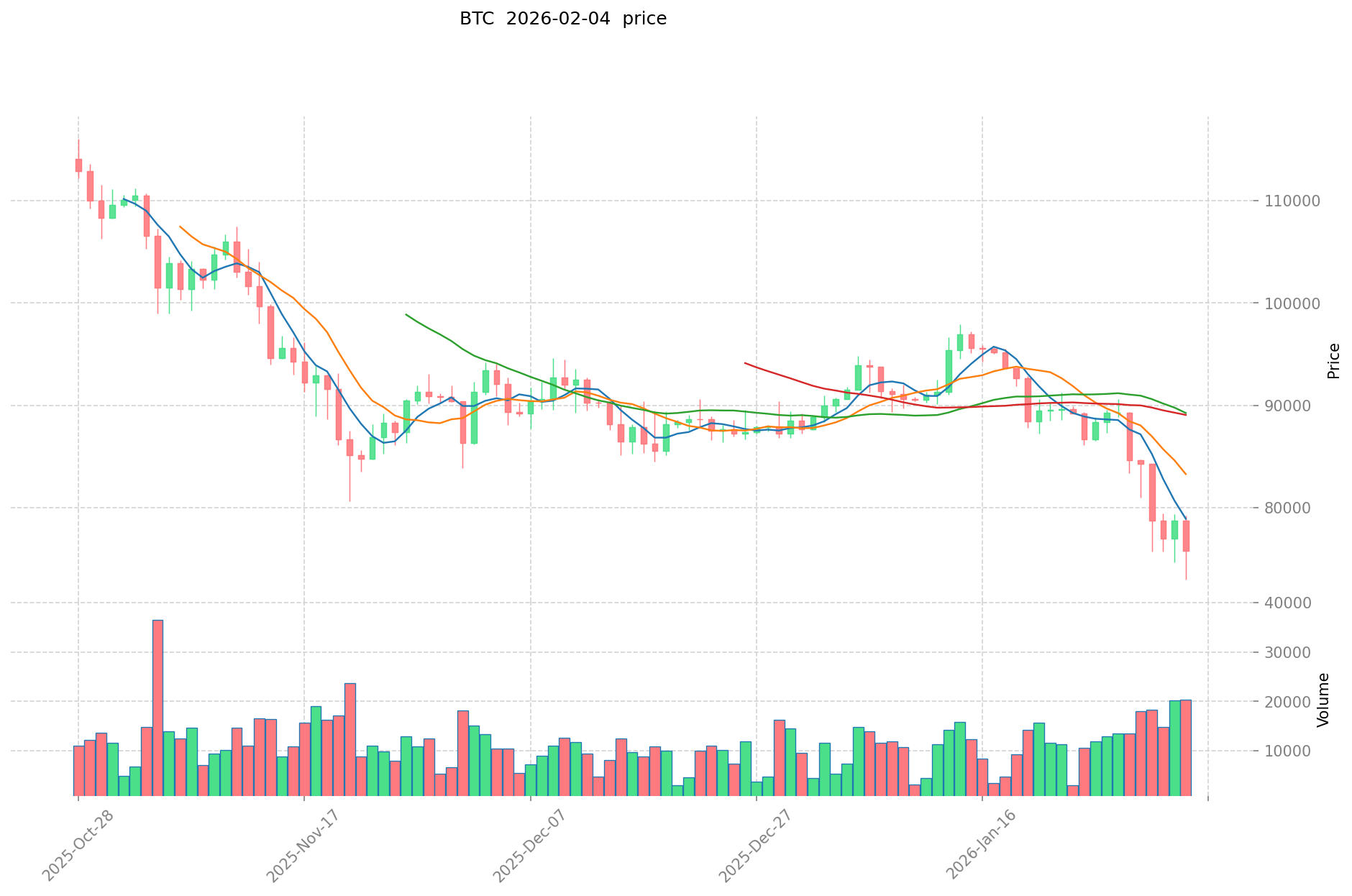
- 2025: BTC experienced significant volatility throughout 2025, reaching a peak of $126,080 in October 2025 amid institutional adoption momentum.
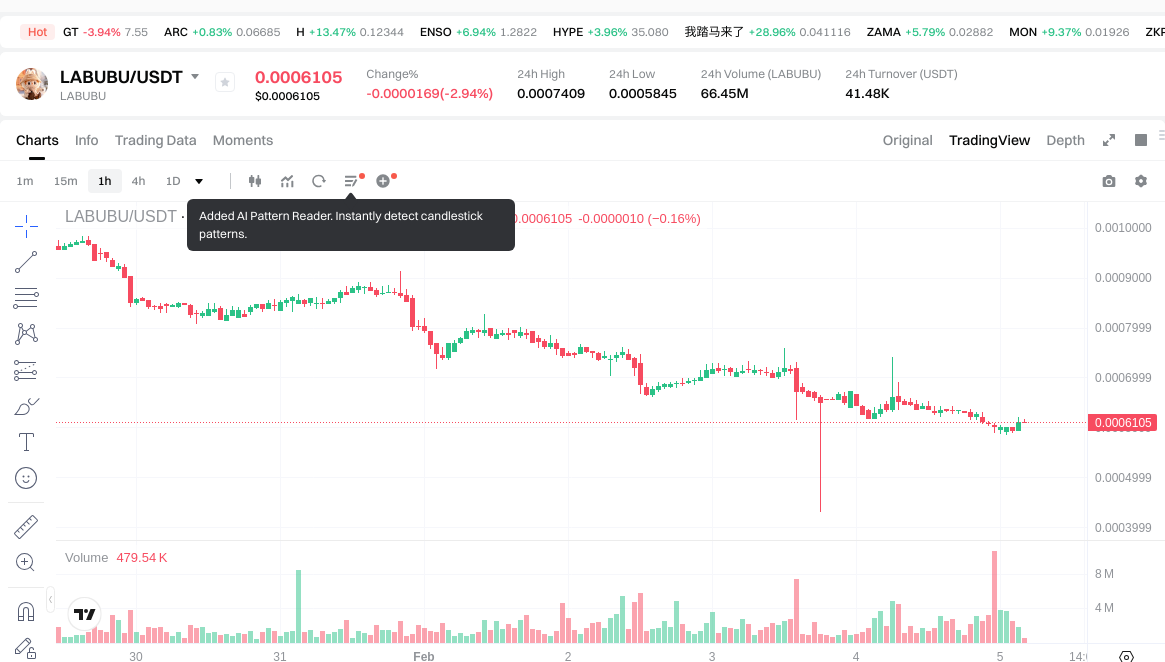
- Comparative Analysis: During the recent market cycle, LABUBU declined from its high of $0.06178 to a low of $0.0004305, representing a substantial correction. Meanwhile, BTC demonstrated relative resilience, though it also faced downward pressure from its peak.
Current Market Landscape (February 5, 2026)
- LABUBU current price: $0.0006177
- BTC current price: $73,873.4
- 24-hour trading volume: LABUBU $41,549.45 vs BTC $1,426,563,207.15
- Market Sentiment Index (Fear & Greed Index): 14 (Extreme Fear)
View real-time prices:
II. Core Factors Influencing LABUBU vs BTC Investment Value
Supply Mechanism Comparison (Tokenomics)
- LABUBU: The token operates without traditional tokenomics or structured supply mechanisms. Its value generation relies primarily on viral dynamics driven by IP brand recognition rather than supply controls.
- BTC: Bitcoin features a fixed supply cap of 21 million coins with a programmed halving mechanism that reduces mining rewards approximately every four years, creating a deflationary model.
- 📌 Historical Pattern: Bitcoin's halving events have historically preceded significant price cycles, with reduced supply growth potentially contributing to upward price pressure during periods of sustained demand.
Institutional Adoption and Market Application
- Institutional Holdings: Bitcoin has attracted substantial institutional interest from asset managers, publicly traded companies, and financial institutions. LABUBU, as a meme token, has minimal institutional participation.
- Enterprise Adoption: Bitcoin has seen adoption in cross-border payment solutions and corporate treasury allocations by certain companies. LABUBU lacks comparable enterprise-level applications.
- National Policies: Regulatory attitudes toward Bitcoin vary globally, with some jurisdictions providing legal frameworks while others maintain restrictive positions. LABUBU faces similar regulatory uncertainties common to meme tokens.
Technology Development and Ecosystem Construction
- LABUBU Technology: The token does not rely on significant technological development or innovation. Its momentum stems from social media virality and fan engagement with the Labubu brand.
- BTC Technology: Bitcoin's development focuses on scalability solutions, security enhancements, and network efficiency improvements. Second-layer solutions continue to expand payment capabilities.
- Ecosystem Comparison: Bitcoin participates in DeFi protocols, payment networks, and institutional settlement systems. LABUBU's ecosystem remains limited, centered primarily on speculative trading activity.
Macroeconomic Environment and Market Cycles
- Performance During Inflation: Bitcoin has been discussed as a potential inflation hedge due to its fixed supply, though its effectiveness varies across different economic periods. LABUBU's valuation depends entirely on market sentiment and IP popularity rather than macroeconomic fundamentals.
- Macroeconomic Monetary Policy: Interest rate changes and U.S. dollar strength influence Bitcoin's price dynamics as investors adjust risk appetite. LABUBU's sensitivity to these factors is indirect, mediated through overall cryptocurrency market conditions.
- Geopolitical Factors: Bitcoin benefits from demand in regions with currency instability or capital control concerns. LABUBU's valuation remains primarily tied to social media trends and celebrity endorsements rather than geopolitical considerations.
III. 2026-2031 Price Forecast: LABUBU vs BTC
Short-term Forecast (2026)
- LABUBU: Conservative $0.00034188 - $0.0006105 | Optimistic $0.0006105 - $0.000909645
- BTC: Conservative $61,287.117 - $73,839.9 | Optimistic $73,839.9 - $82,700.688
Mid-term Forecast (2028-2029)
- LABUBU may enter a consolidation phase, with projected prices ranging from $0.000588600144 to $0.00105764088375 in 2028, and $0.000682178370018 to $0.001018324233506 in 2029
- BTC may enter a growth phase, with projected prices ranging from $70,055.8266447 to $94,272.6556083 in 2028, and $82,246.4053676265 to $119,302.478115678 in 2029
- Key drivers: institutional capital inflows, ETF developments, ecosystem expansion
Long-term Forecast (2030-2031)
- LABUBU: Baseline scenario $0.000772690587084 - $0.00100349426894 (2030) | Optimistic scenario $0.000783427975761 - $0.001101033911881 (2031)
- BTC: Baseline scenario $93,308.99879289846 - $104,841.571677414 (2030) | Optimistic scenario $98,540.5932196014186 - $136,440.8213809865796 (2031)
View detailed price predictions for LABUBU and BTC
Disclaimer
LABUBU:
| Year |
Predicted High Price |
Predicted Average Price |
Predicted Low Price |
Price Change |
| 2026 |
0.000909645 |
0.0006105 |
0.00034188 |
-1 |
| 2027 |
0.00107930295 |
0.0007600725 |
0.00071446815 |
23 |
| 2028 |
0.00105764088375 |
0.000919687725 |
0.000588600144 |
48 |
| 2029 |
0.001018324233506 |
0.000988664304375 |
0.000682178370018 |
60 |
| 2030 |
0.001113878638524 |
0.00100349426894 |
0.000772690587084 |
62 |
| 2031 |
0.001101033911881 |
0.001058686453732 |
0.000783427975761 |
71 |
BTC:
| Year |
Predicted High Price |
Predicted Average Price |
Predicted Low Price |
Price Change |
| 2026 |
82700.688 |
73839.9 |
61287.117 |
0 |
| 2027 |
94707.05574 |
78270.294 |
47744.87934 |
5 |
| 2028 |
94272.6556083 |
86488.67487 |
70055.8266447 |
17 |
| 2029 |
119302.478115678 |
90380.66523915 |
82246.4053676265 |
22 |
| 2030 |
147826.61606515374 |
104841.571677414 |
93308.99879289846 |
41 |
| 2031 |
136440.8213809865796 |
126334.09387128387 |
98540.5932196014186 |
71 |
IV. Investment Strategy Comparison: LABUBU vs BTC
Long-term vs Short-term Investment Strategies
- LABUBU: May appeal to investors with high risk tolerance seeking exposure to viral meme token dynamics and Pop Mart IP brand recognition. The token's price movements depend heavily on social media momentum and community engagement rather than fundamental value drivers.
- BTC: May suit investors seeking exposure to an established digital asset with institutional participation, network effects, and historical price patterns spanning multiple market cycles. Bitcoin's longer operational history provides more reference data for strategic planning.
Risk Management and Asset Allocation
- Conservative Investors: LABUBU: 0-5% vs BTC: 95-100% (if allocating to crypto assets)
- Aggressive Investors: LABUBU: 10-20% vs BTC: 80-90%
- Hedging Tools: Stablecoin allocations, options strategies, cross-asset diversification across multiple cryptocurrencies
V. Potential Risk Comparison
Market Risk
- LABUBU: Faces substantial volatility risk characteristic of meme tokens, with price movements driven primarily by sentiment shifts, social media trends, and speculative trading activity. Limited liquidity relative to major cryptocurrencies may amplify price swings during periods of market stress.
- BTC: Experiences significant price fluctuations influenced by macroeconomic conditions, institutional capital flows, regulatory developments, and broader cryptocurrency market sentiment. Historical volatility patterns show correlation with risk asset cycles.
Technical Risk
- LABUBU: Limited technical infrastructure beyond basic token functionality. Dependency on social media platforms and celebrity endorsements creates vulnerability to platform policy changes and shifting cultural trends.
- BTC: Network security depends on distributed mining operations. Scalability constraints exist at the base layer, though second-layer solutions continue development. Mining concentration in specific geographic regions presents potential centralization concerns.
Regulatory Risk
- Global regulatory frameworks continue evolving for both assets. Bitcoin faces jurisdiction-specific classification debates (commodity vs security vs currency) affecting taxation and compliance requirements. LABUBU, as a meme token without clear utility, may face scrutiny under securities regulations in various jurisdictions. Regulatory uncertainty affects both assets but manifests differently based on their distinct characteristics and use cases.
VI. Conclusion: Which Is the Better Buy?
📌 Investment Value Summary:
- LABUBU Characteristics: Represents speculative exposure to meme token dynamics and Pop Mart IP brand recognition, with price movements driven by social media virality and community sentiment rather than fundamental value propositions.
- BTC Characteristics: Offers exposure to an established digital asset with institutional participation, fixed supply mechanism, longer operational history, and positioning as a potential store of value within the cryptocurrency ecosystem.
✅ Investment Considerations:
- New Investors: May consider focusing initial cryptocurrency exposure on more established assets with longer track records, deeper liquidity, and broader institutional participation before exploring higher-risk speculative tokens.
- Experienced Investors: Could evaluate portfolio allocation based on individual risk tolerance, investment timeframes, and strategic objectives, considering diversification across different cryptocurrency categories and risk profiles.
- Institutional Participants: Typically prioritize assets with regulatory clarity, custody solutions, liquid markets, and established operational infrastructure when constructing cryptocurrency exposure.
⚠️ Risk Disclaimer: Cryptocurrency markets demonstrate substantial volatility. This content does not constitute investment advice. Investors should conduct independent research and consult qualified financial advisors before making investment decisions.
VII. FAQ
Q1: What are the main differences between LABUBU and BTC as investment assets?
LABUBU and BTC represent fundamentally different cryptocurrency categories. LABUBU is a meme token launched in 2025, associated with Pop Mart's Nordic elf IP, with value driven primarily by social media virality and community sentiment rather than underlying technological innovation or utility. BTC, launched in 2008, functions as an established digital asset with a fixed supply of 21 million coins, institutional adoption, and positioning as "digital gold" within the cryptocurrency ecosystem. Their current price differential ($0.0006177 vs $73,873.4) reflects BTC's substantially larger market capitalization, deeper liquidity ($41,549.45 vs $1,426,563,207.15 in 24-hour volume), and longer operational history spanning multiple market cycles.
Q2: How do the supply mechanisms of LABUBU and BTC affect their investment value?
BTC operates with a programmed deflationary model featuring a fixed supply cap of 21 million coins and halving events approximately every four years that reduce mining rewards, creating predictable supply constraints that have historically preceded significant price cycles during periods of sustained demand. LABUBU lacks structured tokenomics or supply controls, with value generation relying on viral dynamics and IP brand recognition rather than scarcity mechanisms. This fundamental difference means BTC's value proposition incorporates supply-side economics while LABUBU's valuation depends entirely on sentiment-driven demand fluctuations, making them suitable for different investment strategies and risk profiles.
Q3: What are the price projections for LABUBU and BTC through 2031?
For 2026, conservative projections estimate LABUBU between $0.00034188-$0.0006105 and BTC between $61,287.117-$73,839.9, with optimistic scenarios reaching $0.000909645 and $82,700.688 respectively. Mid-term forecasts for 2028-2029 show LABUBU potentially consolidating between $0.000588600144-$0.00105764088375 (2028) and $0.000682178370018-$0.001018324233506 (2029), while BTC may enter a growth phase ranging from $70,055.8266447-$94,272.6556083 (2028) to $82,246.4053676265-$119,302.478115678 (2029). Long-term 2031 projections suggest LABUBU reaching $0.000783427975761-$0.001101033911881 and BTC reaching $98,540.5932196014186-$136,440.8213809865796 under optimistic scenarios, though these forecasts carry significant uncertainty given cryptocurrency market volatility.
Q4: Which asset is more suitable for different investor profiles?
Conservative investors seeking cryptocurrency exposure may consider allocating 95-100% to BTC and 0-5% to LABUBU (if allocating at all), prioritizing established assets with institutional participation, custody solutions, and longer track records. Aggressive investors with higher risk tolerance might consider 80-90% BTC and 10-20% LABUBU allocations to capture potential meme token dynamics while maintaining core exposure to more established digital assets. New investors should typically focus initial cryptocurrency exposure on assets with deeper liquidity, regulatory clarity, and broader institutional participation before exploring higher-risk speculative tokens. Institutional participants generally prioritize assets offering established operational infrastructure, liquid markets, and clearer regulatory frameworks when constructing cryptocurrency portfolios.
Q5: What are the key risk factors to consider when comparing LABUBU and BTC investments?
Market risk differs substantially between the assets: LABUBU faces extreme volatility characteristic of meme tokens, with price movements driven by sentiment shifts, social media trends, and limited liquidity that may amplify price swings during market stress. BTC experiences significant fluctuations influenced by macroeconomic conditions, institutional flows, and regulatory developments, with historical volatility patterns showing correlation with broader risk asset cycles. Technical risks vary considerably—LABUBU depends on social media platforms and celebrity endorsements, creating vulnerability to platform policy changes and shifting cultural trends, while BTC faces scalability constraints, mining concentration concerns, and network security considerations. Regulatory uncertainty affects both assets but manifests differently: BTC faces jurisdiction-specific classification debates (commodity vs security vs currency) affecting taxation and compliance, while LABUBU may face securities regulation scrutiny as a meme token without clear utility. The current Fear & Greed Index of 14 (Extreme Fear) indicates elevated market stress conditions affecting both assets.
Q6: How do institutional adoption levels differ between LABUBU and BTC?
BTC has achieved substantial institutional participation from asset managers, publicly traded companies, and financial institutions, with adoption in cross-border payment solutions and corporate treasury allocations by certain companies. Some jurisdictions have established legal frameworks for Bitcoin, contributing to its positioning within institutional portfolios. LABUBU has minimal institutional participation, functioning primarily as a speculative meme token driven by retail trader activity and social media engagement. This institutional adoption gap translates to significantly different market infrastructure: BTC benefits from established custody solutions, derivatives markets, ETF products, and participation in DeFi protocols and payment networks, while LABUBU's ecosystem remains limited, centered primarily on speculative trading activity without enterprise-level applications or institutional-grade infrastructure.
Q7: What role do macroeconomic factors play in LABUBU and BTC price dynamics?
BTC's price movements show sensitivity to macroeconomic conditions including inflation trends, interest rate policies, and U.S. dollar strength as investors adjust risk appetite based on monetary policy changes. Bitcoin has been discussed as a potential inflation hedge due to its fixed supply mechanism, though its effectiveness varies across different economic periods. Geopolitical factors influence BTC demand in regions with currency instability or capital control concerns. LABUBU's valuation demonstrates minimal direct correlation with macroeconomic fundamentals, depending instead on social media trends, celebrity endorsements, and Pop Mart IP popularity. However, LABUBU experiences indirect macroeconomic influence through overall cryptocurrency market conditions, as broader risk-on/risk-off sentiment affects capital flows into speculative assets. The fundamental difference lies in BTC's positioning as a macro-responsive digital asset versus LABUBU's dependence on cultural trends and viral momentum independent of economic cycles.
Q8: What investment strategies are appropriate for LABUBU versus BTC?
Long-term investment strategies differ significantly between the assets: BTC may suit investors seeking exposure to an established digital asset with multiple market cycle references, network effects, and institutional participation patterns spanning over a decade. Bitcoin's longer operational history provides more reference data for strategic planning, making it potentially appropriate for buy-and-hold strategies and gradual accumulation approaches. LABUBU may appeal to short-term tactical traders with high risk tolerance seeking exposure to viral meme token dynamics and rapid sentiment shifts, requiring active monitoring of social media trends and community engagement metrics. Risk management approaches should reflect these differences: BTC allocations might employ dollar-cost averaging, stablecoin hedging, and options strategies within diversified cryptocurrency portfolios, while LABUBU positions typically require strict position sizing limits, rapid profit-taking protocols, and heightened attention to exit strategy given the asset's dependence on maintaining social media momentum and cultural relevance.
* The information is not intended to be and does not constitute financial advice or any other recommendation of any sort offered or endorsed by Gate.