PUSH vs HBAR: Which Blockchain Platform Offers Better Performance and Scalability in 2024?

Introduction: Investment Comparison Between PUSH and HBAR
In the cryptocurrency market, the comparison between PUSH vs HBAR continues to be a focal point for investors. The two assets demonstrate notable differences in market cap ranking, application scenarios, and price performance, while representing distinct positioning within the crypto asset landscape.
PUSH (PUSH): Launched in 2021, it has gained market recognition through its positioning as a decentralized notification protocol, enabling platform-independent communication across dApps, services, and smart contracts.
HBAR (HBAR): Since its introduction in 2020, it has been associated with high-speed transaction processing capabilities, utilizing hashgraph consensus to deliver fast, secure, and fair public ledger operations.
This article will provide a comprehensive analysis of PUSH vs HBAR investment value comparison, examining historical price trends, supply mechanisms, institutional adoption, technological ecosystems, and future projections, while attempting to address the question most relevant to investors:
"Which is the better buy right now?"
I. Historical Price Comparison and Current Market Status
PUSH and HBAR Historical Price Trends
- 2021: PUSH reached its all-time high of $8.73 in April, driven by the initial launch momentum of the Ethereum Push Notification Service protocol.
- 2021: HBAR achieved its peak price of $0.569229 in September, benefiting from growing adoption of the Hedera network and its unique hashgraph consensus mechanism.
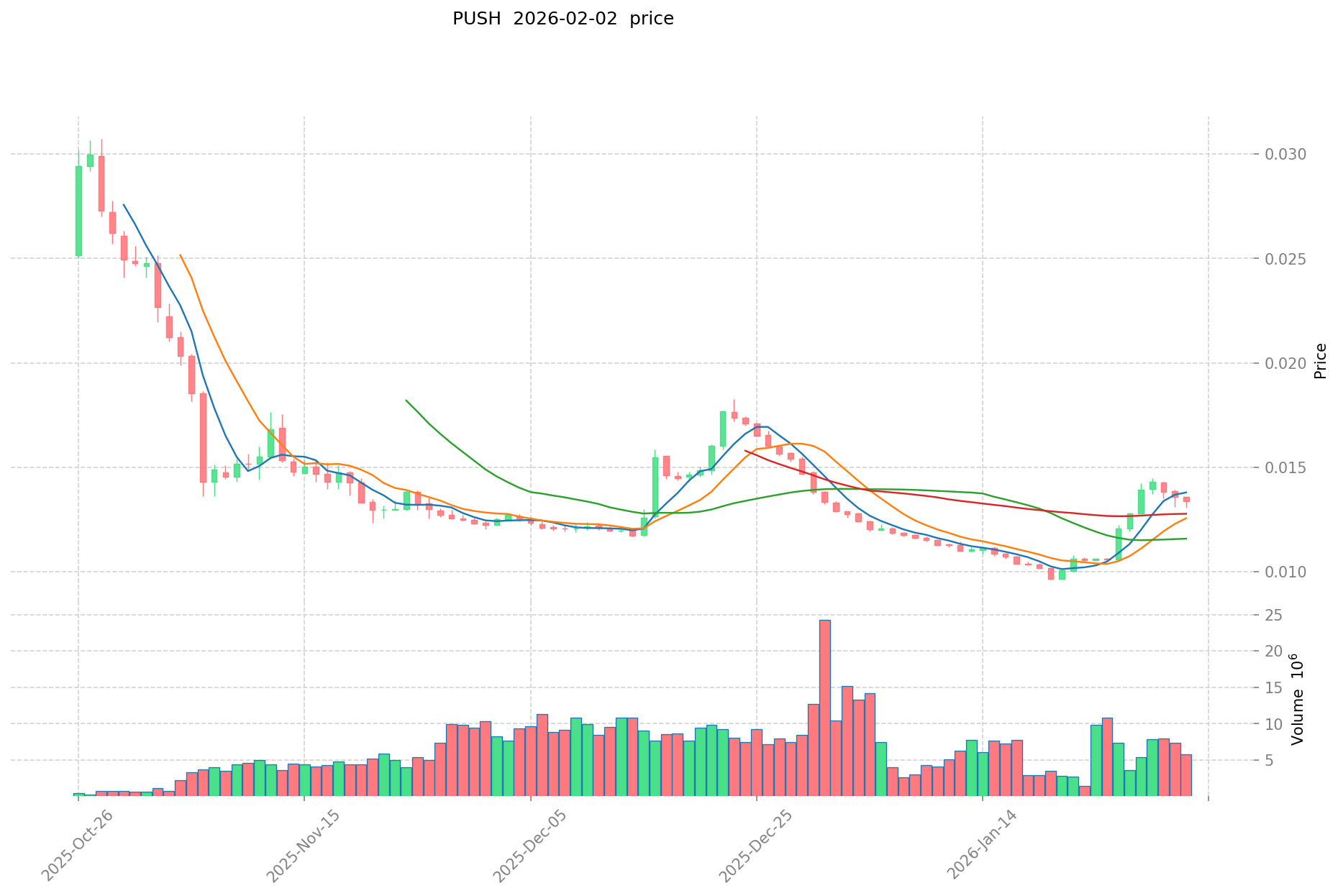
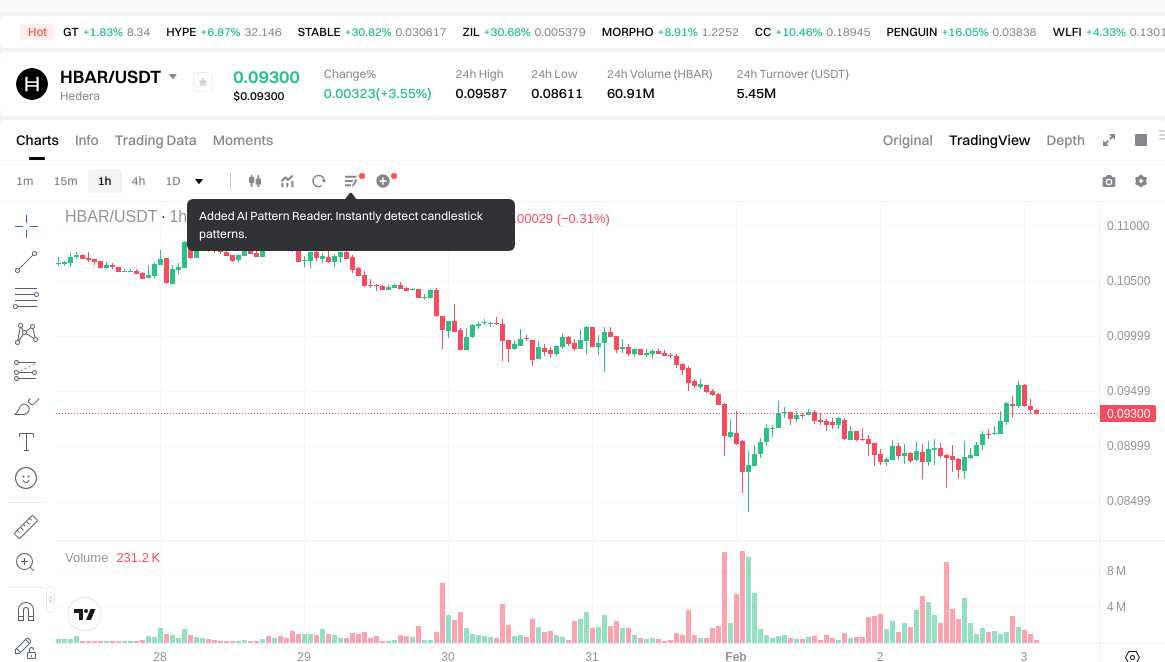
- Comparative analysis: During the 2021-2026 market cycle, PUSH declined from $8.73 to a low of $0.00961203, while HBAR fell from $0.569229 to $0.00986111, showing similar downward trajectories.
Current Market Status (2026-02-03)
- PUSH current price: $0.013629
- HBAR current price: $0.09334
- 24-hour trading volume: PUSH $85,962.43 vs HBAR $5,535,813.62
- Market sentiment index (Fear & Greed Index): 14 (Extreme Fear)
View real-time prices:
- Check PUSH current price Market Price
- Check HBAR current price Market Price
II. Core Factors Influencing PUSH vs HBAR Investment Value
Supply Mechanism Comparison (Tokenomics)
- PUSH: Supply mechanism details were not available in the materials provided.
- HBAR: Supply mechanism details were not available in the materials provided.
- 📌 Historical patterns: Supply mechanisms may influence price cycles, though specific historical data for these assets was not available in the materials.
Institutional Adoption and Market Applications
- Institutional holdings: The materials suggest that industry attention has focused on the potential expansion of ETF asset ranges to include tokens such as HBAR, indicating a degree of institutional interest.
- Enterprise adoption: Specific comparative data on enterprise adoption for cross-border payments, settlements, or investment portfolios was not available in the materials.
- National policies: The materials noted that regulatory attitudes vary across countries, though specific details for PUSH and HBAR were not provided.
Technology Development and Ecosystem Building
- PUSH technology upgrades: Technology upgrade details were not available in the materials provided.
- HBAR technology development: HBAR is supported by the Hedera Hashgraph blockchain, which is noted for efficient transaction processing. The materials indicate that HBAR's investment value may relate to technical innovation and market demand.
- Ecosystem comparison: Specific comparative data on DeFi, NFT, payment, and smart contract applications was not available in the materials.
Macroeconomic Environment and Market Cycles
- Performance in inflationary environments: Comparative data on inflation-hedging properties was not available in the materials provided.
- Macroeconomic monetary policy: The materials suggest that macroeconomic factors such as interest rates and the US dollar index may influence digital asset values, though specific impacts on PUSH and HBAR were not detailed.
- Geopolitical factors: The materials noted that cross-border transaction demand and international situations may affect digital assets, though specific details were not provided.
III. 2026-2031 Price Forecast: PUSH vs HBAR
Short-term Forecast (2026)
- PUSH: Conservative $0.01268-$0.01364 | Optimistic $0.01364-$0.01650
- HBAR: Conservative $0.08290-$0.09315 | Optimistic $0.09315-$0.13600
Medium-term Forecast (2028-2029)
- PUSH may enter a gradual accumulation phase, with projected price range of $0.00867-$0.01862
- HBAR may enter an expansion phase, with projected price range of $0.07184-$0.23874
- Key drivers: institutional capital inflows, ETF developments, ecosystem expansion
Long-term Forecast (2030-2031)
- PUSH: Baseline scenario $0.01296-$0.02161 | Optimistic scenario $0.02536-$0.02593
- HBAR: Baseline scenario $0.10401-$0.23103 | Optimistic scenario $0.26203-$0.33730
Disclaimer
PUSH:
| Year | Predicted High Price | Predicted Average Price | Predicted Low Price | Price Change |
|---|---|---|---|---|
| 2026 | 0.01650198 | 0.013638 | 0.01268334 | 0 |
| 2027 | 0.0176318883 | 0.01506999 | 0.0087405942 | 10 |
| 2028 | 0.0178225236735 | 0.01635093915 | 0.0086659977495 | 19 |
| 2029 | 0.018624537238807 | 0.01708673141175 | 0.009397702276462 | 25 |
| 2030 | 0.025355000741895 | 0.017855634325278 | 0.013034613057453 | 31 |
| 2031 | 0.025926381040304 | 0.021605317533587 | 0.012963190520152 | 58 |
HBAR:
| Year | Predicted High Price | Predicted Average Price | Predicted Low Price | Price Change |
|---|---|---|---|---|
| 2026 | 0.135999 | 0.09315 | 0.0829035 | 0 |
| 2027 | 0.14665536 | 0.1145745 | 0.07103619 | 22 |
| 2028 | 0.1920039471 | 0.13061493 | 0.0718382115 | 39 |
| 2029 | 0.238737969054 | 0.16130943855 | 0.1080773238285 | 72 |
| 2030 | 0.26203105198062 | 0.200023703802 | 0.10401232597704 | 114 |
| 2031 | 0.337299971721312 | 0.23102737789131 | 0.150167795629351 | 147 |
IV. Investment Strategy Comparison: PUSH vs HBAR
Long-term vs Short-term Investment Strategies
- PUSH: May suit investors focused on decentralized communication infrastructure and protocol-layer innovation. The asset's positioning in the notification protocol space could appeal to those seeking exposure to Web3 communication solutions.
- HBAR: May suit investors interested in enterprise-grade distributed ledger technology and high-throughput transaction processing. The hashgraph consensus mechanism could attract those evaluating alternative consensus architectures.
Risk Management and Asset Allocation
- Conservative investors: PUSH 20-30% vs HBAR 70-80% (reflecting relative market capitalization and liquidity differences)
- Aggressive investors: PUSH 40-50% vs HBAR 50-60% (allowing for higher exposure to smaller-cap protocol assets)
- Hedging tools: stablecoin allocation, options strategies, cross-asset portfolio diversification
V. Potential Risk Comparison
Market Risks
- PUSH: Lower liquidity profile with 24-hour trading volume of $85,962.43 may result in higher price volatility and execution challenges during market stress periods.
- HBAR: Higher liquidity with 24-hour trading volume of $5,535,813.62 provides improved market depth, though remains subject to broader crypto market cycles and sentiment shifts.
Technical Risks
- PUSH: Protocol adoption rates and integration across decentralized applications may influence long-term value. Network effects and developer activity represent key technical considerations.
- HBAR: Network stability and consensus mechanism performance under various transaction loads require ongoing monitoring. Enterprise adoption patterns may affect sustained utilization.
Regulatory Risks
- Global regulatory developments may affect both assets differently based on their functional classifications. PUSH's protocol utility and HBAR's enterprise partnerships may encounter distinct regulatory frameworks across jurisdictions. Evolving policies regarding digital asset categorization, securities laws, and cross-border transaction requirements could influence both projects' operational environments.
VI. Conclusion: Which Is the Better Buy?
📌 Investment Value Summary:
- PUSH Advantages: Positioning in the decentralized notification protocol sector offers exposure to Web3 communication infrastructure. The protocol-layer focus may provide differentiated value proposition in the evolving dApp ecosystem.
- HBAR Advantages: Hashgraph consensus technology delivers transaction processing capabilities that may support enterprise applications. Higher liquidity and market capitalization provide relatively improved trading conditions.
✅ Investment Recommendations:
- Novice investors: May consider focusing on the more liquid asset (HBAR) to benefit from improved market depth and reduced execution risk. Thorough research into both projects' fundamentals and risk factors is recommended before allocation.
- Experienced investors: Could evaluate portfolio allocation based on risk tolerance and sector exposure preferences. Diversification across both protocol infrastructure (PUSH) and enterprise-grade networks (HBAR) may provide balanced exposure to different blockchain use cases.
- Institutional investors: May assess both assets within broader digital asset allocation frameworks, considering liquidity requirements, custody solutions, and regulatory compliance factors. Due diligence on governance structures and technical roadmaps remains essential.
⚠️ Risk Disclaimer: The cryptocurrency market exhibits considerable volatility. This content does not constitute investment advice. Investors should conduct independent research and consult qualified financial advisors before making investment decisions.
VII. FAQ
Q1: What is the primary difference between PUSH and HBAR in terms of their core functionality?
PUSH is a decentralized notification protocol designed for platform-independent communication across dApps, services, and smart contracts, while HBAR powers the Hedera Hashgraph blockchain focused on high-speed transaction processing. PUSH addresses the Web3 communication infrastructure layer, enabling push notifications without centralized intermediaries, whereas HBAR provides enterprise-grade distributed ledger technology utilizing hashgraph consensus for fast, secure, and fair transaction processing. These fundamental differences position PUSH as a protocol-layer solution for decentralized communications and HBAR as a transaction-focused network for enterprise applications.
Q2: How do the liquidity profiles of PUSH and HBAR compare, and why does this matter?
HBAR demonstrates significantly higher liquidity with 24-hour trading volume of $5,535,813.62 compared to PUSH's $85,962.43. This approximately 64x difference in trading volume translates to meaningful practical implications for investors: HBAR offers improved market depth, reduced slippage during order execution, and lower volatility during market stress periods. For PUSH, the lower liquidity profile may result in wider bid-ask spreads, increased price volatility, and potential execution challenges during periods of heightened market activity, making position entry and exit more complex for larger allocations.
Q3: Which asset shows better price performance potential according to the 2026-2031 forecasts?
HBAR demonstrates stronger projected price appreciation potential across all timeframes based on the forecast models. By 2031, HBAR's optimistic scenario projects a high of $0.33730 (representing approximately 261% growth from current $0.09334 price), while PUSH's optimistic scenario forecasts $0.02593 (approximately 90% growth from current $0.013629 price). The medium-term 2028-2029 projections show HBAR potentially reaching $0.23874 compared to PUSH's $0.01862. These forecasts reflect HBAR's larger market capitalization, higher institutional interest indicated by potential ETF inclusion, and established enterprise adoption patterns compared to PUSH's earlier-stage protocol development.
Q4: What allocation strategy should conservative versus aggressive investors consider between PUSH and HBAR?
Conservative investors may consider a 20-30% PUSH and 70-80% HBAR allocation, reflecting the relative market capitalization, liquidity differences, and risk profiles of the two assets. This approach favors HBAR's higher liquidity and more established market presence while maintaining limited exposure to PUSH's protocol-layer innovation potential. Aggressive investors might adopt a 40-50% PUSH and 50-60% HBAR split, accepting higher exposure to PUSH's smaller market capitalization and lower liquidity in exchange for potential higher returns from earlier-stage protocol adoption. Both strategies should incorporate proper risk management tools including stablecoin allocations, options strategies for downside protection, and cross-asset portfolio diversification to mitigate cryptocurrency market volatility.
Q5: How do regulatory risks differ between PUSH and HBAR?
PUSH and HBAR face distinct regulatory considerations based on their functional classifications and operational models. PUSH's protocol utility as a decentralized notification service may encounter regulatory frameworks focused on communication infrastructure, data privacy, and cross-platform messaging standards across different jurisdictions. HBAR's enterprise partnerships and transaction processing capabilities could face scrutiny under securities laws, payment system regulations, and financial service compliance requirements depending on specific use cases. The evolving global regulatory landscape regarding digital asset categorization, cross-border transaction requirements, and enterprise blockchain applications may affect each project differently, requiring investors to monitor jurisdiction-specific policy developments relevant to each asset's primary use cases.
Q6: What are the key technical risks investors should evaluate for each asset?
For PUSH, the primary technical risks center on protocol adoption rates across the decentralized application ecosystem and successful integration with diverse blockchain platforms. Network effects and developer activity represent critical factors, as the protocol's value proposition depends on widespread adoption by dApp developers and users. Limited integration or competing notification solutions could impact long-term utility. For HBAR, technical considerations include network stability under varying transaction loads, hashgraph consensus mechanism performance at scale, and sustained enterprise utilization patterns. The success of enterprise partnerships and real-world deployment of applications built on Hedera Hashgraph directly influence HBAR's fundamental value proposition and long-term network utility.
Q7: Based on current market conditions, which asset presents better risk-adjusted value for new cryptocurrency investors?
For novice investors entering the cryptocurrency market, HBAR may present more suitable risk-adjusted characteristics due to its higher liquidity ($5.5M daily volume), larger market capitalization, and improved trading conditions that reduce execution risk. The 24-hour trading volume difference provides HBAR investors with better price discovery, tighter spreads, and easier position management. Additionally, HBAR's potential inclusion in ETF products and established enterprise partnerships offer more transparent institutional validation. However, new investors should recognize that both assets operate in the highly volatile cryptocurrency market with current Fear & Greed Index at 14 (Extreme Fear), requiring thorough research, appropriate position sizing, and risk management regardless of asset selection. Independent due diligence and consultation with qualified financial advisors remains essential before any investment decision.
Q8: What macroeconomic factors should investors monitor when evaluating PUSH vs HBAR investment prospects?
Investors should monitor several macroeconomic variables that may influence both assets' performance trajectories. Interest rate policies from major central banks affect risk asset valuations and capital flows into cryptocurrency markets, with both PUSH and HBAR susceptible to shifts in monetary policy stance. US dollar index movements create inverse correlations with digital asset prices, as cryptocurrency often serves as alternative stores of value. Cross-border transaction demand influenced by international trade patterns and geopolitical developments may particularly affect HBAR given its enterprise focus on transaction processing. Inflationary environments and institutional capital allocation decisions driven by portfolio diversification needs could impact both assets differently based on their market capitalizations and liquidity profiles. Regulatory policy announcements from major jurisdictions regarding digital asset frameworks represent critical catalysts that investors should track continuously.
Share
Content
Introduction: Investment Comparison Between PUSH and HBAR
I. Historical Price Comparison and Current Market Status
II. Core Factors Influencing PUSH vs HBAR Investment Value
III. 2026-2031 Price Forecast: PUSH vs HBAR
IV. Investment Strategy Comparison: PUSH vs HBAR
V. Potential Risk Comparison
VI. Conclusion: Which Is the Better Buy?
VII. FAQ
How to Buy Cryptocurrency


Trending Cryptocurrencies



2025 SUI coin: price, buying guide, and Staking rewards

How to Buy Crypto: A Step-by-Step Guide with Gate.com

HNT Price in 2025: Helium Network Token Value and Market Analysis

What is SwissCheese (SWCH) and How Does It Democratize Investment?

Cardano (ADA) Price Analysis and Outlook for 2025

How to Invest in Metaverse Crypto
Comprehensive Guide to Blockchain Oracles

Top 4 Most Profitable Cryptocurrencies for Mining

FLT vs BTC: Which Digital Asset Offers Better Long-Term Investment Potential in 2024?

GTAI vs FLOW: Which AI-Powered Platform Delivers Superior Performance and User Experience?

SBR vs MANA: A Comprehensive Comparison of Two Leading Decentralized Metaverse Tokens