SBR vs MANA: A Comprehensive Comparison of Two Leading Decentralized Metaverse Tokens


Introduction: Investment Comparison Between SBR and MANA
In the cryptocurrency market, the comparison between SBR vs MANA remains a topic of ongoing interest for investors. These two assets exhibit notable differences in market cap ranking, application scenarios, and price performance, representing distinct positioning within the crypto asset landscape.
Saber (SBR): Launched in 2021, the protocol has established itself as a cross-chain stablecoin exchange infrastructure on the Solana network, focusing on providing liquidity foundation for stablecoins and facilitating asset transfers across blockchain ecosystems.
Decentraland (MANA): Since its 2017 launch, the project has positioned itself as a blockchain-based virtual world platform, addressing intermediary profit issues in decentralized open-source projects while enabling low-cost transactions between content creators and users.
This article will examine historical price trends, supply mechanisms, technical ecosystems, and future considerations to provide a comprehensive analysis of SBR vs MANA investment characteristics, addressing a question many investors contemplate:
"Which asset aligns better with specific investment objectives and risk tolerance?"
The analysis will explore market data, project fundamentals, and technical developments to offer insights into these two distinct crypto assets operating in different segments of the blockchain ecosystem.
I. Historical Price Comparison and Current Market Status
Historical Price Trends of SBR (Coin A) and MANA (Coin B)
- 2021: SBR reached its all-time high of $0.960362 on September 10, 2021, during the broader cryptocurrency market expansion period.
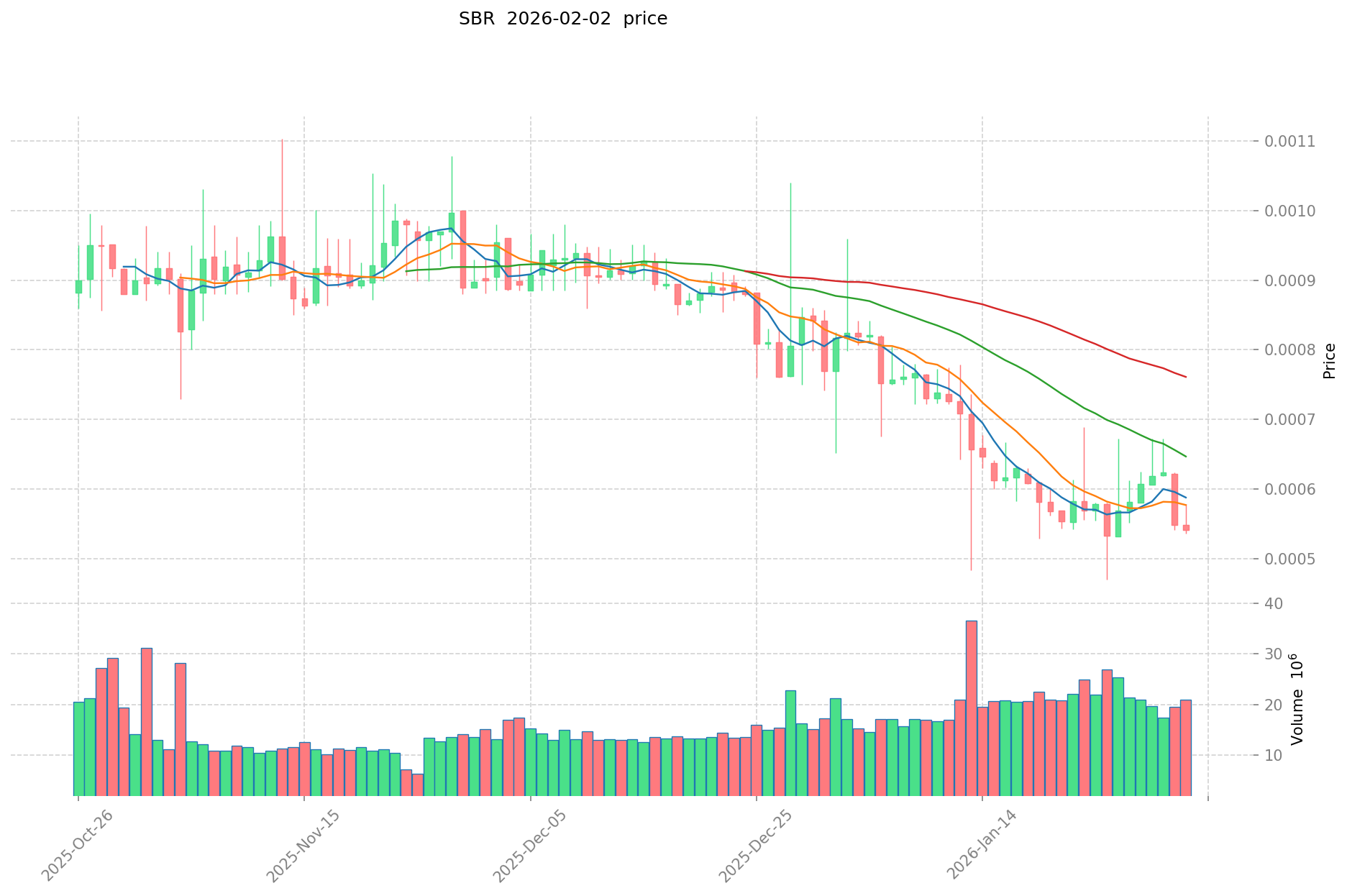
- 2026: SBR recorded its all-time low of $0.00052206 on February 2, 2026, reflecting significant downward price pressure.
- 2021: MANA achieved its all-time high of $5.85 on November 25, 2021, driven by increased interest in metaverse projects and virtual real estate.
- 2017: MANA recorded its all-time low of $0.00923681 on October 31, 2017, shortly after its initial launch.
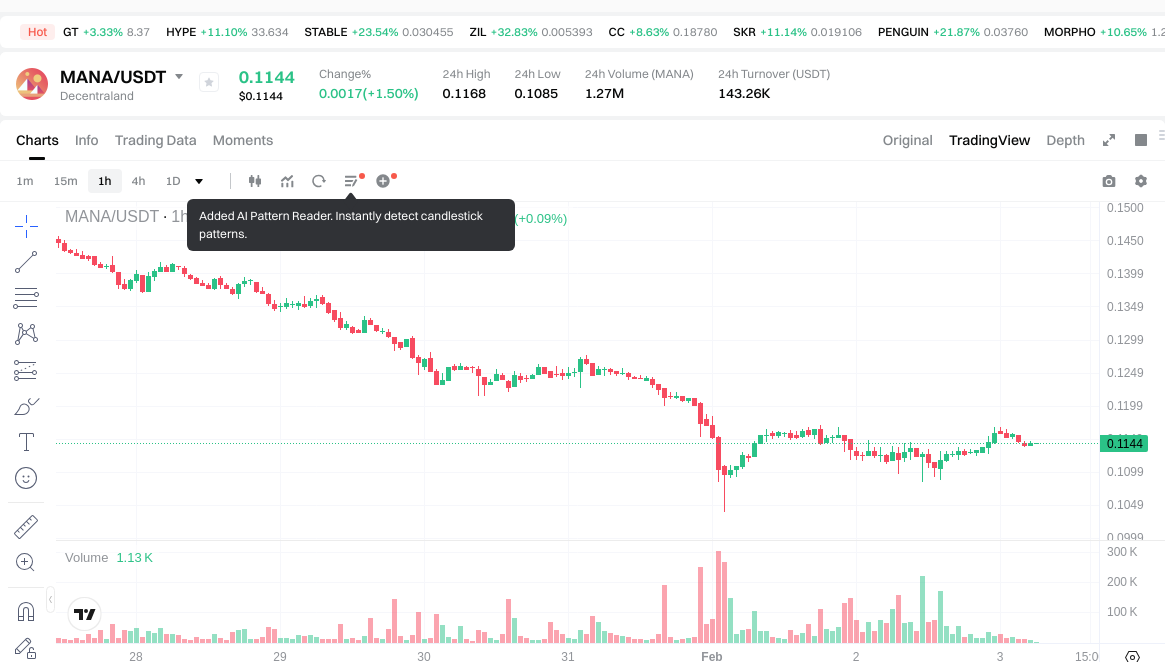
- Comparative Analysis: During the market cycle from 2021 to 2026, SBR declined from its peak of $0.960362 to approximately $0.0005228, representing a decrease of over 99%, while MANA experienced a decline from $5.85 to $0.1144, representing a decrease of approximately 98%.
Current Market Situation (February 3, 2026)
- SBR Current Price: $0.0005228
- MANA Current Price: $0.1144
- 24-Hour Trading Volume: SBR recorded $12,685.39 compared to MANA's $145,121.63
- Market Sentiment Index (Fear & Greed Index): 14 (Extreme Fear)
Click to view real-time prices:
- View SBR current price Market Price
- View MANA current price Market Price
II. Core Factors Influencing SBR vs MANA Investment Value
Supply Mechanism Comparison (Tokenomics)
-
SBR: Information regarding SBR's supply mechanism is not available in the provided materials. Tokenomics details such as total supply, emission schedule, or deflationary features remain unspecified.
-
MANA: Specific supply mechanism details for MANA are not provided in the reference materials. Information about total supply cap, token distribution, or burn mechanisms is not mentioned.
-
📌 Historical Pattern: Supply mechanisms influence price cycles through scarcity dynamics and emission rates. Assets with capped supplies or deflationary models may exhibit different volatility patterns compared to those with inflationary tokenomics. However, specific historical data linking supply mechanisms to price movements for SBR and MANA is not available in the materials.
Institutional Adoption and Market Applications
-
Institutional Holdings: The reference materials do not contain comparative data on institutional preference between SBR and MANA. Information about institutional custody, investment fund allocations, or corporate treasury holdings is not provided.
-
Enterprise Adoption: Specific applications of SBR or MANA in cross-border payments, settlement systems, or institutional investment portfolios are not documented in the available materials.
-
National Policies: Regulatory attitudes toward SBR and MANA across different jurisdictions are not detailed in the reference materials. Information about legal classification, tax treatment, or regulatory frameworks is not available.
Technology Development and Ecosystem Building
-
SBR Technical Upgrades: The provided materials do not contain information about SBR's technological roadmap, protocol improvements, or network enhancements.
-
MANA Technology Development: Specific technical developments for MANA are not detailed in the reference materials. Information about platform upgrades or infrastructure improvements is not available.
-
Ecosystem Comparison: Comparative analysis of DeFi integration, NFT marketplace presence, payment adoption, and smart contract deployment for SBR versus MANA is not provided in the materials. Information about developer activity, dApp ecosystems, or partnerships is not documented.
Macroeconomic Factors and Market Cycles
-
Performance in Inflationary Environments: The reference materials discuss general investment value factors including market trends and economic shifts, but do not provide specific comparative data on how SBR and MANA perform as inflation hedges or store-of-value assets.
-
Macroeconomic Monetary Policy: While the materials reference the importance of economic and technological shifts in determining investment value, specific analysis of interest rate impacts, US dollar index correlations, or Federal Reserve policy effects on SBR and MANA is not provided.
-
Geopolitical Factors: The reference materials mention international relations and regulatory changes as important considerations, but do not detail how cross-border transaction demand or international tensions specifically affect SBR and MANA investment prospects. Information about sanctions, capital controls, or regional adoption patterns is not available.
III. 2026-2031 Price Prediction: SBR vs MANA
Short-term Forecast (2026)
- SBR: Conservative scenario suggests a range of $0.00037204 to $0.000524, with potential upside reaching $0.0007074
- MANA: Conservative scenario indicates a range of $0.105156 to $0.1143, with potential upside reaching $0.118872
Mid-term Forecast (2028-2029)
- SBR may enter a gradual growth phase, with estimated price range of $0.00049834758 to $0.00081309342 in 2028, potentially expanding to $0.0003965797584 to $0.001028169744 in 2029
- MANA may enter a moderate expansion phase, with estimated price range of $0.1067461416 to $0.1766394486 in 2028, potentially reaching $0.144266139585 to $0.214121322963 in 2029
- Key drivers: institutional capital inflows, ETF developments, ecosystem expansion
Long-term Forecast (2030-2031)
- SBR: Baseline scenario suggests $0.00077553374976 to $0.000881288352 in 2030, with optimistic scenario reaching $0.00119855215872; by 2031, baseline scenario indicates $0.000998323445145 to $0.00103992025536, with optimistic scenario at $0.001195908293664
- MANA: Baseline scenario suggests $0.1463921669052 to $0.1829902086315 in 2030, with optimistic scenario reaching $0.188479914890445; by 2031, baseline scenario indicates $0.13187189385029 to $0.185735061760972, with optimistic scenario at $0.19873651608424
Disclaimer: The above predictions are based on historical data analysis and market trends. Cryptocurrency markets are highly volatile and subject to various unpredictable factors. These projections should not be considered as investment advice. Past performance does not guarantee future results. Investors should conduct their own research and consult with financial professionals before making any investment decisions.
SBR:
| Year | Predicted High Price | Predicted Average Price | Predicted Low Price | Price Change |
|---|---|---|---|---|
| 2026 | 0.0007074 | 0.000524 | 0.00037204 | 0 |
| 2027 | 0.000695741 | 0.0006157 | 0.000375577 | 17 |
| 2028 | 0.00081309342 | 0.0006557205 | 0.00049834758 | 25 |
| 2029 | 0.001028169744 | 0.00073440696 | 0.0003965797584 | 40 |
| 2030 | 0.00119855215872 | 0.000881288352 | 0.00077553374976 | 68 |
| 2031 | 0.001195908293664 | 0.00103992025536 | 0.000998323445145 | 98 |
MANA:
| Year | Predicted High Price | Predicted Average Price | Predicted Low Price | Price Change |
|---|---|---|---|---|
| 2026 | 0.118872 | 0.1143 | 0.105156 | 0 |
| 2027 | 0.13757148 | 0.116586 | 0.07228332 | 1 |
| 2028 | 0.1766394486 | 0.12707874 | 0.1067461416 | 11 |
| 2029 | 0.214121322963 | 0.1518590943 | 0.144266139585 | 32 |
| 2030 | 0.188479914890445 | 0.1829902086315 | 0.1463921669052 | 59 |
| 2031 | 0.19873651608424 | 0.185735061760972 | 0.13187189385029 | 62 |
IV. Investment Strategy Comparison: SBR vs MANA
Long-term vs Short-term Investment Strategies
-
SBR: May align with investors interested in DeFi infrastructure and cross-chain liquidity solutions within the Solana ecosystem. The asset's positioning as a stablecoin exchange protocol suggests potential relevance for those monitoring decentralized finance developments and cross-chain asset transfers.
-
MANA: May align with investors interested in virtual world platforms and metaverse-related projects. The asset's focus on blockchain-based virtual real estate and content creator economies suggests potential relevance for those monitoring digital entertainment and decentralized virtual environments.
Risk Management and Asset Allocation
-
Conservative Investors: Allocation strategies should consider volatility profiles, historical performance patterns, and risk tolerance levels. Conservative portfolios typically emphasize capital preservation and lower volatility exposure.
-
Aggressive Investors: Allocation strategies may incorporate higher risk tolerance and potential for greater price volatility. Aggressive portfolios typically emphasize growth potential and accept increased volatility.
-
Hedging Tools: Portfolio risk management may include stablecoin allocations for liquidity preservation, derivatives instruments for downside protection, and cross-asset diversification strategies to reduce concentration risk.
V. Potential Risk Comparison
Market Risk
-
SBR: The asset has experienced significant price decline from its 2021 peak to current levels, with a decrease exceeding 99%. Trading volume of $12,685.39 suggests relatively limited liquidity. The current market sentiment index of 14 (Extreme Fear) reflects broader market uncertainty that may impact price volatility.
-
MANA: The asset has experienced substantial price decline from its 2021 peak to current levels, with a decrease approaching 98%. Trading volume of $145,121.63 indicates moderate market activity. Market sentiment conditions and metaverse sector developments may influence price movements.
Technology Risk
-
SBR: Technology-related considerations include protocol security, network performance, and cross-chain infrastructure reliability. Smart contract vulnerabilities and ecosystem development pace may present operational considerations.
-
MANA: Technology-related considerations include platform scalability, virtual world infrastructure capacity, and user experience optimization. Network stability and content creation tools may present operational considerations.
Regulatory Risk
- Global regulatory frameworks continue to evolve regarding cryptocurrency assets. Different jurisdictions may implement varying approaches to digital asset classification, taxation, and compliance requirements. Regulatory developments may affect both assets differently based on their respective use cases and market positioning.
VI. Conclusion: Which Is the Better Buy?
📌 Investment Value Summary:
-
SBR Characteristics: The asset operates as cross-chain stablecoin exchange infrastructure on the Solana network, addressing liquidity needs for stablecoins and facilitating asset transfers across blockchain ecosystems. Current price levels reflect significant decline from historical peaks.
-
MANA Characteristics: The asset functions as a blockchain-based virtual world platform, enabling decentralized content creation and virtual real estate transactions. The project has established presence in the metaverse sector since 2017.
✅ Investment Considerations:
-
New Investors: Should prioritize understanding fundamental differences between DeFi infrastructure projects and metaverse platforms. Risk assessment should include volatility analysis, liquidity evaluation, and alignment with personal investment objectives. Thorough research into project fundamentals and market dynamics is recommended.
-
Experienced Investors: May evaluate technical developments, ecosystem growth metrics, and competitive positioning within respective sectors. Portfolio integration should consider existing allocations, risk management frameworks, and diversification strategies.
-
Institutional Investors: Should conduct comprehensive due diligence including regulatory compliance assessment, custody solutions evaluation, and risk management protocol development. Strategic allocation decisions may incorporate sector exposure analysis and long-term market trend evaluation.
⚠️ Risk Disclosure: Cryptocurrency markets exhibit extreme volatility and are subject to numerous unpredictable factors including regulatory changes, technological developments, and market sentiment shifts. This analysis does not constitute investment advice. Past performance does not guarantee future results. Investors should conduct independent research and consult qualified financial professionals before making investment decisions.
VII. FAQ
Q1: What are the main differences between SBR and MANA in terms of their use cases?
SBR functions as cross-chain stablecoin exchange infrastructure on the Solana network, while MANA operates as a blockchain-based virtual world platform. SBR focuses on providing liquidity foundation for stablecoins and facilitating asset transfers across blockchain ecosystems since its 2021 launch. In contrast, MANA has positioned itself since 2017 as a metaverse platform enabling decentralized content creation, virtual real estate transactions, and low-cost interactions between content creators and users, addressing intermediary profit issues in decentralized projects.
Q2: How do the current price levels of SBR and MANA compare to their historical peaks?
Both assets have experienced significant declines from their all-time highs. SBR declined from its peak of $0.960362 (September 10, 2021) to approximately $0.0005228 (current price), representing a decrease exceeding 99%. MANA fell from its all-time high of $5.85 (November 25, 2021) to $0.1144 (current price), representing an approximate 98% decline. These substantial reductions reflect the broader cryptocurrency market correction cycle from 2021 to 2026.
Q3: What is the current market sentiment, and how does it affect both assets?
The market sentiment index stands at 14 (Extreme Fear) as of February 3, 2026. This extreme fear environment reflects broader market uncertainty that impacts both assets, though their trading volumes differ significantly—SBR recorded $12,685.39 compared to MANA's $145,121.63 in 24-hour volume. The low sentiment reading suggests heightened caution among market participants, which may contribute to continued price volatility and limited short-term upside potential for both assets.
Q4: What are the price predictions for SBR and MANA through 2031?
For 2026, SBR's conservative scenario suggests a range of $0.00037204 to $0.000524, while MANA indicates $0.105156 to $0.1143. By 2031, SBR's baseline scenario projects $0.000998323445145 to $0.00103992025536 with an optimistic scenario at $0.001195908293664. MANA's 2031 baseline scenario indicates $0.13187189385029 to $0.185735061760972 with an optimistic scenario at $0.19873651608424. However, these predictions are based on historical data analysis and should not be considered investment advice, as cryptocurrency markets remain highly volatile and subject to unpredictable factors.
Q5: Which asset presents lower market risk for investors?
Neither asset can be definitively characterized as lower risk. SBR's trading volume of $12,685.39 suggests relatively limited liquidity, which may present challenges for position entry and exit. MANA's trading volume of $145,121.63 indicates moderate market activity with potentially better liquidity conditions. Both assets have declined over 98% from their peaks, demonstrating substantial historical volatility. Risk assessment should consider individual liquidity needs, volatility tolerance, investment timeframe, and sector-specific developments affecting DeFi infrastructure versus metaverse platforms.
Q6: What regulatory considerations should investors evaluate for SBR and MANA?
Global regulatory frameworks continue to evolve regarding cryptocurrency assets, with different jurisdictions implementing varying approaches to digital asset classification, taxation, and compliance requirements. Regulatory developments may affect both assets differently based on their respective use cases—SBR as DeFi infrastructure and MANA as a metaverse platform. Investors should monitor jurisdiction-specific regulations, potential classification changes, compliance requirements, and how regulatory shifts might impact operational capacity and market access for each project.
Q7: Are SBR and MANA suitable for conservative or aggressive investment strategies?
SBR may align with investors interested in DeFi infrastructure and cross-chain liquidity solutions, while MANA may suit those monitoring virtual world platforms and metaverse developments. Conservative investors typically emphasize capital preservation and lower volatility exposure, which may not align with the extreme historical volatility both assets have demonstrated. Aggressive investors with higher risk tolerance and acceptance of substantial price volatility may find these assets more compatible with growth-oriented strategies. Portfolio allocation should incorporate proper hedging tools, stablecoin allocations for liquidity preservation, and cross-asset diversification to reduce concentration risk.
Q8: What technology risks should investors consider for these assets?
For SBR, technology-related considerations include protocol security, network performance, cross-chain infrastructure reliability, and potential smart contract vulnerabilities. Ecosystem development pace within the Solana network may present operational considerations. For MANA, technology risks encompass platform scalability, virtual world infrastructure capacity, user experience optimization, network stability, and content creation tool development. Both assets face ongoing technical challenges inherent to blockchain-based projects, including code vulnerability risks, network congestion issues, and the need for continuous development to maintain competitive positioning within their respective sectors.
Share
Content
Introduction: Investment Comparison Between SBR and MANA
I. Historical Price Comparison and Current Market Status
II. Core Factors Influencing SBR vs MANA Investment Value
III. 2026-2031 Price Prediction: SBR vs MANA
IV. Investment Strategy Comparison: SBR vs MANA
V. Potential Risk Comparison
VI. Conclusion: Which Is the Better Buy?
VII. FAQ
How to Buy Cryptocurrency


Trending Cryptocurrencies



2025 SUI coin: price, buying guide, and Staking rewards

How to Buy Crypto: A Step-by-Step Guide with Gate.com

HNT Price in 2025: Helium Network Token Value and Market Analysis

What is SwissCheese (SWCH) and How Does It Democratize Investment?

Cardano (ADA) Price Analysis and Outlook for 2025
How to Invest in Metaverse Crypto

LIORA vs STX: A Comprehensive Comparison of Two Leading Enterprise Solutions

BOT vs LINK: Which Blockchain Oracle Solution Offers Better Performance and Reliability for Smart Contracts?

MTV vs MANA: A Comprehensive Comparison of Two Revolutionary Blockchain-Based Entertainment Platforms
Understanding Open Interest: A Key Indicator for Cryptocurrency Trends

Top 9 AI Solutions for Exchange Trading: Software Platforms and Trading Bots