What is PSTAKE: A Comprehensive Guide to Persistence's Liquid Staking Token

pSTAKE Finance's Positioning and Significance
In 2021, the pSTAKE team launched pSTAKE Finance (PSTAKE), aiming to address the underutilization of staked Proof-of-Stake (PoS) assets and the trade-off between earning staking rewards and maintaining liquidity.
As a liquid staking protocol for PoS-based assets, pSTAKE Finance plays a key role in decentralized finance (DeFi) and cross-chain liquidity.
As of 2026, pSTAKE Finance has established itself within the liquid staking sector, serving users seeking to maximize the utility of their staked assets. The protocol bridges Cosmos and Ethereum ecosystems, enabling enhanced composability and liquidity.
This article will explore its technical architecture, market performance, and future potential.
Origin and Development History
Genesis Background
pSTAKE Finance was created by the pSTAKE team in 2021, aiming to solve the illiquidity problem of staked PoS assets, where users had to choose between earning staking rewards and maintaining asset liquidity.
It emerged during the expansion of the DeFi ecosystem and growing adoption of PoS blockchains, with the goal of unlocking the full potential of staked assets by allowing holders to receive rewards while keeping assets liquid.
pSTAKE Finance's launch brought new possibilities to PoS token holders and DeFi participants across multiple ecosystems.
Key Milestones
- 2021: Protocol launch, enabling liquid staking for Cosmos-based assets with 1:1 pegged ERC-20 wrapped tokens (pTOKENs).
- Subsequent development focused on expanding support for additional PoS chains and improving cross-chain functionality.
- Integration with various DeFi protocols enhanced the utility of liquid staked tokens.
- Custom bridge technology facilitated growth within the Cosmos ecosystem while improving Ethereum asset composability.
With support from its community and development team, pSTAKE Finance continues to refine its technology, security features, and real-world applications.
How pSTAKE Finance Works
No Central Control
pSTAKE Finance operates on decentralized blockchain networks, primarily leveraging Ethereum and Cosmos infrastructure, free from control by banks or governments.
These distributed systems collaboratively validate transactions, ensuring transparency and resistance to attacks, granting users greater autonomy and enhancing network resilience.
Blockchain Foundation
pSTAKE Finance utilizes blockchain technology as a public, immutable digital ledger to record all protocol interactions.
Transactions and staking operations are grouped into blocks, linked through cryptographic hashes to form a secure chain.
Anyone can view these records, establishing trust without intermediaries.
The protocol employs custom bridge technology to connect different blockchain ecosystems, enhancing interoperability and liquidity flow.
Ensuring Fairness
pSTAKE Finance leverages the underlying Proof-of-Stake (PoS) consensus mechanisms of the networks it operates on to maintain security and prevent fraudulent activities.
Validators on these networks secure transactions through token staking and validation processes, earning rewards for their participation.
The protocol's innovation includes enabling liquidity for staked assets through 1:1 pegged wrapped tokens, allowing users to participate in DeFi while continuing to earn staking rewards.
Secure Transactions
pSTAKE Finance employs public-private key cryptography to protect user interactions:
- Private keys (like secret passwords) are used to sign transactions and authorize staking operations
- Public keys (like account numbers) are used to verify ownership and receive assets
This mechanism ensures fund security while transactions maintain pseudonymous characteristics typical of blockchain systems.
The protocol implements smart contract security measures and auditing practices to protect user assets throughout the liquid staking process.
pSTAKE Finance (PSTAKE) Market Performance
Circulation Overview
As of 09 February 2026, pSTAKE Finance's circulating supply stands at 500,000,000 tokens, with a total supply of 500,000,000 tokens and a maximum supply capped at 500,000,000 tokens, representing a fixed supply model with 100% of tokens already in circulation.
The token utilizes an ERC-20 standard and is deployed on the Ethereum blockchain, with its circulation mechanism tied to the protocol's liquid staking functionality where users can deposit PoS tokens to mint 1:1 pegged wrapped tokens (pTOKENs).
Price Fluctuations
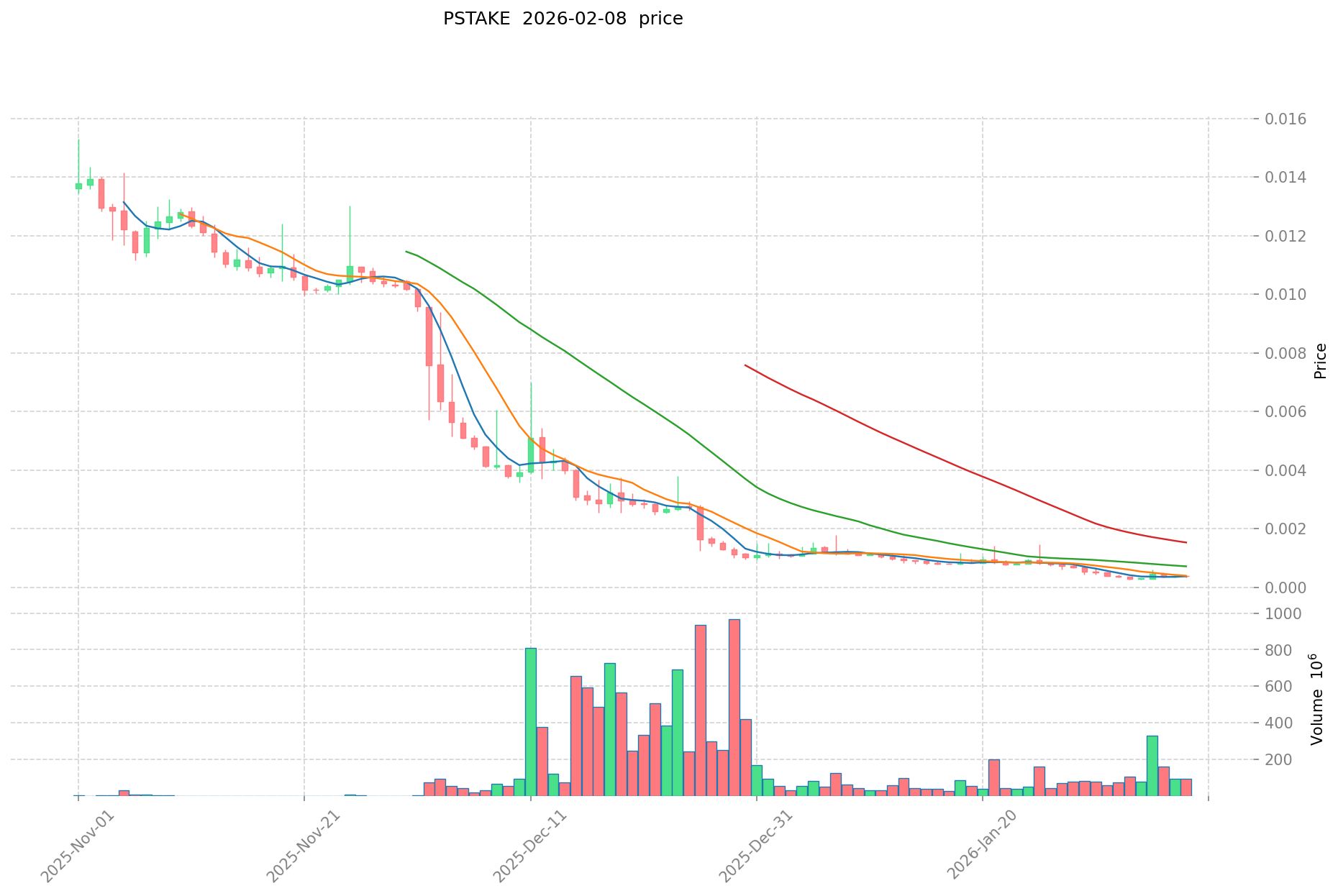
pSTAKE Finance reached a notable price level of $1.21 on 07 March 2022, driven by initial market enthusiasm surrounding liquid staking solutions and the broader interest in Cosmos ecosystem infrastructure during the period.
The token experienced its lowest recorded price of $0.00027458 on 03 February 2026, reflecting challenging market conditions and the project's performance trajectory. As of the latest data, PSTAKE trades at $0.0003446, showing recent price movements of -0.03% over 1 hour, -1.93% over 24 hours, and -2.35% over 7 days.
These fluctuations demonstrate the token's sensitivity to broader market sentiment, adoption trends in liquid staking protocols, and the evolving landscape of cross-chain bridge solutions connecting Cosmos and Ethereum ecosystems.
Click to view current PSTAKE market price
On-Chain Metrics
- Daily Trading Volume: Approximately $23,092 (indicating current market activity levels)
- Token Holders: 14,205 addresses (reflecting community distribution)
- Market Capitalization: $172,300 (representing the current valuation based on circulating supply)
pSTAKE Finance Ecosystem Applications and Partnerships
Core Use Cases
pSTAKE Finance's ecosystem supports multiple applications:
- DeFi: The protocol enables liquid staking for Proof-of-Stake (PoS) assets, providing decentralized staking services that allow users to maintain liquidity while earning staking rewards.
- Cross-chain Infrastructure: Through custom bridge technology, pSTAKE facilitates interoperability between Cosmos and Ethereum ecosystems, enhancing asset composability.
Strategic Partnerships
These partnerships provide a solid foundation for pSTAKE Finance's ecosystem expansion.
Challenges and Controversies
pSTAKE Finance faces the following challenges:
- Technical Considerations: Managing 1:1 pegged ERC-20 wrapped tokens and ensuring seamless bridge operations
- Market Volatility: Significant price fluctuations, with the token experiencing substantial downward pressure
- Competitive Landscape: Competition from other liquid staking protocols in both Cosmos and Ethereum ecosystems
These issues have sparked discussions within the community and market, while also driving pSTAKE Finance's continuous innovation.
pSTAKE Finance Community and Social Media Atmosphere
Community Engagement
pSTAKE Finance's community shows engagement with 14,205 token holders participating in the ecosystem. The protocol's liquid staking mechanism has attracted users seeking to unlock liquidity from staked PoS assets. New feature releases and protocol updates have generated community interest.
Social Media Sentiment
Sentiment on social platforms presents varied perspectives:
- Supporters praise pSTAKE Finance's liquid staking innovation and cross-chain capabilities, viewing it as a solution for unlocking staked asset liquidity.
- Critics focus on price volatility and market performance challenges.
Recent trends reflect the broader market conditions affecting liquid staking protocols.
Popular Topics
Users discuss pSTAKE Finance's liquid staking mechanics, cross-chain bridge technology, and token economics, showcasing both its innovative potential and the challenges in achieving broader adoption.
More Information Sources for pSTAKE Finance
- Official Website: Visit pSTAKE Finance Official Site for features, use cases, and latest updates.
- Blockchain Explorer: pSTAKE on Etherscan provides transparent on-chain data and transaction history.
pSTAKE Finance Future Roadmap
- Ecosystem Goals: Expand support for additional PoS assets and enhance cross-chain capabilities
- Long-term Vision: Become a leading liquid staking infrastructure provider across multiple blockchain ecosystems
How to Participate in pSTAKE Finance?
- Purchase Channels: Buy PSTAKE on Gate.com and other supported exchanges
- Storage Solutions: Use compatible wallets such as MetaMask or hardware wallets to securely store your tokens
- Participate in Staking: Utilize the pSTAKE platform to stake PoS assets and mint liquid staking tokens
- Ecosystem Building: Explore integration opportunities with pSTAKE's liquid staking infrastructure
Summary
pSTAKE Finance redefines liquid staking through blockchain technology, providing enhanced liquidity, continued staking rewards, and cross-chain composability. Its innovative approach to unlocking staked asset value and bridging different blockchain ecosystems positions it within the DeFi landscape. Despite facing market volatility and competitive pressures, pSTAKE Finance's liquid staking model and cross-chain infrastructure demonstrate its commitment to solving real challenges in the PoS staking domain. Whether you are a newcomer or an experienced participant, pSTAKE Finance offers opportunities worth exploring in the liquid staking space.
FAQ
What is PSTAKE? What are its main functions and uses?
pSTAKE is a liquid staking protocol that enables PoS token holders to earn staking rewards while maintaining asset liquidity. It unlocks the potential value of proof-of-stake assets by allowing users to stake and trade simultaneously, generating yield without locking capital.
PSTAKE与其他Staking代币有什么区别?
PSTAKE采用Ve模型减缓通胀压力,提升治理效率。相比其他Staking代币,其代币经济模型更优化,通过锁定机制增强社区治理权重与可持续性。
How to buy and hold PSTAKE tokens?
Register an account and complete identity verification. Deposit funds using your preferred payment method. Navigate to the trading section, search for PSTAKE, enter the desired quantity, and execute the purchase. Transfer tokens to your personal wallet for holding.
What are the risks of PSTAKE? What should I pay attention to before investing?
PSTAKE's main risks include smart contract vulnerabilities that could cause protocol insolvency, and dependence on project team execution. Review contract security audits and team track record carefully before participating.
What is the future development prospect and roadmap of PSTAKE?
pSTAKE Finance aims to enhance Bitcoin staking through cross-chain solutions, focusing on high yields and strategic partnerships. The roadmap includes expanding BTCFi yield solutions and strengthening ecosystem collaborations for sustainable growth.
Share
Content
pSTAKE Finance's Positioning and Significance
Origin and Development History
How pSTAKE Finance Works
pSTAKE Finance (PSTAKE) Market Performance
pSTAKE Finance Ecosystem Applications and Partnerships
Challenges and Controversies
pSTAKE Finance Community and Social Media Atmosphere
More Information Sources for pSTAKE Finance
pSTAKE Finance Future Roadmap
How to Participate in pSTAKE Finance?
Summary
FAQ
How to Buy Cryptocurrency


Trending Cryptocurrencies



What will be the market capitalization of USDC in 2025? Analysis of the stablecoin market landscape.

How is DeFi different from Bitcoin?

What is DeFi: Understanding Decentralized Finance in 2025
USDC stablecoin 2025 Latest Analysis: Principles, Advantages, and Web3 Eco-Applications

Development of Decentralized Finance Ecosystem in 2025: Integration of Decentralized Finance Applications with Web3

2025 USDT USD Complete Guide: A Must-Read for Newbie Investors

What is AIX9: A Comprehensive Guide to the Next Generation of Enterprise Computing Solutions

What is KLINK: A Comprehensive Guide to Understanding the Revolutionary Communication Platform

What is ART: A Comprehensive Guide to Understanding Assisted Reproductive Technology and Its Impact on Modern Fertility Treatment

What is KAR: A Comprehensive Guide to Knowledge and Reasoning Systems in Modern Technology

What is MART: A Comprehensive Guide to Multi-Agent Reinforcement Learning Through Time