WING vs SAND: A Comprehensive Comparison of Two Contrasting Materials in Modern Construction and Design

Introduction: WING vs SAND Investment Comparison
In the cryptocurrency market, the comparison between WING vs SAND has been a topic that investors cannot avoid. The two not only show significant differences in market cap ranking, application scenarios and price performance, but also represent different crypto asset positioning.
WING (WING): Launched in August 2020, it has gained market recognition by positioning itself as a decentralized lending platform based on credit scoring and supporting cross-chain asset and protocol interactions.
SAND (SAND): Launched in August 2020, it has been recognized as a virtual game world token, being one of the prominent players in the metaverse and GameFi space with widespread exchange listings.
This article will comprehensively analyze the investment value comparison of WING vs SAND around historical price trends, supply mechanisms, institutional adoption, technical ecosystem and future predictions, and attempt to answer the question that investors are most concerned about:
"Which is the better buy right now?"
I. Historical Price Comparison and Current Market Status
WING (Coin A) and SAND (Coin B) Historical Price Performance
-
2020: WING experienced significant volatility during its launch period, with the token reaching an all-time high of $140.81 in September 2020, reflecting early investor enthusiasm for the credit-based DeFi lending platform.
-
2021: SAND benefited from the metaverse and NFT boom, achieving an all-time high of $8.40 in November 2021, driven by partnerships with major brands and growing interest in virtual worlds.
-
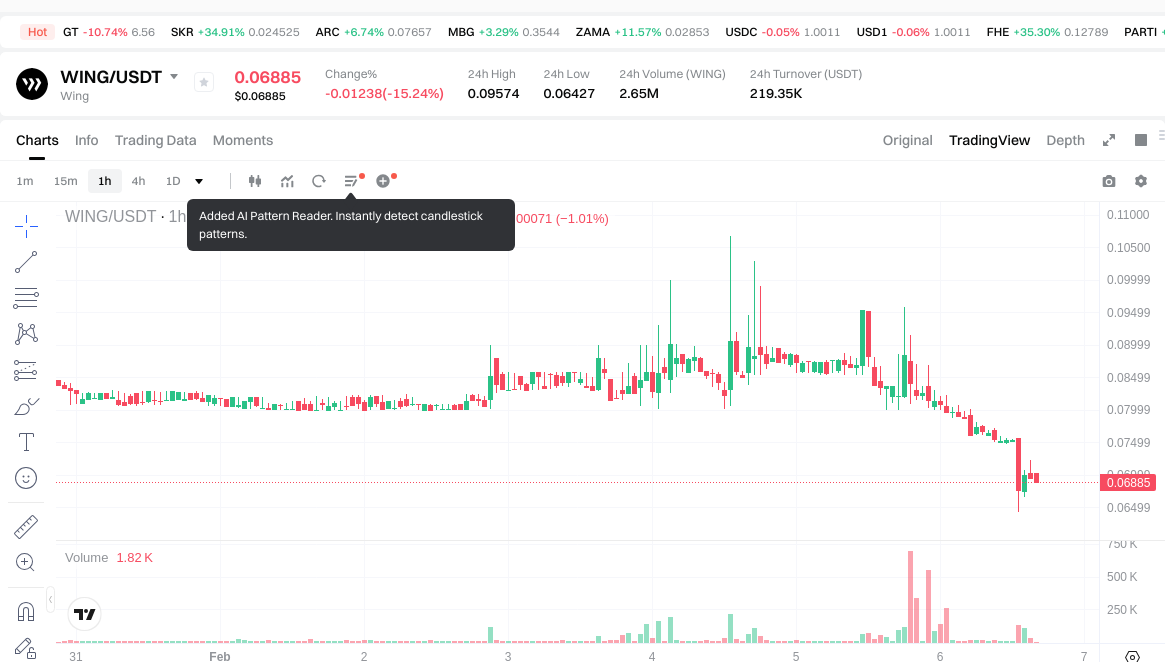
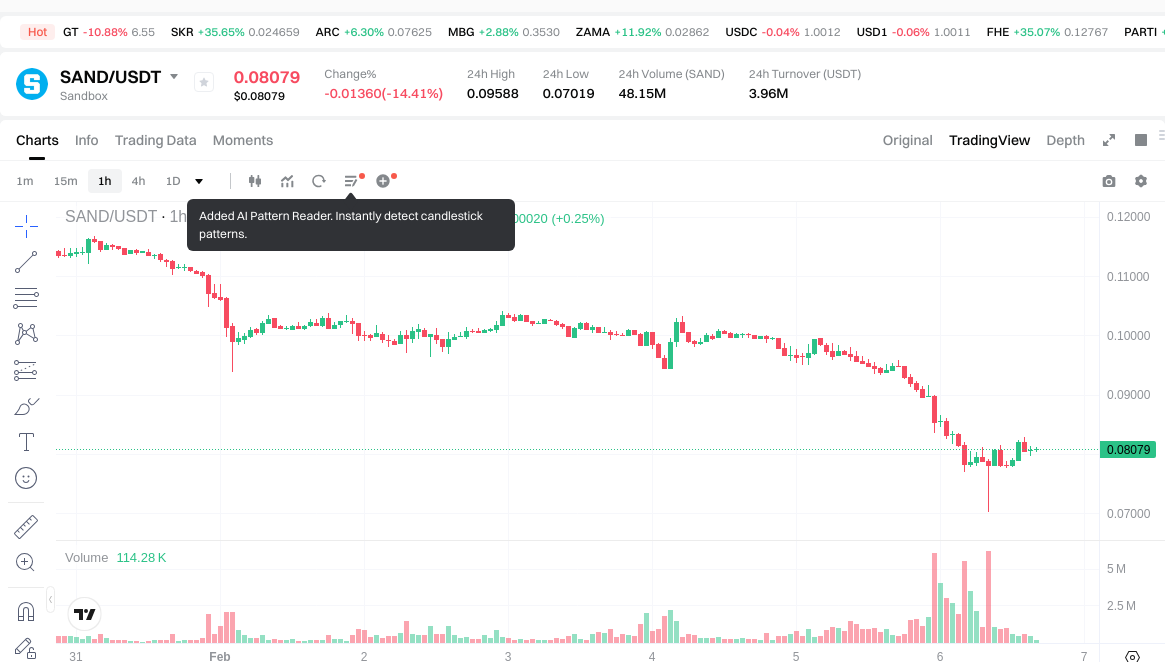
Comparative Analysis: During the 2021-2026 market cycle, WING declined from its peak of $140.81 to approximately $0.06967, representing a decline of over 99%. In contrast, SAND decreased from $8.40 to approximately $0.08076, reflecting a decline of around 99% as well, though starting from a substantially lower absolute peak price.
Current Market Status (2026-02-06)
- WING Current Price: $0.06967
- SAND Current Price: $0.08076
- 24-Hour Trading Volume: WING recorded $219,508.84 while SAND registered $3,969,661.85, indicating significantly higher liquidity and trading activity for SAND.
- Market Sentiment Index (Fear & Greed Index): 9 (Extreme Fear)
View real-time prices:
- Check WING current price Market Price
- Check SAND current price Market Price
II. Core Factors Influencing WING vs SAND Investment Value
Supply Mechanism Comparison (Tokenomics)
-
WING: The token price is influenced by market demand, trading volume, platform applications, and ecosystem development. The supply mechanism operates within the Wing Finance protocol's governance and DeFi functionality framework.
-
SAND: Investment value depends on market performance and confidence in its DeFi applications. The supply dynamics are tied to The Sandbox's metaverse platform utility and token circulation.
-
📌 Historical Pattern: Supply mechanisms drive price cycles through changes in market demand, platform adoption rates, and investor confidence in protocol governance.
Institutional Adoption and Market Application
-
Institutional Holdings: Based on available materials, institutional preference data between WING and SAND remains limited.
-
Enterprise Adoption: Current reference materials do not provide specific evidence of WING or SAND applications in cross-border payments, settlement systems, or institutional investment portfolios.
-
National Policies: Regulatory attitudes toward these specific tokens across different jurisdictions are not documented in the provided materials.
Technology Development and Ecosystem Building
-
WING Technology: The platform focuses on protocol governance and DeFi functionality within the Wing Finance ecosystem. Technical upgrades relate to improving governance mechanisms and expanding DeFi applications.
-
SAND Technology: Development centers on The Sandbox metaverse platform, emphasizing virtual world infrastructure and digital asset integration.
-
Ecosystem Comparison: WING operates primarily in the DeFi governance space, while SAND focuses on metaverse and NFT applications. Specific deployment details in DeFi, NFT markets, payment systems, and smart contract implementations require further documentation.
Macroeconomic Environment and Market Cycles
-
Inflationary Performance: The materials do not provide comparative data on how WING versus SAND perform as inflation hedges.
-
Macroeconomic Monetary Policy: The impact of interest rates and dollar index fluctuations on both tokens depends on broader cryptocurrency market cycles and investor confidence in DeFi versus metaverse applications.
-
Geopolitical Factors: Cross-border transaction demand and international circumstances may influence both tokens, though specific impacts vary based on their respective use cases in DeFi protocols versus virtual world platforms.
III. 2026-2031 Price Forecast: WING vs SAND
Short-term Forecast (2026)
- WING: Conservative $0.0585-$0.0689 | Optimistic $0.0753-$0.0943
- SAND: Conservative $0.0754-$0.0811 | Optimistic $0.0754-$0.1151
Mid-term Forecast (2028-2029)
- WING may enter a consolidation phase with projected prices ranging from $0.0661 to $0.1021
- SAND may enter an expansion phase with projected prices ranging from $0.0705 to $0.1441
- Key drivers: institutional capital inflows, ETF developments, ecosystem growth
Long-term Forecast (2030-2031)
- WING: Baseline scenario $0.0672-$0.1159 | Optimistic scenario $0.0890-$0.1323
- SAND: Baseline scenario $0.0812-$0.1377 | Optimistic scenario $0.1154-$0.1831
Disclaimer
WING:
| Year | Predicted High Price | Predicted Average Price | Predicted Low Price | Price Change |
|---|---|---|---|---|
| 2026 | 0.0943245 | 0.06885 | 0.0585225 | -1 |
| 2027 | 0.1019840625 | 0.08158725 | 0.0644539275 | 17 |
| 2028 | 0.09912850875 | 0.09178565625 | 0.0660856725 | 31 |
| 2029 | 0.102139078275 | 0.0954570825 | 0.0649108161 | 37 |
| 2030 | 0.13238942771925 | 0.0987980803875 | 0.0671826946635 | 41 |
| 2031 | 0.12946500453978 | 0.115593754053375 | 0.089007190621098 | 65 |
SAND:
| Year | Predicted High Price | Predicted Average Price | Predicted Low Price | Price Change |
|---|---|---|---|---|
| 2026 | 0.1151194 | 0.08107 | 0.0753951 | 0 |
| 2027 | 0.118694587 | 0.0980947 | 0.075532919 | 21 |
| 2028 | 0.12790567933 | 0.1083946435 | 0.070456518275 | 34 |
| 2029 | 0.1441431969263 | 0.118150161415 | 0.08861262106125 | 46 |
| 2030 | 0.144261347087715 | 0.13114667917065 | 0.115409077670172 | 62 |
| 2031 | 0.183146337461812 | 0.137704013129182 | 0.081245367746217 | 70 |
IV. Investment Strategy Comparison: WING vs SAND
Long-term vs Short-term Investment Strategies
- WING: Suitable for investors focused on DeFi protocol governance and credit-based lending platforms with higher risk tolerance for early-stage protocols
- SAND: Suitable for investors interested in metaverse and GameFi ecosystems, seeking exposure to virtual world development and NFT integration
Risk Management and Asset Allocation
- Conservative Investors: WING 30% vs SAND 70%
- Aggressive Investors: WING 50% vs SAND 50%
- Hedging Tools: Stablecoin allocation, options strategies, cross-token portfolio diversification
V. Potential Risk Comparison
Market Risk
- WING: High volatility risk due to relatively lower trading volume ($219,508.84 in 24h), limited liquidity may amplify price swings during market stress
- SAND: Market risk tied to metaverse adoption cycles and GameFi sector sentiment, with higher trading volume ($3,969,661.85 in 24h) providing better liquidity
Technology Risk
- WING: Scalability challenges in DeFi protocol governance, network stability dependent on cross-chain functionality development
- SAND: Platform infrastructure stability, potential security vulnerabilities in metaverse smart contracts, technical dependencies on virtual world adoption rates
Regulatory Risk
- Global regulatory policies may impact both tokens differently: DeFi lending protocols face scrutiny regarding financial compliance, while metaverse platforms encounter regulations concerning virtual asset ownership and digital content governance
VI. Conclusion: Which Is the Better Buy?
📌 Investment Value Summary:
- WING Advantages: Early positioning in credit-based DeFi lending, governance token utility within Wing Finance protocol, potential for protocol development growth
- SAND Advantages: Established presence in metaverse sector, higher trading liquidity, broader exchange listings, partnerships with major brands supporting ecosystem expansion
✅ Investment Recommendations:
- Novice Investors: Consider SAND for higher liquidity and more established market presence, allocate smaller positions due to market volatility
- Experienced Investors: Diversify between both tokens based on sector preferences (DeFi vs metaverse), implement risk management through stablecoin hedging
- Institutional Investors: Conduct thorough due diligence on protocol fundamentals and ecosystem development trajectories, consider macro market cycles and sector rotation strategies
⚠️ Risk Disclaimer: The cryptocurrency market exhibits significant volatility. This content does not constitute investment advice.
VII. FAQ
Q1: What are the main differences between WING and SAND in terms of use cases?
WING is a credit-based DeFi lending protocol focused on decentralized finance and governance, while SAND is a metaverse and GameFi token powering The Sandbox virtual world platform. WING's ecosystem centers on cross-chain asset lending and protocol governance within Wing Finance, making it suitable for DeFi-focused investors. In contrast, SAND's value derives from virtual land ownership, NFT integration, and partnerships with major brands in the metaverse space, appealing to investors interested in virtual world development and gaming applications.
Q2: Which token has better liquidity for trading?
SAND demonstrates significantly superior liquidity compared to WING. As of February 6, 2026, SAND recorded a 24-hour trading volume of $3,969,661.85, while WING registered only $219,508.84. This approximately 18x difference in trading volume means SAND offers better price discovery, lower slippage, and easier entry/exit positions for investors. The higher liquidity also reduces market risk during volatile periods, making SAND more accessible for both retail and institutional traders.
Q3: How have WING and SAND performed since their all-time highs?
Both tokens have experienced severe declines from their peaks, though starting from vastly different price levels. WING reached an all-time high of $140.81 in September 2020 and has declined over 99% to approximately $0.06967. SAND peaked at $8.40 in November 2021 during the metaverse boom and has similarly declined around 99% to approximately $0.08076. While the percentage declines are comparable, WING's higher initial valuation and smaller market presence resulted in more dramatic absolute losses for early investors.
Q4: What are the price predictions for WING vs SAND through 2031?
Short-term (2026): WING is projected between $0.0585-$0.0943, while SAND ranges from $0.0754-$0.1151. Mid-term (2028-2029): WING may consolidate between $0.0661-$0.1021, with SAND expanding to $0.0705-$0.1441. Long-term (2030-2031): WING's baseline scenario projects $0.0672-$0.1159 (optimistic $0.0890-$0.1323), while SAND targets $0.0812-$0.1377 (optimistic $0.1154-$0.1831). SAND generally shows higher price targets across all timeframes, driven by metaverse ecosystem growth potential and stronger market positioning.
Q5: Which token is more suitable for conservative investors?
SAND is generally more appropriate for conservative investors due to its higher liquidity, broader exchange listings, and more established market presence. Conservative portfolio allocation suggests 70% SAND versus 30% WING, reflecting SAND's lower liquidity risk and more developed ecosystem with major brand partnerships. However, both tokens remain highly volatile cryptocurrency investments. Conservative investors should maintain significant stablecoin positions for hedging and only allocate capital they can afford to lose entirely, regardless of which token they choose.
Q6: What are the main risks associated with investing in WING versus SAND?
WING faces significant liquidity risk due to low trading volume, potentially causing severe price slippage during transactions. Its DeFi protocol also encounters regulatory uncertainty regarding lending compliance and scalability challenges in cross-chain functionality. SAND's primary risks include dependency on metaverse adoption rates, GameFi sector sentiment cycles, and potential smart contract vulnerabilities in virtual world infrastructure. Both tokens face broader cryptocurrency market volatility, regulatory changes affecting their respective sectors, and technological risks inherent to blockchain protocols. Investors should diversify across multiple assets and implement proper risk management strategies.
Share
Content
Introduction: WING vs SAND Investment Comparison
I. Historical Price Comparison and Current Market Status
II. Core Factors Influencing WING vs SAND Investment Value
III. 2026-2031 Price Forecast: WING vs SAND
IV. Investment Strategy Comparison: WING vs SAND
V. Potential Risk Comparison
VI. Conclusion: Which Is the Better Buy?
VII. FAQ
How to Buy Cryptocurrency


Trending Cryptocurrencies



Detailed Analysis of the Best 10 GameFi Projects to Play and Earn in 2025

Popular GameFi Games in 2025

What Are the Key On-Chain Metrics Revealing About Litecoin's Whale Activity in 2025?

What is GameFi and How Does It Work?
What is DeFi: Understanding Decentralized Finance in 2025

How Will Virtuals Protocol's AI Agent Economy Evolve by 2030?
What is Stellar & How Does it Work
Cryptocurrency Tax Guide: Who Needs to Pay and How to File Crypto Taxes

Candlestick Patterns in Trading: A Fundamental Guide
Cryptocurrency Scam Types and Prevention Methods: Essential Guide to Avoid Losses
What is a DAO? Essential Insights into Decentralized Autonomous Organizations