


Gold, silver, and Bitcoin lose all pricing power! JPMorgan: Market is watching U.S. bonds, not demand
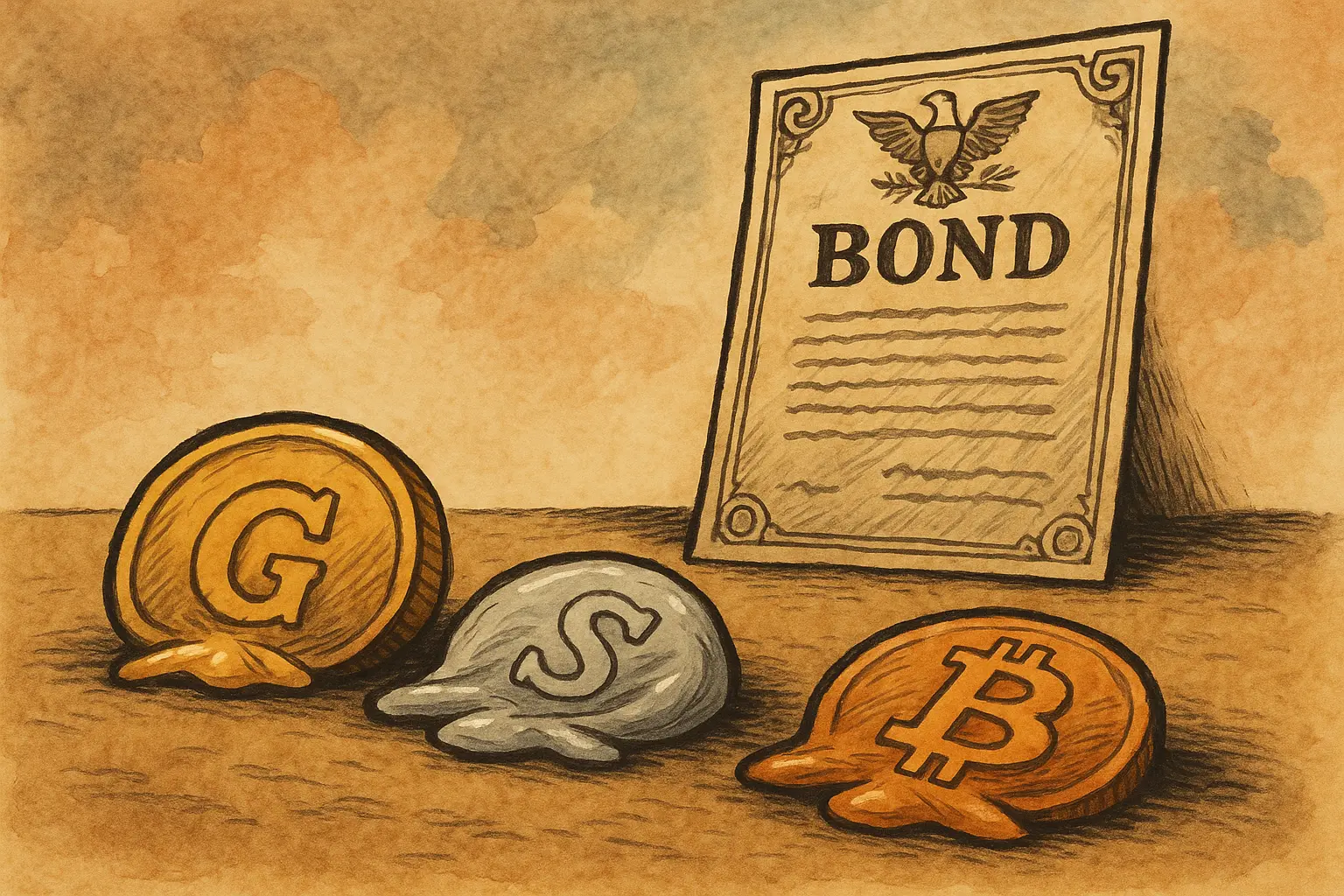
Before the 2026 Spring Festival, gold, silver, and Bitcoin all retraced simultaneously, with institutions buying and selling them together. JPMorgan states that U.S. bond yields control about 70% of the pricing power of gold. In 2025, inflows into gold ETFs reached 89 billion USD, while silver leveraged positions were liquidated. The paper silver market collapsed, but physical premiums in Shanghai and Dubai surged by $20, with central banks purchasing 750–950 tons of gold to support the floor.
The Shift of Precious Metals Pricing Power from Physical to Wall Street
Let’s start with a key fact: the prices of gold and silver are no longer primarily determined by “hedging demand.” In 2025, global gold ETF inflows hit a record of $89 billion, doubling the managed assets to $559 billion. The share of gold in global financial assets rose from a low point in 2010 to 2.8% in Q3 2025. This 2.8% marks a profound structural change: the pricing power of precious metals has shifted from physical demand to financialized markets.
Today, most marginal price movements of gold and silver are driven by the same pool of global macro capital: hedge funds, CTAs, systematic trend funds, and cross-market institutional accounts. These funds don’t care whether “gold is a hedge,” only three variables matter: dollar liquidity, real interest rates, and the speed of risk appetite shifts.
JPMorgan’s research shows that changes in U.S. Treasury yields explain about 70% of quarterly gold price volatility. This indicates that gold pricing has become highly macro-driven and systematic. When you see gold price swings, they are no longer driven by Indian wedding seasons or Chinese retail buying enthusiasm, but by Wall Street’s quant models and algorithmic trading systems. The issue isn’t that gold and silver have “become unsafe,” but that the forces determining their prices have fundamentally changed.
Three Major Evidence of the Shift in Precious Metals Pricing Power
ETF Dominance: In 2025, inflows of $89 billion, managing $559 billion, accelerating financialization.
Interest Rates Set Prices: Changes in U.S. bond yields explain 70% of gold price fluctuations; macro factors outweigh physical demand.
Institutional Homogenization: The same pool of capital trades with similar models; gold, silver, and BTC are treated as similar assets.
This explains why gold, silver, and Bitcoin have recently experienced large simultaneous swings. They are all exposed to the same macro factors: intense fluctuations in global liquidity expectations. When markets bet on rate cuts, dollar weakness, and currency devaluation, these assets are bought together—not because they are “hedges,” but because in quantitative models, they are “non-sovereign scarce assets.”
When inflation remains sticky, interest rate expectations rebound, the dollar strengthens, or risk models trigger deleveraging, they are sold off simultaneously—not because they are “risky,” but because they are in the same risk basket. Price volatility isn’t due to “asset property changes,” but because the groups of participants and trading methods involved in pricing have become homogenized.
January 30 Trump Nomination Sparks a Synchronized Crash
January 30 is the best proof. Trump nominated Kevin Warsh as Federal Reserve Chair, which was interpreted as a hawkish signal. The dollar rebounded, and immediately: gold fell from 5600 to below 4900, silver plunged from 120 to 75, and Bitcoin slipped from 88,000 to 81,000. All three assets, at the same time, in the same direction, with the same violent move. This is no coincidence but direct evidence that they are priced by the same trading system.
Such synchronicity is extremely rare historically. During the 2008 financial crisis, gold actually rose amid stock market crashes. In early 2020, gold briefly dipped then rebounded to new highs. But this time is different: these three traditionally “safe-haven” assets all collapsed together during a risk event. This marks a fundamental change in market structure.
Silver’s performance is especially illustrative. Compared to gold, silver has both precious metal and industrial metal attributes, with higher leverage and more fragile liquidity. By the end of 2025, 30-day realized volatility of silver surged above 50%, while Bitcoin compressed to around 40%. This is a significant reversal. Historically, Bitcoin’s volatility far exceeded silver’s; now, the roles are reversed, with silver becoming a more aggressive speculative target.
Recent rapid rises and falls in silver are essentially macro long positions being concentrated in and out, not short-term fundamental changes. The Chicago Mercantile Exchange raised silver futures margin requirements from historic lows to 15–16.5% in January 2026, ending the era of low-cost “paper silver” speculation. When prices fall, highly leveraged speculators can’t meet the new margin requirements and are forced to liquidate. This triggers cascade liquidations, further price declines, and more forced selling. This “margin trap,” reminiscent of the 1980 silver squeeze by Hunt Brothers via margin increases, is almost identical to Bitcoin’s behavior near liquidity turning points.
The Paradox of Silver Market Collapse and Physical Premiums
While the paper market crashes, the physical market shows opposite signals. After silver plunges, premiums in Shanghai and Dubai soar to $20 above Western spot prices. Major silver miners like Fresnillo have lowered 2026 output guidance to 42–46.5 million ounces. Industrial demand (solar, EVs, semiconductors) remains strong. This split reveals a key contradiction: the highly financialized paper market experiences extreme volatility driven by macro capital, while physical supply and demand remain relatively stable.
A similar split exists in the gold market. Central banks are expected to buy 750–950 tons of gold in 2026, continuing a three-year streak of over 1,000 tons annually. These “traditional” buyers—mainly emerging market central banks—are motivated by de-dollarization, reserve diversification, and long-term value storage. They don’t participate in short-term trading, don’t use leverage, and aren’t forced to liquidate by margin calls. This creates a two-tier structure: a long-term bottom set by central bank buying to establish a floor, while short-term volatility is driven by institutional investors and algorithms creating extreme marginal prices.
This also explains a seemingly paradoxical phenomenon: safe-haven assets tend to crash during “risk-on” events. The reason isn’t that they lose their hedge properties, but that when systemic risk rises to a certain level, markets prioritize “cash” and “liquidity” over “long-term value preservation.” When volatility spikes, liquidity often evaporates. Market makers narrow quotes, widen spreads, and prices gap. In such an environment, all highly financialized, quickly liquidatable, leveraged assets—whether gold, silver, or Bitcoin—are sold simultaneously.
Institutional Dilution of the Crypto Decentralization Narrative
A deeper issue is that the long-standing narrative of crypto as a “decentralized safe haven” is collapsing. The institutionalization process dilutes this narrative. When Bitcoin drops sharply over a weekend with thin liquidity, it’s largely due to leverage liquidations and futures market unwinds—products of centralized finance. True hodlers who hold private keys and adhere to “not your keys, not your coins” have already been marginalized in pricing power.
This shift impacts not just Bitcoin but the entire crypto ecosystem. Altcoins face greater pressure: if even Bitcoin’s unique value proposition is lost and it’s lumped into the “macro liquidity trading basket,” then weaker narratives and more fragile fundamentals of altcoins like Ethereum, Solana, or others become even more vulnerable. When institutions allocate to crypto, they tend to favor the “already domesticated” BTC rather than risking investments in ETH or other chains.
Ethereum’s price has fallen 4% to 2,660 USD, even weaker than Bitcoin. This suggests a brutal possibility: under macro risk regimes, capital flows toward the “crypto market’s gold” (BTC), abandoning assets seen as “crypto’s silver or copper.” Without independent valuation narratives, ETH, SOL, and other tokens risk becoming mere followers of Bitcoin, with even higher volatility.
The paradox of DeFi: once hailed as the most revolutionary innovation in crypto—promising lending, trading, and financial services without traditional intermediaries—becomes questionable if the underlying assets (BTC, ETH) are fully priced by traditional financial markets. If price discovery occurs on Wall Street trading desks, Chicago futures, and quant servers, then DeFi’s “decentralization” is mostly superficial.
Vitalik’s recent criticisms of DeFi may be a premonition of this dilemma. When the pricing power of underlying assets is controlled by centralized forces, even layered protocols claiming decentralization are just playing in a manipulated sandbox. This may explain Vitalik’s push for truly decentralized stablecoins and protocol immutability—an effort to preserve some pure form of decentralization within parts of the financial stack.
For investors, this cognitive update is crucial. Do not think of gold, silver, and Bitcoin as entirely separate asset classes. They are now grouped in institutional portfolios as “non-sovereign scarce assets,” “liquidity trading instruments,” and “macro-sensitive assets.” This classification means they tend to move together at liquidity turning points. Diversifying among these three does not truly diversify risk.