


Ripple Expands XRP Ledger Funding as Long-Term Holders Accumulate
Ripple, the $40 billion payments company utilizing XRP for cross-border transactions, announced a strategic shift toward distributed funding models for XRP Ledger (XRPL) development through a new FinTech Builder Programme, aiming to reduce its historical influence over the ecosystem.
The announcement comes as on-chain data reveals that long-term XRP holders increased their positions by approximately 200% during the asset’s 40% price decline from January to February 2025, while speculative holders reduced their supply share by 74.7%. XRP is currently trading near $1.40, with technical analysts identifying a cup-and-handle pattern that could target the $1.70 range pending confirmation above key resistance levels.
Ripple Transitions XRP Ledger Funding to Distributed Model
Ripple announced in a Thursday blog post its intention to diversify funding channels for XRP Ledger development, moving away from historically Ripple-supported initiatives toward independent organisations, venture partners, and community-led programmes. The company stated that “as the ecosystem matures, the focus is shifting toward expanding access to funding through more distributed and independent pathways so builders have multiple avenues to scale.”
The new FinTech Builder Programme will support startups building financial applications on the XRP Ledger, including stablecoin payments, credit infrastructure, tokenisation, and regulated financial services. This initiative joins existing ecosystem support structures including the XAO DAO, a decentralised autonomous organisation established in June 2025 to provide microgrant funding, XRPL Commons non-profit, and XRP Asia for Asia-Pacific region developers.
Ripple also identified venture capital partners including Dragonfly Capital, Pantera, and Franklin Templeton as participating funding sources. The company emphasised that “the goal is to ensure that no single organisation becomes the sole gatekeeper for ecosystem support.”
The funding diversification strategy addresses longstanding perceptions regarding Ripple’s influence over the XRP Ledger. While Ripple and the XRPL are distinct entities, many original XRPL creators from its 2012 launch subsequently founded Ripple or joined as executives. Ripple remains the largest XRP holder, reporting $57 billion in XRP holdings—approximately two-thirds of circulating tokens—as of March 2025.
XRP Ledger DeFi Ecosystem Faces Decline Despite Development Efforts
Total value locked in XRP Ledger protocols has declined from a peak of $120 million in July 2025 to approximately $49 million currently, indicating challenges in decentralised finance ecosystem growth despite hosting the $84 billion XRP token.
David Schwartz, Ripple’s chief technical officer and key architect of several XRPL DeFi upgrades including the native automated market maker and programmable tokens, stepped down in October after 14 years with the company.
Several infrastructure developments are under consideration to address ecosystem growth. Ripple developers have discussed introducing XRP staking capabilities, which could enhance DeFi participation. Additionally, infrastructure for an XRPL lending market entered validator voting on January 28, requiring an 80% supermajority among XRPL validators for approval. The proposed lending market would enable financial institutions to borrow funds from retail investors.
XRP Holder Behavior Demonstrates Divergence During Price Correction
XRP experienced a 40% price decline from January 5 through February 2025, falling from $2.35 to approximately $1.40. On-chain data reveals contrasting behavior between investor cohorts during this period.
According to HODL Waves metrics, speculative holders—defined as addresses holding XRP for one day to one week—controlled 2.29% of total supply on February 8. By February 26, this figure had declined to 0.579%, representing a 74.7% reduction in speculative supply share during the price decline.
Concurrently, the Hodler Net Position Change metric, which tracks investors holding for at least 155 days, showed accumulation behavior. On January 5, long-term holders had added approximately 47.3 million XRP on a 30-day rolling basis. By February 26, following the price decline to $1.40, their net position change had risen to approximately 145.45 million XRP, representing a 200% increase in accumulation rate. These holders have maintained steady positions through subsequent volatility between $1.21 and $1.52.
XRP Derivatives Positioning Shows Balanced Leverage Structure
Analysis of perpetual contract positioning on Binance indicates relatively balanced leverage across XRP markets. Current data shows approximately $74.93 million in long leverage positions compared to $69.14 million in short leverage.
This balanced structure contrasts with other major cryptocurrencies. Ethereum’s ETH/USDT perpetual contracts on Binance currently show approximately $976 million in long leverage versus $576 million in shorts, creating asymmetrical liquidation risk.
XRP-linked investment products have recorded consistent institutional inflows throughout February, without major net outflow weeks, indicating sustained institutional participation during the price correction.
Technical Analysis Identifies Key Price Levels for XRP
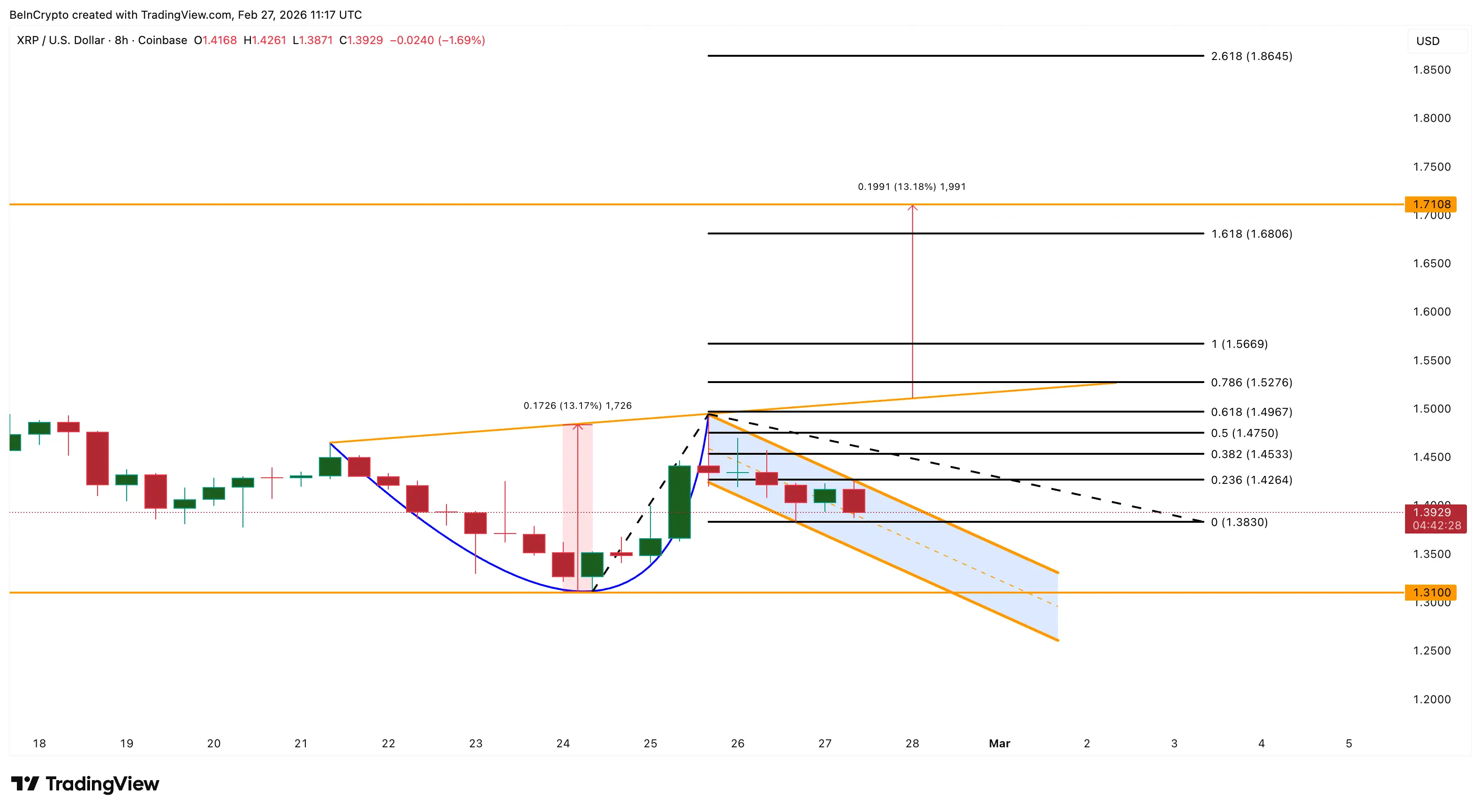
XRP’s 8-hour chart shows formation of a cup-and-handle pattern, a bullish continuation structure. The handle formed following a 7% correction from the February 25 high, creating a consolidation zone.
Technical analysts identify $1.38 as a critical support level for maintaining bullish structure. A decline below $1.31 would invalidate the pattern. Upside confirmation requires a break above $1.42 for handle breakout validation, with the primary resistance at $1.52 near the pattern’s neckline.
 (来源:TradingView)
If XRP breaks above $1.52, technical projections target approximately $1.71, with potential extension toward $1.86 depending on breakout momentum and neckline breach point.
FAQ: Ripple XRP Ledger Funding and Market Developments
What is Ripple’s new FinTech Builder Programme and how does it differ from previous funding approaches?
The FinTech Builder Programme is a Ripple initiative supporting startups building financial applications on the XRP Ledger, including stablecoin payments, credit infrastructure, tokenisation, and regulated financial services. It differs from historical funding models by operating alongside independent organisations, venture partners like Dragonfly Capital and Pantera, and community DAOs rather than channeling development support primarily through Ripple-controlled entities.
Why did long-term XRP holders increase positions during the 40% price decline?
On-chain data from the Hodler Net Position Change metric shows investors holding XRP for at least 155 days added approximately 98 million XRP to their positions between January and February, representing a 200% increase in accumulation rate. This behavior suggests these holders viewed the price correction as an accumulation opportunity rather than an exit signal, potentially indicating conviction in XRP’s long-term value proposition.
What are the key technical levels for XRP price movement?
Based on the cup-and-handle pattern identified on 8-hour charts, critical levels include: support at $1.38 (maintains bullish structure), invalidation level at $1.31 (below which pattern breaks), initial resistance at $1.42 (handle breakout confirmation), primary resistance at $1.52 (neckline), and upside target of approximately $1.71 if breakout above neckline is confirmed.
Related Articles
SBI Holdings Yen Bonds Tied to XRP Attract Customers, Rewards Only $129,000 Spark Controversy
Bitcoin drops back to $65,000! PPI exceeds expectations and Nvidia's sharp decline drag down, Solana, XRP, and Dogecoin all pull back collectively
XRP Today's News: XRPL Serious Vulnerability Nearly Cleared Wallets, Emergency Patch Promotes $1.35 Rebound
US XRP and SOL spot ETFs had a total net inflow of $3,511,500 yesterday
Will Momentum Hold for XRP as Price Defends $1.34 and Challenges $1.42?