


Bitcoin Miners Power Back Above 1 Zettahash — But Profits Hover Near Historic Lows
Bitcoin miners are back to business as usual after last month’s Arctic blast iced operations across the U.S., and the network’s hashrate has clawed its way back above the 1 zettahash per second (ZH/s) mark. Even so, mining revenue is painfully lean to start March at under $30 per petahash per second (PH/s), and difficulty is projected to climb yet again.
Bitcoin Mining Faces Lean Stretch
Bitcoin mining revenue is plumbing depths not seen since the digital currency’s formative years, and on Feb. 24, it dipped below $28 per PH/s. As of Sunday, March 1, data from hashrateindex.com places the current hashprice at $29.01 per petahash of daily output.
In plain terms, miners are earning far less for the same computational grind, tightening profit margins and leaving little room for error. Even with revenue on a tight leash, the network’s hashrate remains north of the 1 ZH/s threshold, equal to 1,000 exahash per second (EH/s).
Data shows miners have kept the network perched above that level since the second week of last month. That persistence accelerated block intervals and triggered a massive 14.73% difficulty adjustment spike, the steepest increase since 2021.
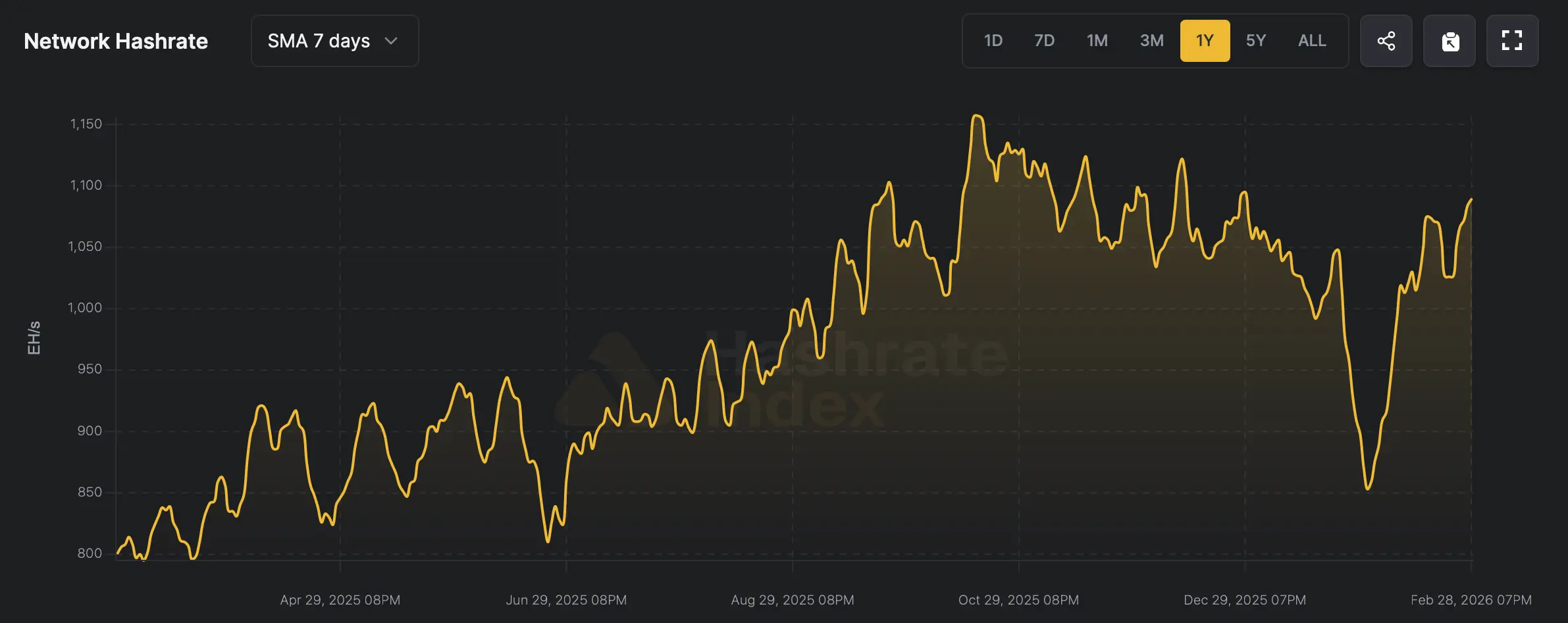
With the hashrate currently at 1,085 EH/s and block intervals averaging 9 minutes 48 seconds, the next epoch is poised for a modest uptick. Projections show that the next difficulty change is expected to occur on March 5, 2026.
It’s also worth noting that activity on the Bitcoin blockchain has been rather subdued, and over the past day, onchain fees have accounted for just 0.47% of the total block reward. In effect, miners are leaning almost entirely on BTC’s spot price, as transaction fees are offering virtually no cushion.
The question now is whether bitcoin can regain its footing after nearly two months of dreary price downturns and persistent bearish signals. For miners operating on razor-thin margins, the answer may determine who weathers the pressure and who powers down.
Compressed mining revenue, elevated difficulty, muted onchain fees, and a hashrate still hovering above 1 ZH/s paint a picture of an industry grinding through a lean stretch with little relief in sight. Until things change, efficiency, scale, and access to low-cost energy remain the decisive advantages in a market that is offering miners no margin for complacency.
FAQ 🔎
- Why are bitcoin miners earning less in March 2026? Mining revenue has fallen below $30 per PH/s as of March 1, 2026, squeezing margins for operators across the United States.
- What is bitcoin’s current hashrate? The bitcoin network is running above 1 zettahash per second (ZH/s), or about 1,085 exahash per second (EH/s), even after February’s Arctic storm disruptions.
- When is the next bitcoin difficulty adjustment expected? The next bitcoin difficulty change is projected to occur around March 5, 2026, following a recent 14.73% increase.
- How much of bitcoin miner revenue comes from transaction fees right now? Onchain fees currently account for just 0.47% of total block rewards, leaving miners largely dependent on bitcoin’s spot price.
Related Articles
The Governor of Indiana has signed the Bitcoin Rights Act, allowing the use of digital assets in state retirement plans.
Data: 79.24 BTC transferred out from Cumberland DRW, worth approximately 2.13 million USD
Best Crypto To Invest In as Bitcoin Bounces From $63K Pepeto Set To Make A New Wave Of Millionaires
Bitcoin futures demand sinks to 2024 lows: Are institutions exiting?