Anthropic released an upgraded version of its flagship model, Claude Opus 4.7, on April 16 (local time). Compared to the previous Opus 4.6 model, Opus 4.7 demonstrates “significant improvements” in advanced software engineering capabilities, particularly on difficult tasks, with enhanced rigor and consistency in complex, long-running operations and improved vision abilities. However, Anthropic deliberately weakened the model’s cybersecurity attack-defense capabilities during training and introduced safety mechanisms to automatically detect and block prohibited or high-risk requests.
Performance and Benchmarks
In benchmark testing, Opus 4.7 achieved scores generally higher than the previous Opus 4.6 and competitor GPT-5.4. However, Anthropic emphasized that Opus 4.7’s overall capabilities do not match the company’s most powerful model, Claude Mythos Preview. According to Anthropic: “By deploying and operating these protective mechanisms in the real world, we will accumulate experience to ultimately enable broader release of Mythos-level models.”
Deployment and Pricing
Opus 4.7 is now live across all Claude products and API interfaces, integrated with Amazon Bedrock, Google Cloud Vertex AI, and Microsoft Foundry services. Pricing remains consistent with Opus 4.6: $5 per million input tokens and $25 per million output tokens.
Token Consumption Changes
Two changes in Opus 4.7 compared to Opus 4.6 will affect token usage. First, Opus 4.7 uses an updated tokenizer, improving how the model processes text. However, this means identical inputs may consume more tokens—approximately 1 to 1.35 times the previous generation’s consumption.
Second, Opus 4.7 performs more reasoning at higher “thinking intensity,” particularly in subsequent rounds of agentic scenarios. This improves reliability on complex problems but generates additional output tokens.
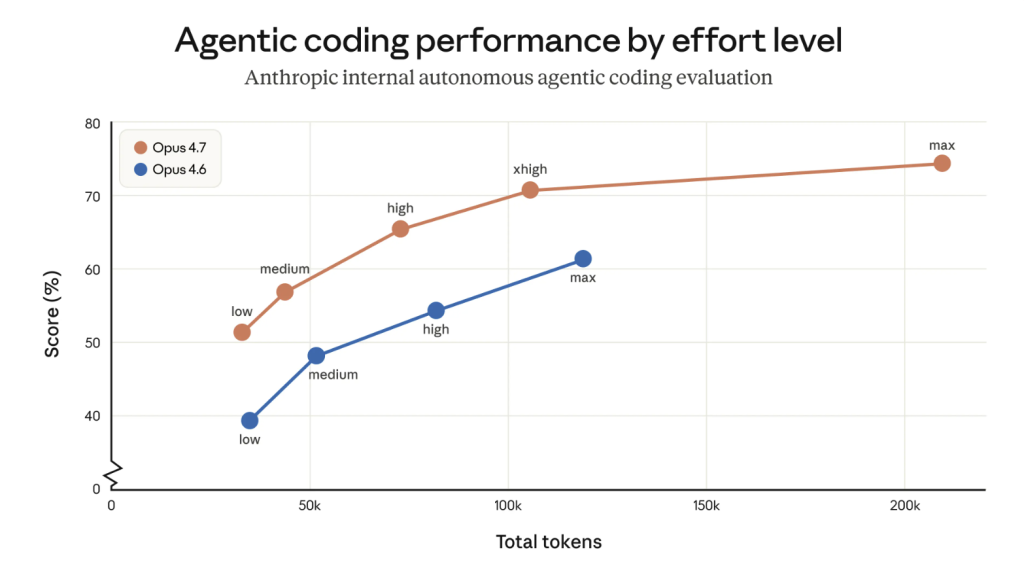 Opus 4.7 token consumption increase. Source: Anthropic
Market Analysis and Context
Analysts characterize Opus 4.7 as a “transitional” model. Investment analyst Adam Button noted that the Opus 4.7 release reinforces Anthropic’s narrative around “godlike models” like Mythos and confirms market skepticism: publicly available paid models are essentially “lite” versions constrained by safety mechanisms.
Company Background and Financial Milestone
Anthropic, founded in 2021 by former OpenAI employees, develops the Claude series of large language models. On April 6, Anthropic announced its annualized revenue (ARR) exceeded $300 billion, a significant increase from $9 billion at the end of 2025. The company is actively pursuing an initial public offering.
Cybersecurity Risk Concerns
Anthropic executives have repeatedly warned about AI’s impact on cybersecurity. According to reports dated April 10 (local time), U.S. Treasury Secretary Yellen and Federal Reserve Chair Powell held an emergency meeting with Wall Street leaders on April 7 to discuss how Anthropic’s latest Mythos AI model could heighten cybersecurity risks. Anthropic has stated that Mythos is not suitable for public release because the model could be misused by cybercriminals and spies. The company is selectively providing access to Mythos to leading global cybersecurity and software enterprises.
Disclaimer: The information on this page may come from third parties and does not represent the views or opinions of Gate. The content displayed on this page is for reference only and does not constitute any financial, investment, or legal advice. Gate does not guarantee the accuracy or completeness of the information and shall not be liable for any losses arising from the use of this information. Virtual asset investments carry high risks and are subject to significant price volatility. You may lose all of your invested principal. Please fully understand the relevant risks and make prudent decisions based on your own financial situation and risk tolerance. For details, please refer to
Disclaimer.
Related Articles
Earth VC Backs Quantum AI Startup Sygaldry in $139M Funding Round
Earth Venture Capital invested in Sygaldry Technologies, a quantum AI startup, contributing to a total funding of $139 million. Sygaldry develops hybrid servers for efficient AI workloads, co-founded by Chad Rigetti, previously of Rigetti Computing.
GateNews1h ago
China to Strengthen Legislative Framework for AI, Digital Economy, and Blockchain
China plans to enhance its network legal system to address the needs of internet development, focusing on legislation for AI, digital economy, and other tech sectors. By December 2025, over 180 laws are expected, though current regulations still lag behind public expectations.
GateNews1h ago
Intchains Group Discloses 8,040 ETH Staked, Accelerates AI-Powered Operations Transformation
Intchains Group reported a cumulative staking of 8,040 ETH, with a strategy that includes the FalconX platform and its own Goldshell Stake. The company is also enhancing operations through AI automation to boost efficiency and decision-making.
GateNews2h ago
Adata and Jay Chou raking in big money? GD’s talent agency secretly meets with Dubai’s royal family to discuss an IPO, AI, and robots
South Korean entertainment technology company Galaxy Corporation has recently moved into the Middle East market, established the Dubai entity “Galaxy ME,” and met with members of the UAE royal family to explore the integration of AI and content. The company has selected an underwriter to carry out its IPO; last year, revenue reached 300 billion Korean won, and it has attracted investments from Jay Chou and Adata, among others. This move is intended to drive the development of the Middle East entertainment ecosystem and underscores the importance of its globalization strategy.
ChainNewsAbmedia3h ago
China team EvoMap erupts in anger over Hermes Agent copying amid viral success: the self-evolving system has a high degree of similarity
The China team, EvoMap, accuses Nous Research’s Hermes Agent of copying its Evolver/GEP architecture, claiming that the two are highly similar across multiple key modules. EvoMap says that Hermes’ design does not reference or acknowledge its previously released content. The controversy has sparked widespread attention in the community. Some Chinese netizens have voiced support for EvoMap and criticized Hermes’ copying behavior. Although the Nous Research team has not yet rebutted the allegations point by point, the incident has quickly spread across AI public discourse.
ChainNewsAbmedia4h ago
OpenAI early investors are bullish! Brain-machine startup Sabi plans to ship by the end of this year with a “thinking-to-type” beanie
Silicon Valley startup Sabi announced that it is developing a non-invasive wearable brain-computer interface that will let users input text into a screen just by “thinking.” It is expected to launch by the end of 2026. The device will be equipped with up to 100,000 micro-sensors, helping to accurately interpret brain activity, and Sabi also emphasizes data privacy protection.
ChainNewsAbmedia4h ago


