The article provides a comprehensive analysis of Hedera (HBAR) as an investment option, focusing on its technology, market position, and potential in the cryptocurrency landscape. Key factors influencing its viability include transaction speed, security model, and institutional-grade governance catering to enterprise adoption. The piece addresses investor concerns about HBAR's historical price volatility and offers short to long-term investment predictions. The content is structured to guide investors through HBAR's technical foundation, market dynamics, risk factors, and future outlook. Keywords prioritize HBAR's investment appeal in the rapidly evolving crypto sector.
Introduction: Hedera (HBAR) Investment Position and Market Prospects
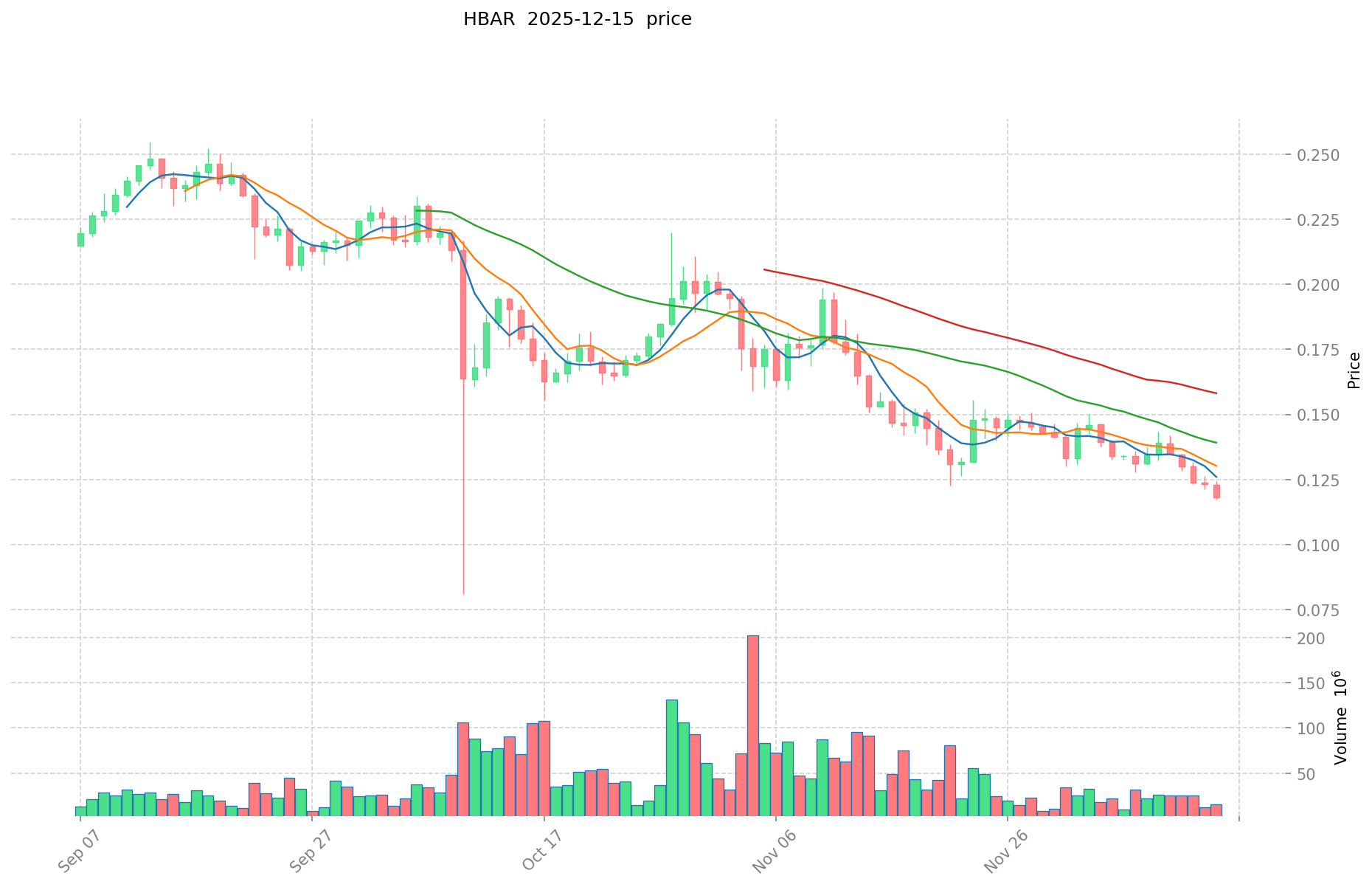
HBAR is an important asset in the cryptocurrency field. As of December 2025, Hedera has achieved a market capitalization of approximately $5.96 billion, with a circulating supply of around 42.48 billion tokens and a current price hovering near $0.11927. Positioned as a "fast, secure, and fair" distributed ledger network utilizing hashgraph consensus technology with transaction speeds exceeding 10,000+ TPS and asynchronous Byzantine Fault Tolerance (aBFT) security, HBAR has gradually become a focal point when investors discuss the question "Is Hedera (HBAR) a good investment?" as the native cryptocurrency of the Hedera public network.
Hedera's technical infrastructure supports distributed applications, enables peer-to-peer and micropayment business models, and provides network protection against malicious actors. Currently ranked 30th by market capitalization with a market dominance of 0.18%, HBAR reflects both the project's established position and the challenges it faces in a competitive landscape. The token has experienced significant price volatility since its all-time high of $0.569229 in September 2021, declining 59.53% over the past year, signaling the importance of comprehensive risk assessment for potential investors.
This article will provide a comprehensive analysis of HBAR's investment value, historical price trends, future price forecasts, and investment risks to serve as a reference for investors evaluating their portfolio allocation decisions.
Hedera (HBAR) Comprehensive Market Research Report
I. HBAR Price History Review and Current Investment Value
Based on available data, the following key price milestones have been recorded:
- All-Time High (ATH): $0.569229, reached on September 15, 2021
- All-Time Low (ATL): $0.00986111, recorded on January 3, 2020
- 12-Month Performance: -59.53% decline from previous year levels
- 30-Day Performance: -24.04% decline
- 7-Day Performance: -11.89% decline
Current HBAR Market Status (December 15, 2025)
| Metric |
Value |
| Current Price |
$0.11927 |
| 24-Hour Change |
-1.47% |
| 1-Hour Change |
+0.54% |
| Market Capitalization |
$5,963,500,000 |
| Circulating Supply |
42,476,304,285.1981 HBAR (84.95% of total) |
| Total Supply |
50,000,000,000 HBAR |
| 24-Hour Trading Volume |
$2,206,370.34 |
| Market Dominance |
0.18% |
| Market Cap to FDV Ratio |
84.95% |
Price Range (24-Hour Period)
- 24-Hour High: $0.1218
- 24-Hour Low: $0.11725
Access real-time HBAR market data at Gate Price Feed
II. Project Overview and Technical Foundation
Project Definition
Hedera is a public distributed ledger network utilizing hashgraph consensus mechanism, characterized by:
- Transaction Throughput: >10,000+ TPS (transactions per second)
- Security Model: aBFT (asynchronous Byzantine Fault Tolerance), representing one of the most secure distributed ledger implementations
- Transaction Transparency: All activity timestamps are publicly recorded; transaction hiding is not permitted
Native Token: HBAR
HBAR functions as the native cryptocurrency of the Hedera public network with the following applications:
- Supporting decentralized applications (dApps)
- Enabling peer-to-peer payments and micropayment business models
- Protecting network infrastructure against malicious attacks
- Facilitating network participation and transaction settlement
III. Market Positioning and Classification
Blockchain Classification
Hedera is categorized as:
- Layer 1 Blockchain
- Smart Contract Platform
Market Ranking
- Current Global Ranking: #30 by market capitalization
IV. Trading Activity and Exchange Availability
- Number of Listed Exchanges: 49 trading venues
- Circulating Supply Ratio: 84.95% of maximum supply currently in circulation
- Fully Diluted Valuation: $5,963,500,000 (equivalent to market cap when all tokens circulate)
V. Official Resources and Community Channels
Primary Websites
Blockchain Explorer
Report Date: December 15, 2025
Data Source: Gate Market Data
Disclaimer: This report presents factual market data and project information. It does not constitute investment advice, recommendations to buy, sell, or hold HBAR tokens, or solicitation to participate in any trading strategy. Cryptocurrency markets are highly volatile and subject to substantial price fluctuations. Investors should conduct independent research and consider their risk tolerance before making any investment decisions.
Hedera (HBAR) Investment Analysis Report
Report Date: December 15, 2025
I. Executive Summary
Hedera (HBAR) is a distributed ledger network utilizing hashgraph consensus technology, designed to deliver high throughput (>10,000+ TPS), enhanced security (ABFT), and transparent transaction ordering. As of the reporting date, HBAR is ranked 30th by market capitalization at approximately $5.96 billion USD, with a circulating supply of 42.48 billion tokens and a current price of $0.11927 per token.
II. Core Factors Influencing Whether Hedera (HBAR) is a Good Investment
Supply Mechanism and Scarcity
Hedera operates with a fixed maximum supply of 50 billion tokens, with 84.95% currently in circulation (42.48 billion tokens). The defined supply cap creates a predetermined scarcity framework that may support long-term value retention. The relationship between circulating supply and total supply establishes a finite issuance schedule that distinguishes HBAR from inflationary cryptocurrency models.
Institutional Investment and Mainstream Adoption
Hedera's governance structure distinguishes it through council-based oversight involving major global corporations, including technology leaders and enterprises. This institutional-grade positioning targets enterprise-scale adoption rather than retail-focused markets. The network is explicitly designed for mission-critical real-world systems integration, positioning HBAR as an infrastructure asset for institutional deployment rather than speculative trading.
Current network development indicates stablecoin issuance capabilities and emerging use cases in tokenized Forex trading and real-world asset (RWA) platforms. Hedera ranks 22nd in stablecoin market value, reflecting growing ecosystem activity in this application layer.
Hedera's hashgraph consensus mechanism provides distinctive technical characteristics:
- Transaction Throughput: >10,000+ TPS capability enables high-volume transaction processing
- Security Model: Asynchronous Byzantine Fault Tolerant (ABFT) consensus reduces attack surface compared to conventional distributed ledger designs
- Transaction Ordering: Deterministic and transparent transaction sequencing prevents hidden transaction records and front-running vulnerabilities
These technical specifications position the network for enterprise applications requiring deterministic ordering and regulatory compliance.
Ecosystem Development
The Hedera ecosystem demonstrates diversification across multiple application categories:
- Stablecoin issuance and management
- Tokenized Forex trading
- Real-world asset (RWA) platforms
- Artificial intelligence infrastructure support
Network adoption indicates initial enterprise pilot conversions toward production-level deployments, though sustained growth depends on generating consistent on-chain transaction volume and demonstrating measurable enterprise adoption metrics.
Current Market Position
| Metric |
Value |
| Current Price |
$0.11927 |
| 24-Hour Change |
-1.47% |
| 7-Day Change |
-11.89% |
| 30-Day Change |
-24.04% |
| 1-Year Change |
-59.53% |
| 24-Hour Volume |
$2,206,370 |
| Market Capitalization |
$5,066,148,812 |
| All-Time High (ATH) |
$0.569229 (September 15, 2021) |
| All-Time Low (ATL) |
$0.00986111 (January 3, 2020) |
HBAR displays significant distance from its historical high, trading at approximately 79% below ATH levels. The one-year performance reflects prolonged downward pressure relative to entry points established during 2021-2022 market cycles.
Price Trend Analysis
Recent price movements indicate near-term volatility with mixed directional signals:
- 1-Hour: +0.54% change
- 24-Hour: -1.47% change (recent weakness)
- 7-Day: -11.89% decline (intensifying downward pressure)
- 30-Day: -24.04% decline (extended bearish phase)
IV. Market Outlook and Analyst Projections
Mid-Term Price Forecasts
Multiple analyst perspectives provide the following consensus ranges:
| Period |
Low |
Average |
High |
| 2025 End |
$0.12 |
$0.14 |
$0.30 |
| 2026 |
$0.20 |
$0.21 |
$0.23 |
| 2027 |
$0.30 |
$0.31 |
$0.35 |
| 2029 |
$0.62 |
$0.64 |
$0.73 |
| 2030 |
— |
— |
$0.873 |
| 2031 |
$1.39 |
$1.43 |
$1.62 |
Analyst projections reflect moderate optimism contingent upon sustained enterprise adoption and on-chain volume generation. Growth trajectories suggest gradual appreciation rather than explosive price movements.
Conditional Growth Factors
Analyst assessments identify the following conditions for positive price development:
- Enterprise Pilot Conversion: Transition from pilot programs to production-level deployments with visible adoption metrics
- On-Chain Volume: Generation of consistent and measurable transaction activity
- Stablecoin Ecosystem: Continued growth in stablecoin issuance and utilization
- RWA Platform Development: Expansion of real-world asset tokenization applications
- Regulatory Clarity: Institutional framework supportive of enterprise blockchain deployment
V. Key Challenges and Risk Factors
Adoption Headwinds
Sluggish retail participation contrasts with the enterprise-focused governance model. The gap between institutional positioning and actual end-user adoption remains a material risk factor. Enterprise pilots have not yet translated systematically into visible production metrics at scale.
Utility Validation Risk
The utility model continues in validation phase. HBAR's long-term value proposition depends fundamentally on whether enterprise pilots achieve real-world deployment metrics and generate ongoing transaction volume at meaningful levels. Failure to convert experimental deployments into sustained operational use would undermine fundamental utility justification.
Polarized Market Perception
HBAR occupies a polarized position within cryptocurrency markets. Institutional-grade positioning targets a different investor class than retail-focused tokens, creating segmented demand dynamics. This structural positioning limits appeal to speculative or retail-driven price momentum.
Regulatory and Governance Considerations
Council-based governance introduces centralization considerations distinct from fully decentralized network architectures. The influence of major corporate council members on network direction presents governance concentration risks that differ from alternative blockchain designs.
VI. Conclusion
Hedera (HBAR) represents an infrastructure asset designed for institutional-scale enterprise deployment rather than retail speculation. The investment thesis depends substantially on whether the network achieves sustainable enterprise adoption with measurable on-chain activity generation.
Supporting factors include fixed supply architecture, institutional governance structure, deterministic transaction ordering capabilities, and expanding ecosystem development in stablecoin and RWA application areas.
Constraining factors include current validation-phase utility model, limited retail market participation, distance from historical price levels, and execution risks in converting enterprise pilots to production deployments.
Analyst consensus projects modest appreciation through 2025-2026 contingent upon sustained enterprise adoption progress, with longer-term growth dependent on visibility of material production-level deployment metrics and consistent on-chain transaction volume generation.
Note: This analysis reflects data available as of December 15, 2025, and market conditions remain subject to rapid change. Past price performance does not indicate future results.
III. HBAR Future Investment Predictions and Price Outlook (Is Hedera(HBAR) worth investing in 2025-2030)
Short-term Investment Prediction (2025, short-term HBAR investment outlook)
- Conservative forecast: $0.076 - $0.119
- Neutral forecast: $0.119 - $0.133
- Optimistic forecast: $0.133 - $0.307
Mid-term Investment Outlook (2027-2028, mid-term Hedera(HBAR) investment forecast)
- Market stage expectations: Increased enterprise integration and broader application of Hashgraph technology in fast, low-cost transactions, coupled with expansion of tokenization and DeFi projects, enhancing overall network demand and ecosystem value.
- Investment return projections:
- 2027: $0.112 - $0.142
- 2028: $0.127 - $0.155
- Key catalysts: Enterprise adoption growth, expansion of tokenization initiatives, partnerships in finance, supply chain and sustainability sectors, increased mainstream cryptocurrency recognition.
Long-term Investment Outlook (Is Hedera a good long-term investment?)
- Base case: $0.160 - $0.251 (corresponding to steady growth and gradual mainstream application adoption)
- Optimistic case: $0.251 - $3.17 (corresponding to large-scale adoption and favorable market environment)
- Transformative case: $13.54 or above (if ecosystem achieves breakthrough progress and mainstream proliferation)
For HBAR long-term investment and price predictions: Price Prediction
2025-2030 Long-term Outlook
- Base case: $0.160 - $0.251 USD (corresponding to steady progress and mainstream application advancement)
- Optimistic case: $0.251 - $3.17 USD (corresponding to large-scale adoption and favorable market conditions)
- Transformative case: $13.54 USD or above (if ecosystem achieves breakthrough progress and mainstream recognition)
- December 31, 2030 predicted high: $3.17 USD (based on optimistic development assumptions)
Disclaimer: Price predictions involve substantial uncertainty. Past performance does not guarantee future results. Crypto markets are highly volatile and influenced by numerous unpredictable factors. Investors should conduct thorough research and assess their risk tolerance before making investment decisions. This analysis is for informational purposes only and does not constitute financial advice.
| 年份 |
预测最高价 |
预测平均价格 |
预测最低价 |
涨跌幅 |
| 2025 |
0.1333696 |
0.11908 |
0.0762112 |
0 |
| 2026 |
0.131273792 |
0.1262248 |
0.076997128 |
5 |
| 2027 |
0.1416242256 |
0.128749296 |
0.11201188752 |
7 |
| 2028 |
0.15546477492 |
0.1351867608 |
0.127075555152 |
13 |
| 2029 |
0.2136288787542 |
0.14532576786 |
0.1395127371456 |
21 |
| 2030 |
0.25126825262994 |
0.1794773233071 |
0.159734817743319 |
50 |
Hedera (HBAR) Research Report
I. Project Overview
Hedera is a fast, secure, and fair public ledger network utilizing hashgraph consensus mechanism. HBAR serves as the native cryptocurrency of the Hedera public network.
Key Technical Specifications:
- Consensus Mechanism: Hashgraph consensus (aBFT - Asynchronous Byzantine Fault Tolerant)
- Transaction Speed: >10,000+ TPS
- Security Model: Asynchronous Byzantine Fault Tolerant (aBFT)
- Transparency: All activity timestamps are publicly transparent with no hidden transaction records
Token Economics:
- Current Price: $0.11927 (as of December 15, 2025)
- Market Capitalization: $5,066,148,812 (circulating supply basis)
- Fully Diluted Valuation: $5,963,500,000
- Circulating Supply: 42,476,304,285.1981 HBAR
- Total Supply: 50,000,000,000 HBAR
- Market Ranking: #30
Primary Use Cases
HBAR is designed to:
- Support distributed applications
- Enable peer-to-peer and micropayment business models
- Protect the network against malicious attackers through network security mechanisms
Price Dynamics
Current Market Status:
- Current Price: $0.11927
- 24-hour High: $0.1218
- 24-hour Low: $0.11725
- 24-hour Change: -1.47%
Historical Performance:
- All-Time High: $0.569229 (September 15, 2021)
- All-Time Low: $0.00986111 (January 3, 2020)
- Decline from ATH: -79.08%
Short-to-Medium Term Trends:
- 1-hour Change: +0.54%
- 7-day Change: -11.89%
- 30-day Change: -24.04%
- 1-year Change: -59.53%
Market Metrics
- 24-hour Trading Volume: $2,206,370.34
- Market Dominance: 0.18%
- Circulating Supply Ratio: 84.95%
- Number of Trading Exchanges: 49
III. Technical Foundation & Network Characteristics
Consensus Mechanism
Hedera employs a hashgraph consensus protocol featuring asynchronous Byzantine fault tolerance (aBFT). This mechanism is designed to provide:
- Speed: Capable of processing over 10,000 transactions per second
- Security: aBFT consensus represents one of the most secure distributed ledger implementations available
- Fairness: Complete transparency of transaction timestamps with elimination of hidden transaction records
Network Infrastructure
The Hedera public network operates as a distributed ledger with transparent cryptographic verification of all activities and transaction ordering.
IV. Investment Strategy and Risk Management
Investment Methodology
Long-term Holdings (HODL HBAR):
- Suitable for conservative investors seeking exposure to the hashgraph consensus technology and Hedera ecosystem development
- Aligns with conviction in the protocol's technical superiority and adoption potential
Active Trading:
- Dependent on technical analysis and range-bound operations
- Requires monitoring price volatility patterns and market sentiment
Risk Management Considerations
Asset Allocation:
Risk profile allocation should consider the cryptocurrency's current performance metrics and volatility patterns relative to overall portfolio objectives.
Security Infrastructure:
- Hot Wallet: For active trading and frequent transactions
- Cold Wallet: For long-term storage of significant holdings
- Hardware Wallet: Recommended for enhanced security of substantial positions
V. Investment Risks and Challenges
Market Risk
- High Volatility: HBAR demonstrates significant price fluctuations (down 59.53% over 1 year, down 24.04% over 30 days)
- Price Manipulation Risk: As a cryptocurrency with relatively lower trading volume compared to major assets, susceptibility to market manipulation requires consideration
Regulatory Risk
- Different jurisdictions maintain varying regulatory approaches to cryptocurrency assets
- Policy changes and regulatory uncertainty across global markets could impact HBAR's legal status and usage
Technical Risk
- Network security vulnerabilities and potential protocol-level issues
- Risks associated with network upgrades and implementation changes
- Adoption challenges and competition from alternative consensus mechanisms
VI. Conclusion: Is HBAR a Good Investment?
Investment Value Summary
HBAR presents a distributed ledger technology with distinctive technical characteristics through its hashgraph consensus mechanism. The current market position reflects significant volatility, with substantial price depreciation from historical highs. The technology demonstrates theoretical advantages in throughput and Byzantine fault tolerance, though practical adoption and network utilization metrics require ongoing assessment.
Investor Recommendations
✅ Beginners: Dollar-cost averaging approach combined with secure wallet storage infrastructure
✅ Experienced Investors: Range-based trading strategies with diversified portfolio allocation considering risk tolerance
✅ Institutional Investors: Strategic long-term positioning based on detailed technical analysis and ecosystem development assessment
Important Disclaimer
⚠️ Notice: Cryptocurrency investment carries substantial risk. This report is provided for informational purposes only and does not constitute investment advice. Past performance does not guarantee future results. Investors should conduct independent research and consult financial professionals before making investment decisions.
Report Generated: December 15, 2025
Data Source: Market data as of December 15, 2025, 21:16:22 UTC
Hedera (HBAR) Frequently Asked Questions
I. FAQ
Q1: What is Hedera (HBAR) and how does it differ from other blockchain networks?
A: Hedera is a public distributed ledger network utilizing hashgraph consensus technology, characterized by transaction speeds exceeding 10,000+ TPS and asynchronous Byzantine Fault Tolerance (aBFT) security. Unlike traditional blockchain networks using proof-of-work or proof-of-stake mechanisms, Hedera's hashgraph consensus provides deterministic transaction ordering with complete transparency—all activity timestamps are publicly recorded with no hidden transaction records. This technical architecture positions Hedera as a Layer 1 smart contract platform designed primarily for enterprise-scale deployment rather than retail-focused applications.
Q2: What is the current market valuation and supply structure of HBAR?
A: As of December 15, 2025, HBAR is ranked 30th by market capitalization at approximately $5.96 billion USD, with a current price of $0.11927 per token. The token has a maximum fixed supply of 50 billion tokens, with 42.48 billion tokens (84.95%) currently in circulation. This defined supply cap creates a predetermined scarcity framework that distinguishes HBAR from inflationary cryptocurrency models. HBAR is actively traded on 49 different exchanges globally.
Q3: How has HBAR's price performed historically, and what are the key price milestones?
A: HBAR reached an all-time high of $0.569229 on September 15, 2021, and has since declined approximately 79% from that peak. The token's all-time low was $0.00986111 on January 3, 2020. Recent performance metrics show significant downward pressure: a 59.53% decline over the past 12 months, a 24.04% decline over the past 30 days, and an 11.89% decline over the past 7 days. This volatility underscores the importance of comprehensive risk assessment for potential investors.
Q4: What is the investment outlook for HBAR through 2030?
A: Analyst projections indicate modest appreciation contingent upon sustained enterprise adoption. Short-term forecasts (2025) range from $0.076-$0.307 depending on market conditions. Mid-term expectations (2027-2028) project $0.112-$0.155. Long-term scenarios (through 2030) suggest base case range of $0.160-$0.251 under steady growth conditions, optimistic case of $0.251-$3.17 with large-scale adoption, and transformative case exceeding $13.54 if ecosystem achieves breakthrough progress. These projections emphasize that growth depends fundamentally on visible enterprise adoption metrics and consistent on-chain transaction volume generation.
Q5: What are the primary use cases and ecosystem development areas for HBAR?
A: HBAR's ecosystem demonstrates diversification across multiple application categories including stablecoin issuance and management, tokenized Forex trading, real-world asset (RWA) platforms, and artificial intelligence infrastructure support. The network is designed to support distributed applications, enable peer-to-peer and micropayment business models, and protect network infrastructure against malicious actors. Current development indicates Hedera ranks 22nd in stablecoin market value, reflecting growing ecosystem activity in this application layer.
Q6: What are the key investment risks and challenges associated with HBAR?
A: Primary risk factors include: (1) Adoption validation risk—utility model remains in validation phase with unclear enterprise deployment metrics; (2) Market adoption headwinds—sluggish retail participation contrasts with enterprise-focused governance model; (3) Price volatility—historical performance shows 79% decline from ATH with significant short-term fluctuations; (4) Regulatory uncertainty—varying jurisdictional approaches to cryptocurrency create policy risk; (5) Governance concentration—council-based oversight involving major corporations introduces centralization considerations distinct from fully decentralized networks; and (6) Technical risks—potential network security vulnerabilities and adoption challenges from competing consensus mechanisms.
Q7: Is HBAR suitable for different investor profiles, and what investment strategies are recommended?
A: HBAR accommodates multiple investor profiles: (1) Conservative long-term investors should consider dollar-cost averaging combined with secure wallet storage infrastructure; (2) Experienced investors may employ range-based trading strategies with diversified portfolio allocation considering individual risk tolerance; (3) Institutional investors should pursue strategic long-term positioning based on detailed technical analysis and ecosystem development assessment. The appropriate strategy depends on investment timeline, risk tolerance, and conviction regarding enterprise adoption prospects. All investors should implement proper security infrastructure including hardware wallets for significant holdings and conduct independent research before allocation decisions.
Q8: What conditions would need to occur for HBAR to achieve the optimistic or transformative price scenarios?
A: Achievement of optimistic ($0.251-$3.17) or transformative (exceeding $13.54) price scenarios requires: (1) successful conversion of enterprise pilot programs to production-level deployments with visible adoption metrics; (2) generation of consistent and measurable on-chain transaction activity at meaningful scale; (3) continued ecosystem expansion in stablecoin issuance, RWA tokenization, and emerging applications; (4) regulatory framework development supportive of enterprise blockchain deployment; (5) mainstream cryptocurrency market recognition and institutional capital inflows; and (6) competitive positioning relative to alternative Layer 1 platforms. Analyst assessments indicate these conditions represent necessary prerequisites for sustained price appreciation beyond current levels.
* The information is not intended to be and does not constitute financial advice or any other recommendation of any sort offered or endorsed by Gate.