Is Hemi (HEMI) a good investment? An In-Depth Analysis of Performance, Risk Factors, and Future Prospects

Introduction: Hemi (HEMI) Investment Position and Market Prospects
Hemi is an important asset in the cryptocurrency space. As a modular Layer-2 protocol powered by Bitcoin and Ethereum, it has garnered significant attention within the blockchain development community. As of December 2025, Hemi's market capitalization stands at $154.4 million, with a circulating supply of 540 million tokens and a current price of approximately $0.01544. The project distinguishes itself by bridging Bitcoin and Ethereum as components of a unified supernetwork rather than isolated ecosystems, positioning itself as an innovative infrastructure solution.
The Hemi Network's core architecture centers on the Hemi Virtual Machine (hVM), which integrates a full Bitcoin node within an Ethereum Virtual Machine. Combined with the Hemi Bitcoin Kit (hBK), developers can create Hemi decentralized applications (hApps) on a powerful, familiar platform. This technical approach represents a distinct positioning in the competitive Layer-2 landscape.
With 6,179 token holders and presence across 19 exchanges, Hemi demonstrates growing adoption. However, the token has experienced considerable volatility, with an all-time high of $0.19481 (reached in September 2025) and a recent low of $0.01344 (December 2025), reflecting broader market dynamics and investor sentiment fluctuations.
This article provides a comprehensive analysis of Hemi's investment value, price trends, future price forecasts, and associated investment risks to serve as a reference for investors evaluating this asset.
Hemi (HEMI) Crypto Asset Research Report
I. Historical Price Review and Current Investment Value
HEMI Historical Price Trends and Investment Performance
Based on market data as of December 22, 2025:
Recent Price Movements:
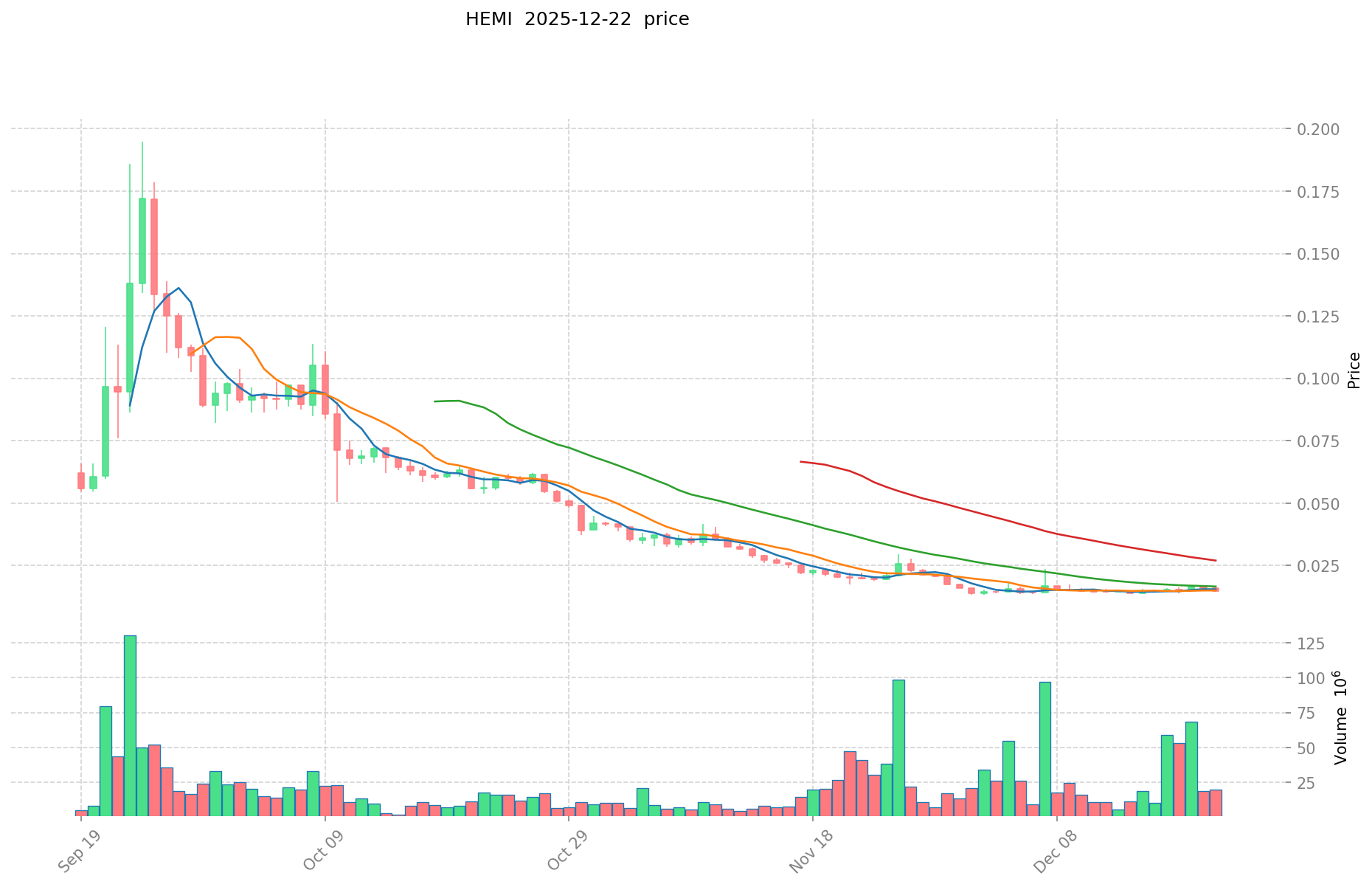
- All-Time High (ATH): USD 0.19481 (September 24, 2025)
- All-Time Low (ATL): USD 0.01344 (December 1, 2025)
- Current Price: USD 0.01544
- Price Change (24H): -3.37%
- Price Change (7D): +7.68%
- Price Change (30D): -24.34%
- Price Change (1Y): -12.90%
Market Performance Context: The token experienced a significant decline of approximately 92% from its all-time high to current levels within a 3-month period, representing substantial volatility characteristic of emerging Layer 2 blockchain projects.
Current HEMI Market Status (December 2025)
Key Market Metrics:
- Current Market Price: USD 0.01544
- 24-Hour Trading Volume: USD 300,634.33
- Total Market Capitalization: USD 154,400,000
- Fully Diluted Valuation (FDV): USD 154,400,000
- Circulating Supply: 540,000,000 HEMI
- Total Supply: 10,000,000,000 HEMI
- Circulating Supply Ratio: 5.4%
- Market Dominance: 0.0047%
- Number of Token Holders: 6,179
- Number of Exchanges: 19
Price Range (24H):
- High: USD 0.01617
- Low: USD 0.01441
Current market data available on Gate
II. Project Overview and Technical Foundation
Protocol Architecture
Hemi Network is a modular Layer 2 protocol designed to achieve superior scaling, security, and interoperability powered by Bitcoin and Ethereum. The project approaches Bitcoin and Ethereum not as ecosystem silos but as components of a single supernetwork, unlocking new levels of programmability, portability, and potential.
Core Technical Components:
I. Hemi Virtual Machine (hVM): A hybrid architecture that incorporates a full Bitcoin node within an Ethereum Virtual Machine, enabling smart contracts to interact directly with Bitcoin functionality.
II. Hemi Bitcoin Kit (hBK): A development framework enabling developers to create Hemi decentralized applications (hApps) on a familiar yet powerful platform.
III. Bitcoin Integration: The protocol integrates Bitcoin's security model through programmable Bitcoin capabilities and cross-chain communication protocols.
Security Model:
The protocol inherits Bitcoin's security properties through its architectural design, leveraging Bitcoin's proof-of-work consensus mechanism as a foundational security layer.
III. Tokenomics and Distribution
Token Supply Structure
- Total Supply: 10,000,000,000 HEMI
- Circulating Supply: 540,000,000 HEMI (5.4% of total)
- Max Supply: 10,000,000,000 HEMI
- Token Standard: BEP-20 (Binance Smart Chain)
Token Contract Details
- Contract Address (BSC): 0x5ffd0eadc186af9512542d0d5e5eafc65d5afc5b
- Blockchain: Binance Smart Chain (BSC)
- Block Explorer: BscScan
IV. Market Liquidity and Trading Accessibility
Exchange Listings
The token is currently listed on 19 cryptocurrency exchanges, with primary liquidity venues including:
- Gate
- MEXC
Trading Volume Analysis
24-hour trading volume of USD 300,634 indicates relatively modest liquidity compared to major cryptocurrency projects, suggesting limited trading capacity and potential price impact from larger transactions.
V. Financing and Development Activity
Funding Round
According to industry reports, Hemi Labs (the project developer) completed a USD 15 million financing round, with notable investors including YZi Labs, Republic Digital, and HyperChain Capital. Additional participants included Breyer Capital, Big Brain Holdings, and Crypto.com.
VI. Ecosystem and Use Cases
Bitcoin Layer 2 Narrative
Hemi Network positions itself within the emerging Bitcoin Layer 2 ecosystem, targeting enhanced capabilities for Bitcoin-based applications. The protocol aims to enable Bitcoin holders to access expanded functionality while maintaining underlying Bitcoin security properties.
Staking and Yield Mechanisms
According to available documentation, the protocol offers Bitcoin staking opportunities through its staking platform with variable yield structures, though specific current yield parameters require independent verification.
VII. Market Position and Competitive Landscape
Market Ranking
- Global Ranking: #1,271 (by market capitalization)
- Market Cap to FDV Ratio: 5.4%
Community and Adoption Metrics
- Active Token Holders: 6,179
- Exchange Presence: 19 trading venues
VIII. Project Resources and Community Channels
Official Channels:
- Website: https://hemi.xyz/
- Whitepaper: https://hemi.xyz/whitepaper/
- Twitter/X: https://x.com/hemi_xyz
- Discord: https://discord.com/invite/hemixyz
- Block Explorer: https://bscscan.com/token/0x5ffd0eadc186af9512542d0d5e5eafc65d5afc5b
IX. Risk Considerations
Important Notice: Cryptocurrency investments carry substantial risk including potential total capital loss. Token valuation depends on market demand, adoption rates, and competitive developments.
Key Risk Factors
Market Volatility: The token declined 92% from ATH to current price within three months, demonstrating extreme price fluctuation typical of early-stage blockchain projects.
Liquidity Risk: Daily trading volume of approximately USD 300,000 represents limited liquidity. Large position accumulation or liquidation could cause significant price slippage.
Concentration Risk: Only 5.4% of total supply is currently circulating, indicating substantial future dilution potential as additional tokens enter circulation.
Competitive Environment: Layer 2 protocols face intense competition from established solutions and other emerging projects. Technology performance and developer adoption remain critical success factors.
X. Summary and Data Snapshot
As of December 22, 2025:
This report reflects Hemi Network's position as an early-stage modular Layer 2 protocol integrating Bitcoin and Ethereum. The project remains in development with emerging ecosystem activity. The substantial price decline from peak levels warrants careful consideration of risk-reward dynamics. Prospective participants should conduct independent research and consider their risk tolerance before any engagement.
Disclaimer: This report presents factual market data and publicly available information. It does not constitute investment advice, financial recommendations, or solicitation for token purchase. Cryptocurrency markets carry extreme volatility and risk. Participants assume full responsibility for their investment decisions.
Hemi (HEMI) Investment Analysis Report
Report Date: December 22, 2025
I. Executive Summary
Hemi (HEMI) is a modular Layer-2 protocol designed to provide superior scaling, security, and interoperability, powered by both Bitcoin and Ethereum. As of December 22, 2025, HEMI trades at $0.01544, reflecting a 24-hour decline of 3.37% and a significant 30-day decline of 24.34%. The token holds a market cap of approximately $8.34 million with a fully diluted valuation of $154.4 million, representing a market dominance of 0.0047%.
II. Core Factors Influencing Whether Hemi (HEMI) is a Good Investment
Supply Mechanism and Scarcity
Hemi operates with a maximum supply of 10 billion tokens and a circulating supply of 540 million tokens (5.4% of total supply). This represents a substantial inflationary structure, with circulating supply comprising only a small fraction of total tokens available. The release of additional tokens into circulation could exert downward pressure on price dynamics, particularly in the absence of corresponding demand acceleration.
Current holder distribution shows 6,179 unique addresses holding HEMI tokens, indicating a relatively concentrated investor base compared to larger layer-2 protocols.
Technical Architecture and Ecosystem Development
Hemi Virtual Machine (hVM): The protocol's core innovation integrates a full Bitcoin node within an Ethereum Virtual Machine, enabling developers to leverage both blockchain ecosystems within a single development environment.
Hemi Bitcoin Kit (hBK): This toolkit facilitates the creation of Hemi decentralized applications (hApps), providing developers with familiar programming paradigms while accessing both Bitcoin and Ethereum security properties.
The protocol's modular design positions Bitcoin and Ethereum not as isolated ecosystems but as components of an integrated supernetwork, theoretically unlocking enhanced programmability, portability, and development potential.
Market Performance Metrics
Price Performance:
- All-time high: $0.19481 (September 24, 2025)
- All-time low: $0.01344 (December 1, 2025)
- 90-day decline: 84.5%
- Current price: $0.01544
Volume and Liquidity:
- 24-hour volume: $300,634.33
- Available on 19 exchanges
- Primary deployment: BSC (Binance Smart Chain)
Sentiment Indicators:
- Crypto Fear & Greed Index: 28 (Fear) as of December 21, 2025
- 200-day moving average trending downward since December 12, 2025
Market Capitalization and Valuation
With a current market cap of $8.34 million and fully diluted valuation of $154.4 million, the protocol demonstrates significant unrealized token supply. The 5.4% ratio of current market cap to fully diluted valuation indicates substantial dilution potential as additional tokens enter circulation.
III. Risk Considerations
Concentration and Volatility: The 84.5% decline over 90 days, coupled with downward-trending technical indicators, reflects pronounced volatility and risk aversion in the current market environment.
Inflationary Supply Structure: With only 5.4% of total supply circulating, future token releases could create selling pressure absent corresponding ecosystem adoption or utility expansion.
Limited Liquidity: Trading volume of approximately $300,000 daily may constrain price stability and position exit opportunities for larger holders.
IV. Project Resources
- Website: https://hemi.xyz/
- Whitepaper: https://hemi.xyz/whitepaper/
- Twitter: https://x.com/hemi_xyz
- Discord: https://discord.com/invite/hemixyz
- Contract Address (BSC): 0x5ffd0eadc186af9512542d0d5e5eafc65d5afc5b
V. Conclusion
Hemi's technological architecture addressing Bitcoin-Ethereum interoperability represents a meaningful innovation within layer-2 scaling solutions. However, current market conditions—characterized by significant recent price declines, downward technical trends, concentrated supply dynamics, and elevated market risk aversion—present material headwinds for short-term investment evaluation. Long-term value realization depends substantially on ecosystem adoption growth and successful deployment of hApps by developer communities.
III. HEMI Future Investment Predictions and Price Outlook (Is Hemi(HEMI) worth investing in 2025-2030)
Short-term Investment Predictions (2025, short-term HEMI investment outlook)
- Conservative Prediction: $0.0138 - $0.0148
- Neutral Prediction: $0.0148 - $0.0178
- Optimistic Prediction: $0.0178 - $0.0198
Mid-term Investment Outlook (2026-2028, mid-term Hemi(HEMI) investment forecast)
-
Market Stage Expectations: HEMI is entering a development phase where Layer-2 scaling solutions are gaining ecosystem traction. The protocol's integration of Bitcoin and Ethereum virtual machines positions it for potential adoption growth as cross-chain interoperability becomes increasingly valuable.
-
Investment Return Projections:
- 2026: $0.0097 - $0.0191 (7% upside potential)
- 2028: $0.0127 - $0.0288 (34% upside potential)
-
Key Catalysts: Expansion of hApp ecosystem development, increased developer adoption of the Hemi Bitcoin Kit (hBK), enhanced Bitcoin-Ethereum interoperability applications, market sentiment shifts toward modular Layer-2 solutions
Long-term Investment Outlook (Is Hemi a good long-term investment?)
-
Base Case Scenario: $0.0187 - $0.0327 by 2030 (assumes stable ecosystem growth and moderate market adoption of modular Layer-2 protocols)
-
Optimistic Scenario: $0.0350 - $0.0500 by 2035-2050 (assumes significant breakthrough in cross-chain applications, mainstream institutional adoption, and sustained DeFi ecosystem expansion)
-
Risk Scenario: $0.0068 - $0.0145 by 2030 (assumes increased competition from other Layer-2 solutions, regulatory headwinds, or delayed ecosystem maturation)
For detailed HEMI long-term investment and price predictions, visit: Price Prediction
2025-2030 Extended Outlook
- Base Case: $0.0137 - $0.0327 USD (corresponding to steady development and mainstream application advancement)
- Optimistic Case: $0.0327 - $0.0500 USD (corresponding to large-scale adoption and favorable market environment)
- Transformative Case: $0.0500+ USD (if ecosystem achieves breakthrough progress and mainstream adoption)
- December 31, 2030 Projected High: $0.0328 USD (based on optimistic development assumptions)
Disclaimer: This analysis is for informational purposes only and should not be considered financial or investment advice. Cryptocurrency markets are highly volatile and subject to regulatory, technological, and market risks. Past price performance does not guarantee future results. Users should conduct their own research and consult with qualified financial advisors before making investment decisions.
| 年份 | 预测最高价 | 预测平均价格 | 预测最低价 | 涨跌幅 |
|---|---|---|---|---|
| 2025 | 0.017802 | 0.01548 | 0.0137772 | 0 |
| 2026 | 0.01913715 | 0.016641 | 0.00965178 | 7 |
| 2027 | 0.02379246975 | 0.017889075 | 0.01449015075 | 15 |
| 2028 | 0.0287602658775 | 0.020840772375 | 0.01271287114875 | 34 |
| 2029 | 0.028520596995187 | 0.02480051912625 | 0.02083243606605 | 60 |
| 2030 | 0.032792486414684 | 0.026660558060718 | 0.018662390642503 | 72 |
Hemi (HEMI) Investment Analysis Report
I. Project Overview
Basic Information
Hemi is a modular Layer-2 protocol designed to achieve superior scaling, security, and interoperability, powered by Bitcoin and Ethereum. The project approaches Bitcoin and Ethereum not as ecosystem silos but as components of a single supernetwork, unlocking new levels of programmability, portability, and potential.
Core Technology Architecture
At Hemi's core is the Hemi Virtual Machine (hVM), which incorporates a full Bitcoin node within an Ethereum Virtual Machine. Combined with the Hemi Bitcoin Kit (hBK), developers have a familiar yet powerful platform for creating Hemi decentralized applications (hApps).
Token Economics
| Metric | Value |
|---|---|
| Current Price | $0.01544 |
| Market Cap | $8,337,600 |
| Fully Diluted Valuation | $154,400,000 |
| Circulating Supply | 540,000,000 HEMI |
| Total Supply | 10,000,000,000 HEMI |
| Circulation Ratio | 5.4% |
| Market Ranking | #1271 |
| Token Holders | 6,179 |
II. Market Performance Analysis
Price Dynamics
| Timeframe | Change Percentage |
|---|---|
| 1 Hour | +1.45% |
| 24 Hours | -3.37% |
| 7 Days | +7.68% |
| 30 Days | -24.34% |
| 1 Year | -12.90% |
Historical Price Metrics
- All-Time High (ATH): $0.19481 (September 24, 2025)
- All-Time Low (ATL): $0.01344 (December 1, 2025)
- 24-Hour High: $0.01617
- 24-Hour Low: $0.01441
- Decline from ATH: -92.06%
Trading Activity
- 24-Hour Volume: $300,634.33
- Exchange Listings: 19 exchanges
- Blockchain: BEP-20 (BSC)
- Market Dominance: 0.0047%
III. Project Strengths & Differentiators
Technical Innovation
-
Cross-Chain Integration: Hemi uniquely treats Bitcoin and Ethereum as components of a unified supernetwork rather than separate ecosystems, enabling enhanced interoperability.
-
Hybrid Virtual Machine: The integration of a full Bitcoin node within an EVM provides developers with dual-chain capabilities on a single familiar platform.
-
Developer-Friendly Infrastructure: The Hemi Bitcoin Kit (hBK) lowers barriers to entry for developers building cross-chain applications (hApps).
Ecosystem Positioning
- Focus on scalability without sacrificing security
- Bridging Bitcoin's security with Ethereum's programmability
- Modular Layer-2 design allowing flexible deployment scenarios
IV. Investment Strategy & Risk Management
Investment Methodology
Long-term Holdings (HODL Strategy)
- Suitable for investors with high risk tolerance seeking exposure to Layer-2 and cross-chain infrastructure
- Requires conviction in Bitcoin-Ethereum interoperability thesis
- Minimum holding period: 12-24 months
Active Trading Approach
- Relies on technical analysis given significant price volatility
- Suitable for experienced traders with risk management discipline
- Monitor key support/resistance levels established during recent price discovery
Risk Management Framework
Asset Allocation Guidelines
- Conservative Investors: 0-2% portfolio allocation; position sizing based on risk capital only
- Aggressive Investors: 3-5% allocation; increased exposure justified by growth potential
- Professional Investors: Tactical allocation (2-8%) based on portfolio correlation analysis
Risk Mitigation Strategies
- Portfolio diversification across multiple Layer-2 protocols and cryptocurrency assets
- Use of stop-loss orders to limit downside exposure
- Dollar-cost averaging to reduce timing risk during high volatility periods
Security Storage Recommendations
- Cold Storage: Hardware wallets (Ledger, Trezor) for long-term holdings
- Hot Wallets: Trust Wallet, MetaMask for active trading with limited holdings
- Institutional Grade: Multi-signature wallets with custodial solutions
V. Investment Risks & Challenges
Market Risks
- Extreme Volatility: Price declined 92% from ATH to current levels; extreme daily fluctuations possible
- Low Liquidity: Daily volume of ~$300K relative to market cap indicates potential slippage on large trades
- Concentration Risk: Only 6,179 token holders suggest high whale concentration
Regulatory Risks
- Layer-2 and cross-chain protocols face evolving regulatory scrutiny globally
- Regulatory classification uncertainty across different jurisdictions
- Potential restrictions on Bitcoin and Ethereum interoperability features
Technology Risks
- Integration complexity of combining Bitcoin and Ethereum nodes in single environment
- Smart contract vulnerabilities in hVM and hBK infrastructure
- Network security dependent on dual-chain consensus mechanisms
- Early-stage protocol with limited operational track record
Market Structure Risks
- Limited exchange presence (19 exchanges) reduces liquidity depth
- Low circulation ratio (5.4%) presents significant dilution risk from token unlock schedule
- Recent ATL within past 3 weeks suggests continued price discovery and volatility
VI. Conclusion: Is Hemi (HEMI) a Good Investment?
Investment Value Summary
Hemi presents an innovative technical solution addressing real fragmentation between Bitcoin and Ethereum ecosystems. The Layer-2 protocol with integrated Bitcoin-Ethereum interoperability represents a differentiated approach within a crowded Layer-2 landscape. However, the token exhibits extreme volatility, limited adoption metrics, and early-stage protocol risk. Long-term investment potential exists contingent on successful protocol adoption and ecosystem growth, but near-term price pressure appears significant.
Investor Recommendations
✅ Beginner Investors
- Implement dollar-cost averaging strategy with limited position sizes (0.5-1% portfolio allocation)
- Prioritize cold wallet storage for security
- Set realistic 3-5 year investment horizon to weather volatility
✅ Experienced Investors
- Utilize technical analysis for swing trading opportunities around support/resistance zones
- Combine with complementary Layer-2 or Bitcoin infrastructure positions for portfolio balance
- Implement disciplined stop-loss discipline given volatility extremes
✅ Institutional Investors
- Strategic long-term positioning justified only if protocol adoption metrics improve materially
- Consider position sizing as venture-stage infrastructure investment rather than liquid capital allocation
- Conduct deep technical due diligence on hVM and hBK architecture robustness
Critical Disclaimer
⚠️ Risk Warning: Cryptocurrency investments carry significant risk including potential total loss of capital. Hemi represents early-stage protocol technology with limited operational history and extreme price volatility. This analysis is for informational purposes only and does not constitute investment advice, financial recommendation, or solicitation to buy or sell. Investors must conduct independent research and consult qualified financial advisors before making investment decisions.
Report Generated: December 22, 2025 Data Source: Gate Market Data References: Official Website | Whitepaper | Twitter | Discord
Hemi (HEMI) Cryptocurrency Investment Research Report
Frequently Asked Questions (FAQ)
Q1: What is Hemi (HEMI) and how does it differ from other Layer-2 protocols?
A: Hemi is a modular Layer-2 protocol powered by Bitcoin and Ethereum that treats both blockchains as components of a unified supernetwork rather than isolated ecosystems. Its core innovation is the Hemi Virtual Machine (hVM), which integrates a full Bitcoin node within an Ethereum Virtual Machine, enabling developers to create cross-chain applications (hApps) using the Hemi Bitcoin Kit (hBK). This dual-chain integration approach differentiates Hemi from traditional Layer-2 solutions that typically optimize for a single blockchain, positioning it uniquely for Bitcoin-Ethereum interoperability use cases.
Q2: What is the current market valuation and token supply structure of HEMI?
A: As of December 22, 2025, HEMI trades at $0.01544 with a market capitalization of approximately $8.34 million and a fully diluted valuation of $154.4 million. The token has a total supply of 10 billion HEMI with only 540 million tokens currently in circulation (5.4% of total supply). This low circulation ratio presents significant dilution risk as additional tokens enter the market. The token is listed on 19 exchanges with 6,179 active holders and operates on the BEP-20 standard on Binance Smart Chain.
Q3: How has HEMI's price performed historically, and what are the key volatility metrics?
A: HEMI has experienced extreme volatility, reaching an all-time high of $0.19481 in September 2025 before declining 92% to its current price of $0.01544. The token hit an all-time low of $0.01344 on December 1, 2025. Over the past 30 days, HEMI declined 24.34%, while demonstrating a 7-day gain of 7.68%. This extreme volatility is characteristic of early-stage blockchain protocols and reflects substantial market uncertainty regarding long-term value realization. Daily trading volume of approximately $300,634 indicates limited liquidity relative to market capitalization.
Q4: What are the primary investment risks associated with HEMI?
A: Key risks include: (i) Extreme price volatility with 92% decline from peak levels; (ii) Limited liquidity with daily volumes around $300,000 creating potential slippage on larger transactions; (iii) Concentration risk with only 5.4% of total supply circulating, creating substantial dilution potential; (iv) Competitive pressure from established Layer-2 solutions and emerging cross-chain protocols; (v) Technology risks inherent to early-stage protocol development and dual-chain integration complexity; (vi) Regulatory uncertainty surrounding Layer-2 and cross-chain applications. Prospective investors should consider these factors as part of comprehensive risk assessment.
Q5: What price projections exist for HEMI through 2030?
A: Price forecasts vary by scenario: Conservative short-term predictions (2025) range from $0.0138 to $0.0198. Mid-term projections (2026-2028) suggest potential movement toward $0.0191-$0.0288 range, representing approximately 7-34% upside potential. Long-term base case scenarios project $0.0187-$0.0327 by 2030, while optimistic scenarios suggest $0.0350-$0.0500 by 2035-2050. Risk scenarios project $0.0068-$0.0145 by 2030 assuming competitive pressures or delayed ecosystem maturation. These projections remain highly speculative and dependent on ecosystem adoption acceleration and market sentiment shifts toward modular Layer-2 solutions.
Q6: Is HEMI suitable for beginner investors, and what investment strategies are recommended?
A: HEMI is suitable only for sophisticated investors with high risk tolerance and adequate capital reserves. Beginner investors should consider: (i) Dollar-cost averaging with minimal position sizing (0.5-1% of portfolio); (ii) Extended investment horizons (3-5 years minimum) to weather volatility; (iii) Secure cold wallet storage; (iv) Comprehensive research on Layer-2 scaling solutions. Experienced traders may employ technical analysis around support/resistance levels, while institutional investors should view Hemi as venture-stage infrastructure investment rather than liquid capital allocation. Position sizing should reflect risk capital only given extreme volatility characteristics.
Q7: What are the key catalysts that could drive HEMI price appreciation?
A: Potential positive catalysts include: (i) Expanded hApp ecosystem development demonstrating real-world utility; (ii) Increased developer adoption of Hemi Bitcoin Kit (hBK); (iii) Enhanced Bitcoin-Ethereum interoperability applications gaining market traction; (iv) Positive shifts in cryptocurrency market sentiment toward modular Layer-2 solutions; (v) Successful protocol upgrades enhancing security and scalability; (vi) Strategic partnerships with major blockchain infrastructure providers; (vii) Institutional adoption of cross-chain capabilities. Realization of long-term price appreciation projections depends substantially on successful execution of ecosystem growth initiatives and favorable macroeconomic conditions for cryptocurrency markets.
Q8: Where can investors access HEMI tokens and verify project information?
A: HEMI tokens are available on 19 cryptocurrency exchanges, with primary liquidity on Gate and MEXC. Investors should verify token authenticity using the contract address 0x5ffd0eadc186af9512542d0d5e5eafc65d5afc5b on BscScan block explorer. Official project resources include: Website (https://hemi.xyz/), Whitepaper (https://hemi.xyz/whitepaper/), Twitter (https://x.com/hemi_xyz), and Discord Community (https://discord.com/invite/hemixyz). Security best practices include storing tokens in hardware wallets for long-term holdings and conducting independent research through multiple information sources prior to investment commitment.
Disclaimer: This research report presents factual market data and publicly available information for informational purposes only. It does not constitute investment advice, financial recommendations, or solicitation for token purchase. Cryptocurrency markets carry extreme volatility and substantial risk including potential total loss of capital. Investors assume full responsibility for their investment decisions and should conduct independent research while consulting qualified financial advisors before engagement.
Share
How to Buy Cryptocurrency


Trending Cryptocurrencies



BCH vs ARB: Comparing Two Crypto Assets in the DeFi Ecosystem

LRC vs BTC: Comparing the Potential of Loopring and Bitcoin in the Cryptocurrency Market

BTR vs OP: A Comprehensive Comparison of Performance, Features, and Use Cases
5 Promising Cryptocurrencies to Consider for 2025

How Has the Price and Volatility of Crypto Evolved in 2025?
Will Crypto Recover in 2025?
Novastro Cross Chain Real Asset Infrastructure

Blockchain Developers Architects Of Decentralized Future

Orochi Verifiable Data Privacy Infrastructure
Current XRP Price Outlook (August 10)

Understanding Orca (ORCA): A User-Friendly AMM Platform on Solana