The article provides an in-depth analysis of Optimism (OP) and Immutable X (IMX) as Layer 2 scaling solutions for Ethereum. It compares investment value, market positioning, and technical ecosystems, aiming to answer which is a better buy. It evaluates aspects like price trends, tokenomics, regulatory environment, technology development, and ecosystem construction. With insights into short-term and long-term investment strategies, the article addresses the needs of both conservative and aggressive investors. Readers gain a clear understanding of risks, market cycles, and strategic decision-making for OP and IMX investments. Check real-time prices on Gate for updated market data.
Introduction: OP vs IMX Investment Comparison
In the cryptocurrency market, comparisons between Optimism and Immutable X have always been a topic investors cannot avoid. The two projects not only demonstrate significant differences in market capitalization ranking, use cases, and price performance, but also represent distinct positions within the crypto asset landscape.
Optimism (OP): Since its launch, it has gained market recognition as a low-cost, lightning-fast Ethereum Layer 2 blockchain solution that addresses the practical needs of developers and users within its ecosystem.
Immutable X (IMX): Positioned as a Layer 2 scaling solution specifically designed for NFTs on Ethereum, it offers instant transactions, massive scalability, and zero gas fees for minting and trading while maintaining security for users and assets.
This article will comprehensively analyze the investment value comparison between OP and IMX across historical price trends, supply mechanisms, market positioning, and technical ecosystems, while attempting to answer the question investors care most about:
"Which is the better buy right now?"
Comparative Market Analysis: Optimism (OP) and Immutable X (IMX)
I. Price History Comparison and Current Market Status
Optimism (OP) and Immutable X (IMX) Historical Price Trends
All-Time Performance Metrics:
- OP reached its all-time high of $4.84 on March 6, 2024, subsequently declining to its recent low of $0.278146 on December 2, 2025.
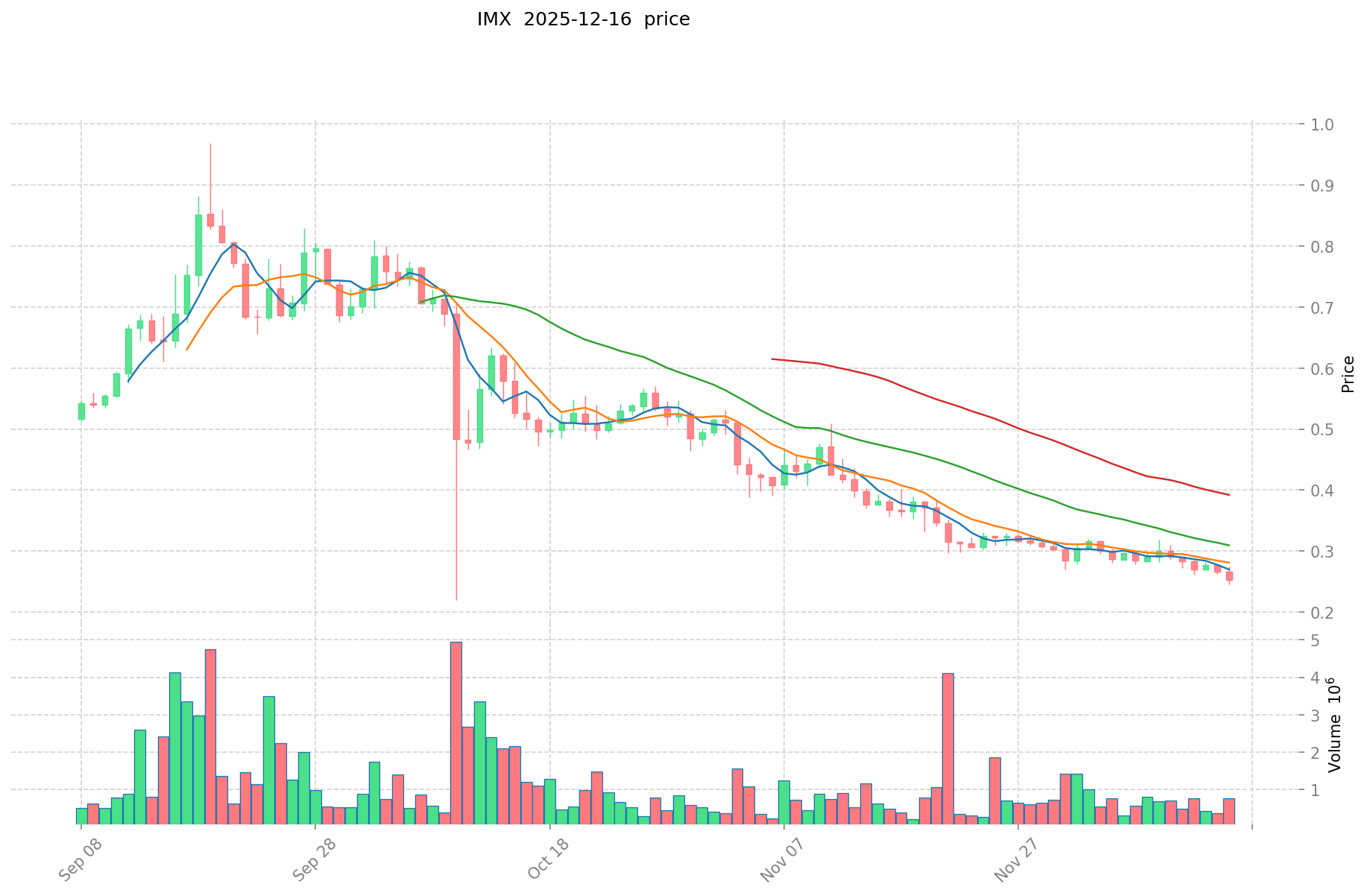
- IMX reached its all-time high of $9.52 on November 26, 2021, subsequently declining to its recent low of $0.24714 on December 16, 2025.
Comparative Analysis:
Both tokens have experienced significant long-term depreciation. OP has declined approximately 94.3% from its peak, while IMX has declined approximately 97.4% from its peak. This reflects broader market cycles affecting Layer 2 scaling solutions and NFT infrastructure assets, with IMX experiencing more severe downward pressure over its trading history.
Current Market Status (December 16, 2025)
Price Data:
- OP current price: $0.2874
- IMX current price: $0.2486
24-Hour Trading Volume:
- OP: $1,590,400.39
- IMX: $195,810.95
Price Movement (24-Hour Period):
- OP: -6.87% change
- IMX: -7.83% change
Market Capitalization Data:
- OP fully diluted valuation: $1,234,373,600.87
- OP circulating market cap: $558,732,183.64
- IMX fully diluted valuation: $497,200,000.00
- IMX circulating market cap: $204,482,042.92
Cryptocurrency Fear & Greed Index: 11 (Extreme Fear)
View Real-Time Prices:

Comparative Analysis Report: Investment Value Drivers of OP and IMX
I. Executive Summary
Optimism (OP) and Immutable (IMX) represent two distinct segments within the Layer 2 scaling and blockchain gaming ecosystems. OP focuses on Ethereum scalability through Rollup technology, while IMX specializes in decentralized gaming infrastructure. Both projects demonstrate growth potential driven by technology innovation, market adoption, and regulatory developments.
II. Core Factors Impacting Investment Value of OP vs IMX
Supply Mechanism Comparison (Tokenomics)
-
Optimism (OP): Token unlocking events create periodic supply pressure. As of August 31, 2025, 31.34 million OP tokens (1.79% of total supply) were unlocked for core contributors and early investors. Historical data indicates OP typically recovers within weeks following unlock events, as demonstrated by a 14% price decline post-July unlock that subsequently recovered.
-
Immutable (IMX): Referenced within gaming and ZK-based blockchain infrastructure categorization; specific tokenomics details are not documented in available source materials.
-
📌 Historical Pattern: Supply releases create short-term selling pressure but do not necessarily establish long-term price ceiling. Market absorption capacity determines whether unlocks result in temporary corrections or sustained downtrends.
Institutional Adoption and Market Application
-
Institutional Holdings: OP demonstrates clearer institutional infrastructure development through regulatory-backed stablecoin integration (Frontier stablecoin FRNT), indicating institutional capital readiness within its DeFi ecosystem.
-
Enterprise Adoption:
- OP is positioned within Layer 2 public chains alongside ARB, MATIC, LRC, CELO, and METIS, serving as infrastructure for decentralized applications.
- IMX operates within gaming, NFT, and ZK systems infrastructure, targeting decentralized gaming experiences and entertainment-focused blockchain applications.
-
Regulatory Environment: OP benefits from state-level regulatory recognition through Wyoming's official support for FRNT stablecoin integration (utilizing LayerZero cross-chain technology). This demonstrates transparency and institutional compatibility. IMX's regulatory positioning in gaming-focused applications differs, with less explicit institutional backing documented in available materials.
Technology Development and Ecosystem Construction
-
OP Technology Foundation: Rollup technology transfers transactions from Ethereum mainchain to sidechain, increasing transaction throughput and reducing costs. This architecture directly addresses Ethereum's scalability constraints and positions OP as foundational infrastructure for Ethereum-native applications.
-
IMX Technology Focus: Operates within decentralized gaming and ZK (Zero-Knowledge) proof systems. The project emphasizes gaming experiences with integrated earning mechanisms, representing the evolution from Play-2-Earn (P2E) models to more sophisticated gameplay structures.
-
Ecosystem Comparison:
- OP Ecosystem: Supports DeFi protocols (VELO, SONNE, SNX, PERP), enabling decentralized finance, stablecoin integration, and institutional-grade infrastructure.
- IMX Ecosystem: Concentrated in gaming (FLOW, IMX, WAXP, WEMIX, MAGIC), NFT infrastructure (BULR, OPUL, BEND, SUDO), and entertainment-focused blockchain applications.
III. Technical and Market Positioning
Price Action and Market Sentiment
Based on August 2025 data, OP traded within the $0.715-$0.740 range with technical indicators showing:
- Relative Strength Index (RSI) proximity to 60 indicating moderate momentum
- $233 million open interest positioning
- Support level at $0.715 with potential upside target of $0.76-$0.78
Neutral-to-bullish sentiment reflects steady capital accumulation despite token unlock events.
Strategic Significance of FRNT Stablecoin Integration
The integration of Wyoming-backed Frontier stablecoin on Optimism represents ecosystem expansion with institutional implications. Regulatory transparency and state-level endorsement signal pathway for traditional finance capital influx into OP's DeFi infrastructure, potentially establishing OP as preferred infrastructure for regulated cryptocurrency operations.
IV. Market Cycle and Risk Considerations
Short-Term Headwinds
- Token unlock volatility affecting price stability
- Market absorption capacity for circulating supply increases
- Technical resistance at $0.740 determining continuation signals
Long-Term Structural Advantages
- OP: Direct benefit from Ethereum network growth, institutional DeFi adoption, and stablecoin integration representing macro tailwinds in institutional cryptocurrency adoption.
- IMX: Growth dependent on gaming industry adoption, play-to-earn mechanism refinement, and NFT market maturation.
Risk Factors
- Token unlock cycles creating periodic selling pressure for OP
- Gaming sector cyclicality and user retention challenges for IMX
- Regulatory developments affecting institutional capital flows to both projects
- Market cycle sensitivity, particularly during bear market periods
V. Conclusion
OP and IMX serve distinct market segments with different risk-return profiles. OP's investment case centers on infrastructure scaling and institutional adoption through regulated stablecoin integration. IMX's value proposition depends on gaming ecosystem development and entertainment-focused blockchain applications. Both projects demonstrate growth potential through technology innovation, though OP exhibits clearer institutional adoption pathways based on available 2025 data, while IMX requires sustained ecosystem growth and market demand validation within the gaming sector.
Report Generated: December 16, 2025
Data Sources: CMC AI, market analysis platforms, on-chain data
Disclaimer: This analysis reflects available source materials and does not constitute investment advice.
III. 2025-2030 Price Forecasts: OP vs IMX
Short-term Forecast (2025)
- OP: Conservative $0.18655-$0.29848 | Optimistic $0.29848
- IMX: Conservative $0.131175-$0.344025 | Optimistic $0.344025
Mid-term Forecast (2027-2028)
- OP may enter a growth consolidation phase, with projected price range of $0.160597-$0.52336, representing cumulative gains of up to 22-180%
- IMX may enter an early expansion phase, with projected price range of $0.209622-$0.458023, representing cumulative gains of up to 33-38%
- Key drivers: institutional capital inflows, spot ETF launches, ecosystem development acceleration
Long-term Forecast (2030)
- OP: Base case $0.329001-$0.738903 | Optimistic scenario $0.738903 (87% upside potential)
- IMX: Base case $0.343749-$0.568823 | Optimistic scenario $0.568823 (64% upside potential)
View detailed price forecasts for OP and IMX
Disclaimer: This analysis is based on historical data models and publicly available forecasts. Cryptocurrency markets are highly volatile and subject to regulatory, technological, and macroeconomic risks. Past performance does not guarantee future results. This content is for informational purposes only and should not be construed as investment advice. Conduct your own due diligence before making investment decisions.
OP:
| 年份 |
预测最高价 |
预测平均价格 |
预测最低价 |
涨跌幅 |
| 2025 |
0.29848 |
0.287 |
0.18655 |
0 |
| 2026 |
0.3249414 |
0.29274 |
0.2722482 |
1 |
| 2027 |
0.398404503 |
0.3088407 |
0.160597164 |
7 |
| 2028 |
0.52336145022 |
0.3536226015 |
0.33947769744 |
22 |
| 2029 |
0.6401983577556 |
0.43849202586 |
0.2674801357746 |
52 |
| 2030 |
0.738902912776686 |
0.5393451918078 |
0.329000567002758 |
87 |
IMX:
| 年份 |
预测最高价 |
预测平均价格 |
预测最低价 |
涨跌幅 |
| 2025 |
0.344025 |
0.2475 |
0.131175 |
0 |
| 2026 |
0.369703125 |
0.2957625 |
0.251398125 |
18 |
| 2027 |
0.356024109375 |
0.3327328125 |
0.209621671875 |
33 |
| 2028 |
0.458023353046875 |
0.3443784609375 |
0.28239033796875 |
38 |
| 2029 |
0.417248943271875 |
0.401200906992187 |
0.357068807223046 |
61 |
| 2030 |
0.568822645933523 |
0.409224925132031 |
0.343748937110906 |
64 |
Comparative Investment Analysis: Optimism (OP) vs Immutable X (IMX)
I. Investment Strategy Comparison: OP vs IMX
Long-Term vs Short-Term Investment Strategy
-
OP: Suitable for investors focused on infrastructure scalability and institutional adoption pathways. Long-term positioning benefits from Ethereum ecosystem growth and regulated stablecoin integration (FRNT). Short-term strategies should account for token unlock cycles and technical resistance levels.
-
IMX: Suitable for investors seeking exposure to gaming infrastructure and decentralized entertainment applications. Long-term positioning depends on gaming sector adoption and play-to-earn mechanism refinement. Short-term strategies require monitoring of ecosystem development milestones and NFT market sentiment.
Risk Management and Asset Allocation
II. Potential Risk Comparison
Market Risks
-
OP: Token unlock volatility creating periodic selling pressure; historical pattern shows 14% price declines post-unlock events. Market absorption capacity for circulating supply represents near-term headwind. Both tokens currently trade near all-time lows with 94.3% depreciation from peaks, indicating sector-wide bear market pressure.
-
IMX: More severe historical depreciation (97.4% from all-time high) reflects concentrated market risk in NFT infrastructure. Gaming sector cyclicality and user retention challenges present structural headwinds. Lower trading volume ($0.196M daily) indicates reduced market liquidity and higher slippage risk for position entry/exit.
Technical Risks
-
OP: Rollup architecture dependency on Ethereum mainchain security; smart contract vulnerabilities in Layer 2 bridge protocols represent technical execution risk. Network congestion during high-volume periods could impact transaction finality and user experience.
-
IMX: Zero-Knowledge proof system complexity introduces technical implementation risks. Gaming infrastructure requires robust custody solutions and asset bridging security; historical NFT market volatility demonstrates product-market fit uncertainty.
Regulatory Risks
-
OP: Positioned favorably with Wyoming regulatory recognition through FRNT stablecoin integration, indicating institutional compatibility pathways. However, evolving DeFi regulations and stablecoin oversight across jurisdictions present long-term policy uncertainty.
-
IMX: Gaming-focused positioning creates regulatory exposure to gaming industry oversight, NFT classification debates, and anti-money laundering requirements within entertainment-focused blockchain applications. Less explicit institutional regulatory backing compared to OP.
III. Conclusion: Which Is the Better Buy?
Investment Value Summary
-
OP Advantages:
- Direct beneficiary of Ethereum network growth and Layer 2 infrastructure expansion
- Institutional adoption pathways evidenced by regulated stablecoin integration
- Clearer technical foundation (Rollup technology) with documented DeFi ecosystem support (VELO, SONNE, SNX, PERP)
- Higher trading liquidity ($1.59M daily volume) reducing execution risk
- Tokenomics transparency with documented unlock events and market recovery patterns
-
IMX Advantages:
- Differentiated positioning within gaming and entertainment-focused blockchain applications
- Projected mid-term upside potential of 33-38% (2027-2028) comparable to OP's 22-180% range
- Lower fully diluted valuation ($497.2M) offers potential for relative value appreciation if gaming ecosystem gains traction
- Zero-Knowledge infrastructure positioning represents emerging blockchain technology frontier
Investment Recommendations
-
Beginner Investors:
- OP positioning recommended due to clearer institutional infrastructure, regulatory backing through FRNT stablecoin integration, and established DeFi ecosystem. Start with 70% OP allocation with stablecoin buffer (30%) to navigate current extreme fear market conditions (Fear & Greed Index: 11).
-
Experienced Investors:
- Balanced OP/IMX allocation (50/50) allows sector diversification between Layer 2 infrastructure and gaming applications. Monitor token unlock calendars for OP and gaming adoption metrics for IMX. Deploy accumulated stablecoin positions during unlock-related price weakness for rebalancing opportunities.
-
Institutional Investors:
- OP preferred for ecosystem infrastructure exposure aligned with regulatory frameworks and stablecoin integration pathways. FRNT integration through LayerZero cross-chain technology demonstrates compatibility with institutional DeFi operations. IMX consideration contingent on gaming industry adoption validation and custody infrastructure maturation.
⚠️ Risk Disclaimer: Cryptocurrency markets demonstrate extreme volatility, particularly during bear market cycles. Current Fear & Greed Index reading of 11 (Extreme Fear) reflects elevated market stress. Both OP and IMX trade near all-time lows with significant historical depreciation (OP: 94.3%, IMX: 97.4% from peaks). Past performance does not guarantee future results. Price forecasts represent probabilistic scenarios dependent on institutional adoption acceleration, regulatory developments, and ecosystem expansion validation. This analysis reflects available source materials as of December 16, 2025, and should not be construed as investment advice. Conduct comprehensive due diligence and risk assessment aligned with individual investment objectives and risk tolerance before making portfolio allocation decisions.
None
Frequently Asked Questions: Optimism (OP) vs Immutable X (IMX) Investment Comparison
I. FAQ
Q1: What are the main differences between Optimism (OP) and Immutable X (IMX) in terms of market positioning?
A: Optimism (OP) is a general-purpose Layer 2 scaling solution for Ethereum that utilizes Rollup technology to reduce transaction costs and increase throughput, making it suitable for decentralized finance (DeFi) applications. Immutable X (IMX), by contrast, is specifically designed for NFT infrastructure and gaming applications, offering zero gas fees for minting and trading. OP focuses on institutional adoption through regulated stablecoin integration (such as the Frontier stablecoin FRNT), while IMX emphasizes entertainment-focused blockchain applications and play-to-earn gaming mechanics.
Q2: How have OP and IMX performed historically, and what do current price trends indicate?
A: Both tokens have experienced significant long-term depreciation from their all-time highs. OP declined approximately 94.3% from its peak of $4.84 (March 2024) to $0.2874 (December 16, 2025), while IMX declined approximately 97.4% from its peak of $9.52 (November 2021) to $0.2486 (December 16, 2025). IMX's more severe depreciation reflects concentrated market risk within the NFT infrastructure sector. Current 24-hour trading volumes show OP at $1.59 million versus IMX at $0.196 million, indicating higher liquidity and reduced slippage risk for OP traders. The Cryptocurrency Fear & Greed Index reading of 11 reflects extreme market fear conditions affecting both assets.
Q3: What are the tokenomics considerations for OP compared to IMX?
A: Optimism (OP) experiences periodic token unlock events that create short-term supply pressure, though historical data demonstrates market recovery within weeks following unlocks. For example, OP declined 14% post-July 2025 unlock but subsequently recovered. As of August 31, 2025, 31.34 million OP tokens (1.79% of total supply) were unlocked for core contributors and early investors. While specific tokenomics details for IMX are limited in available documentation, the comparison illustrates that OP's transparent unlock schedule allows investors to anticipate selling pressure cycles, whereas IMX presents less documented tokenomic visibility. Supply releases create temporary corrections but do not establish long-term price ceilings, as market absorption capacity determines outcomes.
Q4: Which asset demonstrates clearer institutional adoption pathways?
A: Optimism (OP) exhibits substantially clearer institutional adoption infrastructure through regulatory-backed stablecoin integration. Wyoming's official recognition of the Frontier stablecoin (FRNT) utilizing LayerZero cross-chain technology on OP's network signals transparency and institutional compatibility. Additionally, OP's DeFi ecosystem includes established protocols (VELO, SONNE, SNX, PERP) that support decentralized finance operations and stablecoin integration. IMX's regulatory positioning within gaming-focused applications is less explicitly documented for institutional backing. For institutional investors prioritizing regulatory alignment and infrastructure compatibility, OP presents a more defined pathway.
Q5: What are the price forecast projections for OP and IMX through 2030?
A: For Optimism (OP), the 2030 base case projects a price range of $0.329 to $0.739, with optimistic scenario upside potential of 87%. By 2027-2028 consolidation phase, OP may reach $0.160 to $0.523, representing 22-180% cumulative gains. For Immutable X (IMX), the 2030 base case projects $0.344 to $0.569, with optimistic scenario upside of 64%. During 2027-2028 early expansion phase, IMX may reach $0.210 to $0.458, representing 33-38% gains. These forecasts depend on institutional capital inflows, spot ETF launches, and ecosystem development acceleration. OP demonstrates higher absolute upside potential (87% vs 64%), though both projections carry significant volatility risk and should not be construed as guaranteed outcomes.
Q6: What allocation strategy is recommended for different investor profiles?
A: Conservative investors should consider 70% OP allocation versus 30% IMX, capitalizing on OP's clearer institutional infrastructure and lower volatility while maintaining gaming sector exposure. Aggressive investors may adopt a balanced 50/50 OP/IMX allocation to participate in both Layer 2 infrastructure scaling and entertainment-focused blockchain applications. All investors should maintain 20-30% stablecoin reserves (USDC, USDT) for volatility buffering during market downturns and rebalancing opportunities, particularly during OP's token unlock events. Current extreme fear market conditions (Fear & Greed Index: 11) suggest conservative positioning with accumulated stablecoin dry powder for deployment during pronounced weakness.
Q7: What are the primary risk factors distinguishing OP and IMX investments?
A: Optimism (OP) faces token unlock volatility creating periodic 10-15% selling pressure cycles, though historical recovery patterns demonstrate resilience. Technical risks include Rollup architecture dependency on Ethereum mainchain security and smart contract vulnerabilities in Layer 2 bridge protocols. Regulatory risks include evolving DeFi oversight, though Wyoming recognition provides favorable positioning. Immutable X (IMX) faces more severe risks: concentrated 97.4% historical depreciation reflects NFT infrastructure vulnerability; gaming sector cyclicality presents structural uncertainty; lower liquidity ($0.196M daily) creates higher slippage costs; regulatory exposure to gaming industry oversight and NFT classification debates presents policy uncertainty. IMX's technical implementation of Zero-Knowledge proofs introduces additional execution complexity risk relative to OP's established Rollup infrastructure.
Q8: Should I choose OP or IMX, and what factors should guide this decision?
A: The selection depends on individual investment objectives and risk tolerance. Optimism (OP) is recommended for investors prioritizing infrastructure scalability, institutional adoption pathways, and regulatory clarity, offering lower execution risk through established DeFi infrastructure and higher trading liquidity. Immutable X (IMX) is suitable for investors seeking differentiated exposure to gaming and entertainment-focused blockchain applications with appetite for higher volatility and longer adoption timelines. Beginner investors should favor OP (70% allocation) with stablecoin reserves (30%) given institutional backing and clearer adoption pathways. Experienced investors may execute balanced 50/50 allocations monitoring token unlock calendars and gaming adoption metrics. Institutional investors should prioritize OP for ecosystem compatibility with regulatory frameworks. Neither asset should represent concentrated portfolio exposure given current extreme fear market conditions, historical depreciation severity, and execution risk from limited IMX liquidity.
Disclaimer: This FAQ analysis reflects available source materials as of December 16, 2025, and should not be construed as investment advice. Cryptocurrency markets demonstrate extreme volatility and are subject to regulatory, technological, and macroeconomic risks. Past performance does not guarantee future results. Conduct comprehensive due diligence aligned with individual investment objectives and risk tolerance before making allocation decisions.
* The information is not intended to be and does not constitute financial advice or any other recommendation of any sort offered or endorsed by Gate.