This comprehensive ESE price prediction analysis examines Elysian Energy Token's investment potential through 2031. Currently trading at $0.000847 with extreme market fear sentiment, ESE offers a one-stop liquidity solution for digital assets, tokens, and RWAs via innovative raffle mechanisms since 2024 launch on Gate. The article analyzes historical price evolution, market status showing 95.78% decline from April 2024 peak, and critical factors including demand dynamics, corporate performance, regulatory environment, and technological innovation. Expert forecasts predict conservative 2026 range of $0.0005-$0.00085, with potential growth through 2031 reaching $0.00136 under transformative scenarios. Professional investment strategies address long-term holding versus active trading approaches, comprehensive risk management frameworks, and secure storage solutions via Gate Web3 Wallet. Detailed risk assessment covers market volatility, regulatory uncertainty, and technical vulnerabilities. Recommendations empha
Introduction: ESE's Market Position and Investment Value
Eesee (ESE), positioned as a one-stop liquidity solution for digital assets, tokens, and RWAs through its innovative raffle system, has been operating since its launch in 2024. As of 2026, ESE maintains a market capitalization of approximately $552,287, with a circulating supply of around 652 million tokens, and the price hovering at $0.000847. This asset, designed to accelerate sales and provide additional liquidity to the web3 market, is playing an increasingly important role in lowering cost barriers for digital asset transactions.
This article will comprehensively analyze ESE's price trends from 2026 to 2031, combining historical patterns, market supply and demand dynamics, ecosystem development, and macroeconomic conditions to provide investors with professional price forecasts and practical investment strategies.
I. ESE Price History Review and Market Status
ESE Historical Price Evolution Trajectory
- April 2024: ESE launched on Gate.com at an initial price of 0.018 USD, subsequently reaching a peak of 0.29157 USD on April 11, 2024
- 2024-2025: The token experienced significant volatility, with price fluctuations reflecting broader market conditions
- February 2026: ESE recorded its lowest price point of 0.000783 USD on February 4, 2026, representing a substantial decline from previous levels
ESE Current Market Status
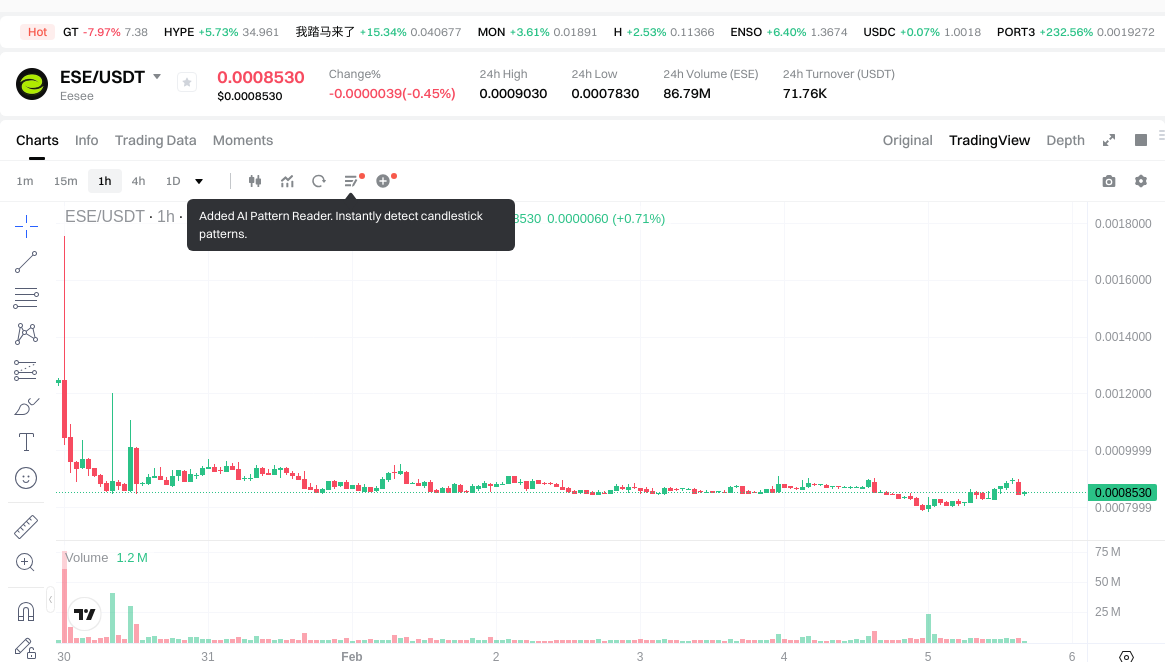
As of February 5, 2026, ESE is trading at 0.000847 USD, showing a marginal decline of 0.91% over the past 24 hours. The token's trading range during this period spans from a low of 0.000783 USD to a high of 0.000903 USD.
Over various timeframes, ESE has exhibited notable price movements. The 1-hour chart indicates a minor decrease of 0.12%, while the 7-day performance shows a 23.66% decline. Extended periods reveal more pronounced changes, with a 57.98% decrease over 30 days and a 95.78% reduction over the past year.
The token's market capitalization stands at approximately 552,287 USD, with a 24-hour trading volume of 71,974 USD. The circulating supply comprises 652,051,134 ESE tokens, representing 65.21% of the total supply of 1 billion tokens. The fully diluted market cap is recorded at 847,000 USD.
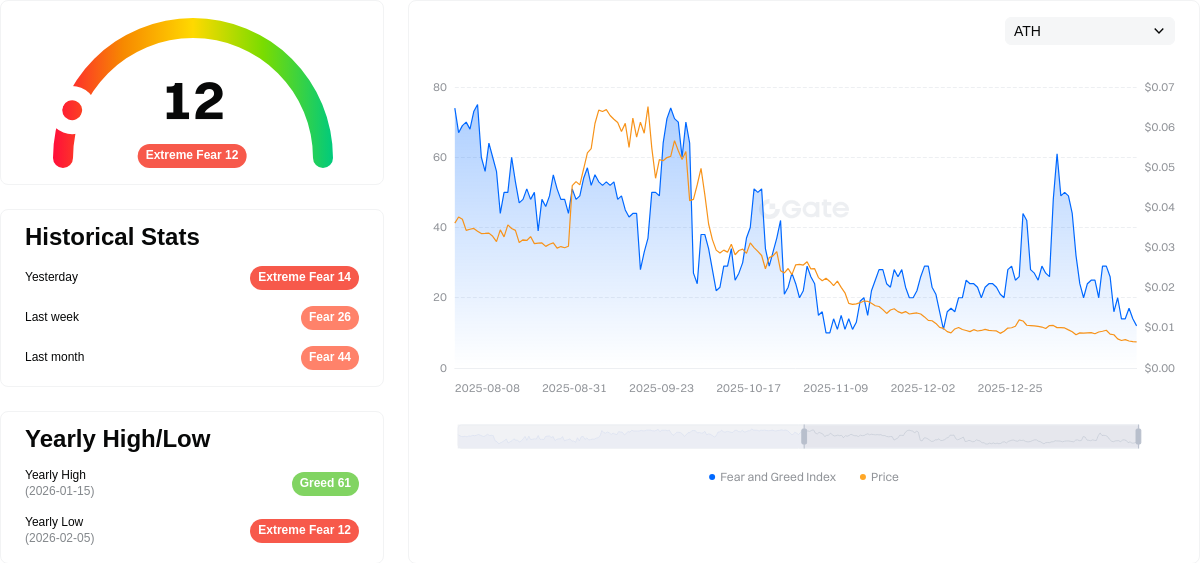
ESE maintains a market dominance of 0.000033% within the broader cryptocurrency ecosystem. The project is supported by approximately 3,262 token holders, and ESE is currently listed on 5 exchanges. The current market sentiment index registers at 12, indicating an extreme fear condition in the market.
Click to view the current ESE market price
ESE Market Sentiment Indicator
2026-02-05 Fear and Greed Index: 12 (Extreme Fear)
Click to view current Fear & Greed Index
The cryptocurrency market is currently experiencing extreme fear, with the index dropping to 12. This represents a significant level of market pessimism and investor anxiety. When the index reaches such low levels, it typically indicates that assets may be undervalued and market participants are overly cautious. Historically, extreme fear periods have presented contrarian opportunities for long-term investors. However, traders should remain vigilant and conduct thorough research before making investment decisions during such volatile market conditions.
ESE Token Holding Distribution
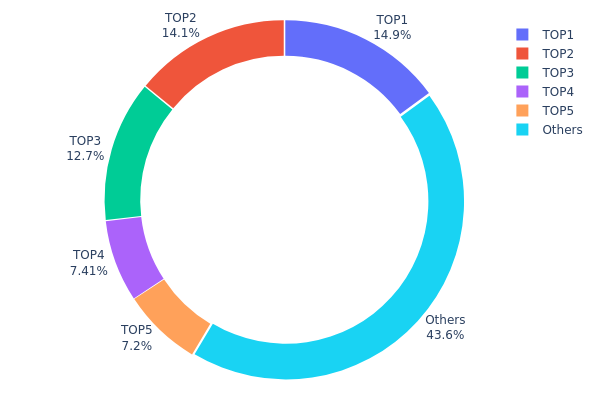
The token holding distribution chart reflects the allocation of ESE tokens across different addresses on the blockchain, revealing the degree of concentration among holders. By analyzing the proportion of tokens held by top addresses versus smaller holders, this metric provides insights into the project's decentralization level and potential market manipulation risks.
According to the latest data, the top 5 addresses collectively hold 378,515.29K ESE tokens, accounting for 53.80% of the total supply. Specifically, the largest holder controls 104,923.45K tokens (14.91%), while the second and third largest addresses hold 14.10% and 12.72% respectively. The fourth and fifth positions maintain 7.40% and 7.20% of the supply. The remaining 43.67% is distributed among other addresses, indicating a relatively concentrated holding structure.
This concentration pattern suggests moderate centralization risk in ESE's market structure. With over half of the token supply controlled by just five addresses, price movements could potentially be influenced by the trading decisions of these major holders. Such concentration may lead to increased volatility during large-scale liquidation events or coordinated actions. However, the fact that 43.67% remains distributed among other participants does provide some buffer against complete market manipulation, maintaining a degree of market resilience and trading liquidity across the broader holder base.
Click to view current ESE Token Holding Distribution
| Top |
Address |
Holding Qty |
Holding (%) |
| 1 |
0x76fa...36f249 |
104923.45K |
14.91% |
| 2 |
0xf89d...5eaa40 |
99258.57K |
14.10% |
| 3 |
0x75cf...0dd7e6 |
89544.78K |
12.72% |
| 4 |
0xad53...26f38f |
52102.05K |
7.40% |
| 5 |
0x9642...2f5d4e |
50686.44K |
7.20% |
| - |
Others |
306989.19K |
43.67% |
II. Core Factors Influencing ESE's Future Price
Market Demand and Competition Dynamics
- Market Demand Trends: ESE's future price movement is closely tied to evolving market demand patterns. As industry growth accelerates, increased adoption could support upward price momentum.
- Competitive Landscape: The competitive environment significantly impacts ESE's pricing power. Intensifying competition may exert downward pressure on average selling prices, as evidenced by recent market observations where competitive factors contributed to price declines despite stable revenue generation.
- Industry Growth Trajectory: The broader industry expansion creates opportunities for ESE, though the translation to price appreciation depends on the company's ability to capture market share effectively.
- Financial Performance: Company profitability and operational efficiency directly influence investor confidence. Improved profitability margins tend to support positive price sentiment, while revenue challenges may weigh on valuations.
- Earnings Outlook: Management's projections regarding future growth, performance results, and capital requirements shape market expectations. Information from third-party industry analysts also contributes to price discovery mechanisms.
- Investor Confidence Levels: The market's assessment of ESE's financial health and strategic positioning plays a crucial role in determining price stability and direction.
Policy and Regulatory Environment
- Policy Changes: Shifts in relevant industry policies and regulations can materially impact ESE's operational environment and market positioning.
- Regulatory Framework: The evolving regulatory landscape may create both opportunities and constraints that influence long-term price trajectories.
- Compliance Considerations: Adherence to industry standards and regulatory requirements affects corporate reputation and investor perception.
Technological Innovation and Adaptation
- Digital Transformation: As digital technologies reshape industry landscapes, ESE's ability to leverage technological advancements may influence its competitive positioning and pricing dynamics.
- Innovation Capacity: The company's investment in research and development, along with its capacity to adapt to technological changes, represents a potential driver of future value creation.
III. 2026-2031 ESE Price Prediction
2026 Outlook
- Conservative prediction: $0.0005 - $0.00085
- Neutral prediction: $0.00085 average price level
- Optimistic prediction: $0.00091 (requires favorable market conditions and positive sentiment)
2027-2029 Outlook
- Market stage expectation: The token may enter a gradual growth phase with moderate volatility as the project develops its ecosystem and user base
- Price range prediction:
- 2027: $0.00046 - $0.00099
- 2028: $0.00064 - $0.00097
- 2029: $0.00092 - $0.00108
- Key catalysts: Potential expansion of utility features, partnership developments, and broader adoption within the cryptocurrency market
2030-2031 Long-term Outlook
- Baseline scenario: $0.00065 - $0.00102 (assuming steady market conditions and consistent project development)
- Optimistic scenario: $0.00105 - $0.00108 (assuming accelerated adoption and favorable regulatory environment)
- Transformative scenario: $0.00136 (requires exceptional market conditions, significant technological breakthroughs, and widespread mainstream adoption)
- 2026-02-05: ESE trading within the lower price range as the market establishes its foundation for potential future growth
| Year |
Predicted High Price |
Predicted Average Price |
Predicted Low Price |
Price Change |
| 2026 |
0.00091 |
0.00085 |
0.0005 |
1 |
| 2027 |
0.00099 |
0.00088 |
0.00046 |
4 |
| 2028 |
0.00097 |
0.00093 |
0.00064 |
11 |
| 2029 |
0.00108 |
0.00095 |
0.00092 |
13 |
| 2030 |
0.00108 |
0.00102 |
0.00065 |
20 |
| 2031 |
0.00136 |
0.00105 |
0.00055 |
24 |
IV. ESE Professional Investment Strategy and Risk Management
ESE Investment Methodology
(1) Long-term Holding Strategy
- Suitable for: Investors with high risk tolerance and long-term commitment to Web3 ecosystem development
- Operational Recommendations:
- Consider dollar-cost averaging approach to mitigate entry point risk in volatile market conditions
- Monitor project development milestones and protocol adoption metrics quarterly
- Storage Solution: Use Gate Web3 Wallet for secure asset custody with multi-signature capabilities
(2) Active Trading Strategy
- Technical Analysis Tools:
- Volume Analysis: Monitor 24-hour trading volume ($71,974) relative to market cap to identify liquidity patterns
- Support/Resistance Levels: Current price range between $0.000783 (24h low) and $0.000903 (24h high) provides short-term trading boundaries
- Swing Trading Key Points:
- Set stop-loss orders below recent support levels to limit downside exposure
- Consider taking partial profits during short-term price recoveries in current downtrend environment
ESE Risk Management Framework
(1) Asset Allocation Principles
- Conservative Investors: 1-2% of crypto portfolio allocation
- Aggressive Investors: 3-5% of crypto portfolio allocation
- Professional Investors: Up to 7-10% with active portfolio rebalancing
(2) Risk Hedging Solutions
- Diversification Strategy: Balance ESE holdings with more established assets to reduce concentration risk
- Position Sizing: Limit single position exposure given the 65.21% circulating supply ratio and current market cap of $552,287
(3) Secure Storage Solutions
- Hot Wallet Option: Gate Web3 Wallet for convenient trading and staking access
- Cold Storage Approach: Transfer majority holdings to hardware wallet for long-term security
- Security Precautions: Enable two-factor authentication, regularly update security protocols, and never share private keys
V. ESE Potential Risks and Challenges
ESE Market Risks
- High Volatility: Price has declined 95.78% from ATH of $0.29157 (April 11, 2024) to current level of $0.000847, indicating significant market volatility
- Limited Liquidity: With only 5 exchange listings and relatively low 24-hour trading volume, position entry and exit may face slippage risks
- Market Cap Concentration: Current market dominance of 0.000033% suggests limited market depth and potential price manipulation vulnerability
ESE Regulatory Risks
- Digital Asset Compliance: Regulatory frameworks for NFT-related platforms and raffle mechanisms remain evolving across jurisdictions
- Cross-border Operations: Platform's global accessibility may face varying regulatory requirements in different regions
- Token Classification Uncertainty: Potential regulatory scrutiny regarding token utility classification and securities law compliance
ESE Technical Risks
- Smart Contract Vulnerabilities: As an ERC-20 token on Ethereum (contract: 0x908dDb096BFb3AcB19e2280aAD858186ea4935C4), exposure to potential code exploits
- Platform Dependency: Project success relies heavily on adoption of eesee protocol for digital asset liquidity solutions
- Competition Risk: Other NFT marketplace and liquidity solutions may capture market share in the evolving Web3 ecosystem
VI. Conclusion and Action Recommendations
ESE Investment Value Assessment
ESE presents an innovative liquidity solution targeting digital assets, tokens, and RWAs through its raffle-based protocol. The project aims to lower entry barriers and accelerate sales in the Web3 market. However, current market conditions reflect significant challenges, with price performance showing substantial decline across all timeframes (-0.91% 24h, -23.66% 7d, -57.98% 30d, -95.78% 1y). The limited exchange presence (5 exchanges) and modest holder base (3,262 holders) suggest early-stage adoption. While the protocol's unique approach to market liquidity addresses real Web3 needs, investors should carefully weigh innovation potential against current market positioning and volatility risks.
ESE Investment Recommendations
✅ Beginners: Approach with extreme caution given high volatility; consider allocating no more than 1% of crypto portfolio after thorough research and only with funds you can afford to lose
✅ Experienced Investors: Monitor project development and market adoption metrics; consider small position sizing (2-3% of crypto portfolio) with strict stop-loss discipline and regular portfolio rebalancing
✅ Institutional Investors: Conduct comprehensive due diligence on protocol mechanics, team credentials, and competitive landscape before considering strategic allocation; implement professional risk management frameworks
ESE Trading Participation Methods
- Spot Trading on Gate.com: Direct purchase and sale of ESE tokens with competitive fees and real-time market access
- Dollar-Cost Averaging: Establish systematic purchase plan to smooth entry price volatility over extended timeframe
- Liquidity Provision: Participate in protocol ecosystem by providing liquidity where applicable (subject to platform availability and risk assessment)
Cryptocurrency investment carries extremely high risk. This article does not constitute investment advice. Investors should make prudent decisions based on their own risk tolerance and are advised to consult professional financial advisors. Never invest more than you can afford to lose.
FAQ
What is ESE? What are its uses and value?
ESE is a protocol that bridges real-world assets into blockchain, connecting traditional finance with decentralized ecosystems. It enhances asset liquidity and transparency by tokenizing physical assets on-chain.
What are the main factors affecting ESE price?
ESE price is primarily influenced by its fixed supply mechanism, which creates scarcity and supports price appreciation as demand grows. Additionally, macroeconomic factors and ESE's inflation-resistant properties as a digital asset drive market dynamics and price movements.
How to predict ESE price? What are the analysis methods?
ESE price prediction uses technical analysis(moving averages, RSI indicators)and fundamental analysis(project development, market demand, transaction volume). Combining on-chain data with market sentiment provides comprehensive forecasting insights for informed decisions.
ESE has surged 70.98% over the past year, reaching an all-time high of $230.0, demonstrating strong upward momentum. Market confidence in future growth remains robust.
What are the risks of investing in ESE? How should I manage these risks?
ESE investment carries market volatility and project execution risks. Manage risk through portfolio diversification, position sizing, and continuous monitoring of project development progress. Start with smaller allocations and gradually increase exposure as you gain market understanding.
What are the advantages and disadvantages of ESE compared to similar tokens?
ESE excels in DeFi innovation and technical infrastructure, offering unique value propositions. However, it faces challenges with market liquidity and regulatory uncertainty. Compared to established tokens, ESE shows strong technological potential but lower market adoption and higher compliance risks.
* The information is not intended to be and does not constitute financial advice or any other recommendation of any sort offered or endorsed by Gate.