AIBOT vs SNX: Which AI-Powered Trading Token Will Dominate the Next Bull Market?

Introduction: Investment Comparison Between AIBOT and SNX
In the cryptocurrency market, the comparison between Cherry AI (AIBOT) and Synthetix (SNX) continues to draw investor attention. Both assets differ significantly in market capitalization ranking, application scenarios, and price performance, representing distinct positioning within the crypto asset landscape.
Cherry AI (AIBOT): Launched in 2025, this token has gained recognition through its AI-driven trading automation tools and community growth mechanisms.
Synthetix (SNX): Established in 2018, this protocol has positioned itself as a decentralized platform for synthetic asset issuance, supporting a range of derivative products from fiat-pegged stablecoins to commodities.
This article will analyze the investment value comparison between AIBOT and SNX across multiple dimensions including historical price trends, supply mechanisms, institutional adoption, technical ecosystem, and future outlook, addressing the key question investors commonly ask:
"Which is the better buy right now?"
I. Historical Price Comparison and Current Market Status
AIBOT (Cherry AI) and SNX (Synthetix) Historical Price Trends
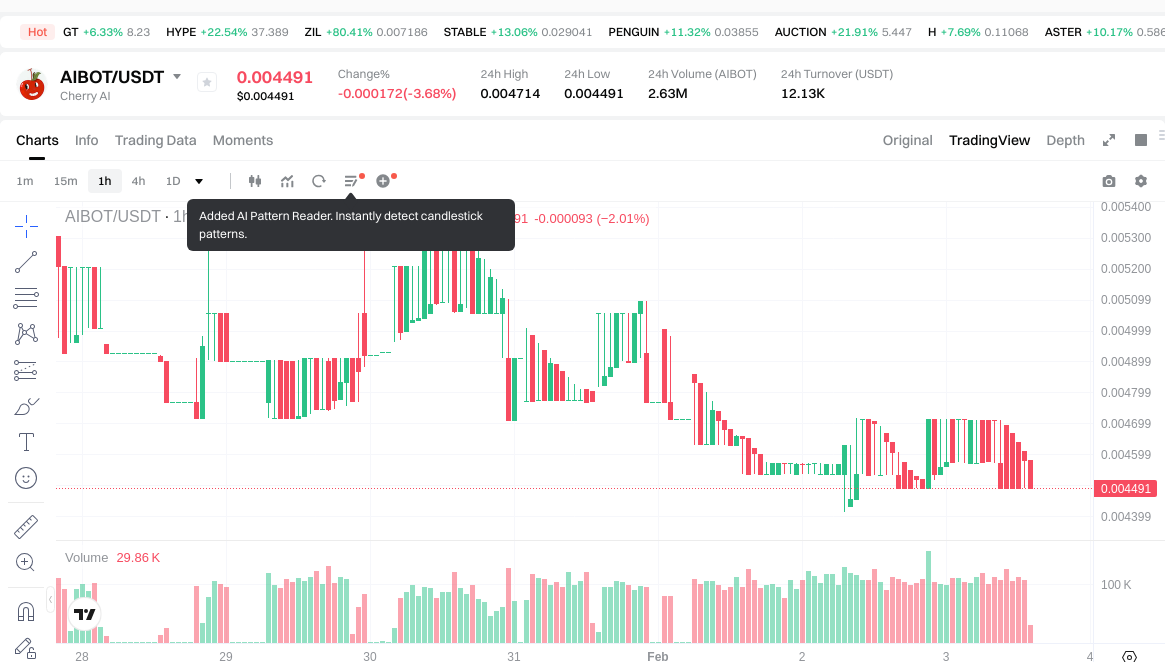
- 2025: AIBOT experienced notable price volatility following its launch in January 2025, with the token reaching $0.0442 in October 2025 during a period of heightened interest in AI-driven trading solutions.
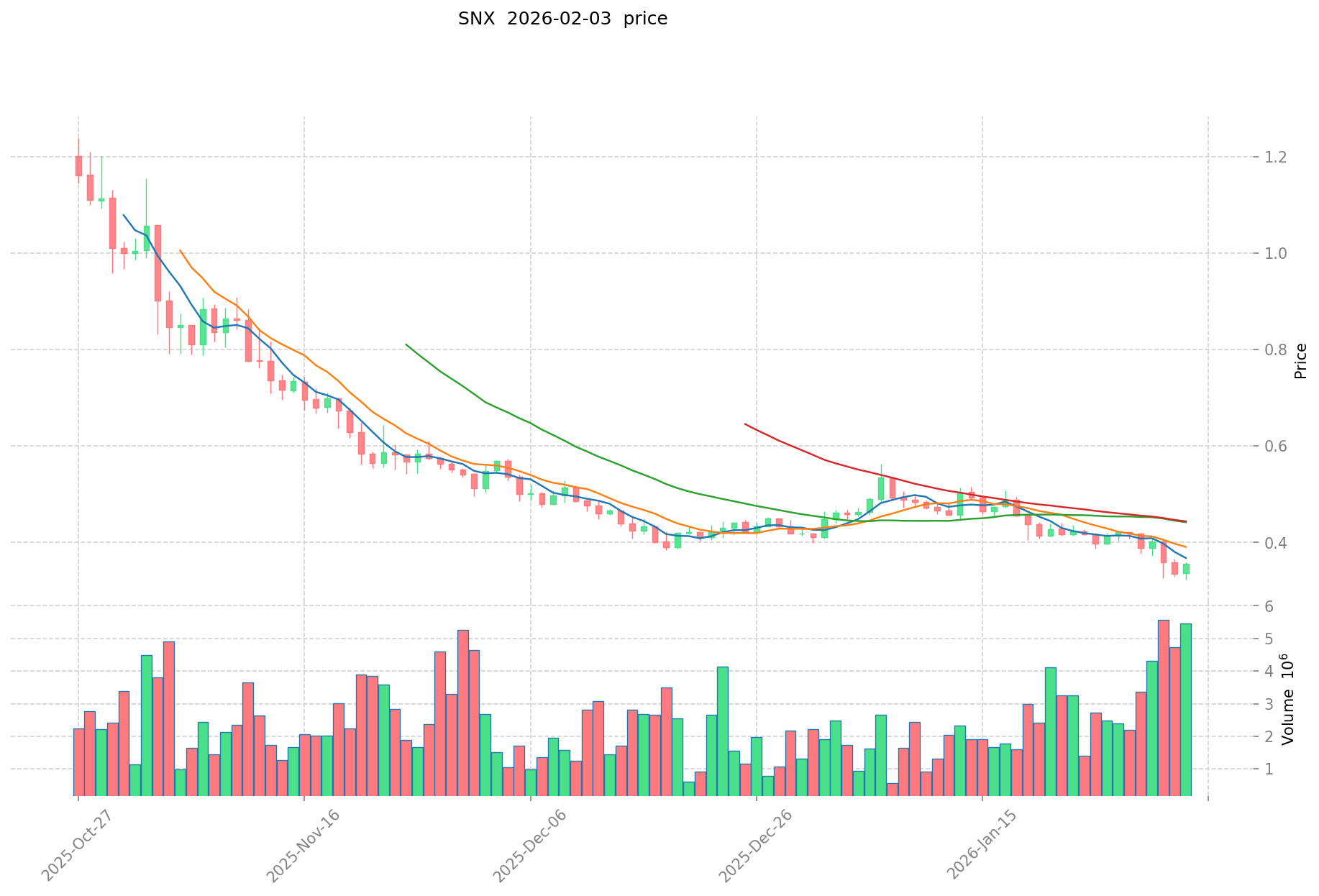
- 2021: SNX was influenced by the DeFi boom, with price movements reflecting increased adoption of synthetic asset protocols, reaching $28.53 in February 2021.
- Comparative Analysis: During the 2025-2026 market cycle, AIBOT declined from $0.0442 to $0.0032, while SNX demonstrated a similar downward trajectory from its peak of $28.53, reflecting broader market corrections in the cryptocurrency sector.
Current Market Status (2026-02-03)
- AIBOT Current Price: $0.004583
- SNX Current Price: $0.3491
- 24-Hour Trading Volume: AIBOT $12,078.89 vs SNX $1,284,290.13
- Market Sentiment Index (Fear & Greed Index): 17 (Extreme Fear)
View real-time prices:
- Check AIBOT current price Market Price
- Check SNX current price Market Price
II. Core Factors Influencing AIBOT vs SNX Investment Value
Supply Mechanism Comparison (Tokenomics)
Due to the absence of detailed supply mechanism information in the provided materials, a comprehensive comparison of tokenomics between AIBOT and SNX cannot be conducted at this time.
Institutional Adoption and Market Application
Without specific data regarding institutional holdings, enterprise adoption patterns, or national policy stances toward AIBOT and SNX, a substantive analysis of their comparative market positioning and regulatory environment cannot be presented.
Technology Development and Ecosystem Construction
The available materials do not contain information regarding technical upgrades, development roadmaps, or ecosystem deployment (including DeFi, NFT, payment systems, or smart contract implementations) for either AIBOT or SNX, preventing a meaningful comparison of their technological trajectories.
Macroeconomic Conditions and Market Cycles
In the absence of historical performance data, correlation analysis with macroeconomic indicators (inflation rates, monetary policy shifts, USD index movements), or geopolitical impact assessments, it is not possible to evaluate the relative positioning of AIBOT and SNX within broader economic cycles or their responses to systemic market forces.
III. 2026-2031 Price Forecasting: AIBOT vs SNX
Short-term Forecast (2026)
- AIBOT: Conservative $0.0026 - $0.0045 | Optimistic $0.0045 - $0.0062
- SNX: Conservative $0.177 - $0.347 | Optimistic $0.347 - $0.504
Mid-term Forecast (2028-2029)
- AIBOT may enter a gradual growth phase, with estimated price range of $0.0035 - $0.0069 in 2028 and $0.0038 - $0.0082 in 2029
- SNX may enter a moderate expansion phase, with estimated price range of $0.240 - $0.475 in 2028 and $0.428 - $0.634 in 2029
- Key drivers: institutional capital inflows, ETF developments, ecosystem expansion
Long-term Forecast (2030-2031)
- AIBOT: Baseline scenario $0.0047 - $0.0072 (2030), $0.0071 - $0.0075 (2031) | Optimistic scenario $0.0078 - $0.010 (2030-2031)
- SNX: Baseline scenario $0.376 - $0.545 (2030), $0.511 - $0.616 (2031) | Optimistic scenario $0.686 - $0.683 (2030-2031)
Disclaimer
AIBOT:
| Year | Predicted High Price | Predicted Average Price | Predicted Low Price | Price Change |
|---|---|---|---|---|
| 2026 | 0.00619758 | 0.004491 | 0.00260478 | -2 |
| 2027 | 0.0061993764 | 0.00534429 | 0.0039013317 | 16 |
| 2028 | 0.006868481508 | 0.0057718332 | 0.003520818252 | 25 |
| 2029 | 0.00815300298666 | 0.006320157354 | 0.0037920944124 | 37 |
| 2030 | 0.007815506583956 | 0.00723658017033 | 0.004703777110714 | 57 |
| 2031 | 0.010160158559143 | 0.007526043377143 | 0.007149741208286 | 64 |
SNX:
| Year | Predicted High Price | Predicted Average Price | Predicted Low Price | Price Change |
|---|---|---|---|---|
| 2026 | 0.50373 | 0.3474 | 0.177174 | 0 |
| 2027 | 0.44684325 | 0.425565 | 0.2978955 | 21 |
| 2028 | 0.47546249625 | 0.436204125 | 0.23991226875 | 24 |
| 2029 | 0.63360830176875 | 0.455833310625 | 0.4284833119875 | 30 |
| 2030 | 0.686348215808062 | 0.544720806196875 | 0.375857356275843 | 56 |
| 2031 | 0.68324330721274 | 0.615534511002468 | 0.510893644132049 | 76 |
IV. Investment Strategy Comparison: AIBOT vs SNX
Long-term vs Short-term Investment Strategies
- AIBOT: May suit investors interested in emerging AI-driven trading automation technologies and early-stage projects with higher risk tolerance, focusing on potential growth trajectories in the AI-crypto intersection
- SNX: May suit investors seeking exposure to established DeFi protocols with synthetic asset capabilities, appealing to those interested in derivative products and decentralized finance infrastructure
Risk Management and Asset Allocation
- Conservative Investors: AIBOT 10-20% vs SNX 80-90%
- Aggressive Investors: AIBOT 40-50% vs SNX 50-60%
- Hedging Tools: stablecoin allocation, options instruments, cross-asset portfolio diversification
V. Potential Risk Comparison
Market Risk
- AIBOT: Higher volatility exposure due to relatively recent market entry and smaller market capitalization, with 24-hour trading volume of $12,078.89 indicating lower liquidity conditions
- SNX: Subject to DeFi sector fluctuations and synthetic asset market dynamics, with higher trading volume of $1,284,290.13 suggesting relatively improved liquidity but still vulnerable to broader market sentiment shifts
Technical Risk
- AIBOT: scalability considerations, network stability factors
- SNX: protocol complexity, smart contract security considerations
Regulatory Risk
- Global regulatory developments may impact both assets differently, with AI-focused projects potentially facing emerging AI governance frameworks, while synthetic asset protocols may encounter securities-related regulatory scrutiny in various jurisdictions
VI. Conclusion: Which Is the Better Buy?
📌 Investment Value Summary:
- AIBOT Characteristics: represents exposure to AI-trading automation convergence, launched in 2025 with current price of $0.004583, showing higher volatility patterns
- SNX Characteristics: established DeFi protocol since 2018 focused on synthetic assets, current price of $0.3491, with more developed ecosystem and trading infrastructure
✅ Investment Considerations:
- New Investors: may consider starting with SNX due to its more established market presence and higher liquidity, while allocating a smaller portion to AIBOT for diversification if risk tolerance permits
- Experienced Investors: could explore balanced allocation strategies based on individual risk profiles, market cycle positioning, and portfolio diversification objectives
- Institutional Investors: may evaluate both assets within broader crypto portfolio frameworks, considering liquidity requirements, regulatory compliance factors, and long-term strategic positioning
⚠️ Risk Disclosure: cryptocurrency markets exhibit significant volatility, and this content does not constitute investment advice.
VII. FAQ
Q1: What is the main difference between AIBOT and SNX in terms of their core use cases?
AIBOT focuses on AI-driven trading automation tools launched in 2025, while SNX operates as a decentralized synthetic asset issuance protocol established in 2018. AIBOT represents the convergence of artificial intelligence and cryptocurrency trading, offering automated trading solutions and community growth mechanisms for users seeking algorithmic trading capabilities. SNX, on the other hand, provides infrastructure for creating and trading synthetic assets including fiat-pegged stablecoins, commodities, and derivative products within the DeFi ecosystem, serving users who require exposure to various asset classes without directly holding them.
Q2: Which asset offers better liquidity for trading?
SNX demonstrates significantly better liquidity compared to AIBOT. As of February 3, 2026, SNX records a 24-hour trading volume of $1,284,290.13, while AIBOT shows only $12,078.89 in trading volume. This substantial difference—over 100 times greater for SNX—indicates that SNX offers deeper order books, tighter spreads, and easier entry/exit positions for investors. The higher liquidity of SNX reduces slippage risk and provides more stable price discovery, making it more suitable for investors requiring frequent trading or large position management.
Q3: How do the price volatility patterns differ between AIBOT and SNX?
AIBOT exhibits higher volatility characteristics due to its recent market entry and smaller market capitalization. The token declined from $0.0442 in October 2025 to the current price of $0.004583, representing approximately 90% decline over a relatively short period. SNX, while also experiencing significant price corrections from its February 2021 peak of $28.53 to the current $0.3491, demonstrates more established trading patterns typical of mature DeFi protocols. AIBOT's volatility may present higher risk-reward scenarios for aggressive traders, whereas SNX's relatively more predictable movements may appeal to conservative investors seeking lower volatility exposure within the cryptocurrency sector.
Q4: What is the projected price outlook for both assets through 2031?
According to the forecasts, AIBOT's conservative scenario estimates range from $0.0026-$0.0045 in 2026 to $0.0047-$0.0072 by 2030, with optimistic projections reaching $0.0078-$0.010 in 2030-2031. SNX's conservative estimates range from $0.177-$0.347 in 2026 to $0.376-$0.545 by 2030, with optimistic scenarios projecting $0.686-$0.683 in 2030-2031. These forecasts suggest both assets maintain growth potential, though SNX demonstrates higher absolute price levels reflecting its more established market position. AIBOT's percentage growth potential may be higher due to its earlier development stage, while SNX offers more predictable growth trajectories aligned with DeFi sector expansion.
Q5: How should different investor types approach allocation between AIBOT and SNX?
Conservative investors should consider a heavily SNX-weighted allocation of 80-90%, with only 10-20% in AIBOT, prioritizing established infrastructure and higher liquidity. Aggressive investors might pursue more balanced exposure with 40-50% AIBOT and 50-60% SNX to capture potential upside from emerging AI-trading technologies while maintaining DeFi protocol exposure. New investors are advised to begin with SNX due to its established market presence, higher trading volume, and more developed ecosystem, potentially adding AIBOT exposure gradually as they develop understanding of AI-crypto convergence risks and opportunities. Institutional investors should evaluate both assets within comprehensive portfolio frameworks, considering liquidity requirements, regulatory compliance factors, and strategic positioning objectives aligned with their investment mandates.
Q6: What are the primary risk factors investors should monitor for each asset?
For AIBOT, investors should monitor scalability challenges, network stability issues, and the evolving regulatory landscape surrounding AI-governance frameworks that may impact AI-driven trading platforms. The token's low liquidity ($12,078.89 daily volume) presents significant execution risk for larger positions. For SNX, key risks include protocol complexity vulnerabilities, smart contract security considerations inherent in DeFi infrastructure, and potential securities-related regulatory scrutiny of synthetic asset platforms across different jurisdictions. Both assets face market risk from broader cryptocurrency sentiment shifts, as evidenced by the current Fear & Greed Index reading of 17 (Extreme Fear), and macroeconomic factors affecting digital asset valuations globally.
Q7: How do market cycles and adoption trends affect the investment case for each asset?
Market cycles impact AIBOT and SNX differently based on their respective sectors. AIBOT's performance correlates with adoption trends in AI-driven trading automation, benefiting from increased interest in algorithmic trading solutions and AI-crypto convergence during innovation-focused market phases. SNX's valuation responds to DeFi sector expansion, synthetic asset adoption rates, and institutional interest in decentralized derivative products. During bullish cycles, both may experience growth, but AIBOT potentially offers higher beta exposure to emerging technology narratives, while SNX provides more established infrastructure plays. During bearish periods, SNX's higher liquidity and developed ecosystem may offer relatively better downside protection, whereas AIBOT's smaller market capitalization exposes it to amplified volatility in both directions.
Q8: Should investors consider both assets for portfolio diversification purposes?
Yes, holding both AIBOT and SNX can provide valuable diversification benefits within a cryptocurrency portfolio. The assets represent different subsectors—AI-trading automation versus synthetic asset protocols—offering exposure to distinct technological trajectories and adoption cycles. SNX provides established DeFi infrastructure exposure with relatively higher liquidity, serving as a core holding for cryptocurrency portfolios focused on decentralized finance. AIBOT offers satellite position opportunities in emerging AI-crypto convergence technologies with higher risk-reward profiles. Appropriate allocation should reflect individual risk tolerance, investment horizon, and overall portfolio construction principles. However, investors must recognize that both assets remain subject to correlated cryptocurrency market movements during systemic events, limiting diversification benefits during extreme market conditions.
Share
Content
Introduction: Investment Comparison Between AIBOT and SNX
I. Historical Price Comparison and Current Market Status
II. Core Factors Influencing AIBOT vs SNX Investment Value
III. 2026-2031 Price Forecasting: AIBOT vs SNX
IV. Investment Strategy Comparison: AIBOT vs SNX
V. Potential Risk Comparison
VI. Conclusion: Which Is the Better Buy?
VII. FAQ
How to Buy Cryptocurrency


Trending Cryptocurrencies



What will be the market capitalization of USDC in 2025? Analysis of the stablecoin market landscape.

How is DeFi different from Bitcoin?

What is DeFi: Understanding Decentralized Finance in 2025

USDC stablecoin 2025 Latest Analysis: Principles, Advantages, and Web3 Eco-Applications
Development of Decentralized Finance Ecosystem in 2025: Integration of Decentralized Finance Applications with Web3

2025 USDT USD Complete Guide: A Must-Read for Newbie Investors

What is Distributed Ledger Technology

Trading vs. Gambling: Understanding the Difference Between Traders and Gamblers

Cryptocurrency for Beginners: A Guide for Newcomers
What is Proof-of-Work in simple terms
Top Bitcoin Mixers: The Most Reliable Options