BEAT vs GMX: Comparing Two Leading Decentralized Perpetual Futures Trading Protocols


Introduction: BEAT vs GMX Investment Comparison
In the cryptocurrency market, the comparison between BEAT and GMX has always been a topic that investors cannot avoid. The two not only show significant differences in market capitalization ranking, application scenarios, and price performance, but also represent different positioning within the crypto asset landscape.
BEAT (Audiera): As the Web3 evolution of the iconic Audition music and dance game IP with over 600 million global users, it integrates AI agents and blockchain technology to provide an immersive, creator-driven experience. Users can interact with AI idols, create music tracks, mint them as NFTs, and engage in full-body gaming experiences via the Smart Fit Mat.
GMX: Established as a decentralized perpetual exchange, GMX token serves as both a utility and governance token, entitling holders to 30% of the platform-generated fees.
This article will comprehensively analyze the investment value comparison between BEAT and GMX across historical price trends, supply mechanisms, market positioning, ecosystem characteristics, and market performance, while attempting to answer the most pressing question investors have:
"Which is the better buy right now?"
Audiera (BEAT) vs GMX Comparative Market Analysis Report
I. Price History Comparison and Current Market Status
Audiera (BEAT) and GMX Historical Price Trends
Audiera (BEAT):
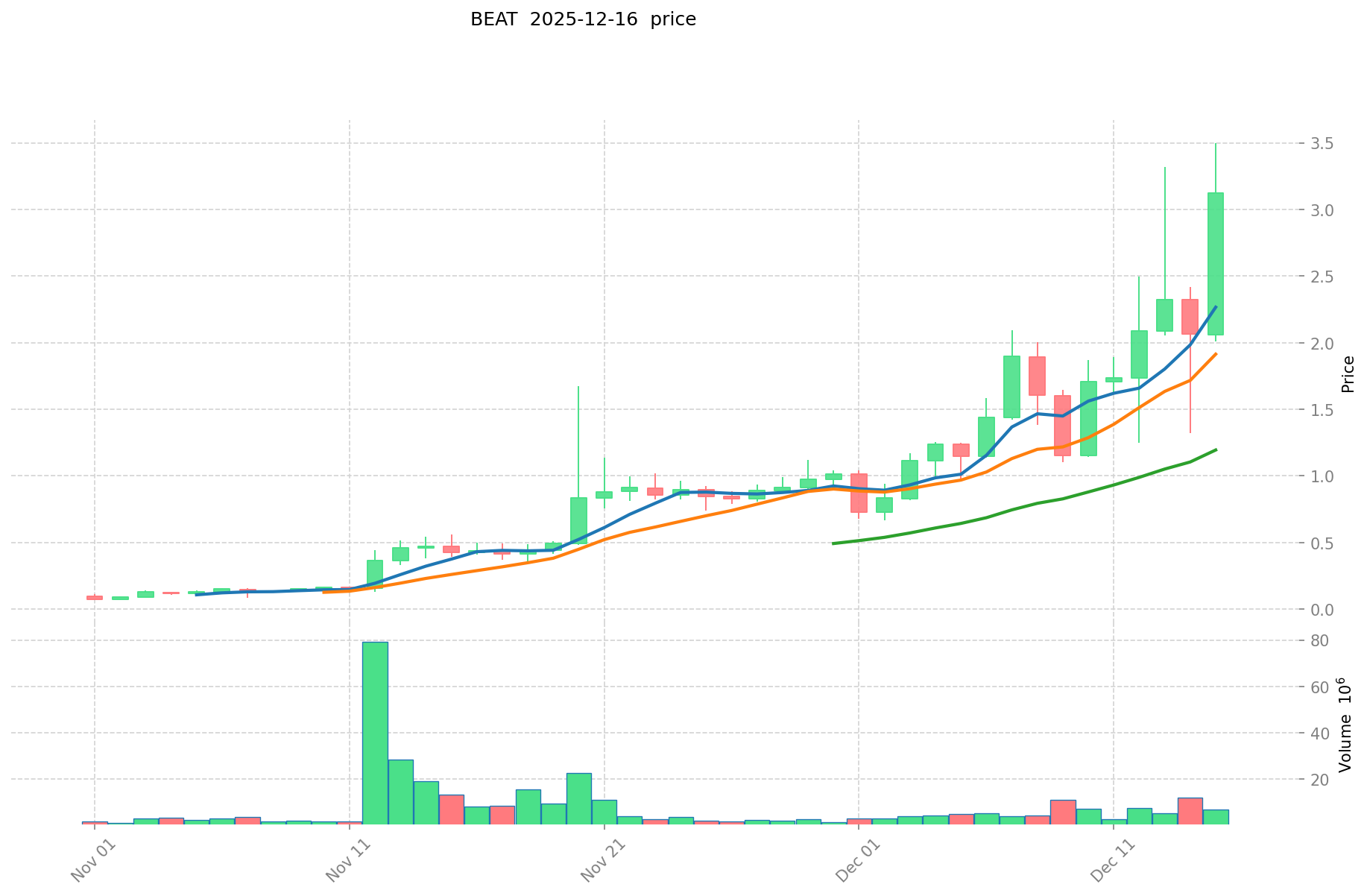
- All-Time High (ATH): $3.49887 (December 15, 2025)
- All-Time Low (ATL): $0.06545 (November 1, 2025)
- Price Range: The token has experienced extreme volatility, with a span of approximately $3.43 from ATH to ATL, representing a 5,242% appreciation from its lowest point to peak within a relatively short timeframe.
GMX:
- All-Time High (ATH): $91.07 (April 18, 2023)
- All-Time Low (ATL): $6.92 (October 11, 2025)
- Price Range: The token has declined significantly from its historical peak, currently trading at approximately 91% below its ATH, indicating substantial long-term downward pressure.
Comparative Analysis: BEAT demonstrates characteristics of an emerging asset with explosive growth potential but extreme volatility, while GMX exhibits characteristics of a mature protocol experiencing prolonged bear market conditions. BEAT has recovered from near-zero valuations to establish a significant market position within months, whereas GMX has experienced consistent depreciation from its 2023 peak, declining approximately 78.58% over the past year.
Current Market Status (December 17, 2025)
Audiera (BEAT):
- Current Price: $1.71223
- 24-Hour Change: -40.22%
- 24-Hour Trading Volume: $27,961,152.83
- Market Capitalization: $238,513,639.00
- Fully Diluted Valuation (FDV): $1,712,230,000.00
- Circulating Supply: 139,300,000 BEAT (13.93% of max supply)
- Market Rank: #206
GMX:
- Current Price: $8.204
- 24-Hour Change: -0.09%
- 24-Hour Trading Volume: $17,168.78
- Market Capitalization: $84,998,285.96
- Fully Diluted Valuation (FDV): $84,998,474.03
- Circulating Supply: 10,360,590.68 GMX (78.19% of max supply)
- Market Rank: #378
Trading Volume Comparison: BEAT's 24-hour trading volume of $27.96M significantly exceeds GMX's $17,168.78, indicating substantially higher market liquidity and trading activity for the Audiera token. This represents approximately 1,628 times greater trading volume.
Market Sentiment Indicator (Fear & Greed Index):
- Index Value: 11
- Status: Extreme Fear
- Interpretation: The cryptocurrency market is currently experiencing extreme fear sentiment, suggesting heightened risk aversion and defensive positioning among investors. This context is particularly relevant for understanding BEAT's sharp 24-hour decline and the overall downward pressure across both assets.
Real-Time Price Information:
- View BEAT current price: Market Price
- View GMX current price: Market Price

Report on Investment Value Factors: BEAT vs GMX
I. Executive Summary
This report analyzes the core investment value factors of BEAT and GMX tokens based on available reference materials. The analysis focuses on protocol security, system risk mitigation, and investment decision frameworks relevant to the decentralized derivatives exchange sector.
II. Core Investment Value Factors for BEAT vs GMX
Protocol Security and Balance Mechanisms
GMX V2 Architecture:
- Core focus on ensuring protocol security and balance through modified fee mechanisms
- Maintains long-short position equilibrium to reduce systemic risk probability during market volatility
- Position valuation standardized in USD regardless of underlying asset denomination at opening price
- Implementation of isolated pool structures to enhance risk compartmentalization
BEAT Protocol:
- Limited specific technical details available in reference materials
- Investment value centers on protocol-level security considerations and system risk reduction
Systematic Risk Mitigation Framework
- Fee Mechanism Design: GMX V2 employs dynamic fee structures to maintain balanced multi-directional exposure
- Risk Probability Reduction: Architecture designed to lower occurrence of systemic risk events during extreme market movements
- Pool Isolation Strategy: Segregated liquidity pools reduce contagion risk across different trading pairs
Investment Decision Framework
The reference materials reference a "five-dimensional investment methodology" (五维投资法) applicable to crypto asset evaluation:
- Track/Sector Analysis: Positioning within the derivatives exchange landscape (currently ~26% of crypto derivatives market)
- Cycle Assessment: Market timing and cyclical positioning
- Competitive Dynamics: Relative positioning versus other perpetual DEX protocols
- Price Valuation: Entry point and risk-reward ratios
- Strategy Implementation: Portfolio construction based on individual risk profile
III. Market Context
Derivatives Market Position
The perpetual DEX (PerpDEX) sector has experienced significant growth driven by:
- Technical innovation breakthroughs
- Increasing user demand for decentralized financial products
- Regulatory pressure on centralized trading platforms
- Current market share: Approximately 26% of the crypto derivatives market
Ecosystem Opportunities
For investors considering derivatives exchange protocols:
- Range of investment opportunities from stable-yield LST protocols to early-stage high-risk projects
- Importance of understanding individual protocol business models and risk factors
- Necessity of developing strategies aligned with personal risk tolerance
IV. Key Considerations for Investment Evaluation
Note: Investors should conduct thorough due diligence on business model fundamentals and risk factors specific to each protocol before making allocation decisions. Understanding the correlation between protocol design choices and long-term viability is essential for informed decision-making.
Analysis Limitations
The available reference materials provide limited comparative data on BEAT token specifics. Future analysis would benefit from:
- Detailed tokenomics comparison (supply schedules, emission mechanisms)
- Institutional adoption metrics and holder concentration analysis
- Comprehensive technical roadmap assessment
- Regulatory environment analysis across key jurisdictions
V. Conclusion
The investment value of GMX and BEAT protocols centers on their ability to maintain protocol security, manage systemic risk through balanced position incentives, and adapt fee mechanisms to changing market conditions. The application of multi-dimensional evaluation frameworks—considering sector dynamics, competitive positioning, and individual risk parameters—provides a more robust approach to crypto asset investment decision-making than single-metric analysis.
Report generated: December 17, 2025
III. 2025-2030 Price Prediction: BEAT vs GMX
Short-term Prediction (2025)
- BEAT: Conservative $0.93-$1.82 | Optimistic $1.82-$2.01
- GMX: Conservative $4.66-$8.18 | Optimistic $8.18-$11.29
Medium-term Prediction (2027-2028)
- BEAT may enter growth accumulation phase, estimated price range $1.70-$3.62
- GMX may enter mainstream adoption phase, estimated price range $7.59-$16.04
- Key drivers: Institutional capital inflows, ETF approvals, ecosystem expansion
Long-term Prediction (2029-2030)
- BEAT: Base case $2.69-$3.67 | Optimistic scenario $4.32-$4.85
- GMX: Base case $11.87-$17.51 | Optimistic scenario $20.37-$20.84
Disclaimer
The price predictions provided are based on historical data analysis and market modeling. Past performance does not guarantee future results. Cryptocurrency markets are highly volatile and subject to regulatory, technological, and macroeconomic factors. These forecasts should not be considered as investment advice. Investors should conduct their own research and consult with financial advisors before making investment decisions.
BEAT:
| 年份 | 预测最高价 | 预测平均价格 | 预测最低价 | 涨跌幅 |
|---|---|---|---|---|
| 2025 | 2.006994 | 1.82454 | 0.9305154 | 6 |
| 2026 | 2.62460079 | 1.915767 | 1.28356389 | 11 |
| 2027 | 2.5880096403 | 2.270183895 | 1.70263792125 | 32 |
| 2028 | 3.6193541837985 | 2.42909676765 | 2.283350961591 | 41 |
| 2029 | 4.324642430285677 | 3.02422547572425 | 2.691560673394582 | 76 |
| 2030 | 4.850252817966552 | 3.674433953004963 | 2.167916032272928 | 114 |
GMX:
| 年份 | 预测最高价 | 预测平均价格 | 预测最低价 | 涨跌幅 |
|---|---|---|---|---|
| 2025 | 11.28978 | 8.181 | 4.66317 | 0 |
| 2026 | 13.629546 | 9.73539 | 8.4697893 | 18 |
| 2027 | 14.83673436 | 11.682468 | 7.5936042 | 42 |
| 2028 | 16.0441174278 | 13.25960118 | 11.0054689794 | 61 |
| 2029 | 20.366084432421 | 14.6518593039 | 11.868006036159 | 78 |
| 2030 | 20.835676523110995 | 17.5089718681605 | 16.283343837389265 | 113 |
Audiera (BEAT) vs GMX Comparative Investment Analysis Report
IV. Investment Strategy Comparison: BEAT vs GMX
Long-term vs Short-term Investment Strategy
BEAT:
- Suitable for investors focusing on emerging Web3 gaming and creator economy ecosystems with high growth potential tolerance
- Short-term: High volatility plays for risk-tolerant traders; current extreme fear sentiment (Fear & Greed Index: 11) presents entry opportunities for contrarian investors
- Long-term: Position accumulation during downturns targeting 2027-2030 growth phases with estimated price appreciation of 76-114%
GMX:
- Suitable for investors seeking exposure to established decentralized derivatives infrastructure with protocol security focus
- Short-term: Defensive positioning during market downturns; current minimal volatility (-0.09% 24H change) indicates stabilization phase
- Long-term: Steady accumulation strategy for those believing in perpetual DEX sector maturation and mainstream adoption (estimated 78-113% appreciation through 2030)
Risk Management and Asset Allocation
Conservative Investor Profile:
- BEAT: 15-20% allocation (emerging asset exposure with defined stop-loss parameters)
- GMX: 30-40% allocation (established protocol with lower volatility profile)
- Stablecoin reserve: 40-50% (capital preservation and rebalancing cushion)
Aggressive Investor Profile:
- BEAT: 40-50% allocation (leveraging extreme fear sentiment and growth trajectory)
- GMX: 20-30% allocation (diversification within derivatives exchange sector)
- Derivatives hedging: 10-20% (options or inverse perpetuals for downside protection)
Hedging Instruments:
- Stablecoin (USDC/USDT) allocation for market uncertainty periods
- Cross-pair diversification across gaming tokens and DeFi protocols
- Rebalancing triggers at predetermined price levels (BEAT: $1.20 / $2.40; GMX: $6.50 / $10.00)
V. Potential Risk Comparison
Market Risk
BEAT:
- Extreme volatility (5,242% price swing from ATL to ATH within weeks) indicates speculative price discovery phase with limited historical data for forecasting
- Highly concentrated liquidity (24H volume $27.96M against $1.71B market cap) creates slippage risk during large position exits
- Early-stage token with 13.93% circulating supply penetration suggests substantial dilution risk as remaining tokens enter circulation
- Heavy dependence on broader market sentiment (current extreme fear context drives 40.22% daily decline)
GMX:
- Prolonged bear market pressure with 91% decline from ATH and 78.58% annual depreciation suggests demand challenges or competitive displacement
- Extremely low trading volume ($17,168.78 daily) relative to market cap indicates severe liquidity constraints and potential exit difficulties for large positions
- Mature token at 78.19% circulating supply penetration reduces growth catalysts from supply-side mechanisms
- Potential protocol obsolescence risk if competing perpetual DEX platforms capture greater market share
Technology Risk
BEAT:
- Limited technical documentation available regarding protocol architecture, AI agent reliability, and Smart Fit Mat hardware integration stability
- Scalability and user experience sustainability across 600M+ potential user base remains unproven
- NFT minting and gaming mechanics reliance creates dependency on Web3 infrastructure performance
GMX:
- GMX V2 architecture implements isolated pool structures and dynamic fee mechanisms to reduce systemic risk, representing technical maturity
- Smart contract audit history and protocol security track record critical evaluation factors (not detailed in available materials)
- Competitive pressure from newer perpetual DEX protocols with potentially superior UX or fee structures
Regulatory Risk
BEAT:
- Tokenized music/gaming IP with creator monetization features faces evolving content licensing and intellectual property regulations across jurisdictions
- AI agent employment and NFT minting may trigger regulatory scrutiny regarding digital asset classification and consumer protection
- Geographic restrictions possible for gaming platforms depending on local gambling/gaming classification in key markets
GMX:
- Perpetual derivatives products face increasing regulatory scrutiny globally, particularly regarding leverage ratios and consumer protection standards
- Potential classification as securities or derivatives in certain jurisdictions could limit operational flexibility
- Cross-border regulatory harmonization developments in 2025-2026 create material impact risk for DEX platforms
VI. Conclusion: Which Is the Better Buy?
📌 Investment Value Summary:
BEAT Advantages:
- Explosive growth trajectory with emerging Web3 gaming and creator economy positioning
- Significantly higher trading liquidity ($27.96M daily volume) indicating strong market interest
- Tokenomics provide potential appreciation: estimated 76-114% growth through 2030 under base-to-optimistic scenarios
- Extreme fear sentiment (Fear & Greed Index: 11) presents historical contrarian entry opportunity
- Integration with iconic IP (600M+ user history) provides unique market positioning
GMX Advantages:
- Established perpetual DEX protocol with proven security architecture and isolated risk management mechanisms
- Lower volatility profile provides capital preservation relative to speculative assets
- Mature tokenomics (78.19% circulating supply) reduce unexpected dilution events
- Estimated 78-113% appreciation through 2030 provides steady returns with defined risk parameters
- Sector positioning within ~26% crypto derivatives market with institutional capital inflow potential
✅ Investment Recommendations:
Beginner Investors:
- Recommended: Diversified allocation with GMX as primary holding (30-40%) supplemented by minimal BEAT exposure (10-15%) and stablecoin reserves (50-60%)
- Strategy: Dollar-cost averaging across 6-12 month timeframe to smooth volatility; utilize limit orders at predetermined price targets
- Priority: Education on perpetual derivatives mechanics and gaming token fundamentals before significant capital deployment
Experienced Investors:
- Recommended: Active portfolio management strategy with tactical BEAT accumulation during extreme fear periods (40-50% allocation) and GMX as core position (20-30%)
- Strategy: Short-term trading around technical resistance levels ($1.20-$2.40 for BEAT; $6.50-$10.00 for GMX) combined with medium-term accumulation targeting 2027-2028 inflection points
- Priority: Implement rigorous stop-loss disciplines and rebalancing protocols given sector volatility
Institutional Investors:
- Recommended: Diversified framework approach combining BEAT exposure (20-30%) within early-stage Web3 gaming allocation alongside larger GMX holdings (25-35%) within systematic DeFi strategies
- Strategy: Structured product construction leveraging perpetual futures markets for yield enhancement; engagement with protocol governance for strategic insights
- Priority: Long-term institutional-grade due diligence on AI agent reliability, creator incentive structures, and DEX protocol competitive positioning
⚠️ Risk Disclaimer: Cryptocurrency markets demonstrate extreme volatility subject to rapid price movements, technological failures, and regulatory changes. The price predictions provided represent mathematical models based on historical data and do not constitute investment guarantees. Past performance offers no assurance of future results. This analysis is informational only and does not constitute investment advice. All investors must conduct independent research, assess personal risk tolerance, and consult qualified financial advisors before committing capital to crypto assets. Positions in BEAT or GMX should represent only capital allocation corresponding to individual risk parameters and diversification objectives.
Report Generated: December 17, 2025 None
Audiera (BEAT) vs GMX Investment Comparison: Frequently Asked Questions
VII. FAQ
Q1: What are the key differences between BEAT and GMX in terms of market positioning and use cases?
A: BEAT (Audiera) is an emerging Web3 gaming and creator economy token based on an iconic music/dance game IP with 600M+ global users, integrating AI agents and blockchain technology for immersive experiences including NFT music creation and Smart Fit Mat gaming. GMX is an established decentralized perpetual exchange token serving as both a utility and governance token, entitling holders to 30% of platform-generated fees. BEAT targets the gaming and creator monetization sector, while GMX operates within the derivatives trading infrastructure space (~26% of crypto derivatives market).
Q2: Given the current market conditions (Fear & Greed Index at 11), which token presents a better buying opportunity?
A: BEAT presents a more attractive contrarian entry opportunity in extreme fear conditions, with its 40.22% 24-hour decline potentially representing oversold conditions for an asset with strong liquidity ($27.96M daily volume) and identified growth catalysts through 2030. However, GMX offers lower-risk exposure with minimal volatility (-0.09% 24H change) and established protocol security, making it suitable for capital preservation-focused investors. Portfolio allocation depends on individual risk tolerance: conservative investors should favor GMX (30-40%), while aggressive investors may capitalize on BEAT's extreme fear sentiment (40-50%).
Q3: How significant is the liquidity difference between BEAT and GMX, and what does it mean for investors?
A: BEAT's 24-hour trading volume of $27.96M is approximately 1,628 times greater than GMX's $17,168.78, indicating substantially higher market liquidity and ease of position entry/exit for BEAT. Conversely, GMX's extremely low volume creates severe liquidity constraints and potential slippage risk during large position exits. This liquidity advantage favors BEAT for short-term traders and positions requiring flexibility, while GMX's low volume reinforces its positioning as a long-term holding for patient capital.
Q4: What are the price predictions for BEAT and GMX through 2030, and which offers better long-term appreciation potential?
A: BEAT conservative projection ranges from $0.93-$1.82 (2025) to $2.69-$3.67 (2030 base case) or $4.32-$4.85 (optimistic), representing 76-114% potential appreciation. GMX conservative projection ranges from $4.66-$8.18 (2025) to $11.87-$17.51 (2030 base case) or $20.37-$20.84 (optimistic), representing 78-113% potential appreciation. Both assets show comparable long-term upside potential; BEAT offers higher volatility with growth acceleration in 2027-2028, while GMX provides steadier appreciation as the derivatives sector experiences mainstream institutional adoption.
Q5: What are the primary risk factors distinguishing BEAT and GMX investments?
A: BEAT faces extreme volatility (5,242% price swing from ATL to ATH), speculative price discovery phase with limited historical forecasting data, and substantial dilution risk from 13.93% current circulating supply penetration. Additional risks include unproven AI agent reliability, Smart Fit Mat hardware integration stability, and regulatory uncertainty surrounding tokenized music IP and NFT mechanics. GMX faces prolonged bear market pressure (-91% from ATH), severe liquidity constraints creating exit difficulties, potential protocol obsolescence from competing perpetual DEX platforms, and regulatory scrutiny regarding leverage products and consumer protection standards in evolving markets.
Q6: Which token is more suitable for conservative versus aggressive investor profiles?
A: Conservative investors should allocate 30-40% to GMX with 15-20% to BEAT, maintaining 40-50% stablecoin reserves for capital preservation and rebalancing opportunities. This strategy emphasizes established protocol security and lower volatility. Aggressive investors should reverse allocations at 40-50% BEAT and 20-30% GMX, implementing 10-20% derivatives hedging through inverse perpetuals or options for downside protection. Aggressive profiles capitalize on BEAT's extreme fear sentiment, emerging growth catalysts, and superior liquidity for tactical trading around technical levels ($1.20-$2.40 for BEAT; $6.50-$10.00 for GMX).
Q7: How do tokenomics differences between BEAT and GMX impact long-term investment viability?
A: BEAT currently has only 13.93% circulating supply penetration from its 1 billion maximum supply, indicating substantial future dilution potential as remaining tokens enter circulation, creating downward price pressure during distribution phases. This tokenomic structure supports accumulation during extreme fear periods with awareness of dilution timing. GMX operates with 78.19% circulating supply penetration at 10.36M tokens, indicating minimal future dilution events and reduced uncertainty from supply-side mechanics. GMX's mature tokenomics provide greater predictability for long-term valuation modeling, while BEAT's early-stage supply structure requires closer monitoring of emission schedules and vesting unlock events.
Q8: What due diligence should investors conduct before making final allocation decisions between BEAT and GMX?
A: Investors should verify BEAT's AI agent technical reliability, Smart Fit Mat user adoption metrics, creator incentive sustainability, and IP licensing agreements across key markets. For GMX, conduct thorough evaluation of smart contract audit history, protocol security track record, competitive positioning against newer perpetual DEX platforms, and management team credentials. Both assets require assessment of regulatory developments affecting gaming tokens (BEAT) and derivatives products (GMX) across priority jurisdictions. Review institutional adoption metrics, holder concentration levels, and ecosystem partnership quality. Finally, establish personal risk tolerance parameters, implement defined stop-loss disciplines at 20-25% portfolio decline thresholds, and ensure crypto allocations represent only surplus capital not required for essential financial obligations.
Report Generated: December 17, 2025
Share
Content
Introduction: BEAT vs GMX Investment Comparison
I. Price History Comparison and Current Market Status
I. Executive Summary
II. Core Investment Value Factors for BEAT vs GMX
III. Market Context
IV. Key Considerations for Investment Evaluation
V. Conclusion
III. 2025-2030 Price Prediction: BEAT vs GMX
IV. Investment Strategy Comparison: BEAT vs GMX
V. Potential Risk Comparison
VI. Conclusion: Which Is the Better Buy?
VII. FAQ
How to Buy Cryptocurrency


Trending Cryptocurrencies



XZXX: A Comprehensive Guide to the BRC-20 Meme Token in 2025

Bitcoin Fear and Greed Index: Market Sentiment Analysis for 2025

Top Crypto ETFs to Watch in 2025: Navigating the Digital Asset Boom

5 ways to get Bitcoin for free in 2025: Newbie Guide

Bitcoin Market Cap in 2025: Analysis and Trends for Investors

2025 Bitcoin Price Prediction: Trump's Tariffs' Impact on BTC

DeFiChain là gì - Hướng dẫn chi tiết cho người mới bắt đầu đầu tư DeFi

Is GUSD (GUSD) a good investment?: A Comprehensive Analysis of Gemini Dollar's Potential in 2024

Is MultiversX (EGLD) a good investment?: A comprehensive analysis of price potential, technology fundamentals, and market risks for 2024 and beyond
Is Eigenlayer (EIGEN) a good investment?: A Comprehensive Analysis of Risk, Potential Returns, and Market Positioning
Is Immutable (IMX) a good investment?: A Comprehensive Analysis of Price Potential, Risk Factors, and Market Outlook for 2024 and Beyond