BID vs XTZ: A Comprehensive Comparison of Two Emerging Blockchain Platforms
Introduction: BID vs XTZ Investment Comparison
In the cryptocurrency market, the comparison between Creator Bid (BID) and Tezos (XTZ) presents an interesting study of contrasting asset profiles. These two projects differ significantly in market capitalization ranking, application scenarios, and price performance, representing distinctly different positions within the digital asset ecosystem. Creator Bid (BID): Launched as an innovative platform, it focuses on leveraging artificial intelligence and blockchain technology to enable creators to develop, monetize, and co-own AI Creator Agents, establishing a new model of digital content creation and ownership. Tezos (XTZ): Since its introduction in 2017, it has established itself as a decentralized blockchain that simplifies formal verification through self-governance mechanisms, offering mathematical assurances for transaction code accuracy and enhanced smart contract security. As a self-evolving digital ledger, Tezos has positioned itself among the established layer-one blockchain protocols. This article will provide a comprehensive analysis of the investment value comparison between BID and XTZ across multiple dimensions including historical price trends, supply mechanics, market positioning, technical ecosystems, and market metrics, addressing the key question investors frequently ask:
"Which presents a more compelling investment opportunity at this juncture?"
Comparative Analysis Report: Creator Bid (BID) vs Tezos (XTZ)
I. Historical Price Comparison and Current Market Status
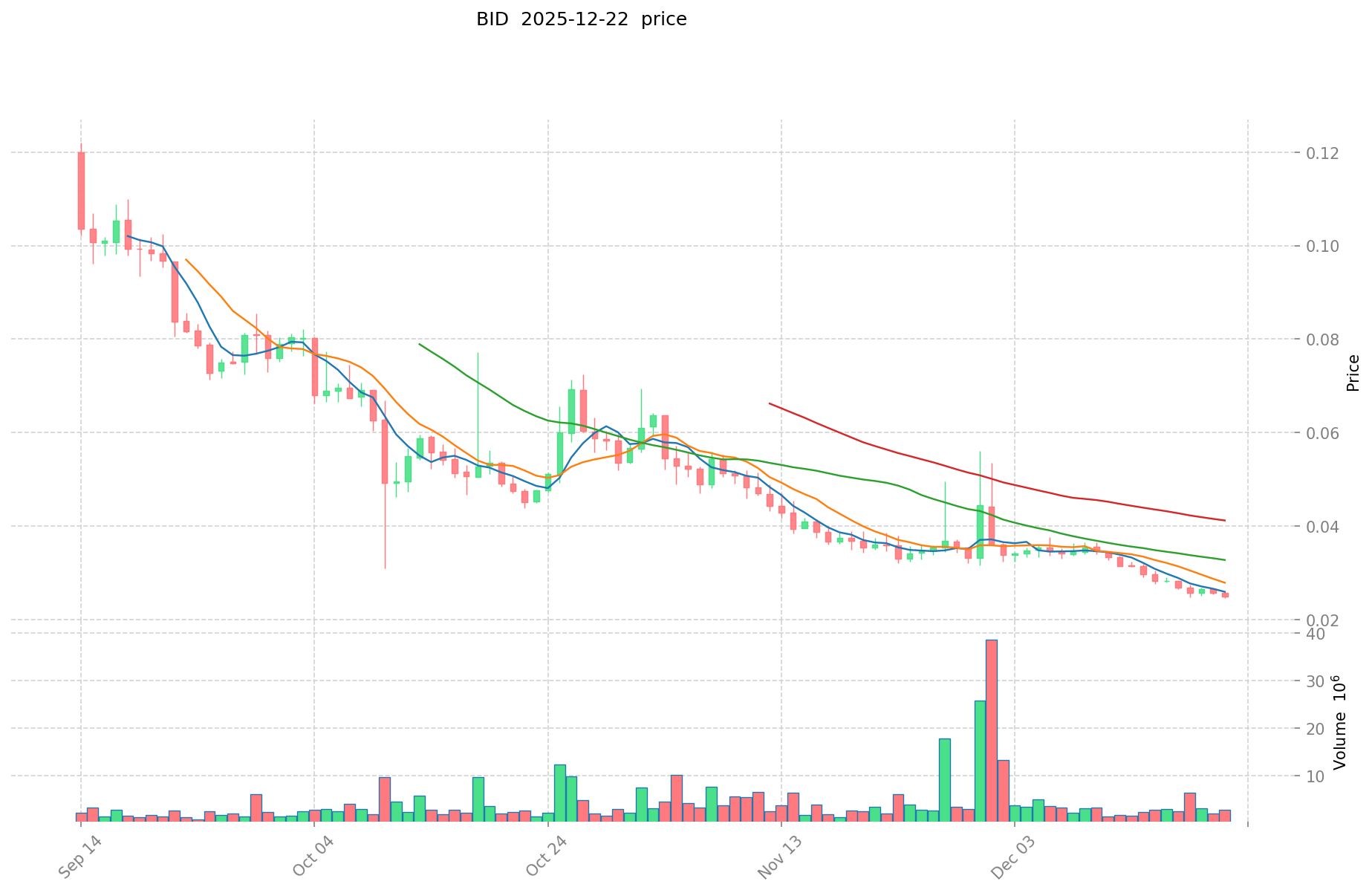
Creator Bid (BID) and Tezos (XTZ) Historical Price Trends
Creator Bid (BID):
- All-Time High (ATH): $0.50 (March 26, 2025)
- All-Time Low (ATL): $0.02447 (December 22, 2025)
- Year-to-Date Performance: -91.049%
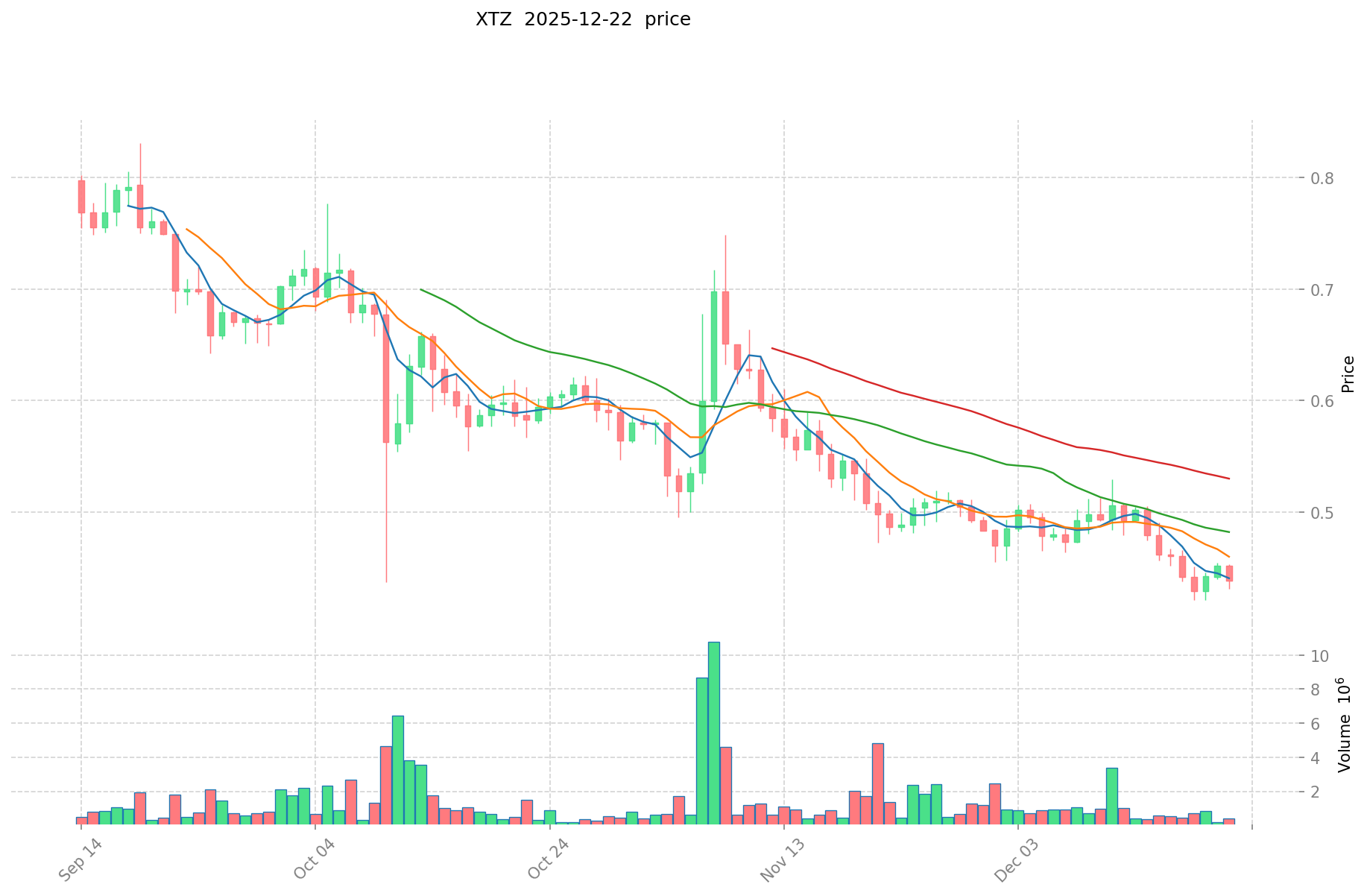
Tezos (XTZ):
- All-Time High (ATH): $9.12 (October 4, 2021)
- All-Time Low (ATL): $0.350476 (December 7, 2018)
- Year-to-Date Performance: -65.2%
Comparative Analysis: Creator Bid has experienced a significantly steeper decline compared to Tezos. While BID declined from its 2025 peak of $0.50 to its recent low of $0.02447 (representing a 95.1% loss from ATH), Tezos has demonstrated greater resilience. Despite its 65.2% year-over-year decline, XTZ maintains a market position ranked 124th by market capitalization, whereas BID ranks 1349th. This suggests that Tezos, as a more established blockchain platform, has weathered market conditions with greater stability.
Current Market Status (December 23, 2025)
Price Data:
- Creator Bid (BID) Current Price: $0.0258
- Tezos (XTZ) Current Price: $0.4496
24-Hour Trading Activity:
- BID 24H Volume: $61,147.33
- BID 24H Change: +1.78%
- XTZ 24H Volume: $125,458.33
- XTZ 24H Change: +4.02%
Market Capitalization:
- BID Total Market Cap: $25,799,482.45
- BID Circulating Supply: 272,291,282.86 BID (27.23% of total supply)
- XTZ Total Market Cap: $489,904,301.62
- XTZ Circulating Supply: 1,069,584,471.21 XTZ (98.16% of total supply)
Market Emotion Index (Fear & Greed Index): 25 (Extreme Fear)
View Real-Time Prices:
II. Project Overview and Technology
Creator Bid (BID)
Project Description: Creator Bid is an innovative platform designed to enable creators to develop, monetize, and co-own AI Creator Agents. The platform leverages artificial intelligence and blockchain technology to establish a new model for digital content creation and ownership.
Technical Specifications:
- Blockchain: BNB Smart Chain (BSC)
- Token Standard: BEP-20
- Contract Address: 0xa1832f7f4e534ae557f9b5ab76de54b1873e498b
- Current Holders: 6,848
Supply Structure:
- Maximum Supply: 1,000,000,000 BID
- Circulating Supply: 272,291,282.86 BID
- Circulation Ratio: 27.23%
Tezos (XTZ)
Project Description: Tezos is a decentralized blockchain that manages itself through an on-chain governance model, simplifying formal verification. The technology mathematically ensures transaction code accuracy and enhances smart contract security. Tezos functions as a universal, self-evolving encrypted digital ledger capable of incorporating best practices from various blockchain implementations.
Technical Specifications:
- Consensus Mechanism: Proof of Stake (specifically Liquid Proof of Stake/LPoS)
- Smart Contract Language: Michelson (designed for security)
- Network Model: Self-amending protocol (no hard forks required for updates)
- Launch Date: 2018 (Mainnet)
- Current Holders: 20,481
Supply Structure:
- Maximum Supply: Unlimited (∞)
- Circulating Supply: 1,069,584,471.21 XTZ
- Circulation Ratio: 98.16%
III. Short-Term Price Performance Analysis
Multi-Timeframe Volatility Metrics
Creator Bid (BID):
| Timeframe | Price Change | Change Amount |
|---|---|---|
| 1 Hour | +1.06% | +$0.000271 |
| 24 Hours | +1.78% | +$0.000451 |
| 7 Days | -7.96% | -$0.002231 |
| 30 Days | -27.1% | -$0.009591 |
| 1 Year | -91.049% | -$0.262436 |
Tezos (XTZ):
| Timeframe | Price Change | Change Amount |
|---|---|---|
| 1 Hour | +0.11% | +$0.000494 |
| 24 Hours | +4.02% | +$0.017375 |
| 7 Days | -2.18% | -$0.010020 |
| 30 Days | -7.26% | -$0.035196 |
| 1 Year | -65.2% | -$0.842354 |
Analysis: While both assets have demonstrated short-term recovery in the past 24 hours, BID shows greater percentage gains (1.78% vs 4.02%), though in absolute terms, XTZ has captured larger trading volumes. Over medium to long-term horizons, both assets exhibit significant downward pressure, with BID experiencing substantially sharper declines across all extended timeframes.
IV. Market Position and Adoption Metrics
Liquidity and Trading Infrastructure
Creator Bid (BID):
- Exchange Listings: Limited to specialized cryptocurrency exchanges
- 24H Trading Volume: $61,147.33
- Market Share: 0.00079%
- Price Range (24H): $0.02447 - $0.02575
Tezos (XTZ):
- Exchange Listings: Available on major centralized exchanges (Binance, Coinbase, Kraken, WhiteBIT, MEXC, and others)
- 24H Trading Volume: $125,458.33
- Market Share: 0.015%
- Price Range (24H): $0.4312 - $0.4542
Assessment: Tezos demonstrates superior market liquidity with approximately double the trading volume and significantly broader exchange coverage. This liquidity advantage provides XTZ holders with better execution capabilities and reduced slippage during transactions. Creator Bid's limited exchange availability suggests emerging market status and higher friction for market participants.
Project Maturity Indicators
Creator Bid:
- Project Status: Recently launched platform focused on AI Creator Agents
- Community Size: 6,848 token holders
- Development Activity: Platform development ongoing
- Market Recognition: Ranked 1349th by market capitalization
Tezos:
- Project Status: Established blockchain infrastructure with multiple ecosystem applications
- Community Size: 20,481 token holders
- Development Activity: Mature ecosystem with active protocol development and governance participation
- Market Recognition: Ranked 124th by market capitalization
- Notable Partnerships: Collaboration with Swiss financial institutions (Crypto Finance AG, InCore Bank, Inacta) as of July 2021
V. Risk Assessment and Market Sentiment
Current Market Conditions
The current Fear & Greed Index reading of 25 (Extreme Fear) indicates pronounced market pessimism affecting the broader cryptocurrency sector. This sentiment has disproportionately impacted emerging projects like Creator Bid.
Key Risk Factors:
Creator Bid:
- Extreme price volatility with 95.1% drawdown from ATH
- Limited market penetration and adoption
- Concentrated token supply (72.77% not yet circulating)
- High dependency on AI Creator Agent ecosystem adoption
- Emerging platform with unproven product-market fit
Tezos:
- Established but still experiencing 65.2% year-over-year decline
- Market saturation in blockchain infrastructure space
- Competition from larger smart contract platforms
- Dependency on governance participation and developer adoption
- Mature phase may limit explosive growth potential
VI. Conclusion
Creator Bid represents an early-stage cryptocurrency project operating within the AI Creator Agents niche, characterized by high volatility and limited market infrastructure. Tezos, conversely, functions as a mature blockchain platform with established governance mechanisms, broader adoption, and significantly greater liquidity.
Current market conditions (Extreme Fear sentiment) have created challenging environments for both assets. BID's 1.78% 24-hour gain and XTZ's 4.02% gain suggest some recovery momentum, though both remain substantially down from their respective peaks. The disparity in their year-over-year performance (-91.049% vs -65.2%) reflects different market positioning and investor confidence levels.
Tezos (XTZ) Investment Value Analysis Report
I. Executive Summary
Tezos (XTZ) represents a blockchain platform with distinct technical characteristics and investment mechanisms. This report examines the core factors influencing XTZ's investment value, including network fundamentals, economic structures, and market dynamics based on available reference materials.
II. Core Factors Influencing XTZ Investment Value
On-Chain Activity and Development Progress
Network Engagement Metrics:
- Active wallet count serves as a primary indicator of actual network utilization
- Daily transaction volume reflects genuine user adoption and network health
- DApp deployment on the Tezos network demonstrates ecosystem development and developer interest
Development Trajectory:
- Developer activity and protocol improvements indicate long-term network viability
- The blockchain's ability to attract new applications affects its utility and demand for XTZ tokens
Staking Mechanism and Token Economics
Proof-of-Stake (PoS) Architecture:
- Tezos employs a PoS consensus mechanism, allowing XTZ holders to stake tokens and receive rewards
- This mechanism enhances network security while providing passive income opportunities to token holders
- Staking participation rates influence token circulation dynamics and holder incentives
Value Generation:
- The reward mechanism creates a built-in incentive structure for network participation
- Staking economics directly affect token holder returns and network decentralization
Strategic Partnerships and Adoption
Notable Collaborations:
- Partnerships with organizations such as Ubisoft, Red Bull Racing Honda, and Kolibri strengthen the ecosystem
- Strategic alliances typically correlate with increased XTZ value and network utility
- Partnership announcements have historically influenced market sentiment and adoption rates
Decentralized Network Properties:
- The protocol's decentralization characteristics support long-term adoption potential
- Network independence attracts users and developers seeking censorship-resistant infrastructure
Self-Amendment and Protocol Governance
Core Technical Differentiation:
- Tezos features self-amendment capabilities, enabling protocol upgrades without hard forks
- This governance design differentiates Tezos from competing blockchains
- The ability for on-chain protocol evolution reduces governance friction and accelerates development cycles
III. Market Performance and Price Dynamics
Price Projection Ranges: Reference materials indicate potential price ranges for XTZ, suggesting market analysts anticipate growth potential driven by:
- Institutional capital inflows
- ETF development and market infrastructure expansion
- Ecosystem maturation and adoption metrics
Key Price Drivers:
- Institutional investor participation levels
- Trading volume and market liquidity
- Major development announcements and partnership news
- Token economic parameters and exchange availability
IV. Risk and Limiting Factors
Market Liquidity Considerations:
- Cryptocurrency liquidity depends on multiple factors including institutional involvement, trading volume, and token availability across exchanges
- Liquidity conditions affect XTZ's trading efficiency and price stability
Competitive Landscape:
- Tezos operates within a crowded blockchain ecosystem with numerous competing platforms
- Sustained network activity growth is necessary to maintain competitive positioning
V. Conclusion
XTZ's investment value derives primarily from network fundamentals including active user engagement, strategic partnerships, and the PoS staking mechanism. The protocol's self-amendment capabilities and decentralized governance structure provide technical differentiation. Market performance remains dependent on continued ecosystem development, institutional adoption, and broader cryptocurrency market conditions. Prospective investors should evaluate on-chain metrics, partnership developments, and liquidity conditions when assessing investment decisions.
III. 2025-2030 Price Forecast: BID vs XTZ
Short-term Forecast (2025)
- BID: Conservative $0.0197967–$0.02571 | Optimistic $0.02571–$0.0377937
- XTZ: Conservative $0.260826–$0.4497 | Optimistic $0.4497–$0.665556
Mid-term Forecast (2027-2028)
- BID may enter a consolidation and recovery phase, with predicted price range $0.018774868905–$0.050556549768075
- XTZ may enter a sustained growth phase, with predicted price range $0.5808253248–$1.000081282368
- Key drivers: Institutional capital inflows, ETF adoption, ecosystem development
Long-term Forecast (2029-2030)
- BID: Base case $0.027636294113678–$0.044574667925287 | Optimistic scenario $0.047694894680057–$0.067356780701901
- XTZ: Base case $0.64617192110016–$0.873205298784 | Optimistic scenario $1.16136304738272–$1.475062050970872
Disclaimer: This analysis is for informational purposes only and should not be construed as investment advice. Price predictions are subject to significant uncertainty and market volatility. Always conduct your own research and consult with qualified financial advisors before making investment decisions.
BID:
| 年份 | 预测最高价 | 预测平均价格 | 预测最低价 | 涨跌幅 |
|---|---|---|---|---|
| 2025 | 0.0377937 | 0.02571 | 0.0197967 | 0 |
| 2026 | 0.0377847015 | 0.03175185 | 0.0301642575 | 23 |
| 2027 | 0.042417296415 | 0.03476827575 | 0.018774868905 | 34 |
| 2028 | 0.050556549768075 | 0.0385927860825 | 0.037435002500025 | 49 |
| 2029 | 0.047694894680057 | 0.044574667925287 | 0.027636294113678 | 72 |
| 2030 | 0.067356780701901 | 0.046134781302672 | 0.041982650985432 | 78 |
XTZ:
| 年份 | 预测最高价 | 预测平均价格 | 预测最低价 | 涨跌幅 |
|---|---|---|---|---|
| 2025 | 0.665556 | 0.4497 | 0.260826 | 0 |
| 2026 | 0.69145872 | 0.557628 | 0.41264472 | 24 |
| 2027 | 0.8681152704 | 0.62454336 | 0.5808253248 | 38 |
| 2028 | 1.000081282368 | 0.7463293152 | 0.626916624768 | 65 |
| 2029 | 1.16136304738272 | 0.873205298784 | 0.64617192110016 | 94 |
| 2030 | 1.475062050970872 | 1.01728417308336 | 0.53916061173418 | 126 |
Comparative Investment Analysis Report: Creator Bid (BID) vs Tezos (XTZ)
IV. Investment Strategy Comparison: BID vs XTZ
Long-term vs Short-term Investment Strategies
Creator Bid (BID):
- Suitable for investors focused on emerging AI Creator Agent ecosystem adoption and those with high risk tolerance seeking potential explosive growth from early-stage platforms
- Short-term strategies require active monitoring due to extreme volatility; long-term strategies depend on platform adoption metrics and ecosystem maturation
Tezos (XTZ):
- Suitable for investors seeking established blockchain infrastructure with proven governance mechanisms, staking yield opportunities, and reduced execution risk
- Provides both short-term trading opportunities through improved liquidity and long-term positioning through network participation rewards
Risk Management and Asset Allocation
Conservative Investors:
- Creator Bid (BID): 0-5% allocation (or complete exclusion given extreme volatility and 95.1% ATH drawdown)
- Tezos (XTZ): 10-20% allocation within cryptocurrency portfolio, leveraging staking mechanisms for passive income
Aggressive Investors:
- Creator Bid (BID): 15-30% allocation for those specifically targeting emerging AI ecosystem plays with explicit understanding of capital loss risk
- Tezos (XTZ): 20-40% allocation emphasizing both trading opportunities and network participation rewards
Hedging Instruments:
- Stablecoin allocation (20-30%) to enable opportunistic entries during market extremes (current Fear & Greed Index: 25)
- Cross-asset diversification across established and emerging protocols
- Consider options strategies for volatility protection in BID positions given 7-30 day downward pressure
V. Risk Comparison
Market Risks
Creator Bid (BID):
- Extreme price volatility with 95.1% decline from ATH demonstrates severe liquidity and adoption-dependent risk
- Limited exchange availability restricts exit opportunities during unfavorable market conditions
- Low trading volume ($61,147.33 daily) creates slippage risk for significant position adjustments
- Heavy dependence on AI Creator Agent ecosystem achieving critical adoption mass
- Potential for continued devaluation if ecosystem fails to demonstrate product-market fit
Tezos (XTZ):
- Established 65.2% year-over-year decline reflects broader market sector pressure rather than fundamental collapse
- Superior liquidity ($125,458.33 daily trading volume) reduces execution risk during market stress
- Competition from larger smart contract platforms (Ethereum, Solana, Cardano) limits market share expansion
- Market saturation in blockchain infrastructure space may constrain explosive growth potential
Technology Risks
Creator Bid (BID):
- Unproven AI Creator Agent architecture with limited deployment history
- Platform security and smart contract audit status not addressed in available materials
- Dependency on BNB Smart Chain infrastructure introduces cross-chain technical risk
- Early-stage platform may experience technical instability during scaling phases
Tezos (XTZ):
- Self-amendment protocol eliminates hard fork risks but introduces governance-related technical risk
- Competing smart contract platforms with larger developer communities may capture market share
- Michelson smart contract language has narrower developer adoption compared to Solidity, limiting ecosystem growth
Regulatory Risks
- Both BID and XTZ operate under uncertain global cryptocurrency regulatory frameworks
- Emerging regulatory clarity on AI-integrated financial products may impact Creator Bid's value proposition
- Staking mechanisms (particularly for XTZ) face potential regulatory scrutiny regarding tax treatment and securities classification
- Institutional adoption barriers differ: XTZ benefits from broader regulatory acceptance as established infrastructure; BID faces scrutiny as emerging technology platform
VI. Conclusion: Which Is the Better Buy?
📌 Investment Value Summary:
Creator Bid (BID) Advantages:
- Early-stage entry point into AI Creator Agent ecosystem with potential for exponential returns if adoption succeeds
- Only 27.23% circulating supply indicates significant expansion potential with reduced immediate dilution
- Currently trading near recent lows, potentially favorable entry risk-reward ratio for high-risk tolerance investors
- Novel technology positioning may capture new market demand if AI Creator Agents achieve mainstream adoption
Tezos (XTZ) Advantages:
- Established market position (ranked 124th by market cap) with proven blockchain infrastructure and governance mechanisms
- Superior liquidity and broad exchange availability (Binance, Coinbase, Kraken) enable efficient position management
- Proof-of-Stake staking mechanism generates passive income (~5-8% annual yields typical for established PoS networks)
- Mature ecosystem with documented partnerships and ongoing protocol development provide stability and growth optionality
- Self-amendment governance eliminates hard fork risks and accelerates protocol evolution
✅ Investment Recommendations:
For New Investors:
- Primary Recommendation: Tezos (XTZ) - Provides gentler learning curve with established infrastructure, transparent governance, and reduced technical complexity
- Allocate modest XTZ positions (5-10% of crypto allocation) while learning market mechanics
- Utilize staking rewards to compound learning experience with tangible yield
- Avoid Creator Bid until comfort level with extreme volatility increases substantially
For Experienced Investors:
- Balanced Approach: Position 60% XTZ (core holding with staking) and 20% BID (tactical allocation targeting ecosystem adoption)
- Monitor BID ecosystem development metrics: daily active users, total transactions, creator agent deployments
- Set stop-loss levels at -40% to -50% for BID positions given inherent volatility
- Rebalance quarterly based on ecosystem maturation progress and governance metrics
- Consider long-term forecast ranges: XTZ conservative 2030 target $0.536-$0.873 vs BID optimistic $0.048-$0.067
For Institutional Investors:
- Primary Focus: Tezos (XTZ) - Suitable for institutional portfolios with established compliance frameworks and minimal single-asset concentration risk
- XTZ offers institutional-grade liquidity, regulatory clarity, and governance participation mechanisms
- Implement systematic staking strategies leveraging institutional nodes to generate alpha above spot returns
- Maintain exploratory BID exposure (maximum 2-3% allocation) for emerging ecosystem trend monitoring
- Creator Bid remains too illiquid and unproven for significant institutional allocation pending demonstrated adoption and regulatory clarity
⚠️ Risk Disclaimer: Cryptocurrency markets exhibit extreme volatility and are subject to rapid, unpredictable price movements. This analysis is provided for informational purposes only and does not constitute investment advice, financial recommendation, or solicitation to buy or sell. The current market sentiment (Fear & Greed Index: 25, Extreme Fear) indicates heightened market stress affecting all digital assets. Price predictions outlined (2025-2030 forecasts) carry substantial uncertainty and should not form the basis for investment decisions. All price forecasts represent analytical models subject to significant error margins. Prospective investors must conduct independent research, evaluate personal risk tolerance, and consult qualified financial advisors before making investment decisions. Past performance does not guarantee future results. Digital assets carry risks including total capital loss. None
Creator Bid (BID) vs Tezos (XTZ) Investment Comparison: Frequently Asked Questions
FAQ
Q1: What are the key differences between Creator Bid (BID) and Tezos (XTZ) in terms of project maturity?
A: Creator Bid is an early-stage platform focused on AI Creator Agents, launched recently with only 6,848 token holders and ranked 1349th by market capitalization. Tezos, established since 2018, is a mature blockchain infrastructure project ranked 124th with 20,481 token holders, proven governance mechanisms, strategic partnerships, and documented ecosystem development. The maturity difference represents fundamentally different risk profiles: BID offers high-risk, high-reward potential for emerging technology adoption, while XTZ provides established blockchain infrastructure with proven utility.
Q2: Which asset demonstrates better liquidity and market accessibility?
A: Tezos (XTZ) exhibits significantly superior liquidity with approximately double the daily trading volume ($125,458.33 vs $61,147.33) and listing on major centralized exchanges including Binance, Coinbase, Kraken, WhiteBIT, and MEXC. Creator Bid remains limited to specialized cryptocurrency exchanges with constrained trading infrastructure. XTZ's liquidity advantage provides better execution efficiency, reduced slippage, and easier position management. BID's limited availability creates friction for market participants and heightened exit risk during adverse market conditions.
Q3: How do the price trajectories of BID and XTZ compare, and what do they indicate about market confidence?
A: Creator Bid has experienced a catastrophic 95.1% decline from its all-time high of $0.50 (March 26, 2025) to current levels near $0.0258, while Tezos has declined 65.2% year-over-year from higher historical peaks. The disparity in drawdown severity reflects different investor confidence levels and market positioning. BID's steeper decline suggests emerging platform skepticism regarding AI Creator Agent ecosystem viability, while XTZ's more moderate decline indicates established infrastructure resilience despite broader cryptocurrency sector pressure. Both assets show small 24-hour gains (BID +1.78%, XTZ +4.02%), suggesting early recovery momentum within extreme market fear conditions.
Q4: What staking and passive income opportunities distinguish Tezos from Creator Bid?
A: Tezos employs a Proof-of-Stake (PoS) consensus mechanism enabling XTZ holders to generate passive staking rewards, typically ranging 5-8% annually on established PoS networks. This mechanism incentivizes long-term holding and network participation while creating additional value generation beyond price appreciation. Creator Bid offers no documented staking mechanism or passive income structure, making it purely a speculative price appreciation vehicle. For income-focused investors, XTZ's staking economics provide meaningful yield differentiation and long-term value generation independent of price movements.
Q5: What token supply dynamics impact the investment potential of each asset?
A: Creator Bid has maximum supply of 1 billion tokens with only 272.3 million (27.23%) currently circulating, meaning 72.77% remains to be released. This significant supply expansion could create substantial dilution pressure on token value as circulation increases. Tezos maintains unlimited maximum supply but already has 1.07 billion tokens (98.16%) in circulation, indicating minimal future dilution. BID's concentrated supply structure creates both opportunity (if adoption drives demand exceeding supply growth) and risk (if adoption fails to materialize, dilution will compress valuations). XTZ's near-complete circulation eliminates surprise dilution scenarios but offers limited supply-side price support.
Q6: How should different investor profiles allocate between BID and XTZ based on risk tolerance?
A: Conservative investors should allocate 0-5% to Creator Bid (or exclude entirely) given 95.1% ATH drawdown and extreme volatility, while allocating 10-20% to Tezos with staking participation for passive income. Aggressive investors can allocate 15-30% to BID targeting emerging ecosystem plays with explicit capital loss understanding, while positioning 20-40% in XTZ emphasizing both trading opportunities and network rewards. The current Fear & Greed Index reading of 25 (Extreme Fear) creates stablecoin allocation opportunities (20-30%) for systematic market entry during stressed conditions. Portfolio hedging through options strategies becomes advisable for significant BID positions given 7-30 day downward pressure.
Q7: What are the long-term price forecast implications for investment horizon planning?
A: Creator Bid forecasts suggest conservative 2030 targets of $0.0420-$0.0444, with optimistic scenarios reaching $0.0477-$0.0674, representing 63-161% upside from current $0.0258 levels. Tezos 2030 forecasts indicate conservative targets of $0.646-$0.873, with optimistic scenarios reaching $1.161-$1.475, representing 44-228% upside from current $0.4496 levels. These forecasts reflect different growth dynamics: BID depends on ecosystem adoption acceleration and market recovery, while XTZ assumes continued institutional adoption and blockchain infrastructure maturation. Price prediction uncertainty remains substantial, and forecasts should inform scenario planning rather than direct investment decisions.
Q8: Which asset presents superior investment value at the current juncture given market conditions?
A: For new and conservative investors: Tezos (XTZ) is the recommended primary holding, offering established infrastructure, superior liquidity, proven governance, and passive staking income with 65.2% year-over-year drawdown representing more predictable risk than BID's 95.1% decline. For experienced investors: A balanced 60% XTZ / 20% BID approach enables core infrastructure positioning with tactical emerging ecosystem exposure, supported by 20% stablecoin allocation for market opportunism during extreme fear. For institutional investors: XTZ remains the exclusive suitable allocation given regulatory clarity, institutional-grade liquidity, and governance participation mechanisms, while BID requires waiting for demonstrated ecosystem adoption and regulatory framework clarification. The current extreme fear environment (Fear & Greed Index: 25) may present better XTZ entry points than BID, which faces adoption rather than mere valuation headwinds.
Share
Content
Introduction: BID vs XTZ Investment Comparison
I. Historical Price Comparison and Current Market Status
II. Project Overview and Technology
III. Short-Term Price Performance Analysis
IV. Market Position and Adoption Metrics
V. Risk Assessment and Market Sentiment
VI. Conclusion
I. Executive Summary
II. Core Factors Influencing XTZ Investment Value
III. Market Performance and Price Dynamics
IV. Risk and Limiting Factors
V. Conclusion
III. 2025-2030 Price Forecast: BID vs XTZ
IV. Investment Strategy Comparison: BID vs XTZ
V. Risk Comparison
VI. Conclusion: Which Is the Better Buy?
FAQ
How to Buy Cryptocurrency


Trending Cryptocurrencies



2025 DCR Price Prediction: Decred's Potential Surge Amid Evolving Crypto Landscape

COOK vs FLOW: The Battle of Culinary Approaches in Modern Kitchen Innovation

How Do Crypto Holdings and Fund Flows Impact Market Trends?

How Does LUNC's Holdings and Fund Flow Impact Its Price in 2025?

How Does Cryptocurrency Holding and Fund Flow Impact Market Dynamics?

How Does FET's Circulating Supply of 2.37 Billion Impact Its Market Cap?
Guide to Purchasing Tether (USDT) with INR in India

Can Shiba Inu's Price Hit 1 Rupee? Future Predictions for SHIB

Effortless NFT Minting Solutions for Solana and Beyond

Understanding Sand Coin (SAND): A Comprehensive Guide

What is VSC: A Comprehensive Guide to Visual Studio Code for Beginners and Developers