This article provides a comprehensive overview of Bitcoin’s price history, examining major surges and corrections alongside expert projections for 2025 and 2030. It also analyzes key market drivers such as halving events, institutional adoption, regulatory developments, and macroeconomic trends shaping Bitcoin’s long-term outlook.
Bitcoin, the world’s first cryptocurrency, has seen dizzying price swings and milestones over the past decade. From a niche experiment to a mainstream asset, its journey has been punctuated by dramatic booms and busts that captivate investors and headlines alike. Today, in 2025, Bitcoin is again in the spotlight as it hovers around historic highs. Enthusiasts and skeptics are debating a familiar question with renewed intensity: How high can Bitcoin’s price go next?
In this article, we’ll take a quick look at Bitcoin’s major price surges and past all-time highs, then examine what experts predict for the near term (2025) and long term (2030 and beyond). We’ll also analyze the key factors — from Bitcoin’s built-in scarcity to institutional adoption and regulation — that could influence its future price. The goal is a balanced, journalistic overview of Bitcoin’s outlook, based on its history and current trends, in a format that’s both informative and easy to digest.

Historical Overview: Bitcoin’s Major Price Surges
Bitcoin’s price history is a tale of volatile climbs and crashes, but with each cycle it has generally landed higher than where it started. Here’s a quick overview of some of the most notable price surges and all-time highs in Bitcoin’s timeline:
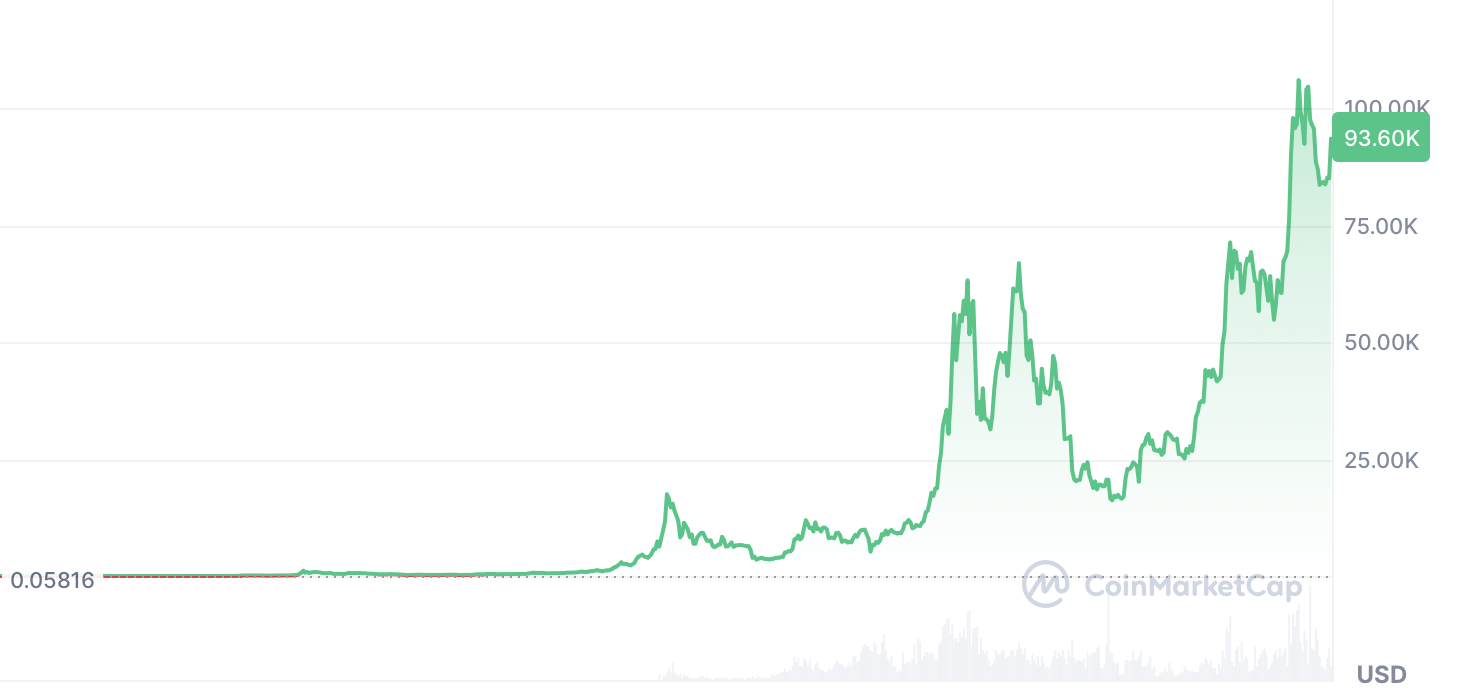
2013: The first major Bitcoin rally saw prices climb from under $100 at the start of the year to over $1,000 by December 2013. This early surge, driven largely by tech enthusiasts and the first wave of media attention, put Bitcoin on the global map. However, a subsequent crash brought the price back down into the $200–$300 range in 2014, showing how quickly hype can turn to panic in uncharted markets.
2017: Bitcoin entered the mainstream consciousness in 2017 with an eye-popping run from about $1,000 in January to nearly $20,000 by December. This 2017 boom was fueled by retail investor FOMO (fear of missing out), initial coin offerings (ICOs), and growing awareness of cryptocurrencies. The frenzy culminated in late 2017 when Bitcoin hit an all-time high just shy of $20k on some exchanges. As in 2013, a steep correction followed — throughout 2018, Bitcoin’s price collapsed by roughly 80%, bottoming out in the $3,000s — yet it still remained well above pre-2017 levels.
2021: The next historic surge came in 2020–2021. Bitcoin started 2020 around $7,000, and by November 2021 it reached a new peak of roughly $69,000. This time, the rally was characterized by institutional adoption and corporate interest: large companies like Tesla and Square (Block) bought Bitcoin for their treasuries, Wall Street firms began offering crypto services, and an ETF tied to Bitcoin futures launched in the U.S. The COVID-19 pandemic era’s easy-money policies and stimulus also played a role, with many investors viewing Bitcoin as “digital gold” in an inflationary environment. After hitting the $69k mark, Bitcoin again saw a cooldown — through 2022, prices retraced significantly (at one point under $20k amid a broader crypto-market downturn) before stabilizing.
2024–2025: In the latest cycle, Bitcoin has once again surged and surpassed its previous high. In late 2024, boosted by the buzz around a major block reward halving and optimism over possible spot Bitcoin ETF approvals, Bitcoin’s price rocketed past the $69k record from 2021. By early 2025, it has traded above $90,000 — even briefly touching the six-figure $100,000 milestone on some market spikes, according to industry reports. This recent rally solidified Bitcoin’s status as one of the best-performing assets of the decade and set a new all-time high. As before, heightened volatility accompanies these gains: rapid price swings are common, reminding investors that Bitcoin’s ascent has never been a smooth ride.
Over the long run, each peak has far exceeded the last, as seen in Bitcoin’s historical price chart. Despite periodic crashes of 50% or more after these highs, Bitcoin’s overall trajectory remains upward. Its market value today is orders of magnitude higher than just a few years ago, illustrating an unprecedented growth story. This cyclical pattern of boom and bust — yet with a rising floor — frames the context for current price predictions and what might lie ahead.
Short-Term Bitcoin Price Predictions (2025)
With Bitcoin back on an upswing going into 2025, market watchers are intensely speculating about how the cryptocurrency might perform in the short term. The prevailing sentiment among many analysts and investors is optimistic. After the 2024 halving (the scheduled reduction in Bitcoin’s mining rewards that occurs every four years), bullish momentum has been building. Historically, these halving events have acted as a catalyst for Bitcoin’s price, often preceding a strong rally over the subsequent 12-18 months. True to form, Bitcoin’s renewed strength in late 2024 and early 2025 has led many to believe that the rally could continue through the end of this year.
Breaking into Six Figures: A number of reputable forecasts suggest that Bitcoin will consolidate above its previous all-time high and potentially push well into six-figure territory in 2025. Analysts at Standard Chartered, for example, predicted that Bitcoin could reach around $100,000 by the end of 2024, citing increased demand and diminishing supply post-halving. If that scenario holds, it means Bitcoin would be trading around the $100k mark as 2025 begins — a watershed moment for the crypto market. Many crypto enthusiasts see $100,000 as a psychological milestone, and breaching it could attract a new wave of buyers, adding further fuel to the rally.
Bullish Analyst Targets: Beyond the $100k level, some industry experts envision even higher short-term prices. Anthony Scaramucci of SkyBridge Capital has suggested Bitcoin could potentially surge to around $150,000–$170,000 within the next year, assuming the current market cycle follows a similar exponential trajectory as past ones. Likewise, Tom Lee of Fundstrat Global Advisors, known for his optimistic crypto outlooks, has projected the possibility of Bitcoin in the mid-six-figures in the near term (he’s floated targets in the $100k+ range for 2024/2025, driven by Bitcoin’s shrinking new supply and increasing institutional interest). Even certain crypto exchange executives have chimed in with bold calls — for instance, the chief strategy officers at some exchanges have speculated about $150k or higher by late 2025 if bullish conditions persist. These predictions underscore a growing confidence that the 2025 cycle could see a peak substantially above the 2021 high.
Of course, not every observer is unequivocally bullish for the immediate term. Bitcoin is still a volatile asset, and short-term price drivers can include unpredictable factors like macroeconomic shifts or geopolitical events. Some cautious analysts warn that if the global economy faces headwinds — say, a recession or tighter monetary policy — investors might pull back from speculative assets like Bitcoin in the short run, which could limit its upside or introduce sharp corrections. Additionally, any adverse regulatory moves (for example, governments suddenly clamping down on crypto trading or taxation surprises) could temporarily sour market sentiment. Still, as of now the bulls have the louder voice: a general consensus for 2025 is that Bitcoin will likely set new all-time highs, with many targeting the $100k milestone and some aiming far beyond. The exact peak is anyone’s guess — forecasts range from moderate (~$80k–$100k) to extremely optimistic (above $150k) by the end of 2025 — but the direction of the trend is broadly expected to be upward. In summary, the short-term outlook for Bitcoin in 2025 is one of guarded optimism, with excitement that the ongoing rally still has room to run, tempered slightly by the knowledge that Bitcoin can surprise even the savviest traders in either direction.

Long-Term Bitcoin Price Predictions (2030 and Beyond)
Peering further into the future, the predictions for Bitcoin’s price become even more ambitious — and admittedly more speculative. Forecasts for what Bitcoin could be worth by 2030 (and in the years beyond) vary wildly, reflecting different beliefs about how widely adopted Bitcoin will become and what role it will play in the global financial system. Despite the uncertainty, one theme is common among long-term Bitcoin believers: they argue that today’s prices might look like a bargain by the end of the decade if Bitcoin’s growth continues.
Mega-Bullish Scenarios (Hundreds of Thousands to $1 Million+)
Some of the most prominent figures in the crypto and investment world have put forward jaw-dropping price targets for Bitcoin’s long-term future. Cathie Wood of ARK Invest has modeled scenarios where Bitcoin exceeds $1 million by 2030. Her thesis is based on institutional adoption, retail usage, and Bitcoin’s fixed supply creating explosive demand.
Similarly, Jack Dorsey, CEO of Block (formerly Square), has echoed these views, describing Bitcoin as the “native currency of the internet.” Dorsey believes that Bitcoin can cross the $1 million threshold due to its potential as a global financial infrastructure.
Even mainstream financial institutions have considered optimistic scenarios. JPMorgan suggested in a report that Bitcoin could reach $146,000 if it captured gold’s market share as a store of value — a more conservative, yet still significant, upside projection.
Moderate to Bearish Long-Term Views
Others foresee a more gradual increase. Projections in the $150,000–$300,000 range are common among analysts who expect continued growth, but with more volatility, competition, or regulatory friction. Some think Bitcoin may stabilize as “digital gold” without evolving beyond that role.
While very bearish views (e.g., Bitcoin falling to zero) have quieted in recent years, some analysts still warn of potential disruptors: technological flaws, a successful competing asset, or major regulatory crackdowns in key markets.
In short, 2030 predictions range from $150k to $1M+, depending on assumptions about adoption and macro trends. Bitcoin’s long-term price will likely depend on how well it navigates regulation, infrastructure development, and real-world integration over the next five years.
Key Factors Influencing Bitcoin’s Future Price
Several major forces will shape Bitcoin’s price in the years ahead:
Supply and Scarcity: Bitcoin’s hard cap of 21 million coins and periodic halvings (next expected in 2028) create built-in scarcity. If demand grows or remains stable, this supply constraint can boost prices.
Institutional Adoption: More corporations, hedge funds, and even governments adopting Bitcoin can drive long-term demand. If a spot ETF is approved in the U.S., it could open the doors to trillions of dollars in institutional capital.
Regulation: Friendly regulation can legitimize and foster adoption, while hostile rules could stifle growth. Countries like El Salvador adopting Bitcoin set important precedents, but risks remain if major economies impose strict controls.
Macroeconomic Trends: Inflation, interest rates, and geopolitical uncertainty can all affect Bitcoin’s appeal. Some investors treat it as a hedge against fiat currency instability.
Technological Progress: Bitcoin upgrades like the Lightning Network improve usability and transaction speed. A growing number of users and integration with financial apps could increase utility and adoption.
Network Effects: Bitcoin’s first-mover advantage and massive hashrate make it one of the most secure blockchains. Its resilience over the years contributes to investor confidence and long-term viability.
Conclusion
Bitcoin’s story from 2009 to 2025 has been nothing short of remarkable. From an experiment in decentralized money to a multi-trillion-dollar asset class, it has changed the way we think about money and sovereignty. With the price hovering near or above all-time highs again, the question of how far Bitcoin can go next is more relevant than ever.
Whether it’s $100,000, $500,000, or $1 million per BTC, the path ahead will depend on how well Bitcoin continues to attract users, win regulatory clarity, and integrate with the broader financial system. One thing is clear: Bitcoin is no longer a fringe idea — it’s a central topic in the future of global finance.
For those looking to trade or invest in Bitcoin, platforms like Gate.com continue to provide access to BTC markets worldwide, supporting secure and liquid trading environments.
As always, the advice remains the same: never invest more than you can afford to lose, and do your research. Bitcoin’s journey is still unfolding, and the coming decade could be even more transformative than the last.
Related Links:
* The information is not intended to be and does not constitute financial advice or any other recommendation of any sort offered or endorsed by Gate.












